

Day 131: Election Day Is Coming. Is Nextdoor Prepared for the Worst?

When political disagreements turn personal, who protects the neighbors—and who holds the moderators accountable?
Election Day is Tuesday, November 3, 2026.
As we approach another election, emotions are running high. Neighbors disagree on candidates, political parties, policies, and the country's direction. People who live next door to each other can hold completely different beliefs, and those disagreements don't magically disappear when they close an app.
That's precisely why I'm raising questions about Nextdoor, its moderation system, and the safeguards that protect the people using the platform.
Let's consider a scenario.
A neighbor publishes a political discussion. Another neighbor strongly disagrees. The discussion escalates. A moderator—who is also a local resident with personal opinions and relationships—disagrees with the original post.
What happens if that moderator stops acting impartially? What if the disagreement becomes personal? What if someone takes the conflict off-screen and retaliates physically against the neighbor?
This is a hypothetical scenario, not a claim that a particular Nextdoor moderator has committed physical violence.
But the questions are real.
What safeguards does Nextdoor have in place before an online disagreement becomes a real-world safety issue?
1. Moderators Are People, Too. That's Both a Strength and a Risk.
Nextdoor relies on a combination of community volunteers, technology and its internal Neighborhood Operations team to moderate content. The company's public resources describe a network of volunteer reviewers who help evaluate reports, while Nextdoor's internal staff handle certain sensitive issues, including discrimination and misinformation.
There are benefits to local moderation. Neighbors understand their communities, local context, and the nuances of conversations that outsiders might miss.
But local knowledge doesn't automatically produce impartial judgment.
Moderators have personal beliefs, political preferences, relationships, and disagreements just like everyone else. Someone trusted to enforce community rules can also have a personal stake in a dispute.
That creates some important questions:
What happens when a moderator has a personal conflict with the person whose content they're reviewing?
Can a moderator be required to recuse themselves from a dispute involving a personal disagreement?
How does Nextdoor identify patterns of biased or retaliatory moderation?
Can a neighbor report a moderator without fearing retaliation?
Who independently reviews a complaint when the moderator is part of the problem?
Nextdoor's public training materials say that moderators are expected to follow the Community Guidelines and that moderation privileges can be removed when there is a pattern of voting against those guidelines. They also state that neighbors can report concerns about moderators to Nextdoor Operations.
That's a starting point.
But I want to understand how those protections work in practice, how consistently they're enforced, and how quickly the company responds when someone reports a serious problem.
A written policy is only as effective as the process behind it.
2. What Happens When Online Conflict Becomes Physical?
Let's return to our hypothetical scenario.
A neighbor posts about politics. A moderator disagrees. The exchange becomes increasingly hostile. Perhaps the moderator uses their position to remove the neighbor's content, publicly targets them, or escalates the personal dispute.
Then imagine the conflict spilling into the real world.
A confrontation occurs. Someone threatens the neighbor. Or, in the most serious scenario, someone physically retaliates.
At that point, this is no longer simply a disagreement about content moderation.
It's a question of personal safety.
Nextdoor's published Community Guidelines prohibit harmful activity, including physical harm and threats of violence. Its moderator training also directs users to report threats to Nextdoor Support.
But what safeguards exist to identify escalating patterns of harassment before they reach that point?
Does Nextdoor have a clear process for assessing credible threats, preserving relevant reports, and escalating serious cases? How does it respond when the person reported is a moderator? How does it ensure that someone with moderation privileges cannot use them to target someone with whom they have a personal dispute?
And what happens after an incident?
I'm not suggesting that Nextdoor can prevent every act of violence. No social media company can guarantee that. Nor should a platform be expected to replace law enforcement.
But it should have clear procedures for handling threats, investigating abuse of moderator privileges, and cooperating appropriately with authorities when necessary.
If a person faces an immediate physical threat, the priority is getting to safety and contacting emergency services—not waiting for an online moderation appeal.
The critical question is whether Nextdoor's safeguards are designed only to manage posts, or also to respond appropriately when online behavior creates credible risks to people.

3. What Annual Compliance Training Must Moderators Complete?
Here's another question I want Nextdoor to answer.
What mandatory training must community moderators complete every year, if any?
I'm not asking whether Nextdoor has training materials. Its public Moderator Academy includes guidance on community rules, respectful conduct, confidentiality, and the appropriate handling of reports.
I'm asking something more specific.
Is annual refresher training mandatory for every volunteer moderator?
Are moderators required to demonstrate that they understand the rules before continuing to exercise their privileges?
Does training cover political neutrality, conflicts of interest and recusal?
Are moderators trained to recognize harassment, threats and signs that a dispute is escalating?
Does the training address confidentiality, privacy and the appropriate use of information available through moderator tools?
Are there consequences for repeatedly abusing privileges or retaliating against neighbors?
How does Nextdoor verify that training has been completed and remains current?
I could not find in the public training materials I reviewed evidence that every volunteer moderator must complete annual compliance training covering all these topics.
That doesn't prove such training doesn't exist. It means Nextdoor should clarify its requirements.
Volunteer moderators are not the same as Nextdoor employees, and their training obligations may differ. That's why the company should explain what each group is required to do.
If moderators have access to additional information or tools that ordinary neighbors don't, the company should ensure they understand the responsibilities that come with those privileges.
A moderation role is a responsibility, not a license to impose personal opinions on a neighborhood.
4. What Is Nextdoor Doing to Protect Nonpublic Information?
This issue deserves more attention.
Nextdoor's Moderator Academy explicitly says that access to additional information is a privilege and that moderators must not disclose details about other neighbors or moderators.
That's an important expectation. But I want to know what safeguards back that up.
What information can volunteer moderators actually access? How is that access limited to what they need for their role? What controls prevent someone from using information obtained through moderation tools to pursue a personal dispute?
Does Nextdoor regularly review access to sensitive information? Does it maintain appropriate records of access and investigate suspected misuse? What happens when a moderator violates confidentiality?
How are neighbors informed when their information has been improperly accessed or disclosed, when notification is required or appropriate?
These are not abstract technical questions. They go to the heart of trust.
A platform built around verified neighbors and local relationships can involve sensitive information about people's identities, locations and community interactions. Users should understand how that information is protected and what accountability exists when access is abused.
Nextdoor's public filings describe a broader security program that includes privacy risk management, security monitoring, incident response and employee training on cybersecurity and data protection. The company also acknowledges that security measures cannot eliminate every risk of unauthorized access.
Those disclosures are useful, but they don't answer every question about volunteer moderators' access, training or safeguards against personal misuse.
I'm asking for a clear explanation of the controls that apply specifically to community moderation.
If access to nonpublic information is a privilege, protecting that information must be more than a sentence in a training module.

5. Nirav Tolia, Let's Talk About Relevant Matters
Nirav Tolia is Nextdoor's co-founder and CEO. Under his leadership, the company continues to develop new products, pursue advertising opportunities, and talk about technology and AI.
Innovation has its place. New products and better technology can help a company grow.
But as Election Day approaches, I think more immediate questions deserve public attention.
How does Nextdoor protect neighbors from harassment and threats? How does it prevent moderators from abusing their positions? What training is mandatory? What protections exist for confidential information? And how does the company investigate allegations when the person being reported is part of the moderation system?
These aren't questions you can answer by announcing another product feature.
They're questions about the safety of the community Nextdoor says it wants to strengthen.
Nirav doesn't need to personally adjudicate every neighborhood dispute. But leadership is responsible for ensuring that the systems, policies, and oversight processes are appropriate for the risks the platform faces.
I want Nextdoor to explain those systems in concrete terms.
Not just that it takes safety seriously. Not just that it has Community Guidelines. Not just that technology helps identify problematic content.
I want to understand the safeguards, training requirements, escalation procedures, and accountability mechanisms.
6. Election Season Is a Test of the Platform
Political disagreements are inevitable. People will argue about candidates, policies, and the country's future.
A neighborhood platform cannot eliminate those disagreements, nor should it attempt to eliminate every civil political discussion.
But it can establish clear rules, enforce them consistently, and provide meaningful ways to report misconduct.
It can distinguish disagreement from harassment, and criticism from threats. It can prevent moderators from treating their personal opinions as the standard everyone else must follow. It can protect confidential information and investigate credible allegations of abuse.
And it can explain to its users how those safeguards work.
I don't expect Nextdoor to prevent every bad interaction. I do expect a platform built around real neighbors and real addresses to take the potential consequences of online conflict seriously.
Election Day is November 3. The need for responsible moderation doesn't end when the ballots are counted.
My Questions for Nextdoor
I'd like Nextdoor and Nirav Tolia to address the following:
Moderator training: Is annual compliance or refresher training mandatory for all volunteer moderators? If so, what does it cover?
Conflicts of interest: What safeguards prevent moderators from handling reports involving personal disputes or political disagreements in which they have a stake?
Threats and escalation:
Confidentiality: What limits are placed on moderators' access to nonpublic information, and how is misuse detected and addressed?
Accountability: How can neighbors report a moderator safely, and what independent review occurs when serious allegations are made?
Transparency: Where can users find clear, current information about these protections and how they are enforced?
These are practical questions. They deserve practical answers.
I'm not asking Nextdoor to abandon innovation. I'm asking the company to put its users' safety, privacy, and trust alongside its growth ambitions.
Stop telling us what technology might do for the platform. Start explaining what the company is doing to protect the people on it.
Because a neighborhood network is only as strong as the trust between its neighbors—and the safeguards that protect them when that trust breaks down.
👉 Follow my ongoing Nextdoor case study at NielFlamm.com/blog.

Day 124: Election-Year Division, Gun Violence and the Responsibility of Nextdoor

As Election Day approaches, political divisions are becoming harder to ignore. People disagree about candidates, policies, and the country’s direction. Too often, those disagreements turn personal.
And sometimes, conflict doesn't stay online.
We continue to see concerns about gun violence and situations where firearms are used to settle arguments that should never have escalated that far. A disagreement, an insult, or a heated exchange can have consequences that reach far beyond a screen.
That brings me back to Nextdoor.
What Happens When an Online Argument Becomes a Neighborhood Problem?
Nextdoor isn't just another social media platform. Its conversations are tied to real neighborhoods, real people, and, in many cases, verified addresses.
The person you're arguing with online might live down the street. You might see them at the grocery store, walking their dog or picking up their mail.
That's what makes Nextdoor's responsibility different.
A platform designed to connect neighbors should take seriously the possibility that online conflict can spill into real life.
I'm not suggesting Nextdoor is responsible for every disagreement or act of violence. But I do believe a platform built around physical neighborhoods has a responsibility to consider how its policies, moderation, and safety practices affect those communities.
The Mystery of Moderator Vetting and Training
I've raised questions before about Nextdoor's moderator model. I still want to understand how Nextdoor vets, trains, and supports moderators.
What does Nextdoor require before someone becomes a moderator?
Vetting: What screening, if any, is conducted before someone receives moderation responsibilities?
Training: Do moderators receive training in de-escalation, political disputes, harassment, threats, and privacy?
Continuing education: Are moderators periodically retrained as policies, risks, and platform features change?
Accountability: How does Nextdoor evaluate moderator decisions, address complaints, and identify inconsistent enforcement?
Safety escalation: What happens when a discussion involves a credible threat, doxxing, or concerns about someone's physical safety?
I don't know all the details of Nextdoor's current procedures. That's precisely why I'm asking.
I'm not suggesting that every moderator is unqualified or that moderators have unrestricted access to users' private information. I'm asking for a clear explanation of the safeguards, training, and oversight in place.

Safety Has to Extend Beyond the Screen
Removing a comment or suspending an account might address a violation of platform rules. But what happens when a neighbor feels threatened in their own community?
Does Nextdoor have clear procedures for handling credible threats? Are users told how to report urgent safety concerns? Are moderators trained to recognize when a dispute requires escalation beyond ordinary content moderation?
How does the company protect personal information so a heated political disagreement doesn't become an opportunity for intimidation or retaliation?
A neighborhood can be technically connected and still feel unsafe.
The goal shouldn't simply be to keep conversations within the rules. It should be to help create an environment where people can disagree without feeling threatened.
Of course, no platform can guarantee that violence will never happen. But clear policies, effective training, appropriate access controls, and accountable moderation are meaningful parts of risk prevention.
Nirav, Let's Talk About the Real World
Nirav Tolia, I know Nextdoor is focused on AI, neighborhood intelligence, and business growth. Those initiatives may create real opportunities for the company.
But as Election Day approaches, I'd like to hear more about how Nextdoor prepares its moderators to manage the very human side of its platform.
How are moderators vetted? What continuing education do they receive? How are safety concerns escalated? And how does Nextdoor evaluate whether its moderation practices help protect neighbors—not just from bad experiences online, but from risks that can follow them into their communities?
These are not questions about political ideology. They're questions about safety, trust, and accountability.
If Nextdoor's mission is to cultivate a kinder world where everyone has a neighborhood they can rely on, how does it prepare the people enforcing its rules to help make that possible?
Day 124. I still want Nextdoor to succeed. But growth, AI, and advertising are only part of the picture. A neighborhood platform also has to take seriously the responsibility that comes with connecting people who live near one another.
Because when an online disagreement follows someone home, the consequences aren't measured in comments, reactions, or engagement metrics.
They're measured in people's lives.
👉 Follow my continuing case study at NielFlamm.com/blog

Citizen Alert vs. Neighborhood Chatter: Which Delivers More Value?
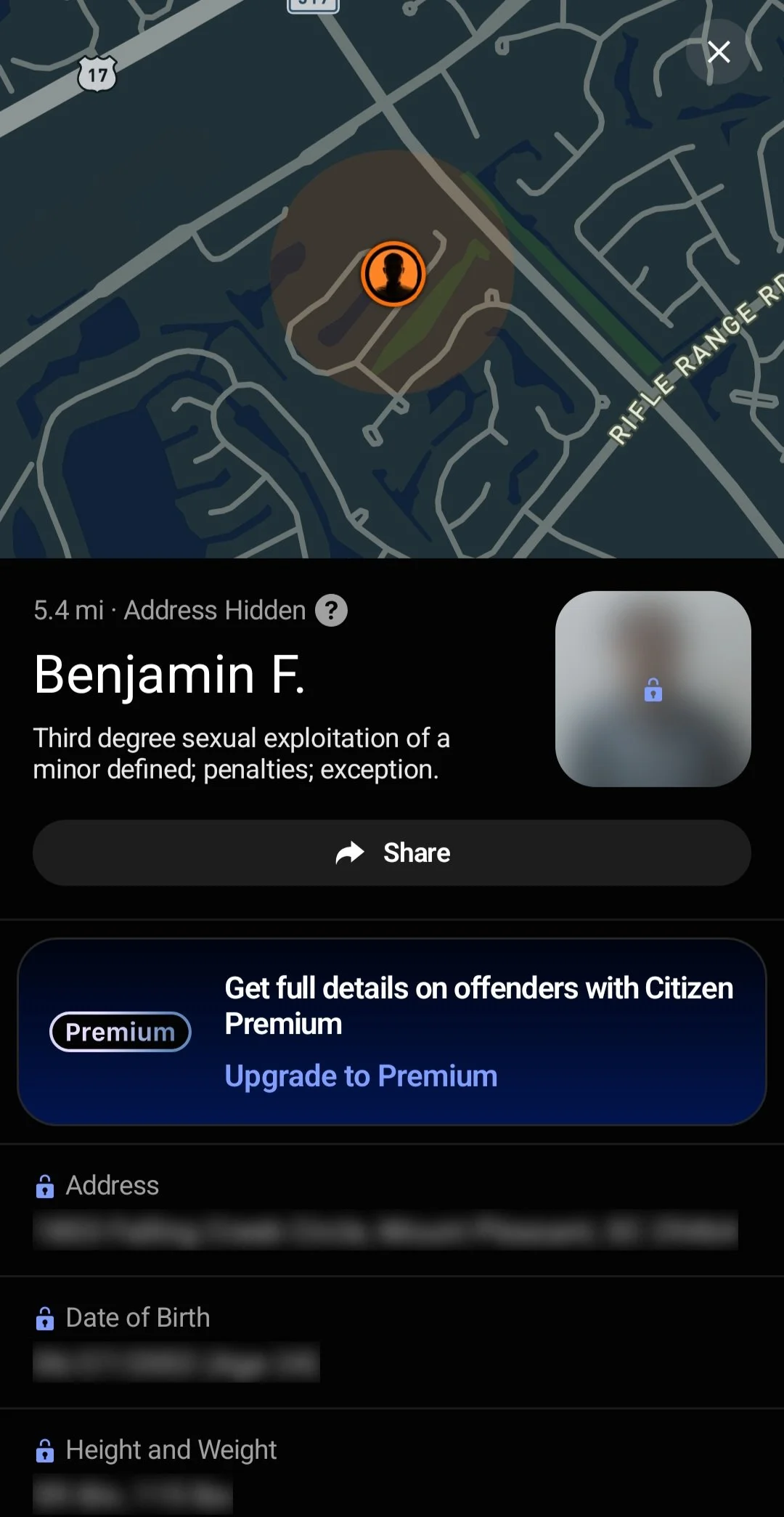
Tonight, I was at Mount Pleasant Towne Center waiting to see Motor City (video review coming later tonight at https://NielFlamm.com/videos).
While I was there, my phone buzzed with a Citizen notification.
The alert informed me that there was a newly registered sex offender in my area. The screenshot is attached.
To be clear, this isn't a discussion about the individuals on the registry, the constitutionality of registries, or the criminal justice system. Those are separate conversations.
The registry exists.
What struck me was the timeliness and usefulness of the information.
I don't currently have young children in my guardianship, but knowing that a new registrant has moved into the area is information many people may find relevant.
Citizen offered additional details through its paid subscription, including the registrant's name, address, and other information.
Instead of subscribing, I spent a few extra minutes on the South Carolina Sex Offender Registry and was able to locate the publicly available information myself:
That experience reinforced something I've been thinking about while comparing neighborhood apps.
Too often, what I see on Nextdoor are lengthy discussions about HOA disputes (after covenants were voluntarily signed at closing), complaints about barking dogs, arguments over young people on e-bikes, or other neighborhood frustrations.
Those conversations have their place.
But receiving a timely notification about publicly available safety-related information felt significantly more valuable.
For me, that's where Citizen currently provides something I haven't experienced with Nextdoor.
Technology should help people become more informed about their communities—not just more informed about neighborhood disagreements.
Join the discussion at NielFlamm.com/blog. Leave some feedback—I'd love to hear from you.