
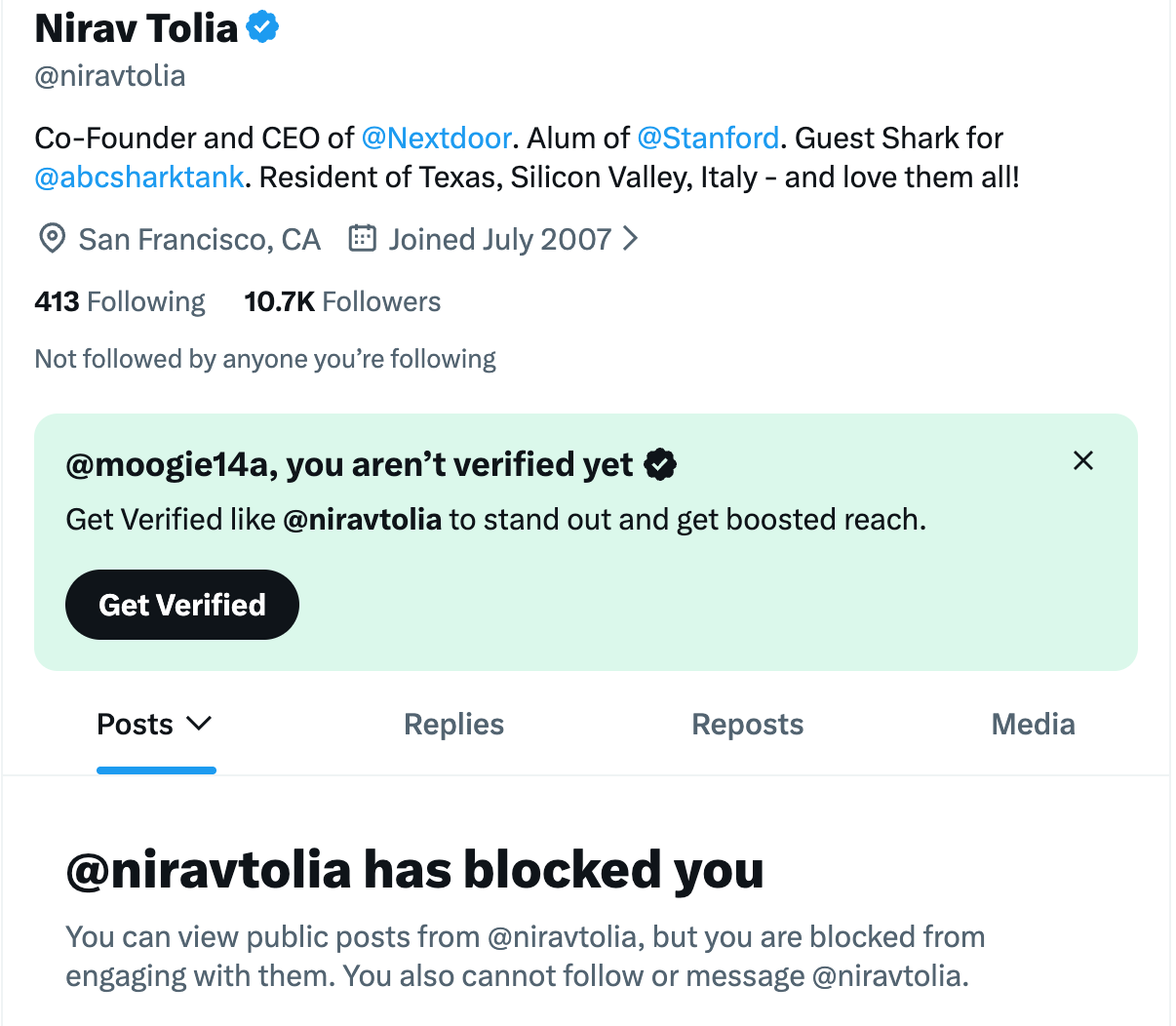
Blocked Again: Apparently My Questions Are Getting Through
There are days when you wonder whether anyone is actually paying attention.
Then there are days when you get a message like this:
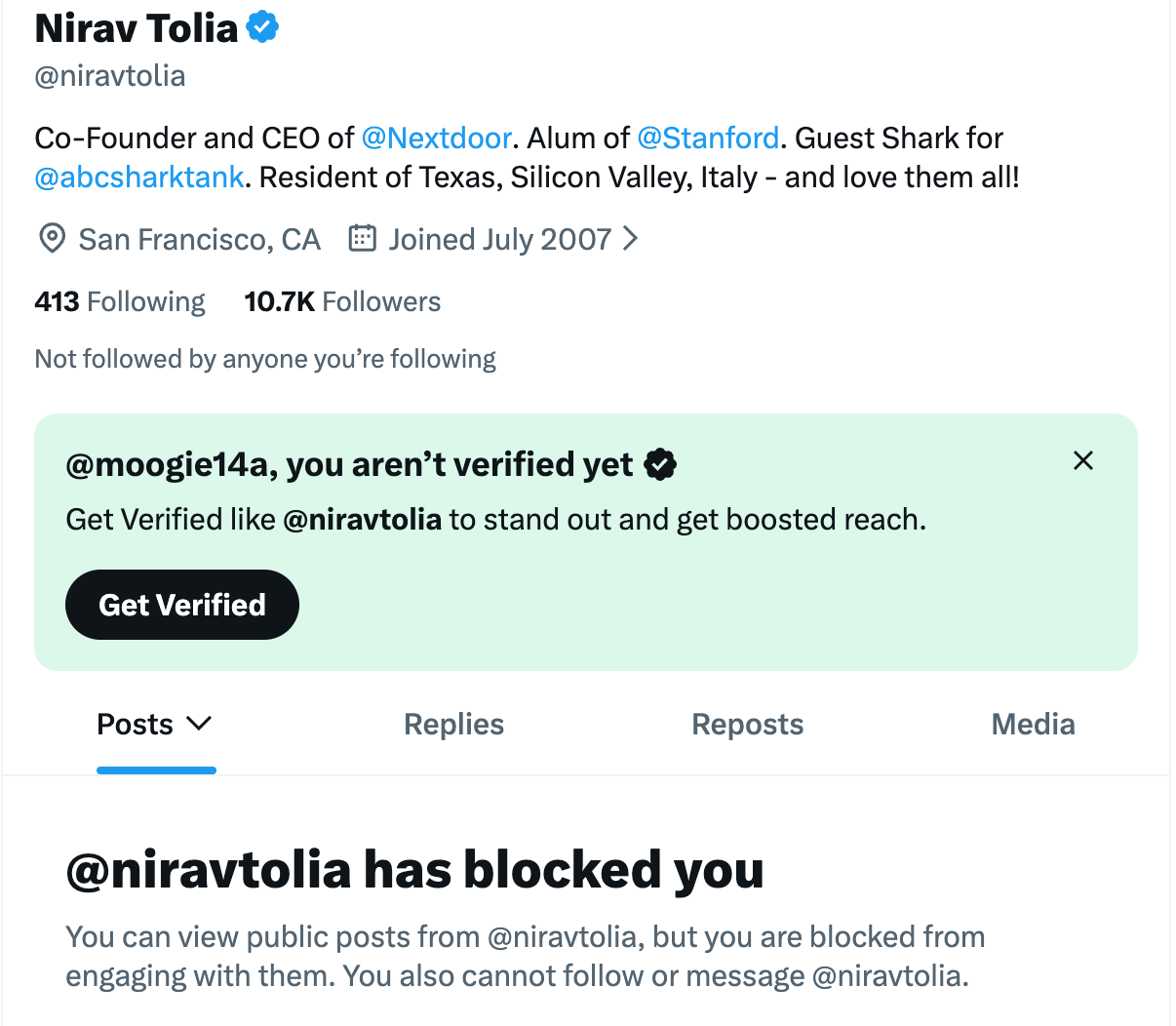
“@niravtolia has blocked you.”
Well, I guess somebody noticed.
For anyone who hasn't been following this ongoing Nextdoor case study, I have a fairly consistent routine for publishing new content
.
First, it goes on my blog:
Then I work my way through the social-media neighborhood:
LinkedIn. Facebook. Instagram. Threads. Bluesky. Then X—my own page, Sarah Leary's page, Nextdoor's page, and finally Nextdoor co-founder and CEO Nirav Tolia's page.
Why?
Awareness.
I'm not exactly operating with Nextdoor's Communications budget. I don't have a corporate PR department distributing carefully crafted statements through Business Wire.
I have a blog, social media, and persistence.
So I use them.
Then I Got to Nirav's Page...
And there it was.
Blocked. Again.
The screenshot couldn't be much clearer.
I can apparently view Nirav's public posts, but I can't engage with them, follow him, or message him.
It amazes me.
Nirav Tolia is the CEO and co-founder of a publicly traded company. He's an entrepreneur. He's appeared as a guest Shark on Shark Tank. He's been making the podcast rounds discussing leadership, entrepreneurship, AI, community, and the future.
Yet criticism from one small shareholder with a blog apparently warrants the block button.
I don't know Nirav's reason for blocking me, so I won't pretend that I do.
Maybe he thinks I'm repetitive.
Maybe he doesn't like my approach.
Maybe he simply doesn't want my criticism appearing underneath his posts.
But I can't help wondering:
Am I hitting a nerve?
Because something about these questions apparently isn't welcome on his page.
Blocking Me Doesn't Fix Nextdoor
Here's the funny part.
Blocking me doesn't stop any of this.
It doesn't delete my blog.
It doesn't stop LinkedIn.
It doesn't stop Facebook.
It doesn't stop Instagram, Threads, or Bluesky.
It doesn't stop my posts on X.
And it certainly doesn't stop me from continuing to examine Nextdoor.
If anything, I'm more determined.
Because my questions aren't about whether Nirav Tolia likes me.
They're about the company he leads.
I'm a Shareholder. I Get to Ask Uncomfortable Questions.
I continue to question Nextdoor's direction.
I continue to question its communication.
I continue to question its treatment of small businesses.
I continue to question its moderation and verification systems.
I continue to question its research transparency.
And I continue to question executive compensation when shareholders are still waiting for sustained value creation.
I've previously written about Nextdoor's GAAP losses even while some operating metrics have improved. That's an important distinction: the company has made progress in areas such as revenue and adjusted EBITDA, but that doesn't automatically mean I should be satisfied with leadership or shareholder returns.
And yes, I want to know:
How much should a CEO be rewarded when shareholders aren't seeing the value they expected?
That's not personal.
That's corporate governance.
I wouldn't characterize executive compensation as literally “burning through cash for a bonus” unless the numbers establish that connection. But I absolutely believe shareholders should scrutinize how much cash and equity go toward executive compensation and whether the company's performance justifies it.
The Irony Is Spectacular
Nextdoor's entire business is supposedly built around conversation.
Neighbors talking to neighbors.
Businesses talking to neighbors.
Community.
Connection.
Recommendations.
Discussion.
And yet, when a shareholder repeatedly questions the leadership of the company built around conversation...
Block.
There's a lesson in there somewhere.
Especially after everything I've written recently about what looks to me, from the outside, like symptoms of a broken corporate culture:
Poor leadership accountability.
Unclear values.
Low trust and transparency.
Poor communication.
Resistance to feedback.
I don't work at Nextdoor, so I can't tell you what the internal culture is.
But culture eventually becomes visible externally.
And blocking criticism doesn't exactly persuade me that my assessment is wrong.
You Can Block the Account. Not the Questions.
I'm one shareholder.
I'm one user.
I'm one guy writing a blog.
Nirav has every right to decide who interacts with his personal social-media account.
And I have every right to continue examining the leadership and performance of a publicly traded company in which I'm invested.
So I'll keep asking.
Show me.
Show shareholders the results.
Show users the improvement.
Show businesses the value.
Show us that the strategy is working.
Because blocking my X account doesn't answer any of those questions.
It just means I'll have to skip one stop on my social-media publishing tour.
And I've still got plenty of other stops.
“Meet the new boss, same as the old boss.”
Those lyrics from The Who kept running through my head this morning.
With my family still going through a difficult time, I’ve been spending a lot of hours in a hospital room with my mom. That has given me time to read, research, and think.
One topic I revisited was Nextdoor’s decision to establish a new engineering hub in Dallas, Texas, while continuing to lease office space at The Stack in Deep Ellum.
That led me to ask: Where is the executive leadership team generally based?
Based on publicly available information, I found:
- Nirav Tolia, CEO – Dallas, Texas
- Sarah Leary, Head of Marketing, Community & Business Operations – Boston, Massachusetts
- Craig Lisowski, President of Product – San Francisco, California
- Indrajit Ponnambalam, Chief Financial Officer – Dallas, Texas
- Sophia Contreras Schwartz, Chief Legal Officer – San Francisco, California
- Michael Kiernan, Chief Revenue Officer – Brooklyn, New York
- Tony Castellanos, EVP, People – San Francisco, California
- Kelsey Grady, EVP, Communications – San Francisco, California
- Nick Lisher, EVP, Product – Tunbridge Wells, England
- Anita Patwardhan, EVP, Product Design – San Francisco, California
These are general locations based on public information, not personal addresses.
If the objective is to hire the best executive talent, the search went as far as England.
So if Nextdoor can recruit globally for its C-Suite, why require engineering talent to be concentrated in one office?
If the goal is to attract top engineers with competitive pay, benefits, bonuses, and equity, why require Dallas when many executives they collaborate with are in San Francisco, Boston, New York, or England?
And it’s 2026.
Cloud infrastructure is managed through providers like Amazon Web Services (AWS) and Microsoft Azure DevOps. Hardware monitoring and data center operations are largely handled by specialists and cloud providers, not executives walking the halls.
Is physical proximity improving collaboration, or just creating another layer of management?
Anonymous Blind discussions mention micromanagement, toxic culture, and even cult-like comparisons. Those are anonymous opinions, not verified facts, but they raise questions worth asking.
Throughout my career, I’ve learned that strong leaders hire talented people, coach them consistently, provide candid feedback, and trust them to do the job.
When performance falls short, you coach, mentor, and partner with HR when needed.
Micromanagement is alive and well in 2026.
Trust still scales better.
Join the discussion on NielFlamm.com/blog.
Day 1: Still Waiting, Nextdoor
Yesterday I sent an email to Jacob Chavis requesting the full research behind Nextdoor's latest insurance study.
Today? Nothing.
No "I'm working on it."
No "You're 57th in line."
Not even a polite "Go pound sand."
In my experience, that's become part of the culture at Nextdoor—where transparency often seems optional and accountability appears to stop somewhere near the top of the org chart. Leadership sets the tone, and that includes CEO Nirav Tolia.
Meanwhile, NXDR climbed another $0.055 today. Maybe the C-suite and Board should send me a thank-you note for suggesting they lean into the circus that is Nextdoor. At least the entertainment value is increasing.
The difference between Nextdoor and the social media platforms it competes with? Those companies may be divisive too, but they consistently generate meaningful revenue and shareholder returns. A pig in a dress is still a pig.
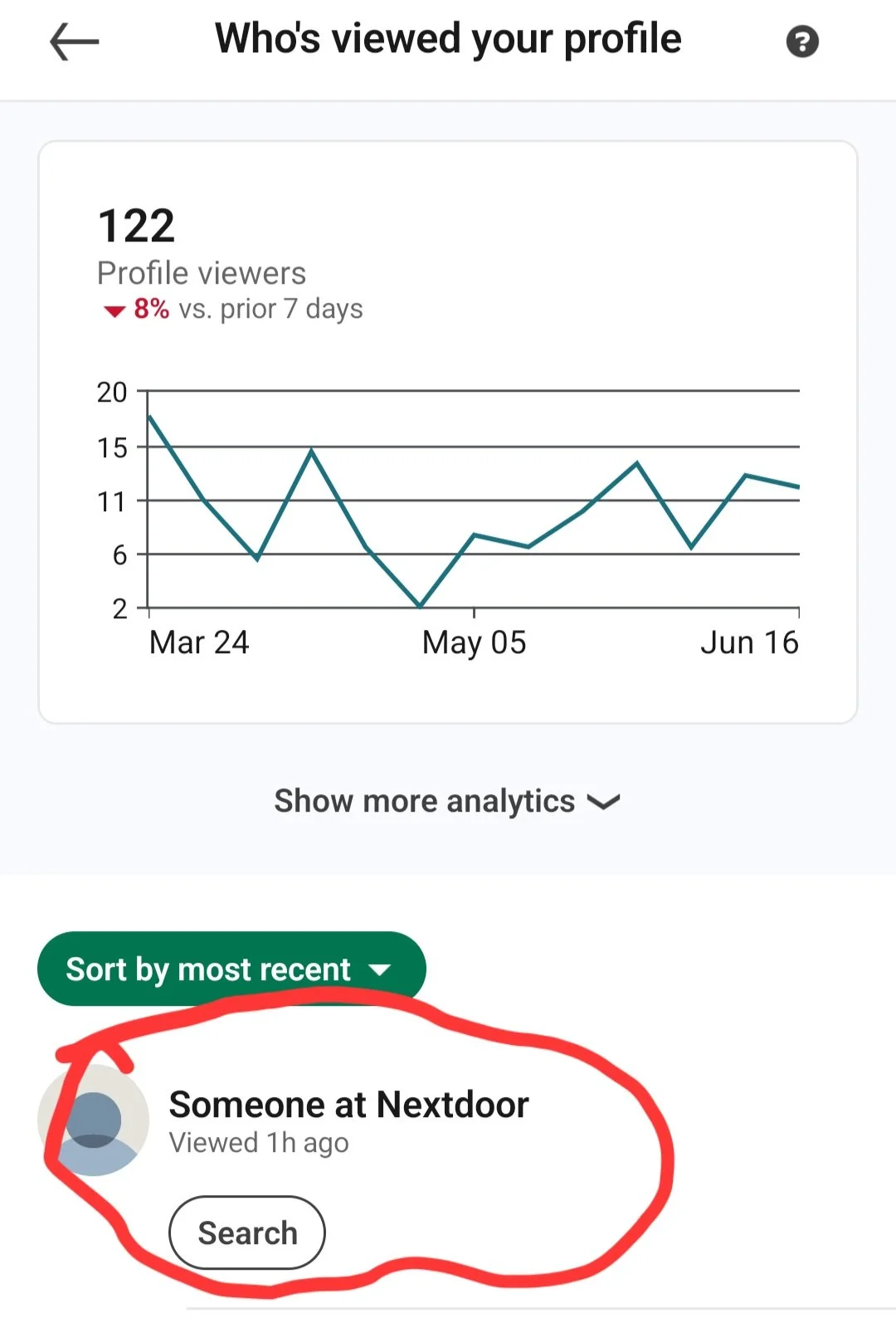
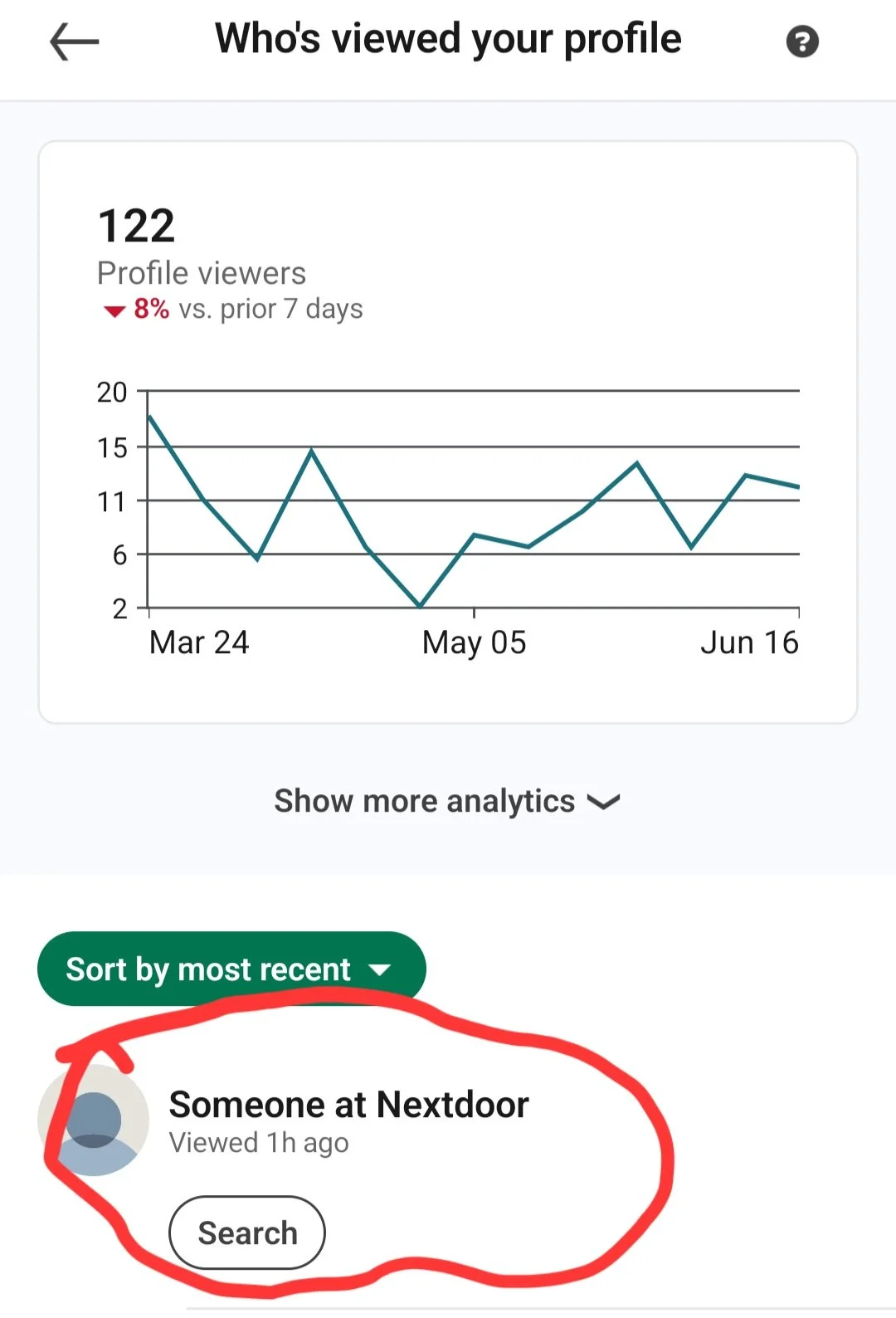
And finally, I got another knock at my virtual door today—from someone at Nextdoor. It happened early this morning Eastern Daylight Time. They're remaining anonymous because they fear the backlash and toxicity they believe exists within the culture.
Sometimes the most interesting conversations happen off the record.
When Data Is Shared, Methodology Matters
Nextdoor recently published a research article titled:
"What Neighbors Want in 2026: Resolutions, Spending Shifts, and Community Connection"
Sources include internal Nextdoor surveys, but the public materials don't appear to disclose key research details such as:
• Sample size
• Margin of error
• Response rate
• Sampling methodology
• Demographic composition
• Weighting methodology
• Exact survey questions
• Full survey results
• Independent review or validation
As someone who has spent years working with assessments, reporting, training metrics, and stakeholder analytics, one of the first questions I ask is:
"How was the data collected?"
Has no one at Nextdoor watched John King work the CNN Big Board on election night?
He doesn't simply point at a state and declare a result. He drills down into counties, demographics, turnout, voting history, margins, and methodology. The audience gets to see how the conclusion was reached.
That's what builds credibility.
Without methodology, we're left with conclusions but limited ability to evaluate the quality of the research behind them.
I'm not suggesting the findings are inaccurate.
Transparency builds trust.
If the research is strong, why not publish the complete methodology, survey instrument, respondent demographics, and supporting data? Doing so would allow advertisers, investors, journalists, researchers, and users to assess the findings and understand the limitations independently.
Data is most valuable when others can examine how the conclusions were reached.
What level of transparency should companies provide when citing internal survey research in public-facing reports?
Subscribe to NielFlamm.com.