
Blocked Again: Apparently My Questions Are Getting Through
There are days when you wonder whether anyone is actually paying attention.
Then there are days when you get a message like this:
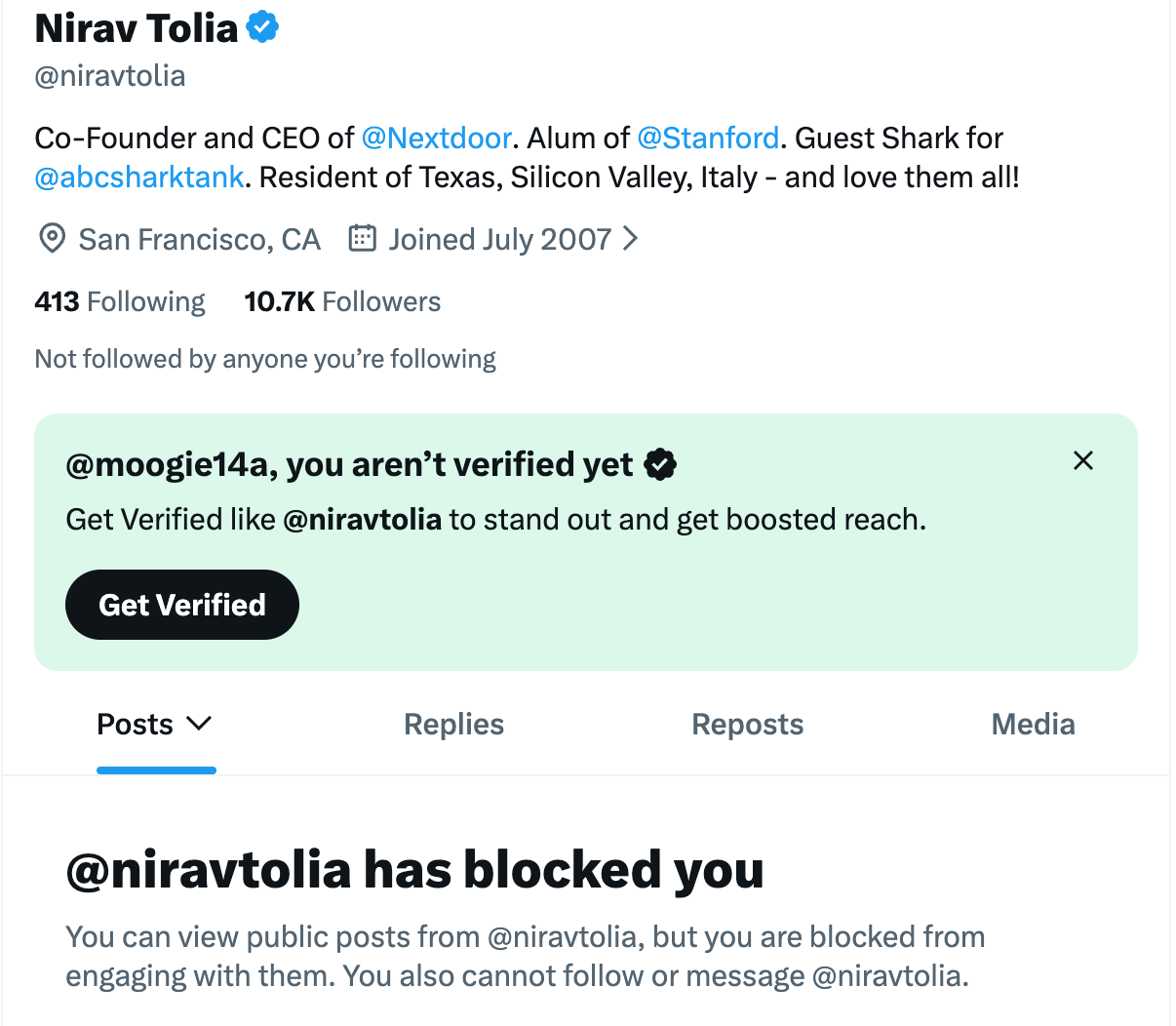
“@niravtolia has blocked you.”
Well, I guess somebody noticed.
For anyone who hasn't been following this ongoing Nextdoor case study, I have a fairly consistent routine for publishing new content
.
First, it goes on my blog:
Then I work my way through the social-media neighborhood:
LinkedIn. Facebook. Instagram. Threads. Bluesky. Then X—my own page, Sarah Leary's page, Nextdoor's page, and finally Nextdoor co-founder and CEO Nirav Tolia's page.
Why?
Awareness.
I'm not exactly operating with Nextdoor's Communications budget. I don't have a corporate PR department distributing carefully crafted statements through Business Wire.
I have a blog, social media, and persistence.
So I use them.
Then I Got to Nirav's Page...
And there it was.
Blocked. Again.
The screenshot couldn't be much clearer.
I can apparently view Nirav's public posts, but I can't engage with them, follow him, or message him.
It amazes me.
Nirav Tolia is the CEO and co-founder of a publicly traded company. He's an entrepreneur. He's appeared as a guest Shark on Shark Tank. He's been making the podcast rounds discussing leadership, entrepreneurship, AI, community, and the future.
Yet criticism from one small shareholder with a blog apparently warrants the block button.
I don't know Nirav's reason for blocking me, so I won't pretend that I do.
Maybe he thinks I'm repetitive.
Maybe he doesn't like my approach.
Maybe he simply doesn't want my criticism appearing underneath his posts.
But I can't help wondering:
Am I hitting a nerve?
Because something about these questions apparently isn't welcome on his page.
Blocking Me Doesn't Fix Nextdoor
Here's the funny part.
Blocking me doesn't stop any of this.
It doesn't delete my blog.
It doesn't stop LinkedIn.
It doesn't stop Facebook.
It doesn't stop Instagram, Threads, or Bluesky.
It doesn't stop my posts on X.
And it certainly doesn't stop me from continuing to examine Nextdoor.
If anything, I'm more determined.
Because my questions aren't about whether Nirav Tolia likes me.
They're about the company he leads.
I'm a Shareholder. I Get to Ask Uncomfortable Questions.
I continue to question Nextdoor's direction.
I continue to question its communication.
I continue to question its treatment of small businesses.
I continue to question its moderation and verification systems.
I continue to question its research transparency.
And I continue to question executive compensation when shareholders are still waiting for sustained value creation.
I've previously written about Nextdoor's GAAP losses even while some operating metrics have improved. That's an important distinction: the company has made progress in areas such as revenue and adjusted EBITDA, but that doesn't automatically mean I should be satisfied with leadership or shareholder returns.
And yes, I want to know:
How much should a CEO be rewarded when shareholders aren't seeing the value they expected?
That's not personal.
That's corporate governance.
I wouldn't characterize executive compensation as literally “burning through cash for a bonus” unless the numbers establish that connection. But I absolutely believe shareholders should scrutinize how much cash and equity go toward executive compensation and whether the company's performance justifies it.
The Irony Is Spectacular
Nextdoor's entire business is supposedly built around conversation.
Neighbors talking to neighbors.
Businesses talking to neighbors.
Community.
Connection.
Recommendations.
Discussion.
And yet, when a shareholder repeatedly questions the leadership of the company built around conversation...
Block.
There's a lesson in there somewhere.
Especially after everything I've written recently about what looks to me, from the outside, like symptoms of a broken corporate culture:
Poor leadership accountability.
Unclear values.
Low trust and transparency.
Poor communication.
Resistance to feedback.
I don't work at Nextdoor, so I can't tell you what the internal culture is.
But culture eventually becomes visible externally.
And blocking criticism doesn't exactly persuade me that my assessment is wrong.
You Can Block the Account. Not the Questions.
I'm one shareholder.
I'm one user.
I'm one guy writing a blog.
Nirav has every right to decide who interacts with his personal social-media account.
And I have every right to continue examining the leadership and performance of a publicly traded company in which I'm invested.
So I'll keep asking.
Show me.
Show shareholders the results.
Show users the improvement.
Show businesses the value.
Show us that the strategy is working.
Because blocking my X account doesn't answer any of those questions.
It just means I'll have to skip one stop on my social-media publishing tour.
And I've still got plenty of other stops.
