

🎃 Day 120: Halloween, Neighbors, and Another Day of Silence from Nextdoor

Halloween could be an AWESOME opportunity for Nextdoor to bring neighbors together. Think about it!
🍬 Kids smiling from ear to ear as they collect candy.
🍫 Adults secretly stealing candy from their own kids.
🏡 Neighbors hosting Halloween parties and welcoming people into their homes.
👻 Communities coming together for a holiday that so many people love.
That's what a neighborhood platform should do: connect people, build relationships, and bring communities together.
But let's check in on Nextdoor's leadership and communications.
📅 Nextdoor's last post: October 8.
📅 Nirav Tolia's last post: October 9.
If Nirav isn't talking about AI, is he talking about anything at all? 🤔
Meanwhile, NXDR is trading at $2.66 a share today. That's movement in the right direction, but it's still a far cry from the Citibank number Nextdoor previously referenced.
And here's the bigger question: What about the people whose data helps power the platform?
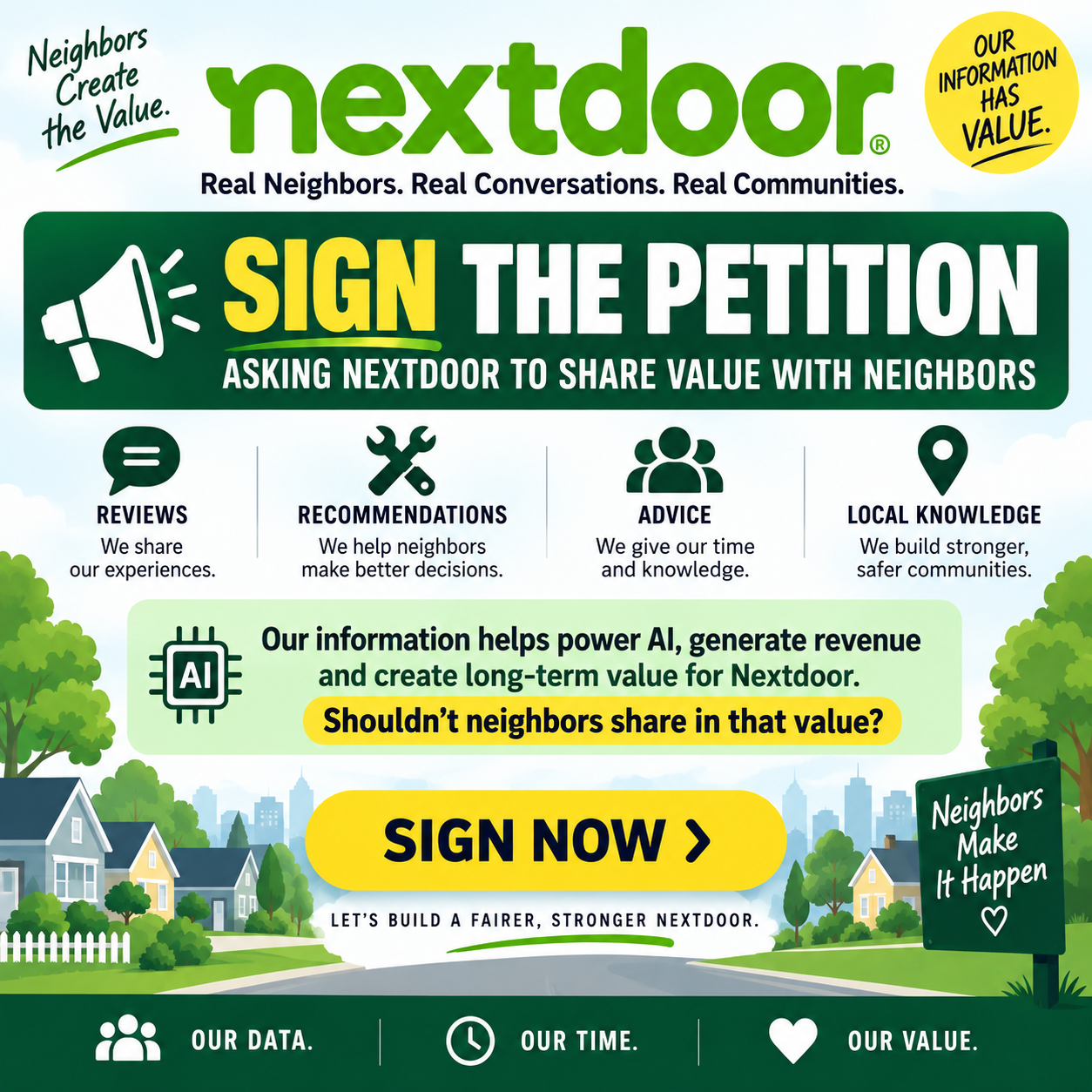
Nextdoor benefits from its users' activity, information, and contributions. Shouldn't those users have a voice in how the value generated from their data is shared?
📢 Have you signed the Nextdoor Neighbor Value-Sharing Petition?
If you believe neighbors deserve a share in the value created by their contributions, add your name today!
✍️ Sign the petition here: https://c.org/GkNWmffgg9
Let's keep the conversation going. A neighborhood platform should be about more than AI announcements and stock prices. It should be about the people who make the neighborhoods — and the platform — what they are.
🎃 Happy Halloween! Let's make it about neighbors again.

Day 118: Nextdoor Can't Fix What's Broken Until It Admits Something Is Broken

I recently heard an entrepreneur make a statement that stuck with me:
Before a company can fix something, it has to admit something is broken.
That sounds pretty simple, doesn't it?
Yet after 118 days documenting my experience with Nextdoor, I have a growing list of issues I'd like to see addressed.
But adding new features, launching advertising products, and promoting neighborhood intelligence won't fix underlying problems.
Let's take a look at what's broken.
1. Communication: A Master Class in How Not to Communicate
For 118 days, I've been requesting detailed Insights research that Nextdoor's own blog posts described as available.
I've emailed. I've followed up. I've expanded my outreach. I've offered to talk by phone, video, or virtual coffee.
I received a response, but not the complete reports I requested.
The problem isn't that Nextdoor must give me everything I ask for. It can tell me the reports aren't available, explain restrictions, or direct me to the appropriate person.
The problem is leaving a straightforward request unresolved.
With more than 20 years of experience in Learning & Development, I've seen the difference between hearing a question and actually addressing it.
Nextdoor has had 118 days to demonstrate that difference.
2. Accountability: Who Owns the Problem?
A simple request shouldn't require a 118-day case study.
Who owns the request? Who is responsible for following up? Who has the authority to resolve it?
If the person receiving a request can't answer it, accountability means making sure it reaches someone who can.
Instead, I'm still documenting the days.
Accountability isn't about finding someone to blame. It's about finding someone responsible for getting the job done.
3. Moderation: Who Holds the Moderators Accountable?
I've repeatedly raised concerns about Nextdoor's moderation model.
Users have publicly described experiences involving inconsistent enforcement, unclear explanations, difficult appeals, and decisions that appear to vary between communities.
I can't independently verify every user's account, and I won't pretend every moderation decision is wrong.
But the broader questions deserve answers:
What training do moderators receive?
How does Nextdoor measure moderation quality and consistency?
What happens when moderators make mistakes?
How can users appeal decisions effectively?
How does Nextdoor identify and address inconsistent enforcement across neighborhoods?
A community platform needs moderation. But moderation without meaningful accountability can undermine the trust it's supposed to protect.

4. User-Generated Content: Who Gets the Economic Benefit?
Nextdoor's neighborhood knowledge is valuable.
Reviews, recommendations, conversations and local experiences help make the platform useful. Nextdoor is now developing products that package neighborhood-level intelligence for advertisers.
I'm a shareholder. I want the company to monetize its competitive advantages.
But I also believe the people supplying valuable content deserve a seat at the table when we discuss how that value is shared.
I'm not claiming every user automatically has a legal right to royalties. Platform terms, privacy laws, and how information is used matter.
I'm asking a broader economic question:
If user contributions help generate commercial value, why shouldn't platforms explore ways for contributors to participate in that value?
That's why I launched my petition calling for a neighbor value-sharing agreement.
👉 Sign it: https://c.org/GkNWmffgg9
5. Transparency: Show Us the Methodology
Nextdoor recently published a neighborhood trust study with The Harris Poll that provided meaningful information about the research methodology.
I applauded that.
It showed that Nextdoor can publish research with useful context about how it obtained the findings.
That's the standard I'd like to see applied consistently.
When a company publishes statistics, promotes research, or uses data to sell advertising, people should understand the methodology behind the claims.
Transparency shouldn't depend on whether the information makes the company look good.
6. Leadership: Blocking Questions Doesn't Resolve Them
Nextdoor CEO Nirav Tolia has blocked me on X twice, according to my experience.
He's entitled to decide whom he interacts with on social media. Being CEO doesn't obligate him to respond personally to every shareholder.
But blocking me doesn't resolve my questions.
Leadership means establishing a process to address difficult questions, even when the CEO isn't the one answering them.
Disagree with me. Explain why I'm wrong. Delegate the question. Tell me the information isn't available.
Just make sure somebody owns the response.

7. Product Strategy: Stop Adding Before Fixing
Nextdoor keeps announcing new initiatives, including Neighborhood Intelligence and seasonal features like its Treat Map.
Innovation is important. Advertising products may help the company grow revenue.
But there's a difference between adding capabilities and fixing the underlying business.
Can Nextdoor turn its neighborhood knowledge into sustainable profits? Can it improve the user experience? Can it build trust with neighbors, advertisers, and shareholders? Can it establish consistent, accountable moderation?
A growing list of features doesn't automatically mean a healthier business.
Sometimes the best next product improvement isn't another feature. It's fixing the process that already exists.
8. Trust: The Company Has to Practice What It Promotes
Nextdoor recently published research emphasizing the importance of trust and communication in neighborhoods.
I welcomed that report.
But trust is built through repeated actions, not just statements.
When a company promotes trust, people evaluate its communication, moderation, and accountability practices as part of the experience.
That doesn't mean Nextdoor has to agree with every user.
It means its actions should support the principles it promotes.
The First Step Is Admitting There's a Problem
These are the issues I believe Nextdoor should examine:
Communication
Accountability
Moderator training and consistency
The economic value of user-generated content
Research transparency
Leadership's response to difficult questions
Product priorities versus operational improvements
Trust between the platform and its stakeholders
I'm not suggesting you can solve every problem overnight.
I'm suggesting that you can't fix a problem you refuse to acknowledge.
Nextdoor has built something with real potential. It has millions of users, a distinctive neighborhood focus, and information that advertisers may find valuable.
I want that potential to translate into a stronger business.
But before the next big announcement, perhaps leadership should ask a different question:
What needs fixing before we build something else?
Day 118.
I'm still here. I'm still asking questions. And I still want Nextdoor to succeed.
Now, let's start fixing things.
👉 NielFlamm.com/blog
Day 117: Nextdoor Can Map 350,000 Neighborhoods. Can It Figure Out Its Own Problems?
I missed a few days of my Nextdoor case study. It's Day 117, and I haven't forgotten. 😂
On October 8, Nextdoor published two posts that caught my attention. One promoted its new Neighborhood Intelligence advertising capabilities. The other announced the return of its annual Treat Map, sponsored in the U.S. by Reese's.
Both demonstrate what Nextdoor can do when it puts its mind to something.
And both highlight the question I've been asking for 117 days:
Why is Nextdoor so good at promoting its capabilities, but still struggling with the questions I've raised about transparency and communication?
350,000 Neighborhoods. That's Impressive.
Nextdoor says it has mapped more than 350,000 neighborhoods, connecting local conversations to verified addresses and letting advertisers understand differences between communities—even within the same ZIP code.
That's a compelling advertising proposition.
A ZIP code can contain neighborhoods with very different interests, needs, and purchasing habits. Helping businesses understand those differences could be a genuine competitive advantage.
Nextdoor is finally trying to turn its neighborhood knowledge into a more differentiated commercial product.
As a shareholder, I want that to succeed.
But here's the catch: having valuable data is one thing. Building a sustainable, profitable business around it is another.
Clear communication about how that data is collected, analyzed, and used matters, too.
Nextdoor wants advertisers to appreciate the value of its neighborhood intelligence. It should welcome reasonable questions about its research and methodology rather than leave people wondering where the detailed information went.

The Treat Map: A Neighborhood Success Story
Nextdoor's Treat Map is another example of the platform doing something useful.
Neighbors can mark their homes or local attractions, such as corn mazes and bakeries. Parents can plan routes, and filters help families find non-food treats and pet treats.
Reese's gets brand exposure. Nextdoor gets engagement. Neighbors get a tool for Halloween.
That's a win-win-win.
It's also a smart example of connecting a commercial sponsor with a community activity.
But notice something important: Nextdoor is asking neighbors to participate. Their homes, local knowledge, and contributions make the experience more useful.
The platform supplies the technology. The sponsor supplies commercial support. The neighbors make it a community experience.
That brings me back to my ongoing question: Do neighbors contribute value to Nextdoor, and should they share in the economic value their content helps create?
Nextdoor's Priorities Are on Display
Let's give credit where it's due. Nextdoor is developing advertising products, finding sponsors and creating seasonal experiences.
Those are legitimate business activities.
But my case study isn't about whether Nextdoor can produce clever marketing posts. It's about whether the company can demonstrate the same commitment to communication, transparency, and accountability when the questions aren't so convenient.
For 117 days, I've been asking for the detailed Insights research Nextdoor's own blog posts described as available.
I've received a response, but not the complete reports I requested.
I've emailed. I've followed up. I've offered to talk.
Meanwhile, Nextdoor keeps announcing new products and partnerships.
There's nothing wrong with that. The company should keep innovating.
But product announcements don't resolve unanswered questions.

Day 117: I'm Still Here
Nextdoor can map 350,000 neighborhoods.
It can help advertisers distinguish one community from another.
It can map Halloween attractions and bring Reese's into the neighborhood.
Those are capabilities worth building on.
Now I'd like to see the company apply that same energy to communicating with people who ask reasonable questions.
I'm a shareholder. I want Nextdoor to succeed, become consistently profitable and create long-term value.
That requires more than clever advertising and seasonal maps. It requires trust, transparency, and the willingness to address difficult questions.
Nextdoor knows how to find the neighborhoods. I'm still waiting to see how it finds the answers.
👉 Follow the continuing case study at NielFlamm.com/blog

Day 114: Nextdoor Finally Found a Way to Sell What It Knows

Nextdoor just launched Neighborhood Intelligence, and I think it could be one of the most important developments I've seen in this 114-day case study.
The basic idea is pretty simple: Nextdoor has spent 15 years building a massive collection of neighborhood-level information. Now it's turning that information into an advertiser product.
Nextdoor says its Neighborhood Intelligence platform maps roughly 350,000 neighborhoods and analyzes signals including neighbor activity, household information, and neighborhood-level activity. It gives advertisers a much more granular view than traditional ZIP-code targeting. Nextdoor Business
That's potentially valuable.
And it brings me back to something I've been saying for a while:
The Data Has Value
For years, neighbors have supplied the conversations, recommendations, reviews, opinions, and local knowledge that make Nextdoor useful.
Now Nextdoor is packaging neighborhood intelligence into something advertisers can use.
That's business.
But here's my question:
Why did it take 15 years?
Nextdoor has been around since 2011. It went public in 2021. Yet it has never achieved GAAP profitability. Even after the recent improvement, Q2 2026 produced a $2 million net loss, although revenue reached a record $75 million and adjusted EBITDA was $10 million. Securities and Exchange Commission
That's a long time to possess a potentially unique asset without figuring out how to turn it into sustainable profits.
Don't Blame Just the Current CEO
It's tempting to point the finger at Nirav Tolia.
He returned as CEO in 2024 and has been tasked with turning the company around.
But that's too easy.
Nirav founded Nextdoor and ran it for years before leaving the CEO role. He then returned.
So this isn't simply:
“The new CEO hasn't figured it out.”
The company has had 15 years to find its niche, monetize its advantages and create sustainable shareholder value.
Now, perhaps, we're seeing a clearer path.
The Neighborhood May Be the Niche
That's what interests me about Neighborhood Intelligence.
Nextdoor doesn't have to beat Google at everything.
It doesn't have to beat Meta at everything.
It doesn't have to become another generic social-media platform.
Maybe the opportunity is much narrower:
Own neighborhood-level intelligence.
Nextdoor says its neighborhood graph provides roughly 12 times the geographic granularity of ZIP-code targeting in covered areas, and its pilot campaigns showed lifts in brand awareness, ad recall and favorability compared with ZIP-code targeting. Investing.com
If advertisers will pay for that advantage, now we're talking.
That's the kind of niche I want Nextdoor to own.
And Then There's the Dividend
I'm not saying Nextdoor should pay a dividend tomorrow.
The company needs to continue investing, improve profitability, and determine the best use of its capital.
But eventually, that's the shareholder question:
Can this company consistently generate enough cash to reward the people who invested in it?
A $100 million share-repurchase authorization already shows that returning capital to shareholders is part of the conversation. Simply Wall St
I'd like to see the next step be sustainable profitability.
Then, someday, perhaps a dividend.
Because revenue isn't the finish line.
Profitability is.

Day 114
Here's the irony.
I've spent 114 days asking Nextdoor for detailed information about its Insights research.
Now Nextdoor is announcing a product that essentially says:
Our neighborhood data is valuable.
I agree.
I've been saying that.
The difference is that Nextdoor is now trying to prove it in the marketplace.
Good.
Now show me that this isn't just another interesting product.
Show me that Nextdoor can turn 15 years of neighborhood intelligence into a sustainable, profitable business.
Because that's what shareholders ultimately need.
Not just data.
Results.
And maybe—finally—Nextdoor has found the niche.
👉 NielFlamm.com/blog

Day 112: Still Waiting

Day 112.
The request hasn't changed.
I'm still asking Nextdoor for the detailed Insights research that its own posts said was available.
I've emailed. I've followed up. I've expanded the audience. I've offered to talk by phone, video, or virtual coffee.
I've received a response, but it doesn't include the complete detailed reports I originally requested.
At this point, the answer doesn't need to be complicated:
Send the reports.
Tell me they're unavailable.
Explain any restrictions.
Or please let me know who can provide them.
Any one of those would end the countdown.
Nextdoor's own recent research emphasizes the importance of trust and communication.
I agree.
So let's communicate.
112 days. One unresolved request.
Maybe Day 113 will be the day.
I've been wrong 112 times so far. 😂
👉 NielFlamm.com/blog