

Day 99: A Stock Ticker Measures More Than Numbers

Day 99.
Tomorrow, this Nextdoor journey officially enters triple digits.
Another email requesting the detailed Insights studies is coming, but today I want to look at something completely different: leadership reputation and shareholder confidence.
I recently saw a reel discussing how a stock isn't influenced only by revenue, earnings, and a balance sheet. Investors also evaluate management, governance, credibility and the risks surrounding the people running a company.
That reminded me of Dan Bilzerian and Ignite International Brands.
Former Ignite executive Curtis Heffernan sued after his 2020 termination, alleging he was fired after refusing to approve substantial expenses he believed were personal expenses being charged to the company. Bilzerian disputed that account and said Heffernan was terminated for negligence and incompetence. The dispute eventually reached the California Court of Appeal. Bloomberg
And the story didn't end there.
Later litigation involving Ignite became even more complicated. In 2024, federal prosecutors charged Dan's father, Paul Bilzerian, and others in a case involving Ignite. Prosecutors alleged Paul secretly exercised significant control over the company while concealing that role. Those are government allegations, not something I'm presenting as independently proven here. Paul had previously been convicted of securities fraud in 1989. Department of Justice
Court records also show that Dan was removed as Ignite's CEO in 2023 after internal disputes, including concerns about his impact on the brand. Justia Law
Why Am I Talking About This on Day 99?
Not because Nextdoor is Ignite.
It isn't.
And I'm certainly not suggesting Nirav Tolia has done anything resembling what was alleged in the Ignite cases.
My takeaway is much simpler:
Leadership becomes part of a company's asset—or liability—whether the balance sheet lists it or not.
A CEO's reputation matters.
How leadership communicates matters.
How criticism is handled matters.
How shareholders are treated matters.
Whether questions receive answers matters.
And when leadership becomes closely identified with the company itself, the distinction between corporate reputation and executive reputation can become increasingly difficult for investors, customers, and the public to separate.
That's something I think about as a Nextdoor shareholder.
I've spent 99 days asking for studies that Nextdoor publicly said readers could request.
Tomorrow we hit 100.
At that point, the unanswered question isn't only about the studies anymore.
It's also about what 100 days of an unresolved request says about communication, ownership, and leadership.
See you in the triple digits.
👉 NielFlamm.com/blog
Blocked by a CEO: What Does the Block Actually Say?
I recently wrote about being blocked on X by Nextdoor co-founder and CEO Nirav Tolia.
And after looking at that screen again, I started thinking about the psychology of the block itself.
Not diagnosing Nirav.
Not pretending I know what he's thinking.
Not claiming I've somehow crawled inside his head.
Because I haven't.
But I do find the behavior fascinating.
Why Does Someone Block a Critic?
There could be a dozen explanations.
Maybe Nirav thinks I'm repetitive.
Maybe he doesn't like my approach.
Maybe he doesn't want criticism appearing underneath his posts.
Maybe it's reputation management.
Maybe he considers my comments disruptive.
Maybe he simply decided, I don't want to deal with this guy anymore.
And you know what?
That's his right.
It's his X account. He can block me.
But here's what makes it interesting:
I'm not some random person yelling insults at him. I'm a shareholder asking questions about the company I own shares in.
I've questioned Nextdoor's leadership.
I've questioned executive compensation.
I've questioned the company's communication.
I've questioned moderation and verification.
I've questioned its treatment and monetization of small businesses.
I've questioned its research transparency.
I've questioned whether the strategy is creating sufficient shareholder value.
Those questions aren't disappearing because my account disappeared from Nirav's X feed.
Psychologically, What Does a Block Accomplish?
This is where the subject gets interesting without playing amateur psychologist.
Blocking someone creates a boundary.
It removes an unwanted interaction.
It gives someone greater control over what appears in their social-media environment.
It can reduce exposure to criticism.
It can end an interaction someone no longer considers productive.
And yes, in some circumstances, avoidance can also be a response to uncomfortable information.
Which one applies here?
I have absolutely no idea.
And unless Nirav tells me, no one else does.
That's precisely why I'm not going to call him psychologically insecure, diagnose him as a narcissist, or claim I've discovered some deep emotional wound.
That would be speculation masquerading as analysis.
Instead, I'll stick with something I can actually document:
He blocked me.
And I'll ask what I think is the much more interesting question.
Why?
The Power Dynamic Is Fascinating
Think about the people involved here.
On one side is Nirav Tolia.
Co-founder and CEO of Nextdoor.
Entrepreneur.
Guest Shark on Shark Tank.
Podcast guest.
Public-company executive.
A person with access to corporate communications professionals, investor relations, attorneys, media opportunities and a significant public platform.
On the other side:
Me.
One shareholder.
One blog.
No communications department.
No investor-relations team.
No Business Wire distribution strategy.
Just questions, screenshots, publicly available information, and apparently an impressive amount of persistence.
Yet I'm the one who needed to be removed from the conversation.
I find that fascinating.
Maybe It's Just Reputation Management
There's also an explanation that requires virtually no psychology.
Maybe Nirav simply doesn't want a persistent critic leaving negative comments beneath his public posts.
That's not necessarily insecurity.
It could simply be reputation management.
If that's the explanation, though, it creates another interesting question for me.
Nextdoor is a company whose entire business is supposedly centered around conversation, community, and connection.
The company wants neighbors talking to neighbors.
It wants neighbors recommending businesses.
It wants businesses interacting with communities.
It wants people exchanging opinions.
But what happens when the conversation becomes uncomfortable for the person running the company?
Apparently, at least in my case:
Block.
There's some irony there.
Here's What the Block Doesn't Accomplish
It doesn't change Nextdoor's financial results.
It doesn't increase NXDR's stock price.
It doesn't answer my questions about executive compensation.
It doesn't explain Nextdoor's strategy.
It doesn't resolve my concerns about small-business monetization.
It doesn't provide the detailed Insights data I've been requesting.
It doesn't address my concerns about communication, transparency, or accountability.
And it certainly doesn't increase my confidence in Nextdoor's leadership.
It accomplishes exactly one thing:
I can't interact with Nirav's X account.
Okay.
I'll survive.
The Questions Are Bigger Than an X Account
This is where I think CEOs—and really any leader—face an interesting choice when dealing with persistent criticism.
You can answer it.
You can ignore it.
You can dispute it.
You can explain why it's wrong.
You can provide evidence that contradicts it.
You can even decide that the critic isn't worth your time.
All legitimate options.
But blocking the person doesn't refute the criticism.
And that's why I'm not particularly interested in trying to determine whether Nirav is “thin-skinned.”
I'm interested in whether I'm wrong.
Show me.
If Nextdoor's leadership strategy is working, show shareholders the results.
If the monetization strategy is strengthening the neighborhood experience, show us.
If executive compensation is appropriately aligned with shareholder value creation, explain it.
If my interpretation of Nextdoor's corporate culture is completely wrong, demonstrate why.
If the detailed research I've spent more than 80 days requesting isn't available, just say so.
Those are substantive responses.
A block isn't.
Maybe I Hit a Nerve. Maybe I Didn't.
Could my criticism have annoyed Nirav?
Sure.
Could he simply be tired of seeing my name?
Absolutely.
Could somebody handling his social media presence have decided that blocking me was the easiest solution?
Possible.
Could it be nothing more complicated than “I don't want this guy commenting here anymore”?
Yep.
That's the point.
I don't know why Nirav Tolia blocked me.
But I find the decision fascinating.
I'm a shareholder repeatedly asking uncomfortable questions about leadership, executive compensation, company performance, and shareholder value.
Whether the block represents frustration, reputation management, a personal boundary or simply a desire not to see my criticism, only Nirav knows.
What it doesn't do is answer the questions.
And that's the part that matters to me.
Block away.

Day 53: Is the Market Celebrating Improvement or Ignoring the Questions?
As I write this, NXDR is up.
The market is clearly reacting positively to Nextdoor's latest earnings report.
I understand why.
The company reported a smaller loss than in previous quarters, along with revenue growth and improved operating metrics.
As a shareholder, I'm glad to see progress.
But I also see it differently.
To me, it's a bit like a marathon where you've consistently finished last and this year you finish second-to-last.
That's an improvement.
It deserves acknowledgment.
But you still didn't win the race.
Nextdoor is still reporting a GAAP net loss.
The company has now been operating for approximately 15 years, and while CEO Nirav Tolia described this as the company's best quarter, I believe it's also fair for shareholders to ask what "best" should ultimately look like.
For me, financial performance is only part of the equation.
Today also marks Day 53 since I requested a study from Jacob Chavis.
Fifty-three days later:

No study.
No acknowledgment.
No explanation.
No response.
I've also noticed that the last Nextdoor Insights article appears to have been published on July 6, 2026.
As a shareholder, I naturally wonder:
Are new studies still being produced?
Has the research strategy changed?
Is the Insights program on pause?
I don't know.
That's exactly why I've continued asking.
This isn't about criticizing improvement.
It's about asking whether improving financial results should also be accompanied by improvements in communication, transparency, and accountability.
Potential alone doesn't create long-term shareholder value.
Execution does.
Communication does.
Culture does.
One quarter doesn't define a company, just as one stock move doesn't define its future.
I'll continue recognizing progress when I see it, and I'll continue asking questions when I believe they're warranted.
That's what engaged shareholders should do.
Join the discussion at NielFlamm.com/blog. Leave some feedback—I'd love to hear from you.

Day 38: Context Matters

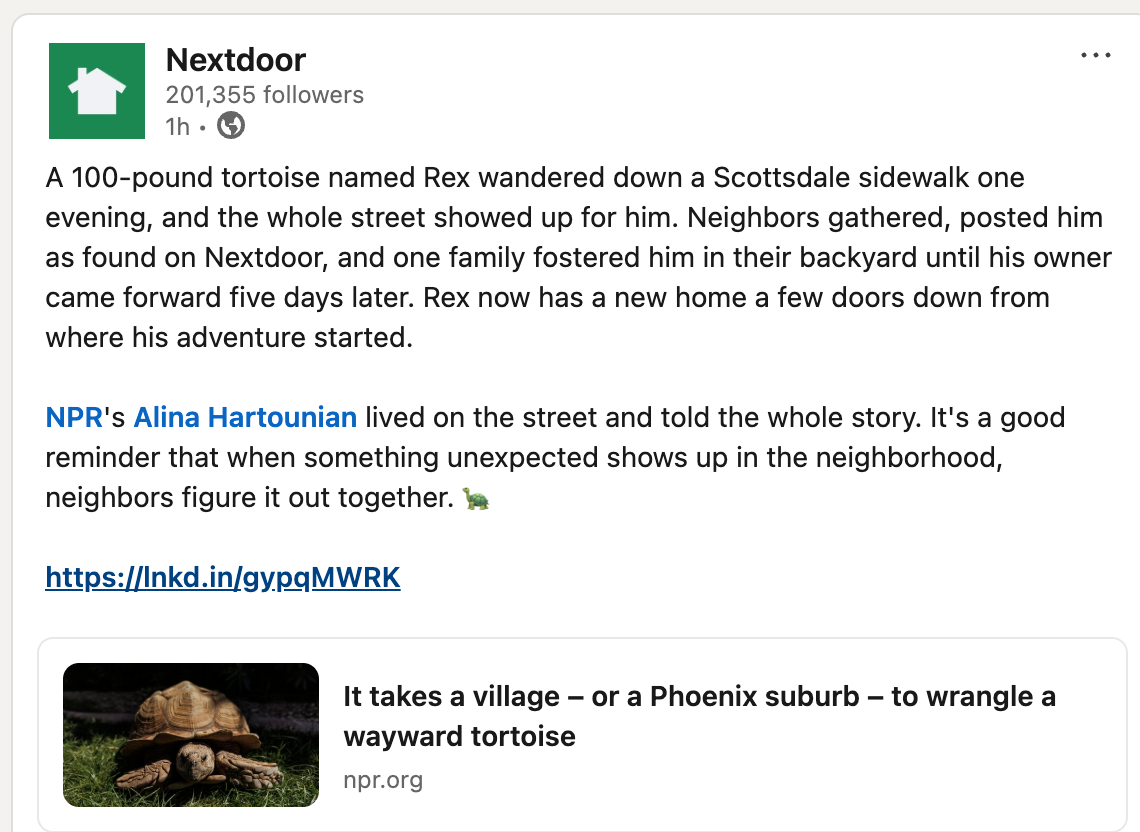

Nextdoor recently shared another feel-good story on LinkedIn about a lost tortoise and a neighborhood coming together to help.
It's a great story.
What caught my attention, however, was what wasn't included in the LinkedIn post.
In the accompanying NPR article by Alina Hartounian, the story notes that both Facebook and Nextdoor were used to help spread the word—with Facebook mentioned first. The LinkedIn post, by contrast, highlights only Nextdoor's role. To me, that leaves out important context about how the community effort came together.
It also raised a few questions.
I wonder whether Alina Hartounian is aware of the criticism some users have raised regarding Nextdoor's moderation and communication practices. NPR has a long history of reporting on issues involving free expression, transparency, and the role of the First Amendment in public discourse. While the First Amendment limits government restrictions on speech rather than private companies' moderation decisions, NPR has frequently covered debates about censorship, platform moderation, and the importance of open dialogue. That made me curious how those broader conversations intersect with reporting on social media platforms.
At the same time, Nextdoor's CEO, Nirav Tolia, continues to lead a company whose LinkedIn posts do not permit public comments. As someone who values feedback and discussion, I find that contrast noteworthy.
Today is also Day 38 since I requested a Nextdoor study. I still have not received the study or a response. At this point, I continue to wonder whether the document is intended primarily as a marketing or lead-generation asset rather than research distributed broadly upon request. I don't know the answer, but the continued silence naturally raises the question.
Transparency isn't just about the stories we tell.
It's also about the context we provide, the conversations we allow, and the questions we're willing to answer.
What are your thoughts?
Join the discussion on NielFlamm.com.
The Nextdoor Experiment Continues: When Does a Comment Cross the Line?
The Nextdoor experiment continues.
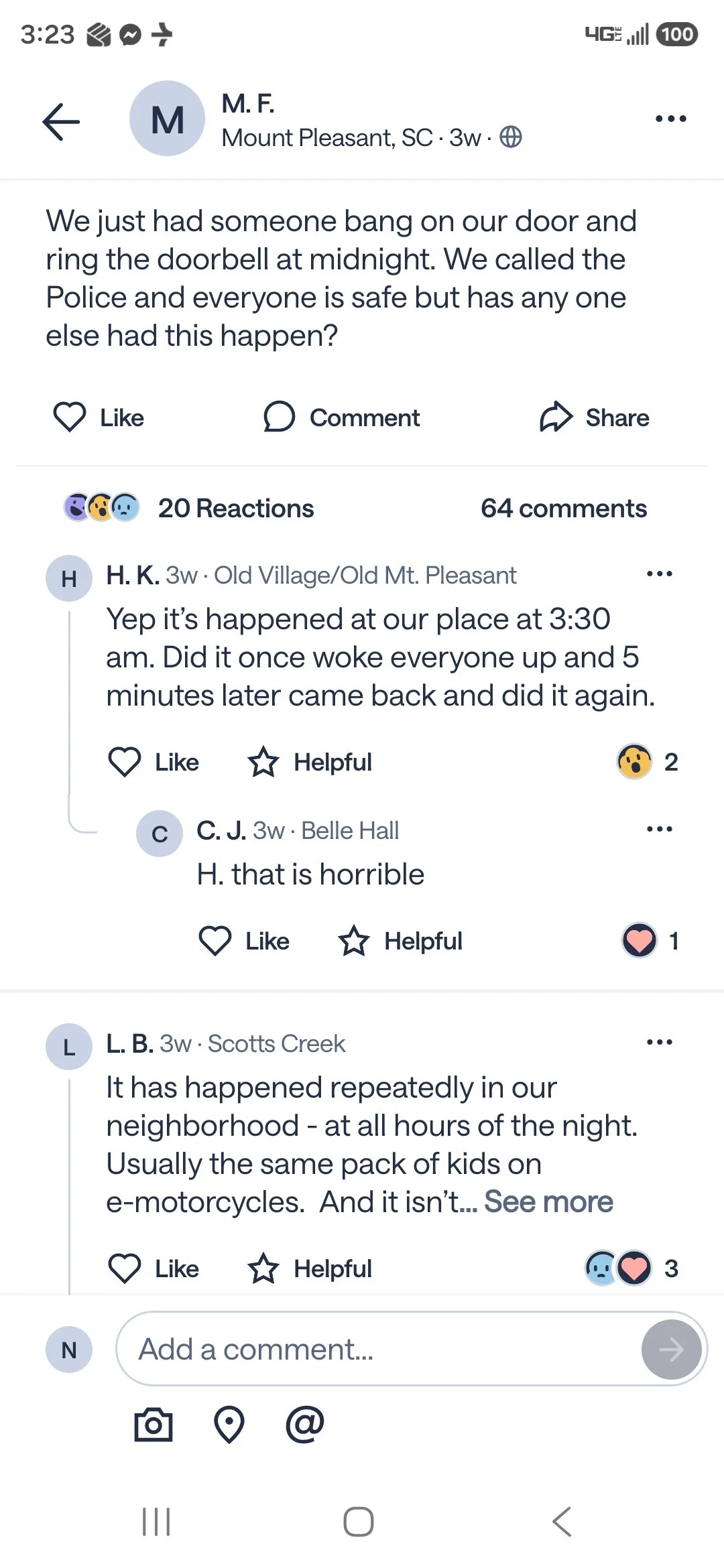
While browsing the platform on Saturday, I came across a neighborhood post that immediately caught my attention.
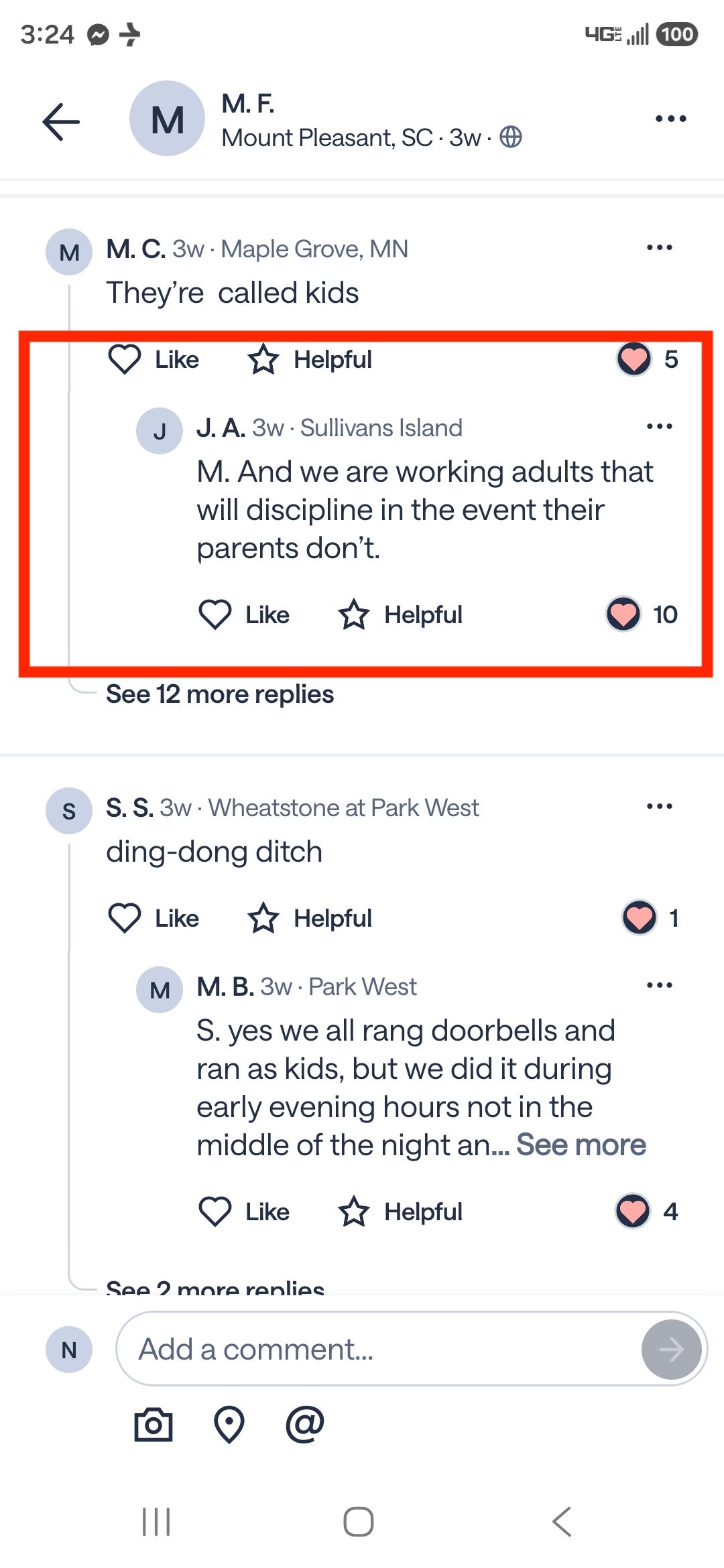
The original post was about someone whose age is unknown who rang a doorbell and ran away.
Back in my day, we called it “ding dong ditch.”
Annoying? Sure.
A nuisance? Absolutely.
But what really stood out wasn’t the original post.
It was one of the comments.
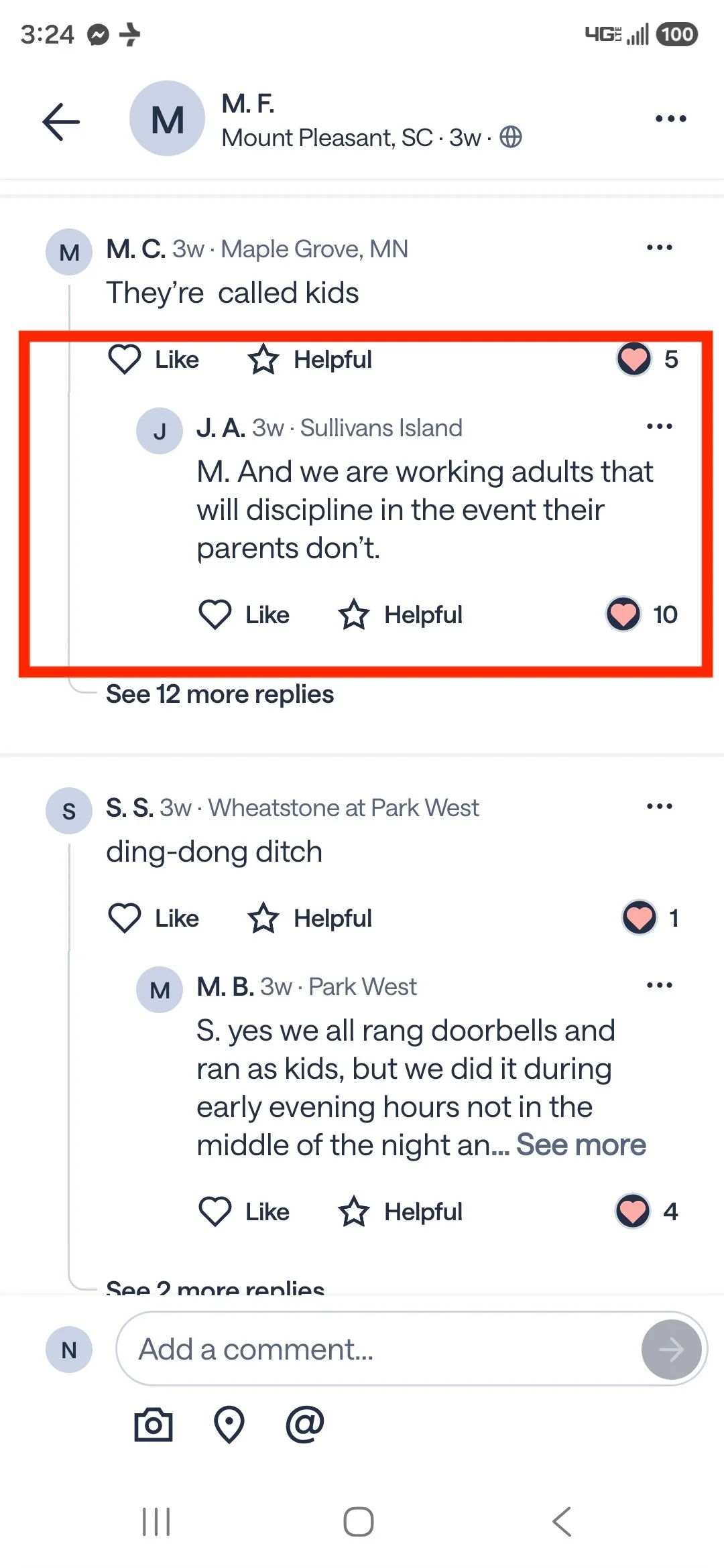
A neighbor commented that if the parents didn’t discipline the child or children, they would.
To me, that’s no longer discussing the issue—it’s a statement that could reasonably be interpreted as a threat.
According to the timestamp, this comment had remained on the platform for approximately three weeks.
That brings me back to a question I’ve been asking repeatedly:
How is this comment allowed to remain while other posts are removed much more quickly?
I don’t know why this particular comment remains visible.
Perhaps no moderator has reviewed it.
Perhaps it has been reviewed and determined not to violate the Community Guidelines.
Perhaps there simply aren’t enough moderators actively reviewing content in this area.
I don’t know.
What I do know is my own experience.
I was suspended for repeatedly posting items I had for sale.
On another occasion, I was suspended for providing negative feedback about the moderation process.
Yet here is a comment that appears to suggest someone will personally discipline another person’s child, and it has remained visible for weeks.
That’s the inconsistency I’m trying to understand.
This isn’t about one comment.
It’s about whether moderation is applied consistently and fairly.
If Nextdoor wants neighbors, advertisers, investors, and shareholders to trust the platform, consistency matters just as much as the written policies.
Otherwise, moderation begins to look less like a standard and more like a perception.
And perceptions shape trust.
Maybe I’m just not one of the “cool kids.”
Or perhaps—borrowing from Mean Girls—the moderators wear pink on Wednesdays.
Either way, consistency should never depend on who’s posting.
Join the discussion on NielFlamm.com.