
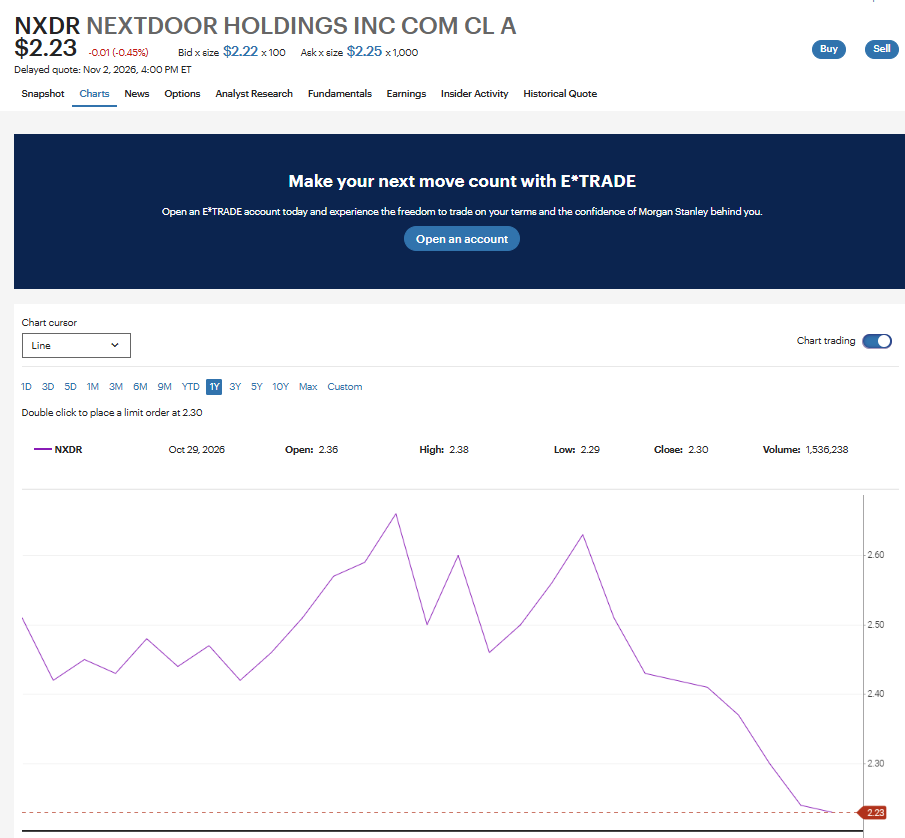
Day 140: NXDR Slides to $2.23 — What Is Driving Nextdoor's Decline?
The slide continues.
Yesterday, NXDR closed at $2.24. Today, it closed at $2.23, down about 0.45%.
One day, another step backward. Not a dramatic drop on its own, but it's part of a trend that's caught my attention.
I've been watching this movement since October 22, 2026, and I'm curious about what's behind it.
Another day in the wrong direction
I've noticed a pattern in previous earnings cycles. NXDR would bump up in the days leading up to an earnings report, only to give back some of those gains shortly afterward.
This time, something looks different.
Instead of the pre-earnings momentum I’ve seen before, the stock has continued to drift downward.
So what's changed?
Is this normal market activity? Are investors waiting for the next earnings announcement? Are there concerns about the company's financial performance, its growth strategy, advertising expansion, or its ability to turn its audience into sustainable revenue?
I don't know the answer, and I'm not going to pretend that I do.
But I would like to hear an explanation.
So I asked The Google: Why do investors think NXDR is sliding?
I asked The Google why investors believe Nextdoor Holdings (NXDR) is declining.
The AI Overview returned several explanations. Some are particularly interesting because they overlap with issues I've been discussing over the past year.
Here's a summary of what The Google identified:
1. Execution and scale concerns
Investors and analysts may be questioning whether Nextdoor has the cost structure and overhead of a much larger technology platform without generating the revenue to support it.
In other words, does the business have the scale to justify its operating structure?
2. Muted guidance and slower growth
The AI Overview pointed to analyst price-target reductions, with targets moving toward the $2.10–$2.20 range, along with expectations for modest revenue growth and adjusted EBITDA margins.
Revenue growth is important, but investors also want to understand how that growth translates into sustainable profitability.
3. Moderation and user friction
This one should sound familiar.
The overview identified concerns about automated moderation, including ordinary neighbor recommendation posts being classified as commercial content and comment threads being closed.
I've spent considerable time discussing moderation, inconsistent enforcement, and the frustration users experience when legitimate neighborhood conversations are restricted.
A platform depends on its users. Make it difficult for them to participate, and you risk damaging the very community that makes the business valuable.
4. Internal culture and leadership questions
The overview also mentioned concerns surrounding employee stock compensation, workplace culture discussions, and leadership changes.
These are areas that deserve careful examination rather than assumptions. However, questions about leadership stability and the ability to execute a strategy can influence investor confidence.
5. A large cash cushion and corporate urgency
Finally, the overview referenced Nextdoor's substantial cash reserves and argued that a significant cash cushion could reduce pressure to make difficult changes.
Having cash is a strength. But cash alone doesn't guarantee a successful business model, profitable growth, or shareholder returns.
These points come from Google's AI Overview, not independently established explanations for today's price movement. They represent potential investor concerns and should be evaluated against company filings, earnings results, analyst research, and other evidence.
Here's what caught my attention
I may not have used the same polished language as Google's AI Overview, but I've raised every one of these issues over the last year or so.
Execution. Revenue growth. Moderation. User experience. Leadership. Company culture. Cash reserves—shareholder value.
I've written about these subjects repeatedly.
I've questioned whether Nextdoor is building a sustainable business or simply adding more advertising opportunities to a platform that still has fundamental user-experience problems.
I've asked whether the company understands the consequences of moderation decisions and how those decisions affect participation and engagement.
I've questioned whether leadership is listening to users and whether the company is doing enough to communicate with investors.
And I've repeatedly asked for answers to specific questions, including the two detailed research reports that remain outstanding.
Apparently, these aren't just questions coming from one neighbor writing a blog.
They're also among the concerns being discussed in the broader investment conversation.
That doesn't mean my commentary caused the stock decline, nor does it prove that every concern in the AI Overview is accurate. But it does reinforce why these subjects deserve attention.
Will management address the decline?
Nextdoor has an earnings report coming up. That creates an opportunity for management to address more than just revenue, user growth, and adjusted EBITDA.
I'd like to hear how leadership views the market's reaction to the company's performance.
Some questions I'd like answered:
What does management believe is driving the recent decline in NXDR?
Is investor confidence changing?
How is Nextdoor measuring the success of its newer advertising and sponsored-search initiatives?
What is the path toward sustainable GAAP profitability?
What is the company doing to create long-term shareholder value?
How does Nextdoor plan to improve trust and engagement among the neighbors who make the platform valuable?
Revenue growth and user numbers are important. But they don't automatically translate into investor confidence or a stronger stock price.
My concern: Will we get any real answers?
Here's where my skepticism comes in.
I expect the earnings report to focus on the usual financial metrics and forward-looking statements. I wonder whether management will address the questions investors are actually asking about the stock's performance.
And that brings me back to a recurring concern throughout this case study: transparency.
I've spent 141 days raising questions about Nextdoor's communication, leadership, moderation, advertising strategy, and accountability.
I've also requested two detailed research reports and am still waiting for a meaningful response.
The company talks about community, connection, and creating value. But those promises need to extend beyond marketing language.
Investors deserve meaningful communication. Users deserve a platform that puts their experience first.
Day 141: The numbers are telling a story. Is anyone listening?
A 0.45% decline in one trading session isn't necessarily a warning sign on its own. I know stock prices move for many reasons, and I don't have enough information to attribute this decline to any one factor.
But the direction since October 22 deserves attention.
Nextdoor has celebrated 15 years, announced new revenue opportunities, and promoted its partnerships. That's great.
Now I'd like to see the company demonstrate how those milestones translate into investor confidence, sustainable growth, and a better experience for its neighbors.
Nirav Tolia and the Nextdoor leadership team: What is driving the slide, and will you address it?
I'll be watching the earnings report.
Day 141. The slide continues. The questions continue. And the wait for answers continues.