
Day 105: “The Power of We” Sounds Great. I’m Still Waiting for the “We.”
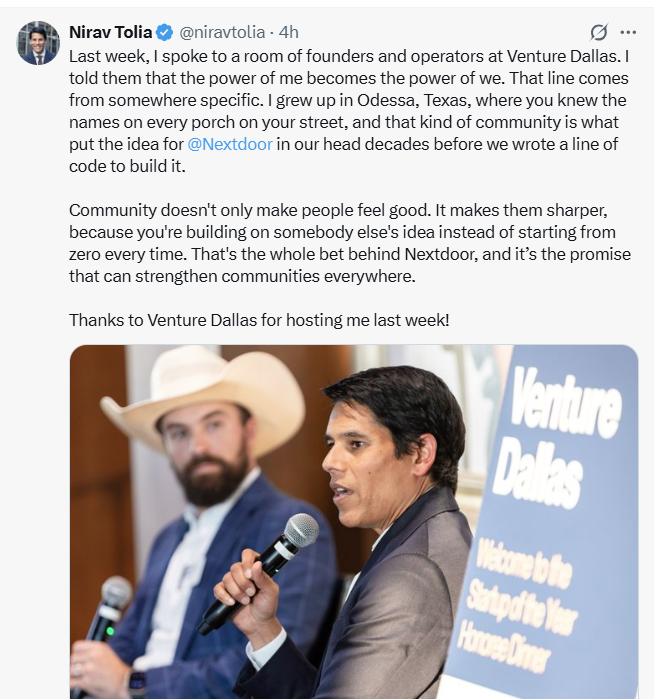
Today, Nextdoor CEO Nirav Tolia posted about speaking to a room of founders and operators at Venture Dallas.
One line immediately caught my attention:
“The power of me becomes the power of we.”
That's a pretty good line.
Actually, it fits remarkably well with what I've been writing about for the past 105 days.
Nirav went on to describe growing up in Odessa, Texas, where knowing the names of people on the street helped shape the idea behind Nextdoor. He wrote that community makes people sharper because they're building on other people's ideas instead of constantly starting from zero.
Then came another line that caught my attention:
“That's the whole bet behind Nextdoor.”
Venture Dallas itself describes its mission in similar terms: connecting innovators and investors while building collaboration and a stronger entrepreneurial community.
Great.
So let's talk about the “we.”
I've Been Trying to Join the Conversation for 105 Days

For 105 days, I've been asking Nextdoor about detailed data referenced in two of its Insights posts.
This hasn't been 105 days of demanding that somebody agree with me.
It hasn't been 105 days of demanding that Nextdoor change its business because one small shareholder has an opinion.
I've asked a question.
I've provided feedback.
I've emailed.
I've followed up.
I've publicly documented the experience.
Communications eventually responded, and I acknowledged that response. I didn't receive the complete, detailed material I requested.
Yesterday, I expanded the email to Nextdoor's Executive Team.
Those emails did not bounce.
I also attempted to CC members of the Board of Directors. Every one of those attempted Board addresses came back undeliverable.
I’m waiting to see if anyone on the Executive Team responds.
My prediction is still that nobody will.
I would love to be wrong.
“Building on Somebody Else's Idea”
This is where Nirav's post gets especially interesting to me.
He talks about the value of building on somebody else's idea.
That's exactly what feedback can be.
Sometimes feedback is wrong.
Sometimes it's annoying.
Sometimes the person providing it has misunderstood something.
Sometimes it's brilliant.
Sometimes it's somewhere in between.
But an organization doesn't figure out which it is by ignoring it.
My Learning & Development brain immediately goes to the difference between hearing and listening.
Hearing is receiving the message.
Listening requires doing something with it—even if the eventual response is:
“We heard you. We disagree, and here's why.”
That's still communication.
What Does “We” Mean When Someone Disagrees?
The “power of we” is easy when everyone in the room is nodding.
It's harder when somebody keeps raising his hand.
For 105 days.
😂
That's where community becomes much more interesting.
If Nextdoor believes communities become stronger by building upon the knowledge and ideas of other people, shouldn't that philosophy apply when the ideas are uncomfortable?
Shouldn't it include shareholders asking questions?
Small businesses providing feedback?
Neighbors questioning policies?
People challenging research methodology?
People asking how their contributions are being monetized?
People saying, “I think there's a better way to do this”?
I'm not suggesting every piece of feedback deserves implementation.
That would be ridiculous.
But feedback can at least deserve consideration and, when appropriate, an answer.
And Then There's the Other “We”
There's another reason the phrase jumped out at me.
I've recently been writing about the economic value of the information neighbors contribute to Nextdoor.
Recommendations.
Reviews.
Local experiences.
Business information.
Questions.
Answers.
Years of neighborhood knowledge.
Nextdoor provides the technology, infrastructure, and distribution.
Neighbors provide most of what's inside it.
That's a pretty literal example of “me” becoming “we.”
And if that collective knowledge becomes increasingly valuable—particularly as AI makes it easier to organize, search, and commercialize enormous amounts of information—I think there's a legitimate conversation about whether the people supplying that knowledge should share in some of the value it creates.
That's why I started my petition calling for a Neighbor Value-Sharing model.
It currently has one signature.
Mine.
I'm apparently dominating the polling. 😂
But I'm still asking the question.
Community Can't Just Be a Stage Message
I like what Nirav wrote.
I genuinely do.
Community can make ideas better. Collaboration can create things an individual never could. Venture Dallas itself is built around connecting entrepreneurs, investors, and innovators.
But that's also why I'm going to keep comparing the message with the experience.
“The power of me becomes the power of we.”
Okay.
I'm here.
I've been here for 105 days.
I've provided feedback, asked questions, and repeatedly offered to connect—phone, video, or virtual coffee, whatever works.
Yesterday, my email appears to have successfully reached the addresses for members of Nextdoor's Executive Team.
So perhaps Day 105 is the perfect day to test the philosophy.
Does the “we” include people who ask uncomfortable questions?
I hope so.
Because if community really is the whole bet behind Nextdoor, then listening to the community shouldn't be the difficult part.
Day 105.
Now I wait.
👉 Read the continuing case study at NielFlamm.com/blog