

Day 135: Nextdoor Rings the Bell. The Questions Are Still Ringing.

Fifteen years of Nextdoor. A celebration at Nasdaq. A stock price of $2.37. And a research request that remains unresolved.
Today, Nirav Tolia and members of Nextdoor's leadership team celebrated the company's 15th anniversary by ringing the closing bell at Nasdaq.
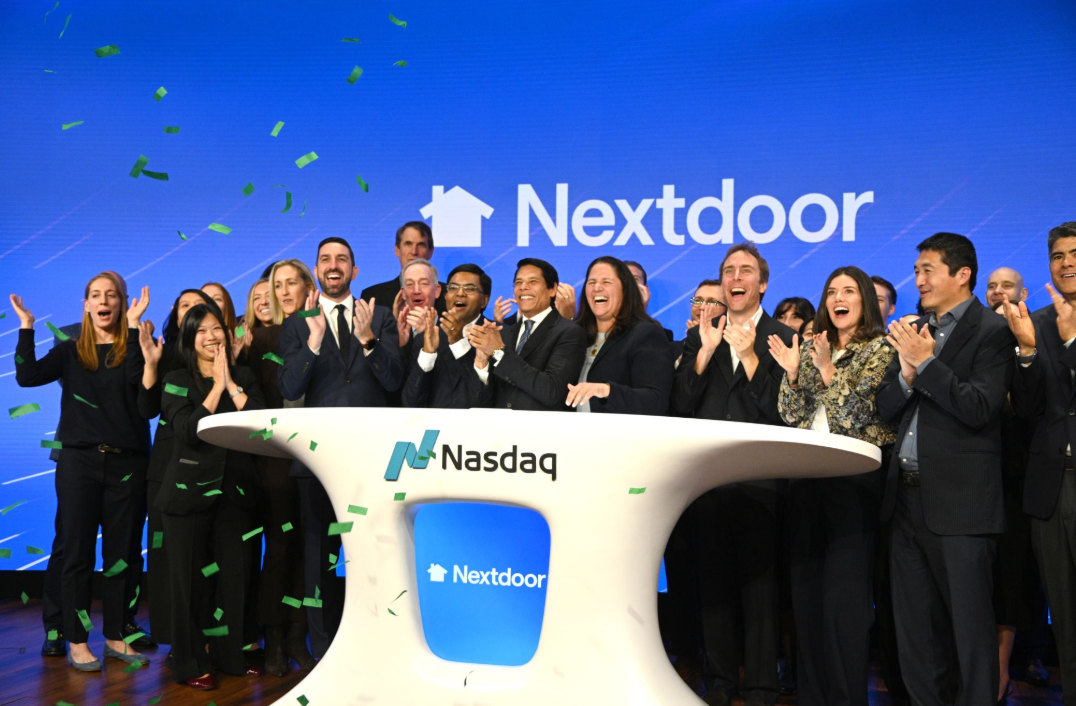
Look at the photograph. Everyone is smiling, applauding, and celebrating. The Nextdoor logo fills the background. It's a moment designed to communicate achievement, momentum, and success.
Now look at my E*TRADE screenshot.
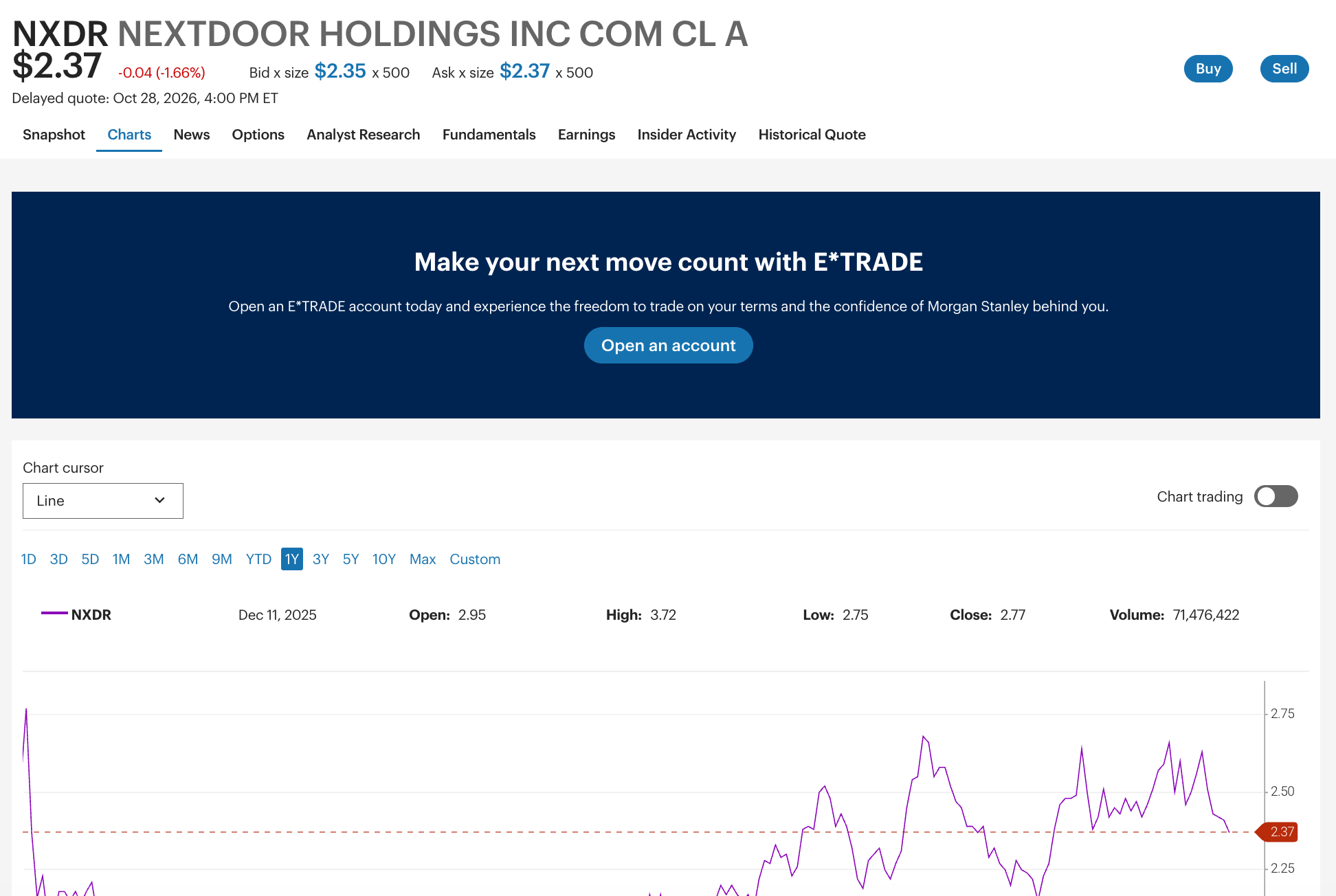
NXDR closed at $2.37 on October 28, 2026, down $0.04, or 1.66%, for the day.
Two pictures. Two very different messages.
I'm not suggesting that the ceremony caused the stock to fall. There's no evidence of that. Nor does one day's movement tell us whether Nextdoor is succeeding or failing as a business.
But I do think the contrast raises a worthwhile question:
What, exactly, are we celebrating—and how should we measure whether Nextdoor has delivered on its promise?
Day 135: A Thank-You to Nirav Tolia and Nextdoor
I'd like to thank Nirav Tolia and the Nextdoor team.
Seriously.
Thank you for not resolving my original request, made more than a year ago, for the detailed data behind Nextdoor's published research. Thank you for the subsequent communications that directed me back to public blog posts rather than providing the detailed reports I requested.
And thank you for letting that request remain unresolved for 135 days in this chapter of my case study.
I realize that sounds sarcastic. It is.
But there's a genuine point underneath it.
By not providing the information I requested—or clearly resolving the request in a way that ended the uncertainty—you gave me the opportunity to learn a great deal about the company.
I learned more about weekly active users (WAU), revenue, adjusted EBITDA, and the difference between a company's financial performance and its investors' returns.
I've taken a refresher course in stock terminology and the relationship between market performance and corporate milestones.
And today, I learned more about how a company can celebrate an anniversary with a stock-exchange bell-ringing ceremony.
That last lesson was particularly timely.
The ceremony is a public-relations opportunity. It creates photographs, social media content, and a positive story about the company's history. There's nothing inherently wrong with that. Companies use milestones to celebrate employees, attract attention and tell their stories.
But a ceremony is not proof of business success.
And a photograph of executives celebrating doesn't answer questions about users, investors, small businesses, or accountability.
Fifteen Years Later: What Does Nextdoor Have to Show for It?
Nextdoor began operating its platform in 2011. Its business has evolved, and there are real accomplishments worth acknowledging.
In its second-quarter 2026 results, the company reported $75 million in quarterly revenue, up 15% year over year; 22.9 million weekly active users on the platform, up 5%; and a net loss of about $2 million, compared with about $15 million a year earlier. Adjusted EBITDA was approximately $10 million.
Those are measurable improvements. I won't pretend otherwise.
But fifteen years in business should invite a broader examination than a list of quarterly highlights.
Here are the areas where I believe Nextdoor still has serious questions to answer.
1. The Business: Can Nextdoor Turn Its Potential Into a Durable Business?
Nextdoor has built a network spanning hundreds of thousands of neighborhoods. It has local conversations, recommendations, safety alerts, business listings, and advertising opportunities.
That is a valuable foundation.
Yet the company has also acknowledged in its regulatory filings that it is still scaling its monetization efforts and that its ongoing product transformation may not produce the engagement or monetization it expects.
My questions include:
Can Nextdoor consistently convert engagement into sustainable revenue?
Can it make the platform more useful without alienating existing users?
Can it improve trust and moderation while growing its commercial business?
Can it establish a durable path to GAAP profitability?
Can it demonstrate that its strategy produces lasting results rather than periodic bursts of optimism?
These claims don't mean Nextdoor has accomplished nothing. They're questions about whether the company has converted its substantial potential into the durable business its supporters expect.

2. Investors: Where Is the Long-Term Return?
Nextdoor became a publicly traded company in 2021. Investors have had years to evaluate the business, its strategy, and its execution.
But revenue growth and an improving operating picture don't automatically translate into strong returns for every shareholder.
My own experience led me to sell my NXDR shares on October 12. I decided I had waited long enough for the investment case to develop, and I was no longer willing to keep waiting for the outcome I had hoped to see.
Today, the screenshot shows NXDR at $2.37, down 1.66% for the session.
That single day's decline doesn't establish the company's long-term prospects. Similarly, executives ringing a bell doesn't mean shareholders have been rewarded.
The questions remain:
Has Nextdoor delivered the long-term shareholder value investors expected?
Can the company sustain revenue growth and improve profitability?
How should investors evaluate management's promises against actual results?
What milestones would demonstrate that the business has reached a new level of maturity?
A corporate anniversary is a calendar milestone. Shareholder value is measured over time.
3. Small Businesses: Are They Getting Enough Value?
Local businesses are a central part of Nextdoor's appeal. Neighbors recommend contractors, restaurants, service providers, and other local businesses. Those recommendations help people decide and can help businesses win customers.
Nextdoor has opportunities to monetize this local commercial activity through advertising and business products.
But one important question remains: how does the platform balance its commercial interests with the interests of the businesses and neighbors who make it useful?
I want to know:
Do local businesses clearly understand the value they receive from paid products?
Can they determine whether advertising generates meaningful results?
Does the platform provide a useful experience for businesses that rely on organic recommendations and free tools?
How does Nextdoor maintain trust when it monetizes local attention and community-generated knowledge?
Nextdoor offers free business tools, so it's inaccurate to say every business must pay to participate. The question is whether businesses of different sizes can understand and access meaningful value from the platform.
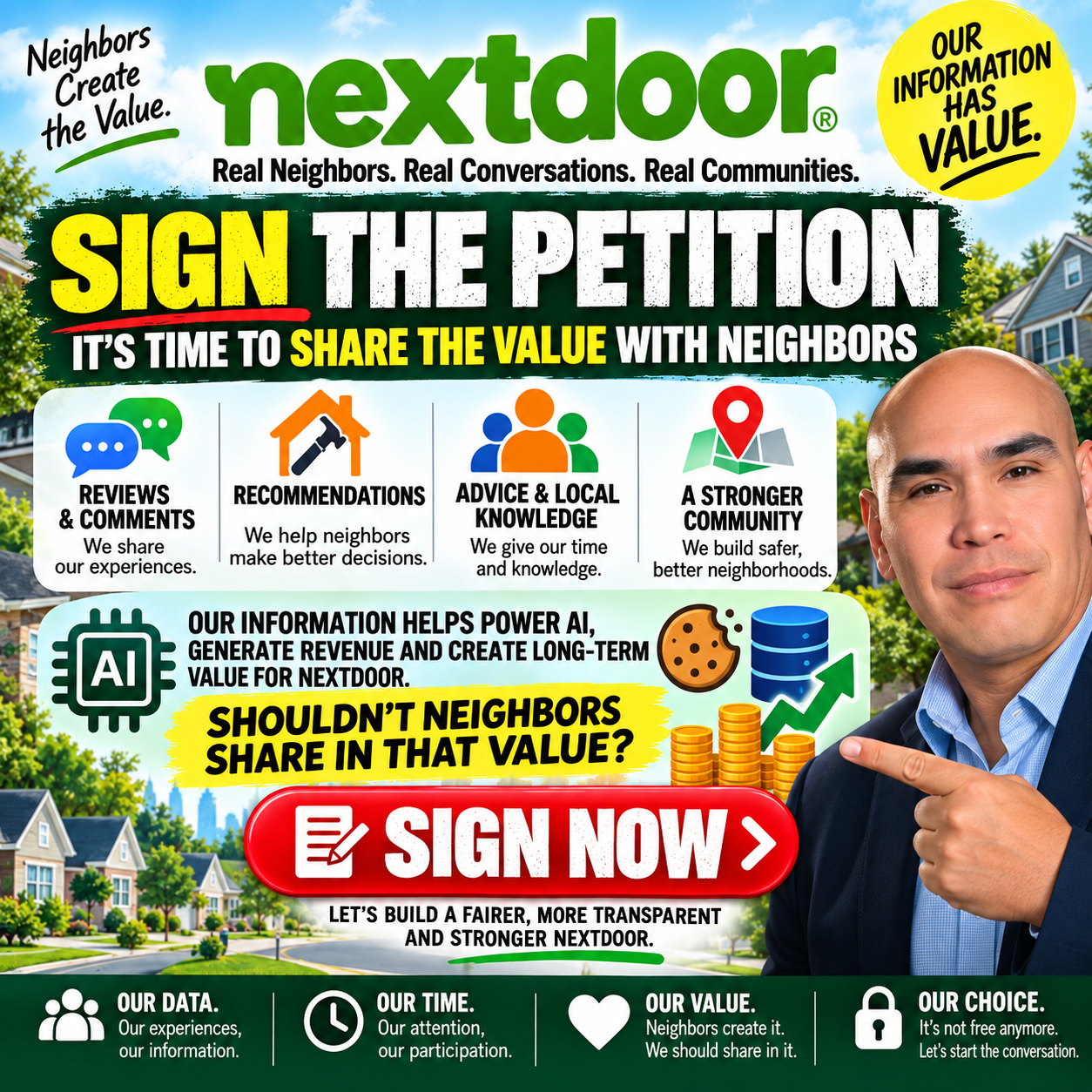
4. Users: Who Creates the Value, and Who Benefits?
This has been one of my central questions throughout the case study.
Neighbors create the content that makes Nextdoor useful. They recommend businesses, share local information, warn others about safety concerns, answer questions, and contribute knowledge about their communities.
Without those contributions, the platform would have far less value.
Yet users have raised concerns about content moderation, inconsistent decisions, communication, and the handling of appeals. I've documented my own experiences and the questions they have raised.
My questions include:
Are moderation decisions consistent and understandable?
Can users obtain meaningful explanations when content is removed?
Are appeals reviewed effectively?
Does Nextdoor communicate clearly when users raise substantive concerns?
Does the company recognize the value of the contributions that keep the network useful?
I don't expect every post to remain online or every appeal to succeed. A community platform needs rules.
But users should understand how those rules are applied and how they can challenge decisions.
And when community-generated knowledge becomes a commercial asset, I believe it's reasonable to ask whether the people contributing that value should have more choices about how it is used.
5. Leadership and Accountability: Who Answers the Difficult Questions?
This is where my personal case study comes back into focus.
I've spent months asking questions about Nextdoor's moderation, communication, research transparency, and leadership accountability.
One unresolved issue has been my request for the detailed data behind two Nextdoor Insights studies. The public posts described additional research details as available through contact with Jacob Chavis. I asked for the underlying detailed reports—not another link to the public summaries.
I have received communications directing me to those public summaries, but I have not received the detailed reports I requested.
As of Day 135, that request remains unresolved.
I recognize that the company may have restrictions or reasons it cannot share particular materials. If so, it can explain that. It can say the reports are unavailable, access is restricted, or someone else is responsible for the request.'
A clear resolution would help.
This isn't about demanding that a CEO personally answer every question sent to the company. It's about whether an organization has a reliable process for responding to substantive requests and closing the loop.
And that’s why today's celebration feels so disconnected from my experience.
The company can coordinate a public ceremony, publish a celebratory announcement, and put its leadership team in front of cameras. Those are visible activities.
But an unresolved research request reminds us that important work also happens outside the spotlight.

6. Transparency: Publicity Is Not the Same as Accountability
The bell-ringing ceremony is a publicity opportunity. I don't mean that as an accusation of wrongdoing. Public companies routinely use ceremonies and anniversaries to celebrate their history.
But publicity and accountability serve different purposes.
Publicity tells the world what a company wants people to see.
Accountability gives people ways to evaluate whether the company is delivering on its commitments.
Nextdoor can celebrate fifteen years of connecting neighbors. It can highlight its growth, products, and financial progress. It can point to new advertising initiatives and improved operating results.
And those accomplishments deserve to be assessed on their merits.
But there are other measures of progress:
Whether users trust the platform.
Whether moderation works consistently.
Whether businesses receive meaningful value.
Whether investors can see a credible path to sustained performance.
Whether leadership responds constructively to difficult questions.
Whether the company resolves legitimate requests for information.
A closing-bell pt captures all of that.
My Suggestion: Celebrate a Milestone That Means Something
Here's my suggestion to Nirav Tolia and Nextdoor.
Rather than making the bell-ringing ceremony the centerpiece of a fifteen-year celebration, I would prefer the company set clear, measurable milestones and celebrate when it achieves them.
For example:
Sustained GAAP profitability.
Consistent user growth accompanied by stronger retention and trust.
Clear evidence that local businesses are getting meaningful value.
Transparent and effective moderation and appeals processes.
A track record of responding to substantive questions and resolving them.
Demonstrable long-term value creation for shareholders.
These are examples, not a claim that the company has made no progress toward them. Some may already be improving; others will require time and evidence.
But they are the kinds of outcomes that would make a celebration especially meaningful to me.
A bell-ringing ceremony is a moment. Building a durable, trusted, and financially sustainable company is the achievement.
And a fifteenth anniversary is a fine time to reflect on both.
Day 135: The Bell Rang. My Questions Remain.
Nirav and the Nextdoor team were smiling in the photograph. I don't begrudge them the celebration. Employees deserve to celebrate the work they've done, and a company is entitled to mark its history.
But the market closed at $2.37 that day, according to my E*TRADE screenshot, and my questions about the company remain.
I am not suggesting that the stock decline was caused by the ceremony, nor am I claiming that one closing price defines Nextdoor's future.
I'm asking for a more meaningful standard of success than the ability to arrange a public celebration.
Fifteen years after launching the platform, Nextdoor has a substantial network, growing revenue, and recent improvements in its financial results. It also still needs to demonstrate durable profitability, build user trust, deliver value to businesses and shareholders, and ensure legitimate questions get clear answers.
I will keep documenting the gap between the company's promise and its execution.
So, congratulations to the employees who helped build Nextdoor over the past fifteen years.
As for the next milestone, I'd suggest choosing one that reflects measurable progress.
Don't ring the bell just because the calendar says fifteen years. Ring it when you've built something that stands up to the questions.
👉 Follow my continuing Nextdoor case study at NielFlamm.com/blog.