

Day 93: Nextdoor Turned the Comments Off Again. So Much for Progress.

Well, that didn't last long.
A few days ago, I actually did something that might surprise people who only see my Nextdoor posts occasionally:
I applauded Nextdoor.
I had previously provided feedback about Nextdoor disabling comments on some of its LinkedIn posts. Then I noticed newer posts where commenting was available again.
I said that was progress.
I said companies should be willing to change course.
I even wrote:
“Nice move, Nextdoor. Keep going.”
Apparently, I should have added:
“…but please don't put it in reverse.”
Because here we are.
It's Day 93 of my ongoing Nextdoor case study, and they've once again turned off comments on a Nextdoor LinkedIn post.
And the post they chose makes this particularly interesting.
The Publix Post Has Comments Turned Off
Nextdoor's recent LinkedIn post celebrates Publix Super Markets ranking No. 4 on PEOPLE's 100 Companies That Care list.
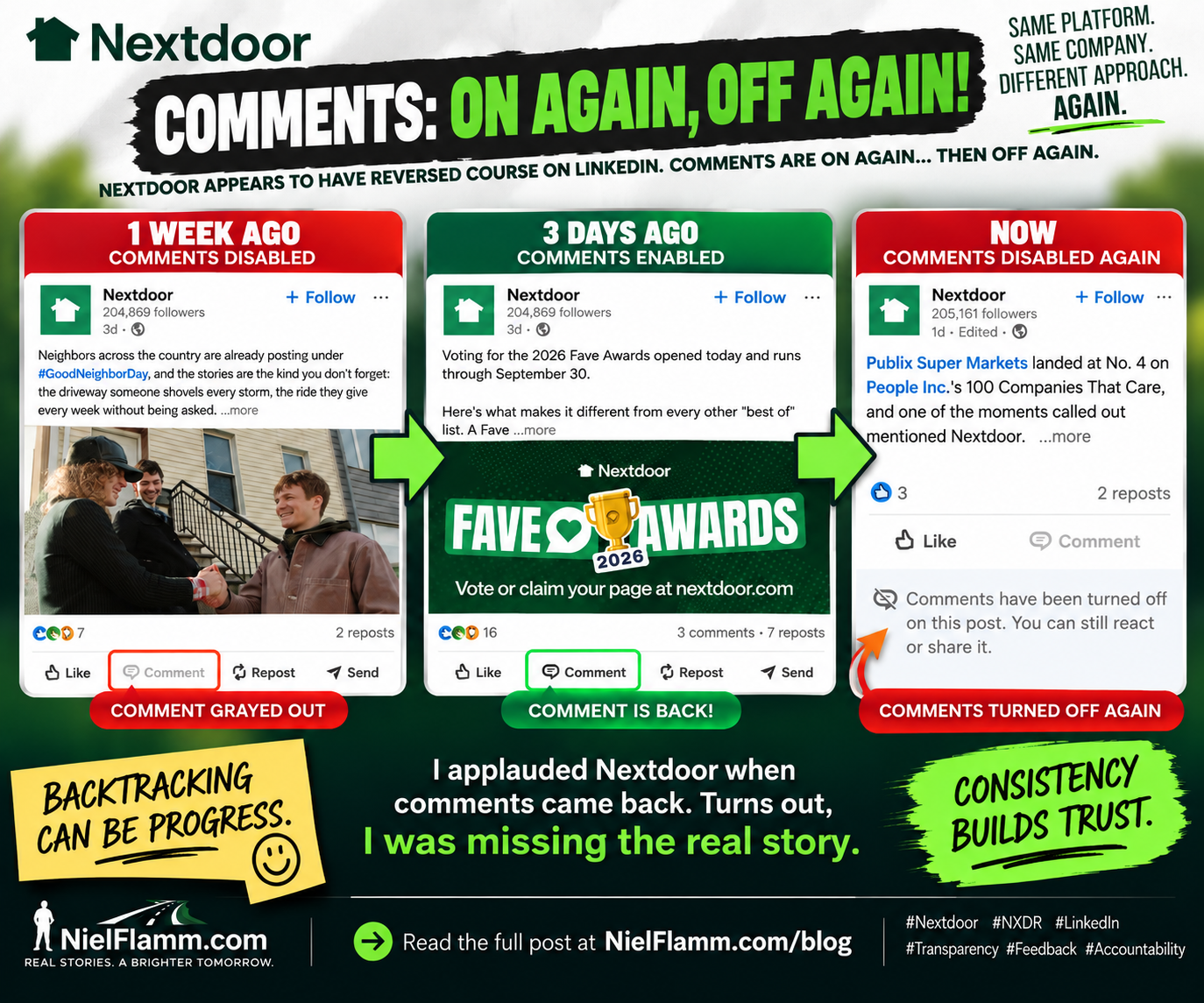
Nextdoor's connection to the story is that a Publix associate used the Nextdoor app while helping neighbors before Hurricane Milton. Nextdoor's post says this demonstrates what can happen when a network is built around real local neighborhoods. LinkedIn
I've already written about why I think there's another, more interesting story here:
Nextdoor didn't make the Top 100.
But now there's another layer.
Look at the screenshot.
The Comment button is grayed out, and LinkedIn states:
“Comments have been turned off on this post.”
LinkedIn lets Page administrators turn comments on or off, even after a post has been published. LinkedIn
So once again, Nextdoor is publishing something publicly on a social network while choosing not to allow the public to respond beneath that particular post.
Wait… Weren't We Moving Forward?
That's what makes this frustrating.
I had just praised Nextdoor for what seemed like a change in direction.
Comments had been disabled.
Then newer posts allowed comments.
I noticed.
And instead of finding another reason to complain, I did exactly what I think someone providing fair feedback should do:
I acknowledged the improvement.
That's important.
If I'm going to point out things I believe Nextdoor gets wrong, then I should be equally willing to acknowledge when I think it gets something right.
I did.
Now we're apparently going backward again.
This Is Exactly Why Communication Matters
Nextdoor describes itself as “the essential neighborhood network” and says it connects neighbors to conversations that matter locally. LinkedIn
Conversation.
That's the interesting word.
Because conversation generally requires more than one participant.
Posting a corporate message and disabling responses isn't really a conversation.
It's a broadcast.
Broadcasting information isn't inherently wrong. Companies do it every day.
But for a company whose entire product is built around people talking to one another, repeatedly switching comments on and off creates an odd contradiction.
A social network should probably be social.
And Why This Post?
That's the question I'm especially curious about.
Why disable comments on this post?
I don't know.
Maybe it was intentional.
Maybe there's a communications strategy behind it.
Maybe Nextdoor anticipated comments it didn't want.
Maybe it has absolutely nothing to do with criticism.
I don't have access to Nextdoor's internal decision-making, so I won't invent a motive.
But I can certainly observe the result:
Nextdoor published a post celebrating another company's recognition for caring about people and communities—and didn't allow people to comment on it.
That's… interesting.
Especially after I realized I had initially been missing the real story.
I Was Missing the Real Story
At first, my reaction to the Publix post was basically:
Nextdoor is playing Six Degrees of Kevin Bacon.
A Publix employee did something wonderful.
The employee happened to use Nextdoor.
Publix made PEOPLE's list.
Nextdoor then highlighted its connection to the story.
I thought that was the story.
It wasn't.
The more interesting question was:
Why wasn't Nextdoor itself on the list?
Technology companies including Salesforce, NVIDIA, Intuit, Adobe, ServiceNow and Hewlett Packard Enterprise made the 2026 Companies That Care list.
These aren't organizations that decided they had to choose between corporate responsibility and running successful businesses.
They demonstrate that companies can pursue their missions, invest in employees and communities, make money, and create value for shareholders.
That's the standard I want Nextdoor to pursue.
Don't borrow someone else's spotlight.
Earn your own.
And Comments Are Part of the Bigger Picture
This isn't really about one LinkedIn button.
It's about something I've been discussing throughout this case study:
Does Nextdoor's behavior match Nextdoor's message?
Nextdoor talks about connection.
Community.
Trust.
Neighbors.
Conversation.
Local businesses.
Good neighbors.
But I've also provided feedback about what I see as problems with its volunteer moderator model, its approach to monetizing small businesses, communication and transparency, shareholder value, and the platform's long-running “Karen” reputation.
And now we're back to comments being disabled on a corporate LinkedIn post.
Again.
None of these things alone define Nextdoor.
But collectively they raise a question I've asked repeatedly:
Does the experience match the mission, vision and values?
Day 93—and the Other Question Still Hasn't Been Answered
And yes, there's another reason today is Day 93.
I'm still waiting for the detailed data referenced in Nextdoor's Home Insurance Insights research.
I've also requested the detailed data referenced in its Financial Advising and Investing research.
I'm not asking for the public blog summaries.
I'm asking for the detailed data Nextdoor told readers they could request.
It's been 93 days.
I've emailed.
I've clarified the request.
I've offered phone.
Video conference.
Virtual coffee.
A simple answer would still resolve it:
Yes, we can provide it.
No, we can't provide it.
It's restricted.
Here are the requirements.
Someone else handles it.
Those are answers.
Silence isn't.
Hearing vs. Listening—Again
Maybe this is why I keep returning to my Learning & Development background.
There is a difference between hearing feedback and listening to feedback.
Listening doesn't mean agreeing.
It doesn't mean giving me what I want.
It doesn't mean leaving every LinkedIn comment section open forever.
And it certainly doesn't mean a company has to implement every suggestion somebody posts online.
Listening means considering the information, making a decision, and communicating.
That's why I was willing to applaud Nextdoor when comments came back.
I thought perhaps the company had reconsidered.
Maybe it had.
Now comments are off again.
So I'll provide feedback about that too.
Nextdoor, Pick a Direction
If comments are going to be open, open them.
Moderate them.
Respond when appropriate.
Ignore ridiculous comments when appropriate.
Let people disagree.
That's what social networks do.
If comments are going to be disabled, that's Nextdoor's decision too.
But then let's acknowledge the irony of the neighborhood conversation company limiting conversation on its own corporate social media.
You can't build a brand around community dialogue and then appear uncomfortable when the dialogue isn't completely controlled.
Moderating conversation and preventing conversation are two very different things.
I applauded Nextdoor when I thought it was moving forward.
Today, I'm pointing out that it appears to have taken a step backward.
That's not negativity.
That's consistency.
When I see improvement, I'll acknowledge it.
When I see something I think deserves feedback, I'll provide it.
And when Nextdoor finally answers my 93-day-old research request?
I'll acknowledge that too.
Until then:
Day 93.
The detailed data still hasn't arrived.
And apparently, the comments haven't either.
Follow the continuing case study at NielFlamm.com/blog.