
Day 101: Our Data Is a Commodity. Why Are We Giving It Away?
Day 101.
Today I want to strip this Nextdoor discussion down to basic economics.
If I have something of value, another party uses it, and that use generates revenue, why shouldn't I share in the value created?
In this case, the commodity is information.
Reviews are information.
Recommendations are information.
Posts, comments, neighborhood observations, business experiences, and local knowledge are information.
Collectively, that's user-generated content.
And when a platform can aggregate, organize, analyze, and monetize that information, those individual contributions can become economically valuable.
We Call It “Content.” But It's Also an Economic Input.
Suppose I recommend a plumber on Nextdoor.
I supplied the experience. I paid to hire the plumber. I evaluated the work. I spent my time writing the recommendation.
Another neighbor reads it.
The plumber potentially gets business.
Nextdoor gets engagement and another piece of local knowledge stored within its platform.
Now multiply that by millions of neighbors and years of participation.
Suddenly, what looks like individual posts becomes something much more interesting:
An asset.
And with AI making it increasingly possible to organize, summarize, and extract useful information from enormous collections of human-created knowledge, that accumulated information may become even more useful.
I'm Not Saying Nextdoor Shouldn't Profit
Quite the opposite.
I'm a shareholder. I want Nextdoor to make money.
Nextdoor built the technology. It operates the platform. It employs people, develops products, sells advertising, and assumes the financial risk of running the business.
Nextdoor should benefit from the value it creates.
My question is:
Why does that automatically mean the neighbor gets zero?
If my contribution becomes part of something commercially valuable, why couldn't there be a model where:
Nextdoor wins.
Shareholders win.
Businesses win.
And the neighbors supplying the information win too.
I'm not suggesting every post deserves a royalty check.
But reviews, recommendations, local knowledge, research participation, and other user-generated information that contributes to commercial value?
Let's have that conversation.
Until Then, Maybe We Stop Supplying the Commodity
That's the idea behind my Neighbor Value-Sharing Petition.
The petition asks Nextdoor users to voluntarily stop providing new routine data, business reviews, recommendations, and other commercial user-generated content until Nextdoor develops a meaningful way for neighbors to participate in the revenue and value their contributions help generate.
It's not about withholding emergency information, safety alerts, missing-person information or other important community communication.
It's about the commodity.
If our information has value, perhaps we should stop giving that value away for free until there's a conversation about sharing it.
Read and sign the petition:
Then share it with another Nextdoor user.
Nextdoor Built the Container. Neighbors Keep Filling It.
A platform without people is software.
A review platform without reviews is an empty database.
A neighborhood network without neighbors sharing neighborhood knowledge isn't much of a neighborhood network.
Nextdoor built the container.
Neighbors keep filling it.
If what's inside that container can be monetized, I think it's reasonable for the people supplying it to ask:
Where's our share?
Until Nextdoor is willing to have that conversation, I'm asking neighbors to consider something incredibly simple:
Don't provide the commodity.
No new routine reviews.
No new business recommendations.
No additional commercial data.
Then let's see how valuable the commodity becomes when the people producing it decide they want to share in its value.
Our data. Our knowledge. Our time. Our value.
👉 Sign the petition:
https://c.org/GkNWmffgg9
👉 More of my continuing Nextdoor case study:
NielFlamm.com/blog
Day 101: Nextdoor Said It. The Person Behind the Post Is Doing the Work.
I missed yesterday on LinkedIn, although I posted almost everywhere else.
So, welcome to Day 101.
NXDR closed today at $2.38, down 4.8%.
But something Nextdoor posted on LinkedIn caught my attention even more.
Read Nextdoor's LinkedIn post.
It highlights Jessica Spann, a Charlotte educator whose work supporting students ultimately caught the attention of The Drew Barrymore Show.
Then I got to Nextdoor's final sentence:
“Local posts have a way of traveling when the person behind them is doing the work.”
ABSOLUTELY!
That's my point.
Jessica did the work.
Jessica made the impact.
Jessica created something worth talking about.
Nextdoor provided the platform that helped amplify it.
That's valuable too.
But if Nextdoor recognizes that the person behind the post is doing the work, why shouldn't we also talk about that person participating in the value their contributions help create?
Think of Nextdoor as the funnel.
The funnel helps direct the gasoline.
But the gasoline makes the engine run.
Neighbors provide the stories, reviews, recommendations, conversations, and local knowledge that keep the platform interesting.
That's why I started the Neighbor Value-Sharing Petition.
And, for transparency, I remain its sole signer. 😂
I need signature No. 2.
If you believe neighbors should participate in the value their contributions help create, sign it. Then share it.
Sign the Neighbor Value-Sharing Petition
Nextdoor said it, not me: the person behind the post is doing the work.
Now let's talk about sharing the value created by that work.
👉 Full Day 101 post: NielFlamm.com/blog

Day 99: A Stock Ticker Measures More Than Numbers

Day 99.
Tomorrow, this Nextdoor journey officially enters triple digits.
Another email requesting the detailed Insights studies is coming, but today I want to look at something completely different: leadership reputation and shareholder confidence.
I recently saw a reel discussing how a stock isn't influenced only by revenue, earnings, and a balance sheet. Investors also evaluate management, governance, credibility and the risks surrounding the people running a company.
That reminded me of Dan Bilzerian and Ignite International Brands.
Former Ignite executive Curtis Heffernan sued after his 2020 termination, alleging he was fired after refusing to approve substantial expenses he believed were personal expenses being charged to the company. Bilzerian disputed that account and said Heffernan was terminated for negligence and incompetence. The dispute eventually reached the California Court of Appeal. Bloomberg
And the story didn't end there.
Later litigation involving Ignite became even more complicated. In 2024, federal prosecutors charged Dan's father, Paul Bilzerian, and others in a case involving Ignite. Prosecutors alleged Paul secretly exercised significant control over the company while concealing that role. Those are government allegations, not something I'm presenting as independently proven here. Paul had previously been convicted of securities fraud in 1989. Department of Justice
Court records also show that Dan was removed as Ignite's CEO in 2023 after internal disputes, including concerns about his impact on the brand. Justia Law
Why Am I Talking About This on Day 99?
Not because Nextdoor is Ignite.
It isn't.
And I'm certainly not suggesting Nirav Tolia has done anything resembling what was alleged in the Ignite cases.
My takeaway is much simpler:
Leadership becomes part of a company's asset—or liability—whether the balance sheet lists it or not.
A CEO's reputation matters.
How leadership communicates matters.
How criticism is handled matters.
How shareholders are treated matters.
Whether questions receive answers matters.
And when leadership becomes closely identified with the company itself, the distinction between corporate reputation and executive reputation can become increasingly difficult for investors, customers, and the public to separate.
That's something I think about as a Nextdoor shareholder.
I've spent 99 days asking for studies that Nextdoor publicly said readers could request.
Tomorrow we hit 100.
At that point, the unanswered question isn't only about the studies anymore.
It's also about what 100 days of an unresolved request says about communication, ownership, and leadership.
See you in the triple digits.
👉 NielFlamm.com/blog
Day 94: LinkedIn Thinks I Should Meet Nextdoor’s Head of People. I Agree.
Sometimes an algorithm has impeccable timing.
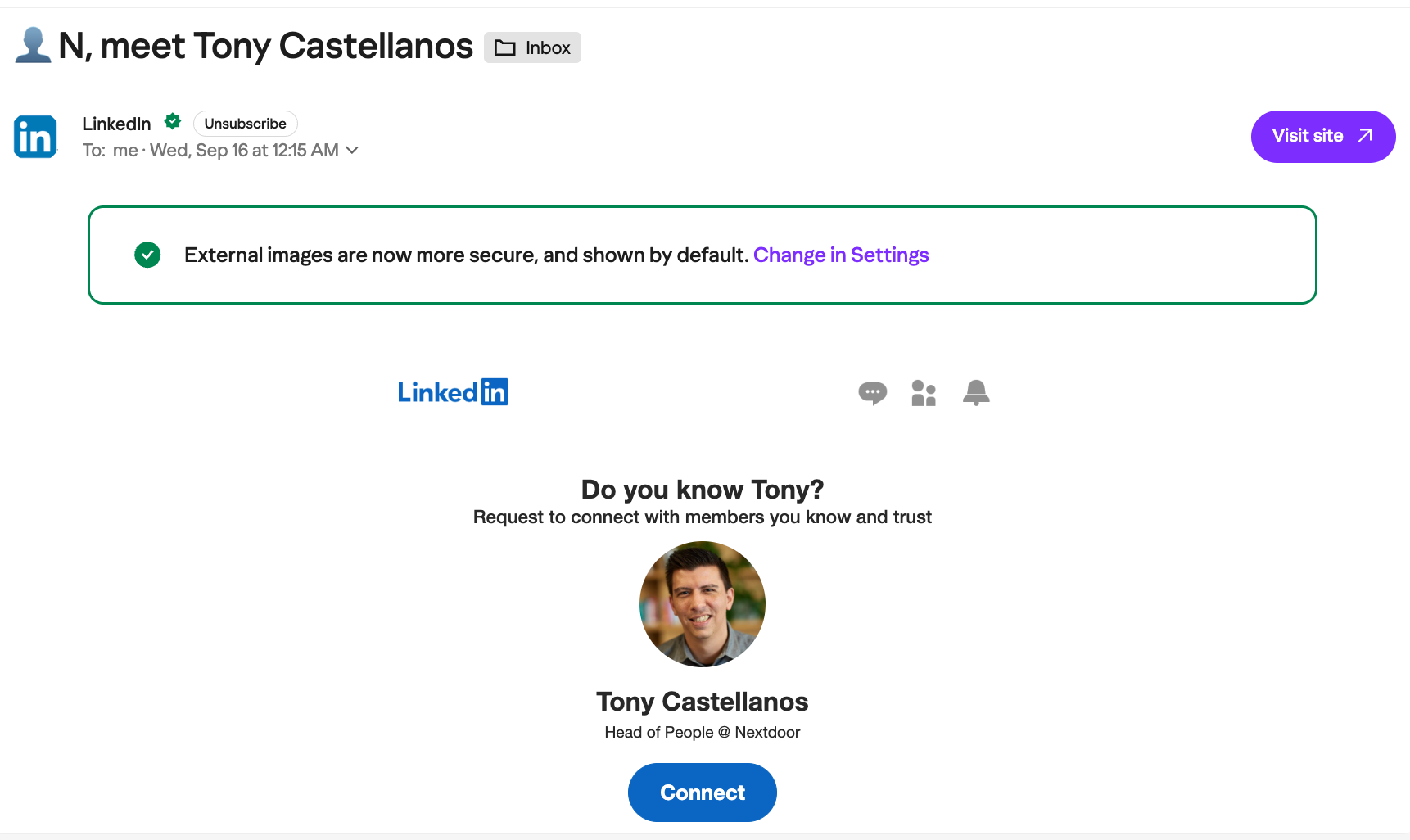
At 12:15 this morning, I received an email from LinkedIn with the subject line:
“N, meet Tony Castellanos.”
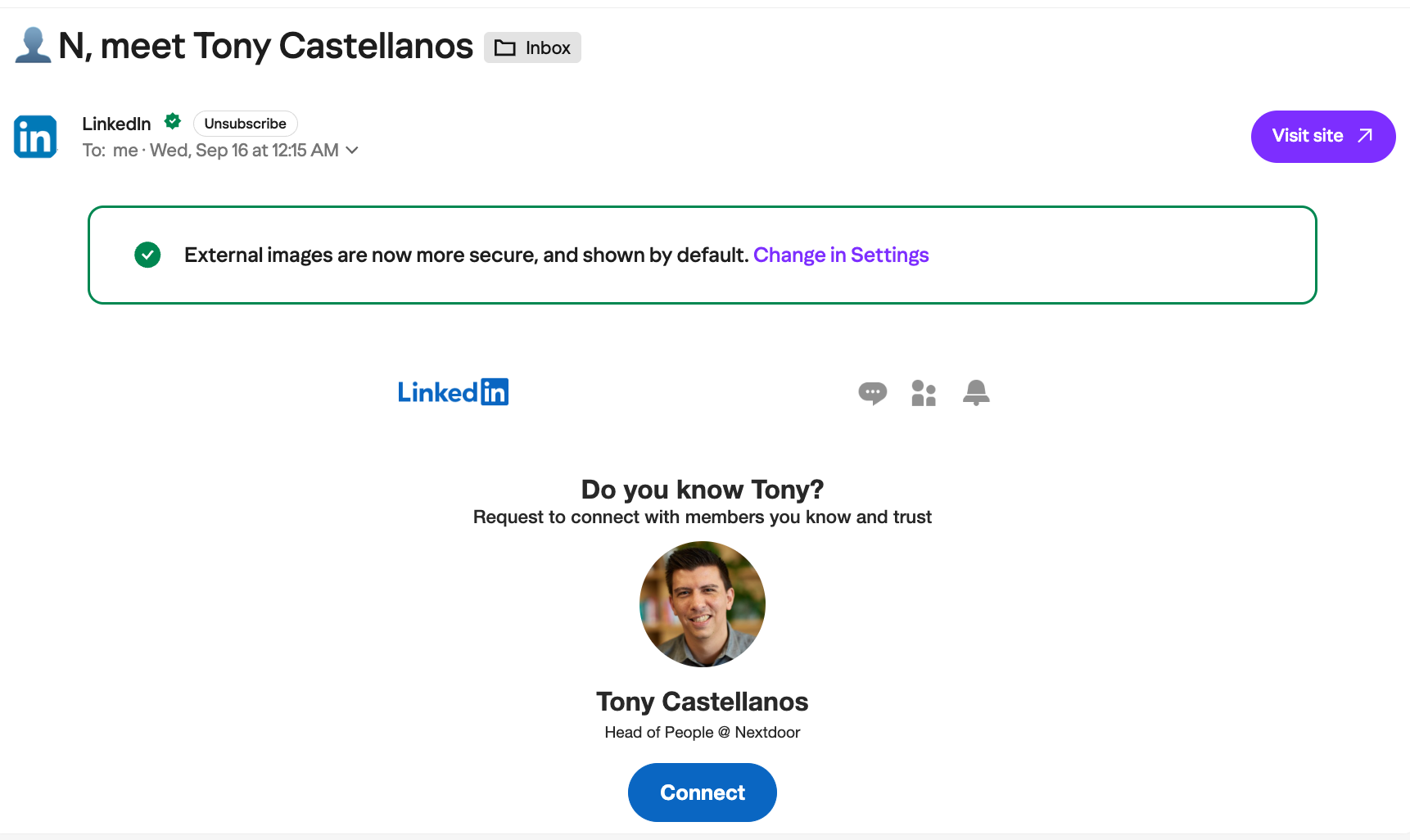
LinkedIn asked:
“Do you know Tony?”
Well, LinkedIn, not exactly.
But after 94 days, I would absolutely love to get to know him.

Tony Castellanos is Nextdoor’s Executive Vice President, People. Nextdoor promoted him to that position in March, giving him responsibility for its People organization, including talent acquisition, compensation, HR business partnering, and benefits. Nextdoor also describes the People function under his leadership as a strategic advisory organization that partners with senior leaders on important talent and organizational decisions. Nextdoor
So LinkedIn, your recommendation got me thinking.
Tony, Want to Have a Virtual Coffee?
I've tagged Tony a few times during this ongoing Nextdoor case study.
I may have even included him on an email or two. After 94 days, the distribution list has gotten a little crowded.
But this isn't about blaming Tony for my unanswered request.
He's not running Nextdoor Insights.
He didn't publish the Home Insurance research.
He's not responsible for sending me the data.
And I wouldn't expect the Head of People to suddenly open a spreadsheet and say:
“Niel, good news. I found your missing insurance study!”
That's not his job.
But the email made me think about something bigger.
What Does the Head of People Think?
My original request remains remarkably simple.
Nextdoor published an Insights article telling readers that they could reach out for detailed data, additional audience segments, and strategic recommendations.
I reached out.
And today is Day 94.
So I'd genuinely be interested in Tony's perspective—not necessarily on where the spreadsheet is, but on what happens organizationally when something like this continues for more than three months.
What does Nextdoor's Head of People think when a shareholder responds to a publicly advertised invitation for information and, 94 days later, still hasn't received the requested material or a definitive explanation that it isn't available?
Does he see a communication problem?
A process problem?
An ownership problem?
An escalation problem?
A training problem?
Or does he look at the situation and think Nextdoor has handled it appropriately?
I'd actually like to know.
And Then There’s Risk
This is where the People perspective becomes especially interesting.
I'm not suggesting that Tony is Nextdoor's chief risk officer, general counsel, or head of investor relations. He's not.
But senior People leaders often have a broad view of organizational behavior, leadership practices, and how internal decisions can affect employees and the business.
Nextdoor itself says Tony's People organization is designed to operate as a strategic advisor to the business. Nextdoor
So from that perspective, I'd be curious about his thoughts on organizational risk.
Not because I am declaring that Nextdoor has created some specific legal liability. That's a different question for lawyers.
I'm talking about something much more basic.
What happens when a small problem is allowed to become a 94-day problem?
The original request could have been resolved with a few sentences:
Yes, here's the data.
No, we can't provide it.
It's restricted, and here are the requirements.
That language in the article was incorrect.
Someone else handles these requests.
Any one of those would have provided closure.
Instead, we're on Day 94.
This Is Becoming a Case Study in Organizational Behavior
That's one of the reasons I've remained fascinated by this.
The longer it goes, the less interesting the actual research data becomes.
The organizational response becomes the story.
Who owns the question?
Who notices when something falls through the cracks?
Who has the authority to resolve it?
When does somebody say, “Why are we still dealing with this?”
How does feedback move through the organization?
Does escalation produce resolution—or another layer of silence?
Those are People questions.
They're also leadership questions.
And they're exactly the kinds of questions that fascinate me after more than two decades working in Learning & Development.
Sometimes what looks like a knowledge problem is really a performance problem.
Sometimes what looks like a communication problem is really an ownership problem.
And sometimes an issue survives for 94 days because nobody has decided it's their job to end it.
Tony Has Talked About Human Judgment
There's another reason LinkedIn's recommendation made me smile.
Nextdoor has recently highlighted Tony's work bringing AI into its People organization. The company says the goal is to use technology for transactional work while letting people spend more time on work that requires human judgment. Nextdoor
I actually like that philosophy.
And this seems like a pretty good opportunity for some human judgment.
Forget AI.
Forget another automated workflow.
Forget another corporate process.
A human being could probably resolve this.
Maybe over coffee.
So Yes, LinkedIn. I’d Like to Meet Tony.
LinkedIn apparently thinks Tony Castellanos and I should know each other.
I'm willing.
Tony, if you happen to see this, the invitation is sincere.
Phone.
Video.
Virtual coffee.
I'll even buy my own coffee.
I don't expect you to personally produce the Insights data. I'd simply be fascinated to hear how someone responsible for Nextdoor's People organization views what has now become a 94-day customer/shareholder communication journey.
What worked?
What didn't?
Where should ownership have existed?
What organizational risks can emerge when relatively simple questions remain unresolved?
And perhaps most importantly:
How would you prevent Day 94 from becoming Day 100?
Because tomorrow, unless something changes, there will be a Day 95.
Thanks for the introduction, LinkedIn.
Tony, the coffee invitation is open.
Follow the continuing case study at NielFlamm.com/blog.
Day 93: Nextdoor Turned the Comments Off Again. So Much for Progress.
Well, that didn't last long.
A few days ago, I actually did something that might surprise people who only see my Nextdoor posts occasionally:
I applauded Nextdoor.
I had previously provided feedback about Nextdoor disabling comments on some of its LinkedIn posts. Then I noticed newer posts where commenting was available again.
I said that was progress.
I said companies should be willing to change course.
I even wrote:
“Nice move, Nextdoor. Keep going.”
Apparently, I should have added:
“…but please don't put it in reverse.”
Because here we are.
It's Day 93 of my ongoing Nextdoor case study, and they've once again turned off comments on a Nextdoor LinkedIn post.
And the post they chose makes this particularly interesting.
The Publix Post Has Comments Turned Off
Nextdoor's recent LinkedIn post celebrates Publix Super Markets ranking No. 4 on PEOPLE's 100 Companies That Care list.
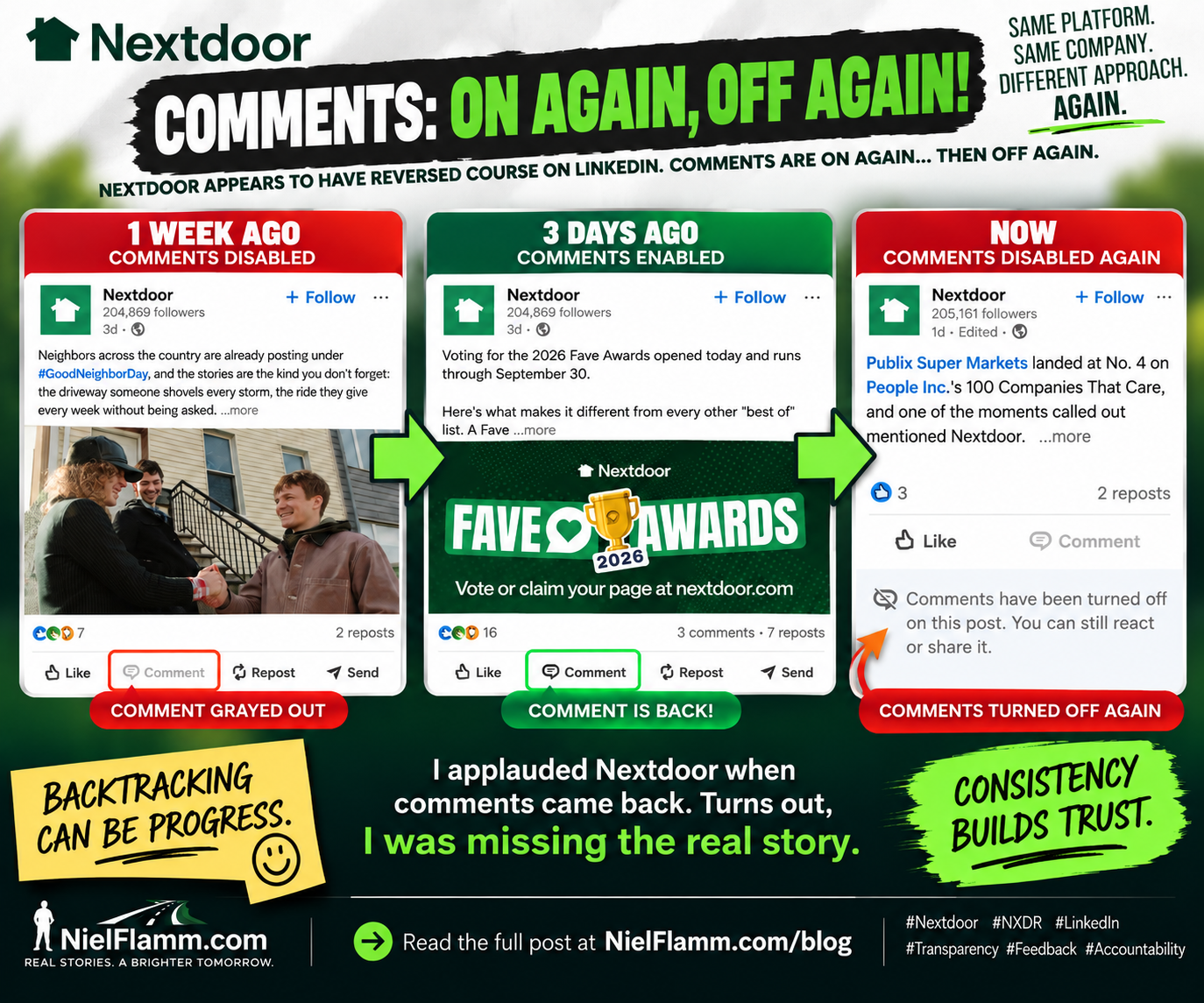
Nextdoor's connection to the story is that a Publix associate used the Nextdoor app while helping neighbors before Hurricane Milton. Nextdoor's post says this demonstrates what can happen when a network is built around real local neighborhoods. LinkedIn
I've already written about why I think there's another, more interesting story here:
Nextdoor didn't make the Top 100.
But now there's another layer.
Look at the screenshot.
The Comment button is grayed out, and LinkedIn states:
“Comments have been turned off on this post.”
LinkedIn lets Page administrators turn comments on or off, even after a post has been published. LinkedIn
So once again, Nextdoor is publishing something publicly on a social network while choosing not to allow the public to respond beneath that particular post.
Wait… Weren't We Moving Forward?
That's what makes this frustrating.
I had just praised Nextdoor for what seemed like a change in direction.
Comments had been disabled.
Then newer posts allowed comments.
I noticed.
And instead of finding another reason to complain, I did exactly what I think someone providing fair feedback should do:
I acknowledged the improvement.
That's important.
If I'm going to point out things I believe Nextdoor gets wrong, then I should be equally willing to acknowledge when I think it gets something right.
I did.
Now we're apparently going backward again.
This Is Exactly Why Communication Matters
Nextdoor describes itself as “the essential neighborhood network” and says it connects neighbors to conversations that matter locally. LinkedIn
Conversation.
That's the interesting word.
Because conversation generally requires more than one participant.
Posting a corporate message and disabling responses isn't really a conversation.
It's a broadcast.
Broadcasting information isn't inherently wrong. Companies do it every day.
But for a company whose entire product is built around people talking to one another, repeatedly switching comments on and off creates an odd contradiction.
A social network should probably be social.
And Why This Post?
That's the question I'm especially curious about.
Why disable comments on this post?
I don't know.
Maybe it was intentional.
Maybe there's a communications strategy behind it.
Maybe Nextdoor anticipated comments it didn't want.
Maybe it has absolutely nothing to do with criticism.
I don't have access to Nextdoor's internal decision-making, so I won't invent a motive.
But I can certainly observe the result:
Nextdoor published a post celebrating another company's recognition for caring about people and communities—and didn't allow people to comment on it.
That's… interesting.
Especially after I realized I had initially been missing the real story.
I Was Missing the Real Story
At first, my reaction to the Publix post was basically:
Nextdoor is playing Six Degrees of Kevin Bacon.
A Publix employee did something wonderful.
The employee happened to use Nextdoor.
Publix made PEOPLE's list.
Nextdoor then highlighted its connection to the story.
I thought that was the story.
It wasn't.
The more interesting question was:
Why wasn't Nextdoor itself on the list?
Technology companies including Salesforce, NVIDIA, Intuit, Adobe, ServiceNow and Hewlett Packard Enterprise made the 2026 Companies That Care list.
These aren't organizations that decided they had to choose between corporate responsibility and running successful businesses.
They demonstrate that companies can pursue their missions, invest in employees and communities, make money, and create value for shareholders.
That's the standard I want Nextdoor to pursue.
Don't borrow someone else's spotlight.
Earn your own.
And Comments Are Part of the Bigger Picture
This isn't really about one LinkedIn button.
It's about something I've been discussing throughout this case study:
Does Nextdoor's behavior match Nextdoor's message?
Nextdoor talks about connection.
Community.
Trust.
Neighbors.
Conversation.
Local businesses.
Good neighbors.
But I've also provided feedback about what I see as problems with its volunteer moderator model, its approach to monetizing small businesses, communication and transparency, shareholder value, and the platform's long-running “Karen” reputation.
And now we're back to comments being disabled on a corporate LinkedIn post.
Again.
None of these things alone define Nextdoor.
But collectively they raise a question I've asked repeatedly:
Does the experience match the mission, vision and values?
Day 93—and the Other Question Still Hasn't Been Answered
And yes, there's another reason today is Day 93.
I'm still waiting for the detailed data referenced in Nextdoor's Home Insurance Insights research.
I've also requested the detailed data referenced in its Financial Advising and Investing research.
I'm not asking for the public blog summaries.
I'm asking for the detailed data Nextdoor told readers they could request.
It's been 93 days.
I've emailed.
I've clarified the request.
I've offered phone.
Video conference.
Virtual coffee.
A simple answer would still resolve it:
Yes, we can provide it.
No, we can't provide it.
It's restricted.
Here are the requirements.
Someone else handles it.
Those are answers.
Silence isn't.
Hearing vs. Listening—Again
Maybe this is why I keep returning to my Learning & Development background.
There is a difference between hearing feedback and listening to feedback.
Listening doesn't mean agreeing.
It doesn't mean giving me what I want.
It doesn't mean leaving every LinkedIn comment section open forever.
And it certainly doesn't mean a company has to implement every suggestion somebody posts online.
Listening means considering the information, making a decision, and communicating.
That's why I was willing to applaud Nextdoor when comments came back.
I thought perhaps the company had reconsidered.
Maybe it had.
Now comments are off again.
So I'll provide feedback about that too.
Nextdoor, Pick a Direction
If comments are going to be open, open them.
Moderate them.
Respond when appropriate.
Ignore ridiculous comments when appropriate.
Let people disagree.
That's what social networks do.
If comments are going to be disabled, that's Nextdoor's decision too.
But then let's acknowledge the irony of the neighborhood conversation company limiting conversation on its own corporate social media.
You can't build a brand around community dialogue and then appear uncomfortable when the dialogue isn't completely controlled.
Moderating conversation and preventing conversation are two very different things.
I applauded Nextdoor when I thought it was moving forward.
Today, I'm pointing out that it appears to have taken a step backward.
That's not negativity.
That's consistency.
When I see improvement, I'll acknowledge it.
When I see something I think deserves feedback, I'll provide it.
And when Nextdoor finally answers my 93-day-old research request?
I'll acknowledge that too.
Until then:
Day 93.
The detailed data still hasn't arrived.
And apparently, the comments haven't either.
Follow the continuing case study at NielFlamm.com/blog.