

Day 77: Congratulations, Nextdoor — You’ve Earned a Certificate

Today is Day 77.
I've tried serious analysis.
I've discussed corporate communications, leadership, customer experience, marketing, transparency, process improvement, hearing versus listening, and even issued my Two-Minute Challenge on Nextdoor.
So today, I'm trying something completely different.
I'm handing out an award.
🏆 The 2026 Nextdoor Certificate of Achievement in Keeping One Simple Question Alive for 77 Consecutive Days
Congratulations!
That's commitment.
The Assignment
Imagine this is a corporate training exercise.
The learner receives the following scenario:
Your company publishes research and tells readers that if they'd like “detailed data, additional audience segments, and strategic recommendations,” they should contact a specific employee.
Someone follows those instructions and requests the detailed data.
What should you do?
A. Send the requested information.
B. Explain that the information isn't available and why.
C. Explain any requirements necessary to receive it.
D. Send links to the summaries the person already read.
E. Allow the request to continue for 77 days until it becomes an ongoing public case study.
I'm going with A, B, or C.
Apparently E has entered the chat.
Let's Add a Bonus Question
Your Communications team eventually responds.
The person explains again that they're not requesting the public summaries.
They provide the exact wording from your website.
They send another email.
They even attach a screenshot highlighting what they're requesting.
What should happen next?
This one isn't multiple choice.
Answer the question.
The L&D Guy in Me Can't Help Himself
I've spent more than 20 years in Learning & Development—as a facilitator, instructional designer, and manager.
One of the most important parts of designing effective training is distinguishing between a knowledge problem and a performance problem.
If someone doesn't know what they're supposed to do, training might help.
But what if the instructions are clear?
What if the request is documented?
What if the appropriate people have received it?
What if the person requesting the information has clarified it repeatedly?
At that point, I'm not sure another training module will solve the problem.
Maybe the issue isn't knowledge.
Maybe it's execution.
Or ownership.
Or accountability.
That's something leadership should probably want to understand.
So Here's Your Day 77 Homework, Nextdoor
No essay required.
No PowerPoint presentation.
No breakout groups.
No role-play exercise.
Please avoid a 45-minute eLearning module with a “Next” button you have to click 37 times.
Just complete this sentence:
“The detailed data referenced in our Insights posts __________.”
Is available.
Isn't available.
Requires certain qualifications.
Can be obtained by doing X.
Pick one.
Explain it.
Course complete.
And Here's the Funny Part
I started this 77 days ago while looking for research on Nextdoor.
Instead, Nextdoor has provided enough material for an entirely different kind of research project.
Communication.
Customer experience.
Leadership.
Marketing.
Process.
Accountability.
At this rate, I may finish my Nextdoor case study before I ever receive Nextdoor's.
Now that deserves a certificate.
Day 77.
Still waiting for the detailed data.
Still documenting the experience.
And Nextdoor remains enrolled in the course.
This is the condensed LinkedIn version. Read the entire Day 77 post and follow my continuing Nextdoor case study at NielFlamm.com/blog. Subscribe at NielFlamm.com so you don't miss Day 78—or, preferably, the post announcing that the counter can finally stop.
Another LinkedIn “Recruiter.” Another Scam Pattern.
Apparently, my LinkedIn profile has become a magnet for people who need to work on their scam scripts.
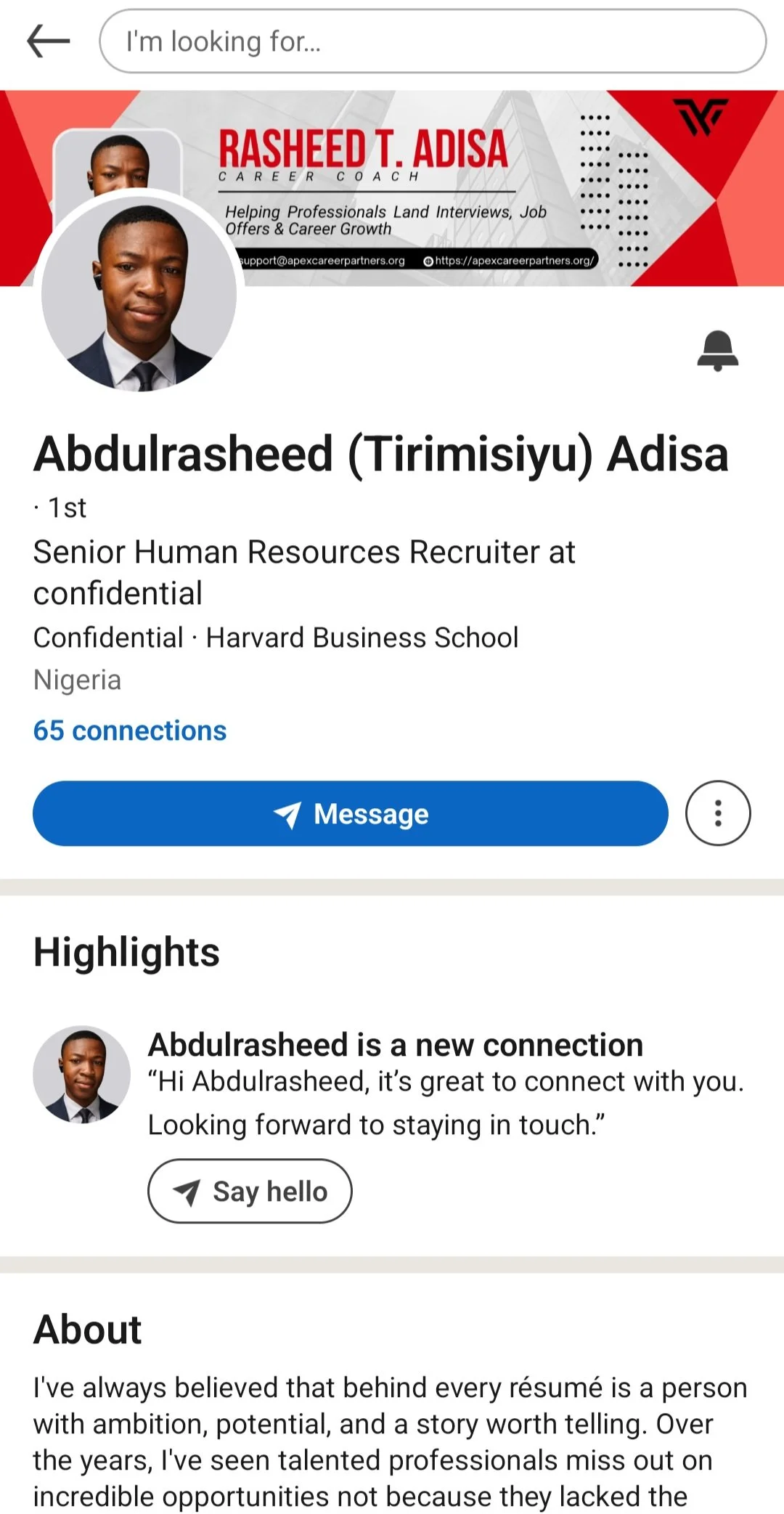
This morning, I received a connection request from someone presenting himself as Abdulrasheed (Tirimisiyu) Adisa, a “Senior Human Resources Recruiter at Confidential.” I accepted it.
Almost immediately, he messaged me about my “career transition” and asked what types of positions I was targeting.
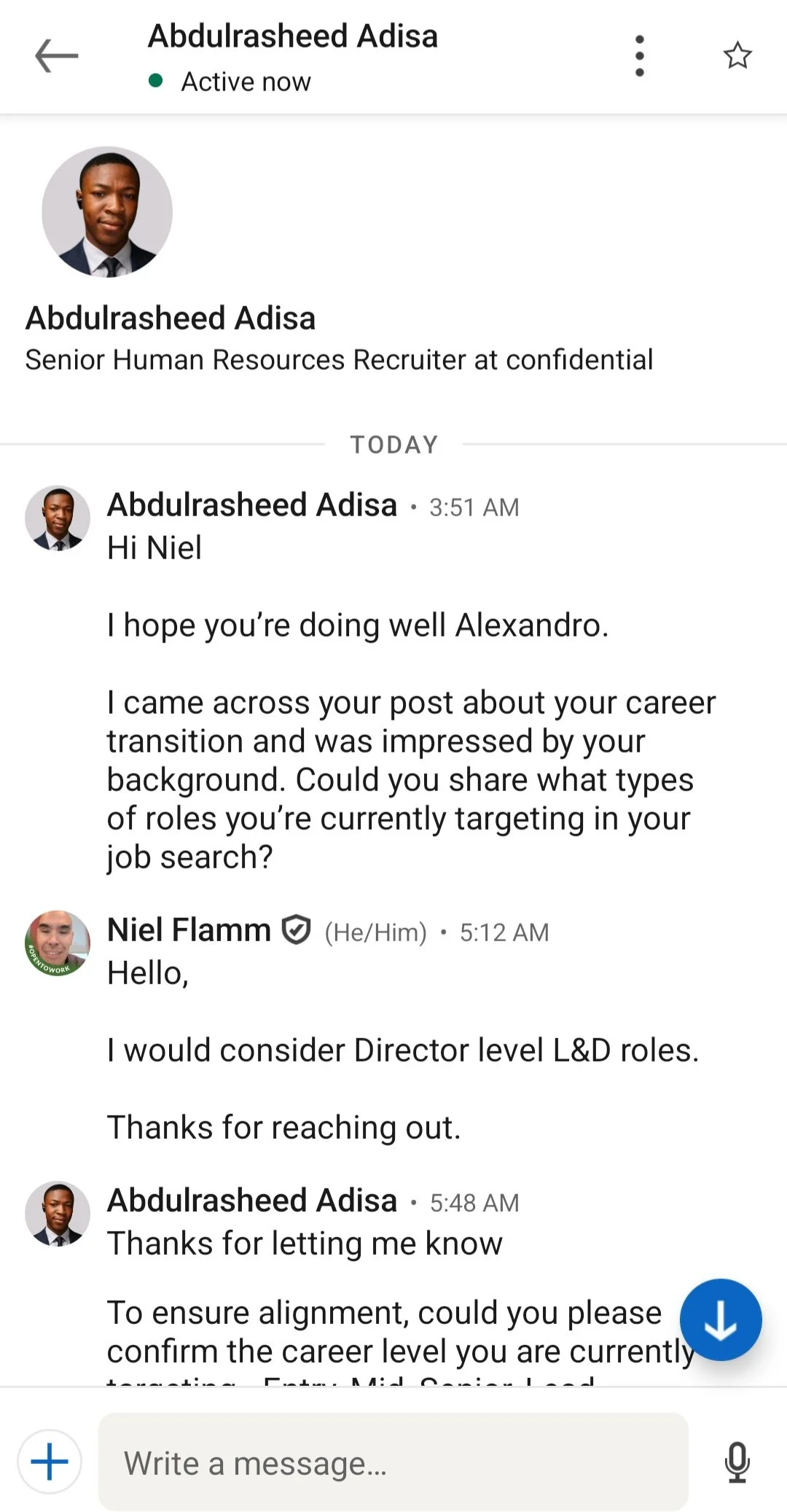
I told him: Director-level Learning & Development roles.
Then he asked what career level I wanted—despite my having just told him Director—and my salary expectations.
I answered: Director, minimum $180K.
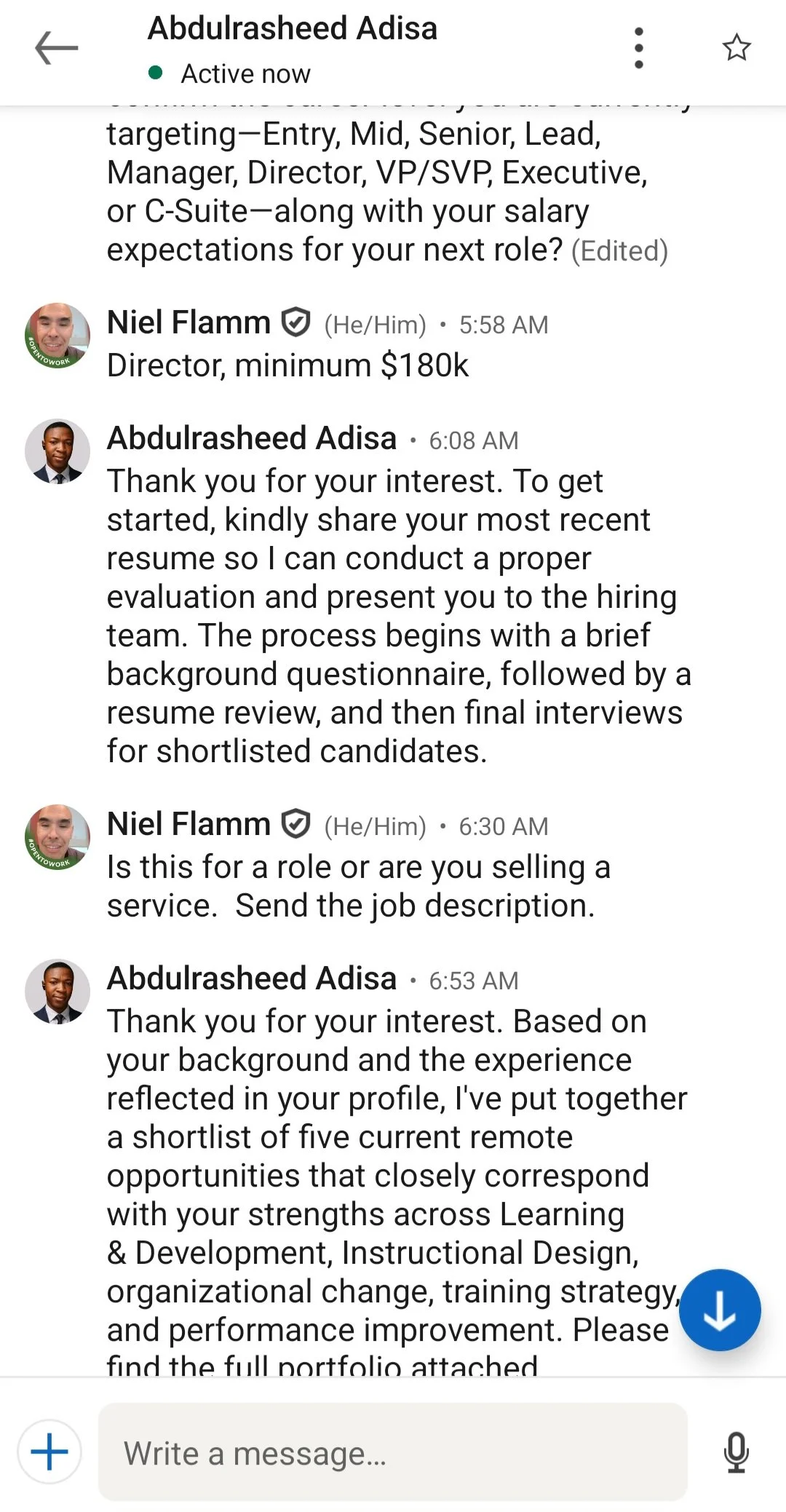
Then came the familiar request:
“Kindly share your most recent resume so I can conduct a proper evaluation and present you to the hiring team.”
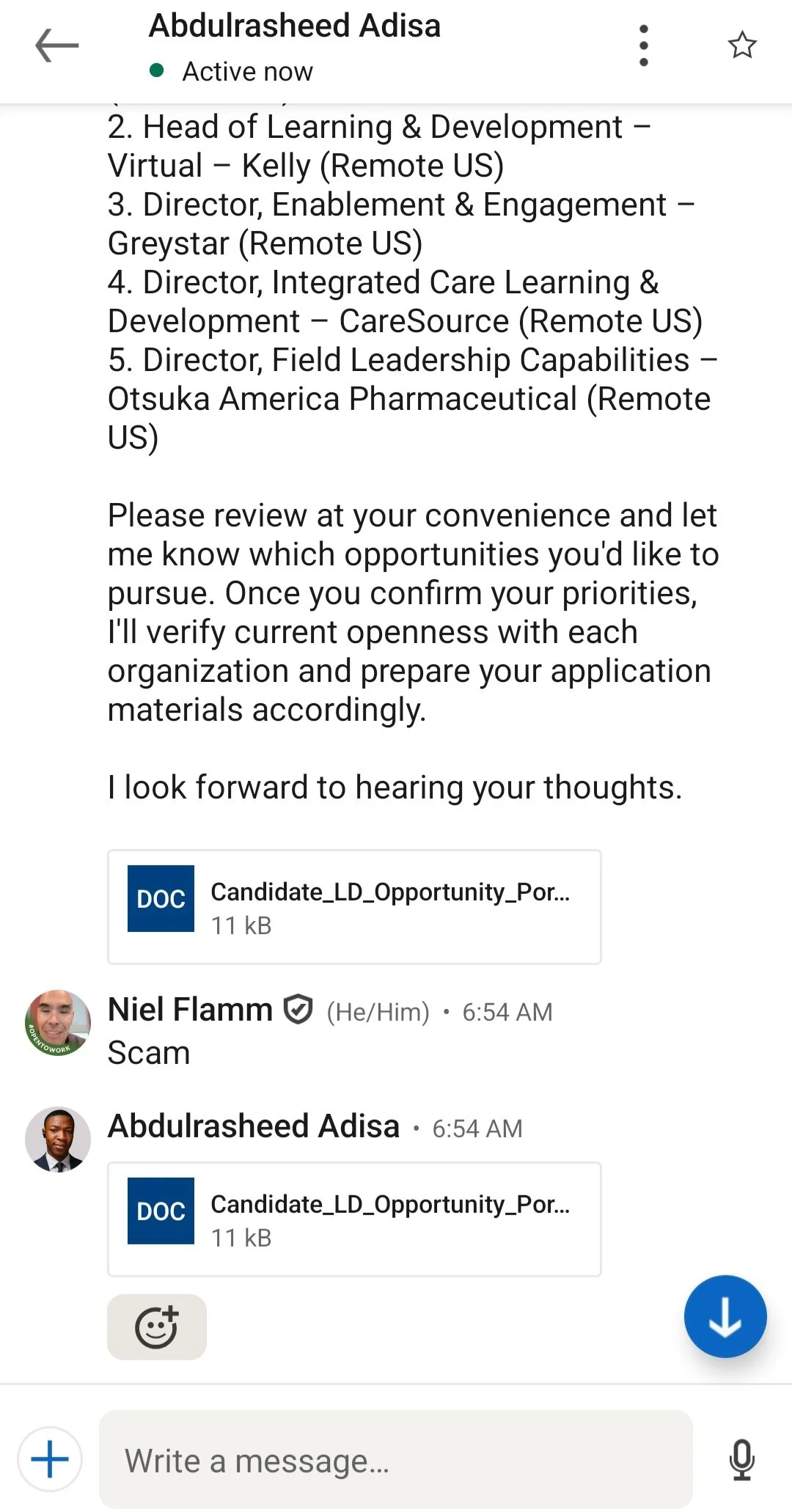
🚩 And here we go again.
I already suspected this was a scam very early in the conversation because I looked at his profile.
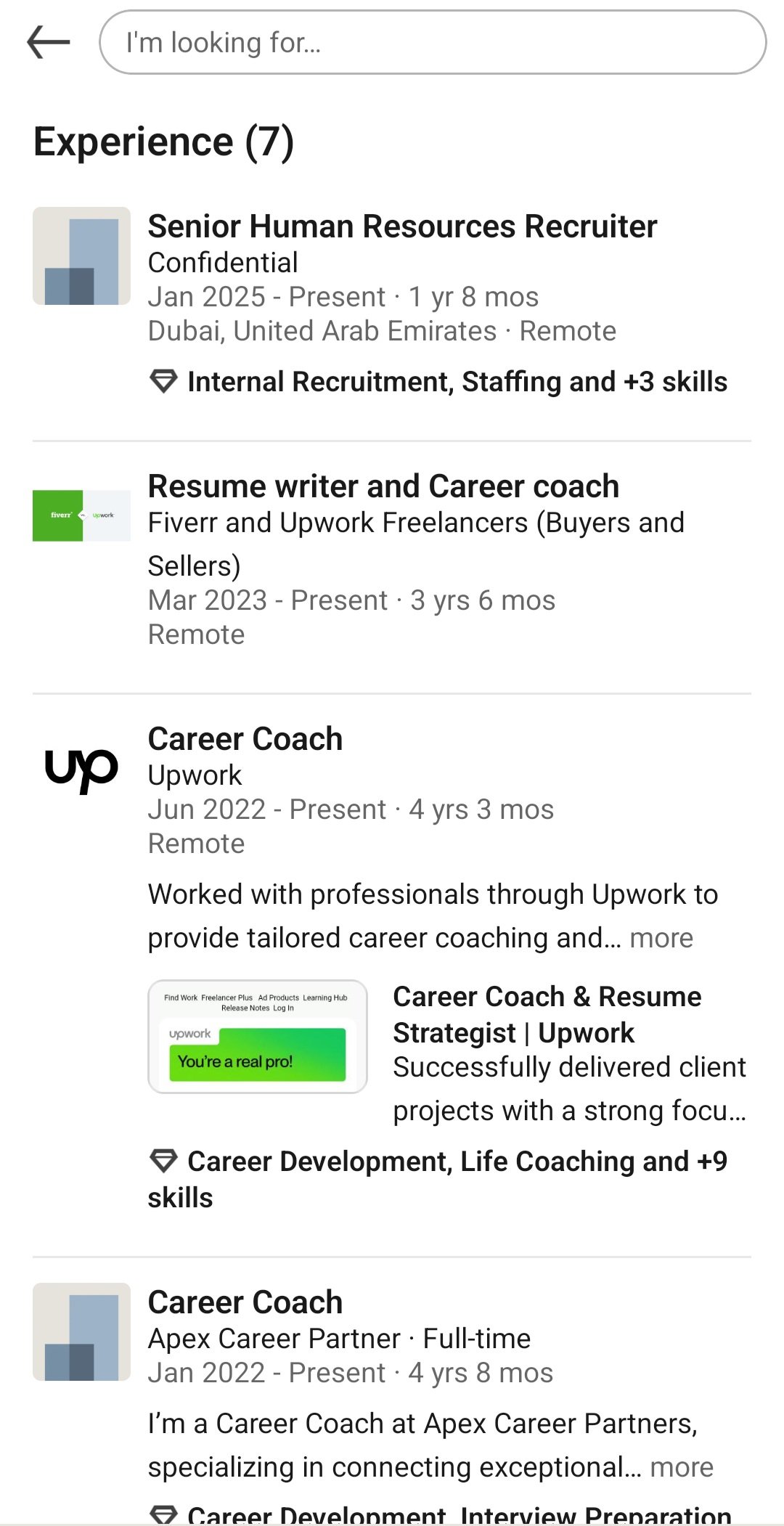
His experience shows several supposedly concurrent positions:
Senior Human Resources Recruiter at “Confidential”
Resume Writer and Career Coach through Fiverr and Upwork
Career Coach at Upwork
Career Coach at Apex Career Partner
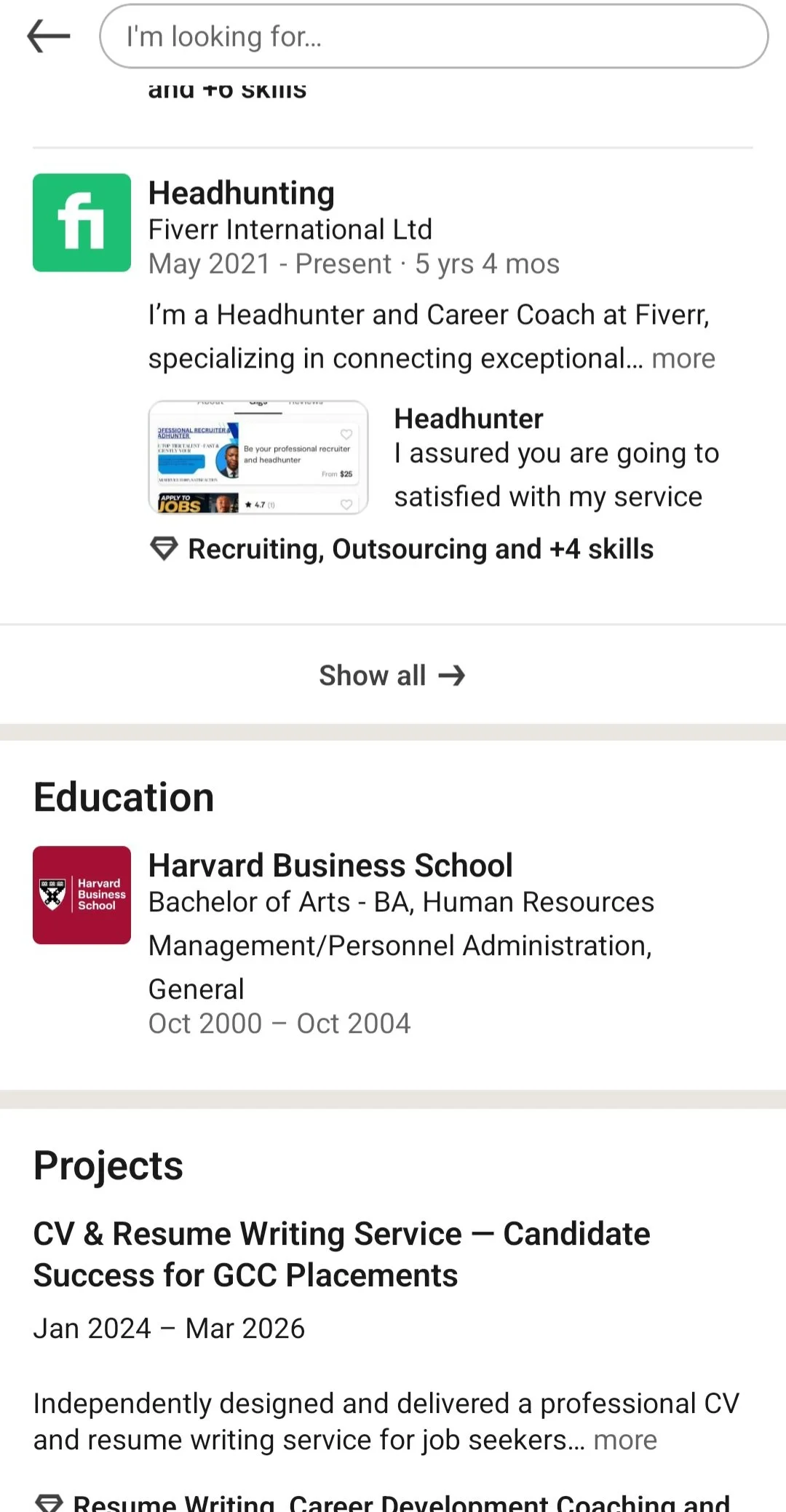
Headhunting through Fiverr
These positions overlap each other extensively.
Then there's an alleged Bachelor of Arts in Human Resources Management from Harvard Business School, which raised another rather large eyebrow.
So I asked a very simple question:
“Is this for a role or are you selling a service? Send the job description.”
Instead of answering the question directly, I suddenly received a list of five remote positions supposedly matching my background, along with an attached Word document.
And here's another interesting detail: the message said he would “verify current openness with each organization”after I selected the positions I wanted to pursue.
Wait.
You're recruiting me for jobs, but you haven't verified that the jobs are actually open?
🤔
I responded with one word:
“Scam.”
And wouldn't you know it?
Almost immediately, the connection disappeared. His name in my LinkedIn inbox became “LinkedIn Member.”
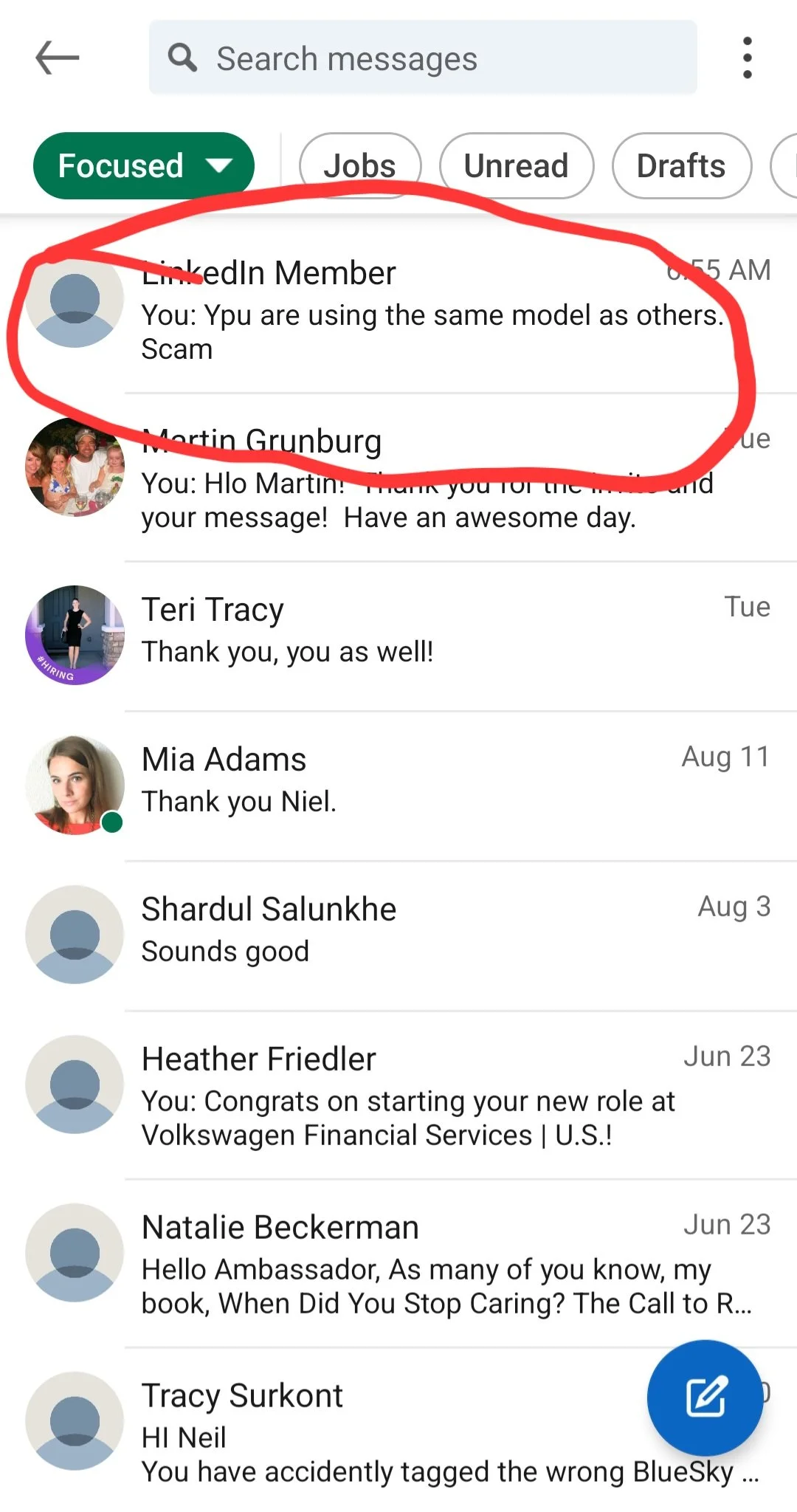
That was fast.
The lesson isn't that every recruiter who contacts you is a scammer. Plenty of legitimate recruiters reach out to candidates every day.
The lesson is to look before you leap.
Check the person's employment history. Look for overlapping jobs that don't make sense. Look at their education. Ask for the actual job description. Ask which company is hiring. Don't unthinkingly send your resume, personal information, or money simply because someone says they have the perfect opportunity.
And when somebody supposedly recruiting for a Director-level position can't even get your name right—his opening message said, “I hope you're doing well Alexandro”—perhaps that's another clue.
Alexandro, wherever you are, apparently we both have an exciting career opportunity.
😂
Follow along at NielFlamm.com/blog for more adventures from the increasingly bizarre world of online recruiting.

Day 69: The Experiment Has Changed

For 68 days, the story was simple:
I asked Nextdoor for detailed research. Nextdoor didn't answer.
Then something finally happened.
Nextdoor Communications responded.
So Day 69 isn't another "Nobody answered me" post.
The experiment has changed.
Now I have something arguably more interesting to examine:
What happens when a company answers the question you didn't ask?
Communications sent me links to the two publicly available Nextdoor blog posts and explained that they didn't believe a response was necessary because the studies were already public.
Except Nextdoor's own language creates a problem with that explanation.
The Financial Advising and Investing post describes itself as a summary highlighting key insights and tells readers interested in the complete findings and detailed data to contact Jacob Chavis.
That's what I've been requesting.
There's a meaningful difference between:
"Here are the highlights."
and
"Here is the underlying detailed research."
If a restaurant menu says, "Ask your server for the dessert menu," and I ask for it, showing me the dinner menu again doesn't fulfill the request.
It proves you heard me.
It doesn't prove you listened.
Hearing Isn't Listening
This distinction particularly stands out to me because I have more than 20 years of Learning & Development experience.
I've been the person standing in front of learners.
I've been the instructional designer building the learning experience.
And I've been the manager responsible for helping others develop the skills to do both effectively.
Across different industries and verticals, I've repeatedly highlighted one deceptively simple concept:
There is a difference between hearing and listening.
Hearing tells you that words reached someone.
Listening requires understanding what was actually communicated—and responding appropriately.
It's a distinction I've taught because it matters in customer service, leadership, sales, management, coaching, and virtually every interaction between two people.
And now I'm watching that lesson play out in real time.
Nextdoor Communications clearly heard me.
They know about my requests.
They know which studies I'm discussing.
They know how to contact me.
They even know about my duplicate-account experiment.
So we've moved beyond:
"Maybe nobody has seen this."
They've seen it.
The question now is:
Did Nextdoor actually listen to what I requested—or has it chosen not to provide it?
Those are two very different things.
If the detailed data isn't available to me, say that.
If it's available only to advertisers or prospective clients, say that.
If Nextdoor has decided not to provide it specifically to me, say that.
If the blog wording overpromises what's available, fix it.
All four answers give me useful information.
Sending me the summary I've already read doesn't.
Day 69 Is About the Gap
Companies spend enormous amounts of money studying customer journeys, employee listening, AI, analytics, sentiment and engagement.
Sometimes the most revealing measurement is much simpler:
Did we answer the question that was actually asked?
That's my Day 69 case study.
Not whether Nextdoor responded.
They did.
Not whether Nextdoor knows who I am.
Apparently, they very much do.
The question is whether a company built around connecting neighbors can close the remarkably small communication gap between:
"Contact us for the detailed data."
and
"Here is the detailed data."
After 69 days, that's the experiment.
And I'm still collecting data.
Full timeline at NielFlamm.com/blog.
From Learning & Development to Live Radio: ¡Buena Suerte, Sam!
There was a time when my social media presence was pretty much limited to LinkedIn. Life was simple. No Facebook Stories. No Bluesky. No endless scrolling. No random videos of people making tiny pancakes for squirrels.
Fast forward to today, and I'm apparently on just about every platform.
While watching Facebook Stories, I came across one from a familiar face — Sam Taylor. Years ago, Sam was on a Learning & Development team that I had the privilege of leading. She was smart, energetic, and definitely not afraid to speak up. In fact, now and then I'd have to gently remind her that meetings worked best when everyone else got a chance to talk too!
So when I saw she's now hosting a radio show, I laughed and thought, that makes perfect sense.
Sam now calls Spokane, Washington home, where she's not only an independent nail business owner but also hosts El Puente on KYRS 88.1 FM/92.3 FM every Monday from 2:00 PM to 4:00 PM Pacific Time.
The show is entirely in Spanish and focuses on the local community. If you're in the Spokane area, speak Spanish, or enjoy community radio, give it a listen. If you're outside the area, you can stream the station live or download previous episodes here:
https://archive.kyrs.org/
Now, as for my Spanish...
Let's say it's... specialized.
I know enough Spanish to order food at a restaurant, survive a trip to a bodega in Harlem, and probably accidentally ask someone where the bathroom is when I meant to ask for ketchup.
So while I won't be critiquing Sam's grammar or vocabulary anytime soon, I can absolutely say congratulations. It's always fun seeing people you worked with find something that fits their personality so well.
Congratulations, Sam! I hope El Puente continues to connect the Spokane community for years to come.
And if you ever decide to do an English-language guest segment... call me. I'll bring my restaurant Spanish.
Listen online:
https://archive.kyrs.org/
Day 51: Another Email Sent. The Question Remains the Same.
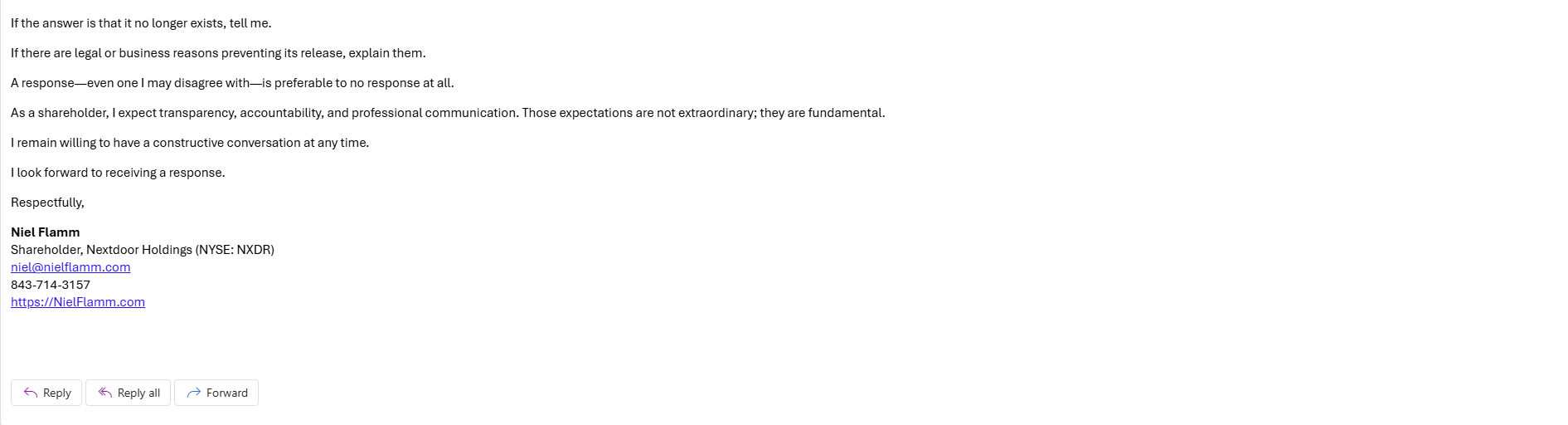
Today, I sent another email regarding my request for the Nextdoor study.
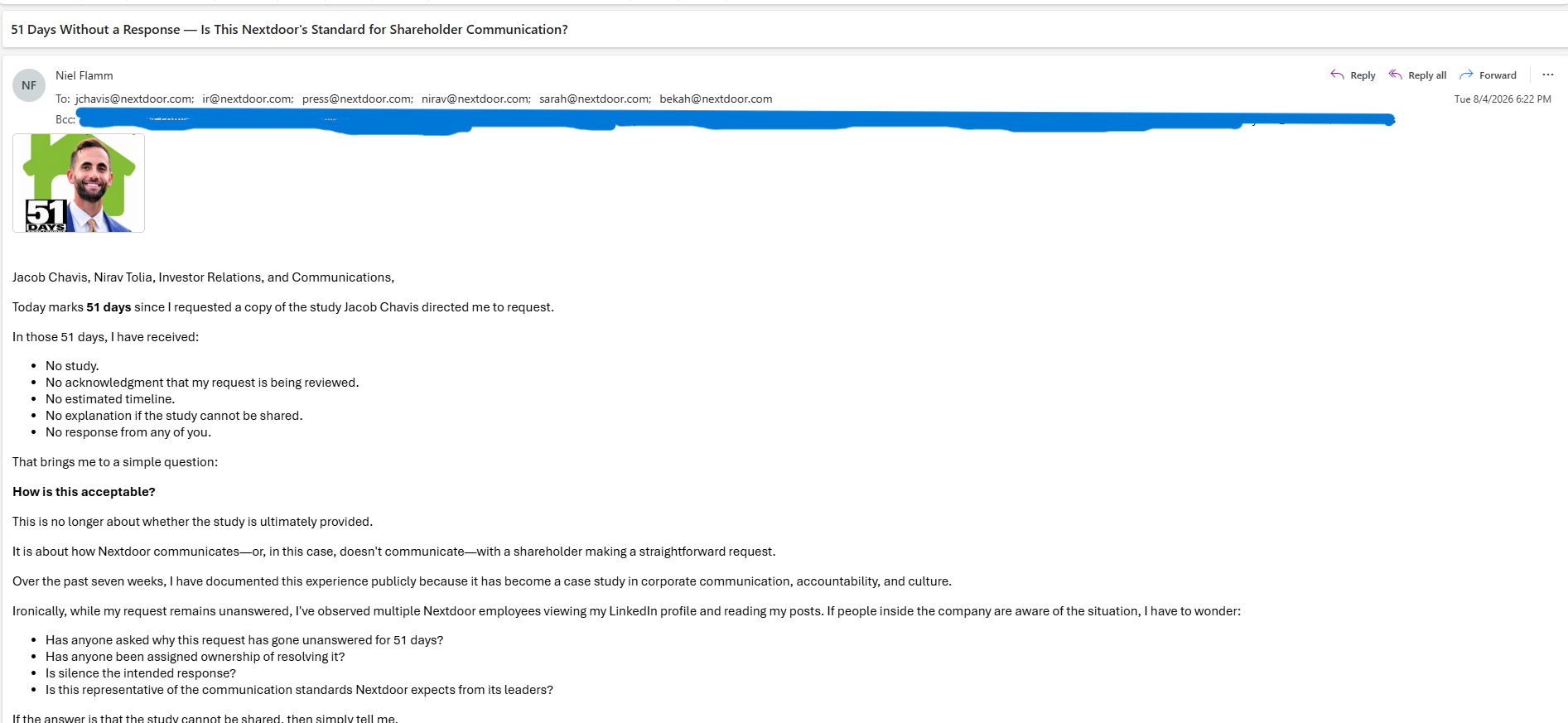
The recipients were:
Nirav Tolia, CEO
Jacob Chavis
Sarah Leary, Co-Founder
Investor Relations
Communications
Bekah Hufnagel, a Nextdoor intern studying Communication Design at the University of Cincinnati
One thing I can confirm:
None of the emails bounced back as undeliverable.
So, as far as I know, the message reached the intended inboxes.
The email wasn't complicated.
It asked a straightforward question:
How does a simple shareholder request go unanswered for 51 days?
At this point, the study itself has almost become secondary.
The larger issue is communication.
If the answer is "no," say no.
If the study can't be shared, explain why.
If it no longer exists, say that.
Communication doesn't require agreement.
It requires acknowledgment.
One reason I included Bekah on the email is that she's studying Communication Design. This is a real-world case study in corporate communication.
If this situation were presented in a college classroom, what discussion would it generate?
How would 51 days without a response from Jacob Chavis, CEO Nirav Tolia, Investor Relations, or the Communications team be evaluated?
As someone who has spent much of my career in learning and development, I believe some of the best lessons come from real situations—not hypothetical ones.
This continues to be one of them.
I'm still willing to have a conversation.
I'm still waiting to see if it's worth having.
Join the discussion at NielFlamm.com/blog. Leave some feedback—I'd love to hear from you.