
Day 93: Nextdoor Turned the Comments Off Again. So Much for Progress.
Well, that didn't last long.
A few days ago, I actually did something that might surprise people who only see my Nextdoor posts occasionally:
I applauded Nextdoor.
I had previously provided feedback about Nextdoor disabling comments on some of its LinkedIn posts. Then I noticed newer posts where commenting was available again.
I said that was progress.
I said companies should be willing to change course.
I even wrote:
“Nice move, Nextdoor. Keep going.”
Apparently, I should have added:
“…but please don't put it in reverse.”
Because here we are.
It's Day 93 of my ongoing Nextdoor case study, and they've once again turned off comments on a Nextdoor LinkedIn post.
And the post they chose makes this particularly interesting.
The Publix Post Has Comments Turned Off
Nextdoor's recent LinkedIn post celebrates Publix Super Markets ranking No. 4 on PEOPLE's 100 Companies That Care list.
Nextdoor's connection to the story is that a Publix associate used the Nextdoor app while helping neighbors before Hurricane Milton. Nextdoor's post says this demonstrates what can happen when a network is built around real local neighborhoods. LinkedIn
I've already written about why I think there's another, more interesting story here:
Nextdoor didn't make the Top 100.
But now there's another layer.
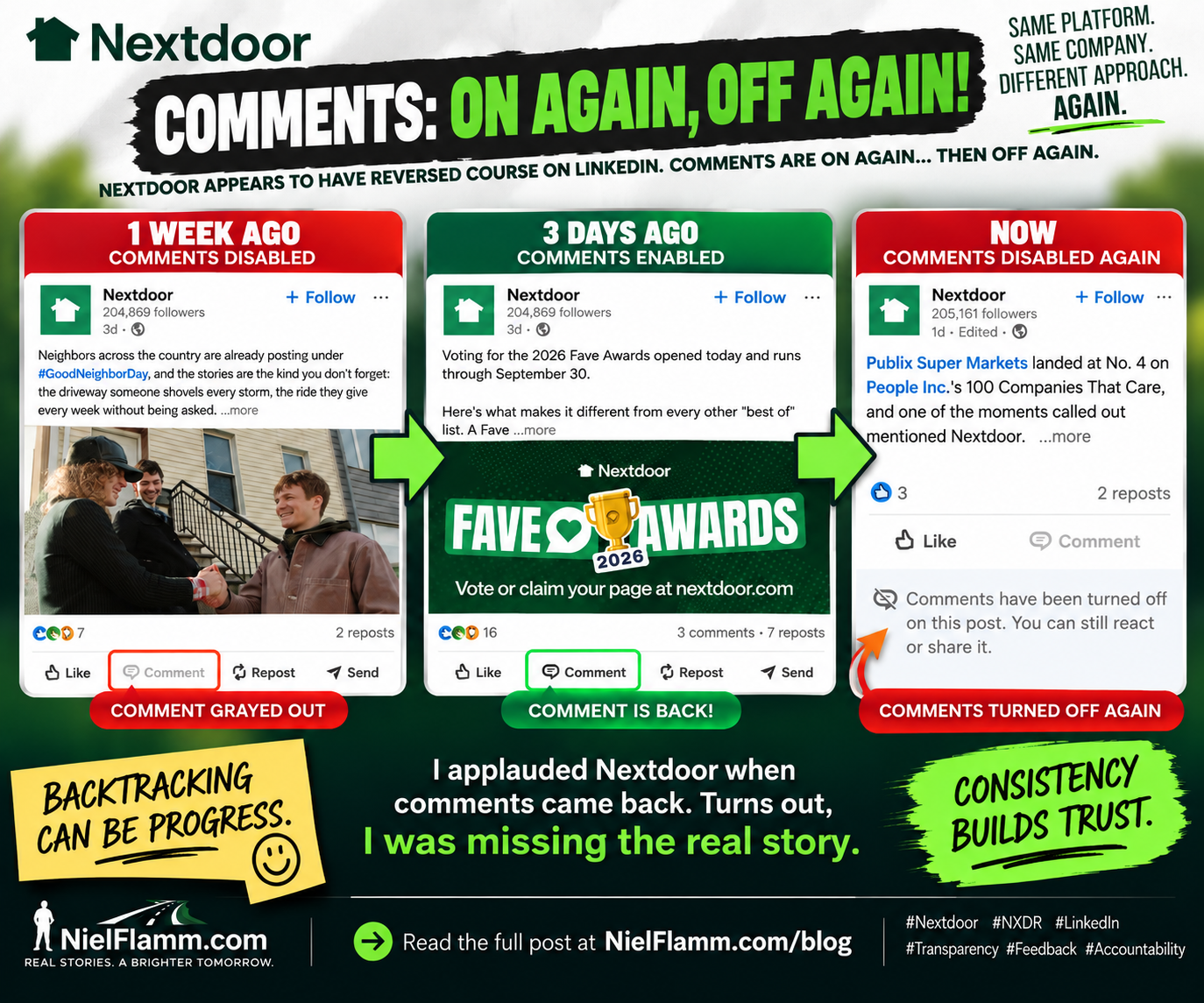
Look at the screenshot.
The Comment button is grayed out, and LinkedIn states:
“Comments have been turned off on this post.”
LinkedIn lets Page administrators turn comments on or off, even after a post has been published. LinkedIn
So once again, Nextdoor is publishing something publicly on a social network while choosing not to allow the public to respond beneath that particular post.
Wait… Weren't We Moving Forward?
That's what makes this frustrating.
I had just praised Nextdoor for what seemed like a change in direction.
Comments had been disabled.
Then newer posts allowed comments.
I noticed.
And instead of finding another reason to complain, I did exactly what I think someone providing fair feedback should do:
I acknowledged the improvement.
That's important.
If I'm going to point out things I believe Nextdoor gets wrong, then I should be equally willing to acknowledge when I think it gets something right.
I did.
Now we're apparently going backward again.
This Is Exactly Why Communication Matters
Nextdoor describes itself as “the essential neighborhood network” and says it connects neighbors to conversations that matter locally. LinkedIn
Conversation.
That's the interesting word.
Because conversation generally requires more than one participant.
Posting a corporate message and disabling responses isn't really a conversation.
It's a broadcast.
Broadcasting information isn't inherently wrong. Companies do it every day.
But for a company whose entire product is built around people talking to one another, repeatedly switching comments on and off creates an odd contradiction.
A social network should probably be social.
And Why This Post?
That's the question I'm especially curious about.
Why disable comments on this post?
I don't know.
Maybe it was intentional.
Maybe there's a communications strategy behind it.
Maybe Nextdoor anticipated comments it didn't want.
Maybe it has absolutely nothing to do with criticism.
I don't have access to Nextdoor's internal decision-making, so I won't invent a motive.
But I can certainly observe the result:
Nextdoor published a post celebrating another company's recognition for caring about people and communities—and didn't allow people to comment on it.
That's… interesting.
Especially after I realized I had initially been missing the real story.
I Was Missing the Real Story
At first, my reaction to the Publix post was basically:
Nextdoor is playing Six Degrees of Kevin Bacon.
A Publix employee did something wonderful.
The employee happened to use Nextdoor.
Publix made PEOPLE's list.
Nextdoor then highlighted its connection to the story.
I thought that was the story.
It wasn't.
The more interesting question was:
Why wasn't Nextdoor itself on the list?
Technology companies including Salesforce, NVIDIA, Intuit, Adobe, ServiceNow and Hewlett Packard Enterprise made the 2026 Companies That Care list.
These aren't organizations that decided they had to choose between corporate responsibility and running successful businesses.
They demonstrate that companies can pursue their missions, invest in employees and communities, make money, and create value for shareholders.
That's the standard I want Nextdoor to pursue.
Don't borrow someone else's spotlight.
Earn your own.
And Comments Are Part of the Bigger Picture
This isn't really about one LinkedIn button.
It's about something I've been discussing throughout this case study:
Does Nextdoor's behavior match Nextdoor's message?
Nextdoor talks about connection.
Community.
Trust.
Neighbors.
Conversation.
Local businesses.
Good neighbors.
But I've also provided feedback about what I see as problems with its volunteer moderator model, its approach to monetizing small businesses, communication and transparency, shareholder value, and the platform's long-running “Karen” reputation.
And now we're back to comments being disabled on a corporate LinkedIn post.
Again.
None of these things alone define Nextdoor.
But collectively they raise a question I've asked repeatedly:
Does the experience match the mission, vision and values?
Day 93—and the Other Question Still Hasn't Been Answered
And yes, there's another reason today is Day 93.
I'm still waiting for the detailed data referenced in Nextdoor's Home Insurance Insights research.
I've also requested the detailed data referenced in its Financial Advising and Investing research.
I'm not asking for the public blog summaries.
I'm asking for the detailed data Nextdoor told readers they could request.
It's been 93 days.
I've emailed.
I've clarified the request.
I've offered phone.
Video conference.
Virtual coffee.
A simple answer would still resolve it:
Yes, we can provide it.
No, we can't provide it.
It's restricted.
Here are the requirements.
Someone else handles it.
Those are answers.
Silence isn't.
Hearing vs. Listening—Again
Maybe this is why I keep returning to my Learning & Development background.
There is a difference between hearing feedback and listening to feedback.
Listening doesn't mean agreeing.
It doesn't mean giving me what I want.
It doesn't mean leaving every LinkedIn comment section open forever.
And it certainly doesn't mean a company has to implement every suggestion somebody posts online.
Listening means considering the information, making a decision, and communicating.
That's why I was willing to applaud Nextdoor when comments came back.
I thought perhaps the company had reconsidered.
Maybe it had.
Now comments are off again.
So I'll provide feedback about that too.
Nextdoor, Pick a Direction
If comments are going to be open, open them.
Moderate them.
Respond when appropriate.
Ignore ridiculous comments when appropriate.
Let people disagree.
That's what social networks do.
If comments are going to be disabled, that's Nextdoor's decision too.
But then let's acknowledge the irony of the neighborhood conversation company limiting conversation on its own corporate social media.
You can't build a brand around community dialogue and then appear uncomfortable when the dialogue isn't completely controlled.
Moderating conversation and preventing conversation are two very different things.
I applauded Nextdoor when I thought it was moving forward.
Today, I'm pointing out that it appears to have taken a step backward.
That's not negativity.
That's consistency.
When I see improvement, I'll acknowledge it.
When I see something I think deserves feedback, I'll provide it.
And when Nextdoor finally answers my 93-day-old research request?
I'll acknowledge that too.
Until then:
Day 93.
The detailed data still hasn't arrived.
And apparently, the comments haven't either.
Follow the continuing case study at NielFlamm.com/blog.
Nextdoor Changed Course—and I’m Going to Applaud Them for It
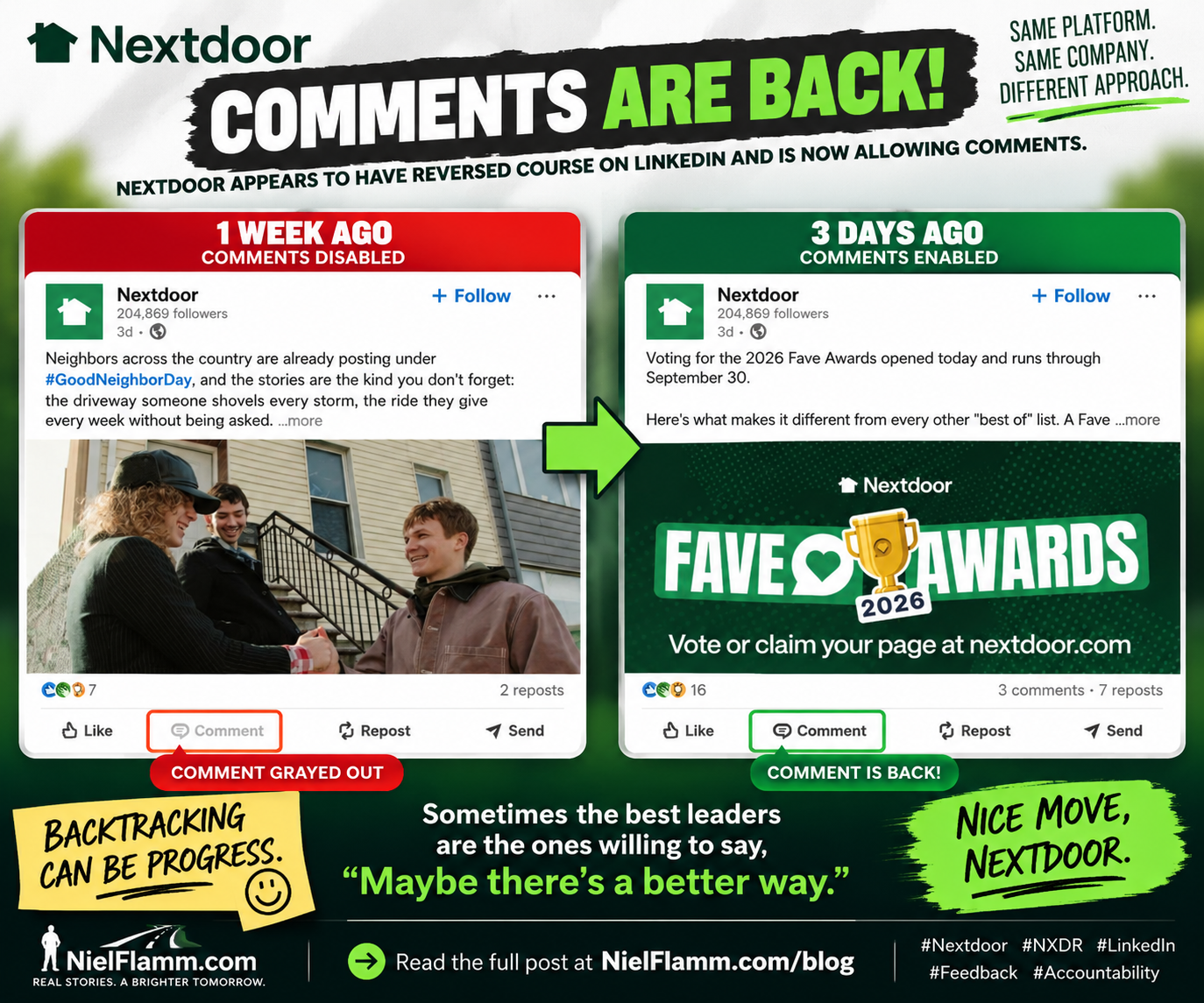
If I'm going to spend time providing feedback to Nextdoor, I should also acknowledge when I see the company do something positive.
And today, I noticed something:
Nextdoor appears to have turned LinkedIn comments back on.
Yes, I'm complimenting Nextdoor.
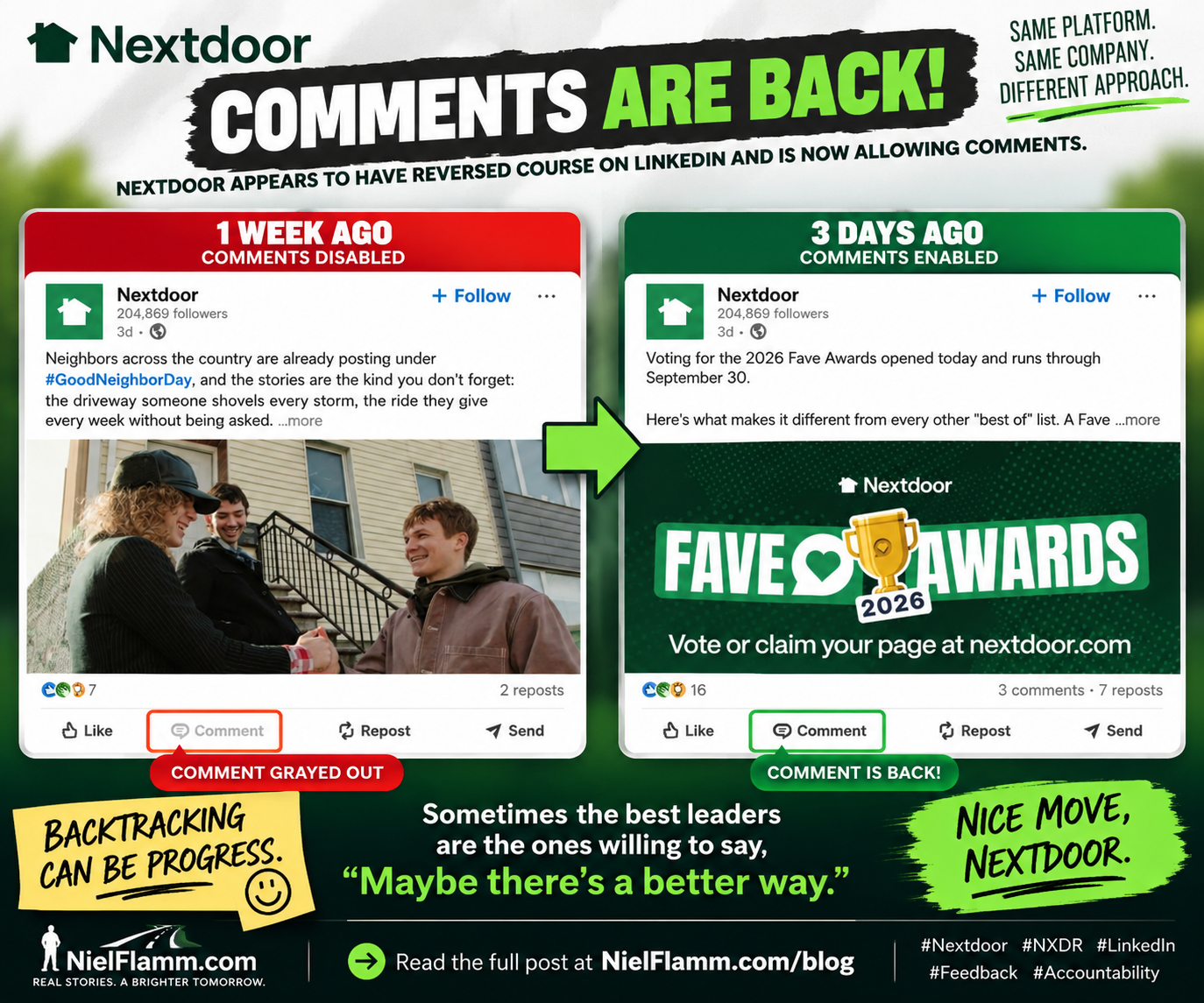
A Week Ago: No Comments
A Nextdoor LinkedIn post from about a week ago promoting #GoodNeighborDay had commenting disabled. Like, Repost, and Send were available, but Comment was grayed out.
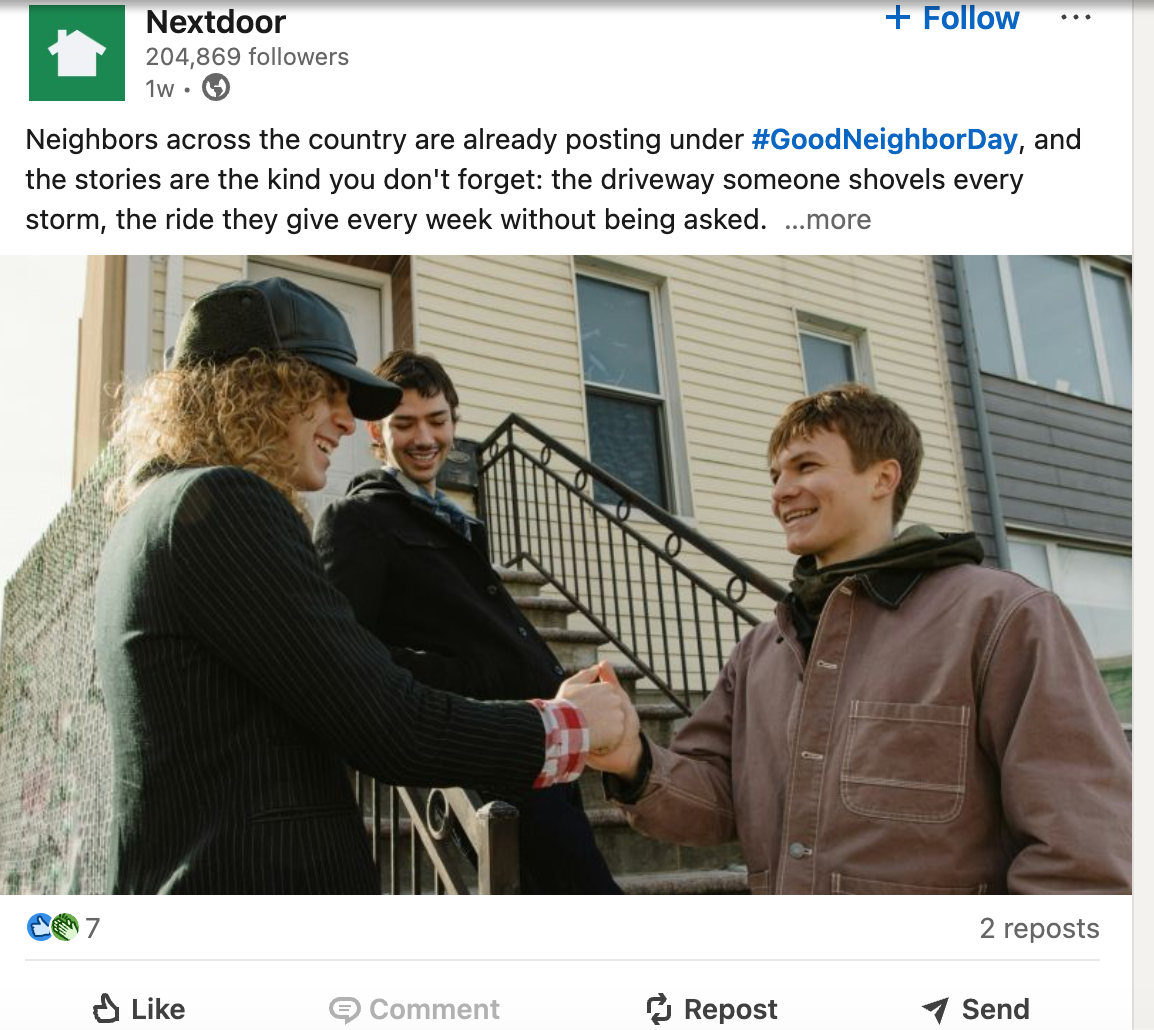
I previously provided feedback about this. For a company built around neighborhood conversations, limiting conversation on its own corporate social media seemed like an odd choice.
But something changed.
Comments Are Back
A more recent post promoting the 2026 Fave Awards allows comments.
There's also another Nextdoor post between these two where commenting is available.
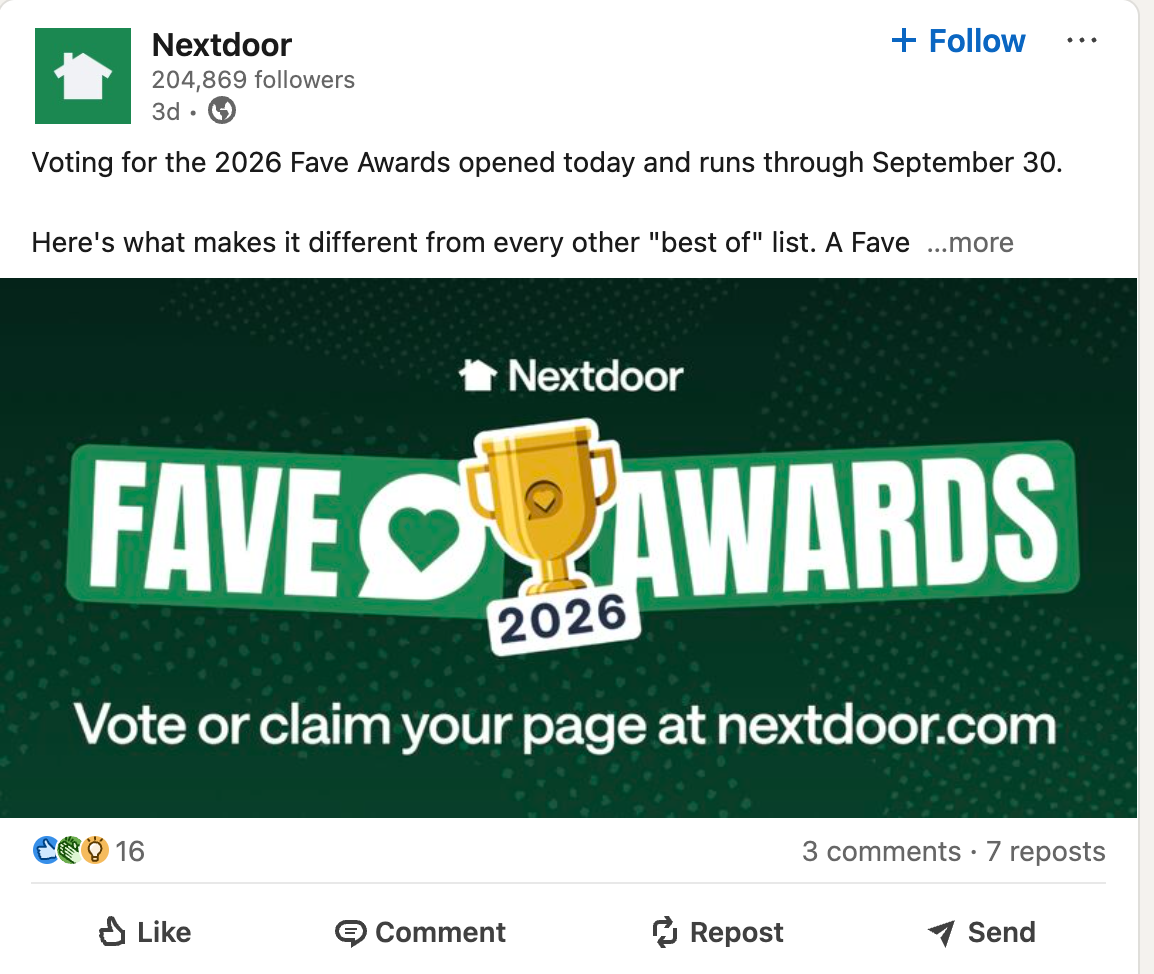
So, whatever the reason, comments appear to be back.
And you know what?
Good. I applaud the decision.
I don't know who made the change or why. I don't know whether Communications reconsidered the approach, whether this is temporary, or whether there's another explanation.
And I'm certainly not claiming my feedback had anything to do with it.
I can only document what I see:
Comments were disabled. Now multiple newer posts allow them.
That's movement in the right direction.
Backtracking Can Be Progress
Companies shouldn't be afraid to reconsider a decision.
If I’m driving somewhere and realize I've made a wrong turn, I don't continue another 40 miles just to prove I was committed to the route.
I turn around.
Changing course isn't necessarily weakness.
Sometimes it's good leadership.
A Social Network Should Be Social
Nextdoor is built around people communicating.
That doesn't mean its LinkedIn page should tolerate spam, abuse, or inappropriate behavior. Moderation has a purpose.
But there's an important difference between:
Moderating the conversation
and
preventing the conversation.
If Nextdoor has decided to allow that conversation again, I think that's a good move.
Credit Where Credit Is Due
I've provided plenty of feedback about Nextdoor's communication, leadership, research transparency, moderation, monetization and shareholder value.
And yes, I'm still waiting for the detailed Insights data I've requested.
But accountability works both ways.
If I'm willing to publicly point out where I think Nextdoor can improve, I should publicly acknowledge when I think Nextdoor gets something right.
This case study isn't about finding something wrong every day.
It's about observing, asking questions, providing feedback, and documenting what happens.
So today:
Nice move, Nextdoor. Keep going.
Now, about that Insights data...
Follow my continuing Nextdoor case study at NielFlamm.com/blog.
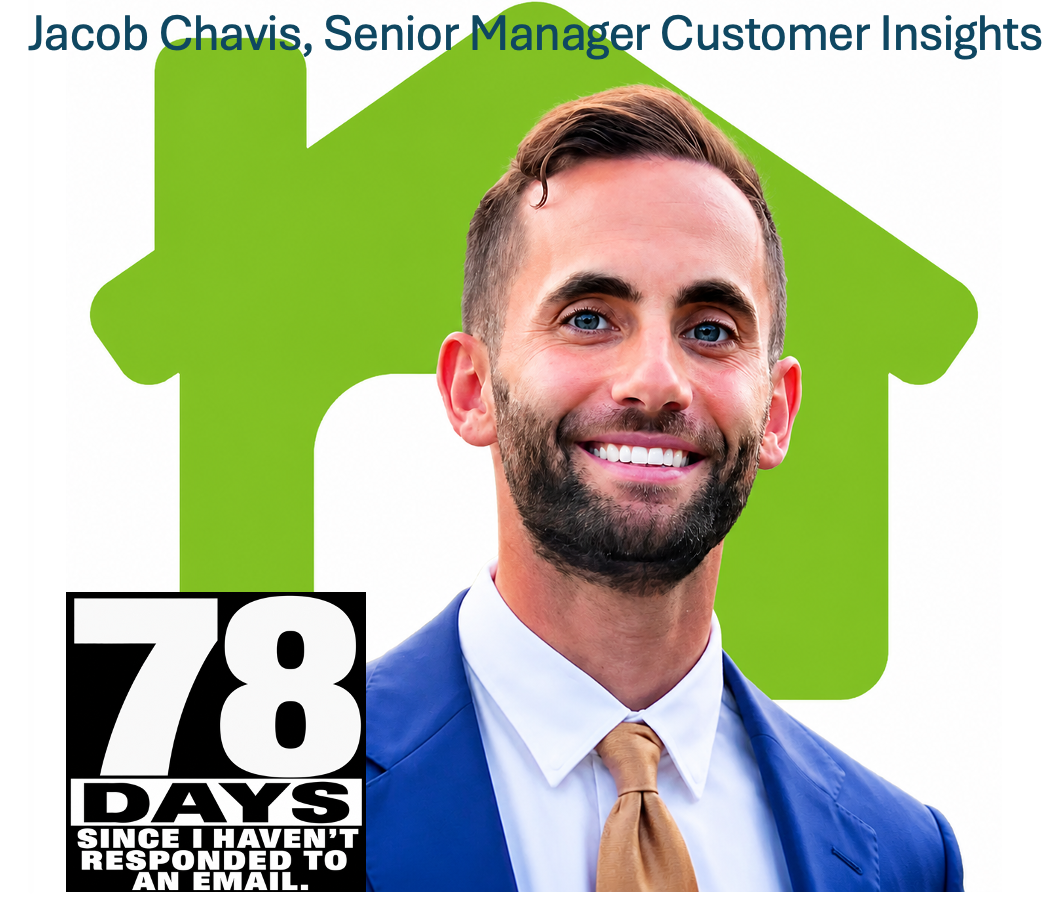
Day 78: Blocked Again — While the Stock Does the Slide
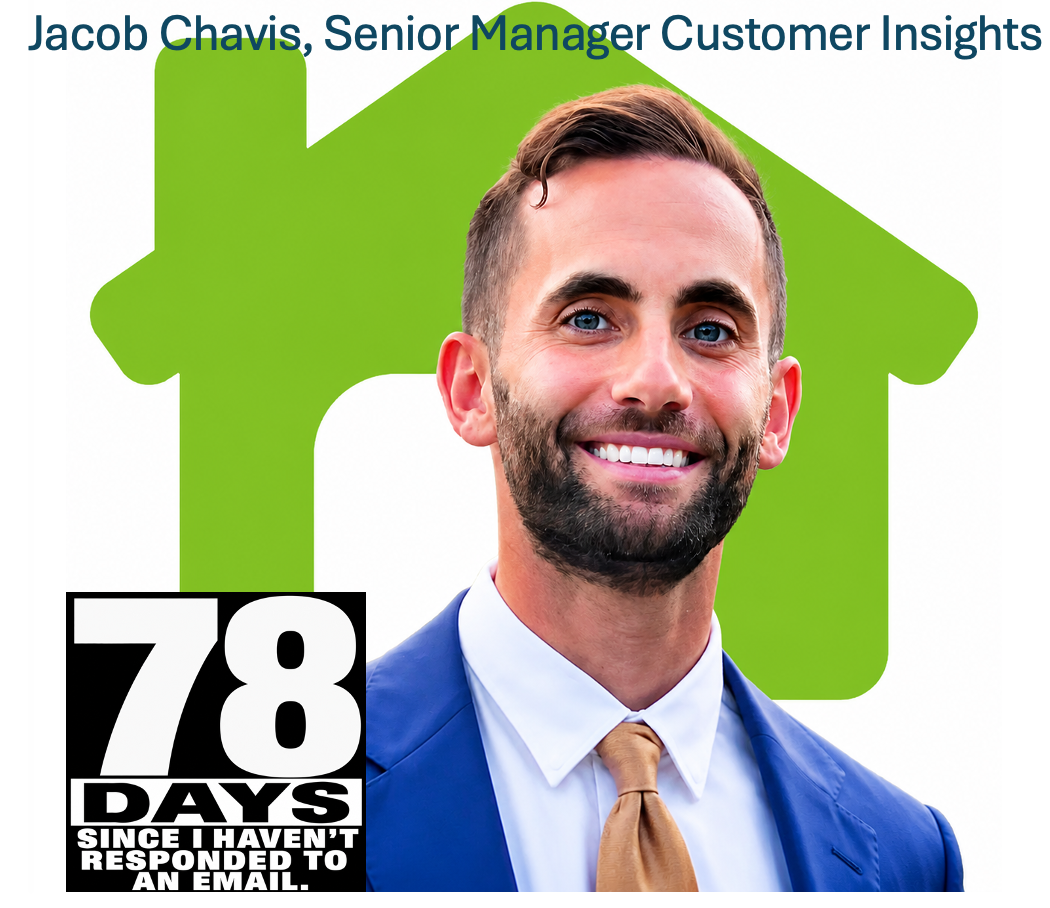
Today is Day 78 of my continuing Nextdoor case study.
And apparently we're doing two kinds of sliding:
The NXDR stock price is sliding.
And I've apparently slid right back onto Nirav Tolia's LinkedIn blocked list.
Well, that didn't take long.
On August 29, I was once again able to comment on Nirav's LinkedIn posts.
So I did.
I surfaced the same questions I've been raising publicly about how Nextdoor is being run: leadership decisions, communication, accountability, transparency, customer experience, and what I believe are some very questionable strategic choices.
And now?
I'm blocked again.
I have to admit, this one really gets me.
I'm one guy.
I'm not running a public company.
I'm not a Silicon Valley CEO.
I'm not appearing on podcasts discussing leadership, entrepreneurship, community, and human connection.
I've never sat in one of those big chairs on Shark Tank deciding whether somebody else's company deserves an investment.
I'm just a small shareholder with a website, a LinkedIn account, questions—and apparently a remarkable ability to locate Nirav Tolia's block button.
Meanwhile, Let's Talk About the Stock
NXDR has been doing a little slide of its own.
The stock closed at $2.68 on August 10.
By August 28, it closed at $2.27.
Stocks go up. Stocks go down. Eighteen days certainly don't determine the future of a company.
But shareholders are allowed to ask questions when the direction isn't the one we'd like to see.
And Nextdoor's latest quarterly results still included a net loss of $2 million.
Yes, that's a significant improvement from the $15 million loss during the same quarter a year earlier. Nextdoor also reported positive adjusted EBITDA.
I acknowledge progress when it's there.
But a loss is still a loss.
And here's what gets me:
The CEO of a public company can receive compensation worth millions while shareholders watch the stock struggle and the company continues reporting a GAAP net loss—and somehow my LinkedIn comments are enough to get me blocked again?
That's fascinating to me.
I'm not the person running the company.
I'm one of the people invested in it.
Imagine This on Shark Tank
An entrepreneur walks into the Tank.
The Shark starts asking uncomfortable questions:
Why are you losing money?
Why is the stock struggling?
Why isn't the strategy producing better results?
What are customers saying?
Why should investors believe in the turnaround?
The entrepreneur doesn't like the questions.
So instead of answering...
they block the Shark.
🦈 “And for that reason, you're blocked.”
I'd watch that episode.
Leadership Isn't Tested by Compliments
It's easy to talk about transparency when everyone agrees.
It's easy to talk about community when everyone is applauding.
It's easy to talk about listening when the message is flattering.
Leadership gets more interesting when someone says:
I don't think you're doing this well. Explain why I'm wrong.
Maybe I am wrong.
Show me.
Challenge my argument.
Explain the strategy.
Tell me why the decisions I'm criticizing make sense.
I'd welcome that conversation.
Blocking is easier.
And apparently we've chosen easier again.
Day 78 — And the Questions Haven't Been Blocked
I'm still waiting for the detailed Insights data that started this entire counter.
I'm still documenting what happens.
And I'm still a shareholder who wants Nextdoor to succeed.
That's precisely why I'm asking questions.
Nirav can block my LinkedIn account.
He can prevent my comments from appearing underneath his posts.
But here's the problem:
Blocking the shareholder doesn't block the questions.
It doesn't change the earnings report.
It doesn't move the stock price.
It doesn't improve communication.
And it doesn't end this case study.
So here we are.
Day 78.
The stock has been sliding.
I'm blocked again.
The detailed data still hasn't arrived.
And somehow, one guy with a blog keeps being worth blocking.
That's becoming a story all by itself.
Read the complete continuing Nextdoor case study at NielFlamm.com/blog and subscribe at NielFlamm.com to see what happens on Day 79.
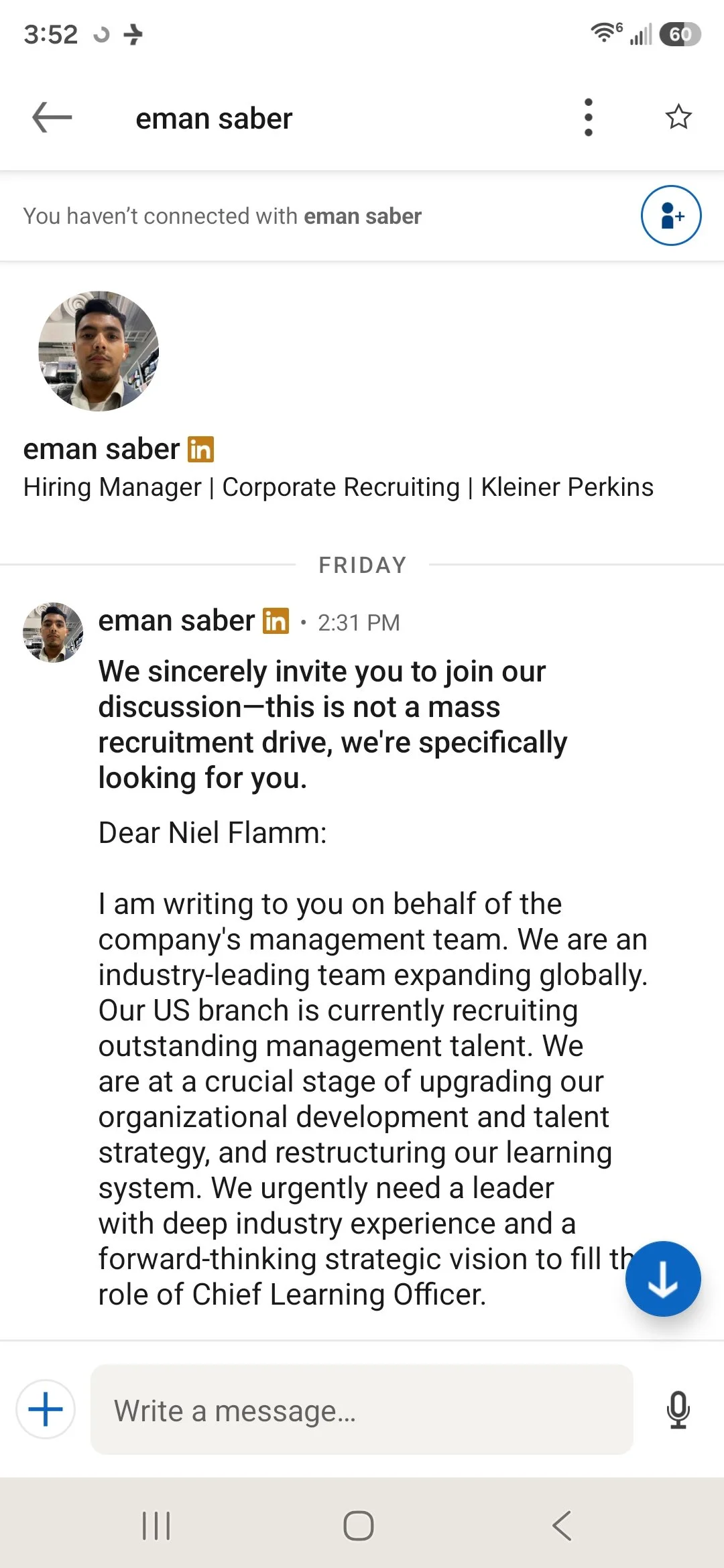
Another Day, Another LinkedIn "Recruiting" Scam
At this point, I'm starting to wonder...
Do I have a mark on my forehead?
This time it was Eman Saber, who claimed to be a Hiring Manager | Corporate Recruiting | Kleiner Perkins.
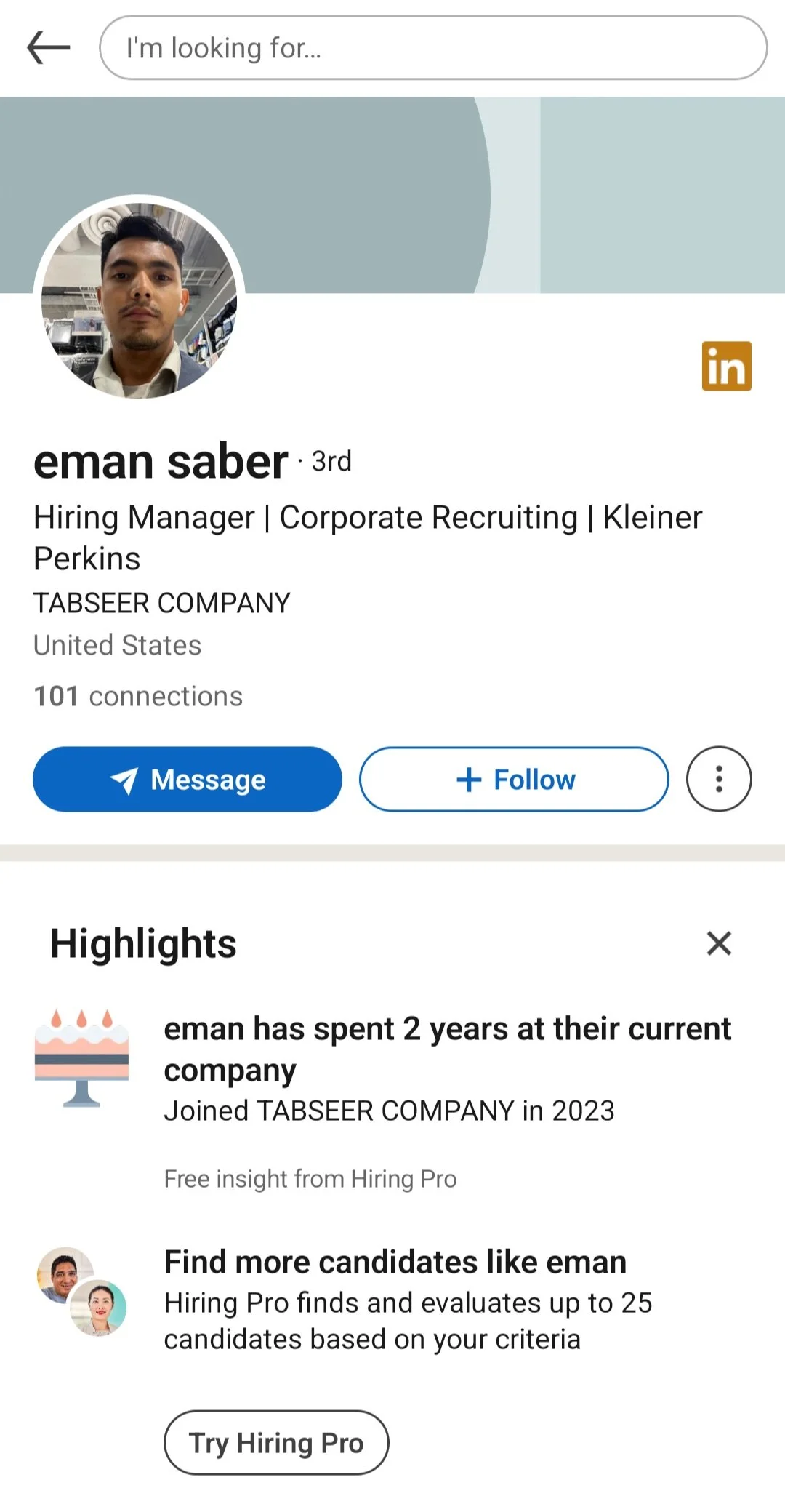
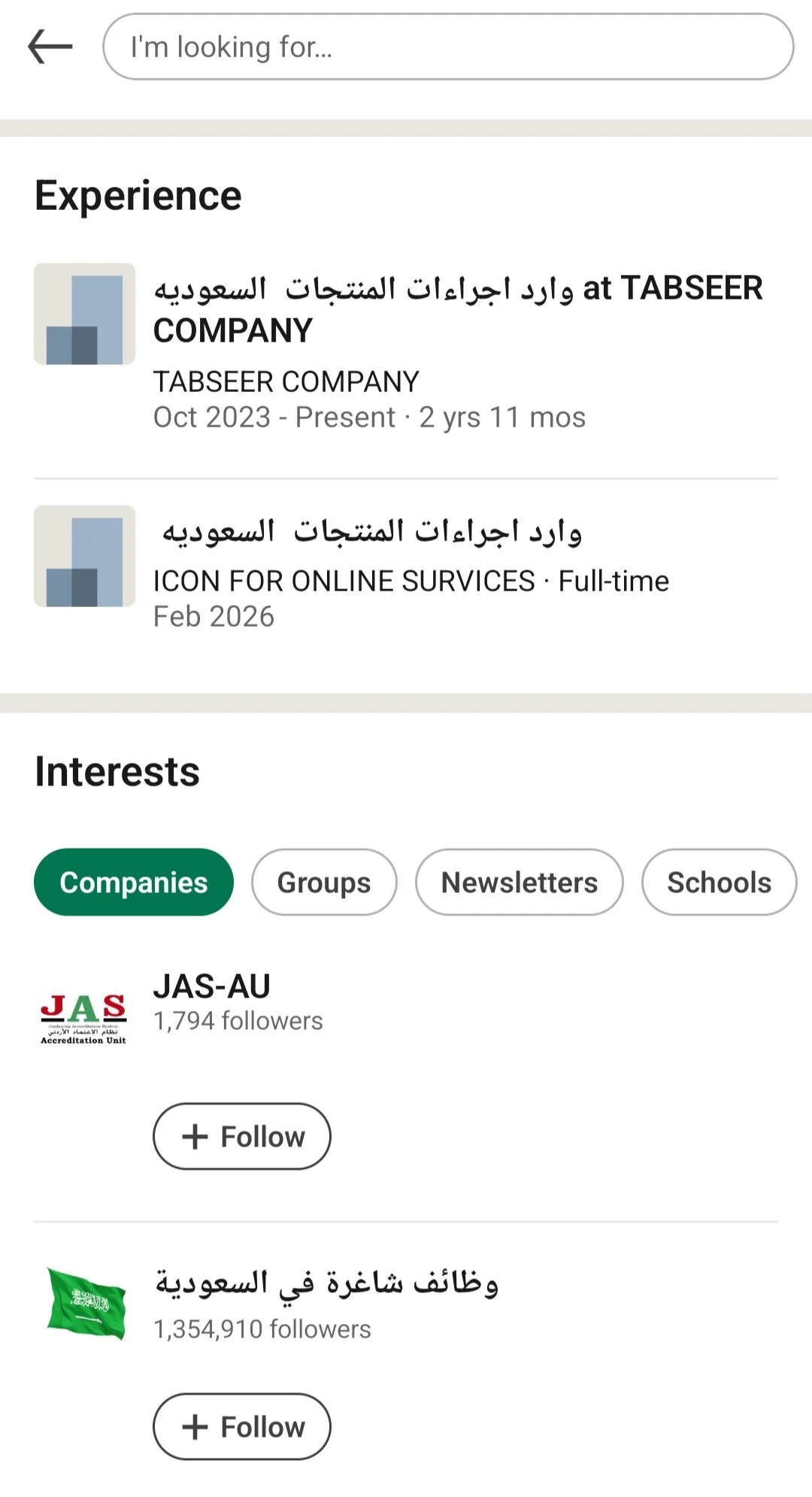
A quick look at the profile raised questions. The experience listed was extremely limited, and the employment timeline appeared to overlap with another role. Despite claiming to represent Kleiner Perkins, the profile also referenced TABSEER COMPANY, which didn't align with the recruiting message.
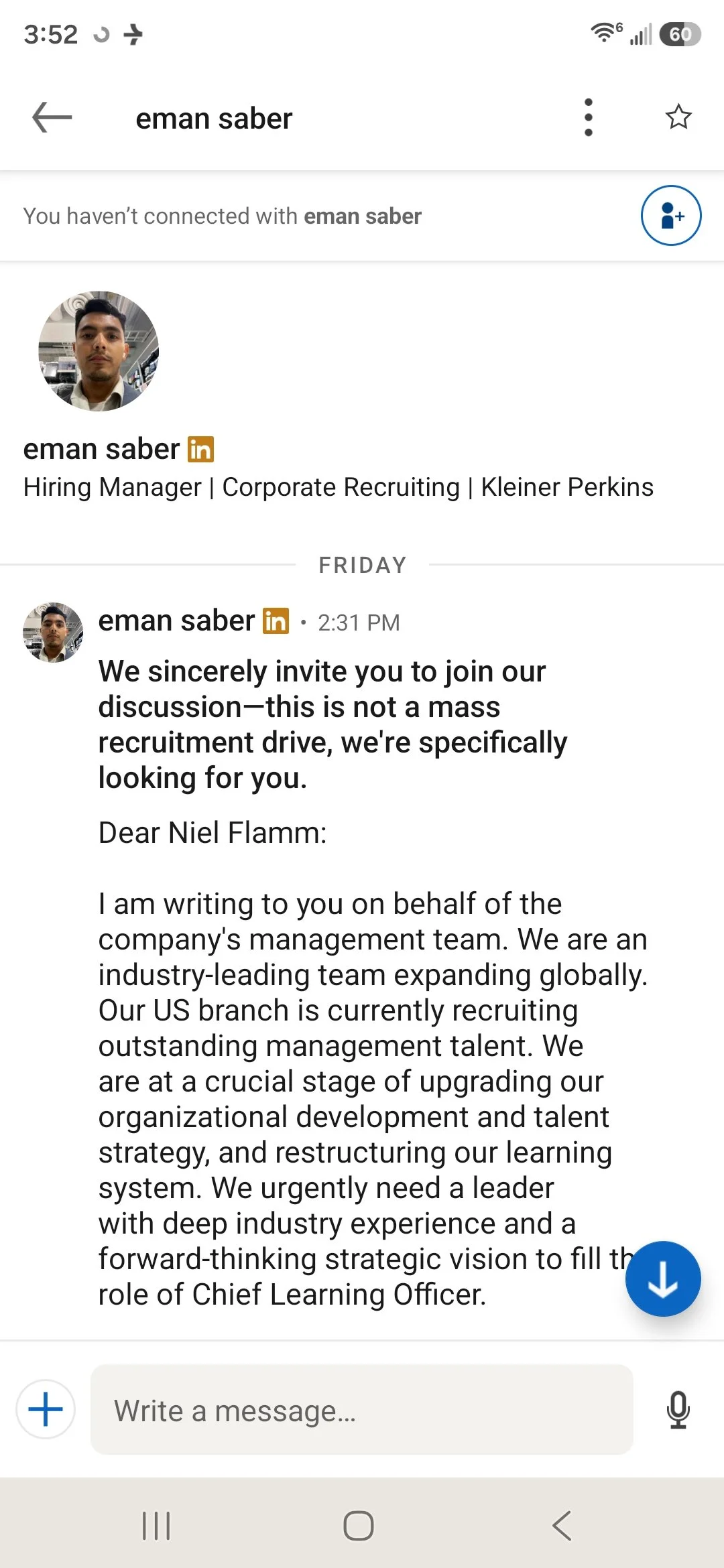
Then came the familiar script:
- An unsolicited executive opportunity.
- Generic praise about my "extensive experience."
- A request to move the conversation off LinkedIn to WhatsApp or Microsoft Teams Users Group.
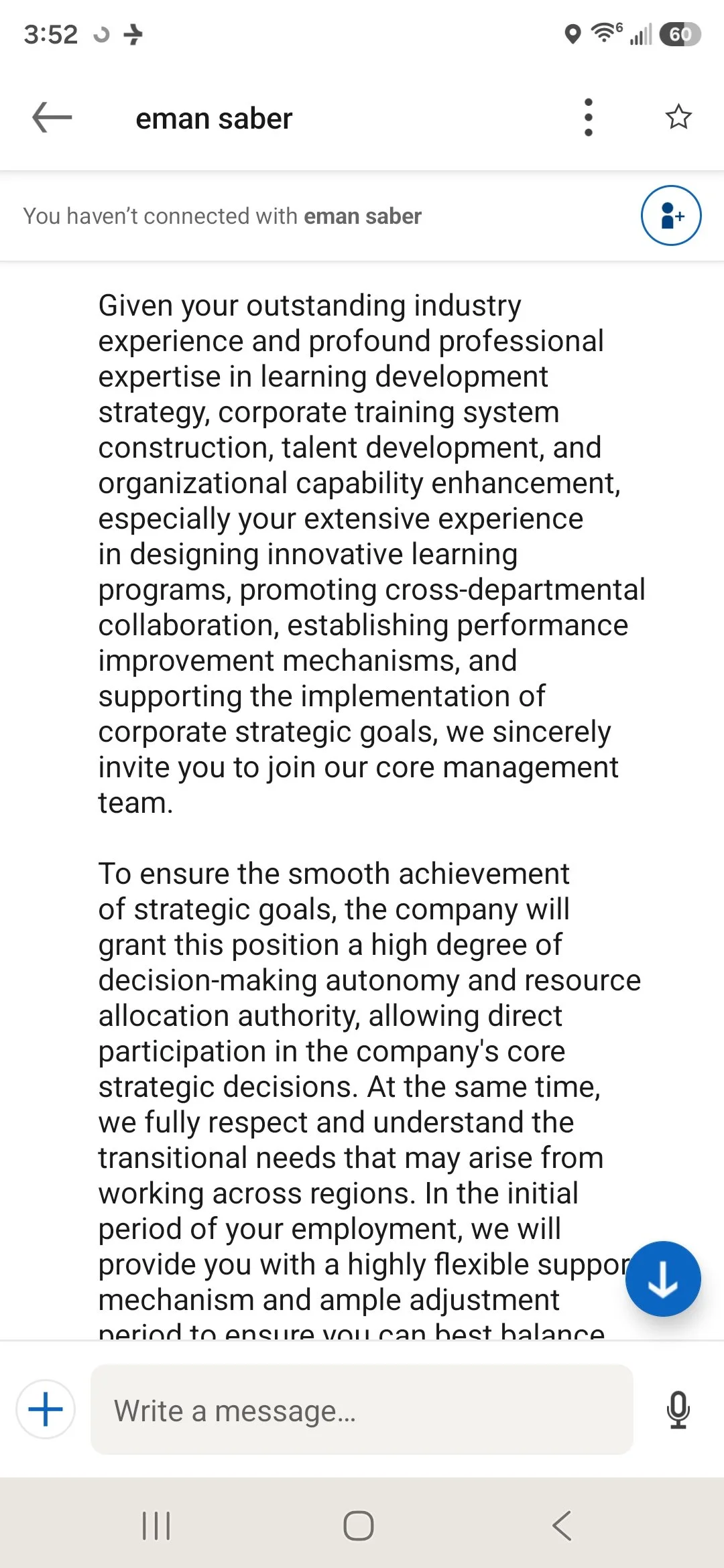
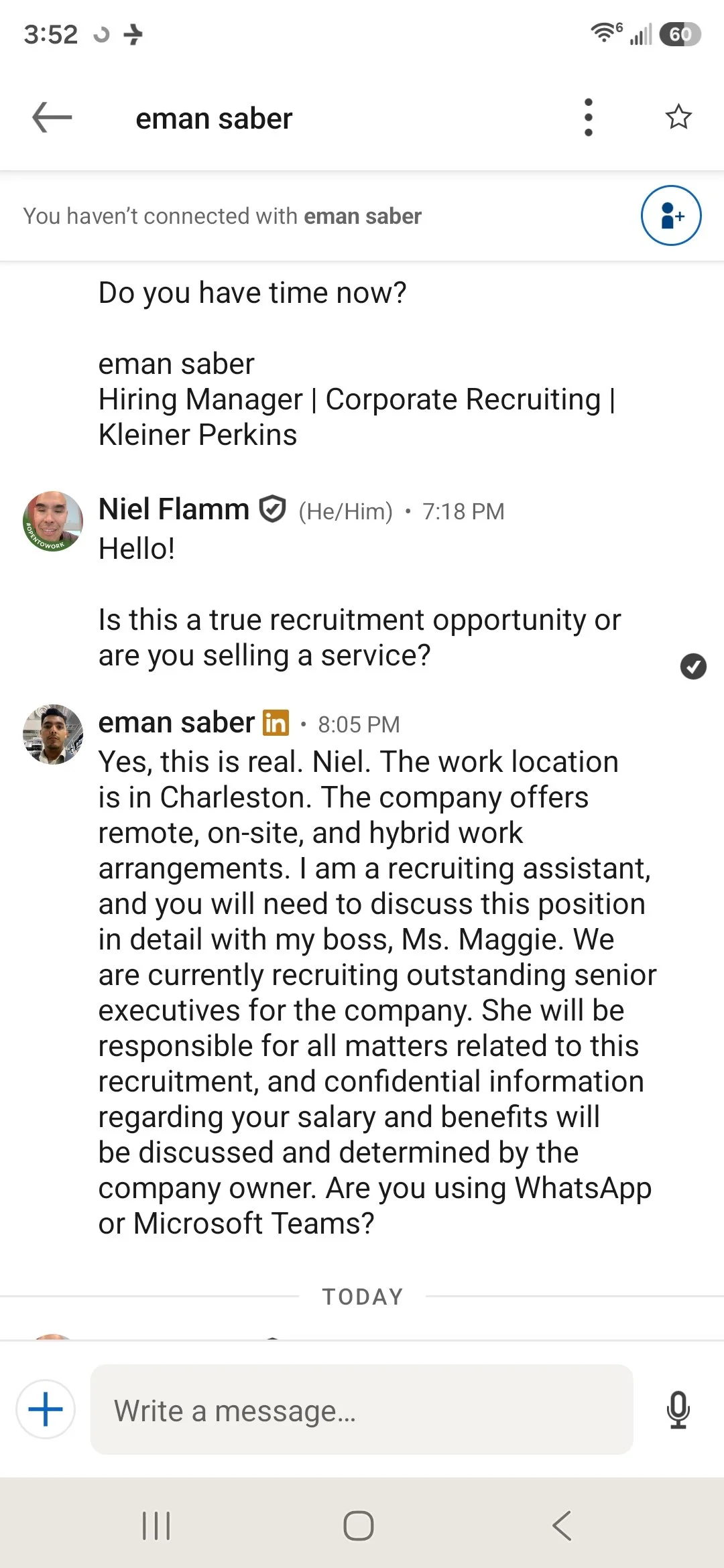
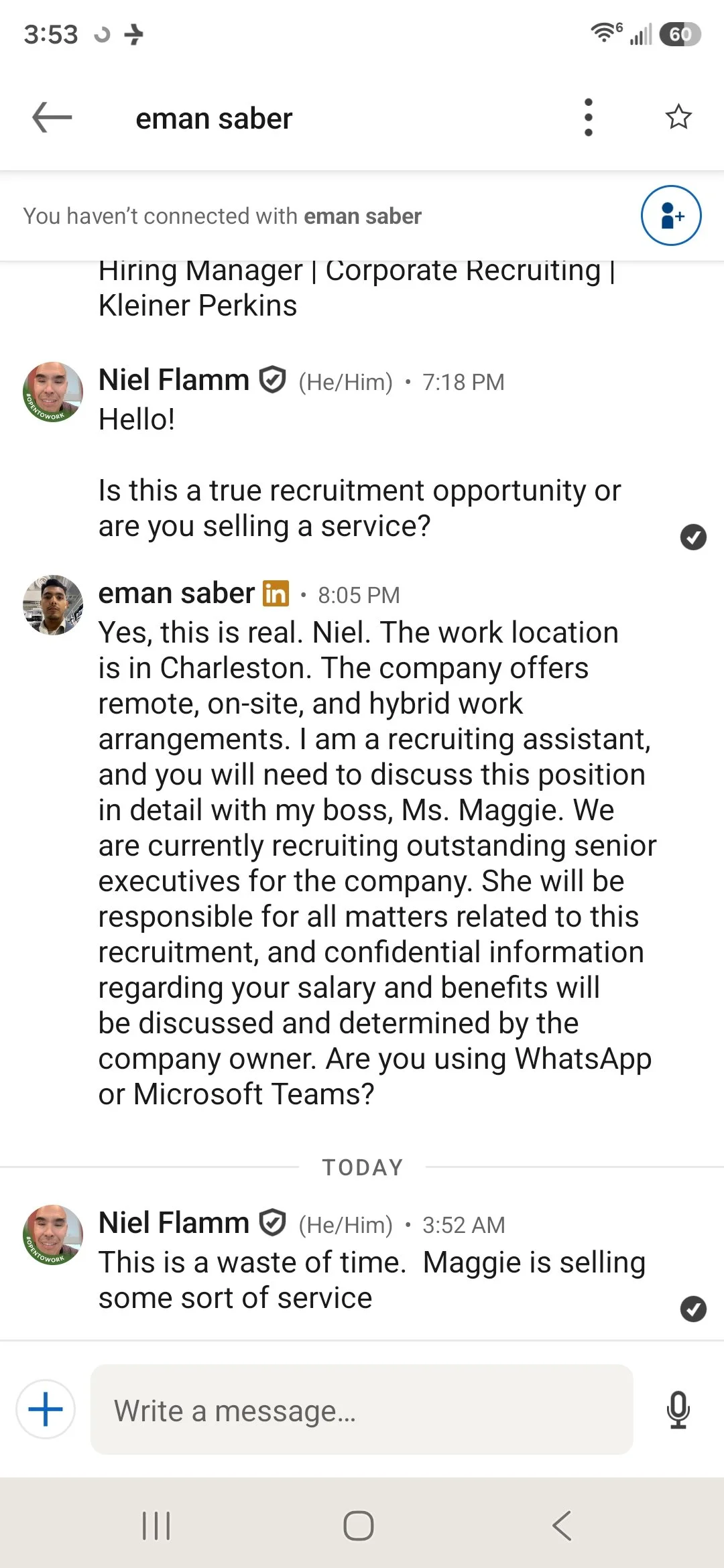
I've seen this pattern too many times.
The scammers need to do better.
Has anyone else noticed an increase in these fake recruiter accounts? I don't even have the #OpenToWork banner enabled, yet they keep finding me.
Stay skeptical. Ask for a job description. Verify who they represent. And don't leave LinkedIn until you've confirmed you're dealing with a legitimate recruiter.
Follow along on NielFlamm.com/blog.
Is It Really a Recruiter... or a Sales Pitch?
Have you ever been contacted by a recruiter with an "exclusive opportunity" that wasn't posted anywhere?
I was.
What happened next raised more red flags with every message.
The conversation moved from LinkedIn to Microsoft Teams, questions went unanswered, and what appeared to be a recruiting opportunity took a very different turn.
If you're actively looking for your next role, you need to know what to watch for before you invest your time—or your money.
I break down the entire interaction, the warning signs, and what happened next in this video.
🎥 Watch here: https://nielflamm.com/videos/scams