

Day 81: Nextdoor Says It Loves Small Businesses. So Why Put a Tollbooth Between Them and Their Neighbors?

Today is Day 81.
Yesterday I wrote about Nextdoor telling businesses:
“A reputation you earn is worth more than one you can buy.”
Today, let's look at what Nextdoor is actually building for those businesses.
Nextdoor's announcement is here:
https://blog.nextdoor.com/small-business-improvements
The company is rolling out Local Faves, redesigned free Business Pages, improved search, new business dashboards and, eventually, the ability for local businesses to participate directly in the neighborhood feed.
Some of that sounds great.
But then we arrive at:
Opportunity Alerts.
Nextdoor describes this as a paid product that routes requests from verified neighbors directly to local service providers so those businesses can respond first and potentially win the job.
And that's where I see the money grab.
Imagine the Neighborhood Conversation
A neighbor posts:
“Does anyone know a good handyman?”
Another neighbor recommends Joe's Handyman Service.
Great.
That's supposedly what Nextdoor is all about: neighbors helping neighbors and businesses earning reputations organically.
But Joe's business being recommended doesn't necessarily mean Joe can simply jump into that conversation today and say:
“Thanks for the recommendation. I'd be happy to help.”
Nextdoor says direct feed access for local businesses is “coming soon.”
In the meantime, Nextdoor has a solution:
Pay for Opportunity Alerts.
Now Nextdoor can route those requests directly to participating service providers.
That's where I start asking questions.
If the value of Nextdoor is organic neighborhood recommendations, why put a tollbooth between the business and the opportunity?
Then There's the Stock
Tuesday, NXDR closed around $2.20.
Wednesday, it rebounded to approximately $2.28.
As I'm writing this, it's around $2.26.
Stocks fluctuate. Three trading days don't prove a management strategy is succeeding or failing.
But look at the broader context I've been documenting.
Communication problems.
Questions about moderation.
Small-business monetization.
Transparency concerns.
Shareholder frustration.
And a stock still well below the $2.68 close on August 10.
No matter how many podcasts the CEO appears on, eventually:
Decisions drive value.
Marketing doesn't substitute for execution.
Podcasts don't substitute for performance.
And corporate messaging doesn't automatically create investor confidence.
And That Brings Me Back to Nirav Tolia
I've already said that I've lost confidence in Nirav's leadership and believe the Board should make a change at the top.
I also continue to wonder about executive compensation.
When a company is still working toward consistent GAAP profitability, and shareholders are waiting for sustained value creation, how should executive bonuses and multimillion-dollar compensation packages be justified?
That's a legitimate shareholder question.
Especially when that compensation ultimately represents resources belonging to the company and its shareholders.
Then I Watched a Reel About Broken Corporate Culture
The reel was aimed primarily at employees evaluating their company's culture.
https://www.facebook.com/share/r/1GpV1cKmwi/
But watching it, I couldn't help but apply those ve observed while looking at Nex’ looking at Nextdoor from the outside.
Five themes stood out:
Poor Leadership Accountability
Unclear Values
Low Trust and Transparency
Poor Communication
Resistance to Feedback
I can't tell you what Nextdoor's internal culture is like.
I don't work there.
But I can describe what the culture looks like to me as a shareholder, user, and outside observer after 81 days of documenting interactions with the company.
And from where I'm sitting, those five descriptions are becoming uncomfortable fits.
Culture Eventually Becomes Visible
Corporate culture doesn't stay inside headquarters.
Eventually customers experience it.
Businesses experience it.
Investors experience it.
The public experiences it.
If communication is broken internally, eventually it appears externally.
If leadership resists internal criticism, outsiders will eventually notice.
If revenue becomes more important than stakeholder experience, the product will eventually reflect it.
And that's why I keep coming back to the same question:
What kind of company is Nextdoor trying to become?
A neighborhood network?
An advertising platform?
A lead-generation service?
A trusted recommendation engine?
Or some combination of all four?
Making money isn't the problem.
Nextdoor absolutely needs to make money.
I'm a shareholder. I want revenue, profit, and a rising stock price.
But there's a difference between monetizing a valuable ecosystem and making every interaction feel like another opportunity to collect a toll.
Day 81
The stock is around $2.26 as I write this.
The small-business monetization strategy continues.
The podcasts continue.
I'm still waiting for the two detailed Insights studies.
And from my perspective, the signs of a broken corporate culture continue to become more visible from the outside.
Poor leadership accountability.
Unclear values.
Low trust and transparency.
Poor communication.
Resistance to feedback.
Maybe Nextdoor disagrees.
Good.
Explain why I'm wrong.
Because blocking criticism, ignoring questions, and adding another paid product isn't changing my assessment.
It's reinforcing it.

Day 80: Nextdoor Wants to Talk About Reputation? Seriously?

Today is Day 80.
And Nextdoor managed to stop me in my tracks with the very first sentence of a LinkedIn post:
“A reputation you earn is worth more than one you can buy.”
They have to be kidding.
Of all the subjects Nextdoor could lecture businesses about, they chose:
Reputation.
This accompanies a new announcement distributed through Business Wire:
Nextdoor Deepens Its Commitment to Local Business Discovery and Recommendations
The release describes Nextdoor as “the essential neighborhood network” and announces changes intended to make the platform a destination for trusted local-business recommendations. It says nearly 30% of Nextdoor content already involves local business recommendations and reports nearly 75 million Faves across almost 6.6 million businesses. Business Wire
Those are impressive talking points.
But let's talk about reputation versus reality.
“The Essential Neighborhood Network”?
Nextdoor can call itself that.
But reputations aren't created by press releases.
And Nextdoor has spent years dealing with a very different nickname:
The “Karen” of social media.
That reputation didn't appear out of nowhere. Nextdoor's so-called “Karen problem” has been publicly discussed for years, including criticism involving neighbors policing one another and reporting behavior they don't like. Wikipedia
Spend enough time on the platform, and the irony becomes hard to miss.
Neighbors arguing about noise.
Lawns.
Politics.
Parking.
Dogs.
e-Bikes.
Someone's trash cans.
Someone else's kids.
Someone looked suspicious.
Someone's music is too loud.
Someone's grass is apparently threatening civilization.
Welcome to the essential neighborhood network.
Nextdoor says a reputation should be earned.
Okay.
Then Nextdoor's reputation has to be judged by what its platform actually produces—not merely by what Communications writes about it.
Then There Are the Businesses
Here's where today's announcement gets particularly interesting.
The release celebrates businesses earning recommendations organically and says Nextdoor is helping businesses build reputations that “can't be bought.”
Then, just a few paragraphs later, we get:
Opportunity Alerts.
That's a paid product that routes requests from verified neighbors directly to local service providers. The release also says a forthcoming business feed will allow businesses to comment and engage with neighbors. Business Wire
Wait.
We're celebrating reputations that can't be bought...
while introducing paid access to opportunities?
I'm not saying businesses shouldn't pay for advertising or leads. Nextdoor needs revenue. I'm a shareholder—I want it to make money.
But let's not pretend there isn't a tension worth discussing.
If a neighbor says:
“Can anyone recommend a plumber?”
and as businesses are increasingly encouraged to pursue paid products to reach those opportunities, where does authentic neighborhood conversation end and lead generation begin?
That's the conversation I'd like Nextdoor to have.
Users. Businesses. Investors.
That's what I find so fascinating about the current Nextdoor strategy.
I see friction across all three groups.
Users can end up fighting with other users over everything from lawns to e-Bikes.
Businesses are being introduced to new monetized tools for reaching neighbors actively seeking services.
And then there are investors like me.
Nextdoor has been around for roughly 15 years, and shareholders are still waiting for the enormous upside we've been promised.
Meanwhile, Q2 2026 still produced a $2 million GAAP net loss, although that's substantially better than the $15 million loss a year earlier, and adjusted EBITDA was positive $10 million. Business Wire
I've already made my position clear:
I have lost confidence in Nirav Tolia's leadership and believe Nextdoor needs a change at the top.
The Press Release Has a Messaging Problem
Read the announcement carefully.
It says:
Real people, not algorithms, decide who's trustworthy.
Then the very same announcement touts AI-powered Search and machine-learning ranking systems that improve what neighbors see. Business Wire
It says reputations can't be bought.
Then promotes a paid product for routing neighbor requests to service providers.
It emphasizes organic word of mouth.
Then discusses tools businesses can use to manage campaigns.
None of those products is inherently bad.
The problem is the gap between the beautifully crafted language and the much messier reality of operating and monetizing the platform.
And after 80 days of examining Nextdoor, that's becoming a recurring theme.
About That Reputation...
Nextdoor's own CEO, Nirav Tolia, says in the release:
“Local businesses have always grown through word of mouth.” Business Wire
I agree.
And word of mouth works for public companies too.
Customers talk.
Businesses talk.
Employees talk.
Investors talk.
Reputation isn't what a company calls itself in a Business Wire headline.
It's what people say about the company when the Communications department isn't writing the sentence.
So when Nextdoor tells businesses:
“A reputation you earn is worth more than one you can buy.”
I actually agree completely.
Which leads to my Day 80 question:
Nextdoor, what reputation have you earned?
Because that's a much more interesting question than the one the press release answers.
Day 80.
Still waiting for the two detailed Insights reports.
Still documenting the contradictions.
Still a shareholder.
And still wondering whether Nextdoor reads its own messaging before telling everyone else about reputation.
Read the full continuing Nextdoor case study at NielFlamm.com/blog and subscribe at NielFlamm.com to follow what happens next.
Is Nextdoor Pricing Out the Very Businesses That Built It?
I've been writing a lot about communication, moderation, and corporate culture at Nextdoor.
Today, I want to talk about small businesses.
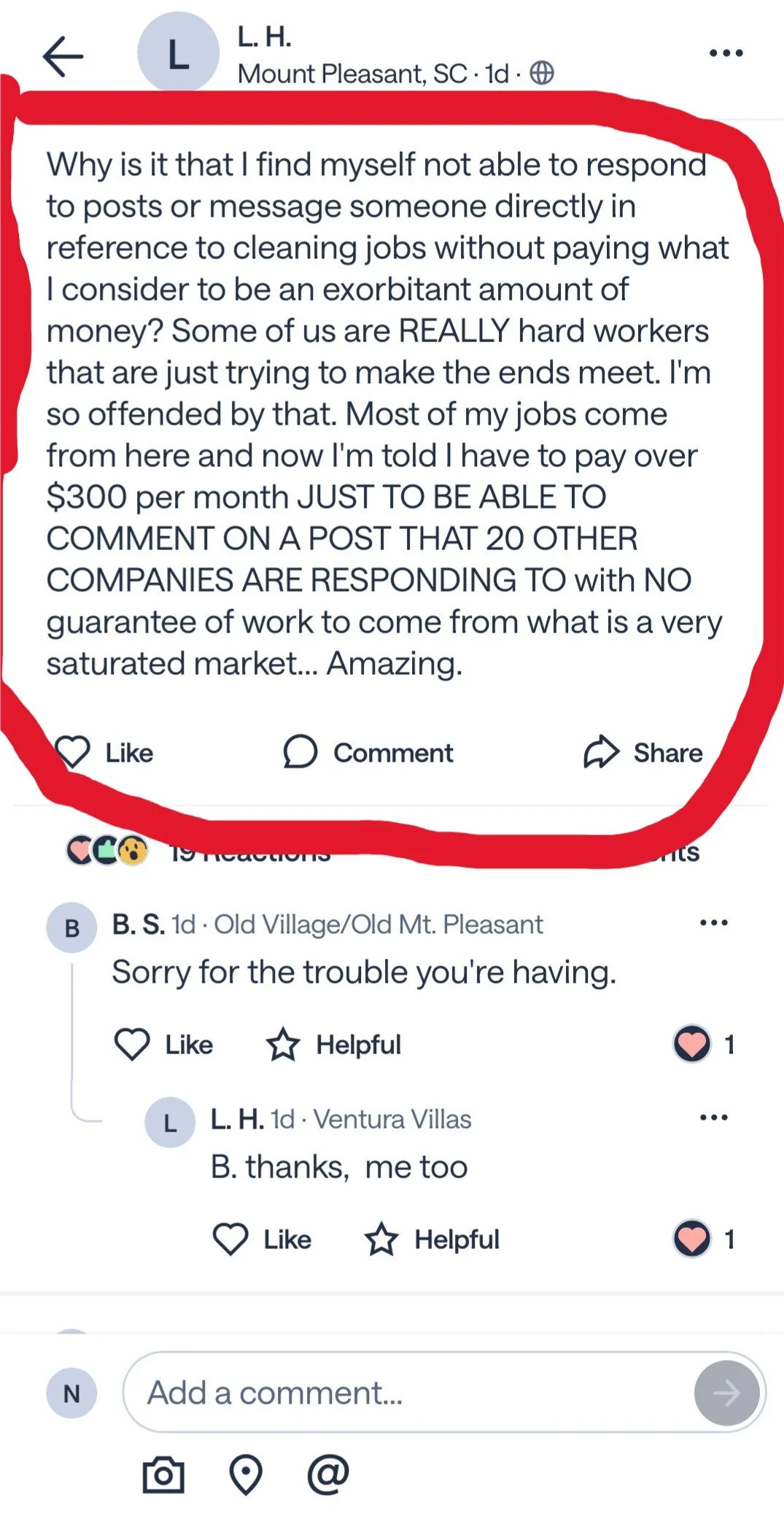
The attached screenshots show a local business owner frustrated after learning that responding to neighborhood requests now requires an additional paid option—reportedly more than $300 per month—on top of maintaining a business presence on the platform.
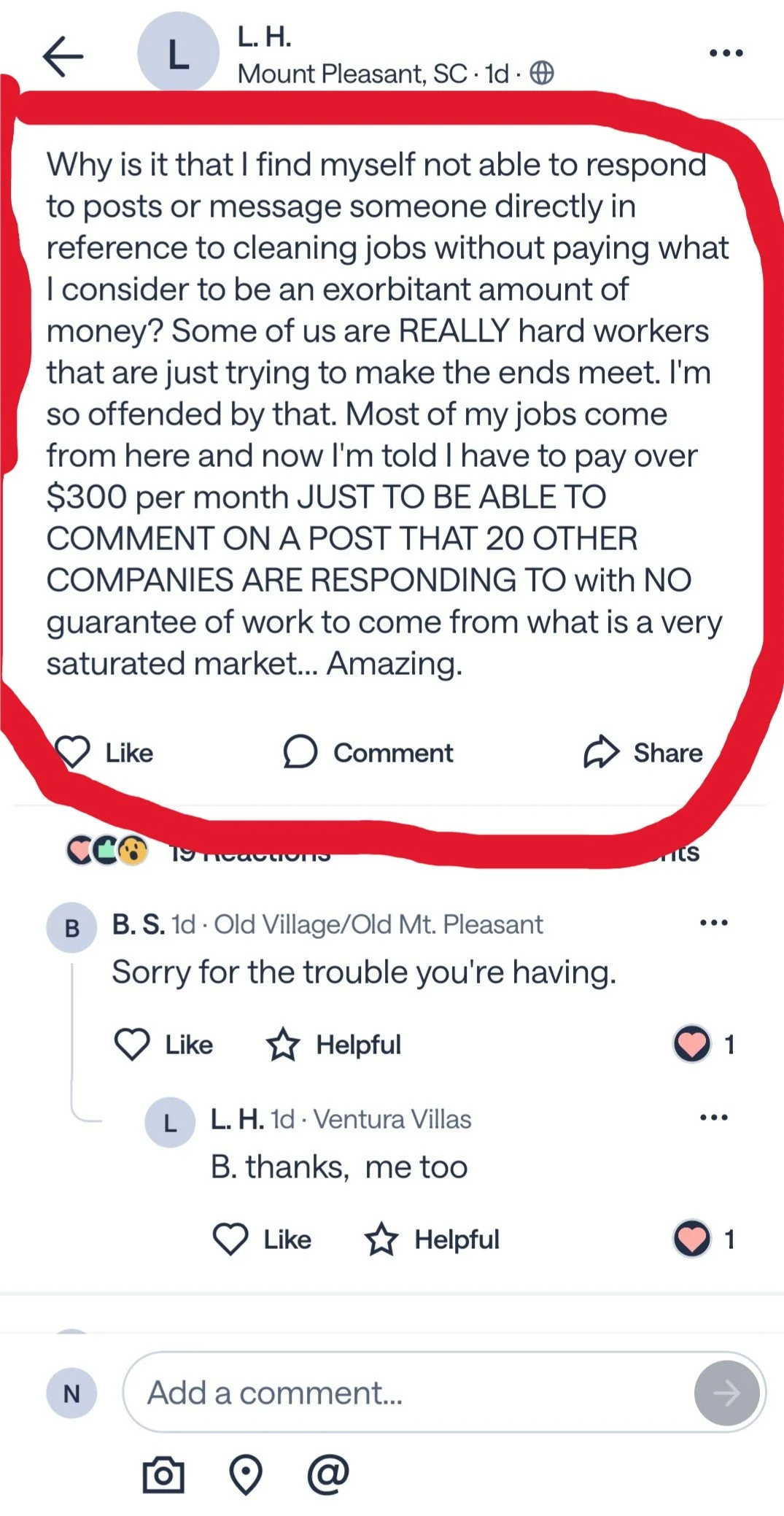
For many cleaners, landscapers, painters, handymen, and other neighborhood businesses, that's a significant monthly expense.
And it comes with no guarantee of winning the work.
That raises an important question.
Is Nextdoor pricing out the very local businesses that helped make the platform valuable?
It also makes me wonder:
Does this also apply to restaurants, contractors, or other businesses that receive feedback? If someone leaves a review or asks a question, can the business publicly respond without paying the additional fee?
If not, how does that strengthen community?
For full transparency, I don't have a Nextdoor business account, and I won't be purchasing one as part of my experiment.
As a shareholder, I'm not interested in making another investment in a company that doesn't currently pay a dividend on my existing one.
What concerns me is the impact on local businesses operating in already saturated markets.
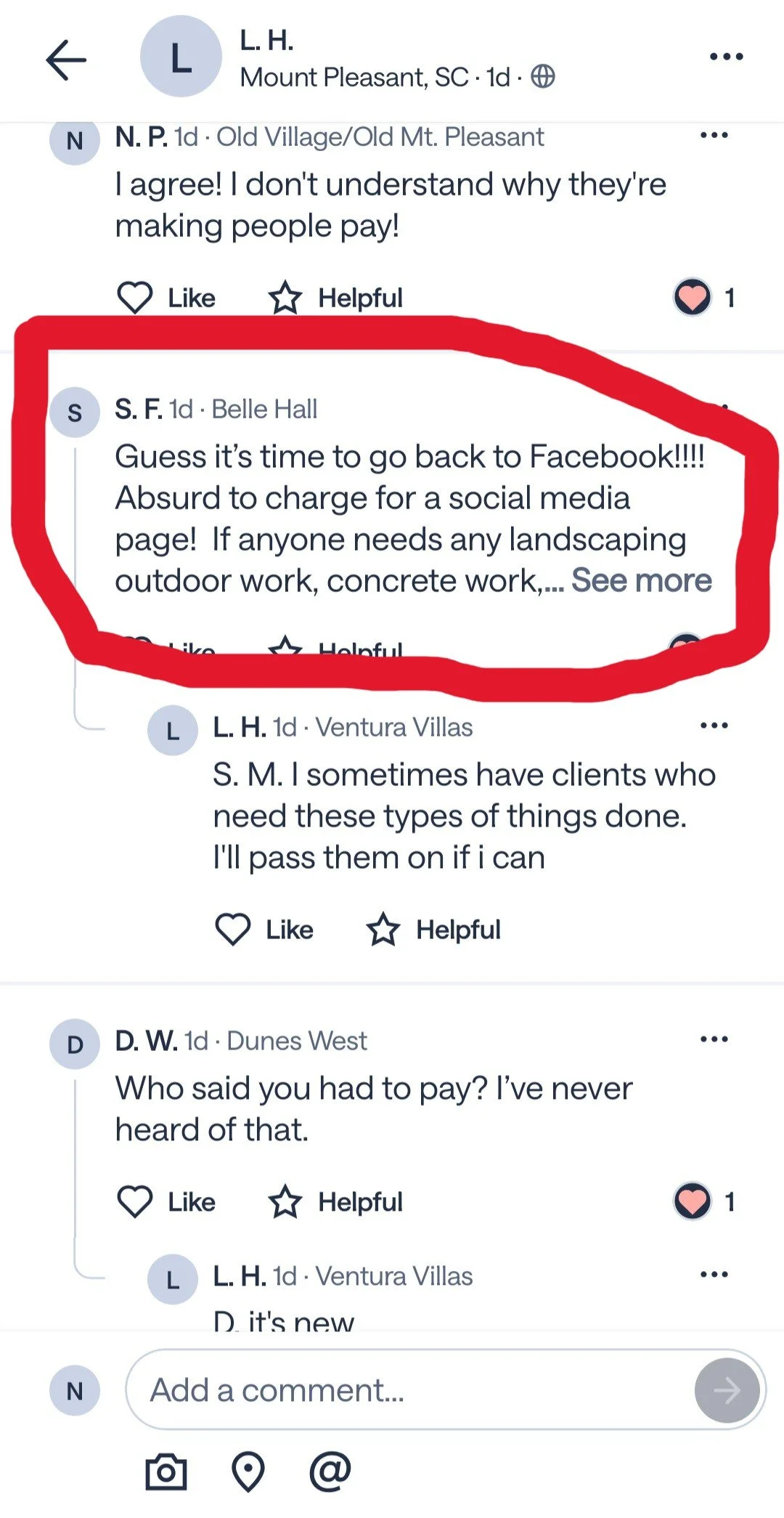
One commenter summed it up:
"Guess it's time to go back to Facebook."
That caught my attention.
Nextdoor grew by connecting neighbors with local businesses. If those businesses conclude the return on investment no longer makes sense, they'll naturally spend their advertising dollars elsewhere.
As a shareholder, I want Nextdoor to grow.
But growth should create value for both shareholders and the businesses paying the bills.
If the screenshots accurately reflect how this feature works, could you help me understand how CEO Nirav Tolia could approve a model like this while continuing to emphasize "community"? To me, community means removing barriers between neighbors and local businesses—not creating new ones.
Would you be willing to pay $300+ per month to respond to neighborhood requests?
Join the discussion at NielFlamm.com/blog. Leave some feedback—I'd love to hear from you.
Nextdoor's Latest Success Story Raises an Interesting Question
I recently read a great story in Business Insider about two young entrepreneurs who built a multimillion-dollar junk removal business from the ground up.
I'm all for it.
Small businesses are the backbone of our economy, and stories like theirs deserve recognition.
https://www.businessinsider.com/seven-figure-business-junk-removal-side-hustles-entrepreneurship-2026-7
What caught my attention, however, wasn't the entrepreneurs.
It was a small detail in the article.
The story notes that their earliest customers came through word of mouth, local Facebook groups, and Nextdoor.
That made me think back to my own experience.
My last suspension from Nextdoor was on September 21, 2025, after posting several items and being told I was violating the platform's spam policies. The message was clear: if you're promoting a business, use a business account and paid business tools.
Nextdoor promotes business advertising starting at approximately $5 per day, making it clear that there are paid options available for local businesses.
So here's my question:
Did these entrepreneurs promote their business on Nextdoor through a paid business account?
Or did they simply use personal neighborhood posts?
The article doesn't say.
That missing detail matters.
I'm not suggesting they did anything wrong. They may have followed every policy perfectly.
But without that context, it raises broader questions about consistency.
If one business owner is expected to pay for visibility while another grows through neighborhood posts, where is the line?
How is that distinction communicated?
How is it enforced?
Consistency matters.
Whether you're a plumber, dog walker, cleaning service, home health aide, winery, or junk removal company, the same rules should apply equally to everyone.
That's what builds trust—not only with neighbors, but also with the small businesses Nextdoor says it wants to support.
As a shareholder, I believe transparency about those policies is just as important as celebrating entrepreneurial success.
Join the discussion on NielFlamm.com.
I Asked ChatGPT What This Means for Nextdoor. The Answer Wasn’t What I Expected.
Nextdoor recently announced a partnership with the Independent Insurance Agents & Brokers of America.
Instead of immediately forming my own opinion, I asked ChatGPT to analyze this announcement:
https://blog.nextdoor.com/indagency-partner
…along with Nextdoor’s business model, public strategy, and the potential impact on users, local businesses, and investors.
The response surprised me.
Yes, there were positives.
More advertising revenue.
More opportunities for independent insurance agencies.
Potentially better monetization.
But the majority of the analysis focused on the risks.
Local businesses could face increasing pressure to pay for visibility instead of earning it organically.
Neighbors may experience a platform that feels more like an advertising marketplace than a community.
Investors could see additional revenue without meaningful improvements in engagement or long-term loyalty.
More partnerships don’t automatically create more trust or stronger neighborhoods.
The core question remains: Does each new partnership improve the user experience, or does it primarily expand advertising opportunities?
One observation stood out to me.
ChatGPT didn’t focus on technology. It focused on behavior.
AI analyzed incentives, relationships, engagement patterns, and the gap between the company’s public messaging and the experience users may have on the platform.
Technology can generate revenue.
Behavior determines whether people return.
I’d love to hear your thoughts after reading the announcement and discussing its potential impact.