
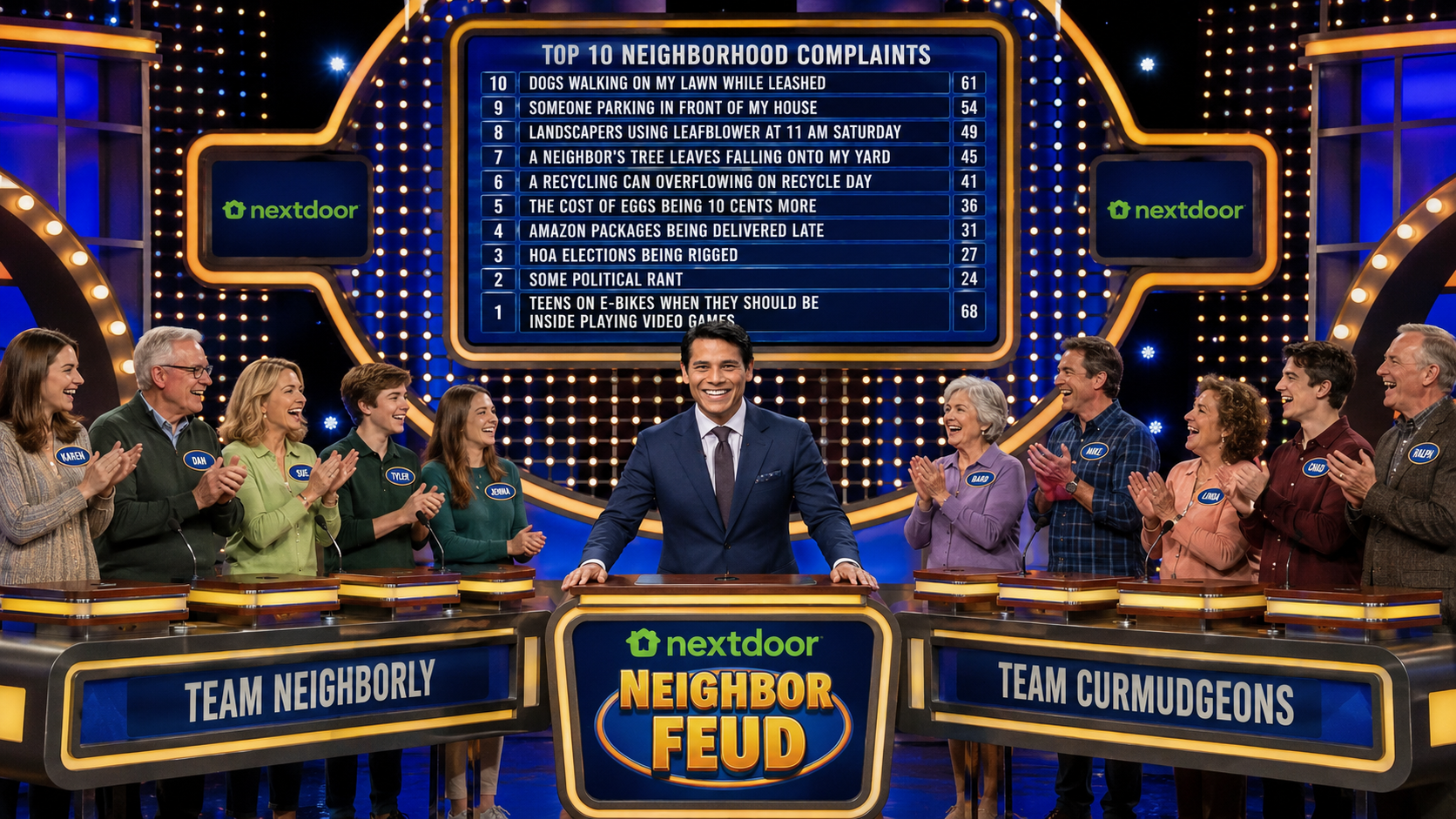
NEXTDOOR NEIGHBOR FEUD
Parody Notice: This fictional satire uses exaggerated characters and dialogue for humor and commentary.
Scene
Live from Nextdoor Studios, it's America's favorite neighborhood complaint game show.
Hosted by #NiravTolia.
The only game show where everybody complains and nobody changes their mind.
Cast
Nirav Tolia – Host
Poush Ohver – Contestant
Blinky the Clown – Contestant
Marcel the Mime – Contestant
Sarah – Contestant
Tony – Contestant
Nirav: Welcome to Nextdoor Neighbor Feud!
Poush: Isn't Nextdoor a social network?
Nirav: That's adorable.
Nirav: We surveyed neighbors and asked:
"What are the biggest neighborhood emergencies that aren't actually emergencies?"
Poush: Dogs walking on my lawn while leashed.
DING!
Nirav: Number 10!
Tony: Someone parking in front of my house.
DING!
Nirav: On a public street?
Tony: That's what makes it personal.
Sarah: Landscapers using leaf blowers at 11 a.m. Saturday.
DING!
Poush: Isn't that a normal time?
Everyone: BOOOOOOO!
Blinky: My neighbor's tree leaves fell into my yard.
Nirav: Nature strikes again.
Tony: An overflowing recycling can.
DING!
Nirav: On recycling day?
Tony: You're missing the point.
Sarah: Eggs cost ten cents more.
DING!
Poush: That's a complaint?
Sarah: It became one.
Blinky: Amazon delivered my package late.
DING!
Nirav: By how much?
Blinky: Four hours.
Tony: HOA elections are rigged.
DING!
Nirav: Evidence?
Tony: Twelve paragraphs.
Sarah: A political rant.
Nirav: Which side?
Sarah: Yes.
Poush: Teens on e-bikes when they should be inside playing video games.
DING! DING! DING!
Poush: I thought adults wanted kids outside.
Tony: Not where adults can see them.
Bonus Round
Nirav: What is Nextdoor really?
Poush: A social network?
Sarah: A community platform?
BUZZZZZZ!
Blinky: A highly efficient complaint delivery system?
Nirav: Correct!
Nirav: Of course it is.
Poush: How?
Nirav: People complain together.
Narrator: And for one brief moment, the entire neighborhood was united.
By complaining about e-bikes.
Subscribe to NielFlamm.com.
𝗜𝘁 𝗙𝗶𝗻𝗮𝗹𝗹𝘆 𝗗𝗮𝘄𝗻𝗲𝗱 𝗢𝗻 𝗠𝗲 𝗪𝗵𝗮𝘁 𝗜’𝗺 𝗗𝗼𝗶𝗻𝗴 𝘄𝗶𝘁𝗵 𝗡𝗲𝘅𝘁𝗱𝗼𝗼𝗿
I think I finally figured it out.
By publicly criticizing, analyzing, parodying, and discussing Nextdoor so often… I’m helping drive attention directly to the platform.
Because Nextdoor doesn’t always feel like a calm digital neighborhood square.
Sometimes it feels like daytime chaos television.
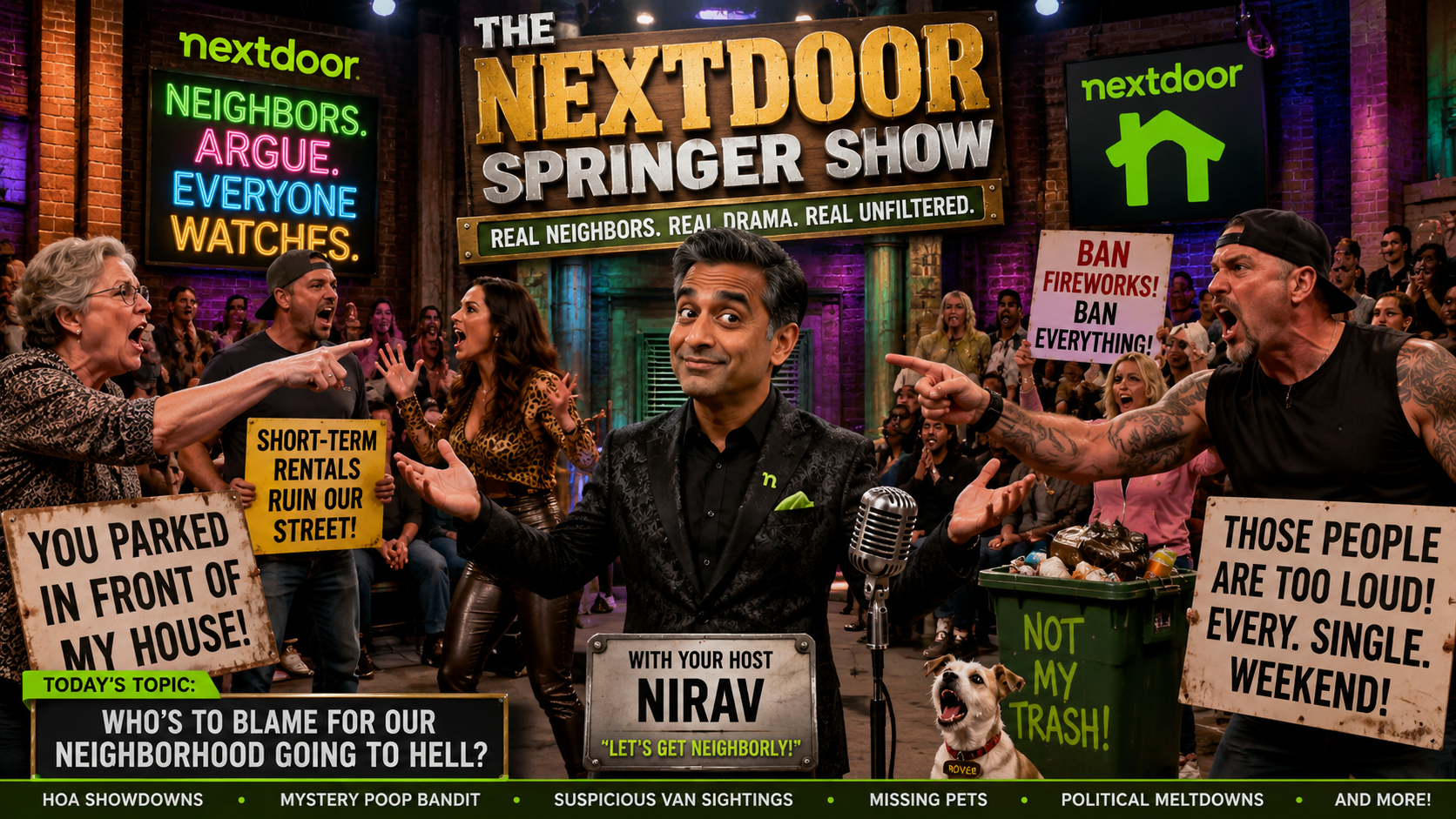
A little The Jerry Springer Show, mixed with The Steve Wilkos Show security energy, and a dash of Maury “the DNA results determined…” drama — except instead of paternity tests, it’s HOA complaints, parking wars, surveillance screenshots, suspicious vans, missing pets, fireworks at midnight, and neighbors arguing over garbage cans.
And historically, chaotic talk shows worked for one reason:
People watched.
People shared.
People talked about the chaos afterward.
That attention became the product.
The irony is hard to ignore:
The more people debate moderation, censorship, neighborhood drama, and strange platform behavior… the more engagement the platform receives.
Even investors may be noticing.
The stock has shown signs of life recently, and whether people love the platform, hate it, mock it, or criticize it — attention still fuels visibility.
That doesn’t erase legitimate concerns surrounding moderation transparency, unpaid moderators, vague rule enforcement, or appeals systems.
But it does reveal something uncomfortable about modern social media:
Outrage has economic value.
Drama has engagement value.
And maybe Nextdoor accidentally became less of a neighborhood app and more of a reality show with property lines.
Which means… I may have joined the marketing department by mistake.
You’re welcome Nirav Tolia.
World Cup 2026 Will Expose What Nextdoor Really Is
FIFA World Cup 2026 is coming to North America.
Millions of visitors. Dozens of host cities. Neighborhoods transformed overnight into unofficial fan zones.
And somewhere in the middle of all of it — Nextdoor's unpaid volunteer moderators trying to hold together a platform that was never really about unity in the first place.
Because Nextdoor markets itself as the app that connects neighbors.
But spend five minutes on it, and you'll find something closer to the opposite — a platform that monetizes suspicion, amplifies grievance, and turns the people living closest to you into the people you trust least.
And World Cup 2026 is about to pour gasoline on it.
When millions of visitors flood into host city neighborhoods, watch how fast "community" curdles into:
"Suspicious vehicle" reports filed against fans who don't look like they belong
Racial profiling dressed up as safety concerns — reported, ignored, or quietly deleted
"Out-of-towners are ruining our neighborhood" posts racking up hundreds of upvotes
Flag displays triggering nationality-based arguments that moderators don't know how to touch
Short-term rental rage that splits neighbors into economic factions
Noise complaints weaponized against certain households but not others
Local businesses accused of price gouging — with no context, no fairness, no appeal
The moderation will be inconsistent. The rule enforcement will be opaque. Some posts will disappear. Others — somehow — won't.
That's not a bug. That's the pattern.
Nextdoor has spent years positioning itself as the trusted hub for hyper-local connection. But what it's actually built is a digital space where fear travels faster than goodwill, where anonymity emboldens bad-faith reporting, and where the loudest, most territorial voices set the tone for everyone else.
World Cup 2026 won't just stress-test Nextdoor's moderation infrastructure.
It will expose what the platform has always been — not a town square, but a complaint box. Not a community builder, but a division engine with a neighborhood aesthetic.
The world is coming to North America to celebrate together.
Nextdoor will find a way to make it a neighborhood dispute.
Is Nextdoor a connector or a divider? Have you seen it bring people together — or push them apart?