

Day 123: Nextdoor Talks About AI. What About Election-Year Privacy and Safety?

Election Day is approaching, and I'd like Nextdoor CEO Nirav Tolia to address something.
We've heard plenty about AI, neighborhood intelligence, and the value of Nextdoor's data. Those are important topics.
But here's a question that deserves just as much attention:
What happens when a neighborhood discussion turns political—and someone with access to sensitive user information decides to misuse it?
Politics can get heated. People disagree. Local moderators try to enforce community rules, but no moderation system can guarantee that every discussion stays civil.
Now consider what makes Nextdoor different from many other social platforms: the connection between accounts and verified neighborhood addresses.
That raises an important question about access, privacy, and accountability.
The Risk Isn't Just What People Post. It's Who Can Access the Data.
Imagine a neighbor gets into a heated political disagreement with someone on Nextdoor.
What if the disagreement escalates beyond comments?
What if someone tries to identify where another person lives, expose their phone number, intimidate them offline, or use private information to retaliate?
I'm not claiming this has happened or that Nextdoor moderators are misusing anyone's information. I'm asking what safeguards exist to prevent it.
If a moderator or someone with platform privileges can access sensitive information tied to verified accounts, what prevents them from abusing that access?
A person's ability to moderate a conversation shouldn't automatically mean they need access to that person's private information.

Nirav, Here's What I'd Like to Know
Access controls: Who can access users' verified addresses, phone numbers, and other sensitive information?
Least privilege: Are moderators restricted to the information they actually need to perform their duties?
Audit trails: Does Nextdoor log and review access to sensitive user information, and can suspicious activity trigger an investigation?
Moderator accountability: What screening, training, and oversight help prevent abuse of moderator privileges?
Reporting and response: If a user suspects their information has been misused, how can they report it, and what protections and response procedures are available?
Election-season readiness: Does Nextdoor have specific procedures for handling political harassment, doxxing, threats, and attempts to take online disputes into the real world?
These aren't accusations. They're basic questions about privacy, security, and risk management.
Verified Addresses Create Responsibility
Nextdoor's neighborhood model depends on connecting people to real communities. That can help make local conversations relevant.
But verification alone doesn't guarantee good behavior.
A verified address is a trust signal—not a guarantee that everyone with access to the platform will act appropriately.
Security has to extend beyond verifying who belongs in a neighborhood. It must also govern who can access sensitive information, why they can access it, and what happens when someone abuses that privilege.
That's especially important when disagreements become personal.
AI Can Wait. Let's Talk About Protecting People.
Nirav, I'm interested in Nextdoor's AI strategy. I'm interested in neighborhood intelligence and how the company plans to become profitable.
But as Election Day approaches, I think privacy and safety deserve a direct conversation, too.
People shouldn't have to choose between participating in their neighborhood and worrying that their personal information could be used against them.
What safeguards does Nextdoor have to protect users when political disagreements get heated—and how does it hold people with privileged access accountable?
I'm not asking Nextdoor to disclose security details that could help someone bypass its protections. I'm asking for a clear explanation of the safeguards, oversight, and reporting procedures that protect its users.
Day 123. I still want Nextdoor to succeed. Protecting the people who make the platform valuable should be part of that success.
👉 Follow my continuing case study at NielFlamm.com/blog
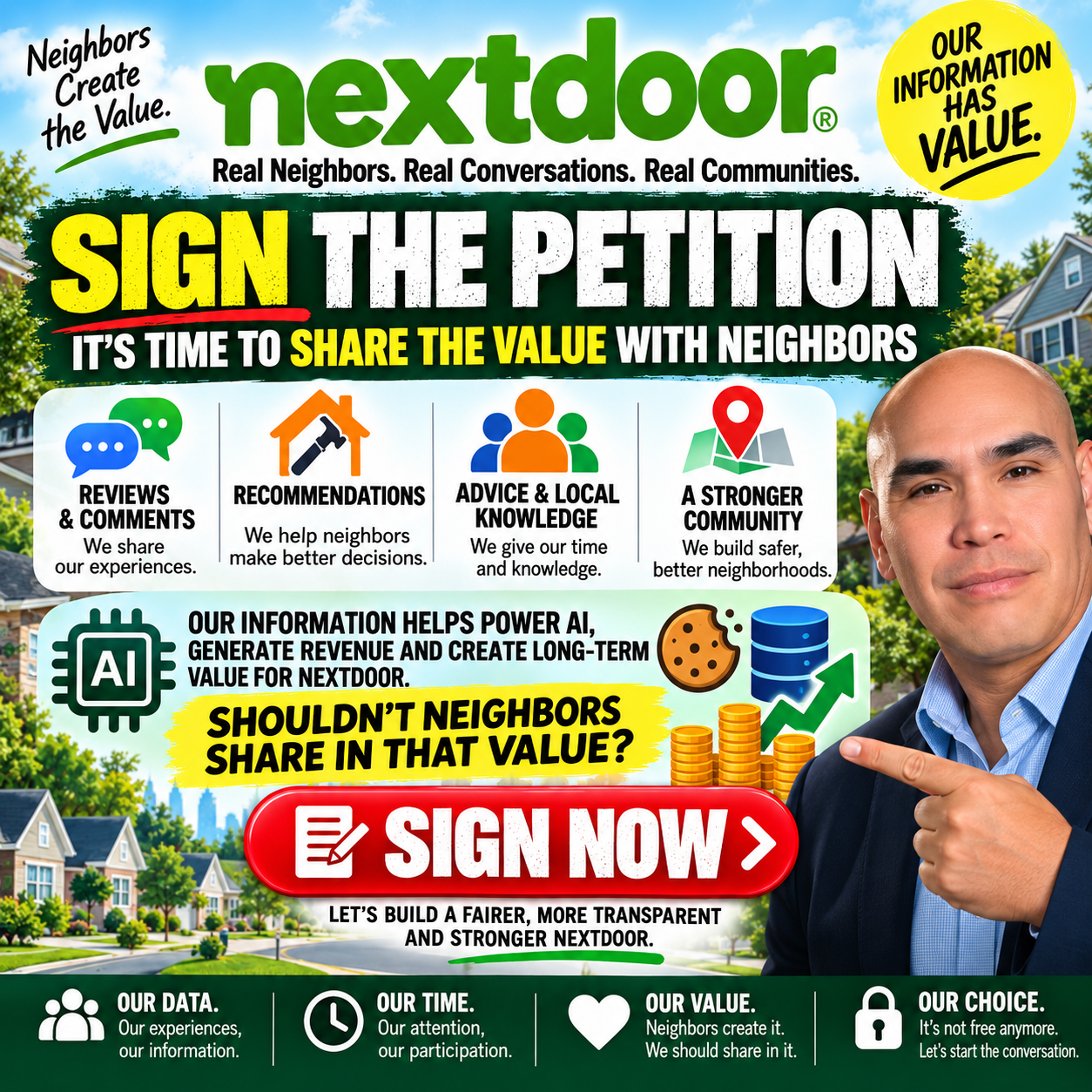
The Free Data Buffet Is Over: If Our Content Creates Value, We Should Share in It
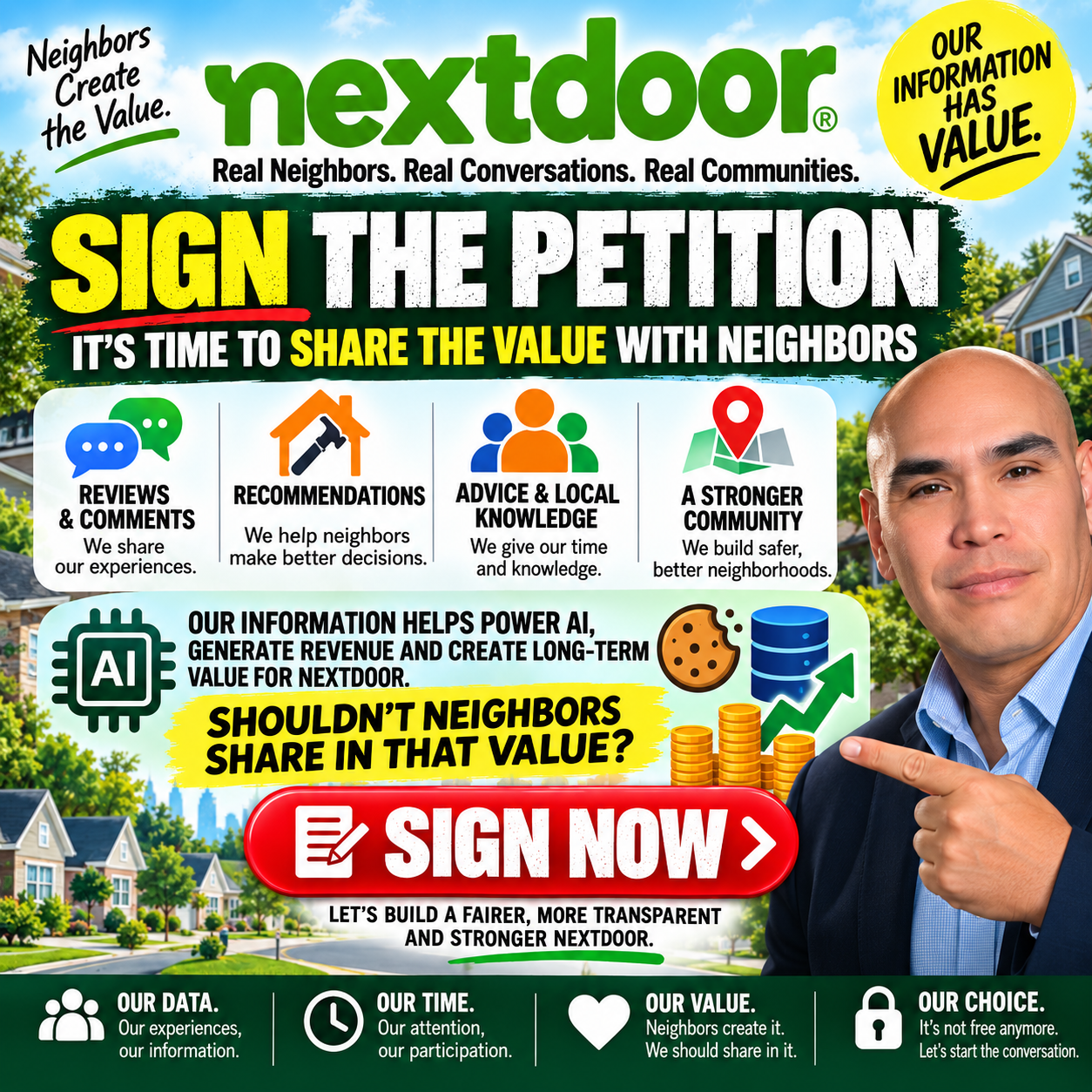
A while ago, I started a petition asking a fairly simple question:
If Nextdoor can create economic value from information neighbors provide, why shouldn't the neighbors who provide it participate in that value?
Today, I'm expanding the question.
This isn't only about Nextdoor anymore.
It's about social media platforms, websites, apps, advertising networks, and other digital businesses that collect information about what we read, click, search, recommend, review, discuss, and buy.
My message is becoming simpler:
Our information isn't free anymore.
At least, I don't think it should be.
We Keep Supplying the Raw Material
Think about what people give digital platforms every day.
We write reviews. We recommend restaurants. We tell neighbors which plumber showed up on time. We answer questions. We upload photographs. We comment. We click. We search. We like things. We tell platforms what interests us.
Then there's the less obvious information: cookies, device identifiers, IP addresses, browsing activity, clicks and other event data.
These aren't all legally or technically the same thing, and different privacy laws and platform agreements govern how different types of information may be collected and used. I'm not claiming that placing a cookie on my browser magically means somebody owes me a royalty check.
I'm making an argument about economic value.
Because individually, one click may be almost meaningless.
Multiply those clicks, posts, recommendations, and behavioral signals across millions of people, however, and suddenly we're talking about an extremely valuable resource.
Nextdoor Makes the Point Particularly Well
Nextdoor increasingly describes itself in terms of neighbor-generated knowledge. Its 2025 Transparency Report described the platform as containing “neighbor-generated content and locally relevant information,” while Nextdoor's newer AI-powered Ask product draws upon nearly 15 years of conversations among verified neighbors. Nextdoor
That's valuable.
And who created those conversations?
Neighbors did.
Nextdoor built the platform.
Nextdoor paid engineers.
Nextdoor created the infrastructure.
Nextdoor developed the advertising business.
Nextdoor has every right to try to build a profitable company from those investments.
But neighbors supplied an enormous amount of the raw material that makes the platform useful.
Nextdoor itself says almost 30% of its content consists of organic recommendations and has talked about tens of millions of “Faves” associated with millions of businesses. Nextdoor Blog
That's nothing.

Cookies Are Part of the Bigger Conversation
The same principle makes me think differently about tracking.
Nextdoor's own data-processing documentation identifies things such as cookie IDs or similar identifiers, IP addresses, user-agent information, and event data such as clicks or installs among categories of personal data involved in certain advertising-related processing. Nextdoor Legal
Again, this isn't uniquely a Nextdoor issue.
It's an internet issue.
We've spent years becoming accustomed to clicking:
ACCEPT ALL COOKIES
Maybe we should start thinking more carefully about what we're accepting and what companies receive in return.
If information about my behavior helps improve targeting, train recommendation systems, develop products, measure advertising, build audiences or otherwise contribute to commercial value, I think it's reasonable to have a larger conversation about what the person generating that information receives in return.
Welcome Back to My Very Lonely Petition 😂
My petition hasn't exactly become the Boston Tea Party of user-generated data.
Last time I checked, it had one signature.
Mine.
😂
I already know what that guy thinks.
But perhaps my original message was too focused on Nextdoor.
Because this question is much bigger.
My updated message isn't:
Destroy social media.
It isn't:
Stop using the internet.
And it certainly isn't:
Companies shouldn't make money.
It's this:
If our participation creates commercial value, let's start talking about sharing that value.
That could take many forms.
Direct compensation for opt-in research. Contribution credits. Subscription benefits. Revenue-sharing pools. Advertising credits. Payments for particularly valuable content. Rewards for reviews or recommendations that generate measurable commercial activity. Stronger controls over commercial reuse. Clear choices about whether content can be used to develop AI products.
I don't pretend to have the perfect economic model.
That's what the conversation is for.
Until Then, We Can Stop Supplying Some of the Commodity
That's the other part of my petition.
Participation is voluntary.
If I don't like the economic arrangement, I can reconsider what I voluntarily contribute.
That doesn't mean withholding information about a missing child, dangerous weather, a lost pet, a fire, an emergency, or something that could protect another person.
Human safety comes before my argument about data economics.
I'm talking about the routine commercial material platforms benefit from:
Which roofer should I hire?
What's the best restaurant nearby?
Who installed your HVAC system?
Would you recommend this dealership?
Which insurance company do you use?
Every answer adds another tiny piece to a valuable database.
Maybe we should stop automatically assuming that contribution costs $0.00.
The Internet Made Us the Product, the Customer and the Workforce
That's what fascinates me.
We can simultaneously be the audience viewing advertisements, the customer purchasing products, the creator producing content, and the source generating behavioral data.
That's an extraordinary business model.
For the companies.
Maybe it's time users become more conscious participants in the economics too.
And I'm not suggesting that users automatically have a legal right to payment for everything they post or every cookie generated. Platform terms, privacy laws, and individual choices matter.
I'm saying something much simpler:
We can ask for a different deal.

Nextdoor, You're Still My Test Case
Nextdoor remains particularly interesting to me because its product depends so heavily on what neighbors know.
Without neighbors, there are no neighbor recommendations.
Without neighbors, AI has no years of neighborhood conversations to search.
Without neighbors, there are no local experiences to organize.
Without neighbors, advertisers have far less reason to want access to those neighborhoods.
Nextdoor says it wants every voice to have value. Nextdoor Business
Great.
Let's talk about the economic value too.
Nextdoor built the container.
Neighbors keep filling it.
So I'm Updating the Invitation
To Nextdoor.
To social-media companies.
To websites.
To apps.
To companies collecting behavioral information.
And, most importantly, to the people creating all of it:
Stop thinking of your digital activity as automatically worthless simply because nobody has historically written you a check for it.
Ask what you're providing.
Ask how it's being used.
Read the privacy controls.
Decline unnecessary tracking when you prefer not to.
Think before voluntarily providing another commercially useful recommendation, review, or piece of content.
And if enough people decide the current exchange isn't good enough?
Companies will have an incentive to offer a better one.
My petition may still have only one signature.
That's okay.
Every movement has a first person willing to look slightly ridiculous standing there alone.
I'm already bald. I've survived worse. 😂
Our information has value.
Our content has value.
Our recommendations have value.
Our attention has value.
Our time has value.
The question isn't whether digital companies should be allowed to create value.
The question is whether the people supplying so much of the raw material should be part of it.
I think that's a conversation worth having.
👉 Sign the petition: https://c.org/GkNWmffgg9
👉 Follow the continuing case study: NielFlamm.com/blog
The Hinge Experiment: Apparently My Date Reads My Blog
Well, The Hinge Experiment™ has taken an interesting turn.
Yesterday, I celebrated that after weeks of absolutely nothing happening on Hinge, I finally had a new match.
Airica.
We started talking. We discovered some things in common. She lives about an hour and a half away, which I don't consider a major obstacle. Most importantly, we started making plans to meet on Sunday.
So naturally, I did what I do.
I wrote about it with her photo.
And this morning, I discovered one tiny detail I probably should have considered more carefully:
Airica saw the post.
Oops.
Time for a Mea Culpa
I had to do a little mea culpa earlier today.
Airica was shocked that I'd posted about her and our Hinge match.
And you know what?
I totally get it.
She's a private person.
I am...
Well...
Have you met me?
I have a website with my name on it where I document my life regularly.
I write about dialysis.
I write about my prosthetic.
I write about eye surgery.
I write about scams.
I write about family.
I write about dating.
I once turned having zero Hinge matches into multiple blog posts and gave an imaginary iguana named Steve a recurring role.
Clearly, privacy and I have a somewhat unconventional relationship.
But that's my choice.
Airica didn't necessarily sign up for the same thing simply because she matched with me.
That's an important distinction.

My Life Is Public. Hers Doesn't Have to Be.
This was actually a good reminder for me.
I'm comfortable putting a lot of my life online.
Airica isn't.
Neither approach is wrong.
But when another person becomes part of one of my stories, particularly someone I'm just getting to know, I need to remember that my comfort level doesn't automatically become theirs.
So I apologized.
No excuses.
No:
“But I'm a blogger!”
No:
“But that's what I do!”
No attempt to convince her that she shouldn't have been surprised.
She was surprised.
I understood why.
Mea culpa.
Lesson learned.
And hopefully, lesson remembered.
But Here's the Good News...
Despite my apparently irresistible ability to create complications before the first date even happens, it looks like we're still on for tomorrow.
Yes.
Tomorrow.
The Hinge Experiment may finally produce an actual date.
Two people.
Same geographic location.
At the same time.
Intentionally.
I'm almost afraid to type that sentence.
Given the history of this experiment, I'm waiting for Hinge headquarters to send someone to my house and say:
“Sir, there's been a clerical error.”
But as of this writing...
We're on.
There's Just One Tiny Problem
Now I need to figure out what we're actually doing.
Details.
Apparently, announcing you're going on a date isn't the same as planning the date.
Who knew?
She's about an hour and a half away, so I'd like to come up with something that's worth the drive but also relaxed enough that we're not trapped in some elaborate four-hour romantic extravaganza if we discover within the first 20 minutes that we have absolutely nothing to say to each other.
That's the strange thing about meeting someone from an app.
We've talked.
We've messaged.
We've seen pictures.
We've read profiles.
But we've never actually been in the same room.
There is still that moment when two people meet and discover whether the digital version translates into real life.
I'm looking forward to finding out.
And Maybe I'll Try Something Radical
Perhaps tomorrow I'll do something completely outside my normal operating procedure.
Experience the date before writing about the date.
Revolutionary.
I know.
And if Airica prefers that parts of her life stay private, I can respect that.
The Hinge Experiment can still be my story without making every person I meet a public character.
Although Steve the Iguana remains fair game.
He signed a release.
Probably.
Current Hinge Standings
After weeks of watching an empty match screen:
Matches: 1.
Woman I'm actually talking to: 1.
Potential date tomorrow: 1.
Distance: About 90 minutes.
Mea culpas issued: 1.
Dates actually completed: Still 0.
That last number could finally change tomorrow.
First, however, I need to answer the most pressing question in The Hinge Experiment:
What the heck are we going to do?
Stay tuned.
Well...
Maybe don't stay too tuned.
I'm learning. 😂
Leadership Disconnect: The Rules You Promote Should Start With You
I’m on a roll tonight.
Maybe it’s because after dialysis, once the “dialysis hangover” feeling starts to fade — a feeling I remember from another lifetime over 17 years ago — I start connecting dots.
Tonight, something stood out.
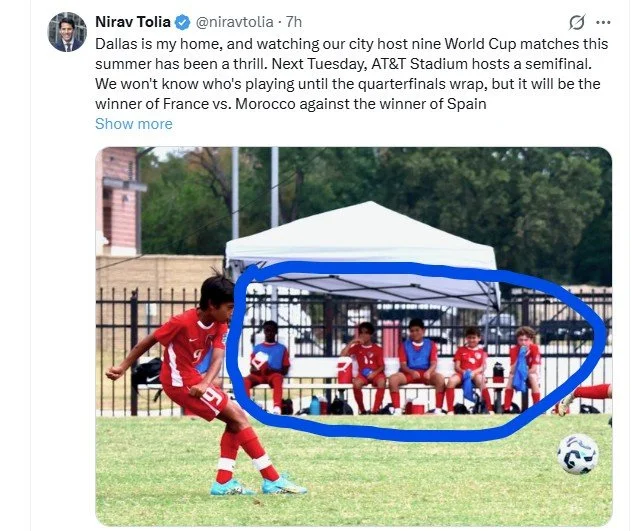
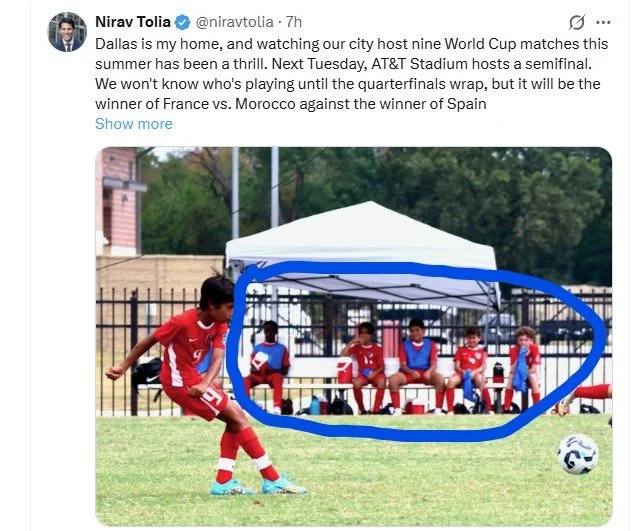
Nirav Tolia posted on X about the World Cup, his family, and how important soccer is to them—a proud parent moment.
I understand that.
However, the picture appeared to include his child during a game with other children and teammates clearly visible in the background.
Is posting a photo from a public event automatically illegal?
No.
That is not the point.
The point is awareness, judgment, and understanding of the community you lead.
The CEO of Nextdoor runs a platform where neighbors regularly discuss safety, privacy, strangers taking photos, and concerns about their children’s images and likeness being shared online without permission.
Parents ask:
“Who took this picture?”
“Why is my child online?”
“Did anyone ask before posting this?”
These are conversations happening on his own platform.
However, the person leading that platform seems comfortable sharing a moment in which other children may be included in a public post without their parents' consent.
That disconnect matters.
Leadership is not just what you say on a podcast.
Leadership is not just about kindness, trust, neighbors, and community.
Leadership is demonstrating an understanding of the concerns of the people using your product.
This is bigger than one picture.
It is about being connected to your customers' reality.
A CEO sets the example.
If your platform promotes trust, safety, respect, and community awareness — those principles should not stop when you log off the app.
You cannot build trust while appearing disconnected from what your own users are concerned about.
The community is speaking.
The question is:
Is leadership listening?
Join the discussion on NielFlamm.com.
Does Dynamic Pricing Build Community or Divide It?
I recently read Nextdoor's latest travel insights report, "Who Are Nextdoor's Summer Travelers? New Data Shows a High-Value, High-Intent Audience," which highlights that neighbors plan to spend significantly more on travel this summer and offers guidance on how advertisers can capitalize on these spending patterns.
I encourage everyone to review the full report and draw their own conclusions.
One section gave me pause.
In a previous post, I questioned whether moderators or platform personnel have access to verified address information. If any individual with inappropriate intent had access to that information and could also infer travel plans, it raises obvious privacy and security questions that deserve discussion. Strong governance and safeguards are essential for any community platform.
I also noticed the report is based on an internal Nextdoor survey conducted in April 2026. Yet, many of the detailed survey methodologies and statistical metrics are not publicly provided alongside the findings. Greater transparency around methodology can help readers better evaluate research conclusions.
Finally, the report discusses opportunities for advertisers to target neighbors based on spending behaviors and travel intent. Dynamic pricing models have become common across industries—from airlines to rideshare services and technology products—but I question whether encouraging businesses to maximize pricing based on demand truly strengthens neighborhood relationships or creates additional financial pressure for families trying to enjoy time together.
Community platforms should strive to connect neighbors, not simply optimize monetization opportunities.
Read the complete report and decide for yourself.
Subscribe to NielFlamm.com.