
Nextdoor Published a Study About Trust. This Is More Like It.
I have spent a lot of time providing feedback about Nextdoor's Insights reports, so when the company does something substantially better, I think it's important to say so.
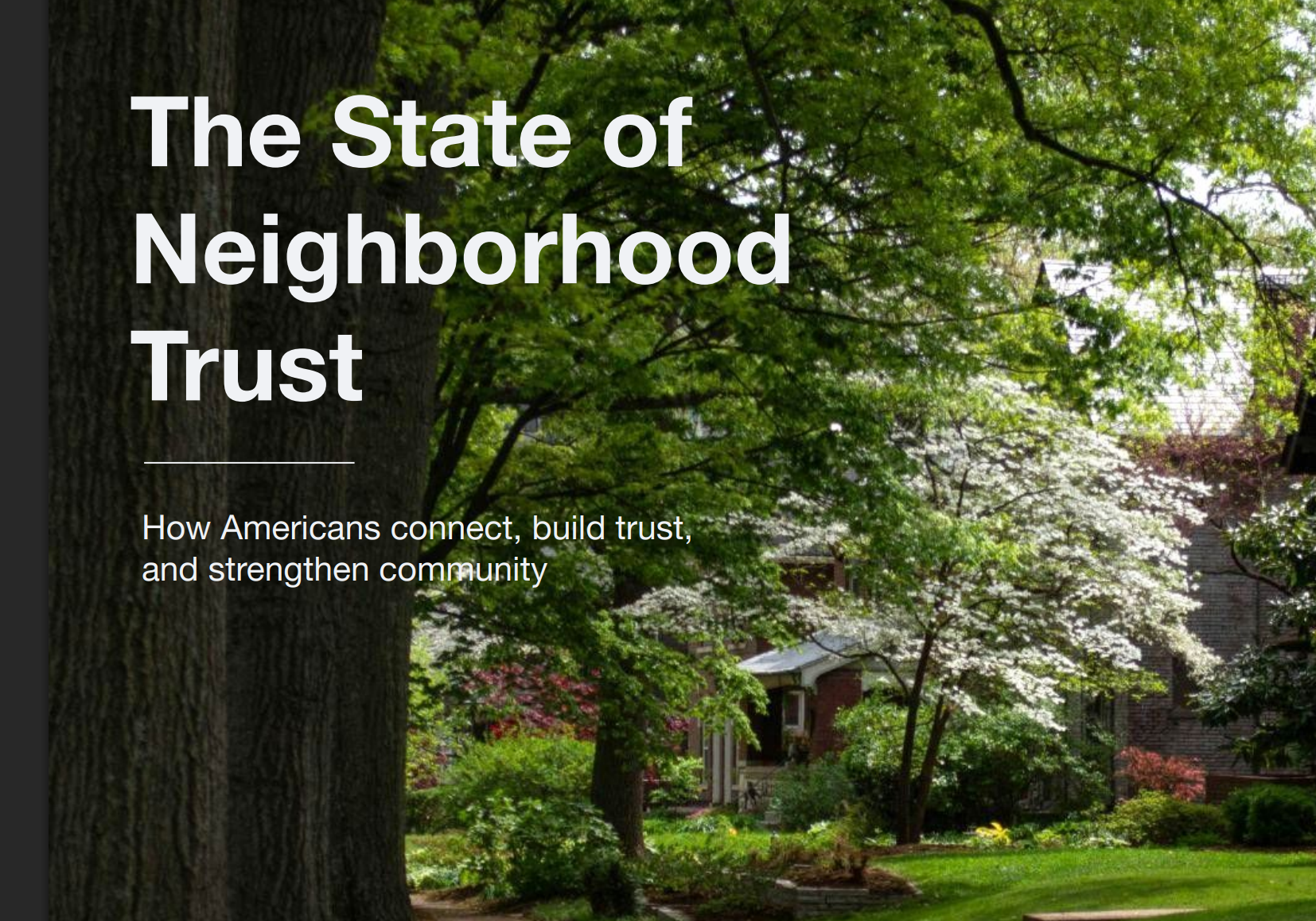
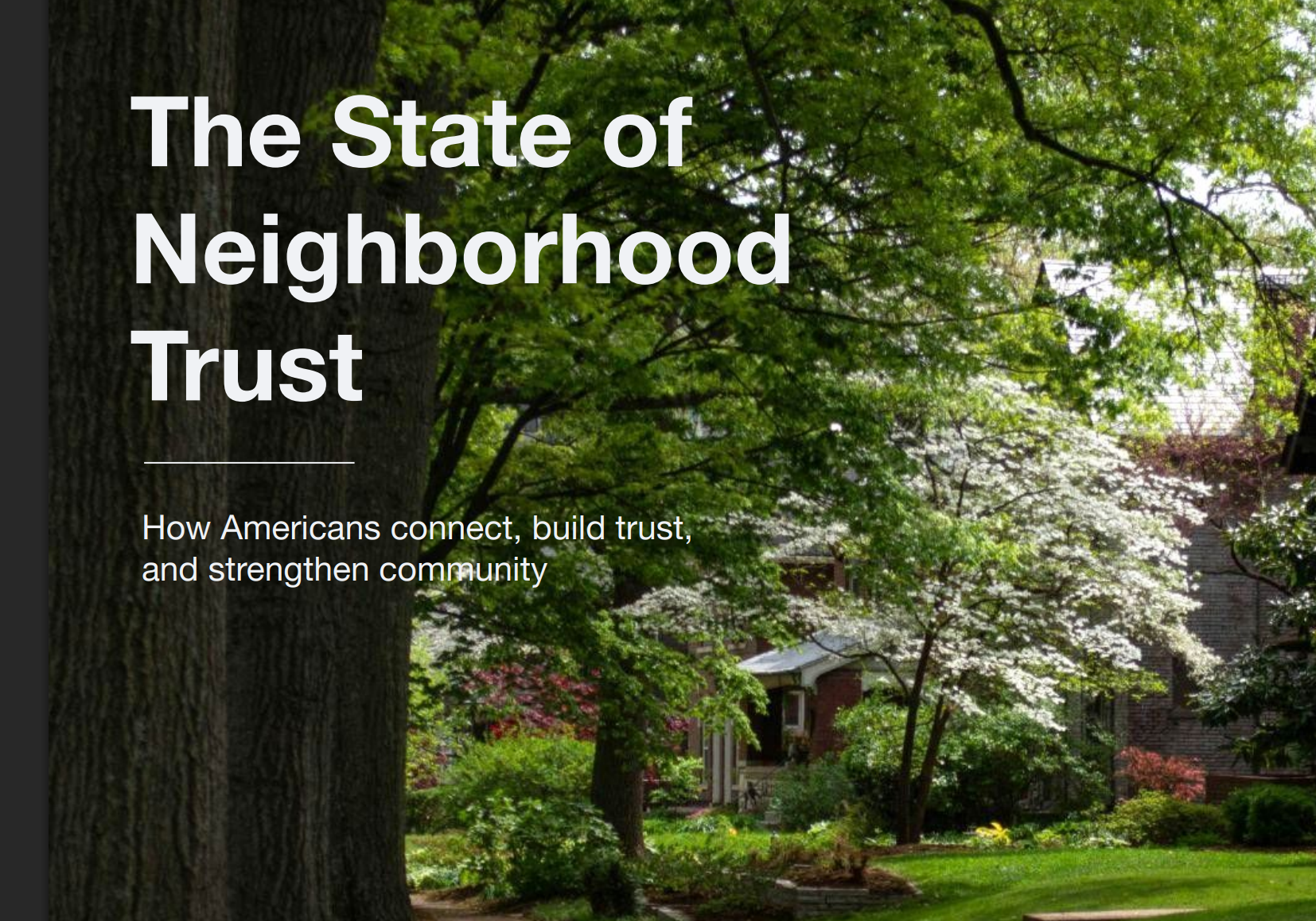
Nextdoor's new “The State of Neighborhood Trust” report, produced with The Harris Poll, is much closer to what I've been asking to see.
This looks and reads like an actual research report.
Not simply a blog post with percentages and a statement that more information exists somewhere else.
The report is 24 pages long. It identifies the research partner, describes the sample, discusses methodology, presents findings in context, includes statistical analysis, identifies outside sources, and provides a research contact. Nextdoor Blog
Read Nextdoor and The Harris Poll's full Neighborhood Trust study
Bravo, Nextdoor.
Yes, I actually said that.
Screenshot it before somebody blocks me. 😂
This Is What I've Been Asking For
Nextdoor commissioned the research, and The Harris Poll fielded it in April 2026 among about 1,000 U.S. adults age 18 and older. Respondents came through The Harris Poll's online panel and were weighted to reflect the U.S. adult population. Nextdoor says it then analyzed the findings and conducted statistical modeling examining factors associated with trust and outcomes including safety, belonging, civic participation and reliance on neighbor recommendations. Nextdoor Blog

The accompanying Nextdoor article provides even more methodological detail: the survey was conducted April 16–20 among 1,003 adults, weighting included age within gender, region, race/ethnicity, marital status, household size, income, education and political affiliation where necessary, and the reported Bayesian credible interval is ±3.8 percentage points at a 95% confidence level. Nextdoor also acknowledges other potential sources of survey error. Nextdoor Blog
That's transparency.
Could there be more?
Sure.
I'd love to see an appendix containing the questionnaire, complete crosstabs and additional demographic breakouts. Since The Harris Poll fielded the survey, it would also be useful to provide a Harris Poll contact or link explaining whether additional demographic information, questionnaires or crosstabs can be obtained.
But that's me asking for the cherry on top rather than wondering where the sundae went.
This report gives readers enough information to begin understanding where the numbers came from and how the research was conducted.
And the Subject Is…Trust
This is where things become particularly interesting given my recent experience with Nextdoor.
The entire report revolves around trust.
One finding says 66% identify friendly day-to-day interactions as something that builds neighborhood trust. Meanwhile, the leading factor respondents identified as weakening neighborhood trust was lack of communication, at 46%. Nextdoor Blog
Read that again.
Lack of communication: 46%.
I've been writing about communication for more than 100 days.
You couldn't script this better.
The study says trust grows through regular opportunities to communicate, interact, and rely on one another. It also says the strongest predictors include how easy people feel reaching their neighbors and how often they actually interact. Nextdoor Blog
That's not my interpretation of what Nextdoor should believe.
That's in Nextdoor's own report.
Then Nirav Tolia Says This
The report includes a statement from CEO Nirav Tolia:
“The difference between a neighborhood and a community is trust.”
That's a powerful statement. Nextdoor Blog
And that's precisely why I can't ignore the contrast with my experience.
Yesterday I discovered that Nirav had blocked me on X.
Again.
For the second time in roughly six months.
I don't know why Nirav blocked me. Only he knows his reason, and I'm not going to pretend otherwise.
He also doesn't have an obligation to personally engage with every person who comments on his social media account.
But I'm allowed to ask what message the action sends to me.
Because I'm not some anonymous account that appeared yesterday screaming at the CEO.
I'm a shareholder.
I've spent months publicly documenting questions about Nextdoor.
I've repeatedly offered to have an actual conversation.
I've said I'd rather talk than type.
And for more than 100 days I've been pursuing detailed research that Nextdoor itself told readers was available by contacting its Insights representative.
Now I'm reading a Nextdoor report telling me:
Trust depends on communication.
You can't make this stuff up.

Trust Has to Work in Both Directions
Another line in the report fascinates me.
Nextdoor writes that trust is built through repeated interactions, communication, and confidence that others will respond when it matters. Nextdoor Blog
Exactly.
That shouldn't only apply neighbor to neighbor.
I think it's a valuable principle for company-to-customer, leadership-to-shareholder, platform-to-user, and executive-to-stakeholder relationships too.
Trust isn't created by saying the word trust repeatedly.
It isn't created by putting trust in the title of a 24-page PDF.
And it isn't automatically created because a company commissions a reputable polling organization.
Trust grows when words and experiences begin matching.
That's what makes this new report simultaneously encouraging and fascinating to me.
The Research Is Actually Helping Build Trust
Here's where I give Nextdoor genuine credit.
This report increases my confidence in these findings because Nextdoor told me how the research was conducted.
That's exactly how transparency builds trust.
Compare:
“67% of Americans say, X.”
Okay. Where did that number come from?
Versus:
Here's who conducted the survey. Here's when it was conducted. Here's the population. Here's the sample. Here's how respondents were recruited. Here's how weighting worked. Here's the statistical approach. Here are limitations. Here are outside sources. Here's a research contact.
Now we're talking.
Interestingly, the PDF once again lists Jacob Chavis, Senior Manager, Customer Insights, along with his Nextdoor email address as the research contact. Nextdoor Blog
Jacob and I already have some history.
😂
Maybe This Is Progress
I've said throughout this case study that if Nextdoor does something I think is good, I'll say it's good.
This report is progress.
I don't know whether my months of posts had anything whatsoever to do with the format. I have no evidence that they did, so I'm not taking credit.
Maybe Nextdoor was already moving toward more comprehensive research reports.
Maybe working with The Harris Poll resulted in a more rigorous presentation.
Maybe somebody inside Nextdoor independently said, We should probably show people how we got these numbers.
Whatever the reason:
Keep doing this.
And take it one step further.
Provide a Harris Poll link or research contact.
Make additional demographic tables available.
Publish questionnaires where appropriate.
Provide downloadable crosstabs.
Let researchers, journalists, advertisers, shareholders, and curious bald bloggers dig deeper.
That's how confidence in research grows.
Now Apply the Research to Leadership
That's my bigger challenge to Nextdoor.
The report says communication matters.
It says repeated interaction matters.
It says accessibility matters.
It says trust helps communities function.
And its CEO says the difference between a neighborhood and a community is trust. Nextdoor Blog
Great.
Apply those principles internally and externally.
When somebody asks a difficult question, communicate.
When somebody provides feedback, listen.
When somebody requests information that you've advertised as available, answer.
When a shareholder repeatedly offers to have a conversation, perhaps conversation is more consistent with the company's message than another block button.
Nirav doesn't have to agree with me.
Nextdoor doesn't have to agree with me.
Jacob doesn't have to agree with me.
Nobody has to like my posts.
But if we're going to talk about rebuilding trust through communication and interaction, then I think it's fair to ask Nextdoor's leadership to demonstrate the same behavior it celebrates in its research.
Trust is a great research topic.
It's an even better leadership practice.
And this time, Nextdoor, on the research itself:
Bravo. Keep going.
👉 Read my continuing Nextdoor case study at NielFlamm.com/blog

Day 91: Another Email Sent. The Question Hasn’t Changed.

Day 91.
I've officially sent another email to the Nextdoor team.
And after 91 days, I have managed to make the request even shorter.
Not because the issue has become less important.
Because I'm running out of ways to make the question clearer.
The Request Is Still Incredibly Simple
Nextdoor published an Insights report about home insurance that told readers they could reach out for “detailed data, additional audience segments, and strategic recommendations.”
Another Nextdoor Insights report about financial advising and investing made a similar offer.
So I did something apparently radical.
I asked for the detailed data.
Not the blog posts.
Not links to the summaries I've already read.
Not an explanation of where the information appears on Nextdoor's website.
The detailed data referenced in the posts.
And today, on Day 91, I sent another email.
This Time, I Made the Choices Pretty Easy
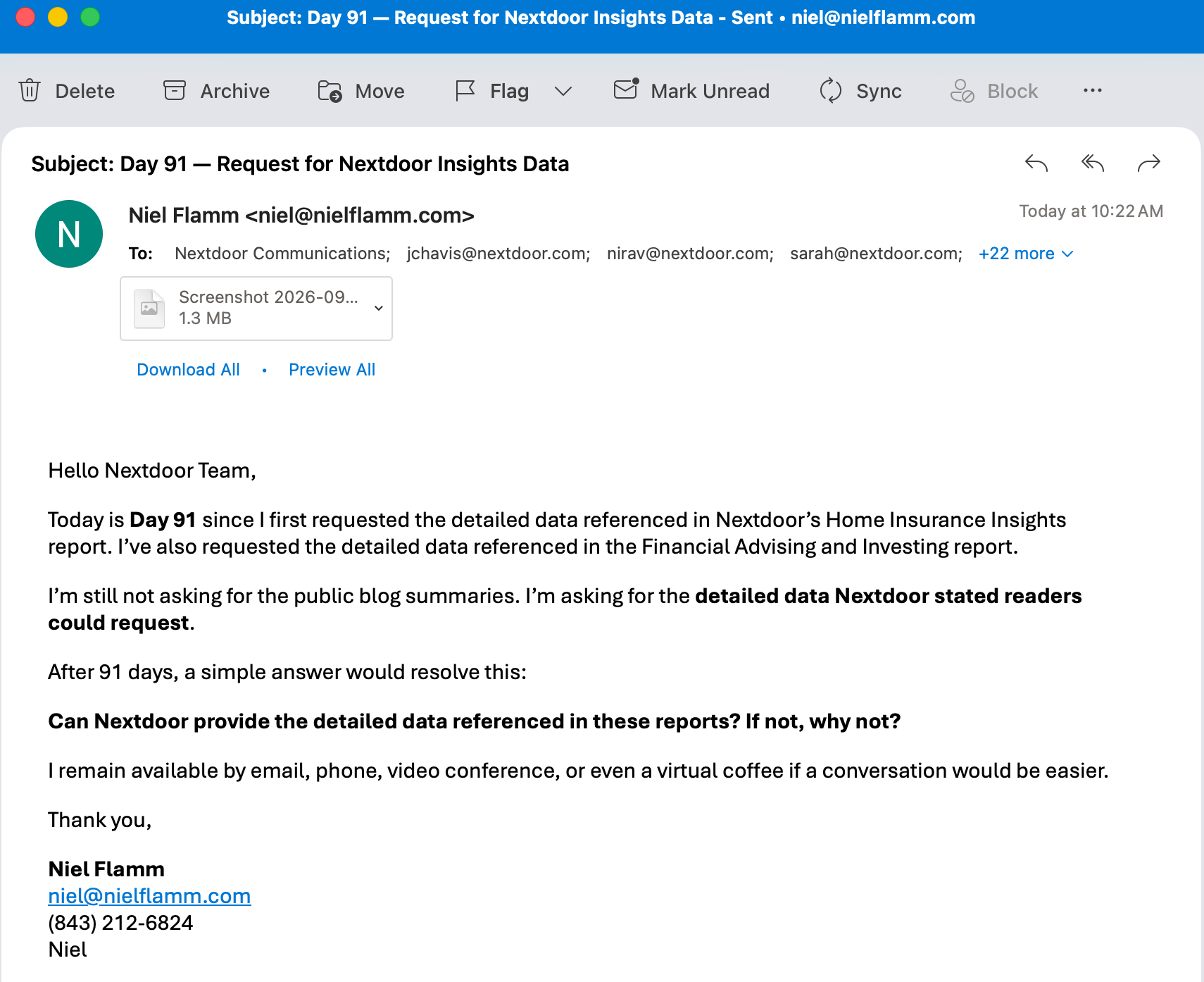
My email essentially asks one question:
Can Nextdoor provide the detailed data referenced in these reports? If not, why not?
That's it.
At this point, I'm not even asking for a yes.
A no is an answer.
“The data isn't available” is an answer.
“The data is restricted to advertisers” is an answer.
“You need to meet certain requirements” is an answer.
“Someone else handles these requests” is an answer.
Silence isn't much of an answer.
91 Days Is a Long Time to Ask One Question
What started as a research request has gradually become something much more interesting to me.
It's become a case study in corporate communication.
If your company publicly tells people to contact someone for more information, what happens when somebody actually does?
Apparently, in my case, you get enough material for 91 days of writing.
I don't think that was the intended content-marketing strategy.
But here we are.
I'm Still Offering an Easier Option
I've repeatedly said that I'm willing to talk.
Email me.
Call me.
Video conference.
Virtual coffee.
I'm not interested in turning this into some endless game of corporate email Ping-Pong.
I'd rather talk than type.
And I'm certainly not hiding.
I included the same contact information I provided before.
Day 91: Another Email Is in the Inbox
Maybe today is the day.
Maybe someone at Nextdoor reads the email and says:
“Wait...has nobody answered this yet?”
Maybe the detailed data arrives.
Maybe somebody explains why it can't be provided.
Either one moves the story forward.
Until then, Day 91 gets added to the case study.
Another email sent.
Same question.
Still waiting for the answer.
Follow the continuing Nextdoor case study at NielFlamm.com/blog.

Day 86: Is Nextdoor Laboring? Or Are We Back to Business as Usual?

Labor Day is over.
It's Day 86 of my continuing Nextdoor case study, and after wondering yesterday whether Nextdoor was taking an extended holiday weekend, I checked again today.
I haven't received any communication regarding the two detailed Insights studies I requested.
And NXDR?
As of this writing, it's hovering around the low $2.20s. Market sources were showing roughly $2.24 late this afternoon after Friday's $2.24 close, so the exact number is moving as I write this.
Hey, at least we're talking pennies now.
Is Nextdoor laboring?
I'm still trying to figure that out.
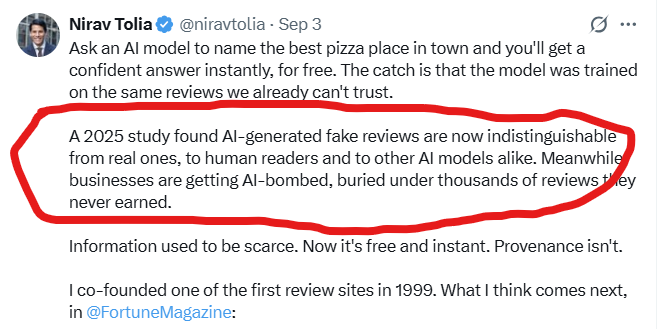
But something Nirav Tolia posted on X on September 3 caught my attention.
“A 2025 Study Found...”
In the post, Nirav wrote:
“A 2025 study found AI-generated fake reviews are now indistinguishable from real ones...”
And immediately I thought:
Here we go again.
A study.
Which study?
Who wrote it?
Where was it published?
What was the methodology?
What was the sample size?
What exactly did “indistinguishable” mean?
This probably sounds familiar to anyone who has followed my 86-day adventure in Nextdoor research transparency.
Here's the interesting part: I looked, and there is identifiable research behind Nirav's statement.
In a Fortune piece published the same day, Nirav identified it more specifically as a 2025 study from Nottingham University Business School.
Peer-reviewed 2025 studies examine AI-generated fake reviews, including a Journal of Retailing and Consumer Services study analyzing 714,016 reviews and finding meaningful linguistic differences between AI-generated fake reviews, human-generated fake reviews, and authentic reviews.
So my criticism isn't:
“The study doesn't exist.”
My question is:
Why not cite it in the original post?
If you're going to use research to establish credibility, give readers enough information to evaluate the research themselves.
Study name. Authors. Publication. Link.
Four things.
Done.
Especially when you're the CEO of a company currently promoting the idea that provenance matters.
That's almost too perfect.
Fake Reviews Didn't Arrive With ChatGPT
Another part of this discussion bothers me.
AI didn't invent fake reviews.
AI made them faster, cheaper, and easier to produce at scale.
Humans have been manipulating reputations for a very, very long time.
In fact, the history is pretty entertaining.
1800s: Walt Whitman anonymously published glowing reviews of his own Leaves of Grass. That's essentially the 19th-century version of creating a burner account and giving yourself five stars.
Early 1900s: Newspapers were already dealing with fabricated information, exaggerated claims, and “fakers.” By 1913, the New York World had established a Bureau of Accuracy and Fair Play partly to address complaints and “stamp out fakes and fakers.”
Pre-internet advertising: Businesses used testimonials and endorsements as marketing tools, creating the same fundamental problem we face today: Is this person recommending the product because they genuinely love it—or because somebody benefits from the endorsement?
Early Internet: Message boards, review sites, and eventually e-commerce let businesses and individuals create accounts and manufacture praise—or attack competitors.
Ironically, Nirav himself co-founded Epinions in 1999, one of the early user-generated review platforms. He now acknowledges that the review economy eventually became vulnerable to manipulation.
2010s: Fake-review businesses became an industry. Businesses could purchase positive reviews, competitors could be attacked with negative ones, and reviewers could operate multiple identities.
2020s: Review farms became increasingly sophisticated. Investigators found coordinated reviewers praising unrelated businesses across countries, with identical reviews sometimes appearing under different names.
Today: Generative AI has dramatically changed the economics. Instead of paying humans to crank out hundreds of reviews manually, someone can rapidly generate enormous quantities of convincing text. Research now shows LLMs can produce deceptive reviews with human-level capabilities, even though researchers can still statistically identify some linguistic differences.
Same scam.
Much better machinery.
Which Brings Me Back to Nextdoor
Nextdoor's current pitch is that verified identity and neighborhood accountability can make recommendations more trustworthy.
That's an interesting strategy.
But verification alone doesn't make an opinion truthful.
A real person can exaggerate.
A verified person can have a grudge.
A real neighbor can recommend their friend's company.
A legitimate customer can receive an incentive.
Two verified neighbors can have completely different experiences with the same business.
And, as I've previously documented, I've had my own questions about how robust Nextdoor's verification system actually is.
So “verified” is a trust signal.
It isn't a magical truth serum.
Provenance Matters? I agree.
That's actually what makes Nirav's post so interesting.
His broader argument is essentially:
Where information comes from matters.
I agree.
Completely.
Which is why when the CEO says:
“A 2025 study found...”
I want the provenance.
Name the study.
Name the researchers.
Link to it.
Let readers inspect it.
And that's precisely what I've been asking Nextdoor to provide regarding its own research.
For 86 days.
Nextdoor published Insights findings.
Nextdoor publicly told readers they could request detailed data.
I requested it.
I've emailed.
I've followed up.
I've expanded the distribution.
I sent another request Saturday.
And I'm still waiting for the two detailed studies.
Day 86
Yesterday was Labor Day.
Today I'm asking:
Is Nextdoor laboring?
Because I'm still doing the work.
Waiting for somebody at Nextdoor to answer the questions.
Nirav's post argues that provenance matters.
On that, we agree.
So here's my Day 86 suggestion:
Practice it.
When you cite research, show us the research.
When Nextdoor publishes research, show us the methodology.
When your own blog tells readers they can request detailed data, provide the detailed data—or explain why you won't.
Because whether we're talking about a restaurant review, an AI-generated recommendation, or a corporate Insights report, the principle is the same:
Don't just tell me to trust it. Give me enough information to decide whether to trust it.
Follow the continuing Nextdoor case study at NielFlamm.com/blog.
Day 79: Wait...Did Nextdoor Just Change Its Insights Playbook?
While looking through Nextdoor's latest blog posts, something caught my attention.
On August 31, Nextdoor published a new Insights article:
New Nextdoor Research: Movers Stay in Purchase Mode for Months. Here's How They Decide What to Buy.
It's based on Nextdoor's 2026 Moving Insights Report, and the post contains plenty of numbers: 66% of neighbors update their Nextdoor address within a month of moving, 46% wished they could ask people already living in a neighborhood questions before moving, 54% bought new home décor, and 80% expect to hire professionals for renovations or repairs. Nextdoor Blog
But those numbers aren't what immediately caught my attention.
It was what was missing at the bottom.
Where Did “Contact Jacob” Go?
Historically, I've seen Nextdoor Insights posts direct readers who want the complete findings or detailed data to Jacob Chavis and the Insights team.
That's how this entire months-long adventure started.
I followed those instructions.
I requested the detailed data.
Again.
And again.
And again.
Instead, look at how this newest report ends.
There's now a section called:
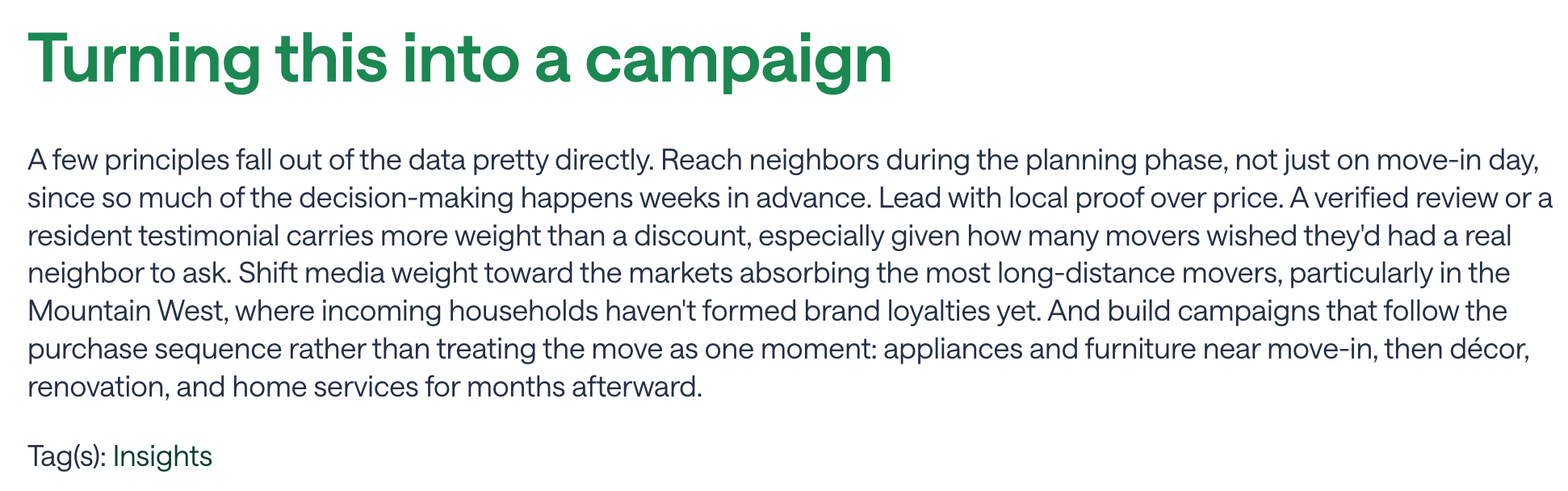
“Turning this into a campaign.”
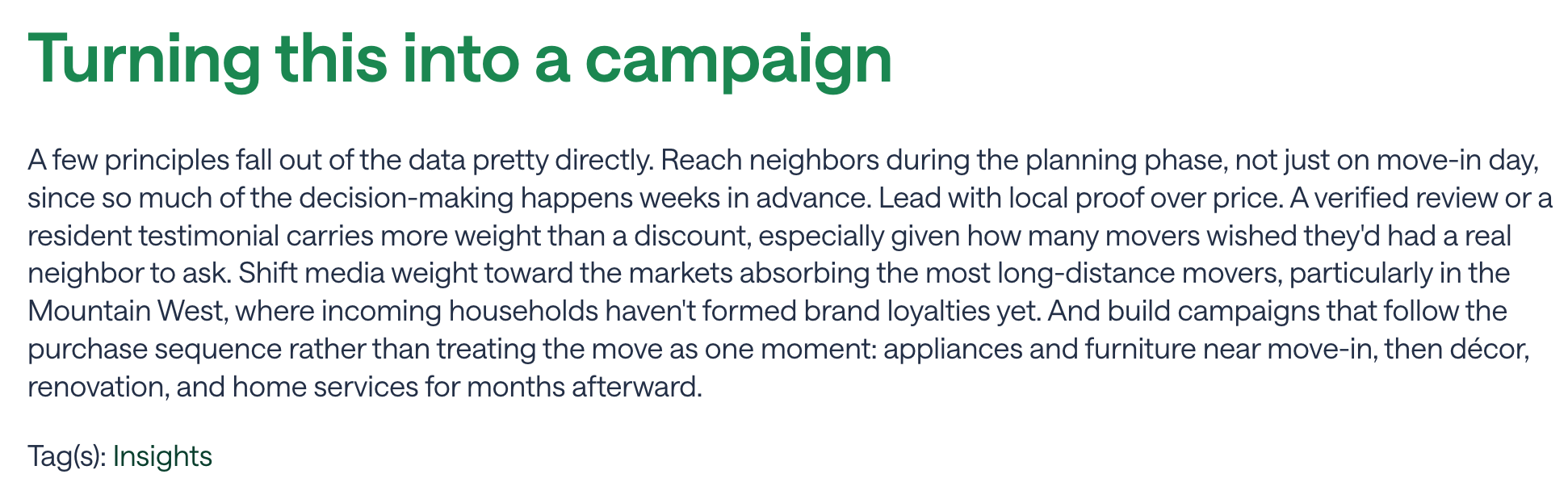
Nextdoor takes the reported findings and turns them directly into recommendations for advertisers: reach neighbors during the planning phase, emphasize local proof, focus advertising on markets receiving long-distance movers, and build campaigns around the purchasing sequence. Nextdoor Blog
Then the article ends.
No invitation to contact Jacob for the complete findings.
No “reach out for detailed data.”
Interesting.
So first:
You're Welcome, Jacob.
You're welcome, Insights Team.
You're welcome, Communications.
😂
Have my 79 days of persistence actually produced a change?
I obviously can't prove that.
Maybe Nextdoor independently decided to change the format.
Maybe this report was always going to be published this way.
But after spending months asking for the “detailed data” Nextdoor publicly invited readers to request, I find the change pretty damn interesting.
Accountability sometimes produces change—even if nobody sends a thank-you note.
But Now I Have Another Question
Nextdoor makes numerous specific statistical claims in this article.
I'm not saying they're wrong.
I'm asking how an external reader would independently evaluate them.
Because putting a percentage in a blog post doesn't magically transform it into unquestionable fact.
For example:
44% of dog walkers prefer non-biodegradable plastic bags over environmentally friendly alternatives.
There.
I just conducted the 2026 Niel Flamm Dog Poop Insights Report.
🐕💩📊
Except I didn't.
I made the number up.
See how easy that was?
Maybe somebody challenges me.
Maybe nobody does.
That's why methodology matters.
Who was surveyed?
How many people participated?
How were respondents selected?
When was the research conducted?
What questions were asked?
What was the margin of error?
What population does the sample represent?
Those details help readers distinguish research from marketing copy.
To Nextdoor's credit, this new article cites independent research from United Van Lines and Harvard's Joint Center for Housing Studies for some of its broader context on moving and home improvement. Nextdoor Blog
But I'm still interested in seeing the methodology behind Nextdoor's own percentages.
And That Brings Me Back to Two Other Reports
Because while Nextdoor may have changed how this newest Insights article ends, there's still some unfinished business.
What about the two previous studies I've requested?
Those posts explicitly told readers that more information was available.
I followed the instructions.
I asked for it.
The wording on a new blog post doesn't erase those previous requests.
So maybe Nextdoor learned something from this experience.
Great.
I'll even take partial credit. 😂
But accountability isn't only about changing what happens next.
It's also about finishing what came before.
Jacob, Insights Team, Communications:
I noticed the change.
Now...
How about those other two studies?
The complete continuing Nextdoor case study is at NielFlamm.com/blog.