
Day 109: Nextdoor Honored Five Great Neighbors. Only One Story Really Needed Nextdoor.
Day 109.
I'm still asking Nextdoor for the detailed data behind the original two Insights studies I requested.
But before getting into today's observation, let me give Nextdoor some credit.
You're welcome. 😂
I've spent 109 days publicly asking for the research Nextdoor said readers could request.
And recently, Nextdoor published a new study on neighborhood trust with substantially more methodology and research information than I've been asking to see.
I liked it.
I said so.
So, Nextdoor, you're welcome for the free accountability service.
Please let me know where the first two detailed reports I originally requested are.
I'm not asking for another summary.
Could you share the underlying research that started this 109-day project?
Now, About Those Good Neighbors
Nextdoor recently published its 2026 Good Neighbor Day honoree roll call.
And I genuinely like these stories.
They selected five honorees from more than 1,300 nominations, representing five regions of the country.
These are people doing exactly what good neighbors should do.
They're feeding people.
Helping someone recovering from a hospital stay.
Taking out trash cans.
Plowing driveways.
Maintaining neighborhoods.
Helping people when they need it.
Bravo.
But while reading Nextdoor's own descriptions of the five honorees, something jumped out at me.
Of the five individual stories, only one explicitly describes Nextdoor as part of how the actual good-neighbor work operates.
That would be Dorea in Raleigh, North Carolina.
Nextdoor says Dorea cooks free dinners for roughly 100 neighbors every Wednesday and that the operation “runs on Nextdoor.” By late September, the project had served more than 2,800 meals.
That's fantastic.
And that, to me, is exactly where Nextdoor makes sense.
A neighbor has a need.
Another neighbor wants to help.
Nextdoor becomes the conduit connecting them.
Simple.
Useful.
Local.
Neighborly.
Then I Read the Other Four Stories
The other four honorees are equally deserving.
But something is different.
Bhagwat Gupta spent years helping rebuild and improve his Texas neighborhood.
Dan Schaefer organized meals and continued helping a neighbor recovering alone.
Dan Brinsky plowed a neighbor's driveway throughout the winter so she could visit her husband in the hospital.
Karl and Debbie Word helped neighbors during a medical emergency and kept up their property while they dealt with it.
Wonderful stories.
But in Nextdoor's descriptions of those four acts, Nextdoor isn't presented as the mechanism that made the help happen.
The neighbors are the story.
Which got me thinking again about something I've been saying for months.
What Exactly Is Nextdoor?
Is Nextdoor a social-media platform?
Is it a neighborhood communication platform?
Is it a recommendation platform?
Is it a business-review platform?
Is it an advertising platform?
Is it a local-services marketplace?
Is it a research and consumer-insights company?
Is it a lead-generation platform for businesses?
Is it all of them?
Because maybe that's part of the problem.
Too many lanes.
I've questioned whether Nextdoor is trying to be so many things that its clearest value proposition gets buried underneath everything else.
And ironically, Nextdoor's own Good Neighbor stories may illustrate the question better than I ever could.

Dorea's Story Shows Me the Nextdoor I Understand
Dorea's story is incredibly easy for me to understand.
Someone cooks meals.
Other people need meals.
Neighbors volunteer.
People donate.
People help deliver.
Nextdoor helps connect them.
Boom.
There's the product.
There's the value.
That’s the reason the platform exists.
Nextdoor doesn't have to be the hero.
Dorea is the hero.
Nextdoor helps the hero find the people who need her—and helps other neighbors find a way to participate.
That's a powerful role.
In fact, I think it's more powerful than trying to make Nextdoor the center of every story.
Maybe the Best Version of Nextdoor Is the Conduit
This is where I keep coming back.
Nextdoor doesn't necessarily need to be the neighborhood.
The neighbors already are the neighborhood.
It doesn't need to create neighborliness.
People were helping the person next door long before there was an app for it.
Technology can make those connections easier.
Someone needs help.
Someone else can provide it.
Someone needs a recommendation.
Someone nearby has experience.
Someone lost a dog.
Someone three streets away just saw it.
Someone needs a plumber.
Someone nearby knows one.
Someone has extra food.
Someone else needs dinner.
Connect them.
That's a value proposition I can understand immediately.
But Then Come All the Other Lanes
Reviews.
Recommendations.
Advertising.
Business Pages.
Paid opportunities.
Consumer research.
Insights reports.
Social feeds.
Local discussions.
Business discovery.
Content.
AI.
And somewhere inside all of that is the original idea:
Neighbors connecting with neighbors.
Maybe all of those other businesses ultimately support that mission.
That's certainly a possible strategy.
But I think Nextdoor's own Good Neighbor post raises a worthwhile strategic question:
Has Nextdoor added so many lanes that the simplest reason for using Nextdoor has become harder to see?
The Good Neighbor stories don't prove the answer is yes.
But they certainly made me ask the question again.

Five Honorees. One Particularly Clear Platform Story.
That's what stood out to me.
Not because the other four honorees somehow matter less.
Quite the opposite.
Their actions are the entire point.
But Dorea's story gives me something the others don't:
A crystal-clear example of what Nextdoor itself contributed.
Nextdoor connected people.
That's it.
And that's enough.
Maybe Nextdoor doesn't need another lane.
Maybe it needs to become exceptionally good at the lane its own name has been describing all along.
Next. Door.
Neighbors helping neighbors.
Technology making the connection easier.
The people do the rest.
And now, back to Day 109
I gave Nextdoor credit for the latest research report.
I gave Nextdoor credit for recognizing these five neighbors.
And I'll continue giving the company credit when I think it gets something right.
Now let's finish some unfinished business.
Where are the detailed reports from the first two studies I requested?
It's Day 109.
You showed with the latest research that greater transparency is possible.
Great.
Now let's close the loop on the first two.
Then we'll be square.
Read Nextdoor's 2026 Good Neighbor Day honorees here:
Announcing Nextdoor's 2026 Good Neighbor Day honorees
👉 NielFlamm.com/blog
Two Strange Calls After Being Blocked: Coincidence? Maybe. But I’m Documenting It.
Well, here's another interesting addition to the Nextdoor case study.
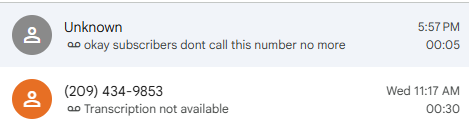
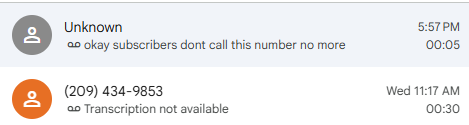
Over the last two days, I've received two calls to my Google Voice number.
Normally, that wouldn't be particularly interesting.
Except no one had called that number right before this.
Then I got blocked on X by Nextdoor CEO Nirav Tolia.
And now I've received two calls in two days.
Coincidence?
Absolutely possible.
But considering everything I've been documenting lately, I'm at least raising an eyebrow.
Then Came This Voicemail
One call left a voicemail.
It's short.
Very short.
The message sounds to me like:
"Tell that subscriber not to call this number anymore."
That's it.
No introduction.
No company name.
No explanation of who the caller is.
No explanation of what number I'm supposedly calling.
No explanation of what "subscriber" they're referring to.
Just a strange voicemail telling someone—or apparently telling me—that a subscriber shouldn't call a number anymore.
Okay then.
Do I Know Who Called?
No.
That's important.
I don't know who made the call.
I'm not sure whether the caller has anything to do with Nextdoor.
I don't know whether it has anything to do with Nirav Tolia.
I'm not sure whether this is related to my posts, emails, X accounts, or the ongoing case study.
And I certainly don't have evidence that anyone at Nextdoor initiated these calls.
I'm not going to turn timing into proof.
But I'm also not going to pretend the timing didn't catch my attention.

Two Calls After None
That's what makes this interesting to me.
I had no calls coming into this Google Voice number immediately before this.
Then, within the last two days, I received two.
That happened during the same period in which I've been publicly documenting being blocked again on X.
One of the calls leaves this odd voicemail.
Maybe it's spam.
Maybe it's a wrong number.
Maybe someone has the wrong Google Voice number.
Maybe it's completely unrelated.
There are plenty of ordinary explanations.
But when something unusual happens during an already unusual series of events, I document it.
That's what I've been doing throughout this entire Nextdoor case study.
Document first. Conclude only when the evidence supports it.
This Is Why Screenshots, Emails and Recordings Matter
One theme running through this case study has been documentation.
If I send an email, I keep it.
If an account blocks me, I take a screenshot.
If I make a mistake, I correct it.
And if an unusual voicemail arrives during an unusual sequence of events, I'm going to preserve that too.
I'm not claiming the voicemail came from Nextdoor.
I'm not claiming Nirav had anything to do with it.
I'm not claiming there's some mysterious corporate operation happening behind the scenes.
Frankly, that would require evidence I don't have.
What I am saying is:
This happened.
Two calls arrived within two days after a period of none.
One left a strange voicemail.
And the timing caught my attention.
Coincidence Is Still an Answer
Sometimes weird timing is just weird timing.
If I get no more calls, maybe this becomes nothing more than another bizarre footnote in the story.
If the calls continue, I'll continue documenting them.
That's the beauty of keeping a record.
I don't have to invent the ending before the story gets there.
For now, I'll put this one in the file labeled:
"That's Odd."
Not "Nextdoor Did It."
Not "Nirav Did It."
Just:
That's. Odd.
And we'll see what happens next.
👉 NielFlamm.com/blog
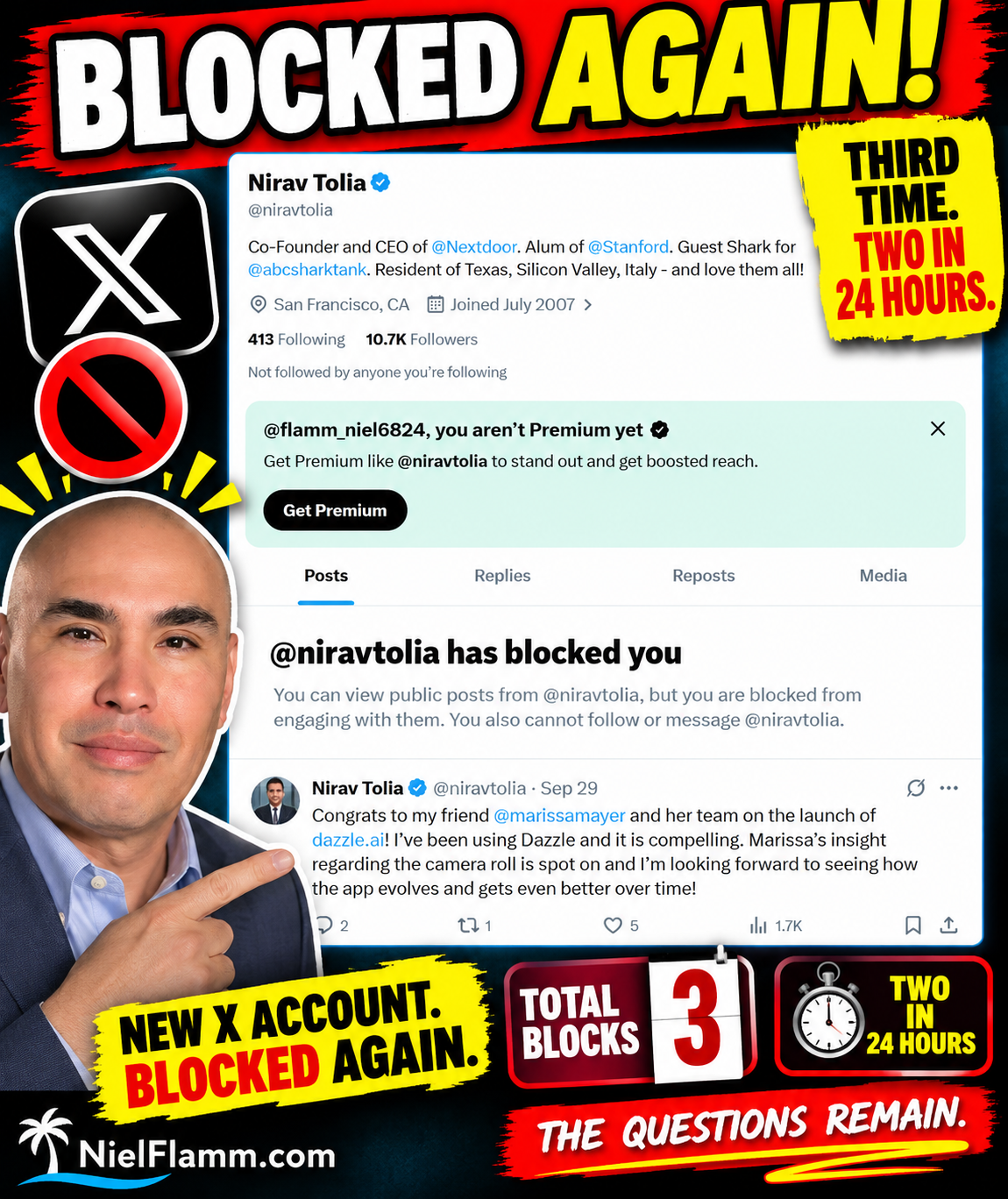
Day 108: New X Account. Blocked Again. That Makes Three.

Well, that didn't take long. 😂
One important correction to my previous version of this story.
I created another X account.
Nirav had already blocked my original account, so I created a new one and kept doing what I've been doing: posting about my experience with Nextdoor and sharing feedback.
Could creating another account to get around a block violate X's Terms and Conditions?
Possibly.
I'm not going to pretend otherwise. It's a risk I'm taking, and if X decides I've violated its rules, I'll deal with the consequences.
But here's what happened next.
Within about 24 hours:
The new account was blocked too.
Based on my records, that's now three blocks, with two different accounts blocked within roughly 24 hours.
At this point, I feel like I'm participating in the world's strangest game of digital Whac-A-Mole.
Who Is Actually Pressing the Button?
Here's something I’m not sure about.
I’m not sure whether Nirav blocked me personally.
The screenshot tells me his account blocked mine. It doesn't tell me who was operating his account when it happened.
Maybe it's Nirav.
An executive assistant can help manage the account.
Maybe someone else has access.
I don't know.
And that's an important distinction because I'm trying to document what actually happened, not fill the gaps with assumptions.
What I do know is that @niravtolia blocked another account I used to provide feedback about Nextdoor.
Again.
Somebody Is Paying Attention
That's the part I find fascinating.
For over 100 days, I’ve been requesting detailed Nextdoor Insights research that the company advertised as available by contacting its Insights representative.
Getting the research has proven remarkably difficult.
Getting blocked?
Apparently we're pretty efficient at that. 😂
Whether Nirav himself is seeing my posts or someone else managing his account, somebody is noticing.
And if company resources are involved—and, again, I don't know that they are—I'd rather see those resources directed toward something that helps Nextdoor.
Find another advertiser.
Improve the small-business experience.
Improve moderation.
Answer customers.
Answer shareholders.
Develop another revenue opportunity.
Build something that increases engagement.
Create company value.
As a shareholder, that's considerably more interesting to me than another block.
Yes, I Created Another Account
I'm not going to bury that detail.
I created another X account after being blocked.
People can decide for themselves whether they think I should have done that.
X can decide whether it complies with its rules.
I'm comfortable owning the decision.
What I'm not doing is pretending to be someone else, inventing allegations, or hiding what I'm doing.
I'm putting my name on my commentary.
I'm taking screenshots.
I'm documenting dates.
And I'm publishing the history as I experience it.
If I'm wrong about something, please tell me.
I've made public corrections before.

Blocking Doesn't Stop the Historical Record
Here's the bigger issue.
Blocking an account doesn't erase the underlying questions.
It doesn't delete the emails I've sent.
It doesn't eliminate the screenshots.
It doesn't make 108 days disappear.
And it doesn't prevent me from writing about the experience elsewhere.
Nirav has a substantially larger social-media audience than I do.
That's fine.
I don't need a bigger audience to maintain a record.
Please provide screenshots, dates, emails, public statements, and the patience to keep everything organized.
I've got those.
Compare That With Sarah Leary
I've also been providing feedback about Nextdoor co-founder Sarah Leary.
I've noticed that the @sarahleary account I've been following stopped posting, while she's been posting through another account.
I don't know why she changed where she posts.
I have no evidence whatsoever that my commentary had anything to do with it.
But from my perspective, it looks different.
Don't want to engage with me?
Fine.
Ignore me.
Post somewhere else.
Don't respond.
Disagree.
There are plenty of options.
That looks better than repeatedly blocking accounts belonging to someone who is publicly documenting a company in which he owns shares.
And We Just Published a Study About Trust
The timing continues to amuse me.
I just wrote about Nextdoor's new study with The Harris Poll examining trust.
And I praised it.
Imagine that.
After months of providing feedback about Nextdoor research, I saw something I thought the company did well and said:
Bravo.
Then I connected the study's discussion of trust and communication with my experience dealing with Nextdoor.
And now another account is blocked.
It looks like you couldn't write this script.
Feedback Isn't Always Comfortable
I've spent more than 20 years in Learning & Development.
Feedback isn't always pleasant.
Sometimes it's wrong.
Sometimes it's poorly delivered.
Sometimes it's repetitive.
Sometimes the person receiving it wants nothing more than for the person providing it to disappear.
But feedback can also expose something worth examining.
A leader doesn't have to agree with it.
A company doesn't have to implement it.
A CEO doesn’t need to debate every shareholder on social media personally.
But I still think there is value in an organization asking:
Why does this person keep raising the same issue?
Maybe he's wrong.
Maybe the company is wrong.
Maybe both sides are missing something.
There's a remarkably effective way to find out.
Have a conversation.
So, Yes, Nirav—You Got Me Again
Third block.
Two accounts within roughly 24 hours.
And yes, one of those accounts was created after the previous one was blocked.
I'm not hiding that.
Maybe X eventually tells me I can't do that.
That's a chance I'm taking.
But this case study doesn't live on X.
It lives on my website.
The emails still exist.
The screenshots still exist.
And the questions still exist.
And I'm still documenting what happens.
Day 108.
Another account blocked.
The questions?
Still here.
👉 NielFlamm.com/blog
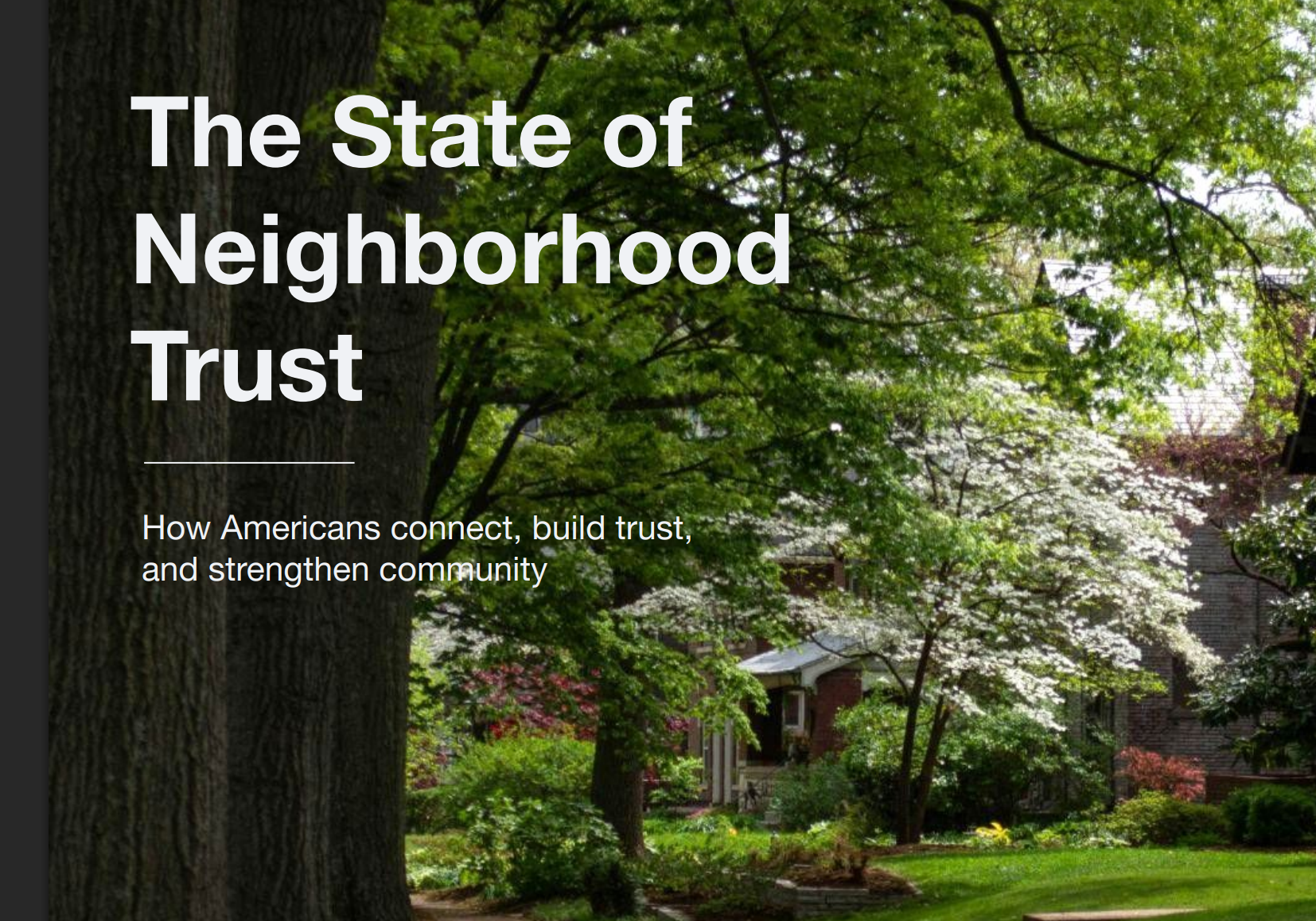
Nextdoor Published a Study About Trust. This Is More Like It.
I have spent a lot of time providing feedback about Nextdoor's Insights reports, so when the company does something substantially better, I think it's important to say so.
Nextdoor's new “The State of Neighborhood Trust” report, produced with The Harris Poll, is much closer to what I've been asking to see.
This looks and reads like an actual research report.
Not simply a blog post with percentages and a statement that more information exists somewhere else.
The report is 24 pages long. It identifies the research partner, describes the sample, discusses methodology, presents findings in context, includes statistical analysis, identifies outside sources, and provides a research contact. Nextdoor Blog
Read Nextdoor and The Harris Poll's full Neighborhood Trust study
Bravo, Nextdoor.
Yes, I actually said that.
Screenshot it before somebody blocks me. 😂
This Is What I've Been Asking For
Nextdoor commissioned the research, and The Harris Poll fielded it in April 2026 among about 1,000 U.S. adults age 18 and older. Respondents came through The Harris Poll's online panel and were weighted to reflect the U.S. adult population. Nextdoor says it then analyzed the findings and conducted statistical modeling examining factors associated with trust and outcomes including safety, belonging, civic participation and reliance on neighbor recommendations. Nextdoor Blog

The accompanying Nextdoor article provides even more methodological detail: the survey was conducted April 16–20 among 1,003 adults, weighting included age within gender, region, race/ethnicity, marital status, household size, income, education and political affiliation where necessary, and the reported Bayesian credible interval is ±3.8 percentage points at a 95% confidence level. Nextdoor also acknowledges other potential sources of survey error. Nextdoor Blog
That's transparency.
Could there be more?
Sure.
I'd love to see an appendix containing the questionnaire, complete crosstabs and additional demographic breakouts. Since The Harris Poll fielded the survey, it would also be useful to provide a Harris Poll contact or link explaining whether additional demographic information, questionnaires or crosstabs can be obtained.
But that's me asking for the cherry on top rather than wondering where the sundae went.
This report gives readers enough information to begin understanding where the numbers came from and how the research was conducted.
And the Subject Is…Trust
This is where things become particularly interesting given my recent experience with Nextdoor.
The entire report revolves around trust.
One finding says 66% identify friendly day-to-day interactions as something that builds neighborhood trust. Meanwhile, the leading factor respondents identified as weakening neighborhood trust was lack of communication, at 46%. Nextdoor Blog
Read that again.
Lack of communication: 46%.
I've been writing about communication for more than 100 days.
You couldn't script this better.
The study says trust grows through regular opportunities to communicate, interact, and rely on one another. It also says the strongest predictors include how easy people feel reaching their neighbors and how often they actually interact. Nextdoor Blog
That's not my interpretation of what Nextdoor should believe.
That's in Nextdoor's own report.
Then Nirav Tolia Says This
The report includes a statement from CEO Nirav Tolia:
“The difference between a neighborhood and a community is trust.”
That's a powerful statement. Nextdoor Blog
And that's precisely why I can't ignore the contrast with my experience.
Yesterday I discovered that Nirav had blocked me on X.
Again.
For the second time in roughly six months.
I don't know why Nirav blocked me. Only he knows his reason, and I'm not going to pretend otherwise.
He also doesn't have an obligation to personally engage with every person who comments on his social media account.
But I'm allowed to ask what message the action sends to me.
Because I'm not some anonymous account that appeared yesterday screaming at the CEO.
I'm a shareholder.
I've spent months publicly documenting questions about Nextdoor.
I've repeatedly offered to have an actual conversation.
I've said I'd rather talk than type.
And for more than 100 days I've been pursuing detailed research that Nextdoor itself told readers was available by contacting its Insights representative.
Now I'm reading a Nextdoor report telling me:
Trust depends on communication.
You can't make this stuff up.

Trust Has to Work in Both Directions
Another line in the report fascinates me.
Nextdoor writes that trust is built through repeated interactions, communication, and confidence that others will respond when it matters. Nextdoor Blog
Exactly.
That shouldn't only apply neighbor to neighbor.
I think it's a valuable principle for company-to-customer, leadership-to-shareholder, platform-to-user, and executive-to-stakeholder relationships too.
Trust isn't created by saying the word trust repeatedly.
It isn't created by putting trust in the title of a 24-page PDF.
And it isn't automatically created because a company commissions a reputable polling organization.
Trust grows when words and experiences begin matching.
That's what makes this new report simultaneously encouraging and fascinating to me.
The Research Is Actually Helping Build Trust
Here's where I give Nextdoor genuine credit.
This report increases my confidence in these findings because Nextdoor told me how the research was conducted.
That's exactly how transparency builds trust.
Compare:
“67% of Americans say, X.”
Okay. Where did that number come from?
Versus:
Here's who conducted the survey. Here's when it was conducted. Here's the population. Here's the sample. Here's how respondents were recruited. Here's how weighting worked. Here's the statistical approach. Here are limitations. Here are outside sources. Here's a research contact.
Now we're talking.
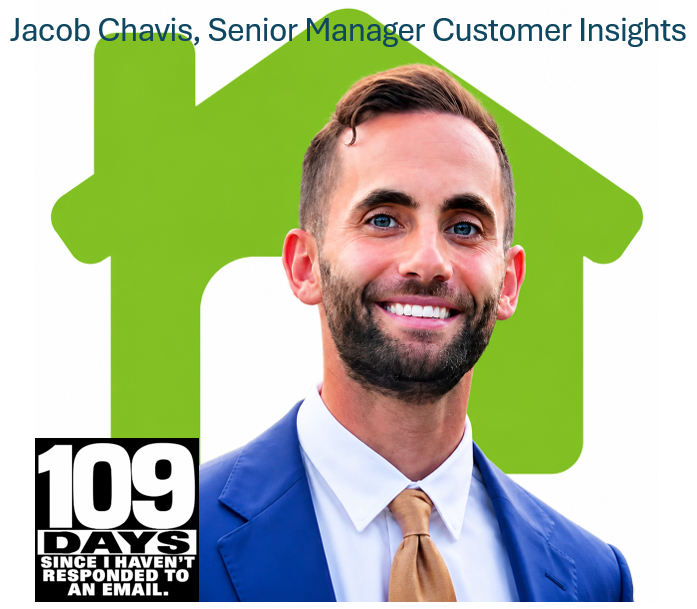
Interestingly, the PDF once again lists Jacob Chavis, Senior Manager, Customer Insights, along with his Nextdoor email address as the research contact. Nextdoor Blog
Jacob and I already have some history.
😂
Maybe This Is Progress
I've said throughout this case study that if Nextdoor does something I think is good, I'll say it's good.
This report is progress.
I don't know whether my months of posts had anything whatsoever to do with the format. I have no evidence that they did, so I'm not taking credit.
Maybe Nextdoor was already moving toward more comprehensive research reports.
Maybe working with The Harris Poll resulted in a more rigorous presentation.
Maybe somebody inside Nextdoor independently said, We should probably show people how we got these numbers.
Whatever the reason:
Keep doing this.
And take it one step further.
Provide a Harris Poll link or research contact.
Make additional demographic tables available.
Publish questionnaires where appropriate.
Provide downloadable crosstabs.
Let researchers, journalists, advertisers, shareholders, and curious bald bloggers dig deeper.
That's how confidence in research grows.
Now Apply the Research to Leadership
That's my bigger challenge to Nextdoor.
The report says communication matters.
It says repeated interaction matters.
It says accessibility matters.
It says trust helps communities function.
And its CEO says the difference between a neighborhood and a community is trust. Nextdoor Blog
Great.
Apply those principles internally and externally.
When somebody asks a difficult question, communicate.
When somebody provides feedback, listen.
When somebody requests information that you've advertised as available, answer.
When a shareholder repeatedly offers to have a conversation, perhaps conversation is more consistent with the company's message than another block button.
Nirav doesn't have to agree with me.
Nextdoor doesn't have to agree with me.
Jacob doesn't have to agree with me.
Nobody has to like my posts.
But if we're going to talk about rebuilding trust through communication and interaction, then I think it's fair to ask Nextdoor's leadership to demonstrate the same behavior it celebrates in its research.
Trust is a great research topic.
It's an even better leadership practice.
And this time, Nextdoor, on the research itself:
Bravo. Keep going.
👉 Read my continuing Nextdoor case study at NielFlamm.com/blog
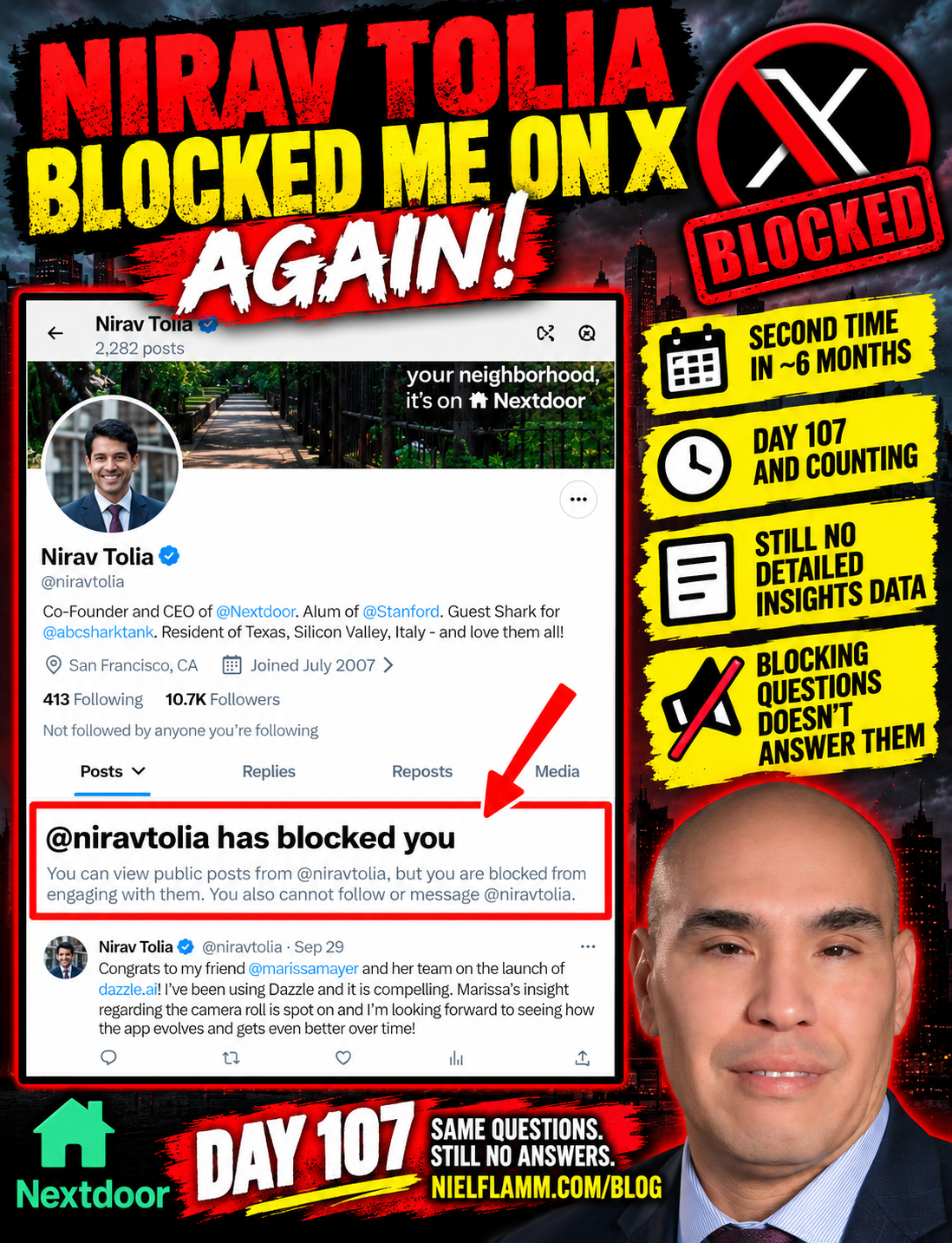
Day 107: Nirav Tolia Blocked Me Again. Apparently, We’re Doing This Twice.
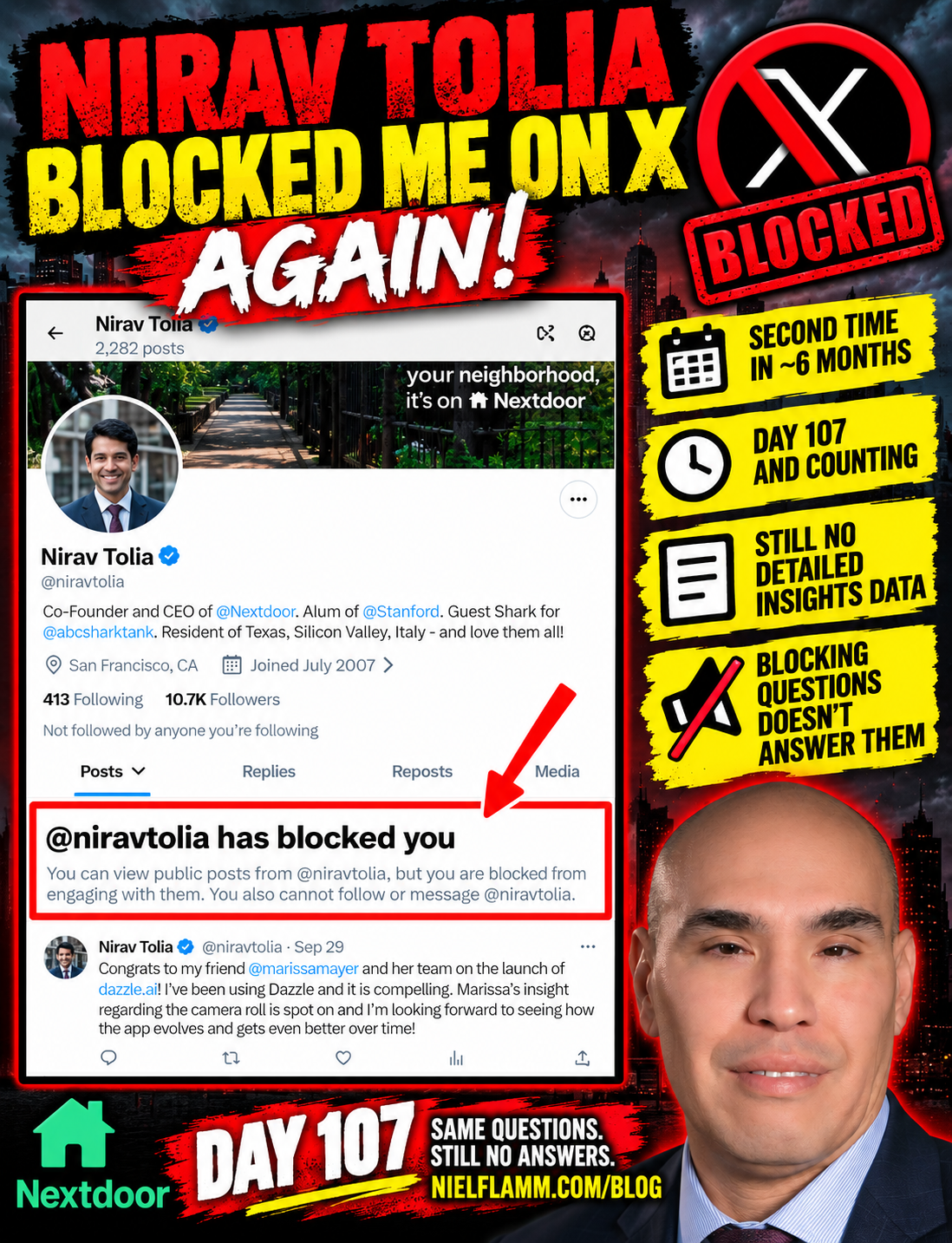
Nirav, you got me. 😂
I've been posting about my request for the detailed Nextdoor Insights research that the company said readers could get by contacting Jacob Chavis.
While making my rounds across the various platforms and Nextdoor accounts, I came across CEO Nirav Tolia's X profile.
And there it was:
“@niravtolia has blocked you.”
Again.
Yes, again.
This is the second time in roughly six months that I've found myself blocked by Nextdoor's CEO.
I have to admit, that's almost impressive.
A Speed Bump, Not a Roadblock
The screenshot says I can still view Nirav's public posts, but I can't engage with them, follow him, or message him from that account.
Okay.
I'm resourceful.
This is a speed bump. It won’t end the conversation.
More importantly, blocking me doesn't answer the question I've been asking.
And this story didn't actually begin 107 days ago.
How Did I Even Get Here?
Long before the Insights report became part of this case study, I was a Nextdoor user in my local neighborhood.
I was eventually banned.
One issue involved my posting multiple personal items for sale. I questioned where the applicable restrictions appeared in Nextdoor's terms and policies and sought clarification.
From my perspective, meaningful communication eventually stopped.
So I started writing about my dissatisfaction on LinkedIn.
Then the discussion expanded.
I started looking more closely at Nextdoor's moderation model, communications, small-business experience, research, leadership, shareholder value, and other aspects of the company.
Eventually I came across Nextdoor's Home Insurance Insights research.
That’s where things got almost comical.

Nextdoor Told Readers to Contact Jacob
The June 15 Home Insurance Insights article says the research came from a survey of 1,000 U.S. adults.
Other Nextdoor Insights articles have been even more explicit about how to get additional research. For example, its summer-travel report tells readers who want the complete findings and detailed data to contact Jacob Chavis, Customer Analytics & Insights Manager.
So I did what Nextdoor told readers to do.
I contacted Jacob.
And then I followed up.
And followed up.
And followed up.
We're now at Day 107 of this particular chapter.
Communications eventually responded, and I've publicly acknowledged that. I didn't receive the complete, detailed material I requested.
Last week, I expanded my email to Nextdoor's Executive Team.
Now, as I continue to post about the experience, I discovered that Nirav has blocked me on X again.
Blocking Is Certainly an Option
Let's be fair about something.
Nirav has every right to decide whom he wants to interact with on his social media accounts.
Being CEO of a public company doesn't mean he owes me a personal conversation every time I have a question.
And I can't tell you why he blocked me.
Maybe he's tired of seeing my posts.
Maybe he thinks they're repetitive.
He may not like my approach.
Maybe he doesn't want to engage.
Only Nirav knows.
But here's where I think this becomes interesting from a leadership perspective.
Nextdoor's own leadership page identifies Nirav as its CEO, President, Chairperson of the Board, and co-founder.
That's a lot of leadership hats.
So when the person wearing all those hats blocks a shareholder who has been publicly questioning the company's communication, I think it's fair for me to write about the experience.
I'd Rather Have a Conversation
I've said this repeatedly:
I would rather talk than type.
Phone.
Video.
Virtual coffee.
An actual conversation.
I'm not asking Nirav to agree with me.
I'm not expecting Nextdoor to implement every idea I throw at it.
I'm not even expecting Nextdoor to enjoy my posts.
Some of them probably aren't particularly enjoyable from their side of the screen.
But if you're going to lead a company built around neighbors communicating with neighbors, criticism and uncomfortable questions come with the territory.
That's leadership.
I've Got Time
I've also joked before that Nextdoor may have picked the wrong person for a waiting contest.
My medical circumstances mean I have more downtime than I once did.
I can write.
I can research.
I can ask questions.
I can follow up.
And apparently I can periodically discover that I've been blocked again. 😂
I prefer Nextdoor to focus on building the business, improving the product, and creating long-term shareholder value.
Yesterday I wrote about NXDR closing at $2.43.
As a shareholder, I'd love to see the company deliver the kind of sustained performance that sends that number substantially higher.
I'd like to see a business return capital to shareholders through a dividend, if and when its financial position and board determine that makes sense.
That's a much more interesting use of corporate energy than this 107-day saga.
Leadership Includes Taking Some Heat
I don't think a CEO needs to respond personally to every critic on social media.
That's unrealistic.
I also don't think blocking someone proves their criticism is correct.
It doesn't.
Leaders of public-facing companies should expect scrutiny.
Especially when they're highly visible themselves.
Especially when they're talking publicly about community, connection, listening, and the “power of we.”
Sometimes leadership means standing behind the product and the rhetoric when somebody says:
“Okay. I have some questions.”
And sometimes those questions aren't flattering.
I don't prefer Nirav to have “thicker skin” because I have no insight into how he personally feels. I don't.
My point is about the leadership behavior I'd prefer to see:
Engage with difficult questions.
Delegate them to someone who will.
Answer them.
Disagree with them.
Explain why they're wrong.
Or say, “We're not providing that information.”
Any of those outcomes would be more interesting than another block button.
So, Nirav, You Got Me
Blocked for the second time.
I laughed when I saw it.
Then I took a screenshot.
And now, naturally, I'm writing about it.
Because after everything I've documented, this has become part of the case study too.
Day 107.
The detailed research question remains.
The Executive Team has my latest email.
And Nirav Tolia has blocked me on X.
Again.
I'm still here.
👉 NielFlamm.com/blog