
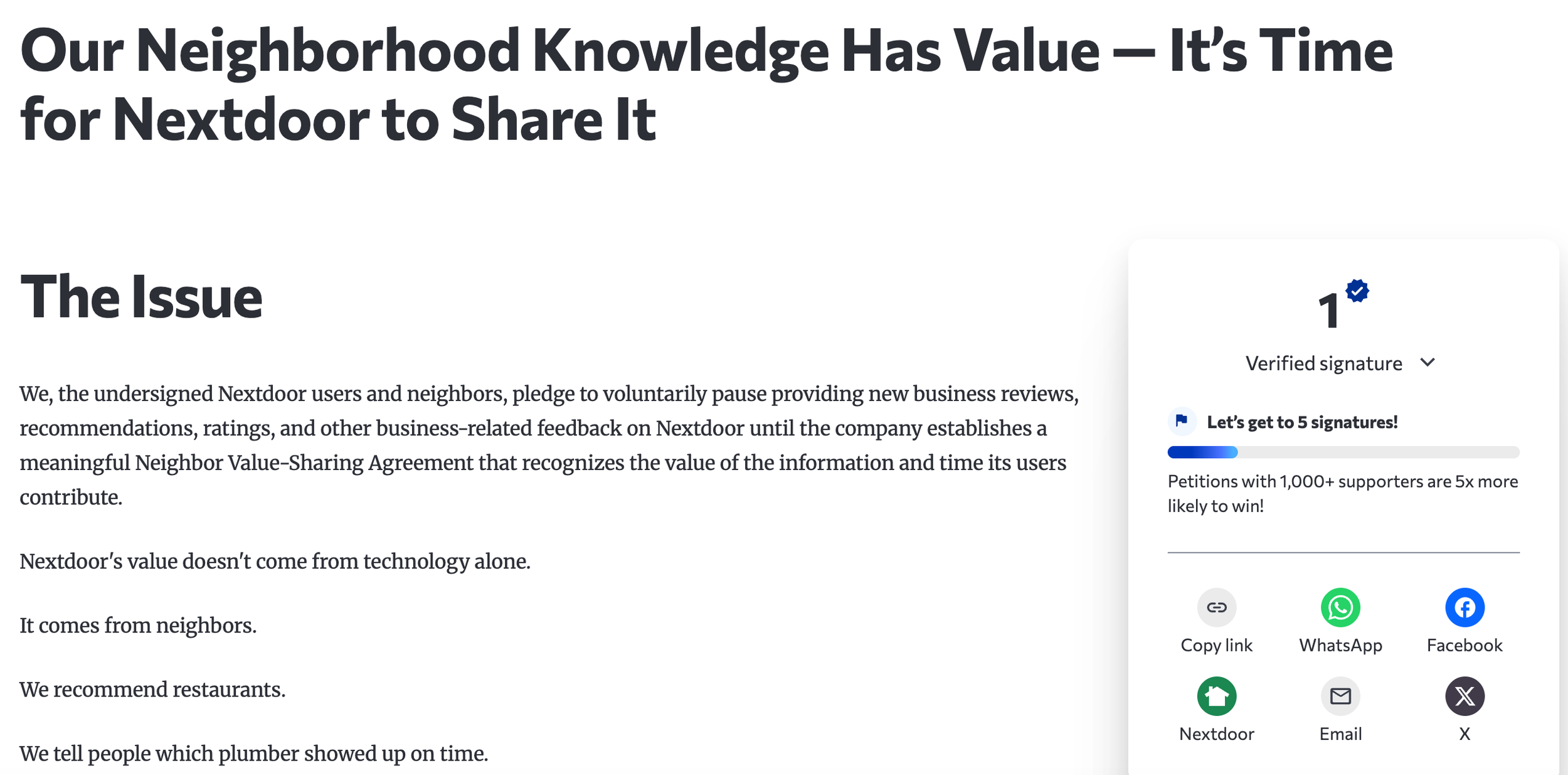
The Petition Is Live: Our Information Has Value
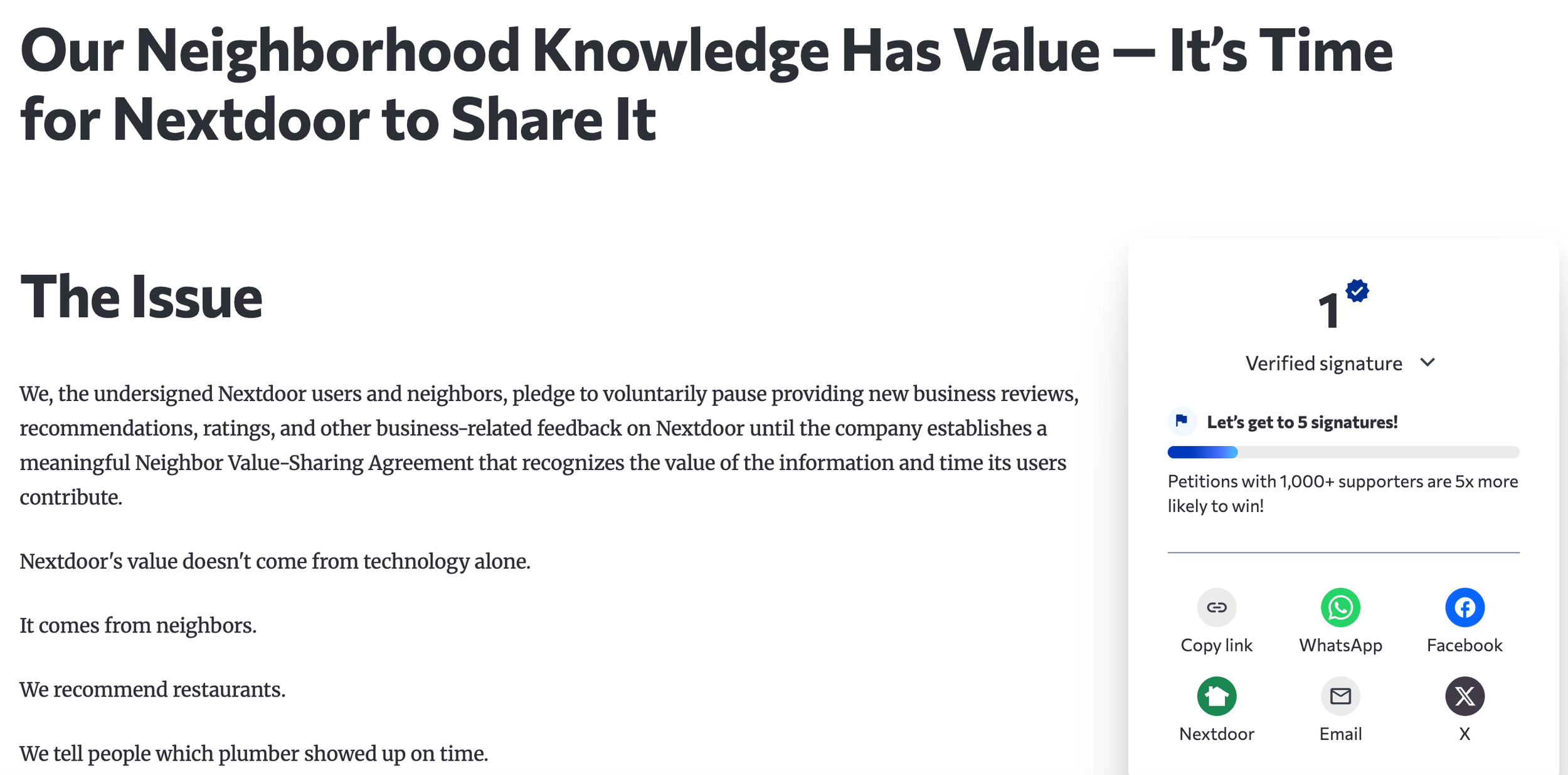
I have a radical idea—and now there's a petition behind it.
For years, Nextdoor neighbors have voluntarily created reviews, recommendations, answers, and other hyperlocal information that helps make the platform useful.
As that accumulated knowledge becomes potentially even more valuable through AI and other commercial products, I think it's time to ask:
If neighbors help create the value, should neighbors share in that value?
I've created a petition asking Nextdoor to establish a Neighbor Value-Sharing Agreement recognizing the time, knowledge, and information neighbors contribute.
Until that happens, the petition asks signers to pledge to pause providing new routine business reviews, recommendations, ratings, and other business-related feedback on Nextdoor.
This isn't about hurting local businesses or withholding emergency or safety information.
It's about recognizing something simple:
Our information has value.
Our recommendations have value.
Our time has value.
Please Sign—and Share It
If you agree, add your name:
Sign the Nextdoor Neighbor Value-Sharing petition
Then please share it with other Nextdoor users, neighbors, small-business owners, and anyone interested in how platforms use and monetize user-generated information.
One signature starts a conversation.
Enough signatures might make that conversation difficult to ignore.
I Have a Radical Idea: If Our Information Has Value, Maybe We Should Get Paid for It
Hear me out.
While doing my usual posting reach this morning, I came across a LinkedIn clip featuring Nextdoor CEO Nirav Tolia.outine
Apparently, Nirav is back on the podcast prowl.
Maybe it's because NXDR has been having a better stretch lately. Maybe not. I can't know the reason, so I'll leave that one alone.
But something Nirav said caught my attention.
He talked about Nextdoor having 16 years of local knowledge and using AI to package that information into something resembling a neighborhood version of ChatGPT. He emphasized that the information comes from real, verified neighbors and said:
“We have the distribution, we have the unique content.” LinkedIn
That's when a radical idea popped into my head.
What if the neighbors started thinking of that “unique content” as ours?
Who Created Those 16 Years of Local Knowledge?
Nextdoor built the platform.
I'll give them that.
They built the technology. They maintain the infrastructure. They developed the distribution. They attracted advertisers. They employ people. They have shareholders—including me—who expect the company to create value eventually
.
But who created those 16 years of neighborhood knowledge Nirav is talking about?
Neighbors did.
We wrote the restaurant recommendations.
We answered:
“Does anybody know a good plumber?”
We explained which mechanic we trusted.
We posted about missing dogs.
We recommended roofers.
We warned people about road closures.
We answered questions about neighborhoods.
We reviewed local businesses.
We told everyone where to find the best pizza.
We debated whether that sound was fireworks, gunshots, or somebody dropping a refrigerator.
And, of course, we conducted thousands upon thousands of neighborhood investigations into the most important issue facing America:
Whose dog left that poop?
😂
Individually, those posts may seem insignificant.
Collectively?
Apparently they're 16 years of unique local knowledge valuable enough to become part of Nextdoor's AI strategy.
Nextdoor itself describes its newer Ask experience as providing summarized recommendations from neighbors. Nextdoor
That changes the way I think about what neighbors are contributing.
Maybe We Should Take Our Information Back
I'm not suggesting people literally own every fact, recommendation, or conversation once it's posted online; the legal rights around platform content are governed by the service's terms and applicable law.
I'm talking about something different:
Recognizing the economic value of our participation.
If my recommendation helps create a dataset that makes Nextdoor more valuable, my recommendation has value.
If I spend five minutes answering another neighbor's question, my time has value.
If thousands—or millions—of neighbors do that repeatedly for years, the resulting body of information has enormous potential value.
That's essentially what makes a network like Nextdoor useful.
Without neighbors contributing information, what's left?
A very sophisticated map with advertisements.
Think About Market Research
Companies routinely pay people to participate in research.
Focus groups.
Consumer panels.
Product testing.
Surveys.
Interviews.
Why?
Because people's experiences, preferences, and opinions have value.
Someone asks:
“Which home insurance company do you use?”
That's data.
“Would you consider switching?”
Data.
“Who's the best plumber around here?”
Data.
“Which restaurant has the best burger?”
Data.
“Which contractor would you never hire again?”
Data.
When I participate in a formal market-research study, somebody may compensate me because my time and opinion are part of the product being created.
But when neighbors collectively produce years of incredibly specific hyperlocal information?
We call that engagement.
Interesting distinction.
Maybe There Should Be a Neighbor Dividend
Now we're getting radical.
What if platforms found ways to share some of the economic value created from user contributions?
It doesn't necessarily have to mean Nextdoor sends me $1.37 every time I recommend a Chinese restaurant.
Although I'm listening, Nirav.
😂
Imagine contribution credits.
Premium-feature credits.
Advertising credits for neighbors who own businesses.
Revenue-sharing pools for certain commercial uses of community-generated insights.
Opt-in research panels where neighbors are compensated when their responses are packaged into commercial research.
Or even a clearly defined rewards program recognizing people whose contributions consistently create useful information.are worth exploring.
Plenty of models
The principle is more interesting than any specific mechanism:
If community-generated knowledge becomes a commercial asset, should the community participate in the value it creates?
That's a conversation I'd love to have.
Because Nextdoor Is Monetizing the Network
There's nothing inherently wrong with that.
Nextdoor is a business.
I'm a shareholder. I want Nextdoor to make money.
Nextdoor sells advertising products to businesses and has expanded its commercial offerings over the years. Its newest small-business initiatives include free Business Pages and forthcoming feed participation, while Opportunity Alerts is explicitly a paid product that routes requests from verified neighbors to local service providers. Nextdoor
That's a business model.
But look at what's happening economically.
A neighbor asks:
“Does anybody know a good landscaper?”
The neighbor created the demand signal.
Other neighbors may create recommendations.
Nextdoor owns the platform where the interaction occurs.
And now a local service provider can pay Nextdoor for an opportunity to respond quickly to that demand. Nextdoor
Again, that's not inherently improper.
But it's certainly worth examining.
Because the small business is potentially paying.
The advertiser is paying.
Nextdoor is monetizing.
And the neighbors generating the underlying conversation?
They're providing the raw material.
So Who Is Squeezing Whom?
I've already provided plenty of feedback about what I see as Nextdoor increasingly squeezing small businesses for revenue.
To be fair, Nextdoor also provides free business tools, and the company says businesses can claim a Business Page at no cost. Nextdoor
But the company is simultaneously building more ways to monetize access to neighborhood demand.
Now Nirav is talking publicly about another incredibly valuable asset:
16 years of local knowledge.
Our knowledge.
Our conversations.
Our recommendations.
Our questions.
Our experiences.
Our time.
If Nextdoor's future AI products become more valuable because they can package years of neighbor-generated knowledge, I think neighbors have every right to ask:
What's our part of the value equation?
“We Have the Unique Content”
I keep coming back to that phrase.
“We have the unique content.” LinkedIn
From a corporate perspective, I understand exactly what Nirav means.
Nextdoor has accumulated something competitors can't easily recreate: years of geographically specific conversations from people connected to actual neighborhoods.
That's potentially a formidable competitive advantage.
But from the neighbor's side, I hear something else:
We created the unique content.
Nextdoor collected it.
Organized it.
Distributed it.
Stored it.
And now AI may make it dramatically easier to extract value from it.
That's why I think the conversation needs to evolve beyond:
“Isn't this a cool AI feature?”
It should also include:
Who created the knowledge?
How is it being used?
How transparent is that use?
Who benefits financially?
Should contributors share in any of that benefit?
Those are much more interesting questions.
Maybe Our Posts Aren’t Free Raw Material
For years, social media trained us to think the transaction was simple:
We get a free platform.
The platform gets our attention.
Advertisers pay for access to that attention.
Fair enough.
AI complicates that bargain.
Our contributions aren't merely something displayed between advertisements anymore.
Years of human conversations can become a knowledge base from which new products are created.
That's different.
And if platforms increasingly treat human-generated information as an asset that can power AI products, perhaps users should increasingly treat their contributions as assets too.
My time isn't worthless because I typed it into an app.
Neither is yours.
Here's My Radical Idea
Nextdoor wants authentic human knowledge.
Neighbors have it.
Nextdoor wants unique local content.
Neighbors create it.
Nextdoor wants businesses to pay to reach neighborhood demand.
Neighbors generate much of that demand.
Nextdoor wants AI to package years of community knowledge into something increasingly useful.
Neighbors spent 16 years building that knowledge base.
So perhaps the next evolution of the neighborhood network shouldn't simply be:
How can Nextdoor monetize neighbors more effectively?
Maybe it should also be:
How can neighbors participate in the value they're helping create?
Pay us for opt-in research.
Reward valuable contributions.
Create meaningful incentives.
Give people greater visibility and control over how their contributions feed commercial products.
Experiment with revenue sharing.
Treat neighbors not merely as users, but as participants in the economic ecosystem.
Because there's an uncomfortable irony in squeezing small businesses for more revenue while simultaneously discovering new ways to extract value from the knowledge neighbors contribute.
The AI Revolution Might Change More Than Search
Nirav may be right that Nextdoor possesses something enormously valuable in an AI world.
AI can summarize the internet.
But Nextdoor potentially has something different:
Hyperlocal human experience.
That's valuable.
Very valuable.
Which is exactly why neighbors should start thinking differently about it.
The next time an app asks:
“Can anyone recommend a good roofer?”
Maybe don't just think:
"I'll help my neighbor."
Think about this too:
I'm contributing another piece to a commercial knowledge network.
Helping your neighbor and understanding the economic value of your contribution aren't mutually exclusive.
Our information has value.
Our experiences have value.
Our recommendations have value.
And our time has value.
If Nextdoor's future is built on 16 years of knowledge from real neighbors, maybe the neighbors who created that knowledge deserve a seat at the table when its value is realized.
Now that would be a radical neighborhood conversation.
Read the continuing Nextdoor case study at NielFlamm.com/blog.
Nextdoor Didn’t Make the Top 100. Why Not?
The more I thought about Nextdoor’s LinkedIn post celebrating Publix making PEOPLE’s 100 Companies That Care, the more I realized I was focused on the wrong part of the story.
Yes, Publix ranked No. 4.
Yes, Nextdoor highlighted a Publix associate who used the Nextdoor app to discover an elderly neighbor needed help before Hurricane Milton.
It's a great story, and the employee deserves recognition.
But there's another question that I find much more interesting:
Where was Nextdoor?
Nextdoor didn't make the Top 100.
For a company whose identity revolves around neighbors, community, connection, trust and helping people locally, that's something worth examining.
Technology Companies Made the List
This wasn't a ranking limited to grocery stores, hospitals and nonprofits.
Technology companies made it.
Companies including Salesforce, Intuit, Hewlett Packard Enterprise, Adobe, ServiceNow and NVIDIA were recognized.
Salesforce ranked an impressive No. 5.
So technology isn't the barrier.
And that makes me wonder:
For a company that promotes itself as a platform for connection and community, why wasn't Nextdoor there?
We Don't Know Why—and That's Important
I don't know whether Nextdoor applied.
I don't know whether it was evaluated.
I don't know whether it qualified but didn't score high enough.
And because the published ranking ends at 100, I don't know whether Nextdoor would have been No. 101 or No. 1,001.
I'm not going to manufacture an explanation.
But I can look at some of the issues I've documented and ask whether they provide opportunities for Nextdoor to improve.
Because that's what feedback should ultimately accomplish.
Start With Small Businesses
Nextdoor talks frequently about supporting local businesses.
I've also provided feedback about what I see as an increasingly aggressive effort to monetize those businesses.
Business Pages.
Advertising.
Paid products.
Opportunity Alerts.
Nextdoor needs to make money.
Let me emphasize that because I'm a shareholder:
I WANT NEXTDOOR TO MAKE MONEY.
My concern is where intelligent monetization ends and what I've described as a money grab begins.
If you're going to position yourself as the champion of neighborhood businesses, those businesses should feel like valued members of the ecosystem—not simply another opportunity to extract revenue.
Nextdoor needs to make money with small businesses, not merely from them.
There's a difference.
Then There’s the Moderator Model
I've also repeatedly provided feedback about what I believe is a flawed volunteer moderator model.
I've questioned consistency.
Training.
Accountability.
Quality assurance.
Centralized oversight.
And what happens when personal neighborhood disputes collide with moderation authority.
When moderation works, most people probably never notice it.
When it doesn't, moderation can become the entire Nextdoor experience.
If Nextdoor wants to sell trust, its moderation system needs to consistently create trust.
That requires more than asking unpaid neighbors to police other neighbors.
And Then There’s the “Karen” Problem
Let's address the person demanding to speak with the neighborhood manager.
Nextdoor has faced a long-running public reputation in commentary as something of the “Karen” of social-media platforms.
Fair or unfair, the reputation exists.
Suspicious-neighbor posts.
Parking complaints.
Garbage-can disputes.
Political arguments.
Dog-poop investigations worthy of CSI: Suburbia.
And the classic:
“Did anyone else hear that boom?”
Nextdoor can't control every ridiculous thing someone posts.
But Nextdoor can influence the experience surrounding those posts.
Moderation.
Product design.
Algorithms.
Enforcement.
Community standards.
Leadership.
If a platform develops a cultural reputation for complaining, suspicion and neighborhood conflict, marketing alone isn't going to change it.
You have to change the experience that created the reputation.
But Here’s What Really Got My Attention About Those Tech Companies
Companies such as Salesforce, NVIDIA, Intuit, Adobe, ServiceNow, and HPE aren't charities.
They're businesses.
And some of them are extraordinarily profitable businesses.
That's important because sometimes conversations about corporate responsibility create a false choice:
Make money
or
do good.
The companies appearing on this list demonstrate that it doesn't have to work that way.
Caring and Making Money Aren’t Opposites
Take Salesforce.
Salesforce ranked No. 5 on the Companies That Care list.
In fiscal 2026, Salesforce reported a 20.1% GAAP operating margin, generated approximately $14.4 billion in free cash flow, and returned approximately $14.3 billion to shareholders through stock repurchases and dividends.
At the same time, its community efforts included its AI for Impact initiative and millions of dollars in funding, technology, and expertise for nonprofits.
Then there's NVIDIA.
NVIDIA made the Companies That Care list while also returning enormous amounts of capital to shareholders. During fiscal 2026, NVIDIA reported approximately $40.4 billion in share repurchases and $974 million in dividends.
Intuit made the list while continuing to operate a profitable technology business and connecting its community initiatives directly to its mission of “powering prosperity.”
See the pattern?
These companies didn't have to choose.
They could make money.
They could return money to shareholders.
They could invest in employees.
They could support communities.
And they could still work toward fulfilling their stated missions, visions and values.
Mission Shouldn’t Be a Substitute for Results
This is where I think the comparison becomes particularly relevant to Nextdoor.
Mission statements are wonderful.
Values are wonderful.
Community is wonderful.
But shareholders can't deposit a mission statement.
And customers can't experience corporate values that exist only on a website.
Mission, vision, and values shouldn't substitute for business results.
But the reverse is equally important:
Business results shouldn't require abandoning mission, vision and values.
Great companies figure out how to do both.
That's the standard.
And That’s Why Nextdoor’s Absence Interests Me
Think about the proposition Nextdoor is trying to sell.
It's the neighborhood platform.
The connection platform.
The place where real people connect with real neighbors.
The place where local businesses connect with customers.
The place where communities supposedly become stronger.
If I were designing a company specifically to compete for something called “100 Companies That Care,” that sounds like a pretty good starting point.
Yet Nextdoor didn't make the Top 100.
Meanwhile, companies that don't have “neighborhood connection” at the center of their entire identity did.
That's fascinating.
Maybe Connection Needs to Start at Home
Here's the question I'd ask Nextdoor:
Does the experience inside and around Nextdoor match the values Nextdoor markets outside?
Do employees feel connected?
Do neighbors trust the platform?
Do small businesses feel supported—or monetized?
Do volunteer moderators have the training, oversight, and accountability they need?
Does leadership welcome difficult feedback?
Does the platform's actual reputation resemble the brand Nextdoor wants people to see?
Is the company building sustainable profitability?
And are shareholders seeing the value created by all of it?
Those aren't accusations.
They're questions.
But they're questions I think any company built around connection should be willing to ask.
Profitability Is Part of Caring Too
This may sound strange, but I believe it.
A company that can't sustain itself can't fulfill its mission for very long.
Profit matters.
Cash flow matters.
Shareholder returns matter.
Capital allocation matters.
Employees need a financially healthy employer.
Customers need a financially sustainable product.
Communities benefit when companies can continue investing in them.
And shareholders provided capital with the expectation that management would create value.
Profit isn't the enemy of purpose.
Done correctly, profit helps fund purpose.
That's why I'm impressed when a company can simultaneously generate profits, reward shareholders, invest in employees and communities, and remain aligned with its stated values.
Imagine the Better LinkedIn Post
Rather than Nextdoor posting:
“Publix made the list, and somebody from Publix used Nextdoor!”
Imagine next year:
“Nextdoor Named One of PEOPLE’s 100 Companies That Care.”
Now we're talking.
No Six Degrees of Kevin Bacon.
No connection through Publix.
No borrowed spotlight.
Nextdoor's accomplishment.
Then imagine being able to add:
Revenue growing.
Profitable.
Employees engaged.
Small businesses succeeding.
Moderation improving.
Neighbors finding genuine value.
Shareholders receiving returns.
Community mission intact.
That's the story I'd love to write.
Here’s My Challenge to Nextdoor
Don't dismiss the Top 100 list.
Study it.
Look at the technology companies that made it.
Look at how they treat employees.
Look at their philanthropy.
Look at their community investment.
Look at their corporate cultures.
And importantly, look at how some of them simultaneously make money and create shareholder value.
Then look inward.
Fix what needs fixing.
Improve the moderator model.
Make small businesses feel like partners rather than ATMs.
Continue improving communication.
Address the platform's “Karen” reputation by improving the actual experience.
Listen to feedback—even when it's uncomfortable.
Build sustainable profitability.
Create shareholder value.
And make sure the company's actions reflect the mission, vision and values it talks about publicly.
Because you don't have to choose between:
Caring about communities
and
caring about shareholders.
The best companies can do both.
Nextdoor's mission should actually give it an advantage.
Now it needs to prove it.
Don't just connect yourself to Companies That Care.
Become a profitable Company That Cares.
And give the neighbors, employees, small businesses and shareholders something worth celebrating.
If Nextdoor makes that list someday?
I'll happily applaud them.
Read my continuing Nextdoor case study at NielFlamm.com/blog.

Day 90: What If Nextdoor Is Trying to Serve Too Many Customers at Once?

Day 90.
Ninety consecutive days of looking at Nextdoor from different angles.
Yesterday, NXDR closed at $2.27. That's up from the $2.23 close I discussed on Day 88, but I'm not going to spend Day 90 dissecting four cents.
Instead, I want to ask a completely different question:
Who exactly is Nextdoor's customer?
Sounds simple.
I'm not sure it is.
Meet the Nextdoor Family
Think about all the different people Nextdoor is trying to satisfy.
There's the neighbor who wants to know why three police cars just went down the street.
There's the small-business owner who wants customers.
There's the advertiser who wants access to those neighbors.
There's the moderator trying to keep everyone from digitally strangling each other over political signs and dog poop.
There's the researcher or marketer interested in Nextdoor's Insights.
There's the shareholder—hello!—who wants the company to create sustainable value.
And then there's Nextdoor itself, which has to somehow turn this entire neighborhood block party into a profitable business.
That's a lot of people sitting at one table.
And they don't necessarily want the same meal.
The Neighbor Doesn't Wake Up Thinking About Monetization
I doubt many people roll out of bed thinking:
“I hope Nextdoor improves its advertising yield today.”
Neighbors want utility.
What's happening?
Who can fix my air conditioner?
Did somebody find my dog?
Why is the power out?
Is that restaurant any good?
What's being built down the street?
And, naturally:
“Did anyone else hear that boom?”
That's the product from the neighbor's perspective.
But there's a problem.
The neighbor may be the person using the product...
without being the person primarily paying for it.
That's where things get interesting.
The Advertiser Wants Something Completely Different
The advertiser doesn't necessarily care whether Karen and Steve finally resolve their six-day dispute over Steve's garbage cans.
The advertiser wants:
Attention.
Preferably local attention.
And preferably attention from people likely to buy something.
That creates a balancing act.
Nextdoor needs enough people using the platform to make the audience valuable to advertisers.
But if monetizing that audience makes the experience less useful, those people may use Nextdoor less.
And then the audience becomes less valuable.
Welcome to the social-media hamster wheel.
Then Along Comes the Small Business
This is where Nextdoor has another interesting relationship.
The local business can simultaneously be:
Content creator.
Advertiser.
Community participant.
Recommended business.
Potential paying customer.
That's a lot of hats.
Nextdoor wants neighbors to recommend local businesses organically because those recommendations build trust and create useful content.
But Nextdoor also needs to make money from businesses.
That's not inherently wrong.
Nextdoor is a public company, not a neighborhood charity.
The interesting question is where the line sits between:
Helping local businesses participate
and
Monetizing their need to reach neighbors.
That's a strategic question worth watching.
And Then There Are Shareholders
This is the group I belong to.
I don't need Nextdoor to be free of advertising.
I want revenue growth.
I want profitability.
I want innovation.
I want management making intelligent investments.
And yes...
I want NXDR worth more than $2.27.
But here's the catch.
If Nextdoor squeezes too much money out of the platform and damages the neighbor experience, that isn't necessarily good for shareholders long-term.
If Nextdoor focuses exclusively on making neighbors happy but can't build a profitable business around them, that's not particularly helpful either.
The interests are connected.
Maybe Nextdoor Isn't One Product
This is the thought that really interests me on Day 90.
Maybe we're evaluating Nextdoor incorrectly by thinking of it as one product.
It may actually be several products sharing the same neighborhood.
To the neighbor, Nextdoor sells connection and information.
To the local business, it sells visibility and potential customers.
To the advertiser, it sells access and attention.
To researchers and marketers, it offers neighborhood insights.
And to shareholders, management is ultimately selling something else:
The promise that all of those pieces can become a valuable business.
That's a difficult puzzle.
Imagine Trying to Run This Restaurant
Imagine opening a restaurant where one customer wants steak.
Another wants vegan.
Another wants breakfast.
Another wants cocktails.
Another wants everything free.
And there's a shareholder standing near the kitchen asking why the margins aren't better.
Hi. I'm the guy near the kitchen.
Meanwhile, the chef is doing podcasts explaining the future of restaurants.
At some point somebody has to decide:
What's our signature dish?
That's what I'm asking about Nextdoor.
What Is the One Thing Nextdoor Must Be Exceptional At?
Not 17 things.
One.
Is Nextdoor primarily:
The place to discover what's happening nearby?
The place to connect with neighbors?
The place to discover trusted local businesses?
A hyperlocal advertising platform?
A neighborhood recommendation engine?
A source of uniquely valuable local data?
Maybe it can eventually be all of those things.
But companies usually become indispensable because they're exceptionally good at something.
Then they expand.
And That Brings Me Back to $2.27
NXDR closed yesterday at $2.27.
Four cents higher than the $2.23 close I discussed earlier this week.
Good.
As a shareholder, I'll happily take the four cents.
But Day 90 isn't about whether the stock moved four cents.
It's about what eventually moves it forty cents, a dollar, or several dollars—and keeps it there.
That requires more than announcements.
It requires a business people understand.
A product neighbors value.
An ecosystem businesses value.
An audience advertisers value.
And a strategy shareholders believe will eventually create sustainable returns.
That's a lot of customers to keep happy.
Day 90: Who Gets the Best Seat at the Table?
So after 90 days, here's today's question:
When the interests of neighbors, businesses, advertisers, and shareholders collide, who comes first?
Because saying everyone comes first sounds wonderful.
Until two of them want completely different things.
That's when corporate strategy stops being a mission statement and becomes a decision.
And those decisions may ultimately tell us far more about Nextdoor's future than whether NXDR closed yesterday at $2.27 or $2.23.
Ninety days down.
And somehow, I still haven't run out of doors to open.
Follow my continuing Nextdoor case study at NielFlamm.com/blog.
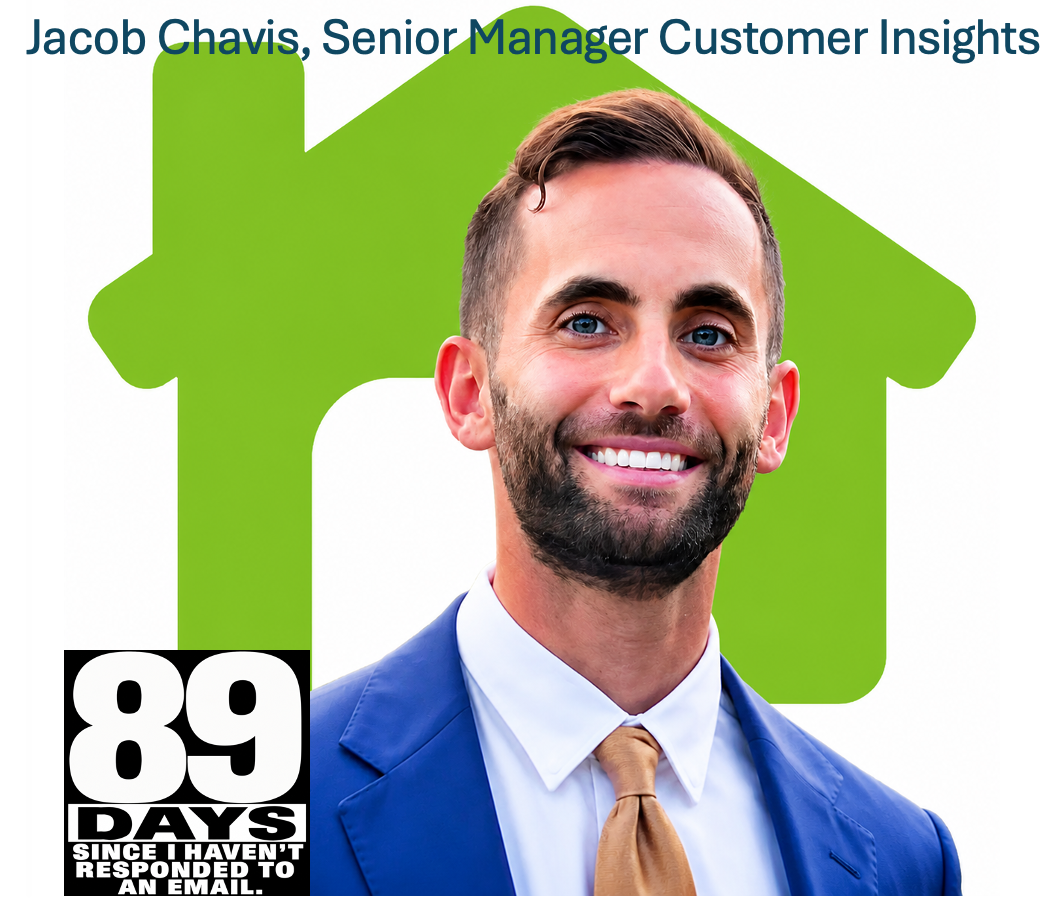
Day 89: What If Nextdoor’s Biggest Competitor Isn’t Another App?
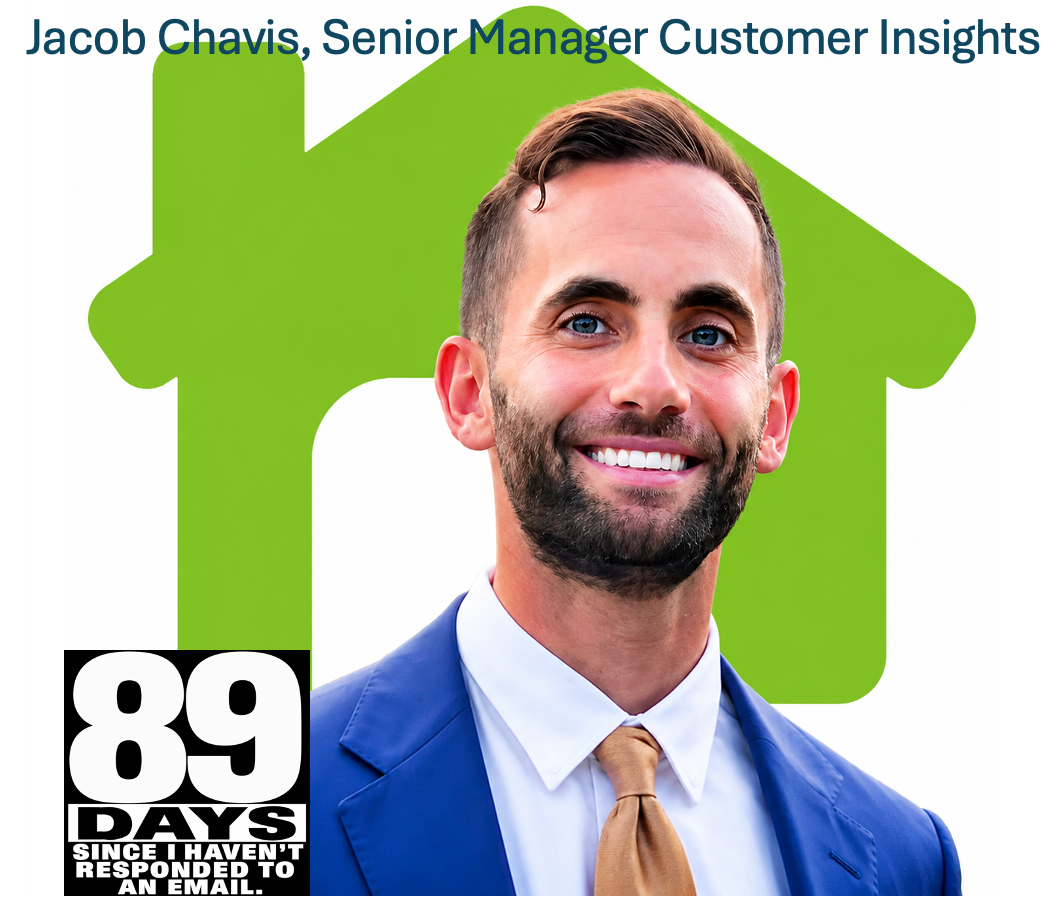
For 88 days, I’ve written about Nextdoor from almost every angle imaginable.
Leadership. Communication. Surveys. Detailed data that I’m still waiting for. Moderation. Small businesses. Advertising. Stock price. Executive decisions. AI. Trust. Blocking shareholders. Even the question of whether anybody is actually driving the bus.
So for Day 89, let's go somewhere completely different.
What if Nextdoor's biggest competitive threat isn't Citizen, Facebook, Ring, Reddit, or some new neighborhood app?
What if Nextdoor's biggest competitor is simply…not opening Nextdoor?
Think about that.
The Most Dangerous Competitor Has No Logo
Every technology company watches its competitors.
What features did they launch?
How many users do they have?
What are they charging?
What are people saying about them?
But there's another competitor that doesn't appear on a PowerPoint competitive-analysis slide.
Indifference.
The person who gets a Nextdoor notification and swipes it away.
The business owner who decides it isn't worth figuring out how Nextdoor works.
The neighbor who hasn't deleted the app but hasn't opened it in six months.
The person who once checked Nextdoor every morning and gradually stopped.
They're technically still a potential user.
But Nextdoor has lost something arguably more important than an account:
Nextdoor has lost their attention.
Deleting an App Is Actually a Dramatic Event
Someone deleting Nextdoor can be measured.
Someone quitting publicly can be noticed.
Someone posting:
“I'M DONE WITH NEXTDOOR!”
is actually giving the company valuable information.
They're angry enough to explain why they're leaving.
But what happens when someone doesn't leave?
They just stop caring.
No complaint.
No angry email.
No support ticket.
No dramatic goodbye post.
Nextdoor remains buried somewhere between Candy Crush and an app they downloaded three phones ago.
That's much harder to fix.
Think About Your Own Neighborhood
If something happens on your street, what's your first instinct?
Do you open Nextdoor?
Text a neighbor?
Check Facebook?
Look at Ring?
Search Google?
Check Citizen?
Look out the window?
Walk outside?
Or do you simply wait until somebody tells you what happened?
That's the real competitive battle.
Nextdoor doesn't merely need to convince people that it's better than another social platform.
It needs to become the answer to:
“Where do I go when I want to know what's happening around me?”
That's a much bigger challenge.
This Is Where “Essential” Gets Interesting
Nextdoor has described itself as an essential neighborhood network.
That's a powerful word.
Essential.
Water is essential.
Electricity is essential.
My morning caffeine can occasionally feel essential.
But an essential product isn't something people have to remind themselves to use.
It becomes habitual because it repeatedly provides value.
That's why I think Nextdoor's most important metric may not simply be how many people can use it.
It's whether people feel they need to use it.
And This Isn't Just About Users
The same question applies to businesses.
Imagine you're a plumber.
A landscaper.
A restaurant.
A dog groomer.
A handyman.
With limited time and limited marketing dollars.
They can be spent on Google.
Facebook.
Instagram.
Direct mail.
Local sponsorships.
Search advertising.
Or Nextdoor.
Nextdoor doesn't just compete against those platforms.
It competes against the business owner saying:
“Nah. I'm good.”
That's the competitor without a logo again.
Indifference.
Maybe This Is the Question Nextdoor Should Obsess Over
Instead of:
How do we get another click?
Try:
What would make somebody miss Nextdoor if it disappeared tomorrow?
That's a fascinating question for any company.
If Nextdoor vanished tonight, what would neighbors genuinely lose?
Local recommendations?
Emergency information?
Community discussion?
Business discovery?
Lost-dog alerts?
Someone asking what that helicopter is doing?
The annual neighborhood debate about whether fireworks are legal?
And, of course, the timeless classic:
“WHOSE DOG POOPED ON MY LAWN?”
There is genuine value buried inside all of that.
The challenge is making the valuable parts important enough that people tolerate—or better yet, don't encounter—the parts that drive them away.
Day 89: Forget the Competition for a Minute
I've spent a lot of time examining what Nextdoor says.
Today I'm more interested in what users do.
Nextdoor can advertise trust.
Nextdoor can announce AI.
Nextdoor can redesign Business Pages.
Nextdoor can create new advertising products.
Nextdoor can publish Insights reports.
Nextdoor can make podcast appearances.
But none of it matters if the customer eventually responds with the most dangerous sentence in business:
“I don't really use it anymore.”
Anger can be addressed.
Complaints can be investigated.
Products can be improved.
Even a shareholder writing about you for 89 consecutive days is demonstrating engagement.
But indifference?
Indifference doesn't complain.
It just leaves the app sitting unopened.
And maybe that's the Nextdoor problem worth talking about on Day 89.
Not who's criticizing the company.
Not who's blocking whom.
Not even where NXDR closed yesterday.
Who still cares enough to open the door?
Follow my continuing Nextdoor case study at NielFlamm.com/blog.