
Day 133: Nextdoor Has Time for AI. What About Protecting Neighbor Data?
Monday. Just before noon.
It's been a slow day on Nextdoor. I missed Day 132 because there wasn't much to report. Now, four days have passed without a public response to the questions I've been raising about moderator accountability, neighbor privacy, and protecting nonpublic information.
Nirav Tolia hasn't responded to those questions either.
At this point, the silence feels routine.
Meanwhile, I checked NXDR this morning. The stock is trading around $2.37, down from $2.63 on Friday. That's a notable move, although I have no evidence connecting it to anything I've been discussing.
But the stock price isn't today's story.
Today's story is what Nextdoor chooses to talk about—and what it doesn't.
Day 133: The Questions Are Still There
My question is straightforward.
What safeguards does Nextdoor have to protect neighbors if a volunteer moderator misuses their position or accesses nonpublic information for purposes unrelated to moderation?
I'm not accusing a specific moderator of misconduct. I'm asking about the controls that should exist before something goes wrong.
Nextdoor's U.S. Member Agreement says that volunteers who have access to nonpublic information through account features must use it only in connection with their volunteer role. That's an important rule.
But a rule is only one part of a safeguard.
What limits access in the first place? How does Nextdoor monitor potential misuse? What happens when a neighbor reports that a moderator has abused their privileges? How does Nextdoor investigate complaints when the person being reported is part of the moderation system?
And what training must moderators complete to understand their responsibilities around confidentiality, conflicts of interest, and personal retaliation?
I want Nextdoor to publicly explain these protections in plain English.
Not because I know a breach has happened. I don't.
Not because I know a moderator has misused nonpublic information. I don't.
I want the company to explain how it prevents these things from happening and how it responds if they do.
AI Days: An Interesting Initiative, but Is It the Priority Neighbors Need?
Last week, Tony Castellanos, Nextdoor's head of People, highlighted the company's monthly AI Days—time set aside for employees to experiment with AI tools and explore ways to improve their work. HR Brew also covered the initiative.
Experimentation can be useful. Companies should explore tools that help employees work more effectively.
My concern isn't that Nextdoor is exploring AI.
My concern is the difference between the topics the company promotes and the practical questions users still need answered.
We hear about AI experimentation, neighborhood-level advertising intelligence and product initiatives. Those subjects may be relevant to Nextdoor's business strategy.
But where is the equally clear public explanation of how the company protects the people who make its platform valuable?
Where is the straightforward discussion of moderator access, confidentiality, accountability and safeguards against retaliation?
AI can help a company move faster. It cannot replace sound policies, effective oversight or accountability.
Nirav Tolia, What Are the Safeguards?
Nirav, I'm not asking you to respond personally to every post I publish. I'm asking Nextdoor, as a company built around verified neighbors and local relationships, to explain how it protects the information and trust those relationships depend on.
Here are the questions I'd like answered:
Access: What nonpublic information can volunteer moderators access, and how is that access restricted?
Monitoring: What controls detect or investigate potential misuse of moderator privileges?
Training: Is annual refresher or compliance training mandatory for volunteer moderators? What does it cover?
Complaints: How can neighbors report suspected moderator abuse without fear of retaliation?
Accountability: Who reviews serious complaints when the moderator is the subject of the report?
Transparency: Where can users read a clear explanation of these safeguards and how they're enforced?
Nextdoor's public policies provide some information about expected conduct. What I want to understand is how the company puts those expectations into practice.
Publishing the rules is important. Explaining the protections behind them is important, too.

Four Days of Silence, Another Day of Questions
I started this case study to examine the gap between Nextdoor's promise and its execution.
I'm still doing that.
I don't expect a response to every question, and I recognize that the company can't disclose every detail of its security procedures. There are legitimate reasons not to publish information that could help someone circumvent a security control.
But there's a difference between revealing sensitive technical details and explaining the principles, training, oversight, and accountability measures used to protect people.
A company can be transparent about its approach without giving bad actors a roadmap.
That's what I'm asking for.
As I write this on Monday, October 26, NXDR is down from Friday's close, and, from my perspective, my questions about moderator safeguards remain unanswered. The stock movement is one data point. The unanswered questions are a separate issue.
Nextdoor has announced that its next earnings report will come on November 5. Investors will hear about business performance, and I'm sure there will be plenty to discuss.
But I hope Nextdoor also remembers that its long-term future depends on more than revenue, engagement, and new technology.
It depends on whether neighbors can trust the platform—and whether the company can demonstrate that it takes their privacy and safety seriously.
Stop making AI the headline for a moment. Tell neighbors how you're protecting them.
That's the update I'm waiting for.
👉 Follow my continuing Nextdoor case study at NielFlamm.com/blog.

🎃 Day 120: Halloween, Neighbors, and Another Day of Silence from Nextdoor
Halloween could be an AWESOME opportunity for Nextdoor to bring neighbors together. Think about it!
🍬 Kids smiling from ear to ear as they collect candy.
🍫 Adults secretly stealing candy from their own kids.
🏡 Neighbors hosting Halloween parties and welcoming people into their homes.
👻 Communities coming together for a holiday that so many people love.
That's what a neighborhood platform should do: connect people, build relationships, and bring communities together.
But let's check in on Nextdoor's leadership and communications.
📅 Nextdoor's last post: October 8.
📅 Nirav Tolia's last post: October 9.
If Nirav isn't talking about AI, is he talking about anything at all? 🤔
Meanwhile, NXDR is trading at $2.66 a share today. That's movement in the right direction, but it's still a far cry from the Citibank number Nextdoor previously referenced.
And here's the bigger question: What about the people whose data helps power the platform?
Nextdoor benefits from its users' activity, information, and contributions. Shouldn't those users have a voice in how the value generated from their data is shared?
📢 Have you signed the Nextdoor Neighbor Value-Sharing Petition?
If you believe neighbors deserve a share in the value created by their contributions, add your name today!
✍️ Sign the petition here: https://c.org/GkNWmffgg9
Let's keep the conversation going. A neighborhood platform should be about more than AI announcements and stock prices. It should be about the people who make the neighborhoods — and the platform — what they are.
🎃 Happy Halloween! Let's make it about neighbors again.
Day 105: “The Power of We” Sounds Great. I’m Still Waiting for the “We.”
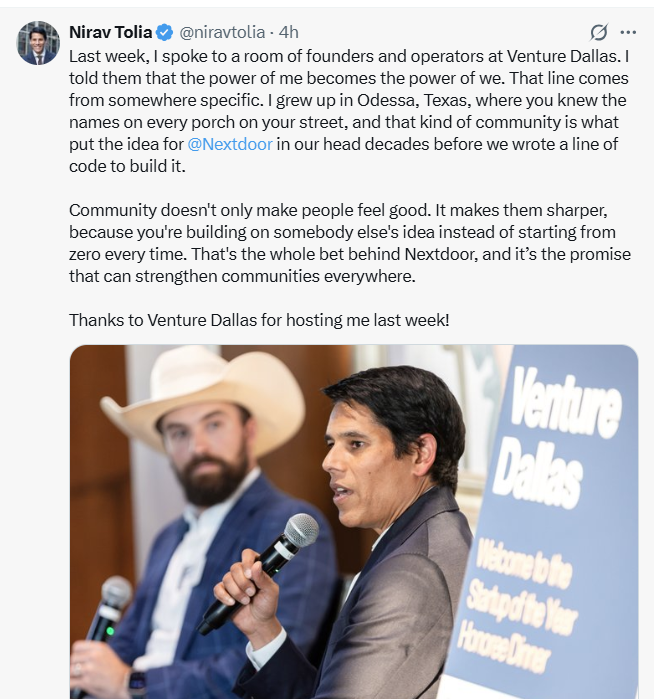
Today, Nextdoor CEO Nirav Tolia posted about speaking to a room of founders and operators at Venture Dallas.
One line immediately caught my attention:
“The power of me becomes the power of we.”
That's a pretty good line.
Actually, it fits remarkably well with what I've been writing about for the past 105 days.
Nirav went on to describe growing up in Odessa, Texas, where knowing the names of people on the street helped shape the idea behind Nextdoor. He wrote that community makes people sharper because they're building on other people's ideas instead of constantly starting from zero.
Then came another line that caught my attention:
“That's the whole bet behind Nextdoor.”
Venture Dallas itself describes its mission in similar terms: connecting innovators and investors while building collaboration and a stronger entrepreneurial community.
Great.
So let's talk about the “we.”
I've Been Trying to Join the Conversation for 105 Days

For 105 days, I've been asking Nextdoor about detailed data referenced in two of its Insights posts.
This hasn't been 105 days of demanding that somebody agree with me.
It hasn't been 105 days of demanding that Nextdoor change its business because one small shareholder has an opinion.
I've asked a question.
I've provided feedback.
I've emailed.
I've followed up.
I've publicly documented the experience.
Communications eventually responded, and I acknowledged that response. I didn't receive the complete, detailed material I requested.
Yesterday, I expanded the email to Nextdoor's Executive Team.
Those emails did not bounce.
I also attempted to CC members of the Board of Directors. Every one of those attempted Board addresses came back undeliverable.
I’m waiting to see if anyone on the Executive Team responds.
My prediction is still that nobody will.
I would love to be wrong.
“Building on Somebody Else's Idea”
This is where Nirav's post gets especially interesting to me.
He talks about the value of building on somebody else's idea.
That's exactly what feedback can be.
Sometimes feedback is wrong.
Sometimes it's annoying.
Sometimes the person providing it has misunderstood something.
Sometimes it's brilliant.
Sometimes it's somewhere in between.
But an organization doesn't figure out which it is by ignoring it.
My Learning & Development brain immediately goes to the difference between hearing and listening.
Hearing is receiving the message.
Listening requires doing something with it—even if the eventual response is:
“We heard you. We disagree, and here's why.”
That's still communication.
What Does “We” Mean When Someone Disagrees?
The “power of we” is easy when everyone in the room is nodding.
It's harder when somebody keeps raising his hand.
For 105 days.
😂
That's where community becomes much more interesting.
If Nextdoor believes communities become stronger by building upon the knowledge and ideas of other people, shouldn't that philosophy apply when the ideas are uncomfortable?
Shouldn't it include shareholders asking questions?
Small businesses providing feedback?
Neighbors questioning policies?
People challenging research methodology?
People asking how their contributions are being monetized?
People saying, “I think there's a better way to do this”?
I'm not suggesting every piece of feedback deserves implementation.
That would be ridiculous.
But feedback can at least deserve consideration and, when appropriate, an answer.
And Then There's the Other “We”
There's another reason the phrase jumped out at me.
I've recently been writing about the economic value of the information neighbors contribute to Nextdoor.
Recommendations.
Reviews.
Local experiences.
Business information.
Questions.
Answers.
Years of neighborhood knowledge.
Nextdoor provides the technology, infrastructure, and distribution.
Neighbors provide most of what's inside it.
That's a pretty literal example of “me” becoming “we.”
And if that collective knowledge becomes increasingly valuable—particularly as AI makes it easier to organize, search, and commercialize enormous amounts of information—I think there's a legitimate conversation about whether the people supplying that knowledge should share in some of the value it creates.
That's why I started my petition calling for a Neighbor Value-Sharing model.
It currently has one signature.
Mine.
I'm apparently dominating the polling. 😂
But I'm still asking the question.
Community Can't Just Be a Stage Message
I like what Nirav wrote.
I genuinely do.
Community can make ideas better. Collaboration can create things an individual never could. Venture Dallas itself is built around connecting entrepreneurs, investors, and innovators.
But that's also why I'm going to keep comparing the message with the experience.
“The power of me becomes the power of we.”
Okay.
I'm here.
I've been here for 105 days.
I've provided feedback, asked questions, and repeatedly offered to connect—phone, video, or virtual coffee, whatever works.
Yesterday, my email appears to have successfully reached the addresses for members of Nextdoor's Executive Team.
So perhaps Day 105 is the perfect day to test the philosophy.
Does the “we” include people who ask uncomfortable questions?
I hope so.
Because if community really is the whole bet behind Nextdoor, then listening to the community shouldn't be the difficult part.
Day 105.
Now I wait.
👉 Read the continuing case study at NielFlamm.com/blog

Day 104: The Emails Made It. Now We Wait.
Day 104.
Yesterday, I expanded the audience for my ongoing request for Nextdoor’s detailed Insights reports.
Today, I have a little more clarity about what actually made it through.
Every Board email I attempted was returned as undeliverable.
I couldn’t reach the Nextdoor Board through those addresses. I used what seemed like a reasonable first-name@nextdoor.com format. It didn't work.
The Executive Team was different.
None of those emails bounced back.
That doesn't prove anyone read my email. It doesn't prove it reached a particular executive's inbox instead of getting filtered somewhere along the way.
But unlike my attempted Board emails, I received no delivery-failure messages.
So now?
I wait.
Will Anyone Answer?
My guess?
No.
But that's only a prediction based on my experience over the previous 103 days—not a fact. I'd actually be delighted to be wrong.
The request remains remarkably simple.
Nextdoor previously published Insights posts telling readers that additional findings and detailed data were available if they contacted the company.
I've been asking for that material.
Communications eventually responded, but the materials I received weren't the complete, detailed set I requested.
Yesterday, I put the question in front of a broader group of Nextdoor executives:
Can you provide the detailed reports/data—or tell me they aren't available?
That's it.
No 50-page shareholder proposal.
No demand for a seat in the boardroom.
No decoder ring required.
Send it, say no, explain the restrictions, or tell me who owns the request.
Any of those answers works.
Day 104 Is Now About the Response
The email appears to have reached the Executive Team addresses.
My attempted Board emails didn't.
I've documented both.
Now there's nothing more to add until Nextdoor decides what it wants to do with the question.
Maybe someone responds tomorrow.
Maybe someone responds next week.
Maybe nobody responds at all.
If they answer, I'll publish that too.
For now, the ball is in Nextdoor's court.
Day 104.
The email was sent.
The Executive Team addresses didn't bounce.
Now we find out whether delivery leads to communication.
👉 Follow the continuing case study at NielFlamm.com/blog