

Happy Labor Day — Day 85: Nextdoor, Did You Forget the People Who Do the Work?

Happy Labor Day! 🇺🇸
Today is Day 85 of my continuing Nextdoor case study.
Before I get to Nextdoor, it's worth remembering what today actually represents.
Labor Day isn't simply the unofficial end of summer, a three-day weekend, mattress sales, barbecues or one last trip to the beach.
Labor Day recognizes the contributions and achievements of American workers and the labor movement that fought for better working conditions, reasonable hours, fair wages, and greater protections for working people.
It became a federal holiday in 1894, and more than 130 years later, it's still an opportunity to recognize the people whose work keeps businesses, communities, and this country moving.
Which brings me to Nextdoor.
Hello? Anybody Home?
As of this writing, I haven't seen a Labor Day post on Nextdoor.
Nothing from CEO Nirav Tolia either.
Maybe something will appear later today.
If it does, I'll happily update this post.
But right now?
Crickets. 🦗
And I find that remarkable.
This is a company whose entire identity revolves around neighborhoods, communities, local businesses, and the people who make those communities work.
Teachers.
Nurses.
First responders.
Restaurant workers.
Retail employees.
Construction workers.
Delivery drivers.
Small-business owners.
Landscapers.
Electricians.
Plumbers.
Mechanics.
And, yes, the employees who actually keep Nextdoor operating.
If there were ever a holiday that practically writes itself for a company claiming to be the “essential neighborhood network,” wouldn't Labor Day be it?
Talk About Out of Touch
This isn't about whether every corporation is required to publish a social-media post for every holiday.
Of course not.
It's about awareness and consistency with your own brand.
Nextdoor has plenty to say when there's an opportunity to talk about advertisers.
It has plenty to say about businesses building brand recognition.
It has plenty to say about reaching verified neighbors.
It has plenty to say when there's a new product, advertising opportunity, or monetization strategy to promote.
But Labor Day?
A day specifically recognizing the people who actually do the work in those neighborhoods?
Nothing so far.
From my perspective, that's another example of how out of touch Nextdoor's corporate communications can appear.
And this isn't exactly a surprise holiday.
Labor Day has been on the calendar for a while.
You can even schedule a post.
Nobody needed to abandon the barbecue this morning to log into LinkedIn.
Meanwhile, I Worked Saturday
While Nextdoor was apparently enjoying the holiday weekend, I sent another email on Saturday.
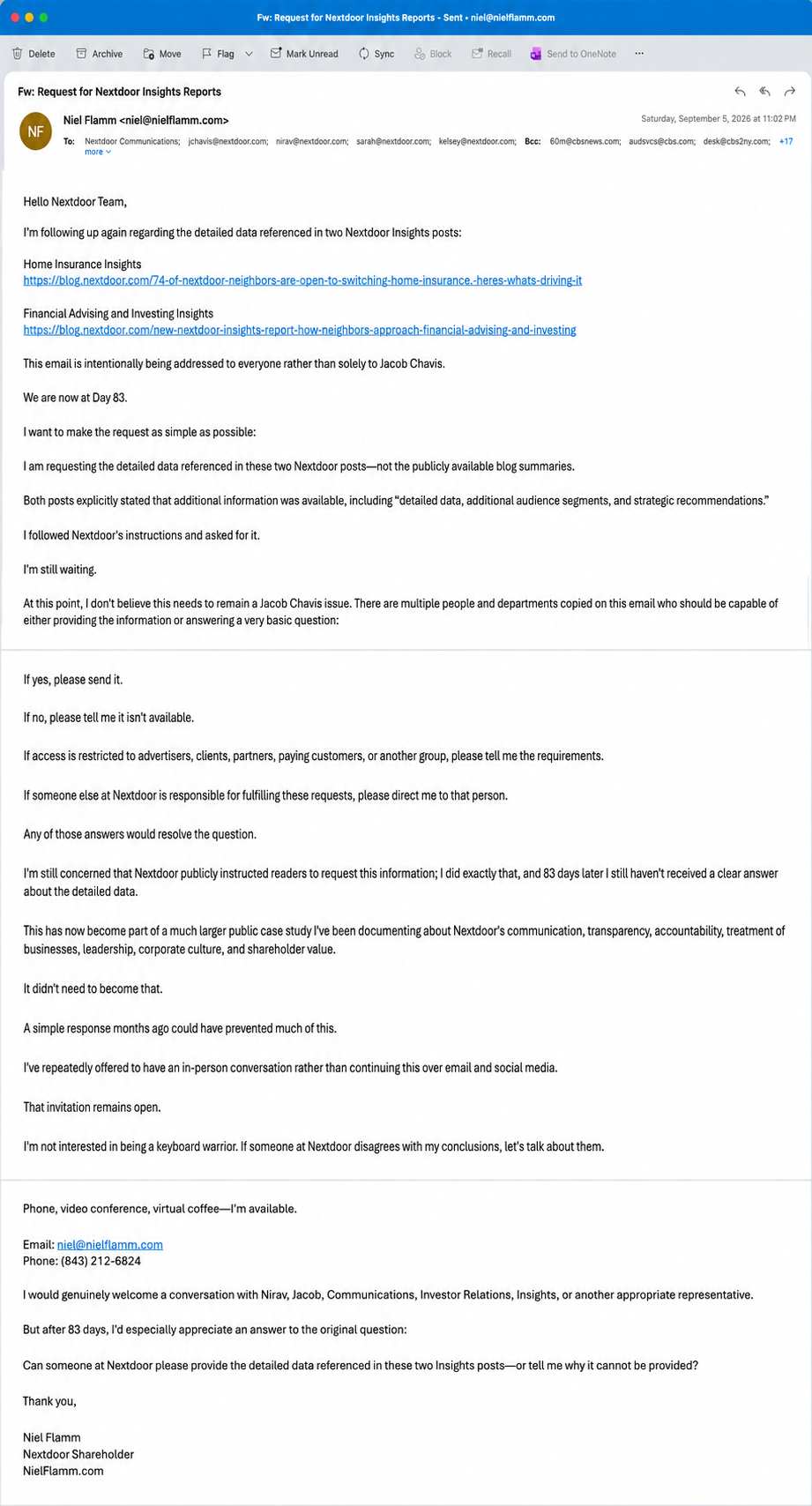
Yes.
Another one.
The subject remains the same issue I've been documenting for nearly three months:
Where are the two detailed Insights studies?
These are the two studies where Nextdoor's own published material told readers they could reach out for additional information, including detailed data, additional audience segments, and strategic recommendations.
I followed the instructions.
I've followed up.
I've clarified that I'm requesting the detailed data—not links to the summaries I've already read.
I've expanded the email beyond Jacob Chavis to include others at Nextdoor who can answer the question.
And now we're at:
Day 85.
At this point, the answer doesn't even need to be complicated.
Yes, Niel, here's the information.
Or:
No, Niel, we're not providing it.
Or:
It's only available to certain customers, advertisers, or partners.
Pick one.
I'll take clarity over silence.
The Irony of Labor Day
Maybe that's what makes today's silence particularly interesting to me.
Labor Day is partly about recognizing the value of people's work.
And one of the themes I've repeatedly raised throughout this case study is whether Nextdoor adequately recognizes the value created by the different people surrounding its platform.
Neighbors create the conversations.
Neighbors provide the recommendations.
Small businesses provide the services.
Employees build and operate the platform.
Advertisers provide revenue.
Investors provide capital.
Every one of those groups contributes something.
A healthy organization understands that relationships with those stakeholders require more than polished marketing language.
They require communication.
Listening.
Trust.
Transparency.
And accountability.
Day 85
So, Happy Labor Day to everyone working today.
Happy Labor Day to everyone fortunate enough to have today off.
Happy Labor Day to the small-business owners who don't really get holidays.
And Happy Labor Day to Nextdoor's employees too.
As for Nextdoor and Nirav Tolia:
Maybe the Labor Day message is coming.
Maybe somebody will answer tomorrow's email.
Maybe I'll finally receive those two detailed studies.
We'll see.
But as of this writing, Day 85 looks remarkably similar to many of the previous 84 days.
.I'm still waiting for somebody at Nextdoor to demonstrate that communication and accountability aren't just words used when they're convenient for the brand.
Happy Labor Day. 🇺🇸
Follow the continuing Nextdoor case study at NielFlamm.com/blog.

Day 83: Nextdoor Has $100 Million for Stock Buybacks. So Why Isn't It Buying?

It's Day 83 of my continuing Nextdoor case study.
Today I want to talk about something different:
NXDR shares.
More specifically, if Nextdoor's leadership believes the company is undervalued and believes strongly in its direction, why isn't it aggressively buying its own stock at these prices?
Before somebody jumps into the comments with a correction, let me make one myself.
Nextdoor DOES have a stock-buyback program.
And it has bought shares.
According to Nextdoor's SEC filings, during the first six months of 2026, the company repurchased and retired approximately 17 million shares for $28.7 million, at an average price of $1.69 per share.
But here's the part I find interesting:
During Q2 2026, Nextdoor repurchased ZERO shares.
And as of June 30, the company still had $100 million available under its current share-repurchase authorization.
So my question isn't:
Why doesn't Nextdoor have a buyback?
My question is:
Why aren't you using it now?
Nextdoor reported $378 million in cash, cash equivalents, and marketable securities at the end of Q2.
The Board has already authorized up to $100 million for share repurchases through June 2028.
Meanwhile, NXDR has recently been trading in the low-$2 range.
If management believes Nextdoor's strategy is working...
If management believes the market is undervaluing the company...
If management believes all these new products, small-business initiatives, AI features, and advertising strategies are going to create substantial future value...
Why wouldn't buying your own stock be an attractive use of at least some of that authorized capital?
Put Your Money Where Your Podcasts Are
I've watched Nirav Tolia make the podcast rounds.
I've heard the vision.
I've read the press releases.
I've seen Nextdoor describe itself as the “essential neighborhood network.”
Okay.
Show me the confidence with capital.
A meaningful stock repurchase at a price management genuinely believes is substantially below intrinsic value can send a very different message than another podcast interview.
It says:
We believe our shares are worth more than this.
And we're willing to put the company's money behind that belief.
Nextdoor itself made almost exactly that argument when it announced its original buyback program in 2022, saying the plan reflected confidence in its strategy and a belief that the market valuation didn't reflect the company's opportunity.
So what does management believe today?
Then There's Stock-Based Compensation
There's another side to this discussion.
Nextdoor reported approximately $14.9 million in stock-based compensation in Q2 2026.
Stock compensation isn't automatically bad. It's extremely common in technology companies and can help align employees and executives with shareholders.
But shareholders should still ask what happens to their ownership percentage as equity compensation is issued over time.
Dilution matters.
If you're issuing equity to employees and executives while the stock struggles, shareholders have every reason to ask whether repurchases are sufficiently offsetting that dilution—and whether compensation is producing the performance shareholders are paying for.
That's particularly important to me when we're discussing executive compensation.
I've repeatedly questioned how Nirav Tolia's compensation aligns with the value being delivered to shareholders.
Here's another way management could demonstrate confidence:
Buy the stock.
Imagine the Message
Forget another Business Wire release for a moment.
Imagine Nextdoor announcing that management believes NXDR is materially undervalued and therefore intends to meaningfully utilize its existing $100 million repurchase authorization.
That's a statement I would notice as a shareholder.
Not because buybacks magically fix a company.
They don't.
Nextdoor itself warns investors that repurchases aren't guaranteed to increase long-term shareholder value and that they reduce cash available for other purposes.
That's fair.
If Nextdoor can invest $1 internally and generate substantially more than $1 in long-term shareholder value, invest the dollar in the business.
But if management believes its own stock represents one of the best values available to the company?
Buy it.
That's capital allocation.
This Is Really a Question About Confidence
Nextdoor's Q2 wasn't all bad.
Revenue increased 15% year over year to $75 million.
Platform Weekly Active Users reached 22.9 million.
Adjusted EBITDA reached approximately $10 million.
The GAAP net loss narrowed dramatically to approximately $2 million, compared with $15 million a year earlier.
And the company finished June with approximately $378 million in cash, cash equivalents, and marketable securities.
Those are real improvements.
So here's what I want to understand:
If management believes those improvements are the beginning of something much bigger, why did Nextdoor repurchase zero shares during Q2?
You already have the authorization.
You have substantial liquidity.
You've bought shares before.
And the stock remains at a valuation that has frustrated shareholders like me.
Day 83
I'm still waiting for the two detailed Insights studies.
I'm still questioning the small-business monetization strategy.
I'm still questioning corporate communication.
I'm still questioning leadership.
And now I'm adding another question for Nirav Tolia and Nextdoor's Board:
You authorized $100 million to buy back NXDR shares.
At these prices, what are you waiting for?
If leadership believes in the direction of Nextdoor, I'd like to see that confidence demonstrated not just through words, podcasts and press releases.
Show shareholders through decisions.
Because ultimately, confidence isn't what management says about the company.
It's what management is willing to do with the company's capital.
Follow my continuing Nextdoor case study at NielFlamm.com/blog.

Day 82: Is Nextdoor Taking Another Four-Day Weekend?

It’s Day 82.
I’m still here.
Still reaching users.
Still talking to businesses.
Still raising questions for investors.
Still documenting my disappointment with Nextdoor.
And Nextdoor?
Well, from where I’m sitting, it looks like the company may be sticking to a familiar communications playbook:
It’s Friday before Labor Day weekend. Things have gotten very quiet.
No new post today that I’ve seen from Nextdoor’s corporate communications channels.
Nothing new from CEO Nirav Tolia.
And those two detailed Insights studies I’ve been requesting?
Still nothing.
But I do have some exciting news.
NXDR Is Up a Penny! 🎉
As I write this, NXDR is up approximately $0.01.
Hey, at least it isn’t down.
After 82 days, I’ve learned to appreciate the little things.
One penny at a time, people.
Of course, a penny on one trading day doesn't tell us much about the company's long-term value or investor confidence. What matters is sustained performance and whether management's decisions ultimately create shareholder value.
Will We Hear From Nextdoor on Labor Day?
My guess?
Probably not.
We'll see Monday.
But I have to wonder: how difficult is it for a corporate communications organization to schedule a Labor Day post in advance?
You don't exactly need someone sitting at a desk Monday morning typing:
“Happy Labor Day!”
Schedule it.
Go enjoy the barbecue.
Problem solved.
Then Tuesday arrives.
Maybe we'll get another beautifully polished message about verified neighbors, trusted recommendations, local businesses building brand recognition, and how Nextdoor is strengthening communities.
That's the messaging.
I'm interested in what happens underneath it.
Because the Bigger Questions Are Still Sitting There
How is Nextdoor's increasing monetization of small-business interactions going to affect the businesses that helped create the platform's local value?
Where are the two detailed Insights studies that Nextdoor's own previous blog posts invited readers to request?
How does executive compensation align with sustained shareholder value creation?
When does Nextdoor move from improving its losses to delivering the consistent profitability and value shareholders ultimately expect?
And when does somebody simply say:
“Niel, let's talk.”
That's the part that continues to amaze me.
This Could Have Been Very Different
I've said this before, but it becomes more relevant with every passing day.
If someone from Nextdoor had simply reached out to me almost a year ago, I doubt I would be this invested in documenting accountability today.
Not because they needed to agree with me.
Not because I expected special treatment.
Not because one phone call magically solves every disagreement.
Because somebody would have demonstrated something incredibly basic:
Accountability.
“We hear you.”
“We disagree.”
“Here's why.”
“Here's what we can do.”
“Here's what we can't do.”
That's communication.
Instead, I've spent months documenting what happens when questions linger, communication breaks down and a dissatisfied shareholder becomes increasingly interested in understanding why.
And here we are.
Day 82.
And No, I'm Not Interested in Being a Keyboard Warrior
Somebody reading all of these posts might think:
This guy just likes fighting with people online.
Actually, I'd much rather have a conversation.
In person.
By phone.
By web conference.
I'll even make it pleasant.
Let's Have a Virtual Coffee Date ☕
Anyone from Nextdoor who wants to discuss what I've been documenting is welcome to contact me.
I've provided this information before, and it's available on my website.
Email: niel@nielflamm.com
Phone: (843) 212-6824
Nirav, Communications, Investor Relations, Insights—or someone else at Nextdoor:
Pick up the phone. Send an email. Schedule a video call.
Coffee is on me.
Well, technically, my coffee is on me. Yours is on you.
Enjoy the Weekend
Maybe Nextdoor surprises me Monday.
Maybe there's a Labor Day post.
Maybe someone sends the studies.
Maybe my phone rings.
Maybe NXDR goes up another penny.
At this point, anything is possible.
Because almost a year ago, a conversation might have been enough.
Now we're on Day 82.
The invitation remains open.
Let's talk.
Blocked by a CEO: What Does the Block Actually Say?
I recently wrote about being blocked on X by Nextdoor co-founder and CEO Nirav Tolia.
And after looking at that screen again, I started thinking about the psychology of the block itself.
Not diagnosing Nirav.
Not pretending I know what he's thinking.
Not claiming I've somehow crawled inside his head.
Because I haven't.
But I do find the behavior fascinating.
Why Does Someone Block a Critic?
There could be a dozen explanations.
Maybe Nirav thinks I'm repetitive.
Maybe he doesn't like my approach.
Maybe he doesn't want criticism appearing underneath his posts.
Maybe it's reputation management.
Maybe he considers my comments disruptive.
Maybe he simply decided, I don't want to deal with this guy anymore.
And you know what?
That's his right.
It's his X account. He can block me.
But here's what makes it interesting:
I'm not some random person yelling insults at him. I'm a shareholder asking questions about the company I own shares in.
I've questioned Nextdoor's leadership.
I've questioned executive compensation.
I've questioned the company's communication.
I've questioned moderation and verification.
I've questioned its treatment and monetization of small businesses.
I've questioned its research transparency.
I've questioned whether the strategy is creating sufficient shareholder value.
Those questions aren't disappearing because my account disappeared from Nirav's X feed.
Psychologically, What Does a Block Accomplish?
This is where the subject gets interesting without playing amateur psychologist.
Blocking someone creates a boundary.
It removes an unwanted interaction.
It gives someone greater control over what appears in their social-media environment.
It can reduce exposure to criticism.
It can end an interaction someone no longer considers productive.
And yes, in some circumstances, avoidance can also be a response to uncomfortable information.
Which one applies here?
I have absolutely no idea.
And unless Nirav tells me, no one else does.
That's precisely why I'm not going to call him psychologically insecure, diagnose him as a narcissist, or claim I've discovered some deep emotional wound.
That would be speculation masquerading as analysis.
Instead, I'll stick with something I can actually document:
He blocked me.
And I'll ask what I think is the much more interesting question.
Why?
The Power Dynamic Is Fascinating
Think about the people involved here.
On one side is Nirav Tolia.
Co-founder and CEO of Nextdoor.
Entrepreneur.
Guest Shark on Shark Tank.
Podcast guest.
Public-company executive.
A person with access to corporate communications professionals, investor relations, attorneys, media opportunities and a significant public platform.
On the other side:
Me.
One shareholder.
One blog.
No communications department.
No investor-relations team.
No Business Wire distribution strategy.
Just questions, screenshots, publicly available information, and apparently an impressive amount of persistence.
Yet I'm the one who needed to be removed from the conversation.
I find that fascinating.
Maybe It's Just Reputation Management
There's also an explanation that requires virtually no psychology.
Maybe Nirav simply doesn't want a persistent critic leaving negative comments beneath his public posts.
That's not necessarily insecurity.
It could simply be reputation management.
If that's the explanation, though, it creates another interesting question for me.
Nextdoor is a company whose entire business is supposedly centered around conversation, community, and connection.
The company wants neighbors talking to neighbors.
It wants neighbors recommending businesses.
It wants businesses interacting with communities.
It wants people exchanging opinions.
But what happens when the conversation becomes uncomfortable for the person running the company?
Apparently, at least in my case:
Block.
There's some irony there.
Here's What the Block Doesn't Accomplish
It doesn't change Nextdoor's financial results.
It doesn't increase NXDR's stock price.
It doesn't answer my questions about executive compensation.
It doesn't explain Nextdoor's strategy.
It doesn't resolve my concerns about small-business monetization.
It doesn't provide the detailed Insights data I've been requesting.
It doesn't address my concerns about communication, transparency, or accountability.
And it certainly doesn't increase my confidence in Nextdoor's leadership.
It accomplishes exactly one thing:
I can't interact with Nirav's X account.
Okay.
I'll survive.
The Questions Are Bigger Than an X Account
This is where I think CEOs—and really any leader—face an interesting choice when dealing with persistent criticism.
You can answer it.
You can ignore it.
You can dispute it.
You can explain why it's wrong.
You can provide evidence that contradicts it.
You can even decide that the critic isn't worth your time.
All legitimate options.
But blocking the person doesn't refute the criticism.
And that's why I'm not particularly interested in trying to determine whether Nirav is “thin-skinned.”
I'm interested in whether I'm wrong.
Show me.
If Nextdoor's leadership strategy is working, show shareholders the results.
If the monetization strategy is strengthening the neighborhood experience, show us.
If executive compensation is appropriately aligned with shareholder value creation, explain it.
If my interpretation of Nextdoor's corporate culture is completely wrong, demonstrate why.
If the detailed research I've spent more than 80 days requesting isn't available, just say so.
Those are substantive responses.
A block isn't.
Maybe I Hit a Nerve. Maybe I Didn't.
Could my criticism have annoyed Nirav?
Sure.
Could he simply be tired of seeing my name?
Absolutely.
Could somebody handling his social media presence have decided that blocking me was the easiest solution?
Possible.
Could it be nothing more complicated than “I don't want this guy commenting here anymore”?
Yep.
That's the point.
I don't know why Nirav Tolia blocked me.
But I find the decision fascinating.
I'm a shareholder repeatedly asking uncomfortable questions about leadership, executive compensation, company performance, and shareholder value.
Whether the block represents frustration, reputation management, a personal boundary or simply a desire not to see my criticism, only Nirav knows.
What it doesn't do is answer the questions.
And that's the part that matters to me.
Block away.

Day 81: Nextdoor Says It Loves Small Businesses. So Why Put a Tollbooth Between Them and Their Neighbors?

Today is Day 81.
Yesterday I wrote about Nextdoor telling businesses:
“A reputation you earn is worth more than one you can buy.”
Today, let's look at what Nextdoor is actually building for those businesses.
Nextdoor's announcement is here:
https://blog.nextdoor.com/small-business-improvements
The company is rolling out Local Faves, redesigned free Business Pages, improved search, new business dashboards and, eventually, the ability for local businesses to participate directly in the neighborhood feed.
Some of that sounds great.
But then we arrive at:
Opportunity Alerts.
Nextdoor describes this as a paid product that routes requests from verified neighbors directly to local service providers so those businesses can respond first and potentially win the job.
And that's where I see the money grab.
Imagine the Neighborhood Conversation
A neighbor posts:
“Does anyone know a good handyman?”
Another neighbor recommends Joe's Handyman Service.
Great.
That's supposedly what Nextdoor is all about: neighbors helping neighbors and businesses earning reputations organically.
But Joe's business being recommended doesn't necessarily mean Joe can simply jump into that conversation today and say:
“Thanks for the recommendation. I'd be happy to help.”
Nextdoor says direct feed access for local businesses is “coming soon.”
In the meantime, Nextdoor has a solution:
Pay for Opportunity Alerts.
Now Nextdoor can route those requests directly to participating service providers.
That's where I start asking questions.
If the value of Nextdoor is organic neighborhood recommendations, why put a tollbooth between the business and the opportunity?
Then There's the Stock
Tuesday, NXDR closed around $2.20.
Wednesday, it rebounded to approximately $2.28.
As I'm writing this, it's around $2.26.
Stocks fluctuate. Three trading days don't prove a management strategy is succeeding or failing.
But look at the broader context I've been documenting.
Communication problems.
Questions about moderation.
Small-business monetization.
Transparency concerns.
Shareholder frustration.
And a stock still well below the $2.68 close on August 10.
No matter how many podcasts the CEO appears on, eventually:
Decisions drive value.
Marketing doesn't substitute for execution.
Podcasts don't substitute for performance.
And corporate messaging doesn't automatically create investor confidence.
And That Brings Me Back to Nirav Tolia
I've already said that I've lost confidence in Nirav's leadership and believe the Board should make a change at the top.
I also continue to wonder about executive compensation.
When a company is still working toward consistent GAAP profitability, and shareholders are waiting for sustained value creation, how should executive bonuses and multimillion-dollar compensation packages be justified?
That's a legitimate shareholder question.
Especially when that compensation ultimately represents resources belonging to the company and its shareholders.
Then I Watched a Reel About Broken Corporate Culture
The reel was aimed primarily at employees evaluating their company's culture.
https://www.facebook.com/share/r/1GpV1cKmwi/
But watching it, I couldn't help but apply those ve observed while looking at Nex’ looking at Nextdoor from the outside.
Five themes stood out:
Poor Leadership Accountability
Unclear Values
Low Trust and Transparency
Poor Communication
Resistance to Feedback
I can't tell you what Nextdoor's internal culture is like.
I don't work there.
But I can describe what the culture looks like to me as a shareholder, user, and outside observer after 81 days of documenting interactions with the company.
And from where I'm sitting, those five descriptions are becoming uncomfortable fits.
Culture Eventually Becomes Visible
Corporate culture doesn't stay inside headquarters.
Eventually customers experience it.
Businesses experience it.
Investors experience it.
The public experiences it.
If communication is broken internally, eventually it appears externally.
If leadership resists internal criticism, outsiders will eventually notice.
If revenue becomes more important than stakeholder experience, the product will eventually reflect it.
And that's why I keep coming back to the same question:
What kind of company is Nextdoor trying to become?
A neighborhood network?
An advertising platform?
A lead-generation service?
A trusted recommendation engine?
Or some combination of all four?
Making money isn't the problem.
Nextdoor absolutely needs to make money.
I'm a shareholder. I want revenue, profit, and a rising stock price.
But there's a difference between monetizing a valuable ecosystem and making every interaction feel like another opportunity to collect a toll.
Day 81
The stock is around $2.26 as I write this.
The small-business monetization strategy continues.
The podcasts continue.
I'm still waiting for the two detailed Insights studies.
And from my perspective, the signs of a broken corporate culture continue to become more visible from the outside.
Poor leadership accountability.
Unclear values.
Low trust and transparency.
Poor communication.
Resistance to feedback.
Maybe Nextdoor disagrees.
Good.
Explain why I'm wrong.
Because blocking criticism, ignoring questions, and adding another paid product isn't changing my assessment.
It's reinforcing it.