
Do as I Say, Not as I Do?
Earlier today, I wrote a post asking questions about Nextdoor’s workplace strategy.
From what I’ve seen, members of the C-suite appear to work from various locations, while engineers are expected to report to a new engineering hub in Dallas, Texas. If that’s the strategy, I’d genuinely like to understand the business rationale behind it.
I tagged several members of Nextdoor’s leadership team. Some I couldn’t tag because I couldn’t locate their LinkedIn profiles. Ironically, one of them was Kelsey Grady, Executive Vice President, Communications.
An interesting thing happened afterward.
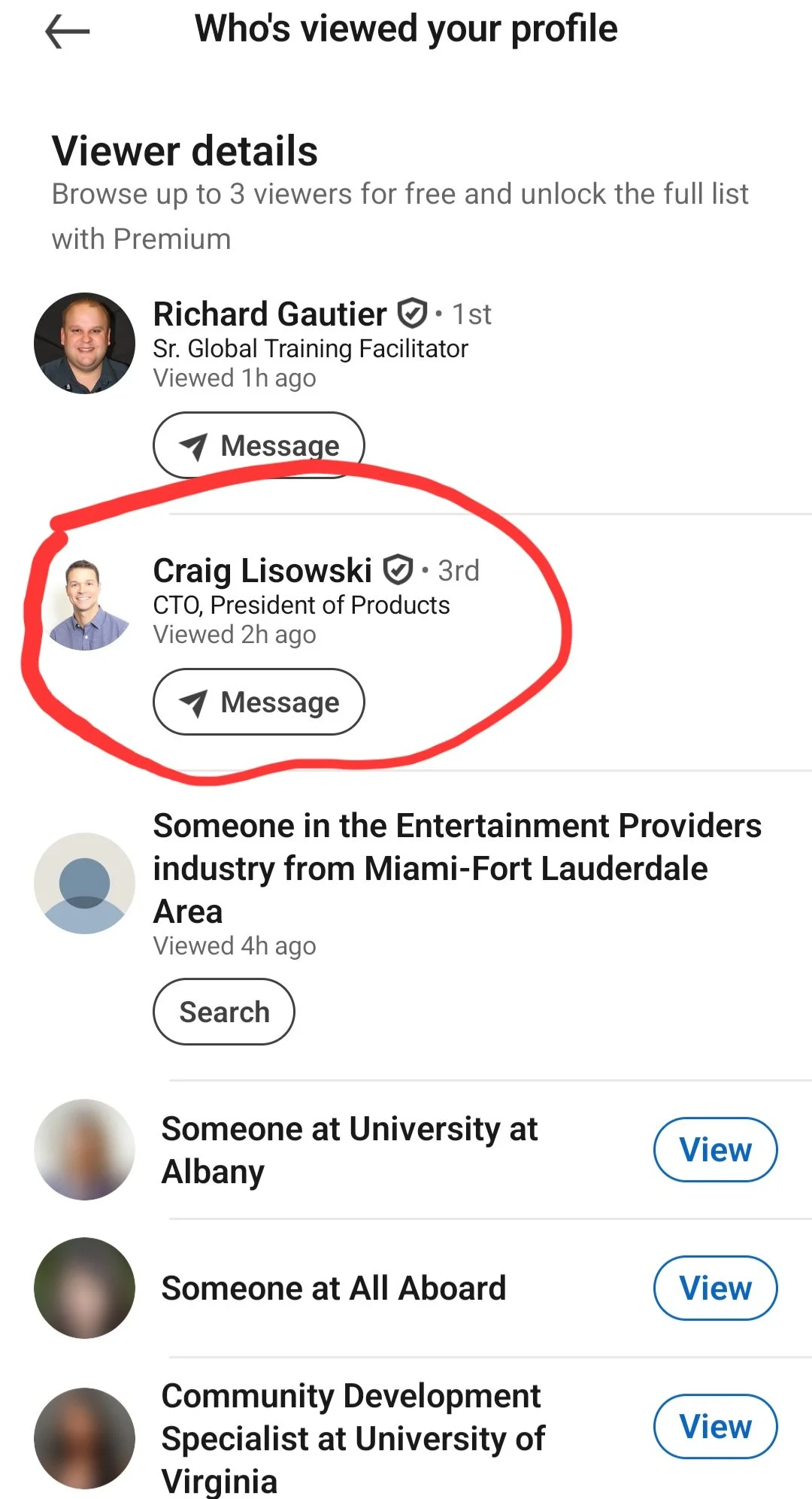
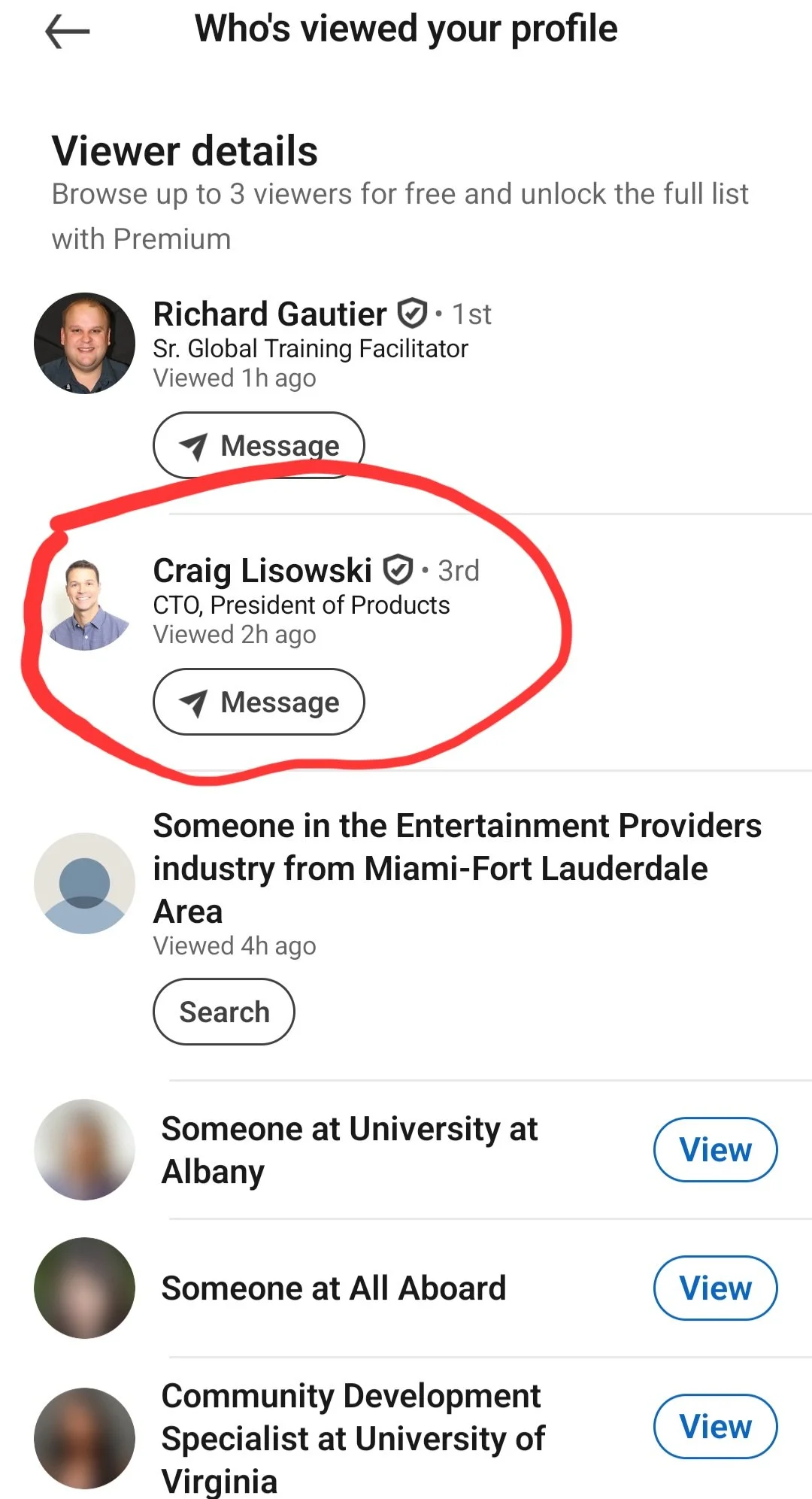
Craig Lisowski viewed my LinkedIn profile.
According to his LinkedIn profile, he is CTO (Chief Technical Officer) and President of Products, and his location is listed as San Francisco, California.
If the engineering “meeting of the minds” is centered in Dallas, that’s quite a commute.
So I’ll ask again, respectfully:
What is the leadership philosophy behind having executives distributed across multiple locations while requiring engineers to work from a centralized office?
There may be a sound business reason. If so, I’d love to hear it. Transparency around decisions like these helps employees, prospective candidates, shareholders, and customers better understand the company’s direction.
Someone, please explain this to me.
Join the discussion on NielFlamm.com/blog
Measuring Service Levels
Today I started a new counter.
As someone with a background in Learning & Development, Operations, Customer Experience, and Quality, I believe metrics matter. You can’t improve what you don’t measure.
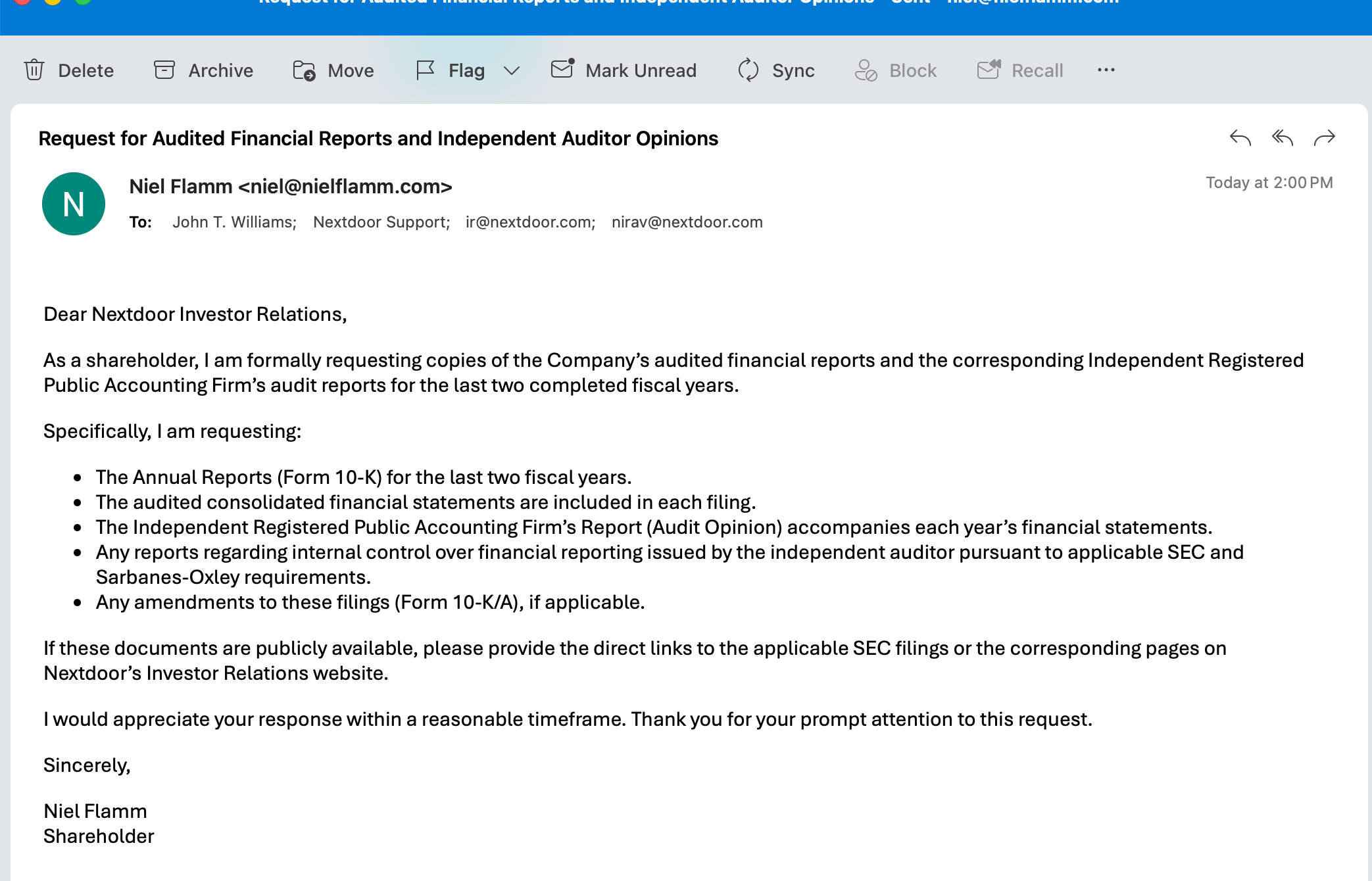
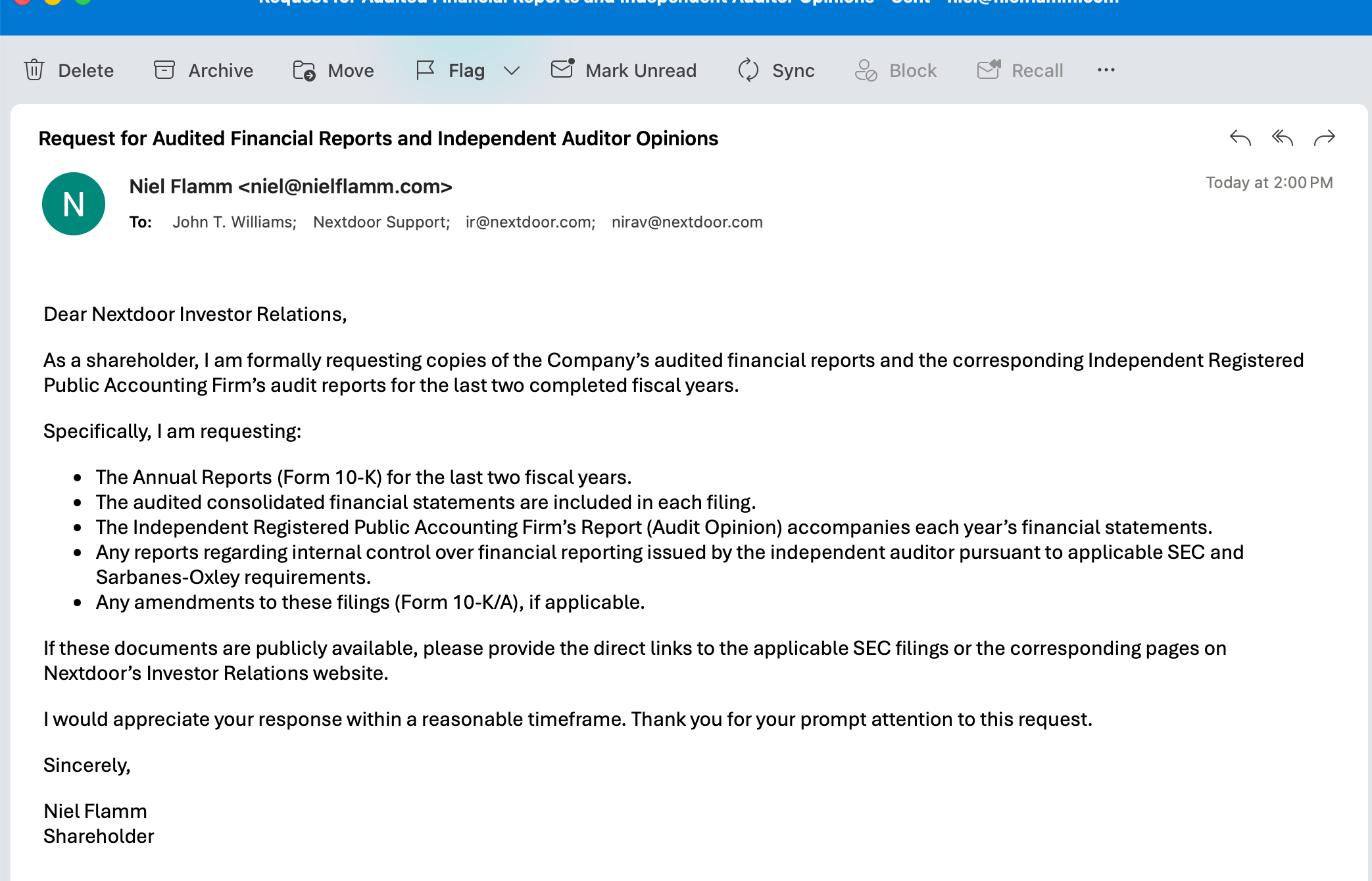
Today, I submitted a request to Nextdoor Investor Relations for the Company’s audited financial reports for the last two fiscal years, or for direct links to the publicly available filings.
As a reminder, today is Day 14 since I requested a copy of a study from Jacob Chavis, Senior Manager, Customer Insights, that was referenced as being available at the conclusion of one of Nextdoor’s posts. I have not yet received the study or a response to my request.
I’m interested in understanding the service levels provided to shareholders and whether this experience differs from the responsiveness I’ve experienced through other Nextdoor channels.
Anyone who knows me knows I don’t simply walk away from unanswered questions. In sales, there’s an old saying: “They buy, or they die.” Persistence matters. In this case, I’m interested in seeing whether Nextdoor is willing to have an open discussion about its culture, communication practices, and methodology—or what CEO Nirav Tolia has described as the company’s “thesis.”
An update: As I was writing this post, I received a reply from John T. Williams, Head of Investor Relations. Talk about timing.
Now I have to wonder… did someone set up an alert, or has John decided it’s time to head for the lifeboats instead of staying aboard the Titanic? 😄 Either way, I appreciate the response and look forward to reviewing the information provided.
The counter continues. I’ll document what I receive, how long it takes, and what I learn. Transparency, accountability, and continuous improvement benefit customers, employees, shareholders, and the company alike.
Join the discussion on NielFlamm.com/blog.
“Meet the new boss, same as the old boss.”
Those lyrics from The Who kept running through my head this morning.
With my family still going through a difficult time, I’ve been spending a lot of hours in a hospital room with my mom. That has given me time to read, research, and think.
One topic I revisited was Nextdoor’s decision to establish a new engineering hub in Dallas, Texas, while continuing to lease office space at The Stack in Deep Ellum.
That led me to ask: Where is the executive leadership team generally based?
Based on publicly available information, I found:
- Nirav Tolia, CEO – Dallas, Texas
- Sarah Leary, Head of Marketing, Community & Business Operations – Boston, Massachusetts
- Craig Lisowski, President of Product – San Francisco, California
- Indrajit Ponnambalam, Chief Financial Officer – Dallas, Texas
- Sophia Contreras Schwartz, Chief Legal Officer – San Francisco, California
- Michael Kiernan, Chief Revenue Officer – Brooklyn, New York
- Tony Castellanos, EVP, People – San Francisco, California
- Kelsey Grady, EVP, Communications – San Francisco, California
- Nick Lisher, EVP, Product – Tunbridge Wells, England
- Anita Patwardhan, EVP, Product Design – San Francisco, California
These are general locations based on public information, not personal addresses.
If the objective is to hire the best executive talent, the search went as far as England.
So if Nextdoor can recruit globally for its C-Suite, why require engineering talent to be concentrated in one office?
If the goal is to attract top engineers with competitive pay, benefits, bonuses, and equity, why require Dallas when many executives they collaborate with are in San Francisco, Boston, New York, or England?
And it’s 2026.
Cloud infrastructure is managed through providers like Amazon Web Services (AWS) and Microsoft Azure DevOps. Hardware monitoring and data center operations are largely handled by specialists and cloud providers, not executives walking the halls.
Is physical proximity improving collaboration, or just creating another layer of management?
Anonymous Blind discussions mention micromanagement, toxic culture, and even cult-like comparisons. Those are anonymous opinions, not verified facts, but they raise questions worth asking.
Throughout my career, I’ve learned that strong leaders hire talented people, coach them consistently, provide candid feedback, and trust them to do the job.
When performance falls short, you coach, mentor, and partner with HR when needed.
Micromanagement is alive and well in 2026.
Trust still scales better.
Join the discussion on NielFlamm.com/blog.
Earlier this year, after Nirav Tolia blocked me on LinkedIn, I started tracking something different.
I kept a running count of how many days had passed since Nirav Tolia and Nextdoor Communications had publicly connected with the community.
At one point in early January, Nextdoor Communications went 17 days without posting.
Later, in mid-February, Nirav Tolia went 18 days without engaging publicly.
Since then, both have become noticeably more active.
Am I claiming I’m the only reason?
No.
But after months of consistently asking questions, documenting my experience, and advocating for greater transparency, it’s difficult for me to ignore the possibility that persistent public feedback can influence the conversation.
Which brings me to today.
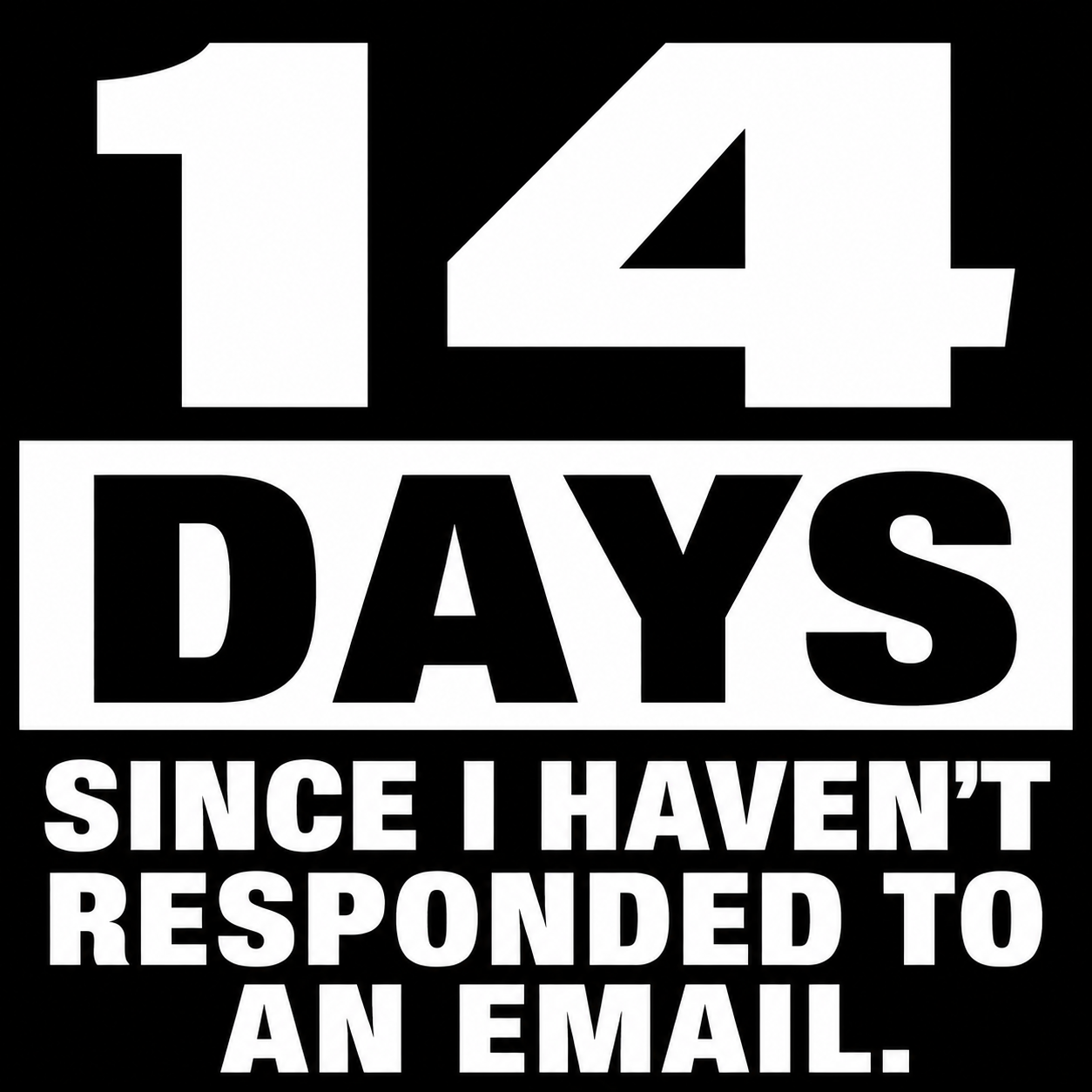
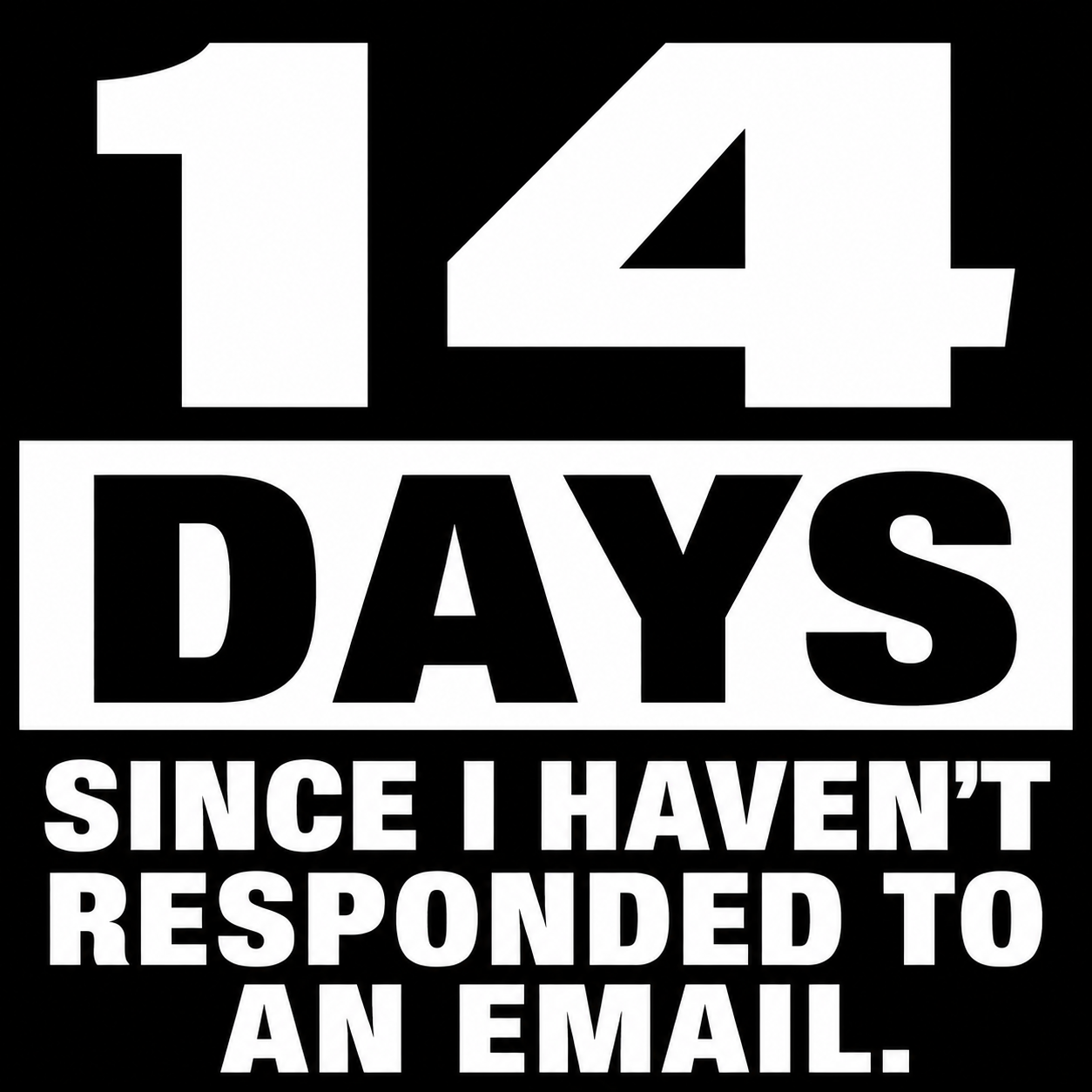
It has now been 14 days since I requested the Home Insurance Insights study referenced by Jacob Chavis, Senior Manager of Customer Insights at Nextdoor.
Think about how simple this could be.
Reply to the email.
Attach the study.
Or send a link.
That’s it.
Instead, the lack of a response has become a story of its own.
At this point, I’m left asking:
What is Jacob Chavis trying to prove?
I’m also not a keyboard warrior.
I’d genuinely welcome an in-person conversation or a video conference—on your platform of choice. I’d even suggest a truly independent moderator with no history, no skin in the game, and no dog in the fight (apologies to the ASPCA).
If anyone at Nextdoor is interested, here’s my scheduling link to find a mutually convenient time:
https://calendly.com/niel-flamm-1cz/a-nielflamm-com-podcast
Who knows? If we streamed it as a pay-per-view event, maybe it would rival:
Mayweather vs. Pacquiao (2015)
Tyson vs. Holyfield II (1997)
The Rock vs. John Cena (2012)
Humor aside, I’d rather have an honest conversation than continue exchanging silence.
Sometimes the easiest solution is also the best one.

I Thought It Was a Tom Cruise Tribute... Then It Took a Weird Turn
One of the unexpected highlights before my screening of Supergirl (2026) wasn't the movie itself—it was one of the previews.
It opens with one of the most recognizable movie moments ever:
"I feel the need... the need for speed."
Immediately, I thought, "This is going to be an homage to Tom Cruise."
The trailer starts with clips from his career, not just the blockbusters. It goes way back.
We're talking about movies like Taps, released before Risky Business. Then there's Risky Business itself, followed by All the Right Moves. I've seen both, and it was fun watching the montage remind me just how long Tom Cruise has been entertaining audiences.
As the clips kept rolling, I figured this was simply a celebration of one of Hollywood's biggest stars.
Nope.
I was completely wrong.
After a couple of minutes of walking down memory lane, the montage suddenly pivots into about thirty seconds of footage from Tom Cruise's upcoming movie, Digger, scheduled for release in October 2026.
Talk about a plot twist.
The footage itself looked... odd.
Not bad.
Just... odd.
The kind of trailer that left me scratching my head and wondering, "What exactly did I just watch?"
Then it hit me.
Maybe that was the whole marketing strategy.
Instead of opening with an unfamiliar movie that audiences might ignore, they first remind everyone why they've spent decades watching Tom Cruise. They build excitement by revisiting the films that made him a global movie star. By the time the new footage appears, you're already invested enough to give it a chance.
If that was intentional, it's actually a pretty clever piece of marketing.
Whether Digger ends up being a hit or a miss remains to be seen, but that preview definitely got my attention—and that's exactly what a trailer is supposed to do.
If you'd like to see my full review of Supergirl along with my other movie reviews, head over to https://NielFlamm.com/videos and let me know what you think.
And Tommy... if we're really Scientology buddies in some alternate universe... thanks for the memories.