
America's 250th: A Celebration That Should Include Everyone
I came across Nextdoor's post celebrating America's 250th anniversary and noticed the incredible lineup of performers, including Chris Chris Stapleton, Chaka Khan, and Billy Corgan.
It made me wonder:
How do artists who celebrate community, freedom, and bringing people together feel about the experiences some users report on social platforms when they believe they've been treated inconsistently or unfairly?
As a Nextdoor shareholder, I've publicly shared my own concerns about moderation consistency, transparency, and responsiveness. I've also questioned the company's investment priorities, including significant spending on office space while advocating for stronger investments in customer experience, moderation oversight, and quality assurance.
To me, those questions are worth asking because they go to the heart of what it means to build a platform centered on community.
America's founding ideals include open dialogue, accountability, and equal treatment. Whether Nextdoor is living up to those ideals is a conversation I believe shareholders, users, advertisers, and leadership should all be willing to have.
Recent examples shared by users continue to highlight concerns around inconsistent moderation decisions and limited avenues for meaningful resolution, reinforcing why this conversation matters now more than ever.
If you think these questions are worth discussing, feel free to share this post, tag the artists involved, and help get the word out so their voices—and the voices of users—can be part of this conversation. Constructive conversations are how organizations improve.
Join the discussion on NielFlamm.com
#Nextdoor #NXDR #America250 #Leadership #CorporateGovernance #Transparency #CustomerExperience #Community #Shareholders #Accountability #niravtolia
The Great Uniter Is at It Again
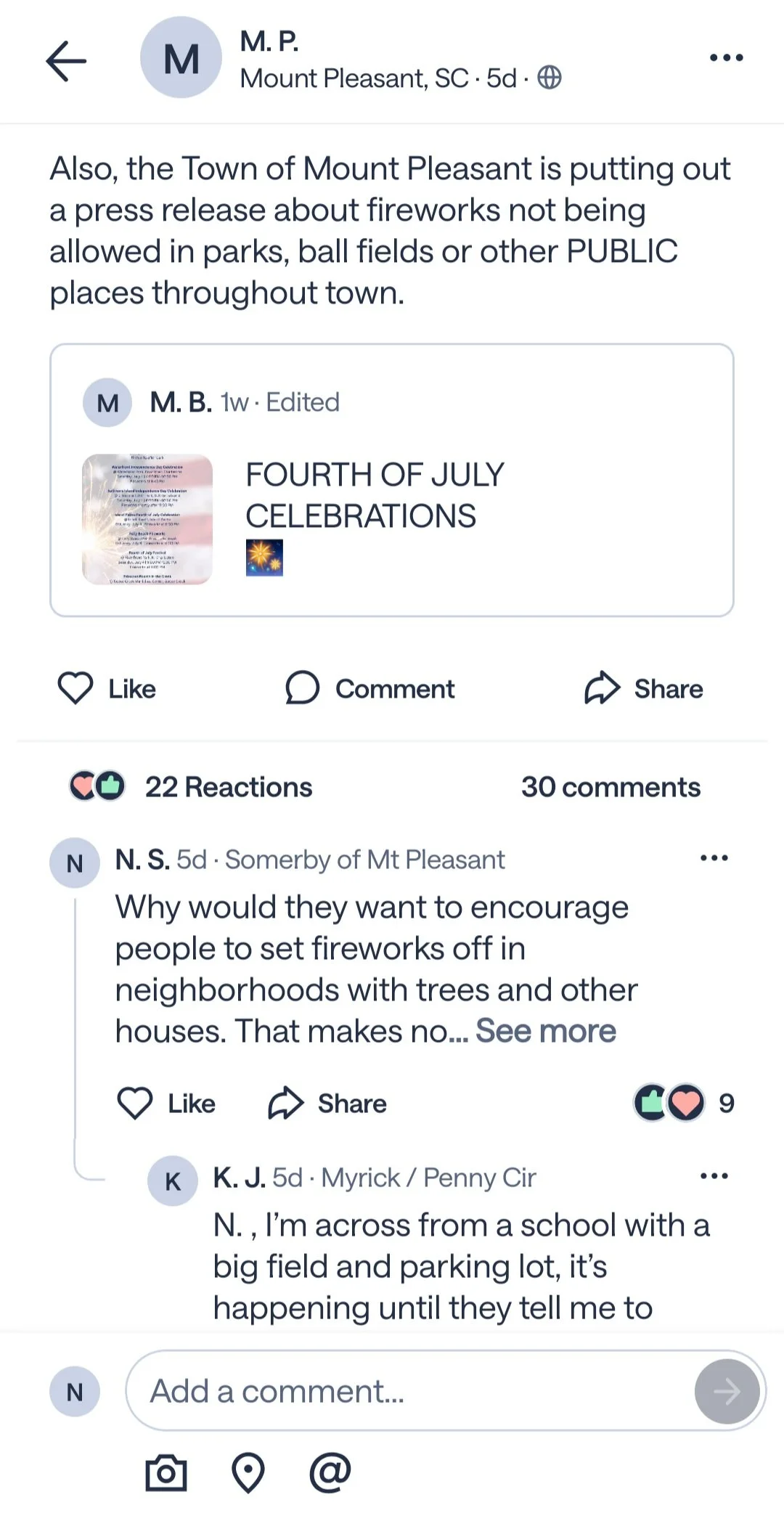
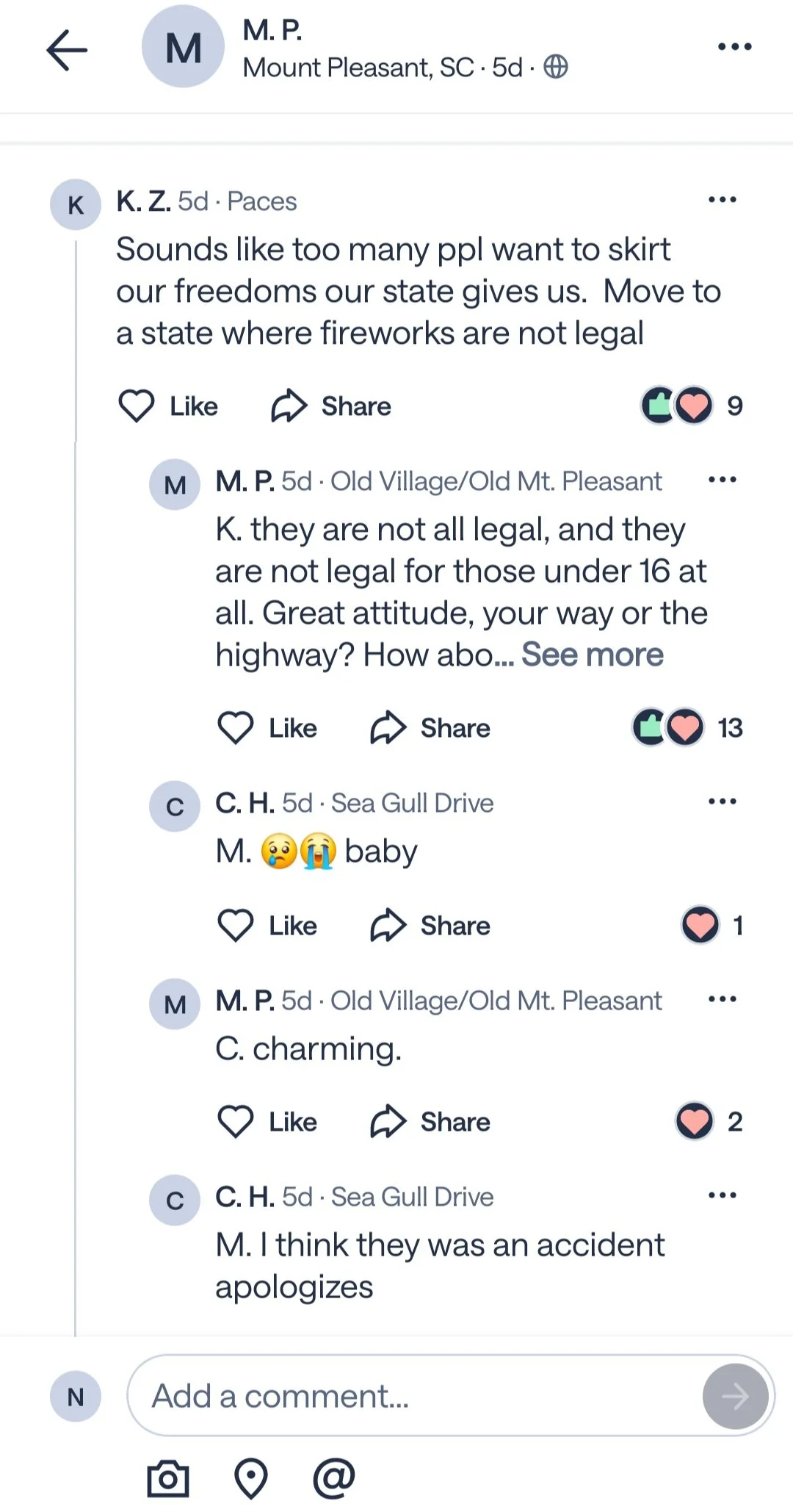
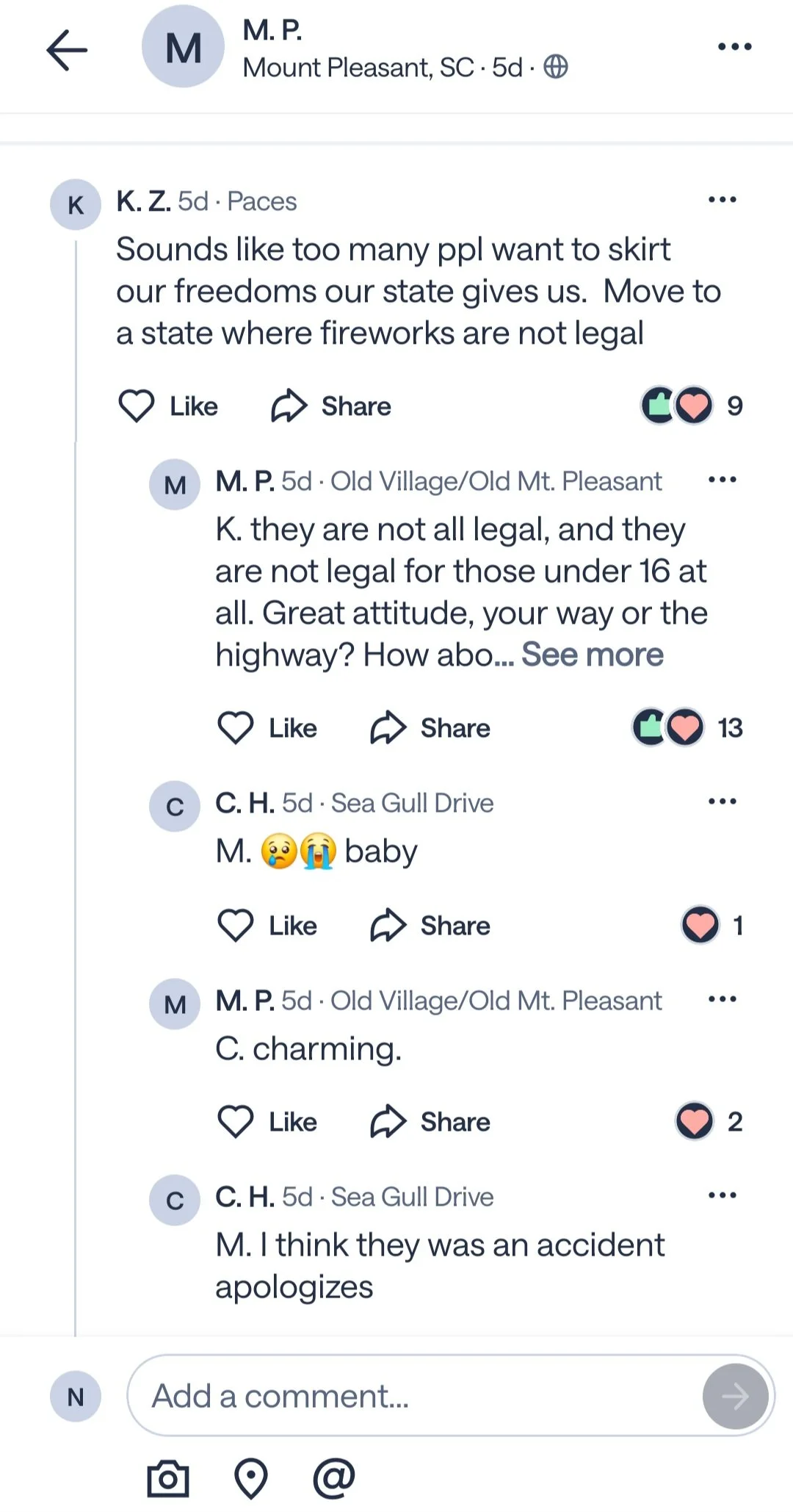
It was only a matter of time.
Every Independence Day in the Lowcountry, fireworks become one of the hottest topics on Nextdoor. I’m all for spirited discussions—neighbors won’t always agree, and that’s healthy.
What I don’t understand is the inconsistency.
The thread I observed began about a week ago. Comments that, based on my own experience, I believe could have violated community standards have remained visible for five days.
That leaves me asking the same question I’ve been asking throughout my Nextdoor experiment:
Why are some comments allowed to remain while others result in moderation?
If moderation standards were applied consistently across neighborhoods, perhaps these situations would be less common.
My suggestion hasn’t changed.
Invest in AI to identify comments that may violate community standards using a clearly defined decision matrix. When the AI isn’t confident, route the content to trained human reviewers who receive ongoing coaching, calibration, and quality assurance.
That’s how many organizations deliver consistency.
Instead, Nextdoor continues to rely on a decentralized network of unpaid moderators. While many undoubtedly volunteer with good intentions, any moderation system benefits from oversight, feedback, and accountability.
Consistency builds trust.
Without it, users are left wondering whether the rules depend on the content—or on who’s reviewing it.
Join the discussion on NielFlamm.com.
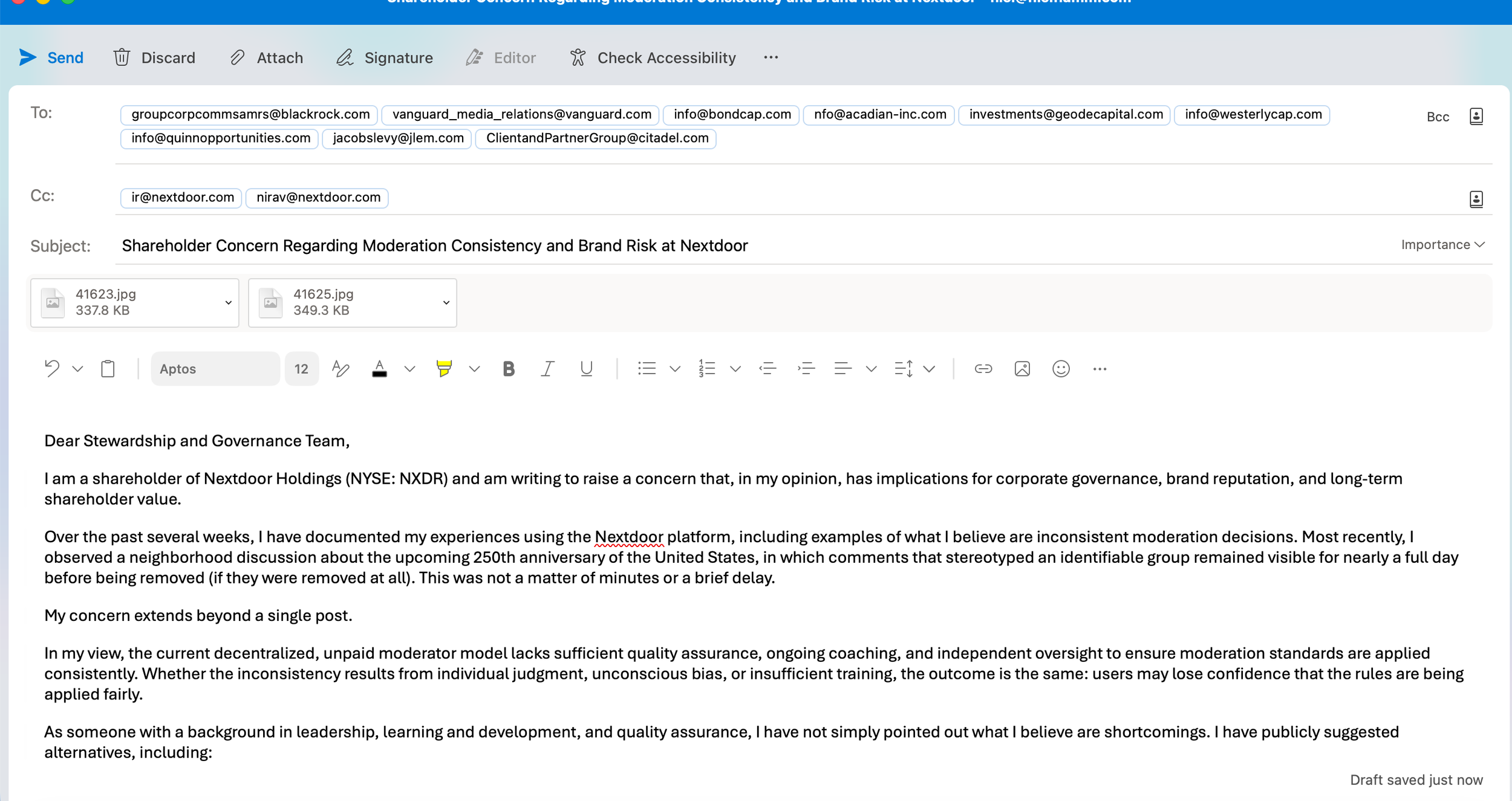
Taking My Concerns to Nextdoor’s Largest Shareholders
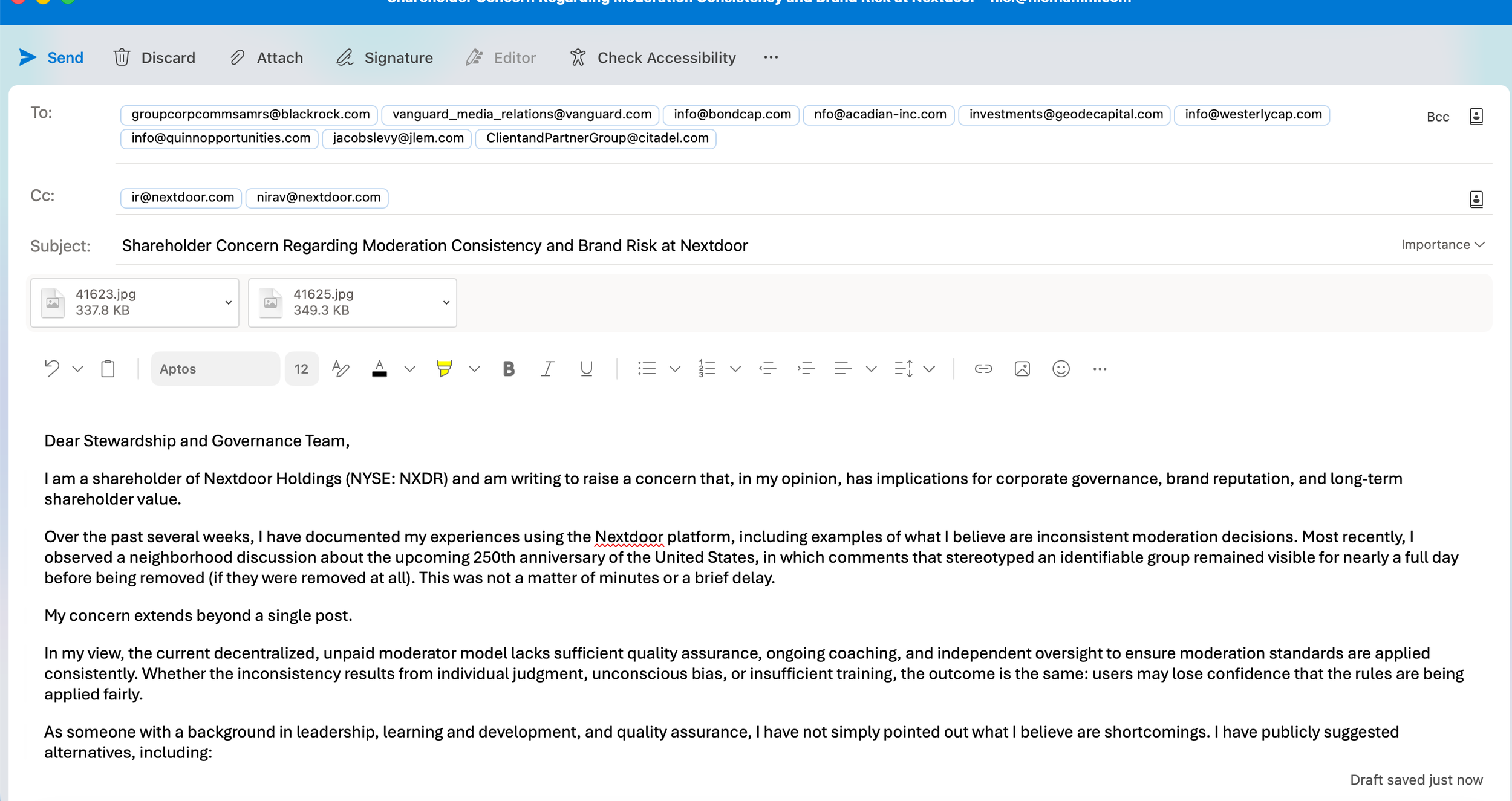
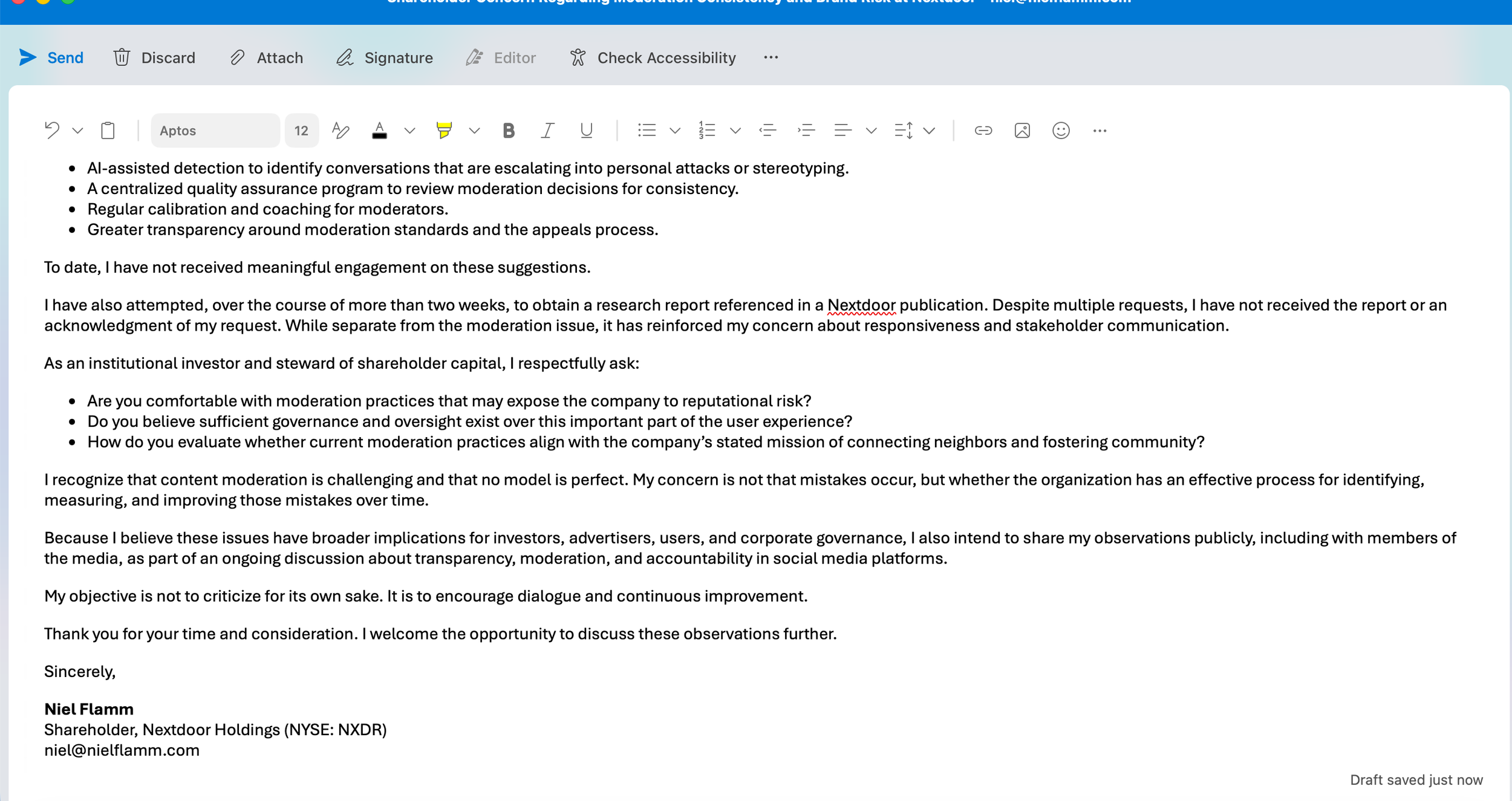
For the past several weeks, I’ve documented my observations and experiences with Nextdoor as both a shareholder and user. My goal has been straightforward: ask questions, offer recommendations, and encourage continuous improvement.
Today, I’m taking the next step.
I have sent the attached letter to several of Nextdoor’s major institutional investors, including BlackRock, Vanguard, State Street, Geode Capital Management, Acadian Asset Management, and Bond Capital.
My request is simple.
I am asking these investors to review the concerns I’ve raised and consider whether Nextdoor’s moderation practices, governance, and customer experience align with the long-term interests of shareholders.
In particular, I’m asking them to seek an explanation from Nextdoor’s leadership regarding how the moderation example I’ve documented was allowed to remain on the platform for an extended period and what oversight exists to promote consistent moderation decisions.
Content moderation is complex, and reasonable people may disagree about individual decisions. My concern is whether the company has effective quality assurance, accountability, and transparency around the process.
Whether you agree with my conclusions or not, I believe these are fair questions for shareholders to ask of company leadership.
I welcome respectful discussion and differing viewpoints. Continuous improvement begins with asking questions.
My Nextdoor Experiment: When Moderation Leaves Questions Unanswered
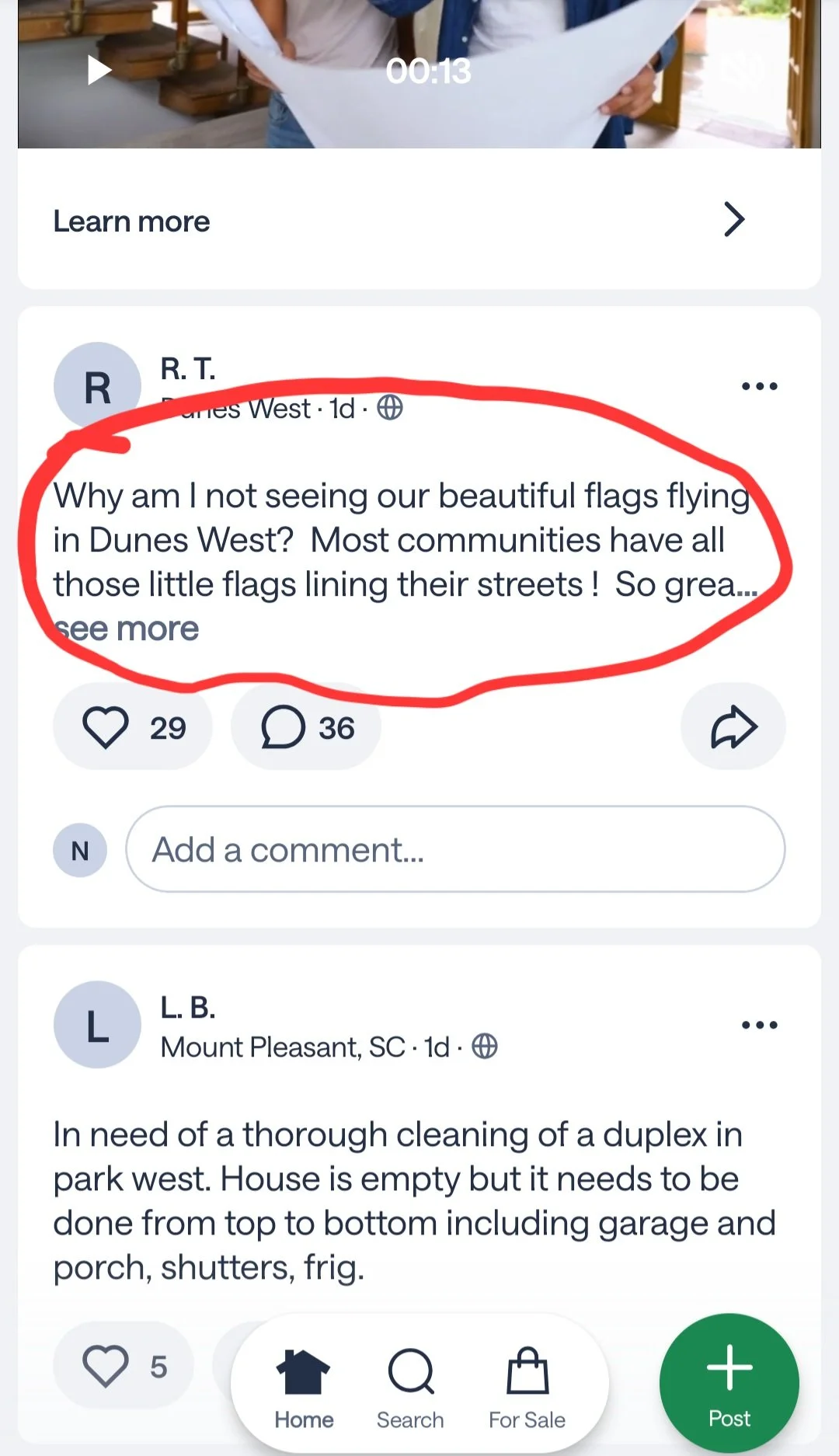
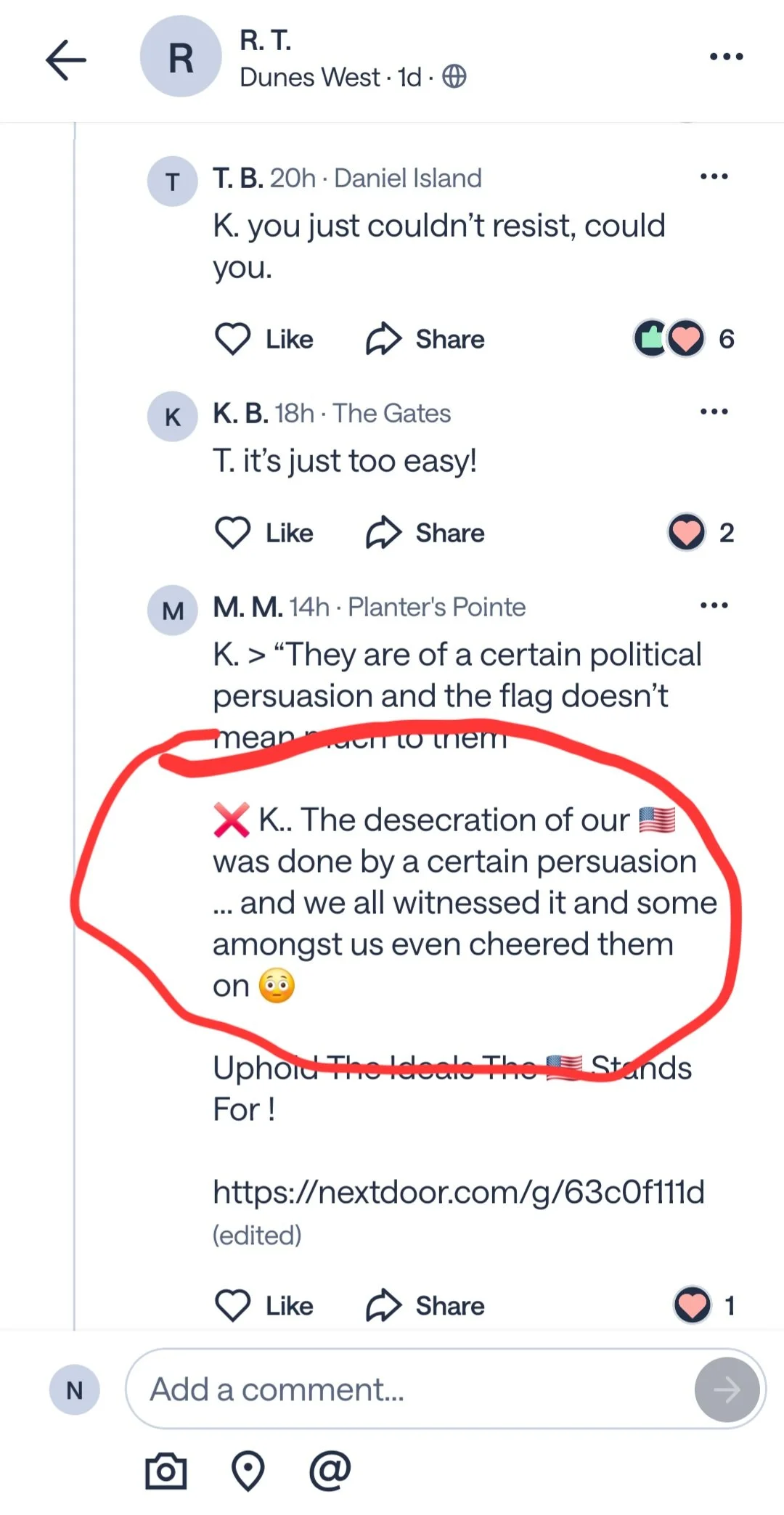
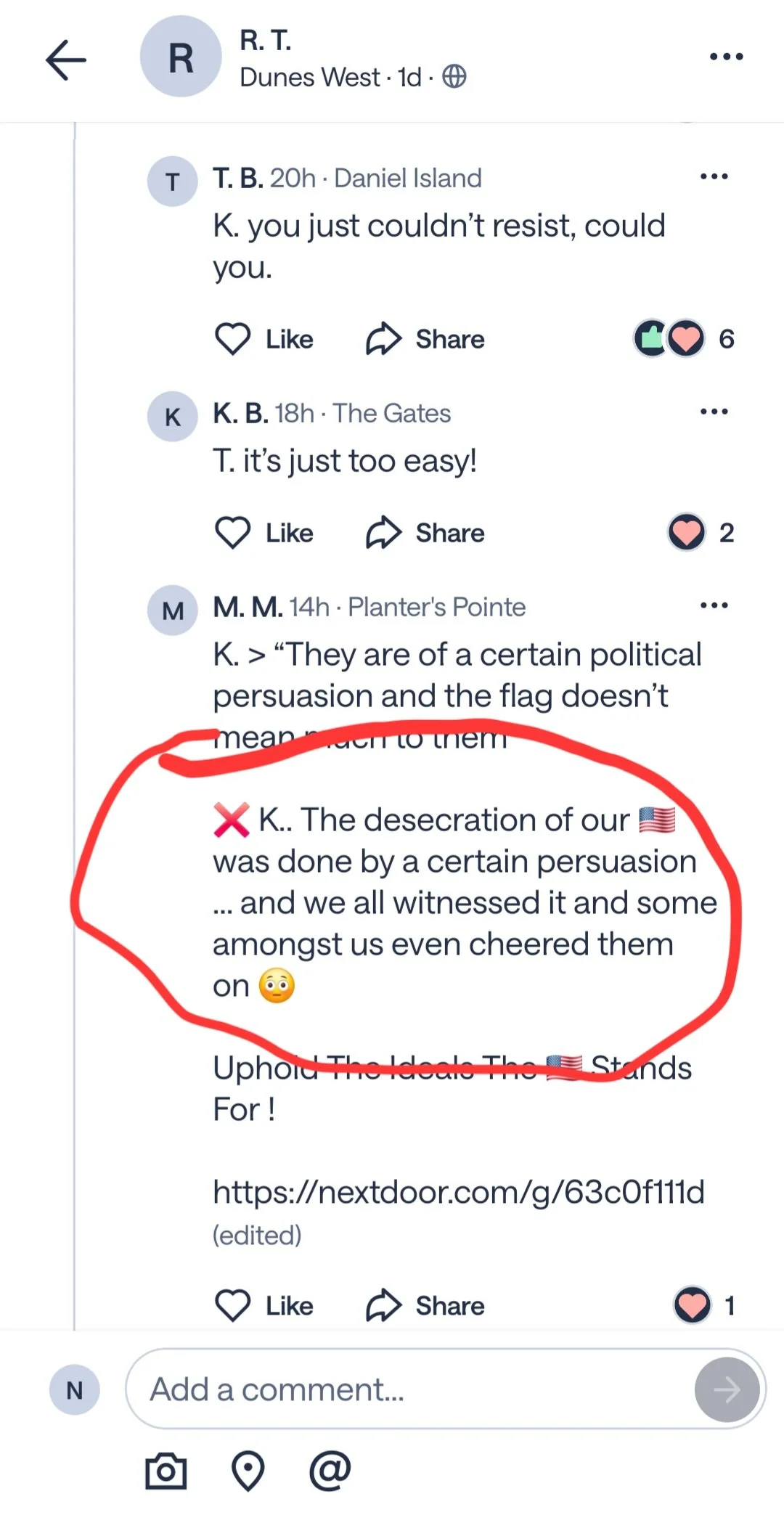
As part of my ongoing Nextdoor experiment, I continue to observe discussions in my local community. Some of what I see is thoughtful. Some of it is disappointing.
With the 250th anniversary of the founding of the United States approaching, it’s encouraging to see neighbors celebrating a milestone in our country’s history. I’m grateful to have been born in the United States and appreciate the opportunities this country has provided.
What concerns me is when conversations move beyond the topic itself and begin singling out groups of people with broad stereotypes or negative generalizations.
Whether the target is based on race, ethnicity, religion, political affiliation, or another characteristic, allowing comments that stereotype an entire group can undermine the sense of community a platform aims to foster.
I included a screenshot of the discussion in this post so readers can judge the context for themselves.
That brings me back to a question I’ve asked repeatedly:
How are moderation decisions being made, and are they being applied consistently?
When users see some comments removed while others containing personal attacks or broad stereotypes remain, it’s natural to ask whether the moderation process is consistent.
I’ve suggested before that Nextdoor could strengthen its moderation model by combining AI-assisted detection with centralized quality assurance and regular moderator coaching. Regardless of the approach, consistency and transparency are important if users are expected to trust the process.
I’d like to see moderation that encourages constructive conversations while reducing comments that target or stereotype groups of people.
You can see the screenshots, read my full analysis, and join the discussion on NielFlamm.com/blog.
What has your experience been with online community moderation?
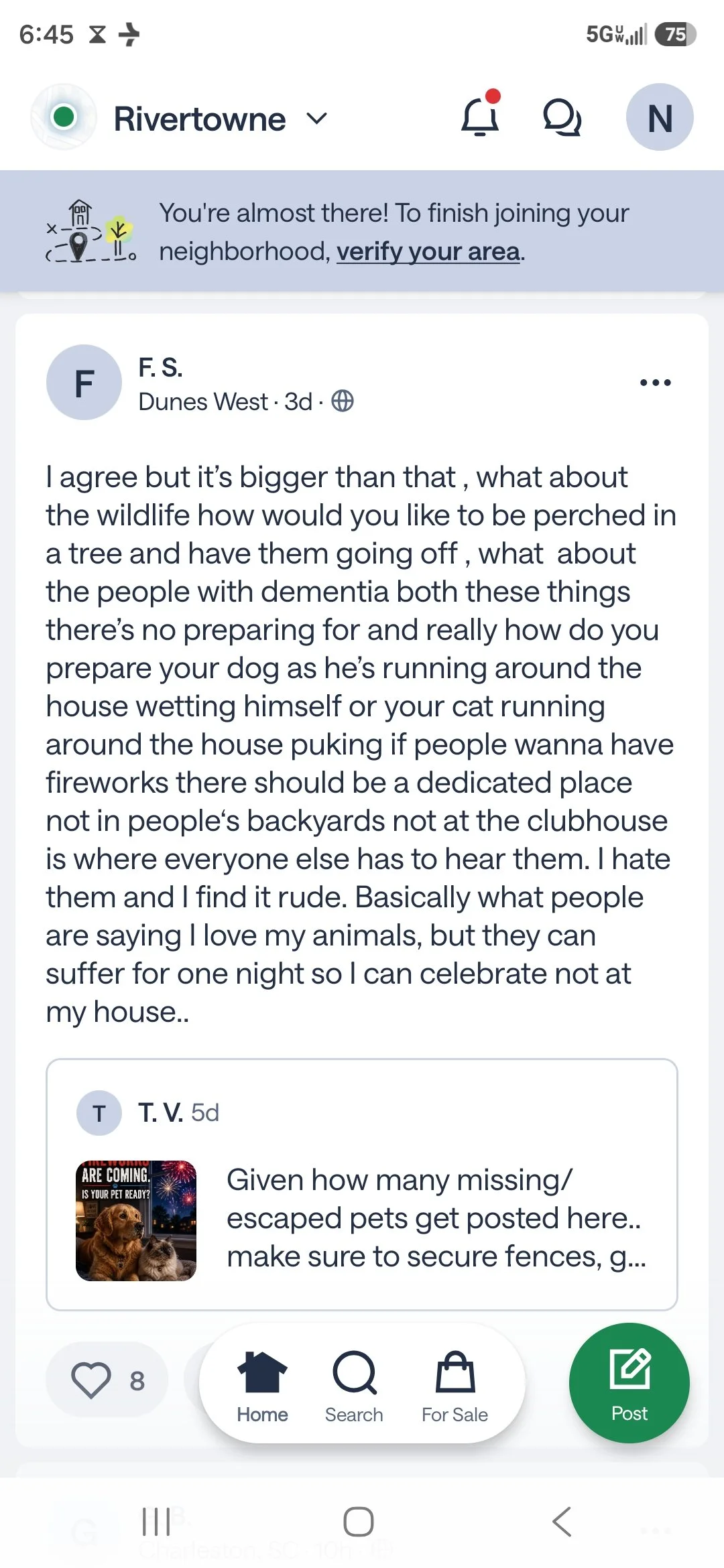
Day 16: Consistency Shouldn’t Depend on Who You Know
Every year around Independence Day, neighborhoods light up with discussions about fireworks and pets.
I understand why. It’s a topic that generates strong opinions.
What caught my attention wasn’t the topic itself—it was the comments that followed.
One commenter referred to another neighbor as “Karen.” By the way, I know an awesome Karen, Karen Romero and would recommend her for a leadership QA role in a heartbeat.
Another made a reference to Charles Darwin, implying that a species disappears because of poor choices—a comment clearly aimed at another person.
Yet those comments remained visible.
That leaves me asking the same question I’ve been asking throughout my Nextdoor experiment:
How are comments like these allowed to remain while other posts or comments are moderated or removed?
From my perspective, consistency is the issue.
Whether the inconsistency stems from differences in judgment, neighborhood dynamics, or something else, the result is the same: users may wonder whether the standards are being applied evenly.
My suggestion hasn’t changed.
Combine AI with centralized quality assurance and independent oversight. Let AI identify conversations that are becoming personal, and have trained reviewers apply the same standards across every neighborhood.
That seems like a better investment than expanding office space if the goal is to improve the user experience.
Meanwhile, today is Day 16 since I requested the Home Insurance Insights study referenced in a Nextdoor article.
I’ve now emailed Nirav Tolia, Jacob Chavis, and another member of the Customer Insights team.
Was it awkward?
A little.
But it also raises a broader question.
If this is the experience of someone making a straightforward request for information referenced in a public article, what should advertisers or users expect when they need help with a billing issue, campaign, or account problem?
Customer experience is built one interaction at a time.
I’d love to hear your thoughts.
Join the discussion on NielFlamm.com.