

Day 25: Stock Price, Strategy, and the Question of Accountability

Day 25.
Still no response from Jacob Chavis regarding my request for the full study information published by the Nextdoor Communications team, listing him as the contact.
No study.
No methodology.
No acknowledgment.
As of this post, Nextdoor (NXDR) is trading around $2.33 per share.
For me, with my modest investment, that represents a small gain.
But I continue asking the bigger question:
What exactly are investors buying into?
Nextdoor launched over 15 years ago. The company continues discussing technology, AI, growth opportunities, and the future of connecting neighbors.
Those are great talking points.
But eventually the conversation has to shift from possibilities to results.
Technology alone does not fix execution.
Podcasts do not fix execution.
Social media posts do not fix execution.
A true change in direction does.
Speaking of technology, there are companies building solutions around the Nextdoor ecosystem — lead generation, sales performance, advertising optimization, and analytics.
My concern as a shareholder is simple:
Trust.
If my experience requesting information connected to a published study is any indication, what happens when a larger issue requires escalation?
What happens when a business partner, advertiser, or technology provider needs support when something actually impacts revenue?
Ignoring a simple question is easy.
Solving difficult problems requires a culture of ownership.
This is not about one email.
It is about what behaviors become acceptable.
Leadership sets expectations.
Processes become culture.
Culture becomes results.
A saying I continue coming back to:
“We tolerate what we allow.”
Shareholders, users, advertisers, and partners should always ask:
What are we allowing?
Join the discussion on NielFlamm.com.
#Nextdoor#NXDR#Leadership#Accountability#CorporateGovernance#InvestorRelations#Technology#AI#CustomerExperience#BusinessStrategy#Transparency

Handicap Parking: It’s Not a Suggestion, It’s a Necessity

This morning I arrived at the hospital to visit my mom. Like many mornings recently, it’s another chapter of balancing life, family, dialysis, and everything else that comes with it.
As I pulled into the parking lot, I started looking for a handicap-accessible parking spot. I have a handicap plate. Not because it’s convenient. Not because I want a closer walk.
I have one because I’m an above-the-knee amputee and I live with ESRD (End Stage Renal Disease). Some days the extra distance isn’t just a few more steps — it’s a lot more energy, more strain, and more effort.
There were no handicap spots available.
Then I noticed something.
Apparently, when the designated spots are full, someone decided the solution was simple: create their own spot.
A spot that wasn’t actually a parking spot.
Maybe they were in a hurry. Maybe they had a reason. Maybe they thought, “I’ll only be a minute.”
But here’s the thing — hospitals are one of the places where accessibility matters the most. People coming through those doors may be dealing with challenges you can see and many you can’t.
The lines, signs, and designated spaces aren’t there for decoration. They exist because someone may be walking on a prosthetic leg. Someone may be recovering from treatment. Someone may be helping a loved one while fighting their own battle.
I don’t expect special treatment. I expect people to think beyond themselves.
A little awareness and consideration go a long way.
Because one day, the spot you think doesn’t matter may be the spot you truly need.
Leadership Disconnect: The Rules You Promote Should Start With You
I’m on a roll tonight.
Maybe it’s because after dialysis, once the “dialysis hangover” feeling starts to fade — a feeling I remember from another lifetime over 17 years ago — I start connecting dots.
Tonight, something stood out.
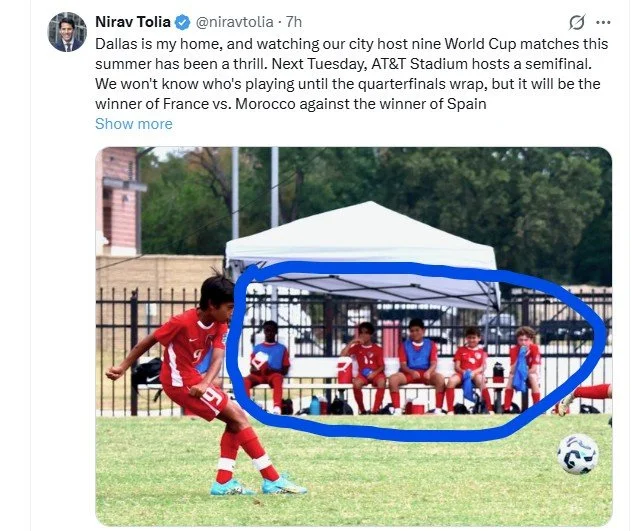
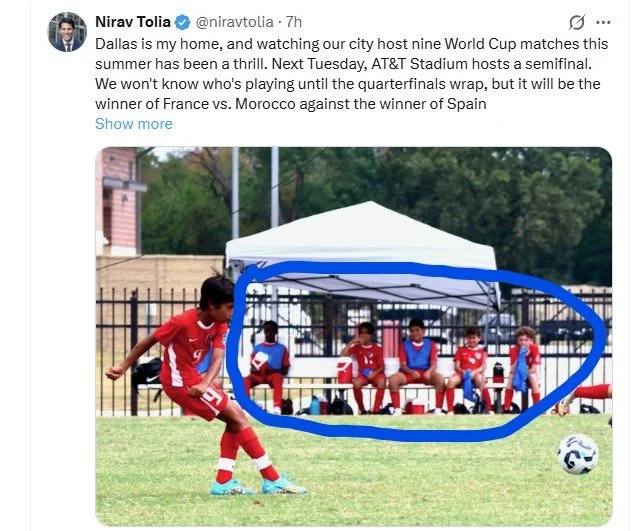
Nirav Tolia posted on X about the World Cup, his family, and how important soccer is to them—a proud parent moment.
I understand that.
However, the picture appeared to include his child during a game with other children and teammates clearly visible in the background.
Is posting a photo from a public event automatically illegal?
No.
That is not the point.
The point is awareness, judgment, and understanding of the community you lead.
The CEO of Nextdoor runs a platform where neighbors regularly discuss safety, privacy, strangers taking photos, and concerns about their children’s images and likeness being shared online without permission.
Parents ask:
“Who took this picture?”
“Why is my child online?”
“Did anyone ask before posting this?”
These are conversations happening on his own platform.
However, the person leading that platform seems comfortable sharing a moment in which other children may be included in a public post without their parents' consent.
That disconnect matters.
Leadership is not just what you say on a podcast.
Leadership is not just about kindness, trust, neighbors, and community.
Leadership is demonstrating an understanding of the concerns of the people using your product.
This is bigger than one picture.
It is about being connected to your customers' reality.
A CEO sets the example.
If your platform promotes trust, safety, respect, and community awareness — those principles should not stop when you log off the app.
You cannot build trust while appearing disconnected from what your own users are concerned about.
The community is speaking.
The question is:
Is leadership listening?
Join the discussion on NielFlamm.com.

CEO Accountability: The Culture You Allow Becomes the Culture You Build

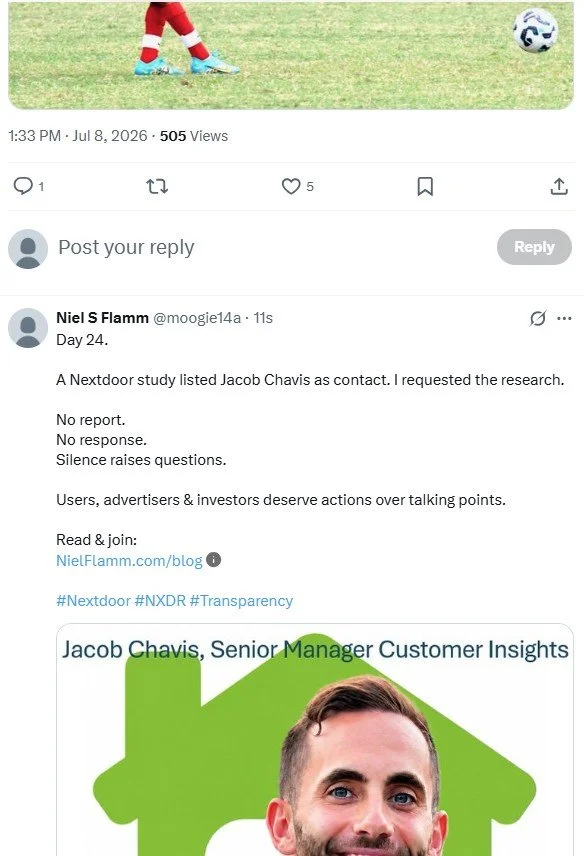
As part of my process, I continue sharing my documented experience with Nextdoor, Nirav Tolia, and, currently, Jacob Chavis.
Today is Day 24.
A simple request was made for the full study information from research published by the Nextdoor Communications team, listing Jacob as the contact.
No study.
No methodology.
No response.
While posting updates, I noticed Nirav sharing a message about the World Cup, neighbors connecting, and finding common ground.
That is a great message.
But leadership is not only about the message you deliver externally.
It is about the experience people receive internally and externally when nobody is watching.
I commented on the post with my experience, an infographic, and directed people to the full story.
It was the first comment.
Nirav has responded to other commenters. My experience remains unacknowledged.
This is where CEO accountability matters.
Every organization has issues. Every company makes mistakes. The difference is how leadership responds when something is brought forward.
Feedback is not automatically “noise.”
Feedback can be data.
Feedback can identify gaps between what the company leaders believe they are building and the experience customers, users, employees, and shareholders are actually having.
A CEO sets the standard.
If communication gaps are accepted, they become normal.
If accountability is optional, it becomes culture.
If silence is tolerated, it becomes the process.
“I tolerate what I allow.”
The question isn’t whether every piece of feedback is comfortable.
The question is whether leadership is willing to listen, evaluate, and improve.
That is how trust is built.
Join the discussion on NielFlamm.com.

Day 24: The Cost of Silence — Communication Is Leadership

The clock keeps ticking.
It has now been 24 days since I requested information about a study published by the Nextdoor Communications team, which listed Jacob Chavis as the contact person and included his email address.
No report.
No methodology.
No correspondence.
Not even a simple acknowledgment.
Which brings me back to the question:
What is the theory?
Nirav Tolia has discussed the importance of testing theories, learning, and understanding outcomes. So what is the theory behind not responding?
What is the goal?
What does silence accomplish that a simple one-line email could not?
Users, advertisers, and investors may want to ask a bigger question:
If this is the communication model for when someone asks for information about a published study, what happens in a true crisis?
It is easy to say:
“We would handle it differently because ______.”
Fill in the blank with any explanation.
But results are measured by what happens, not what someone says would happen.
Show me actions.
Show me consistency.
Show me accountability.
Relationships — personal and business — often break down when
expectations and reality no longer match.
In the meantime, something unexpected happened.
My following and engagement continue to grow, and ironically, I have Nextdoor to thank for part of that.
That wasn't the reason I raised questions. It is simply the result.
More people are asking questions about platforms, leadership, moderation, transparency, and accountability.
At some point, people become tired of accepting what they believe needs to change.
Nextdoor launched over 15 years ago. The question remains:
Are conversations, interviews, and future promises enough?
Or is it time to focus on measurable results?
Join the discussion on NielFlamm.com.