
Automatic Gratuities? Not on My Next Cruise.
I have a Royal Caribbean cruise planned, paid for, and waiting for me.
On Thursday, October 29, 2026, I’ll board Radiance of the Seas in Tampa. Then it’s a day at sea, a stop in Cozumel, Mexico, another glorious day at sea, and back to Tampa on Monday, November 2.
I love cruising. I love being on the water. I love eating an irresponsible amount of bacon. And I absolutely love people watching.
Put me on a ship with the ocean, bacon, Coke Zero, and a few thousand strangers making questionable vacation decisions, and I'm entertained.
But lately, I've been watching a lot of cruise videos about one surprisingly polarizing subject:
Automatic gratuities.
And I think I've changed my mind about them.
What Exactly Is a Gratuity?
If you haven't cruised before, you pay a cruise fare that includes your cabin, most meals, some beverages, entertainment, and plenty of other things.
Of course, there are upcharges. Want a specialty restaurant? Pay extra. Want a fancy coffee? Pay extra. Want alcohol? Definitely pay extra.
Then there are gratuities.
On my first Royal Caribbean cruise, tipping worked very differently.
Toward the end of the cruise, we were given envelopes. The daily newsletter provided guidance on suggested tip amounts, and passengers put cash into the envelopes and personally handed them to the people who had provided service during the cruise.
Your room attendant.
Your waiter.
Assistant waiter.
Maitre d'.
It was direct. Someone provided you with great service, and you tipped them.
At some point, that system largely disappeared, and automatic gratuities became the norm.
Buy a drink at a bar or by the pool, and an 18% gratuity is already added to the price. You can add even more if you'd like.
Then there's the separate daily automatic gratuity charged to passengers.
The explanation makes some sense: the money isn't just for the employees you see. It's also distributed to people working behind the scenes who contribute to your vacation.
Laundry.
Maintenance.
Food preparation.
Other crew members you may never meet.
These people absolutely contribute to the cruise experience.
But there's one word I keep coming back to:
Gratuity.
I asked The Google for a definition, and it gave me this:
A gratuity is an extra amount of money given to a person who provides a service.
Extra
.
That word matters.
A Video Changed My Thinking
I recently watched a video from an avid cruiser who said he was going to stop adding automatic gratuities.
My initial reaction was basically, Ehhhhhh...
I've actually defended automatic gratuities before.
My normal practice has been to leave the automatic gratuities in place and then tip additional cash to crew members who provide me with great service.
That includes room attendants, servers, bartenders, and even crew members working in the buffet.
If someone takes care of me, I believe in taking care of them.
I'm not looking for an excuse to save a few bucks at the expense of the people working incredibly hard on a cruise ship.
But the cruiser in the video made a point that stuck with me:
Why is it the passenger's responsibility to supplement the compensation of back-of-house employees through something called a gratuity?
And that's where my thinking changed.
Pay Your Employees
If a cruise line needs a certain amount of money per passenger to properly compensate laundry workers, maintenance employees, kitchen staff and other behind-the-scenes crew members, then build that amount into the cruise fare.
Charge me what it actually costs.
Be transparent.
If the cruise needs to cost another $100, $150, or $200 for the company to compensate its employees properly, please include it in the advertised price.
I can then decide whether that cruise is worth that price.
What concerns me is treating what is traditionally understood as a service tip as part of the company's labor cost structure.
I have absolutely no problem with a company making a profit.
Royal Caribbean is a business, not a floating nonprofit with a waterslide.
Make money.
Make lots of money.
Build another gigantic ship with 47 restaurants, 19 pools, and a zip line directly through a Starbucks for all I care.
It's how the money is collected that I'm questioning.
If the automatic gratuity is necessary to compensate employees properly, is it really a gratuity anymore?
Or is it simply part of the cruise fare with a different name?
So I'm Trying Something Different
When I board Radiance of the Seas on October 29, I'm changing my normal routine.
At some point during the cruise, I'm going to go to Guest Services, stand in line—not in line, because I am a New Yorker—and ask to have the automatic gratuities removed.
But I'm not going to stop tipping.
Quite the opposite.
I'm going to bring a bunch of cash.
When someone provides great service, I'm going to tip them directly.
Room attendant? Cash.
Great waiter? Cash.
Bartender? Cash.
Someone at the buffet goes out of their way to help me? Cash.
If you're taking care of me while I'm wandering around a ship eating bacon and staring at the ocean, I want you to know that I appreciated what you did.
The people working behind the scenes deserve to be compensated fairly, too.
I believe their employer should be responsible for making sure that happens.
Maybe It's Time for More Passengers to Question It
I'm curious what other cruisers think about this because I've discovered this topic can get surprisingly heated.
Some passengers consider removing automatic gratuities practically a declaration of war against the crew.
Others argue that cruise lines have successfully shifted responsibility for employee compensation onto passengers while continuing to advertise lower base fares.
I'm moving toward the second camp.
I'll gladly tip.
I'll gladly reward great service.
I'll probably tip more than I would have otherwise.
But I'd rather put the money directly into the hands of the people who made my vacation better and tell them:
Thank you.
And if the cruise line needs additional funds to compensate everyone else properly?
Put it in my fare.
Tell me what the cruise actually costs.
Then let a gratuity actually be a gratuity.
Now I need October 29 to get here.
There is an ocean, a cruise ship, and an unreasonable quantity of bacon waiting for me.
Summit Coffee: A Relaxing Local Stop After Sullivan’s Island
After attending a recovery meeting on Sullivan’s Island, I wasn’t ready to head home. I wanted a locally owned coffee shop where I could write, use Wi-Fi, drink coffee, and have a small bite. Summit Coffee was nearby, open until 4 p.m., and checked all those boxes.
The parking lot is quite small, with one accessible space and perhaps four additional spots. Inside, I counted roughly eight tables and a long four-seat high-top overlooking Ben Sawyer Boulevard. Since I needed an outlet, the high-top was perfect. The air-conditioning was especially welcome on such a brutally hot and humid day.
The shop was clean, and the staff was friendly. This is what I remember a coffee shop being: a comfortable place to hang out, enjoy a drink, eat something small, and relax without trying to be everything to everyone.
I ordered a 16-ounce decaf Americano in a ceramic “stay” mug. It was good and served piping hot, so I let it cool while I worked. The self-service area had Stevia, Sugar in the Raw, stirrers, cup stoppers, and plastic utensils.
I also ordered a Nutella croissant. It was flaky and had just the right amount of Nutella—enough chocolate and hazelnut flavor without being overwhelming. There were a few other small food options. The closest thing to a sandwich was a bacon-and-cheddar biscuit. When I asked whether it contained egg, the answer was, “I imagine so.” Since I strongly dislike eggs—and because ingredient knowledge can matter for allergies and dietary restrictions—I would encourage the staff to become familiar with exactly what each item contains.
A slightly more substantial lunchtime option would also be a welcome addition. Overall, though, Summit Coffee is a super-cool neighborhood spot with good coffee, reliable Wi-Fi, friendly service, and a relaxed atmosphere. I would happily return.
Well, That Was Fast: I Got My First Hinge Match
Remember when I said the Tinder experiment was over and I had moved on to The Hinge?
Remember when I wondered how long it would take before I got a match?
Apparently, the answer was:
Not very long.
I woke up this morning and got a bit of a late start. No dialysis today, so there wasn't an alarm dragging me out of bed at an ungodly hour. I eventually got myself moving, checked my email, and there it was:
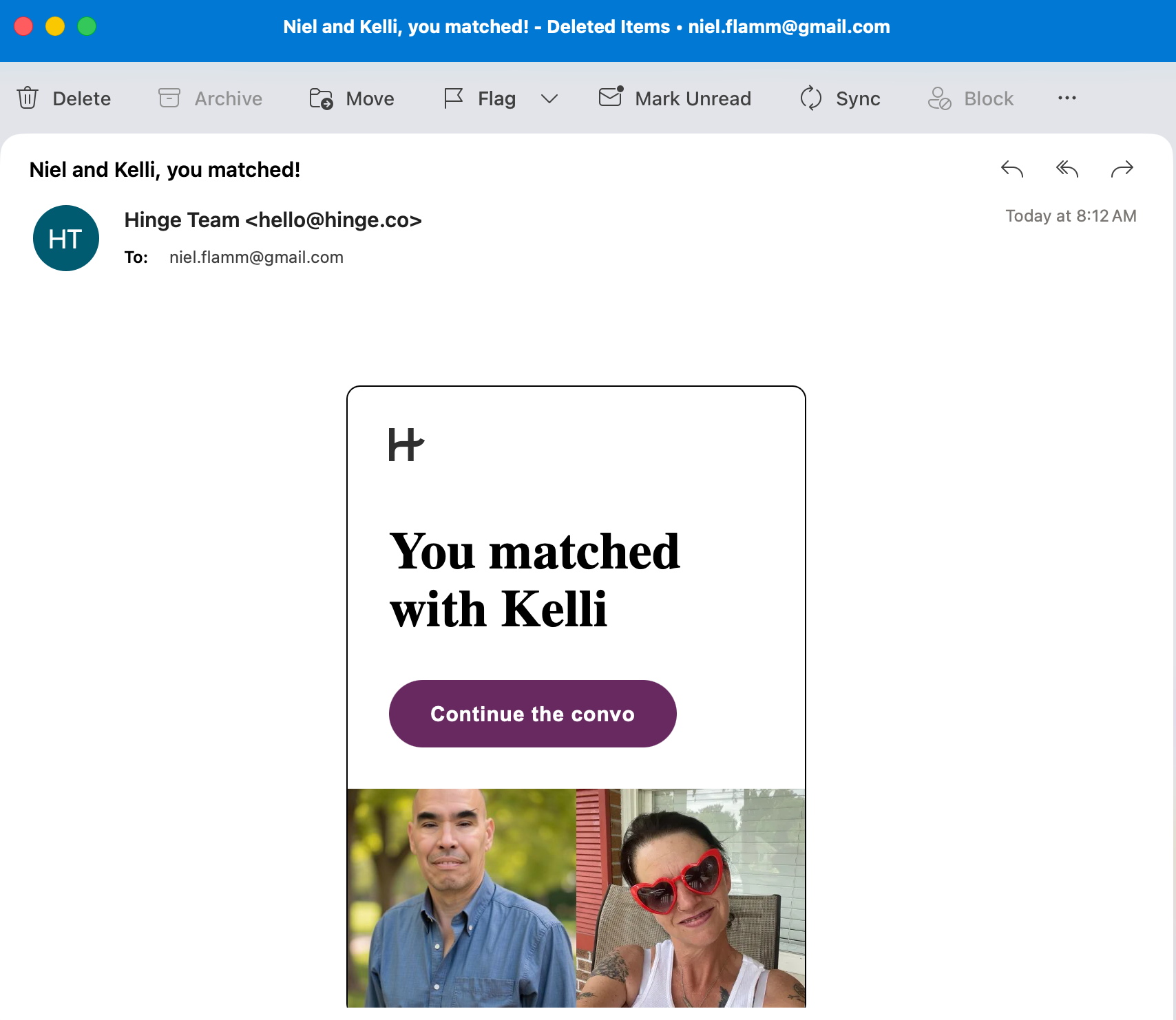
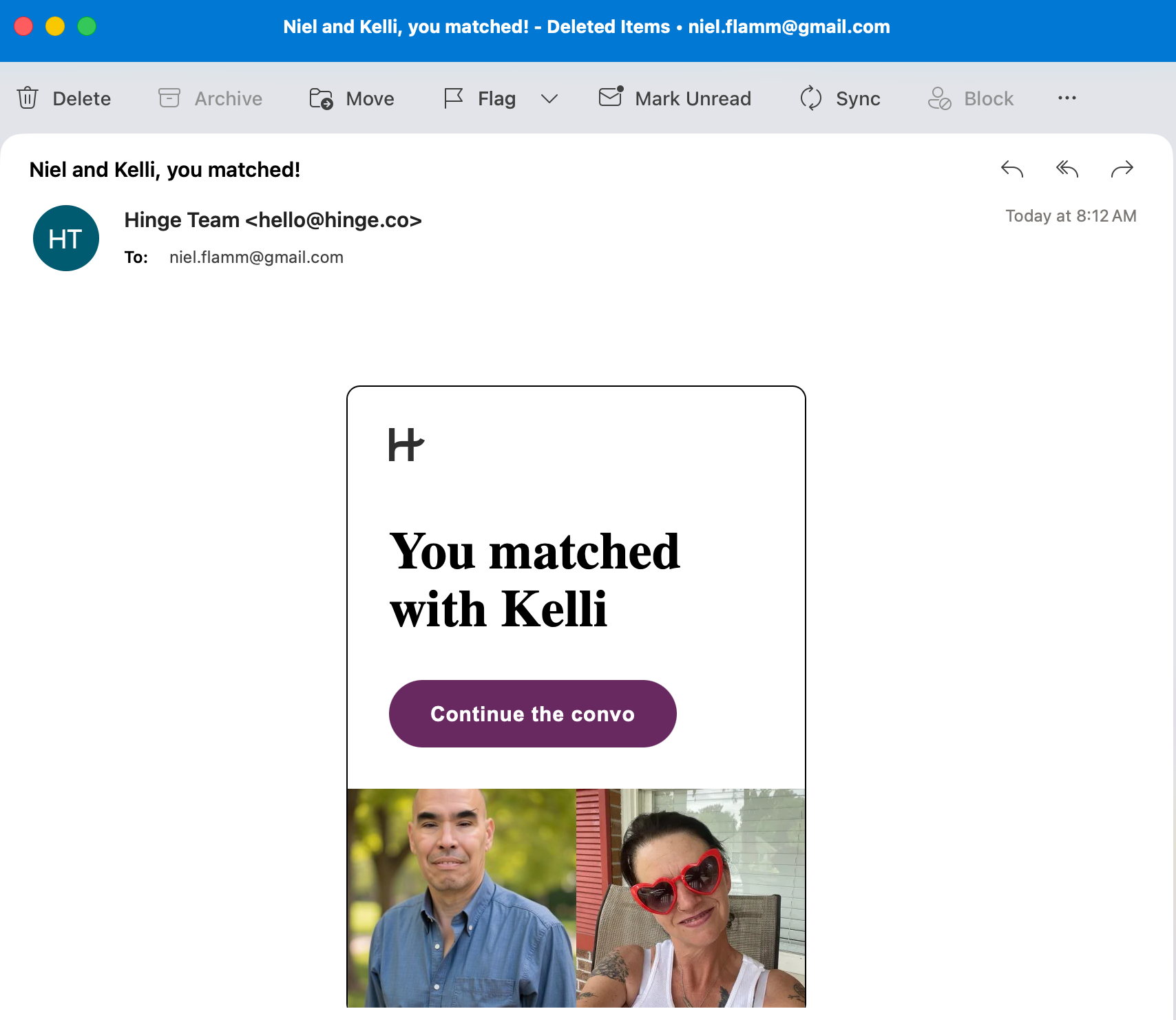
“Niel and Kelli, you matched!”
Wait.
WHAT?
I actually matched with someone?
On a dating app?
Already?
I was surprised.
I was amazed.
And against everything I've learned from online dating thus far, I was even a little...
Hopeful.
Her name is Kelli, and she's in Conway, South Carolina.
That's roughly an hour away from me.
Some people might look at that distance and say, “That's kind of far.”
I look at it and say:
I like to drive.
Problem solved.
But First, I Had Stuff to Do
Despite receiving this potentially historic notification, I didn't immediately drop everything and begin crafting the greatest opening line in the history of online dating.
I had things to do.
Also, let's establish something very important:
I don't spit mad game.
There was no:
"Did it hurt when you fell from heaven?"
No carefully researched pickup line.
No ChatGPT-generated Shakespearean sonnet about her eyes.
I eventually opened the conversation with:
“Hello Kelli! How are you coping with the stupid heat and humidity?”
Smooth?
Debatable.
Authentic?
Absolutely.
Because it is stupid hot and humid.
We're in South Carolina in August. You can walk outside for four minutes and somehow need another shower.
So rather than pretending I'm some suave dating-app Casanova, I went with something every person in South Carolina can currently agree upon:
Why is the air wet?
And now...
I wait.
This Is Where the Experiment Gets Interesting
The first hurdle has officially been cleared.
I got a match.
Now we move on to Phase Two of The Hinge Experiment.
Will Kelli respond?
Will we have an actual conversation?
Will we discover we have things in common?
Could there eventually be a drive to Conway—or somewhere in between—to actually meet another human being in person?
Or will the universe continue its recent tradition of using dating apps to teach me valuable lessons about cryptocurrency, WhatsApp, and international investment opportunities?
I don't know.
But right now, I'm choosing optimism.
A real match appeared.
I sent a completely normal message.
She's about an hour away.
I like driving.
And, most importantly, nobody has tried to sell me anything yet.
This is already progress.
Now we wait.
Pray with me, Forest. Pray with me.

Day 65: A Reset—But Not of the Clock
It's Day 65 since I originally requested Nextdoor's Home Insurance Insights study.

That clock isn't resetting.
What I'm getting at with a semi-reset is my approach.
I've written plenty. I've sent detailed emails. I've asked questions about communication, leadership, moderation, accountability, and most recently, whether my experience represents differential or discriminatory treatment.
Today, I stripped all of that away.
Simple. Short. To the point.
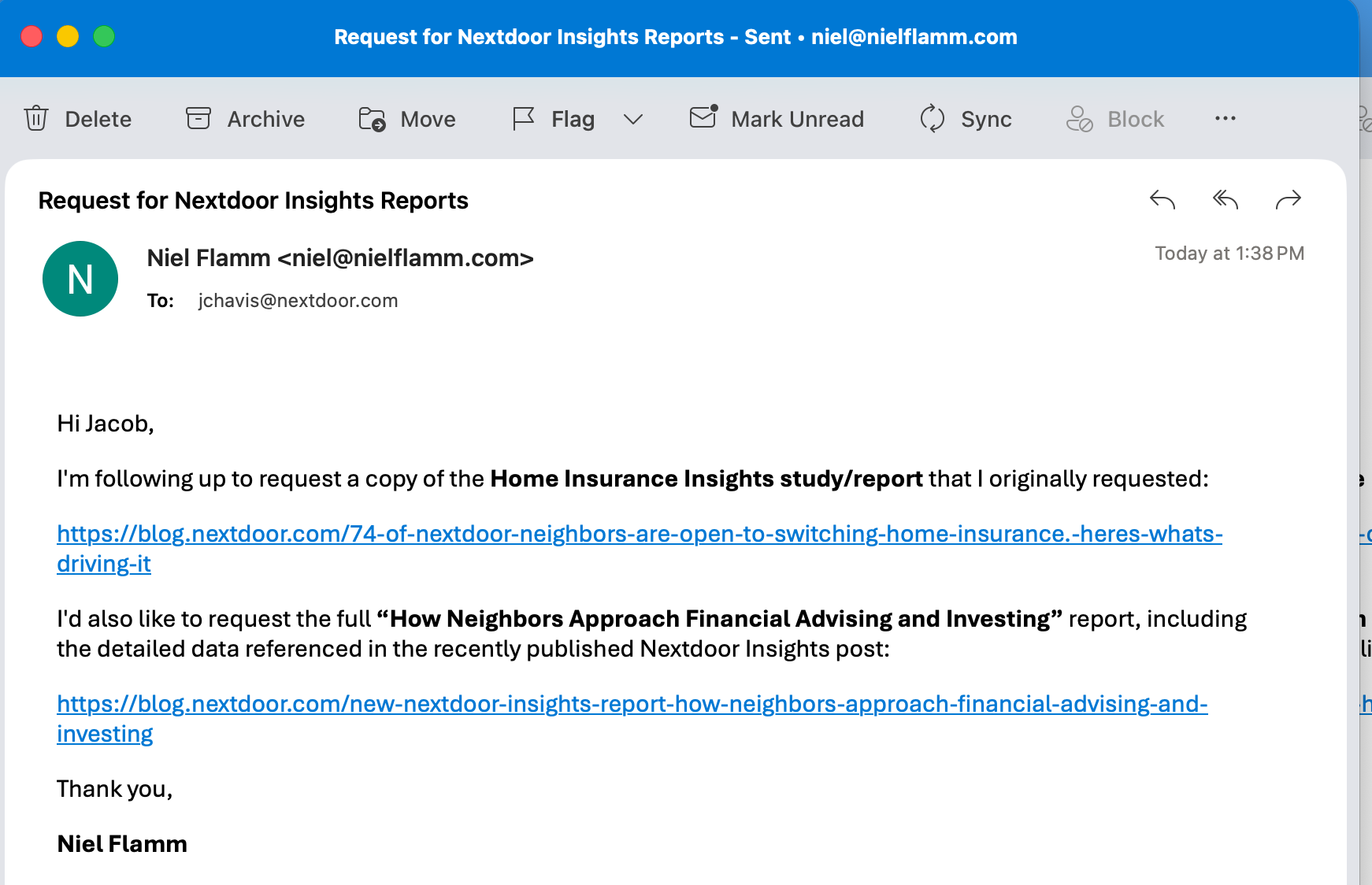
I sent Jacob Chavis an email requesting two things:
1. The Home Insurance Insights study I've been requesting for 65 days.
2. The full “How Neighbors Approach Financial Advising and Investing” study, which Nextdoor recently published and specifically tells readers to contact Jacob for additional detailed data.
That's it.
No lengthy explanation.
No 65-day history.
No commentary about Nirav Tolia, Sarah Leary, Communications, or Investor Relations.
Just two requests.
Now let's see what happens.
Maybe Jacob responds.
Even better, maybe I simply receive both studies, and we can finally put this particular question to rest.
If I don't?
Then the question I've recently raised about discrimination or differential treatment becomes even more interesting to me.
I'm not asserting that unlawful discrimination has occurred. Whether there is a viable legal claim—and whether any broader group has experienced comparable treatment—is something an attorney would need to evaluate based on the facts and applicable law.
So I'll put this out there:
Is there an attorney experienced in discrimination, corporate practices, consumer rights, or shareholder matters who finds this situation worth exploring?
Potentially even whether there's a broader pattern affecting others?
If an attorney believes the facts support an individual or class-action case and is willing to evaluate it on a contingency-fee basis, I'm open to a conversation and, if appropriate, serving as a lead plaintiff.
Reach out.
But I'd much rather have the simpler outcome.
Two studies requested.
One short email.
Let's see if Nextdoor responds.
The reset starts today.
The 65-day clock does not.
Full timeline at NielFlamm.com/blog.
✈️ New York This Weekend… Maybe. Mother Nature Has Entered the Chat.
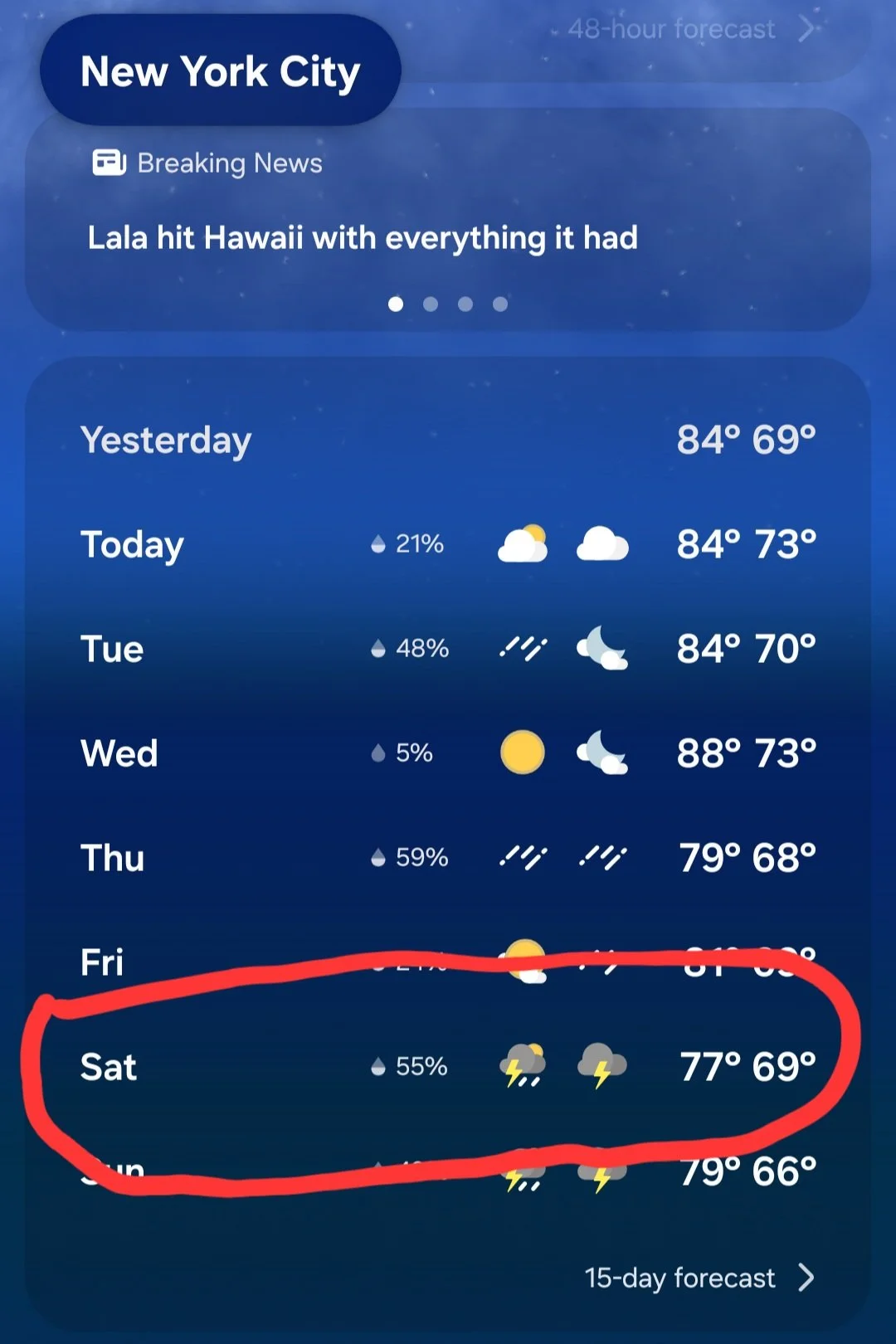
This Saturday, I’m supposed to be flying to New York—LaGuardia (LGA), specifically—then heading over to Astoria, Queens for a yearly gathering.
Normally, I’d be excited.
It’s a nonstop flight, which already makes the trip significantly more appealing. No sprinting through Atlanta. No sitting in Charlotte wondering why my connecting flight has changed gates four times. Just get on the plane, land at LGA, and head into Queens.
And then there’s Queens itself.
The bagels. The pizza. The Greek food in Astoria. The seemingly endless supply of carbohydrates that somehow taste better once you cross into New York City.
I grew up in New York, so there’s also something familiar about going back. Even if the trip is short, there’s always a little nostalgia mixed in with the carbohydrates.
There is, however, one potential problem:
The weather.
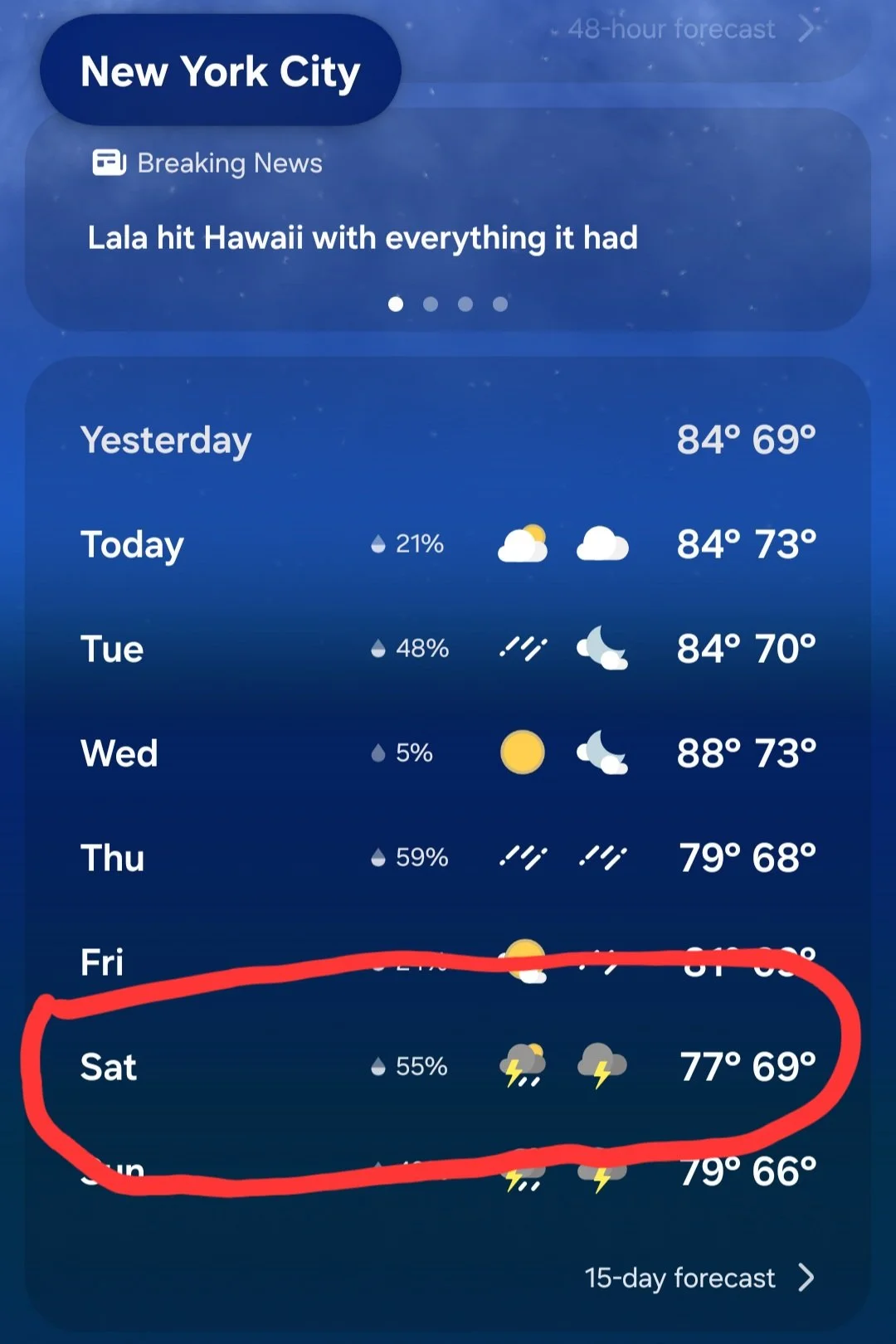
Right now, Saturday is looking a little questionable, with about a 55% chance of rain throughout the day.
Now, I’m willing to travel for a good bagel.
I’m willing to travel for New York pizza.
I’m willing to tolerate LGA, traffic, questionable drivers, expensive everything, and the possibility that someone will honk at me for absolutely no reason.
What I’m not particularly interested in doing is flying all the way to Queens just to spend the day staring out of a hotel-room window watching rain fall.
I can sit inside and watch rain in South Carolina. It’s significantly cheaper.
Of course, weather forecasts several days out have approximately the same reliability as some dating profiles: interesting information, but I'm not making major life decisions based on them just yet.
So, for now, the trip is still on.
The suitcase isn't packed.
The bagel order hasn't been placed.
And I'm watching that forecast.
Will I be eating pizza in Astoria this weekend?
Or will I be sitting comfortably at home thinking about the money I saved by not flying to New York to watch it rain?
Stay tuned.