
Is Nextdoor Discriminating Against Me?
After writing my other posts today, I came across something that changed the conversation.
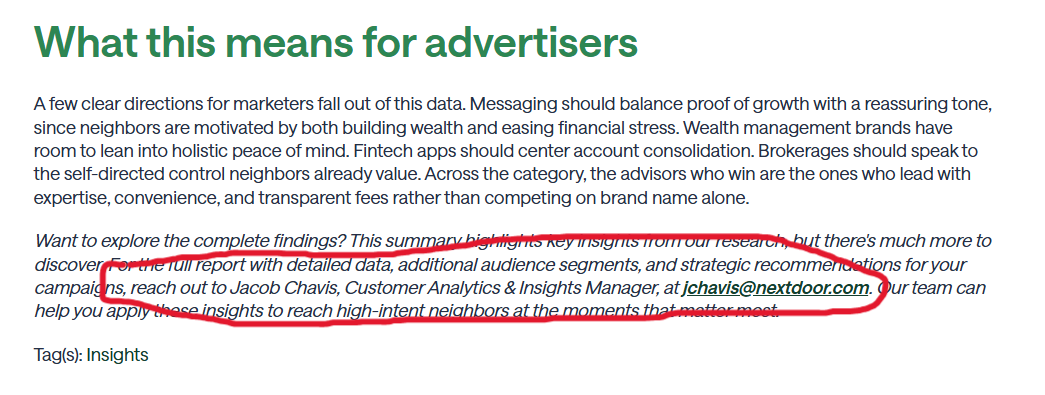
Nextdoor published a new Insights report today:
New Nextdoor Insights Report: How Neighbors Approach Financial Advising and Investing
And at the bottom?
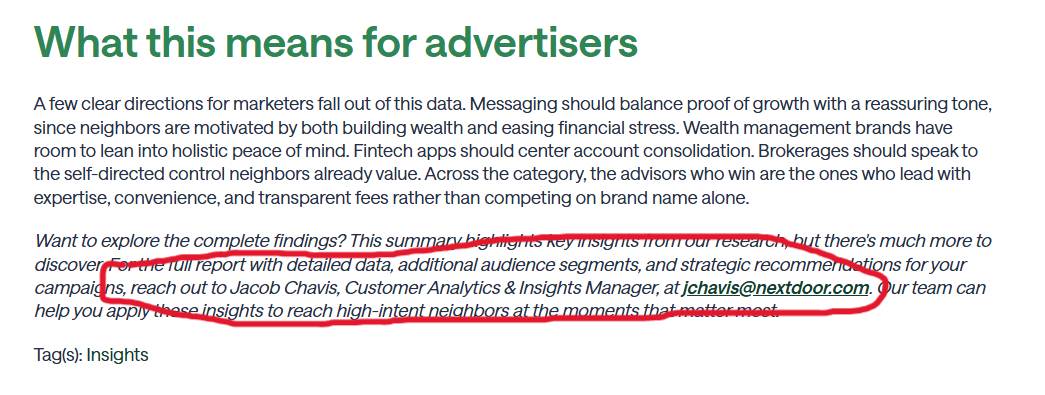
Nextdoor tells readers who want the full report with detailed data, additional audience segments, and strategic recommendations to contact Jacob Chavis, Customer Analytics & Insights Manager.
Yes.
This is the same Jacob Chavis I've been trying to get a study from for 64 days.
So I'm going to use a word I haven't used throughout this experience:
Discrimination.
To be clear, I'm not stating that Nextdoor has engaged in unlawful discrimination.
I'm asking whether I'm being treated differently, why, and whether that differential treatment could raise more serious questions.
For weeks, I've considered other explanations.
Maybe Jacob's responsibilities changed.
Maybe Nextdoor stopped publishing these studies.
Maybe Insights was on pause.
Maybe Jacob wasn't the appropriate contact anymore.
Today's publication makes those explanations much harder for me to reconcile.
Nextdoor is publicly saying:
Want detailed research? Contact Jacob Chavis.
Well...
I did.
Sixty-four days ago.
And again.
And again.
I've also contacted Nirav Tolia, Sarah Leary, Investor Relations, Communications, and others.
Still no substantive answer.
So I think it's fair to ask:
Am I specifically being treated differently?
And if I am:
Why?
Is it because I'm publicly critical of Nextdoor?
Because I'm a shareholder asking uncomfortable questions?
Because I've challenged its moderation model?
Because I've questioned leadership?
Has someone internally decided not to engage with me?
Or is there another explanation?
I don't know.
Different treatment doesn't automatically constitute unlawful discrimination. I'm not making that allegation.
But when Nextdoor publicly invites people to contact Jacob for detailed research, while my comparable request has remained unanswered for 64 days, I believe that asking about differential or discriminatory treatment is reasonable.
Let Me Play Devil's Advocate
Someone could look at my emails, posts, tags, comments, and follow-ups and say:
"Niel, maybe they think you're contacting them too much."
Fair question.
I'm persistent. I'm publicly documenting my experience and following up on this.
But persistence and criticism aren't automatically harassment.
I'm not threatening anyone. I'm not advocating violence. I'm not seeking anyone's private information. I'm asking questions about a publicly traded company, its leadership, policies, research, and my experience as a shareholder.
If Nextdoor believes my communications have crossed a boundary, please let me know.
"We're declining your request."
"Direct future inquiries here."
Even:
"We will not engage further."
That's still communication.
Instead, I'm left wondering whether Nextdoor has deliberately decided not to communicate with me.
And I'd ask every business, advertiser, news organization, government agency, and partner working with Nextdoor to consider something:
Today it's me. Could you eventually find yourself on the other side?
What happens when your experience doesn't match the corporate messaging?
What happens when you ask an uncomfortable question?
What happens when your company needs information Nextdoor publicly says is available—and suddenly nobody responds?
Partnerships aren't just about reach, impressions, WAU, and revenue.
They're also about the organization you choose to do business with and how it behaves when the conversation becomes uncomfortable.
So I'll ask Nextdoor directly:
Has Nextdoor decided not to respond specifically to me?
If yes, why?
If no, how does Nextdoor explain 64 days without a response while publicly directing others to Jacob Chavis for detailed research?
Earlier today, I was asking where Jacob was.
Then Nextdoor answered part of that question.
Apparently, he's exactly where I've been told to look all along.
Now I'd like Nextdoor to answer the rest.
Join the discussion at NielFlamm.com/blog. I'd genuinely like to hear your perspective.

Day 64: I’m Not Asking for the C-Suite. I’m Asking for Someone.
It's Day 64.

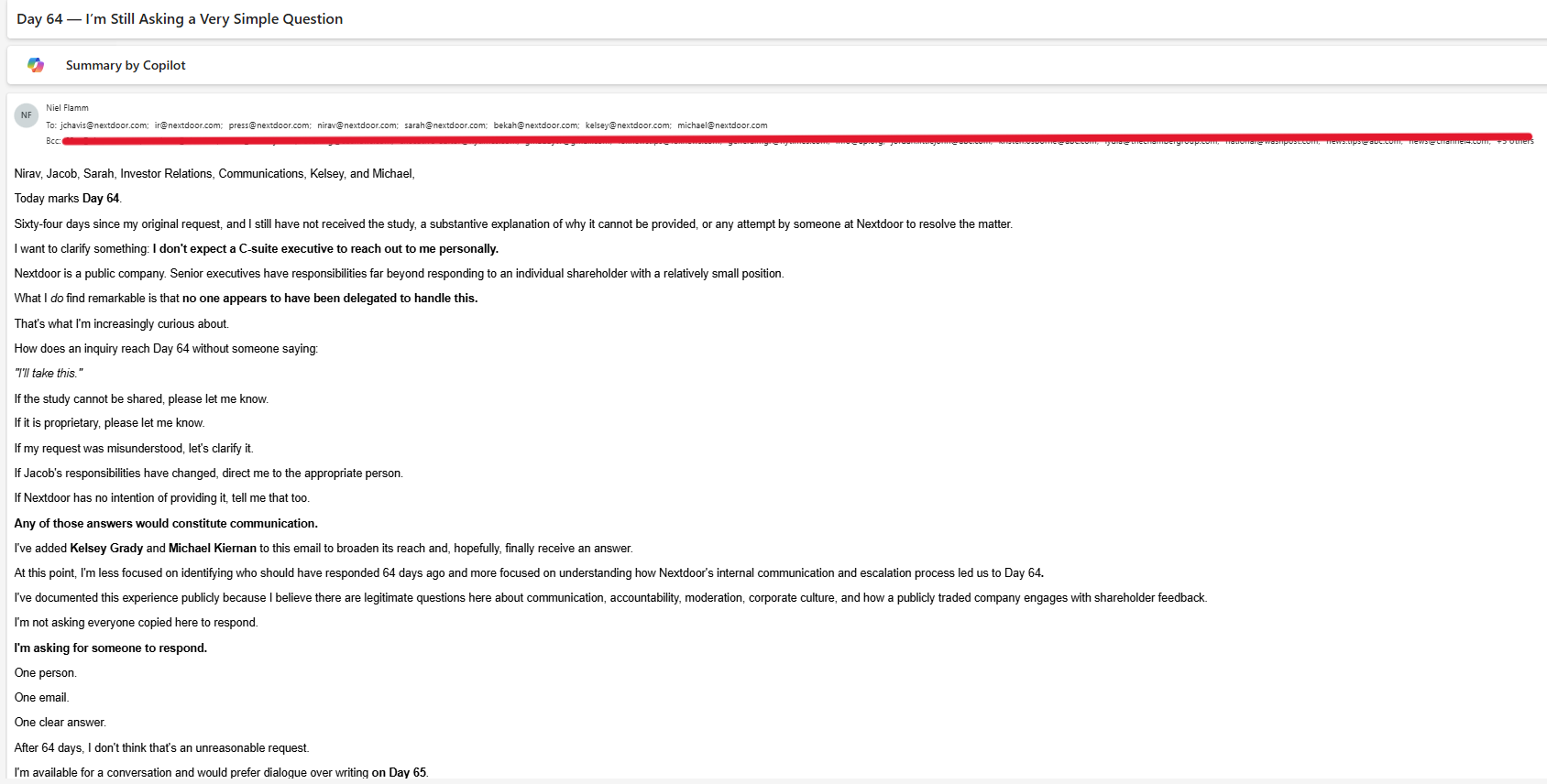
I sent another email today regarding the study I originally requested from Jacob Chavis.
This time, I want to make something clear:
I don't expect a C-Suite executive to contact me personally.
I'm a shareholder with a relatively small position. I understand that Nirav Tolia, Sarah Leary, and other senior leaders have responsibilities far beyond answering my emails.
But here's what I don't understand:
Why hasn't anyone been delegated to respond?
Sixty-four days.
No study.
No substantive explanation.
No, "We can't provide it."
No, "You've reached the wrong person."
No, "Let me connect you with someone who can help."
Not even, "Niel, the answer is no."
That's what makes this increasingly fascinating to me.
Today I expanded the email distribution list to include Kelsey Grady and Michael Kiernan, along with the people I've previously contacted.
Why?
Reach.
And hopefully, finally, an answer.
At this point, I'm no longer asking only:
Where is the study?
I'm asking:
How does a publicly traded company allow a relatively simple shareholder inquiry to reach Day 64 without assigning someone to handle it?
That's a process question.
That's a communication question.
And, increasingly, I believe it's a culture question.
Someone inside Nextdoor could end this particular chapter with one email.
The answer doesn't have to be what I want.
It doesn't have to come from Nirav.
It doesn't have to come from Sarah.
It doesn't even have to come from Jacob.
I'm asking for someone to respond.
One person.
One email.
One clear answer.
I've spent 64 days documenting what happens when communication doesn't happen.
I'd much rather spend Day 65 writing about what happened when someone finally decided to communicate.
The email has been sent.
Your move, Nextdoor.
Join the discussion at NielFlamm.com/blog. Leave some feedback—I'd genuinely love to hear your perspective.
The Tinder Experiment Is Over. Welcome to The Hinge.
Well, it happened.
The Tinder experiment is officially over.
I deleted my profile. Hopefully.
I say “hopefully” because deleting anything from the internet feels less like destroying evidence and more like politely asking a multinational corporation to maybe stop showing it to people eventually.
But Tinder and I have parted ways.
After the swiping, the matching, the questionable conversations, and the recurring suspicion that I was less likely to find a date than I was to receive an exciting new investment opportunity, I decided it was time.
So naturally, I did the sensible thing.
I joined another dating app.
Welcome to The Hinge.
Yes, I know it's just called Hinge. But “The Hinge” sounds more dramatic, like a nightclub, a medical procedure, or something at Home Depot.
Apparently, Hinge is “designed to be deleted.”
Challenge accepted.
The question is: why will I delete it?
Will I actually meet someone?
Will I get any matches at all?
Will I match with someone, have a perfectly normal conversation, and then hear:
“I don't check this app very often. Do you have WhatsApp?”
🚩🚩🚩
Will someone want to take the conversation offline almost immediately?
Will she suddenly have an incredible business opportunity?
Will cryptocurrency somehow enter the conversation?
Will she own a thriving import/export business that requires absolutely no physical location?
Will we talk for three days and then she mysteriously disappear?
Or—and I realize this is an absolutely insane possibility—will someone actually want to meet me in person?
Coffee.
Dinner.
A movie.
Two human beings occupying the same physical location without anyone trying to sell the other one something.
Imagine that.
I'm going into The Hinge with an open mind. I'm going to swipe—or like, or comment, or whatever terminology we're using over there—and see what happens.
I'm not expecting perfection.
I'm not even expecting normal.
I'm just hoping for an actual human being who wants to have a conversation, laugh a little, eventually meet in person, and doesn't need me to download another messaging app before revealing that her uncle has taught her a proprietary cryptocurrency trading strategy.
The bar is low, people.
Very low.
So begins the next dating experiment.
How long will The Hinge last?
How many matches will I get?
How many will turn into conversations?
How many conversations will turn into actual dates?
And how many will end with me staring at my phone thinking:
“Oh, for God's sake. Not again.”
Only time will tell.
Until then...
Pray with me, Forest.
Pray with me.

Day 63: If the Rules Aren’t Consistent, Are They Really Rules?

It's Day 63, and this morning while continuing my study of the Nextdoor app, I found another example that has me questioning its moderation model.
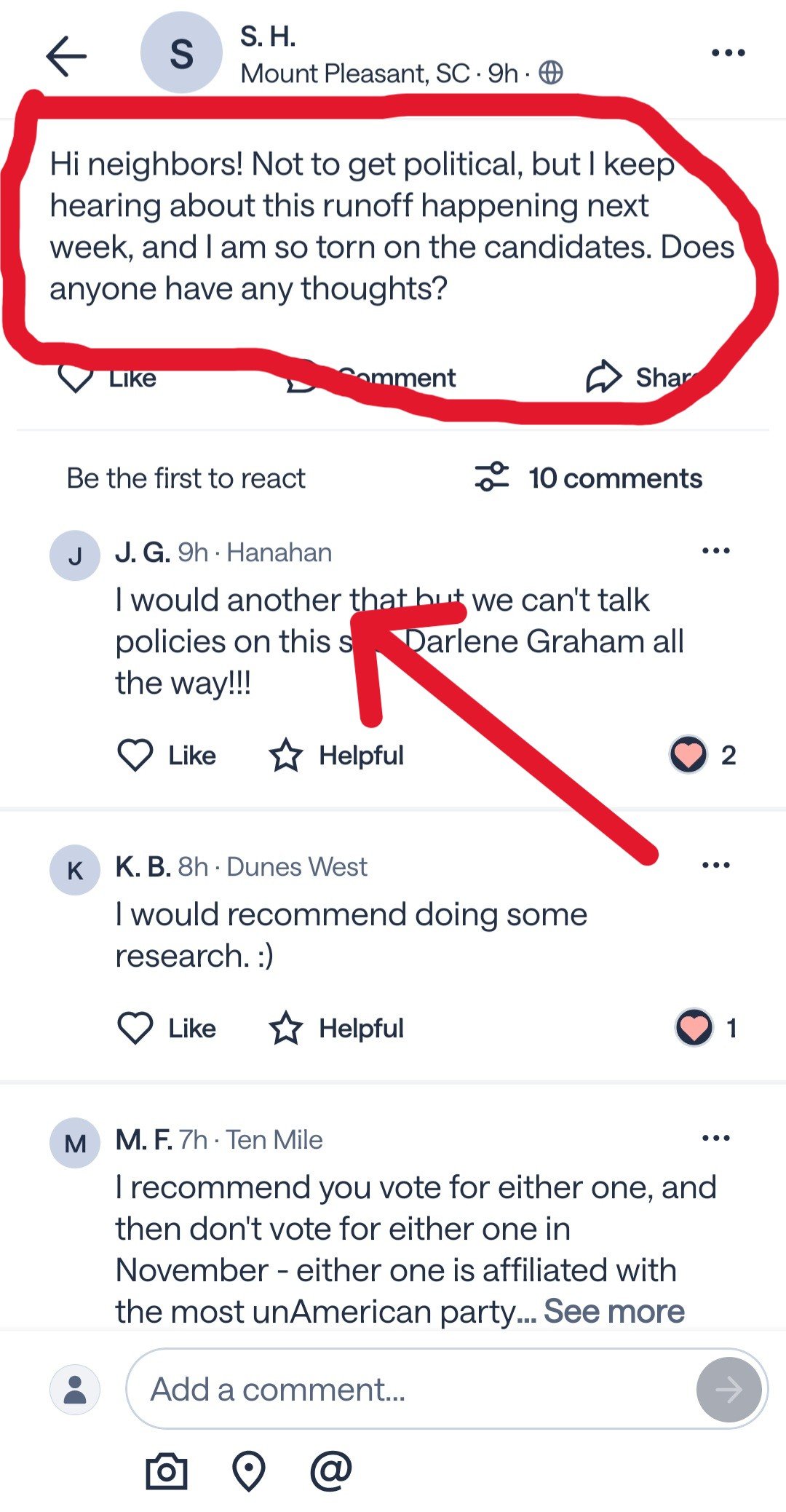
A neighbor posted:
“Not to get political, but I keep hearing about this runoff happening next week and I am so torn on the candidates. Does anyone have any thoughts?”
Whenever something begins with “Not to get political…”, we can probably guess where it's headed.
Politics.
And that's exactly what happened.
Neighbors discussed candidates, political parties, voting choices, and opinions. Some users even pointed out:
“We can't talk politics on this site.”
Another wrote:
“Not the place for politics. PLEASE STOP.”
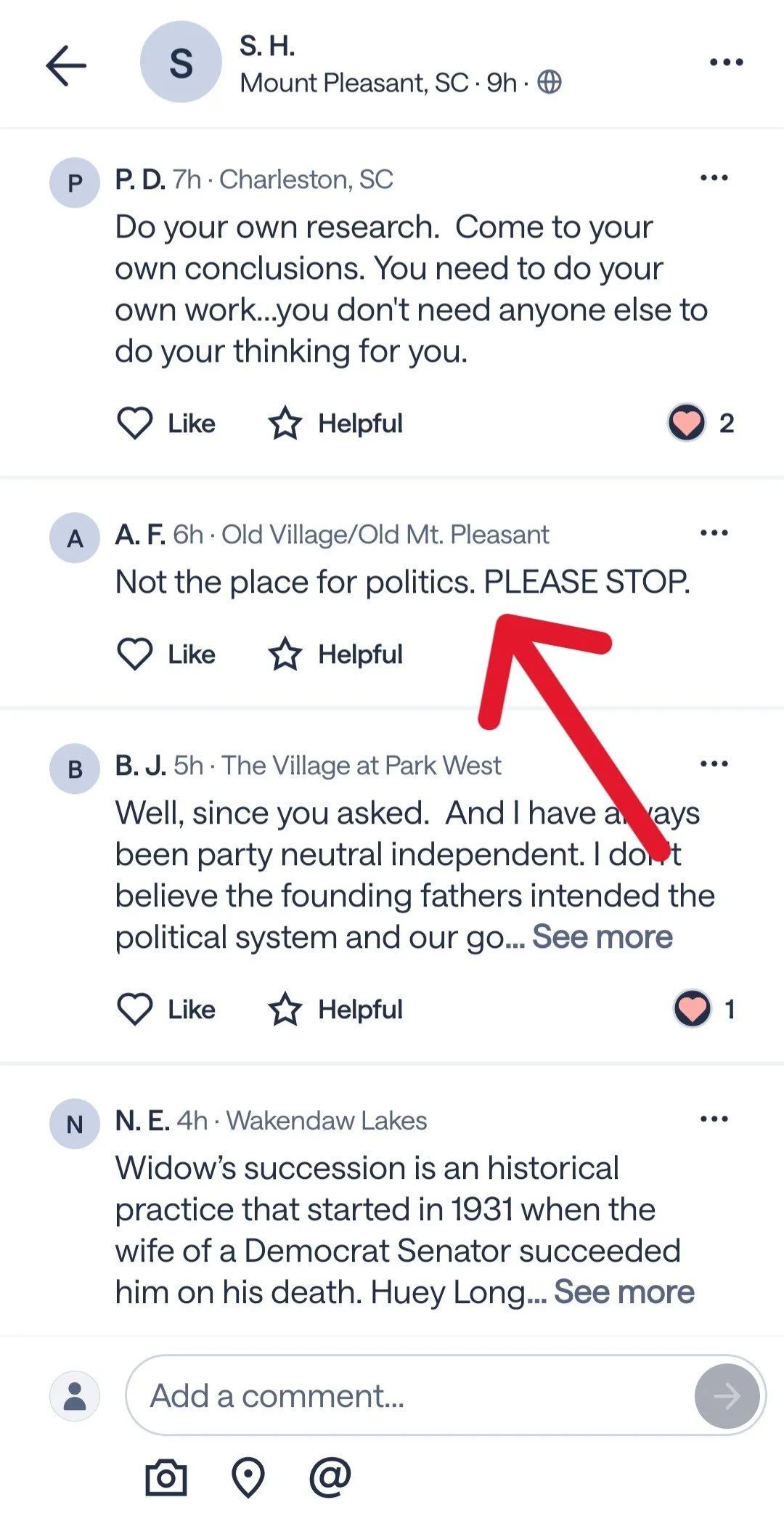
Yet, approximately nine hours after the original post, it was still there.
Here's my moderation question.
Nextdoor permits certain local political discussions, but restricts broader national politics.
This discussion involves a U.S. Senate seat. South Carolina voters elect the senator statewide, but that person then goes to Washington to vote on national legislation and policy.
So where's the line?
Is a U.S. Senate race local because the candidates campaign within South Carolina?
Or national because the winner becomes one of 100 U.S. senators?
More importantly:
Do Nextdoor's moderators agree on the answer?
That's the larger issue I've been documenting.
A moderation system is only as effective as its consistency, training, quality assurance, and enforcement.
If Moderator A removes something while Moderator B leaves essentially the same content up for nine hours—or indefinitely—the policy isn't producing consistent outcomes.
That's not merely a neighbor problem.
That's a process problem.
And when moderation relies heavily on unpaid neighbors making judgment calls about other neighbors, quality control becomes incredibly important.
I've said it before:
We inspect what we expect.
So who's inspecting the moderators?
Who's measuring agreement between them?
Who's auditing incorrect removals—and incorrect decisions to leave content up?
What are the accuracy metrics?
These aren't rhetorical questions. I'd like to see the data.
I've been asking questions about Nextdoor's research, moderation, communication, and accountability for 63 days.
Maybe this post complies with Nextdoor's rules. If so, explain why.
Maybe it doesn't. If so, why was it still there nine hours later?
Either answer would be useful.
What isn't useful is having policies whose enforcement appears unpredictable depending on the moderator, neighborhood, or day.
Day 63. Another post. Another moderation question.
And somehow, still no Jacob Chavis.
Join the discussion at NielFlamm.com/blog. Leave some feedback—I'd love to hear your perspective.

The End of Oak Street: Dinosaurs, Detroit and a LOT of Thigh

Detroit. 1982. Gas-guzzling cars, giant tube TVs, dangerously short men's shorts... and dinosaurs.
That's the setup for The End of Oak Street, starring Anne Hathaway and Ewan McGregor. What starts as a neighborhood block party takes a very strange turn involving a storm, a wormhole, some extremely unfriendly dinosaurs—and neighbors who apparently don't understand that screaming usually means STAY INSIDE.
Did I love it? Nope. Did it entertain me? Sometimes intentionally... sometimes I'm not so sure.
And I've got some questions about that ending.
🎬 Watch my full spoiler-filled review at NielFlamm.com/videos/moviereviews
Then tell me: theater-worthy, streaming-worthy, or dinosaur food?