
Day 63: If the Rules Aren’t Consistent, Are They Really Rules?

It's Day 63, and this morning while continuing my study of the Nextdoor app, I found another example that has me questioning its moderation model.
A neighbor posted:
“Not to get political, but I keep hearing about this runoff happening next week and I am so torn on the candidates. Does anyone have any thoughts?”
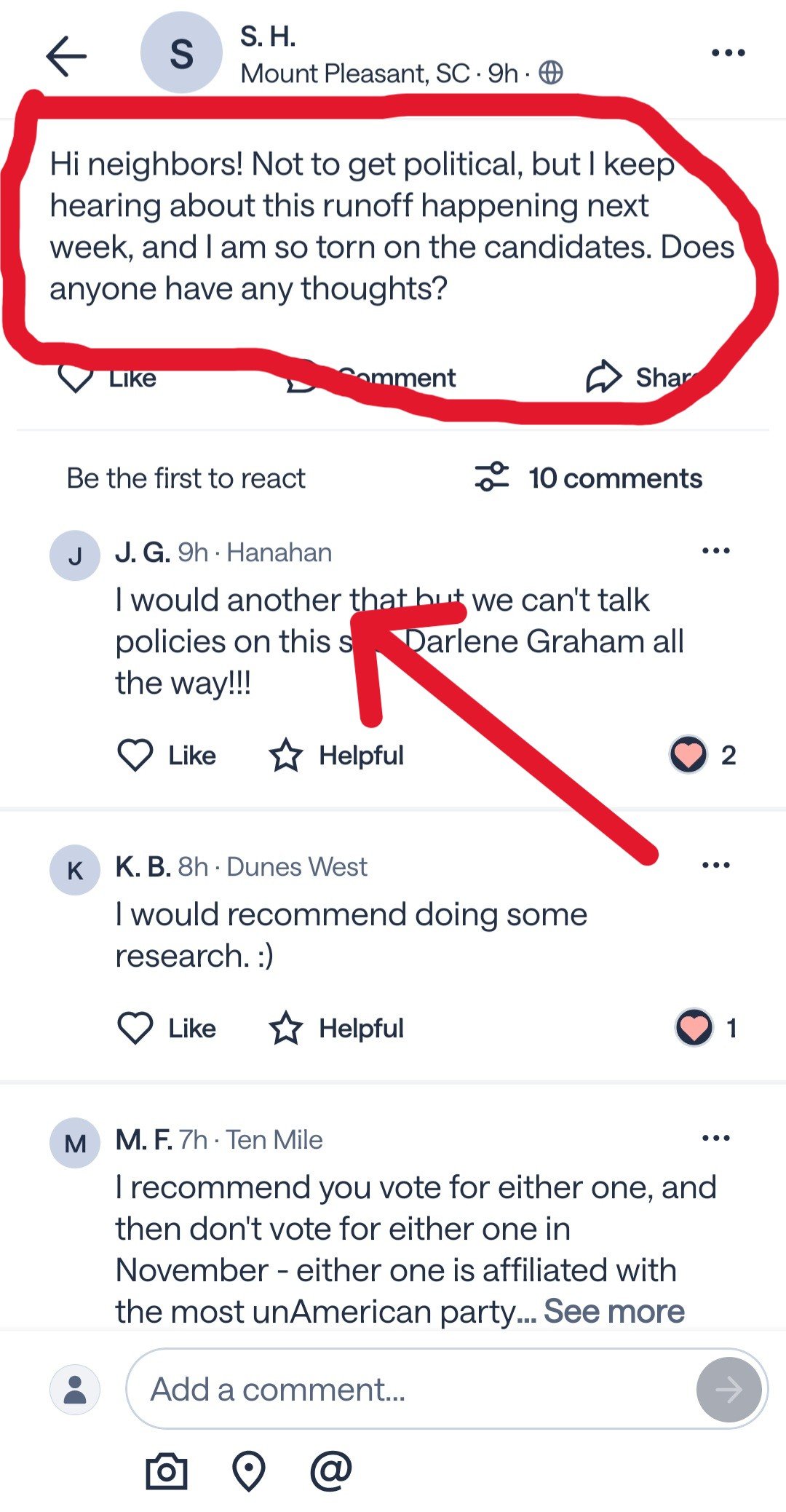
Whenever something begins with “Not to get political…”, we can probably guess where it's headed.
Politics.
And that's exactly what happened.
Neighbors discussed candidates, political parties, voting choices, and opinions. Some users even pointed out:
“We can't talk politics on this site.”
Another wrote:
“Not the place for politics. PLEASE STOP.”
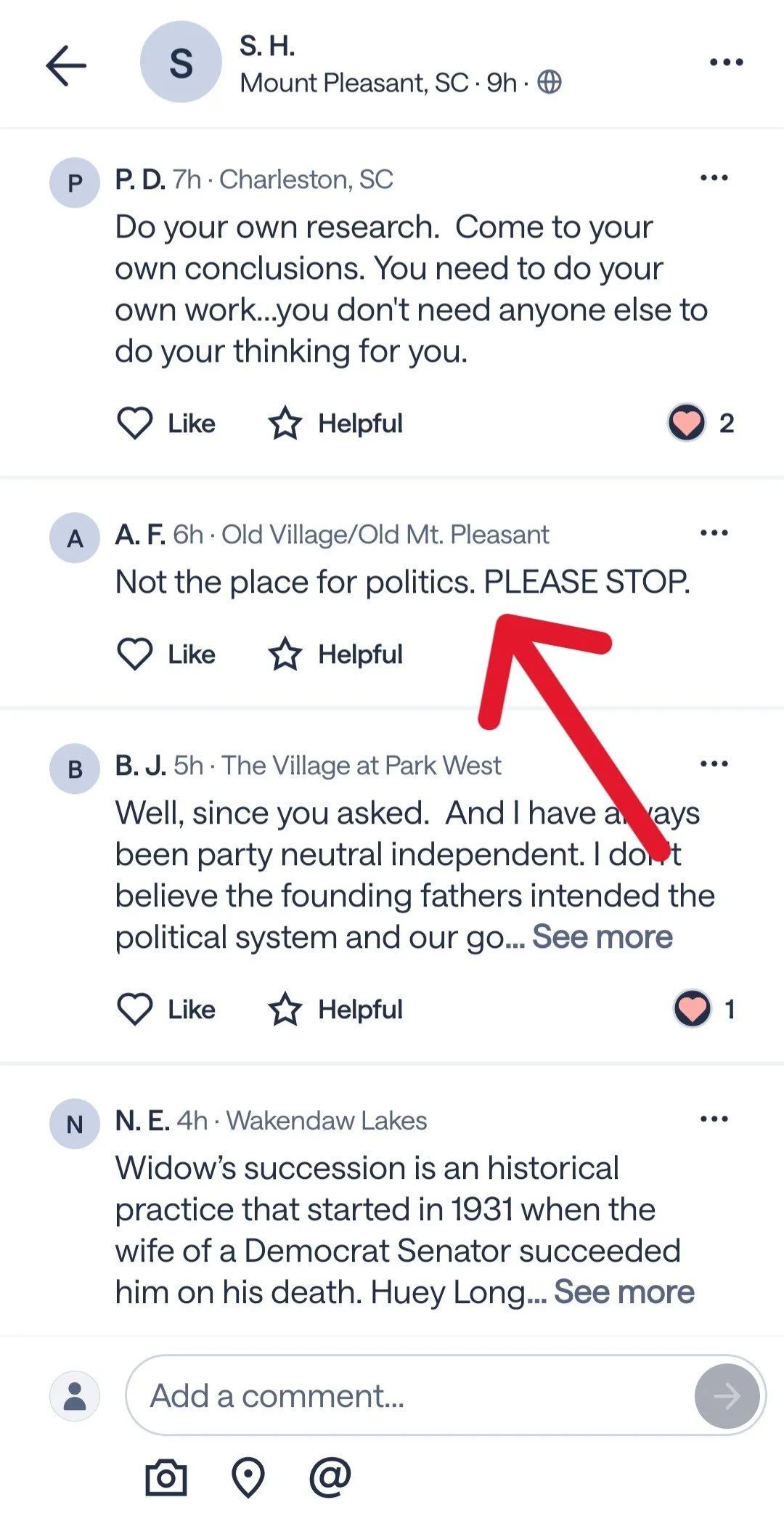
Yet, approximately nine hours after the original post, it was still there.
Here's my moderation question.
Nextdoor permits certain local political discussions, but restricts broader national politics.
This discussion involves a U.S. Senate seat. South Carolina voters elect the senator statewide, but that person then goes to Washington to vote on national legislation and policy.
So where's the line?
Is a U.S. Senate race local because the candidates campaign within South Carolina?
Or national because the winner becomes one of 100 U.S. senators?
More importantly:
Do Nextdoor's moderators agree on the answer?
That's the larger issue I've been documenting.
A moderation system is only as effective as its consistency, training, quality assurance, and enforcement.
If Moderator A removes something while Moderator B leaves essentially the same content up for nine hours—or indefinitely—the policy isn't producing consistent outcomes.
That's not merely a neighbor problem.
That's a process problem.
And when moderation relies heavily on unpaid neighbors making judgment calls about other neighbors, quality control becomes incredibly important.
I've said it before:
We inspect what we expect.
So who's inspecting the moderators?
Who's measuring agreement between them?
Who's auditing incorrect removals—and incorrect decisions to leave content up?
What are the accuracy metrics?
These aren't rhetorical questions. I'd like to see the data.
I've been asking questions about Nextdoor's research, moderation, communication, and accountability for 63 days.
Maybe this post complies with Nextdoor's rules. If so, explain why.
Maybe it doesn't. If so, why was it still there nine hours later?
Either answer would be useful.
What isn't useful is having policies whose enforcement appears unpredictable depending on the moderator, neighborhood, or day.
Day 63. Another post. Another moderation question.
And somehow, still no Jacob Chavis.
Join the discussion at NielFlamm.com/blog. Leave some feedback—I'd love to hear your perspective.
