
Day 68: Nextdoor Finally Responded—Sort Of*

Yes, that's an asterisk next to Day 68.
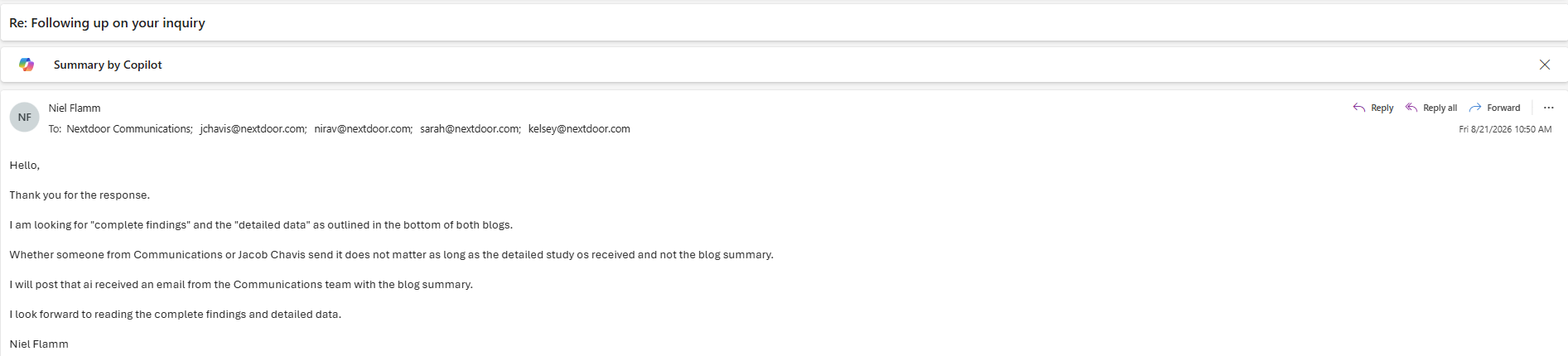
After more than two months of emails, posts, questions, tags, and wondering whether anyone at Nextdoor would respond, Nextdoor Communications emailed me.
Progress?
Well...sort of.
Their email said:
“We did not find it necessary to respond to your request for the following studies because they are both publicly available.”
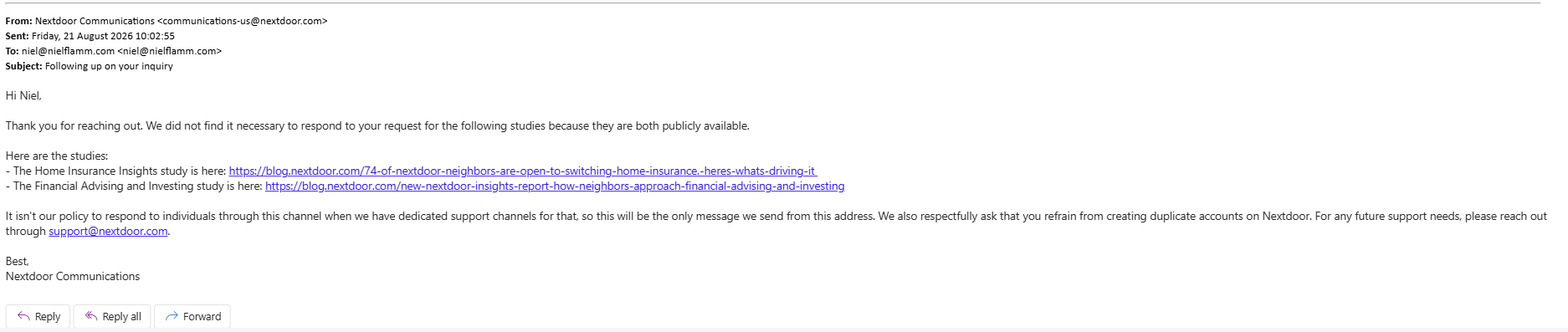
They then sent me links to the Home Insurance Insights and Financial Advising and Investing blog posts.
There's just one problem.
Those aren't what I've been requesting.
Nextdoor's own Financial Advising and Investing post says:
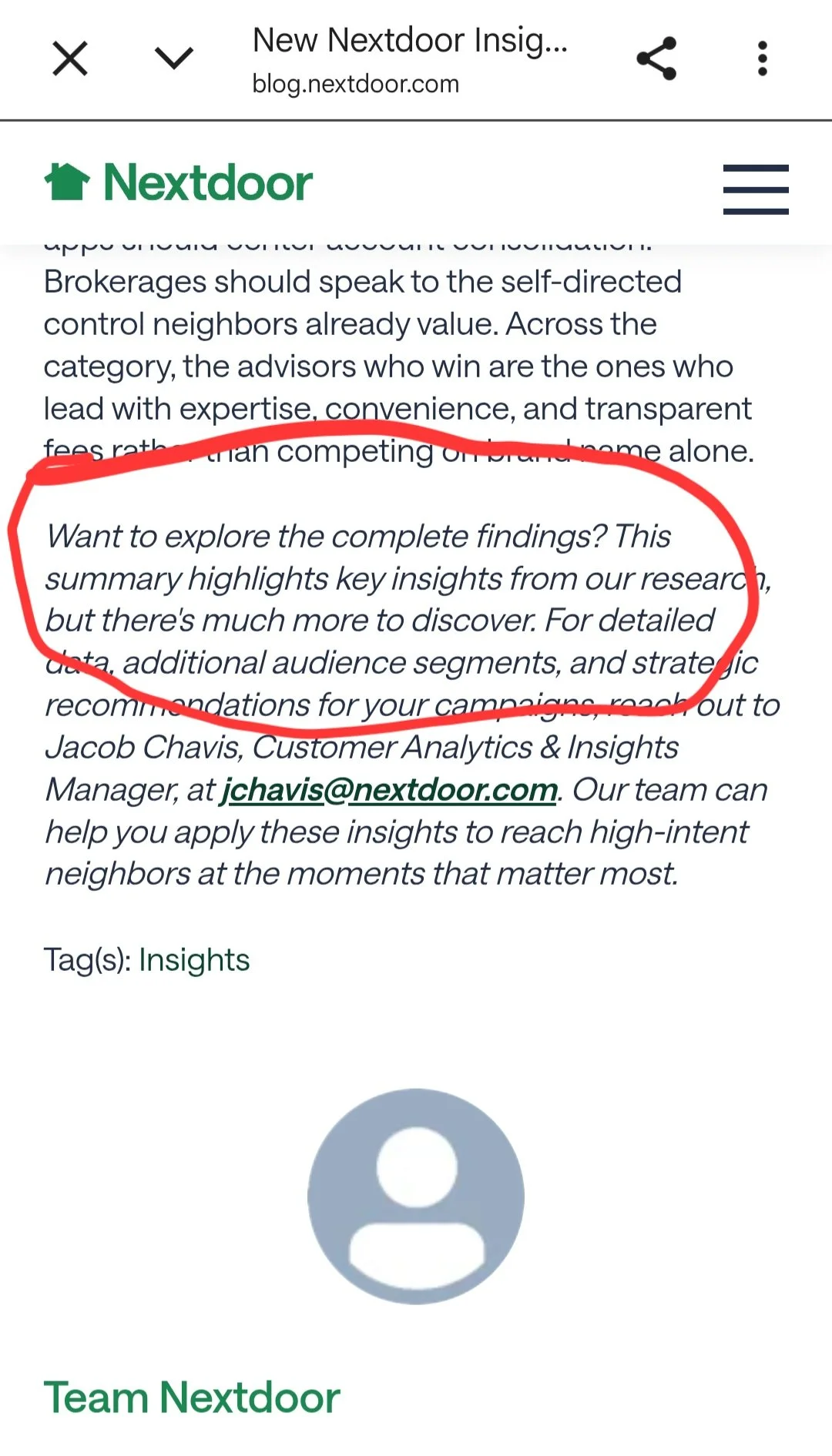
“Want to explore the complete findings? This summary highlights key insights from our research, but there's much more to discover.”
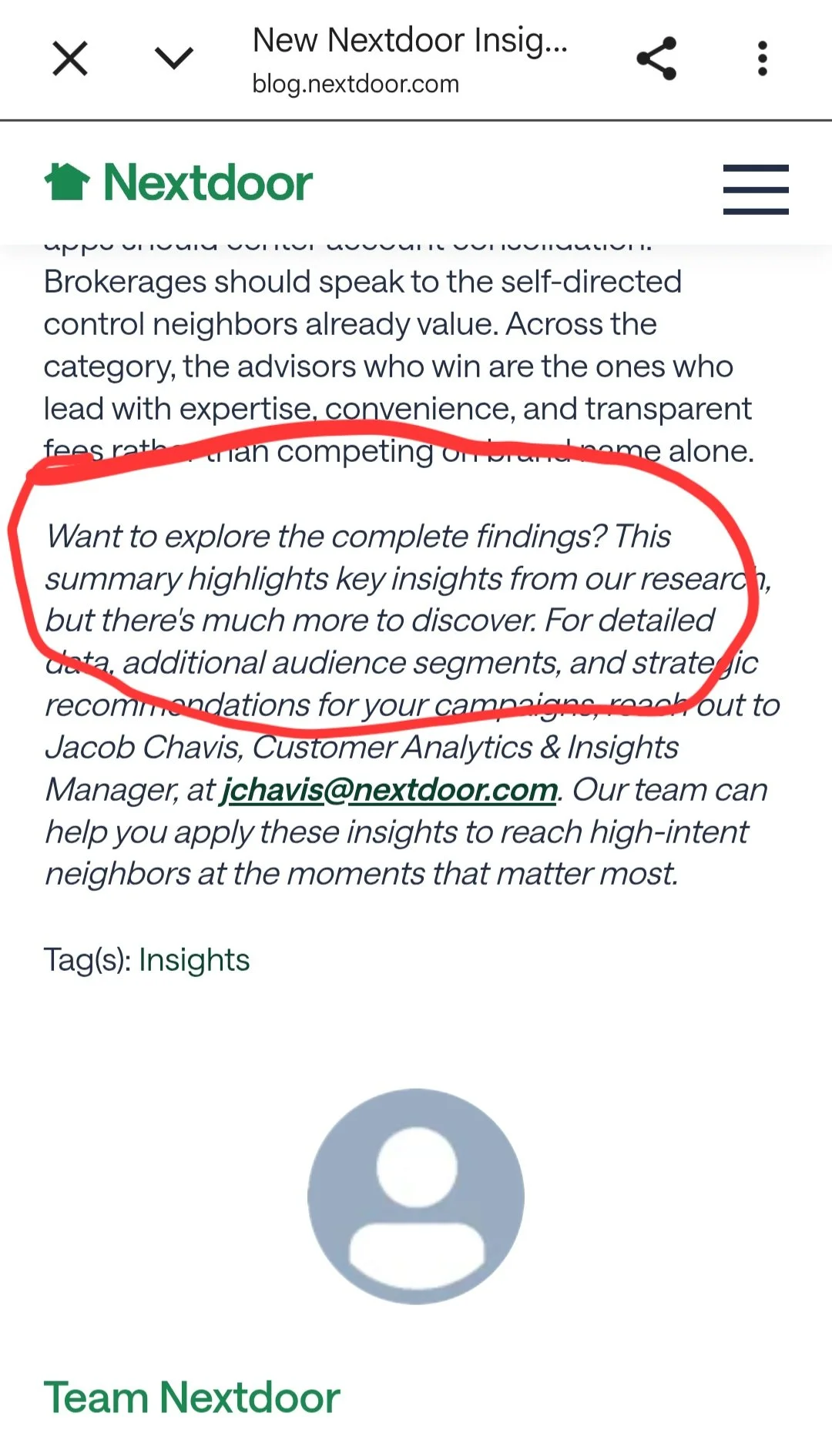
It then tells readers seeking detailed data, additional audience segments, and strategic recommendations to contact Jacob Chavis.
That's precisely what I've been doing.
I responded and thanked Communications for reaching out. I'm requesting the complete findings and detailed data—not the blog summaries.
Whether Jacob sends them or Communications sends them doesn't matter to me.
I want what Nextdoor's own blog says readers can request.
Then came another interesting part of their email.
Nextdoor Communications told me this would be the only message they would send from that address and directed future support inquiries elsewhere.
Well, at least after 68 days I've confirmed something:
The Communications inbox works.
And since my research request remains unanswered, I'm not backing away from the underlying question. I'm doubling down on asking for clarity.
Meanwhile, Nurav Tooleyah Has Left the Neighborhood
Remember my experiment testing Nextdoor's verification system?
I created a duplicate account using the intentionally fake name “Nurav Tooleyah.”
Nextdoor Communications specifically mentioned the duplicate account in its email, and the account has now been indefinitely suspended.
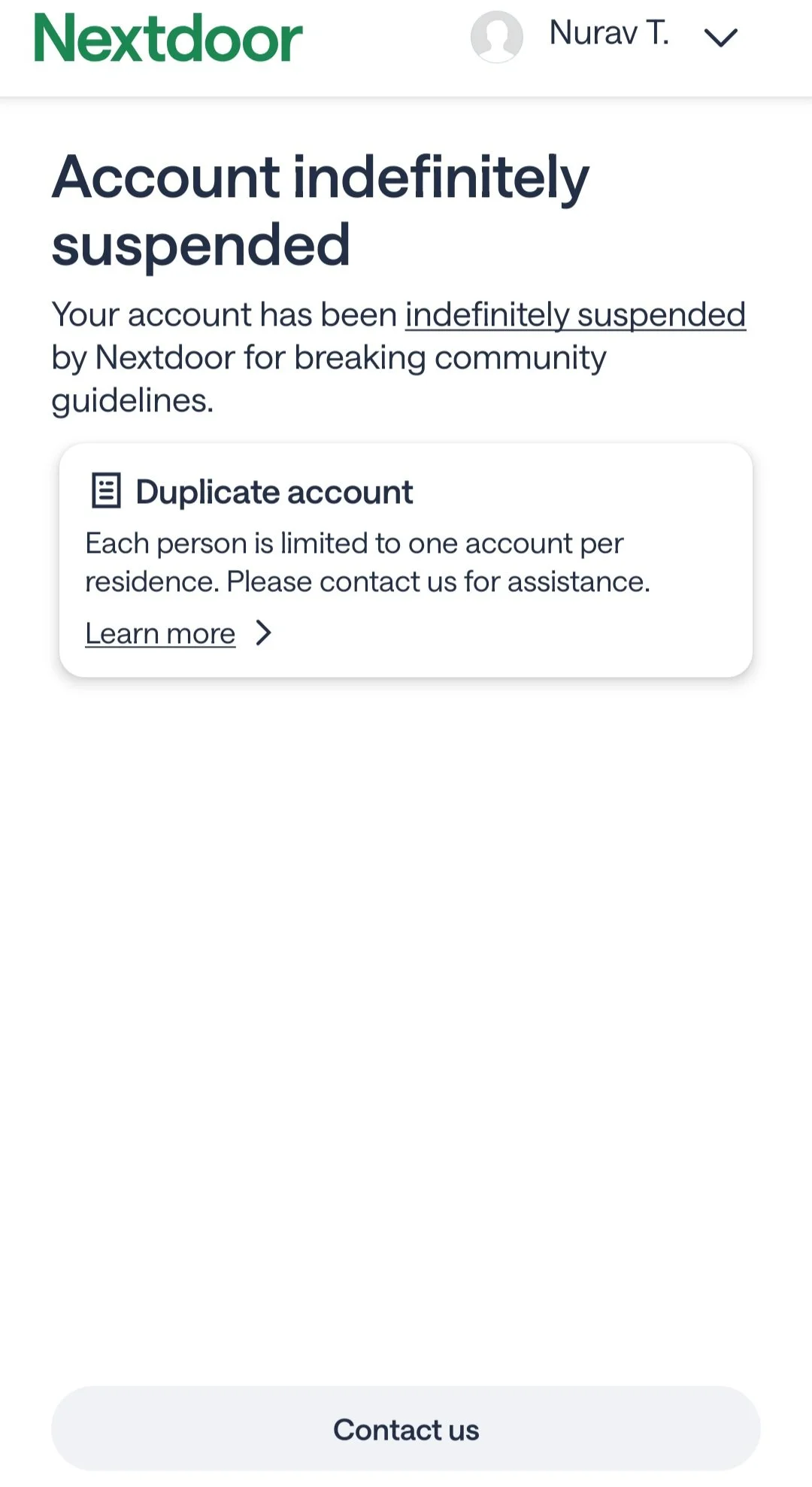
Reason:
Duplicate account.
So, credit where it's due: Nextdoor eventually caught it.
But there's another asterisk.
It took more than 68 days.
That's the part that should concern anyone interested in platform trust and safety.
My account was an experiment intended to test the verification process. But imagine someone creating a false identity with genuinely malicious intentions.
How much damage could a bad actor potentially cause in 68 days while appearing to be a verified neighbor?
Could they build trust?
Collect information?
Contact vulnerable neighbors?
Promote a scam?
That's why I've been questioning Nextdoor's verification model.
Eventually catching a fake account is better than never catching it.
But how quickly you detect it matters.
And there's an interesting irony here.
Nextdoor found my duplicate account.
Nextdoor Communications found my email.
Nextdoor Communications found the two blog posts.
After 68 days, I haven't received the detailed research those posts explicitly invite readers to request.
So yes:
Day 68.*
The asterisk matters.
Nextdoor finally communicated.
The fake account finally disappeared.
But the original question remains remarkably simple:
Jacob, could you please share the complete findings and detailed data that Nextdoor tells readers to contact you to obtain?
Full timeline at NielFlamm.com/blog.
The Scammers Have Apparently Moved On From Bitcoin — Now I’m Getting My Watch Repaired
Well, the scammers are branching out.
Over the past couple of weeks, I've apparently purchased Bitcoin, renewed Geek Squad protection multiple times, and been invited to Facebook events celebrating these financial accomplishments.
Today, we have something new.
Apparently, I'm getting a watch repaired.
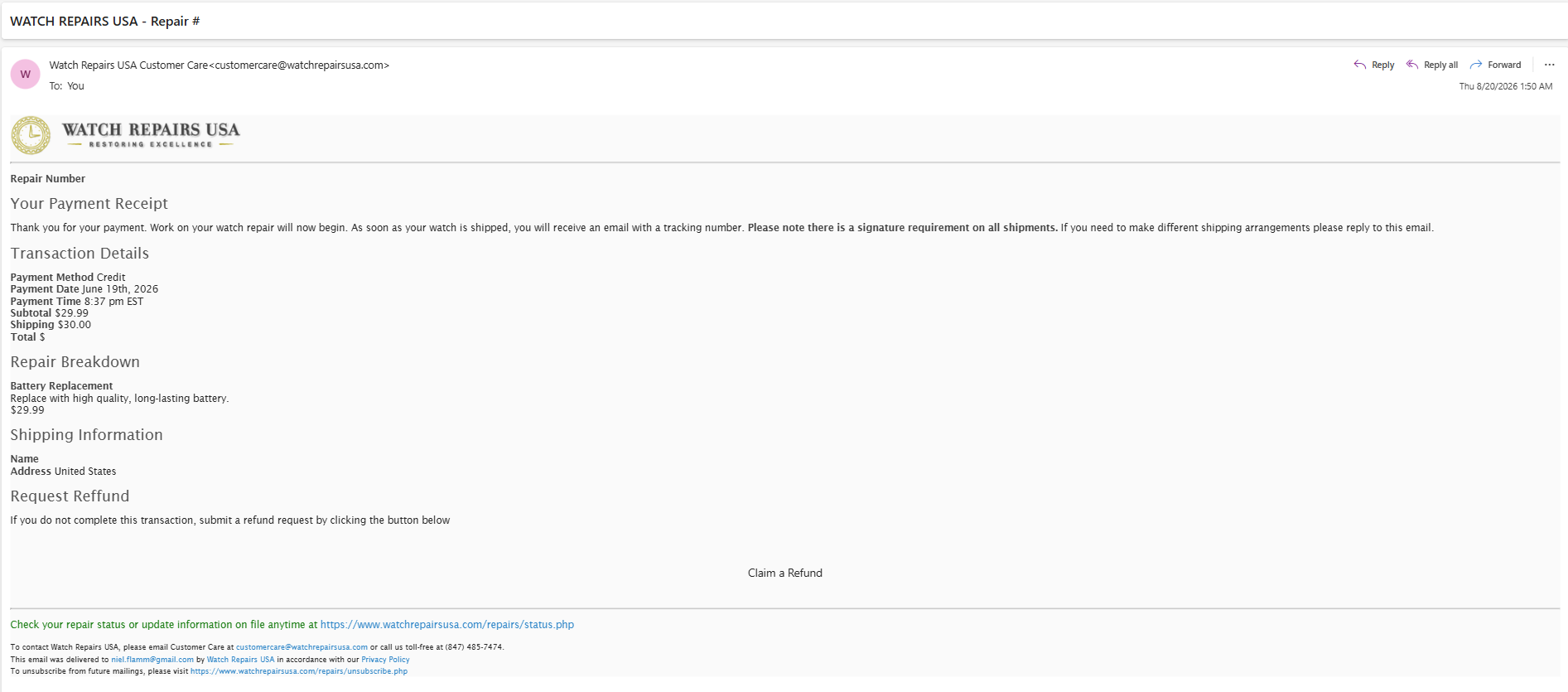
I received an email from something calling itself Watch Repairs USA Customer Care with the subject:
“WATCH REPAIRS USA - Repair #”
Repair number what?
Excellent question.
There isn’t a repair number after the #.
We're off to a strong start.
Thank You for My Payment!
The email proudly announces:
“Your Payment Receipt.”
It then thanks me for my payment and says work on my watch will now begin.
Wonderful!
Except for one minor detail:
I DIDN'T SEND THEM A WATCH.
According to the email, I'm getting a battery replacement for $29.99, plus $30.00 for shipping.
That's some serious shipping for a watch battery.
The transaction information also has some interesting details.
Name: blank.
Address: United States.
That's it.
Apparently, somewhere among approximately 340 million people, there's a watch heading my way.
Good luck, FedEx.
My Favorite Part: “Total $.”
The email lists:
Subtotal $29.99
Shipping $30.00
Total $
That's right.
No number.
Just a dollar sign.
I appreciate a company that lets me use my imagination.
Maybe the total is $59.99.
Maybe it's $5,999.
Maybe they're waiting for me to choose.
This is less of a receipt and more of a financial Mad Lib.
But Don't Worry — There's a Refund Button!
Naturally, the email includes a section titled:
“Request Refund.”
How convenient.
If I didn't complete this transaction, all I have to do is click the nice “Claim a Refund” button.
And that's exactly where my scam radar starts screaming.
An unexpected purchase.
A transaction I don't recognize.
Incomplete information.
Then a convenient button offering to fix everything.
The objective is familiar even though the packaging has changed:
Make me worried about money and get me to react.
This One Is More Interesting
What makes this message different from the recent Facebook event scams is that it looks much more like an ordinary business transaction email.
There's a logo.
There's a payment section.
There's a repair breakdown.
There's shipping information.
There's contact information.
There are links at the bottom.
It has all the ingredients that can make someone think:
“Wait...did I actually order this?”
And that's why unexpected transactional emails deserve a few extra seconds of thought before clicking anything.
A professional-looking email isn't proof that the transaction is yours.
I'm Still Not Clicking
My approach hasn't changed.
If I receive an email saying I've been charged for something I don't remember buying, I won't click the refund button in the email right away.
First, I'll independently check my credit card or bank account.
If there's no charge, there's nothing to refund.
If there is an unauthorized charge, I'll contact the financial institution using contact information I obtain independently—not whatever is presented in the suspicious message.
The important thing is to avoid letting the email dictate what I do next.
That's exactly what these messages are designed to accomplish.
My Imaginary Spending Is Getting Out of Control
Let's review my recent financial activity according to my inbox:
Bitcoin.
More Bitcoin.
A mystery subscription.
Geek Squad.
More Geek Squad.
And now...
A watch battery.
My imaginary self is apparently terrible with money.
Imaginary Niel has excellent diversification.
Cryptocurrency.
Technology services.
Luxury accessories.
It's practically a portfolio.
I'm just waiting for tomorrow's email:
“Congratulations! Your $799 annual yacht maintenance plan has successfully renewed.”
That'll be disappointing.
Mostly because I don't have a yacht.
Although, based on my inbox, apparently I might.

Nextdoor Has an AI Day. Maybe It Needs a Communication Day.
I came across an interesting HR Brew article about Nextdoor's HR team dedicating one full day every month to AI experimentation.
Full article:
https://www.hr-brew.com/stories/nextdoors-hr-team-halts-people-work-once-a-month-and-dedicates-the-day-to-ai
First, credit where it's due.
As someone with a Learning & Development background, I like this idea.
Nextdoor Head of People Tony Castellanos told HR Brew that the HR team clears its calendars one day each month—no meetings, interviews, or reports—so employees can experiment with AI and build solutions.
That's experiential learning.
That's giving employees permission to experiment, iterate, and learn.
I can get behind that.
But given everything I've been documenting about Nextdoor, another thought immediately crossed my mind:
Could we dedicate one day to communication?
I've spent more than two months trying to obtain a Nextdoor Insights study from Jacob Chavis.

I've contacted Jacob, Nirav Tolia, Sarah Leary, Investor Relations, and Communications.
Then Nextdoor published another Insights report directing readers who want detailed information to—you guessed it—Jacob Chavis.
I followed those instructions again.
Short email. Kinder, gentler reset. Two studies requested.
I'm still waiting.
That's why this article fascinates me.
Nextdoor can pause routine HR work for an entire day each month so employees can explore AI.
Great.
But technology doesn't solve every organizational problem.
Sometimes the solution isn't another AI agent.
Sometimes it's:
"Hey, somebody answer that email."
HR Brew also reports that Nextdoor's "People Brain" reviews content published to public channels to help ensure messaging and policy align with the People team's core content.
Now that makes me curious.
If AI is helping evaluate Nextdoor's public messaging, I'd love to know what it thinks about:
Community without conversation.
Communication posts with comments disabled.
Research advertised as available while requests go unanswered.
A shareholder spending more than two months asking for an answer.
Maybe those aren't AI problems.
Maybe they're leadership and execution problems.
I've repeatedly said I want Nextdoor and NXDR to succeed. I'm a shareholder. Financially, that's in my interest.
AI Days could genuinely improve efficiency.
But innovation shouldn't distract from the basics.
Artificial intelligence is impressive.
Answering an email doesn't require it.
Perhaps alongside AI Day, Nextdoor should try a Communication Day.
I'll volunteer my inbox for the pilot.
Full timeline at NielFlamm.com/blog.
Two Stories About Recovery That Hit Differently This Week
On Monday, I heard about two very different stories involving two very famous people. Both made me think about recovery, sobriety, addiction, and something those of us around recovery learn pretty quickly:
There is no finish line.
The first story was about Brad Pitt.
I haven't talked to Brad Pitt. He hasn't called me lately. We haven't grabbed coffee. And until he invites me over to hang out, I can only go by what he actually said publicly.
In a recent Esquire interview, Pitt talked about having been sober for seven years and then deciding to drink again. He described his drinking now as being more restrained and acknowledged that there have already been a couple of occasions when he realized larger quantities weren't good for him.
This is also the same Brad Pitt who publicly thanked Bradley Cooper in 2020 for helping him get sober.
I'm not here to judge Brad Pitt's decision.
Recovery is personal. What works—or doesn't work—for Brad Pitt is Brad Pitt's business.
But his story caught my attention because I've heard versions of it before.
I've sat in meetings and heard people talk about having years of sobriety before eventually deciding they didn't need recovery anymore.
Maybe things were different now.
Maybe enough time had passed.
Maybe they had learned their lesson.
Maybe this time they could drink like a "normal" person.
And sometimes it started exactly that way.
Moderately.
One drink.
A glass of wine with dinner.
Only on vacation.
Only on weekends.
Until it wasn't moderate anymore.
Those are the stories I've heard. That doesn't mean Brad Pitt's story will end the same way. I don't know him, and neither I nor anyone else should pretend we know what his future holds.
But it reminds me why recovery asks us to focus on today.
Not seven years from now.
Not seven years ago.
Today.
Then There Was Hayden Panettiere
The second story was much harder to hear.
Actress Hayden Panettiere died at 36 in Greenville, South Carolina.
I knew her work. I watched Remember the Titans. I watched I Love You, Beth Cooper. I watched Scream 4.
She was somebody I'd seen on a screen for years.
She had also spoken publicly about struggles with addiction and depression.
According to authorities, Panettiere was found unresponsive and in cardiac arrest. Emergency responders attempted to resuscitate her, but she was pronounced dead. An autopsy reportedly found no trauma that contributed to her death.
At the time I'm writing this, her official cause and manner of death have not been determined. Toxicology results are still pending.
That's important.
I'm not going to declare that addiction caused her death when investigators haven't determined that.
I'm not going to turn someone's death into speculation.
But hearing about her death still made me think about recovery.
Because I've seen what addiction can do.
I've known people who got frighteningly close to dying.
I've known people who came back.
And I've known people who didn't.
There Is a Solution
That's really why I'm writing this.
Not because Brad Pitt decided to drink again.
Not because we know what caused Hayden Panettiere's death.
I'm writing it because somebody reading this might be struggling right now.
Someone might be wondering whether they really have a problem.
Someone might have been sober for years and be thinking, Maybe I've got this figured out now.
Someone might have relapsed yesterday and believe they've thrown everything away.
Someone else might be sitting alone thinking there isn't another way.
There is.
Recovery isn't reserved for celebrities.
It isn't reserved for people with money.
It isn't reserved for people who haven't relapsed.
It isn't reserved for someone who has reached some imaginary "bottom."
You don't have to wait until everything is gone.
You don't have to wait until your family gives up.
You don't have to wait until you're sitting in a hospital.
You don't have to wait until you're dying.
There is a solution.
There are meetings. There are treatment programs. There are professionals. There are recovery communities filled with people who understand exactly what it feels like to wonder how the hell life got to this point.
And there are people willing to help.
Sometimes the hardest part is simply admitting:
I can't do this by myself anymore.
You don't have to.
Whether someone has seven hours, seven days, seven months, or seven years, recovery still happens the same way.
Today.
Then tomorrow, we try to do it again.
There is a solution, and it's available to all.
✈️ New York Trip Update: Mother Nature Is Making Her Case
A couple of days ago, I wrote that I’m supposed to fly to New York this Saturday, landing at LaGuardia (LGA) and heading to Astoria, Queens for a yearly gathering.
At the time, the forecast called for about a 55% chance of rain.
I wasn't thrilled, but 55% still leaves room for negotiation.
Well...
Mother Nature has apparently retained counsel.
I checked the forecast again today.
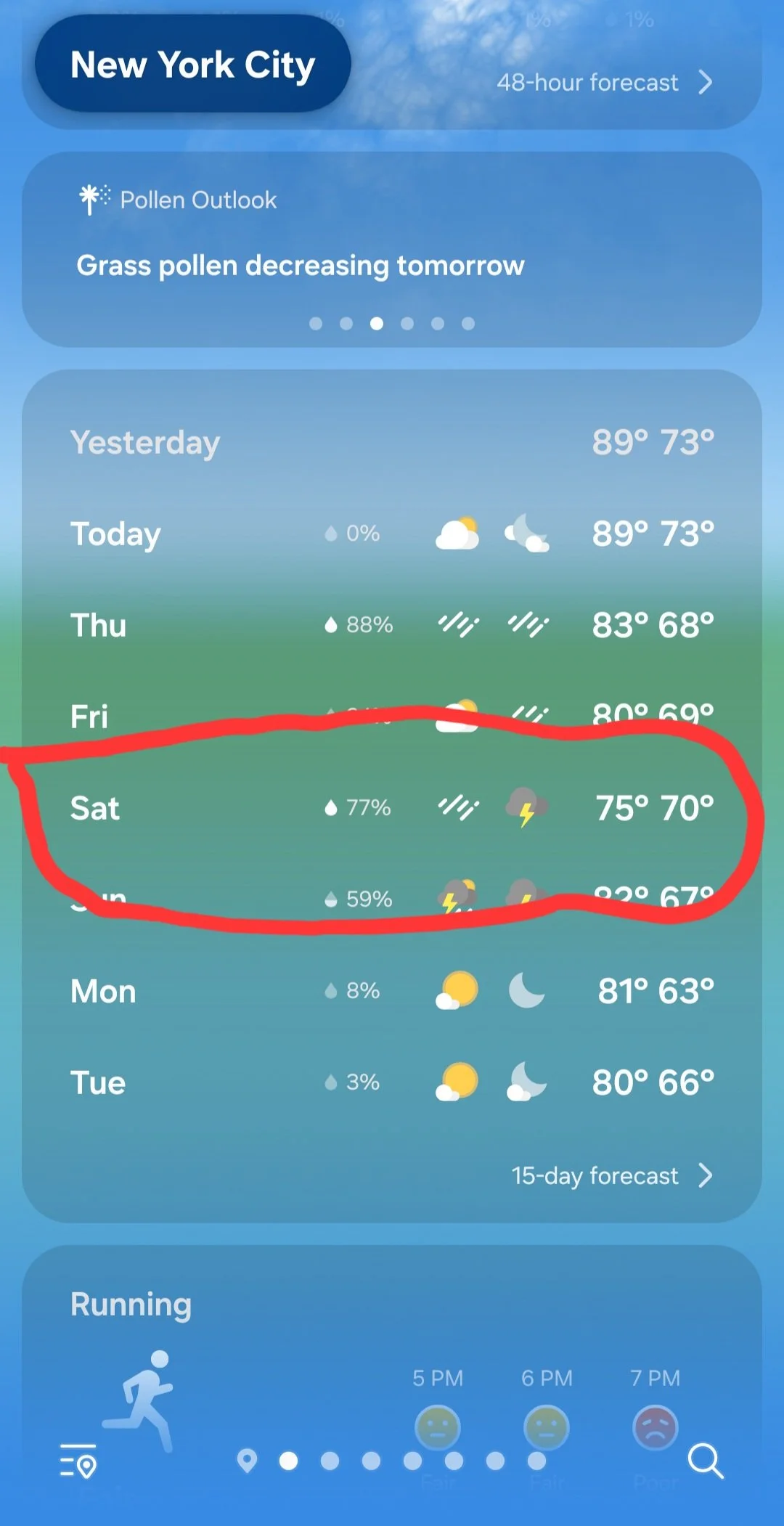
🌧️ Saturday: 77% chance of rain.
⛈️ And now there are thunderstorms involved.
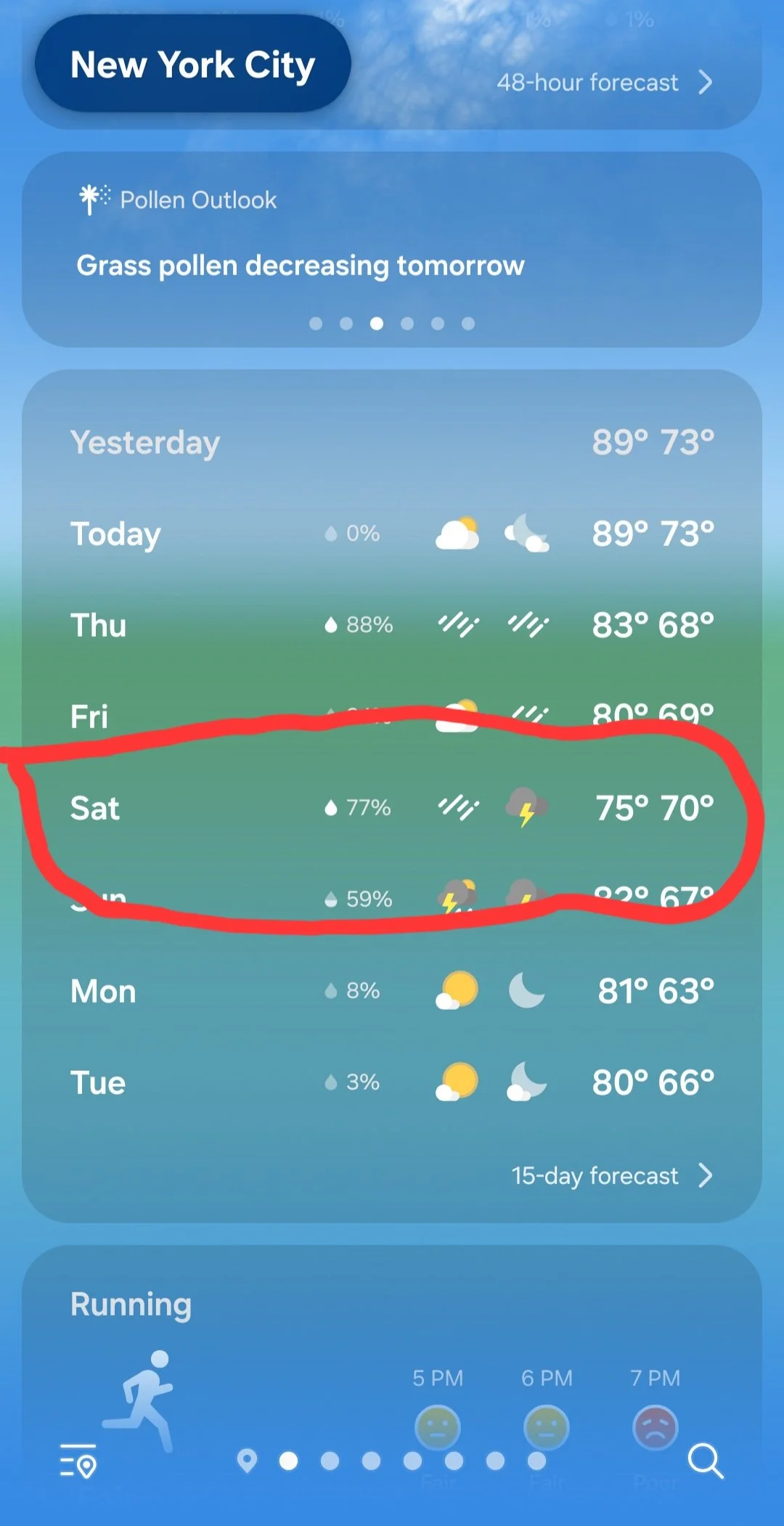
This negotiation is moving in the wrong direction.
Normally, I'd be excited about this trip. It's a nonstop flight. I get to see people I haven't seen in a while. And most importantly, I'd be returning to Queens—the magical land of real bagels, real pizza, and enough incredible food to destroy any reasonable eating plan within approximately four hours of landing.
But here's my problem:
I'm not flying to New York just so I can sit in a hotel room and say:
"Yep. That's definitely rain."
I can watch rain from home.
For free.
And I don't have to deal with airports, flight delays, Uber surge pricing, wet sidewalks, or trying to maneuver around New York City while Mother Nature dumps buckets of water on everyone.
There's also the airport factor.
Rain and thunderstorms in the New York area don't exactly have a reputation for making air travel more efficient. Suddenly my beautiful nonstop flight could become an exciting afternoon of staring at an airport departure board while the word DELAYED slowly destroys my will to live.
The good news?
The forecast could still change.
The bad news?
It already changed—from 55% rain to 77%.
That's not the direction I was hoping for.
So, the great Will Niel Actually Go to New York? saga continues.
The flight is still scheduled.
Astoria is still waiting.
The bagels are presumably still delicious.
The pizza is calling my name.
But at 77% rain with thunderstorms, those bagels are going to have to make a very persuasive argument.
Stay tuned.