

Day 81: Nextdoor Says It Loves Small Businesses. So Why Put a Tollbooth Between Them and Their Neighbors?

Today is Day 81.
Yesterday I wrote about Nextdoor telling businesses:
“A reputation you earn is worth more than one you can buy.”
Today, let's look at what Nextdoor is actually building for those businesses.
Nextdoor's announcement is here:
https://blog.nextdoor.com/small-business-improvements
The company is rolling out Local Faves, redesigned free Business Pages, improved search, new business dashboards and, eventually, the ability for local businesses to participate directly in the neighborhood feed.
Some of that sounds great.
But then we arrive at:
Opportunity Alerts.
Nextdoor describes this as a paid product that routes requests from verified neighbors directly to local service providers so those businesses can respond first and potentially win the job.
And that's where I see the money grab.
Imagine the Neighborhood Conversation
A neighbor posts:
“Does anyone know a good handyman?”
Another neighbor recommends Joe's Handyman Service.
Great.
That's supposedly what Nextdoor is all about: neighbors helping neighbors and businesses earning reputations organically.
But Joe's business being recommended doesn't necessarily mean Joe can simply jump into that conversation today and say:
“Thanks for the recommendation. I'd be happy to help.”
Nextdoor says direct feed access for local businesses is “coming soon.”
In the meantime, Nextdoor has a solution:
Pay for Opportunity Alerts.
Now Nextdoor can route those requests directly to participating service providers.
That's where I start asking questions.
If the value of Nextdoor is organic neighborhood recommendations, why put a tollbooth between the business and the opportunity?
Then There's the Stock
Tuesday, NXDR closed around $2.20.
Wednesday, it rebounded to approximately $2.28.
As I'm writing this, it's around $2.26.
Stocks fluctuate. Three trading days don't prove a management strategy is succeeding or failing.
But look at the broader context I've been documenting.
Communication problems.
Questions about moderation.
Small-business monetization.
Transparency concerns.
Shareholder frustration.
And a stock still well below the $2.68 close on August 10.
No matter how many podcasts the CEO appears on, eventually:
Decisions drive value.
Marketing doesn't substitute for execution.
Podcasts don't substitute for performance.
And corporate messaging doesn't automatically create investor confidence.
And That Brings Me Back to Nirav Tolia
I've already said that I've lost confidence in Nirav's leadership and believe the Board should make a change at the top.
I also continue to wonder about executive compensation.
When a company is still working toward consistent GAAP profitability, and shareholders are waiting for sustained value creation, how should executive bonuses and multimillion-dollar compensation packages be justified?
That's a legitimate shareholder question.
Especially when that compensation ultimately represents resources belonging to the company and its shareholders.
Then I Watched a Reel About Broken Corporate Culture
The reel was aimed primarily at employees evaluating their company's culture.
https://www.facebook.com/share/r/1GpV1cKmwi/
But watching it, I couldn't help but apply those ve observed while looking at Nex’ looking at Nextdoor from the outside.
Five themes stood out:
Poor Leadership Accountability
Unclear Values
Low Trust and Transparency
Poor Communication
Resistance to Feedback
I can't tell you what Nextdoor's internal culture is like.
I don't work there.
But I can describe what the culture looks like to me as a shareholder, user, and outside observer after 81 days of documenting interactions with the company.
And from where I'm sitting, those five descriptions are becoming uncomfortable fits.
Culture Eventually Becomes Visible
Corporate culture doesn't stay inside headquarters.
Eventually customers experience it.
Businesses experience it.
Investors experience it.
The public experiences it.
If communication is broken internally, eventually it appears externally.
If leadership resists internal criticism, outsiders will eventually notice.
If revenue becomes more important than stakeholder experience, the product will eventually reflect it.
And that's why I keep coming back to the same question:
What kind of company is Nextdoor trying to become?
A neighborhood network?
An advertising platform?
A lead-generation service?
A trusted recommendation engine?
Or some combination of all four?
Making money isn't the problem.
Nextdoor absolutely needs to make money.
I'm a shareholder. I want revenue, profit, and a rising stock price.
But there's a difference between monetizing a valuable ecosystem and making every interaction feel like another opportunity to collect a toll.
Day 81
The stock is around $2.26 as I write this.
The small-business monetization strategy continues.
The podcasts continue.
I'm still waiting for the two detailed Insights studies.
And from my perspective, the signs of a broken corporate culture continue to become more visible from the outside.
Poor leadership accountability.
Unclear values.
Low trust and transparency.
Poor communication.
Resistance to feedback.
Maybe Nextdoor disagrees.
Good.
Explain why I'm wrong.
Because blocking criticism, ignoring questions, and adding another paid product isn't changing my assessment.
It's reinforcing it.
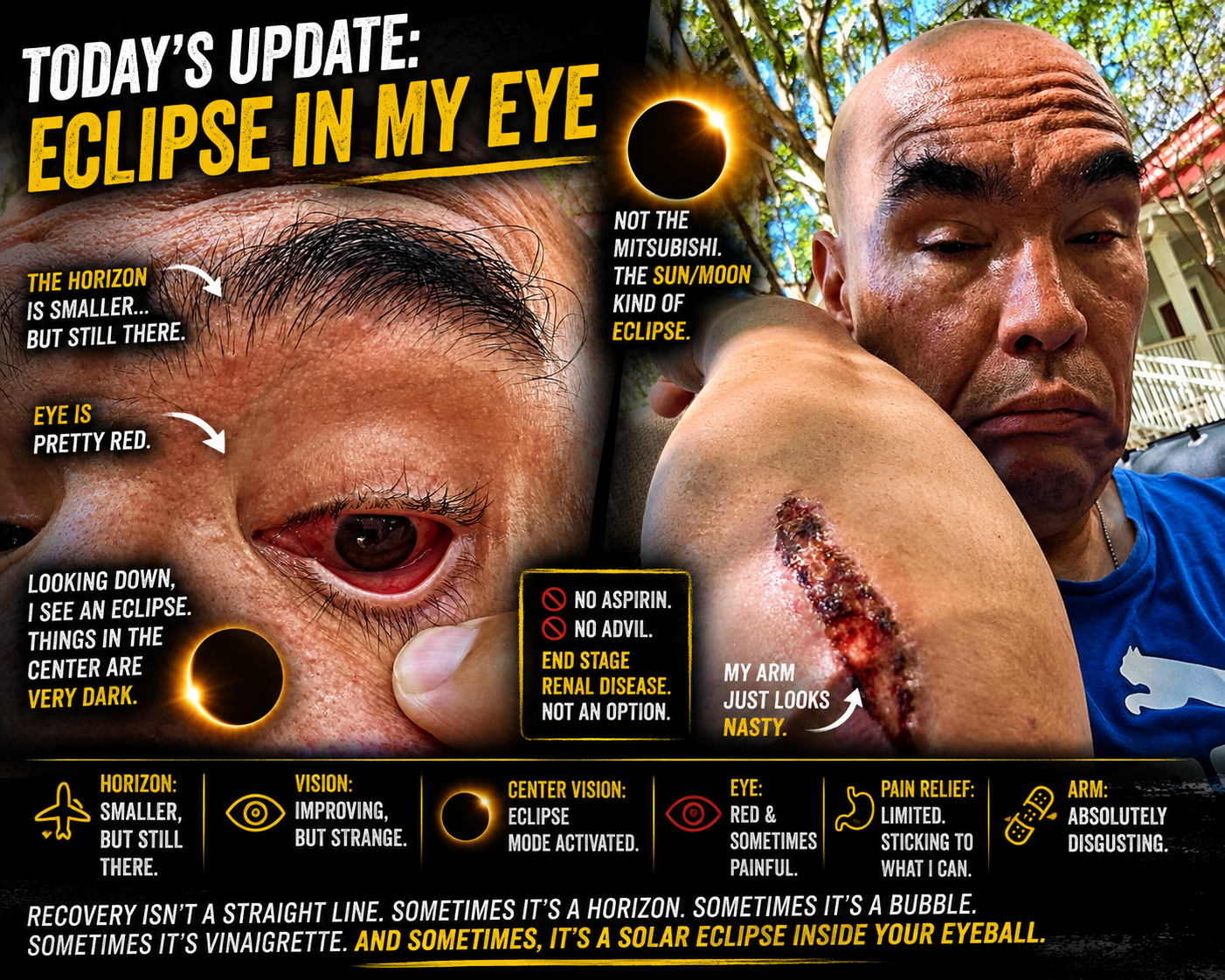
Apparently, My Eye Has an Eclipse Now
Another day, another update from the cockpit of Left Eye Airlines, where apparently the in-flight entertainment has switched from aviation instruments to astronomy.
The good news is that the horizon is getting smaller.
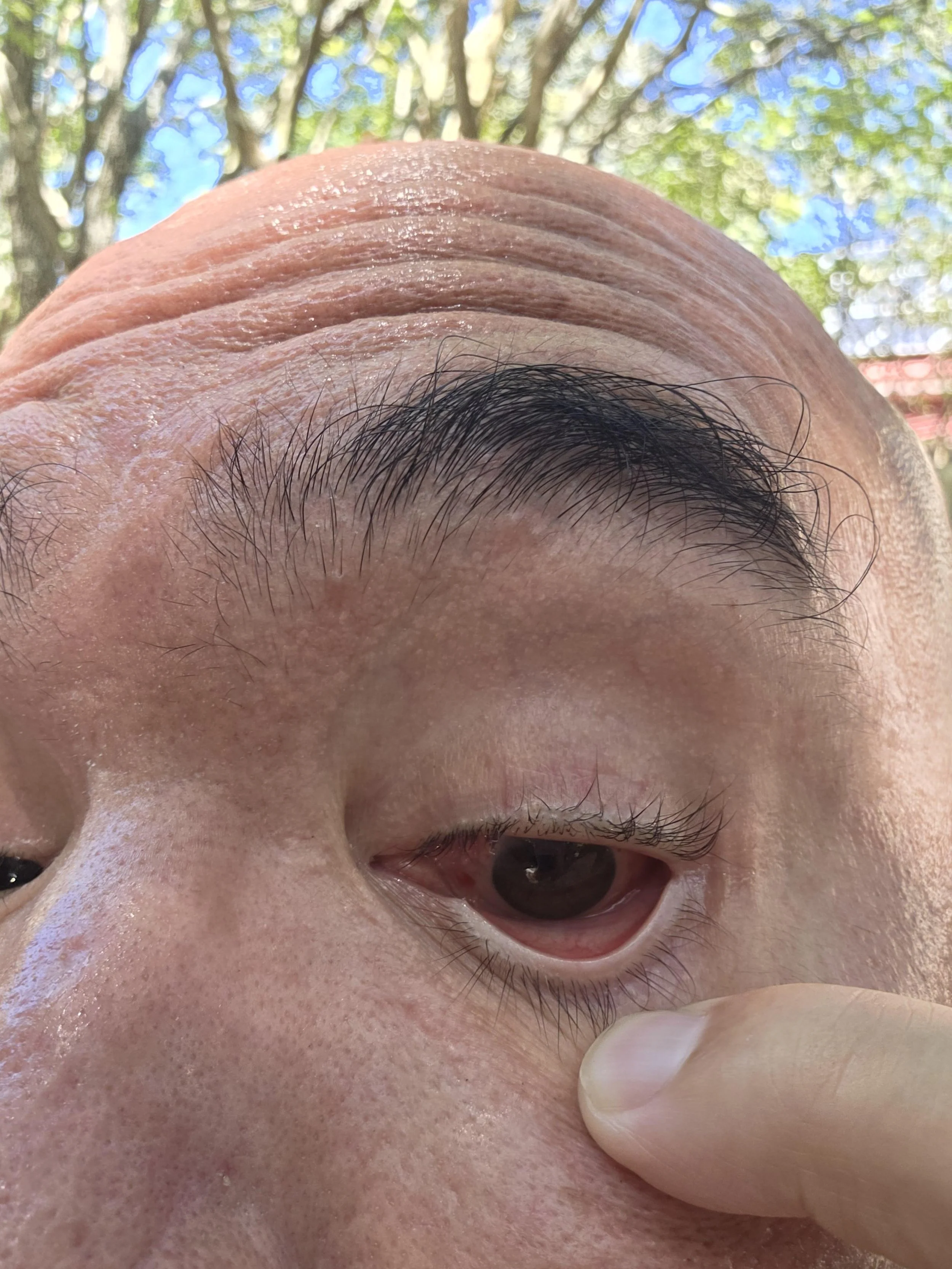
The less-good news?
It’s still there.
That strange line across my vision that I've been comparing to the horizon indicator in an airplane cockpit hasn't completely disappeared. It takes up less of my field of vision than it did before, which I'll count as progress.
But today I discovered another visual effect.
And this one is weird.
I went to a recovery meeting with quite a bit of reading. I spent a lot of time looking downward at the material, and that's when I really noticed something different happening in the center of my vision.
It looks like an eclipse.
🌞🌑
Not the Mitsubishi Eclipse.
Although, admittedly, a turbocharged 1990s Mitsubishi would be considerably more entertaining than what my left eye is currently doing.
I'm talking about the sun-and-moon kind of eclipse.
When I'm looking down, things directly in the center of my vision become very dark. There's this dark circular area that reminds me of the moon passing in front of the sun.
So we've officially upgraded the Left Eye Airlines instrument panel.
First, I had a horizon indicator.
Then, apparently, we were climbing.
Then the horizon started shrinking.
And now?
We're apparently experiencing a total eclipse somewhere around cruising altitude.
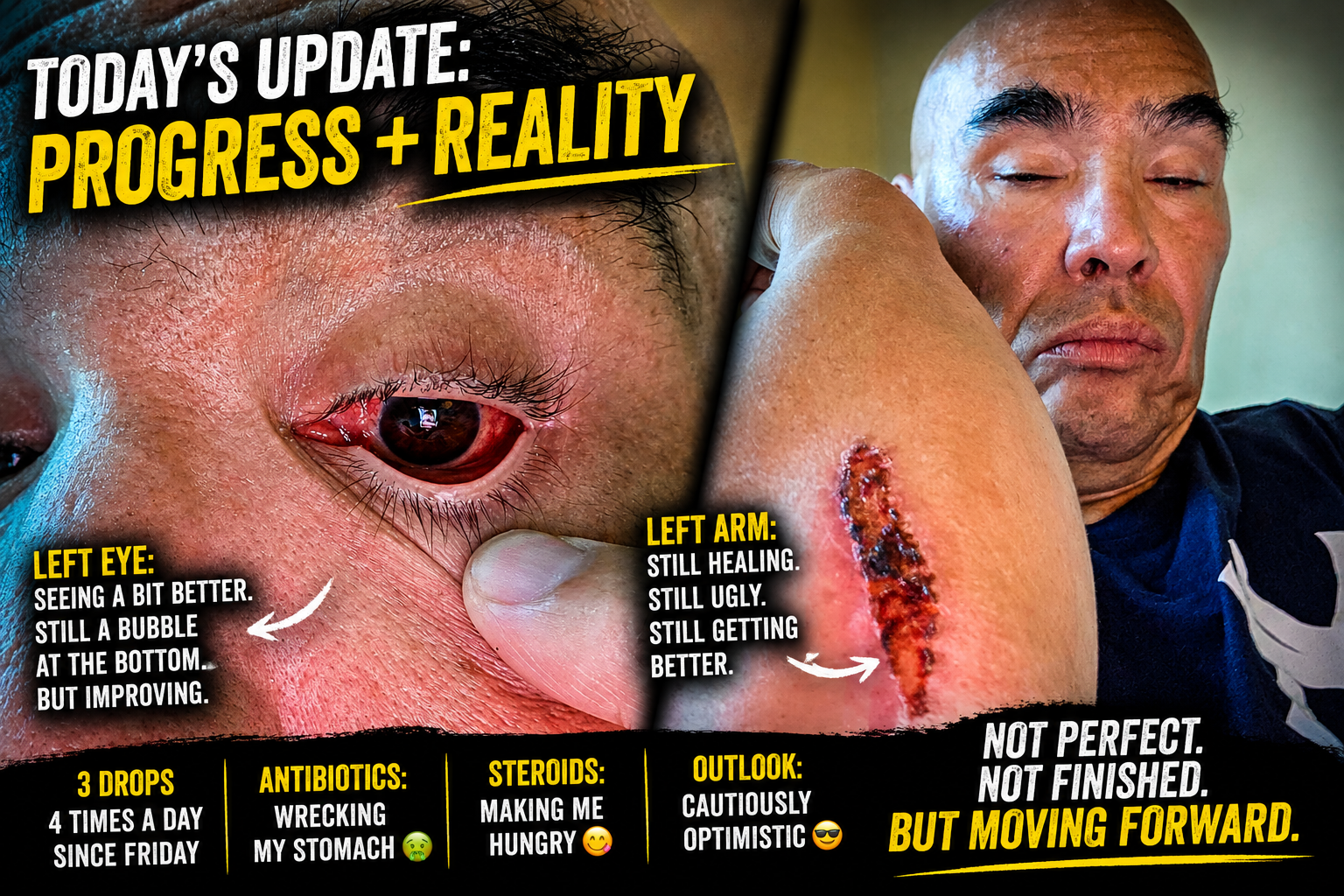
Meanwhile, the eye itself is still pretty red, as you can see in the photo. It also hurts sometimes.
Pain management isn't quite as simple for me as grabbing whatever happens to be in the medicine cabinet. I have end-stage renal disease, so Advil isn't an option for me, and I don't take aspirin. That means I'm not casually reaching for those when the eye starts bothering me.
For now, I'm continuing to pay attention to what the eye is doing and following the recovery process.
And then there's my arm.
There really isn't an elegant way to describe today's arm update.
It just looks nasty.
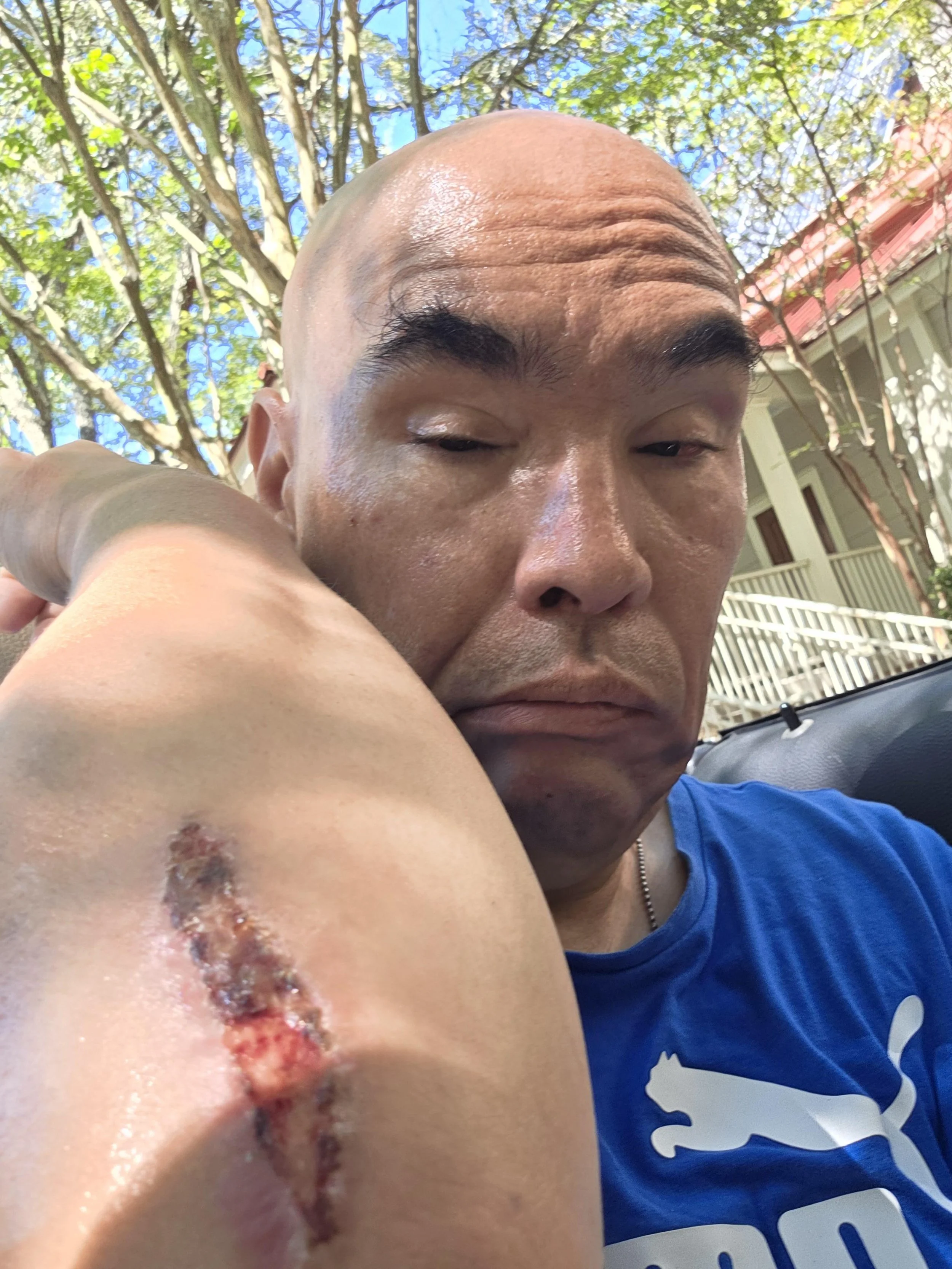
The scrape from my disagreement with my prosthetic, gravity, and the carpet is still healing, but visually it has reached that wonderful stage where someone could look at the picture and reasonably ask:
"What the hell happened to you?"
The answer remains:
I fell.
Apparently, however, my arm believes it was involved in a motorcycle accident, bar fight, and bear attack simultaneously.
So today's recovery scoreboard:
Horizon: Smaller, but still there. ✈️
Vision: Improving, but strange. 👁️
Center of vision: Eclipse mode activated. 🌞🌑
Eye: Still red and occasionally painful.
Arm: Absolutely disgusting.
Sense of humor: Somehow still operational.
Recovery isn't always a straight line.
Sometimes it's a horizon.
Sometimes it's a bubble.
Sometimes it's vinaigrette.
And apparently, sometimes it's a solar eclipse inside your eyeball.
At this rate, I'm slightly concerned about what tomorrow's special effect will be.
Captain Niel signing off from Left Eye Airlines. Please do not stare directly at the eclipse. ✈️👁️🌑
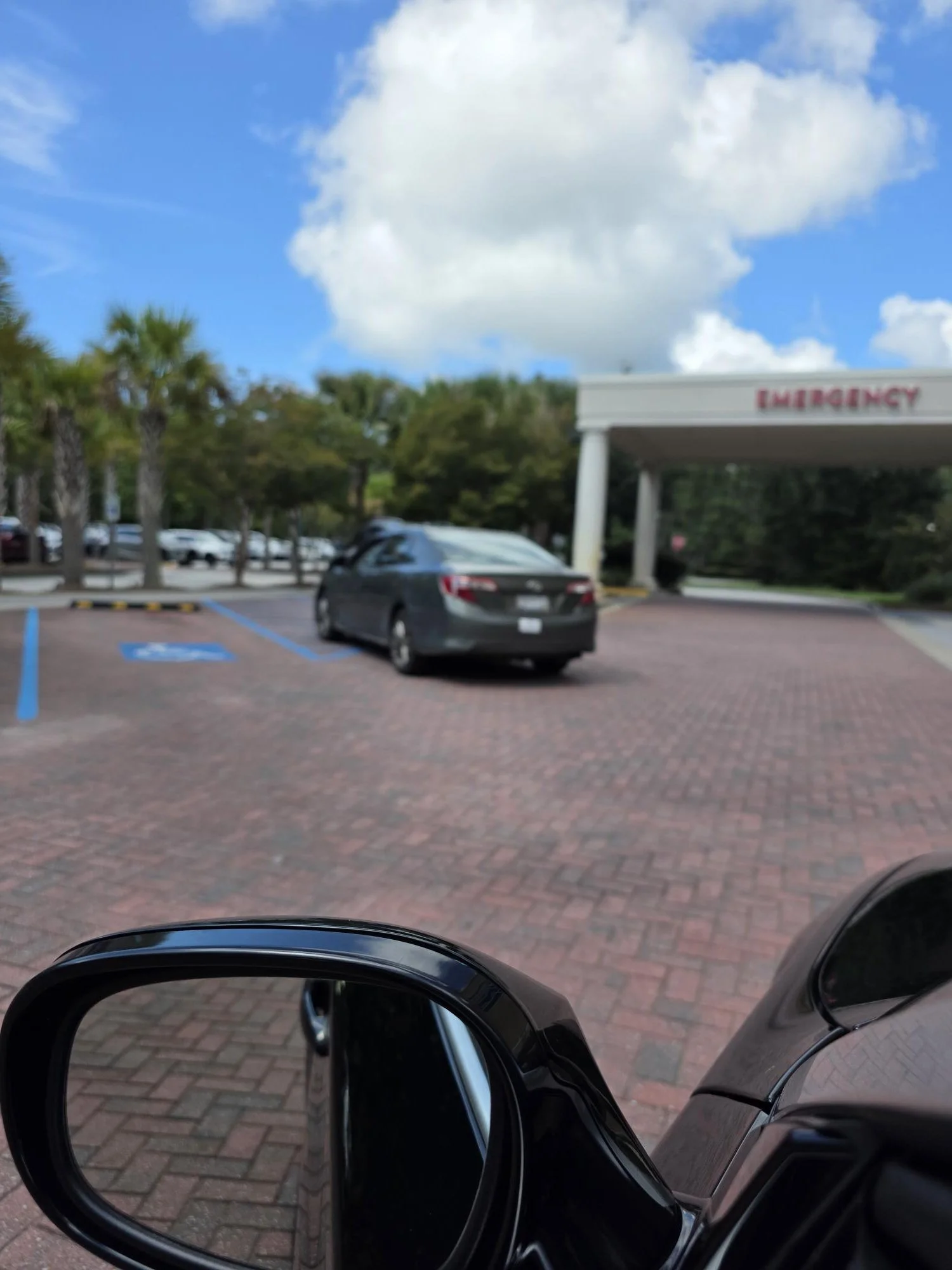
A Parking Job So Bad It Needed Emergency Care
I was visiting my mother at Roper St. Francis in Mount Pleasant when I left for a few hours to attend a recovery meeting.
On my way out, I saw this car parked outside the Emergency Department.
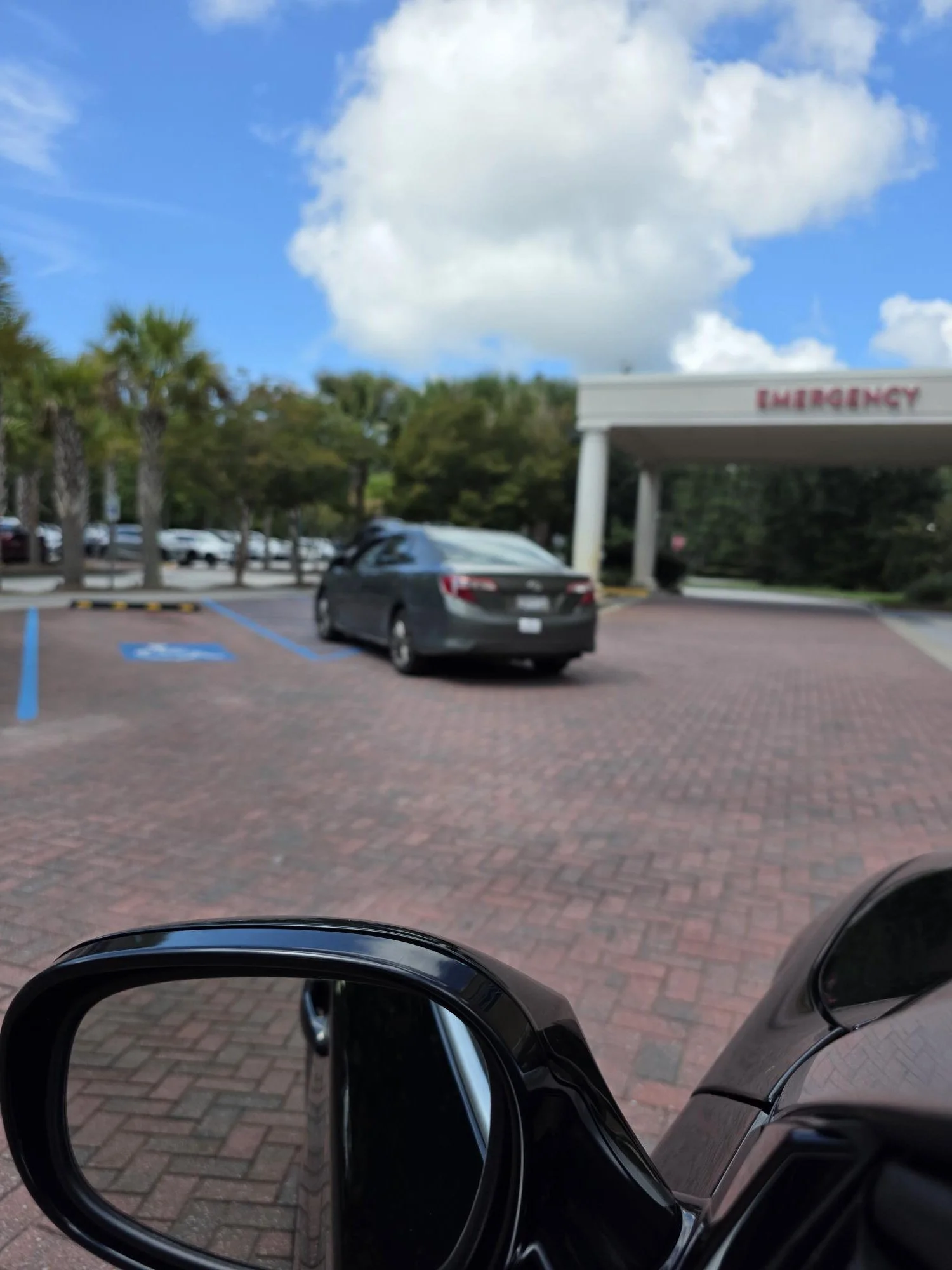
Or at least I think it was parked. It appeared to have simply stopped wherever it lost interest in moving.
Now, because this was outside the Emergency Department, I kind of understand. Emergencies are emergencies. Sometimes you pull up, get someone inside, and worry about the car afterward.
I have my own story.
When my ex-wife was about to give birth to our son—our second child—she waited until nearly the last possible moment to announce that it was time to go to the hospital.
On the way there, I may have run a few red lights. I did honk as I approached them to warn people that a panicked father-to-be was coming through.
When we reached the Emergency Department, I jumped out, ran inside, and grabbed a wheelchair. My ex-wife was still sitting in the car. I got her into the wheelchair and rushed her inside.
Meanwhile, the car was still running, the keys were still in it, and the doors were wide open.
Was that proper parking etiquette?
Absolutely not.
But a baby was arriving, and my priorities were clear: mother, baby, and then the unattended getaway car sitting outside.
So yes, I can understand a bad parking job at an emergency room—at least temporarily.
But the car I saw at Roper St. Francis was on another level. It was sitting crooked across the blue-striped access aisle next to an accessible parking space, looking less like someone had parked it and more like it had been abandoned mid-thought.
Those striped areas are not bonus parking spaces. They provide the room people need to deploy wheelchair ramps, use mobility equipment, and safely enter or exit their vehicles.
When I returned from my recovery meeting, the car was gone.
Hopefully, whatever brought the driver to the Emergency Department turned out okay.
Or perhaps the car had simply been moved to another part of the parking lot—where it was parked just as horribly.
Either way, emergencies may explain a rushed arrival. They do not turn an access aisle into a parking space indefinitely.
Be safe. Be considerate. And once the emergency is under control, please go back and park the car between two actual lines.
Left Eye Airlines Is Gaining Altitude
Another day, another update from the increasingly complicated flight deck known as my left eye.
And today, I actually have some good news:
I can see a little better.
Not 20/20; throw away the glasses; read the bottom line of the eye chart better.
But better.
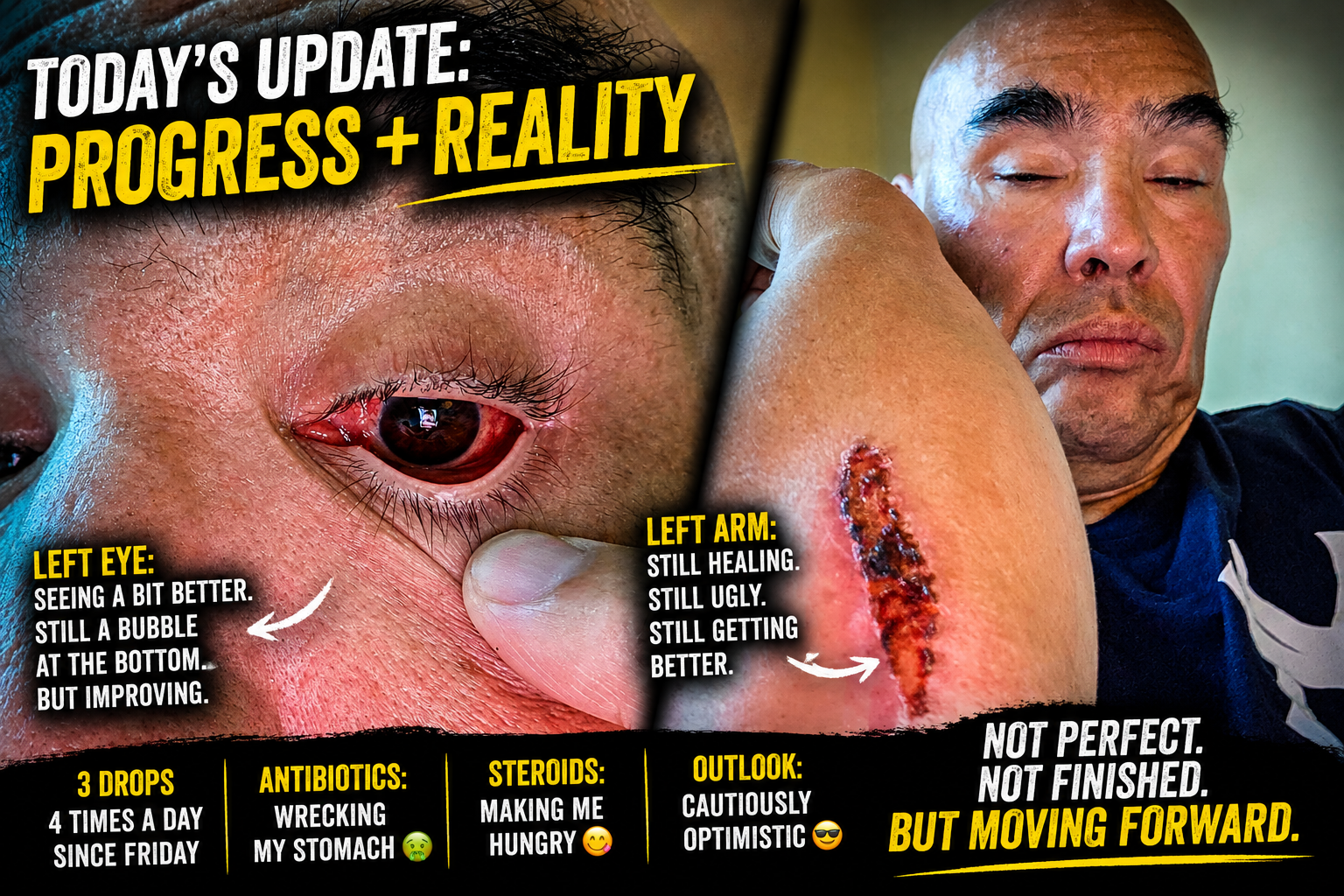
Since Friday, I’ve been taking three different eye drops, four times a day. At this point, administering eye drops has basically become a part-time job.
Morning: drops.
Later: drops.
Afternoon: drops.
Evening: you guessed it... more drops.
But something appears to be happening.
The strange horizon-indicator view I've been describing is changing again. When I look straight ahead, there is still a visible bubble at the very bottom of my field of vision.
So apparently, the complimentary vinaigrette service aboard Left Eye Airlines is finally running low. 🥗
The bubble hasn't completely disappeared, but I'm able to see a bit better through the left eye than I could before.
I'll take it.
Unfortunately, while my eye may be improving, the rest of my body has apparently filed several complaints about the treatment plan.
The antibiotics are absolutely wrecking my stomach.
I don't tolerate antibiotics particularly well to begin with, and my stomach has made its position on the matter extremely clear:
NO THANK YOU.
Then we have the steroids.
Those aren't upsetting my stomach.
They're doing something much more dangerous.
They're making me hungry.
Not regular hungry.
Steroid hungry.
The kind of hungry where you eat something and your stomach immediately asks:
"That was the appetizer, right?"
So the current recovery scoreboard looks something like this:
Left eye: improving. 👁️
Bubble: still hanging around at the bottom. 🫧
Stomach: protesting the antibiotics.
Appetite: apparently preparing for hibernation.
Arm: still healing from my recent disagreement with my prosthetic, gravity and the carpet.
The photos continue to make everything look considerably more dramatic than it feels, especially the arm. But compared with where things were just a few days ago, I'll happily take incremental progress.
And perhaps most importantly, Captain Niel seems to be getting a little more visibility from the cockpit.
We're not at cruising altitude yet.
The seatbelt sign is definitely still illuminated.
But for the first time in a few days, I think we may actually be able to see the runway.
And the vinaigrette?
Almost off the menu. ✈️👁️🥗🫧

Day 80: Nextdoor Wants to Talk About Reputation? Seriously?

Today is Day 80.
And Nextdoor managed to stop me in my tracks with the very first sentence of a LinkedIn post:
“A reputation you earn is worth more than one you can buy.”
They have to be kidding.
Of all the subjects Nextdoor could lecture businesses about, they chose:
Reputation.
This accompanies a new announcement distributed through Business Wire:
Nextdoor Deepens Its Commitment to Local Business Discovery and Recommendations
The release describes Nextdoor as “the essential neighborhood network” and announces changes intended to make the platform a destination for trusted local-business recommendations. It says nearly 30% of Nextdoor content already involves local business recommendations and reports nearly 75 million Faves across almost 6.6 million businesses. Business Wire
Those are impressive talking points.
But let's talk about reputation versus reality.
“The Essential Neighborhood Network”?
Nextdoor can call itself that.
But reputations aren't created by press releases.
And Nextdoor has spent years dealing with a very different nickname:
The “Karen” of social media.
That reputation didn't appear out of nowhere. Nextdoor's so-called “Karen problem” has been publicly discussed for years, including criticism involving neighbors policing one another and reporting behavior they don't like. Wikipedia
Spend enough time on the platform, and the irony becomes hard to miss.
Neighbors arguing about noise.
Lawns.
Politics.
Parking.
Dogs.
e-Bikes.
Someone's trash cans.
Someone else's kids.
Someone looked suspicious.
Someone's music is too loud.
Someone's grass is apparently threatening civilization.
Welcome to the essential neighborhood network.
Nextdoor says a reputation should be earned.
Okay.
Then Nextdoor's reputation has to be judged by what its platform actually produces—not merely by what Communications writes about it.
Then There Are the Businesses
Here's where today's announcement gets particularly interesting.
The release celebrates businesses earning recommendations organically and says Nextdoor is helping businesses build reputations that “can't be bought.”
Then, just a few paragraphs later, we get:
Opportunity Alerts.
That's a paid product that routes requests from verified neighbors directly to local service providers. The release also says a forthcoming business feed will allow businesses to comment and engage with neighbors. Business Wire
Wait.
We're celebrating reputations that can't be bought...
while introducing paid access to opportunities?
I'm not saying businesses shouldn't pay for advertising or leads. Nextdoor needs revenue. I'm a shareholder—I want it to make money.
But let's not pretend there isn't a tension worth discussing.
If a neighbor says:
“Can anyone recommend a plumber?”
and as businesses are increasingly encouraged to pursue paid products to reach those opportunities, where does authentic neighborhood conversation end and lead generation begin?
That's the conversation I'd like Nextdoor to have.
Users. Businesses. Investors.
That's what I find so fascinating about the current Nextdoor strategy.
I see friction across all three groups.
Users can end up fighting with other users over everything from lawns to e-Bikes.
Businesses are being introduced to new monetized tools for reaching neighbors actively seeking services.
And then there are investors like me.
Nextdoor has been around for roughly 15 years, and shareholders are still waiting for the enormous upside we've been promised.
Meanwhile, Q2 2026 still produced a $2 million GAAP net loss, although that's substantially better than the $15 million loss a year earlier, and adjusted EBITDA was positive $10 million. Business Wire
I've already made my position clear:
I have lost confidence in Nirav Tolia's leadership and believe Nextdoor needs a change at the top.
The Press Release Has a Messaging Problem
Read the announcement carefully.
It says:
Real people, not algorithms, decide who's trustworthy.
Then the very same announcement touts AI-powered Search and machine-learning ranking systems that improve what neighbors see. Business Wire
It says reputations can't be bought.
Then promotes a paid product for routing neighbor requests to service providers.
It emphasizes organic word of mouth.
Then discusses tools businesses can use to manage campaigns.
None of those products is inherently bad.
The problem is the gap between the beautifully crafted language and the much messier reality of operating and monetizing the platform.
And after 80 days of examining Nextdoor, that's becoming a recurring theme.
About That Reputation...
Nextdoor's own CEO, Nirav Tolia, says in the release:
“Local businesses have always grown through word of mouth.” Business Wire
I agree.
And word of mouth works for public companies too.
Customers talk.
Businesses talk.
Employees talk.
Investors talk.
Reputation isn't what a company calls itself in a Business Wire headline.
It's what people say about the company when the Communications department isn't writing the sentence.
So when Nextdoor tells businesses:
“A reputation you earn is worth more than one you can buy.”
I actually agree completely.
Which leads to my Day 80 question:
Nextdoor, what reputation have you earned?
Because that's a much more interesting question than the one the press release answers.
Day 80.
Still waiting for the two detailed Insights reports.
Still documenting the contradictions.
Still a shareholder.
And still wondering whether Nextdoor reads its own messaging before telling everyone else about reputation.
Read the full continuing Nextdoor case study at NielFlamm.com/blog and subscribe at NielFlamm.com to follow what happens next.