

Finding Emily: Sometimes I Just Need a Rom-Com

People getting unalived. Dinosaurs. Jason Statham kicking everyone's ass.
Apparently, I needed a break.
So I watched Finding Emily, a British rom-com involving a musician who loves love, a mysterious woman dressed as a fairy, a phone number missing ONE FREAKING DIGIT, and a psychology student who thinks our entire notion of romantic love may be archaic.
What could possibly go wrong?
It reminded me a little of a John Hughes movie with its use of music, while the British humor brought back some of what I love about Notting Hill, Four Weddings and a Funeral, and Love Actually.
There's even Minnie Driver—and an Emily who kept making me think of a young Amy Adams in Enchanted.
Is it predictable? It's a rom-com. Of course it is.
But sometimes I need some music, British cheekiness, romance, and maybe even an inner—or OUTSIDE—cry.
🎬 Watch my full Finding Emily movie review at NielFlamm.com/videos/moviereviews
An Unpopular Argument: How the Clancy Defense May Set Women Back Politically
This may be an unpopular position. Questioning the arguments made in support of Lindsay Clancy can easily be mistaken for dismissing postpartum illness or lacking compassion for a family devastated by tragedy. That is not the argument being made here.
Postpartum psychosis is real, serious, and deserving of greater public awareness. Clancy was also entitled to present every legally relevant defense available to her. The concern is that the way some supporters describe that defense—particularly their emphasis on hormones and sleep deprivation—may unintentionally reinforce one of the oldest arguments against electing a woman president: that women’s biology makes them unreliable under pressure.
Clancy’s lawyers did not claim that ordinary hormonal fluctuations made her irresponsible. They argued that she was experiencing postpartum psychosis, a rare psychiatric emergency, and therefore lacked criminal responsibility when she killed her three children. According to the defense, an underlying bipolar disorder, medication changes, disrupted sleep, and postpartum biological changes contributed to a profound break with reality. The prosecution disputed that account, and the trial ended in a mistrial when jurors could not agree on criminal responsibility. Associated Press
That was an argument about one defendant’s mental condition. The broader political danger arises when supporters transform it into a sweeping narrative about hormones, motherhood, and female vulnerability.
Some supporters portray Clancy primarily as a victim of postpartum biology, emphasizing that hormonal changes and exhaustion deprived her of control. Although this may be intended to promote compassion and maternal mental-health awareness, imprecise versions of the argument can validate the stereotype that women become irrational or incapable of making responsible decisions when their hormones change.
Postpartum psychosis is not an ordinary female emotion. It is an uncommon and severe condition that can involve delusions, hallucinations, paranoia, mania, and confusion. Researchers have investigated hormonal changes and sleep deprivation as possible contributing factors, alongside bipolar-spectrum illness, genetics, immune mechanisms, and circadian disruption. Clinical review in Focus Cleveland Clinic
When supporters reduce this complicated condition to “hormones and lack of sleep,” however, they make it easier for opponents of female leadership to misuse the case. Women running for office have long faced suggestions that menstruation, pregnancy, menopause, or emotion make them incapable of exercising sound judgment. Research examining Hillary Clinton’s 2016 campaign found that attacks on her health and stamina drew upon gendered assumptions about women’s fitness for leadership. Women’s Studies in Communication
The presidency makes this framing especially concerning. Presidents operate under tremendous pressure and may experience interrupted or inadequate sleep during national emergencies. Sleep deficiency can impair judgment, problem-solving, emotional control, and adaptability in people of every sex. National Heart, Lung, and Blood Institute
Yet inadequate sleep in male leaders is often presented as evidence of dedication or endurance. When discussed in connection with women, it can instead become supposed evidence of instability. Supporters who treat sleep deprivation as central proof that Clancy could not control herself risk strengthening that double standard.
This criticism will make some people uncomfortable. It asks supporters of a sympathetic cause to consider whether their language could have harmful consequences. But acknowledging those consequences does not require denying Clancy’s illness, prejudging her legal responsibility, or minimizing the importance of postpartum healthcare.
A defendant is entitled to a defense based on her individual medical condition. The setback occurs when public advocacy abandons that individual focus. Saying that a particular person experienced a rare psychotic disorder is fundamentally different from suggesting that the normal biological experiences of women make them less responsible for their actions.
Supporters who blur that line may give new language to people already inclined to question whether a woman can handle military conflict, national tragedy, sleep disruption, or the constant pressure of the presidency.
There is no evidence establishing that the Clancy defense has directly reduced a woman’s electoral prospects. But political stereotypes do not require sound evidence to survive. They grow through repetition, emotionally powerful examples, and careless generalization.
Those who support Clancy’s defense should therefore describe it accurately: an individualized claim involving severe mental illness, not a declaration about women’s hormones. Otherwise, an argument intended to protect one woman could be appropriated to diminish the perceived competence of millions—including women seeking the nation’s highest office.

Recovery Update: The Mystery Dot Is on the Move
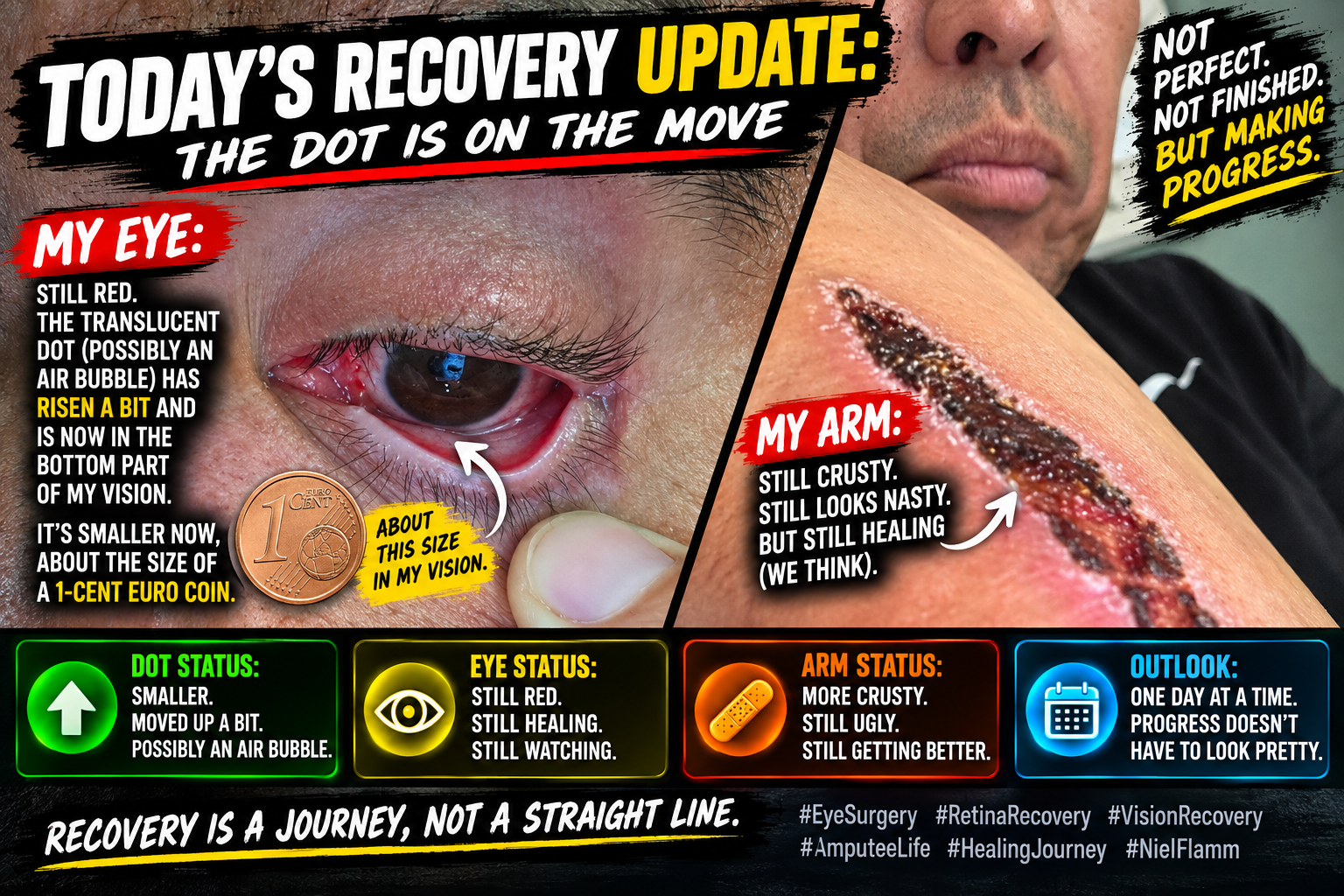
Another day, another episode of “What Is My Left Eye Doing Now?”
The good news is that there seems to be some movement — literally.
For the last several days, I’ve been talking about the translucent dot in my vision. At my one-week follow-up after the silicone oil removal, the doctor couldn’t actually see the dot I was describing. His thought was that it might be an air bubble.
When I looked straight ahead, it had been sitting near the very bottom of my field of vision.
Today, it has moved.
The dot — bubble, UFO, freeloading tenant, whatever it ultimately turns out to be — has risen a little farther into the bottom portion of my view.
And it’s getting smaller.
At this point, I’d estimate it’s about the size of a 1-cent euro coin in my field of vision.
So apparently my eye has its own European currency now. 🇪🇺🪙👁️
I’m taking the fact that it’s getting smaller as something worth watching. I’m certainly not declaring victory, especially after the doctor told me there’s a possibility I may need injections because of the blood vessels in the back of my eye.
For now, though, I can report:
Mystery dot: smaller.
Mystery dot: moving.
Eye: still red.
Me: still watching everything like a hawk.
Meanwhile, the arm continues doing its impression of something discovered during an archaeological excavation.
It’s crustier, darker, and still looks considerably more dramatic than it feels. Every day it seems to find a new way to look disgusting while apparently continuing to heal.
Between the eye and the arm, my body seems determined to make sure I never run out of material for these updates.
Tomorrow?
Who knows.
Maybe the bubble will shrink again.
Maybe my arm will finally stop auditioning for a zombie movie.
At this point, progress doesn't necessarily have to look pretty. It just needs to keep moving in the right direction.

BREAKING NEWS: The Hinge Experiment May Have Produced an Actual Date
I don't want anyone to panic.
Remain calm.
Please keep your hands and feet inside the vehicle at all times.
Because after weeks of conducting what has increasingly resembled a federally funded research project into why people on dating apps refuse to actually date, something extraordinary has happened.
I MAY HAVE A DATE.
Yes.
A date.
With another human being.
In person.
I don't think cryptocurrency is involved.
“Missing Me” Is Apparently Not Missing Anymore
Those following The Hinge Experiment™ may remember contestant number three, appropriately named “Missing Me.”
We've had an interesting communication journey.
There have been messages.
There have been gaps.
There have been “good mornings.”
There have been questions I've asked that apparently entered the same mysterious dimension where missing socks from the dryer live.
But I continued the experiment.
Eventually, I decided to try something radical.
Something perhaps unprecedented in the history of online dating.
I asked a woman on a dating app to go on a date.
I know.
Crazy.
My message was simple:
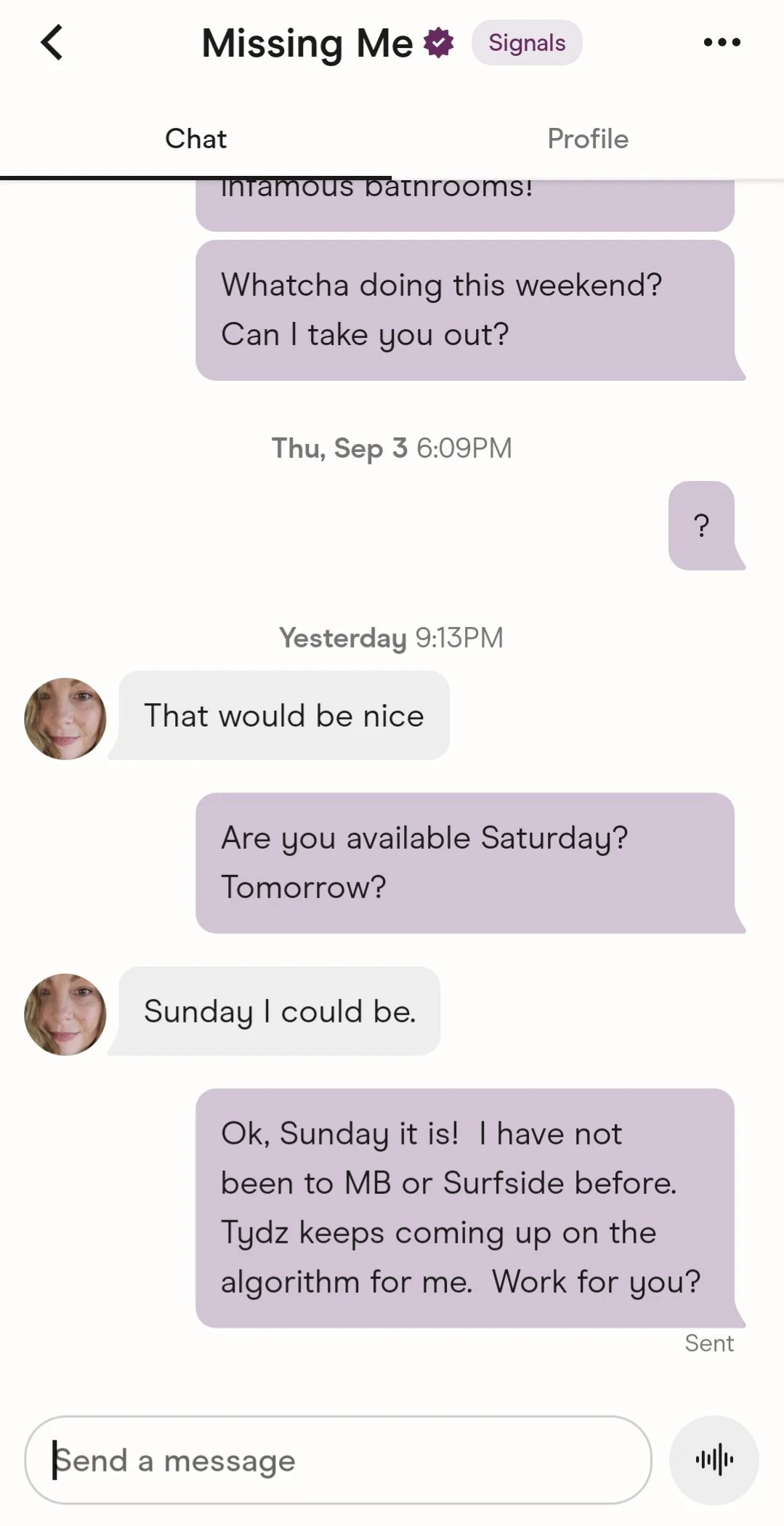
“Whatcha doing this weekend? Can I take you out?”
Then...
Nothing.
Thursday passed.
So naturally, I deployed the internationally recognized symbol for:
HELLO? IS THIS THING ON?
“?”
Elegant.
Sophisticated.
Shakespeare would have been proud.
And then last night...
A RESPONSE.
“That would be nice.”
WAIT.
WHAT?
WE HAVE ENTERED UNCHARTED TERRITORY
I immediately asked:
“Are you available Saturday? Tomorrow?”
She replied:
“Sunday I could be.”
Ladies and gentlemen...
WE HAVE A DAY.
This is no longer theoretical dating.
We have moved beyond:
“Good morning.”
We have advanced beyond:
“How was your weekend?”
We have smashed through the seemingly impenetrable barrier known as:
Actually answering a direct question.
Sunday.
SUNDAY!
At this point, I feel like NASA Mission Control.
Houston, we have verbal confirmation of Sunday.
Of course, Sunday isn't enough.
Now we need a location.
I've never really been to Myrtle Beach or Surfside, so I suggested Tydz, which keeps appearing in my algorithm.
Because apparently the same technology that has spent months showing me scammers, bizarre Facebook Reels, and random videos I never requested may finally be useful.
So I wrote:
“Ok, Sunday it is! I have not been to MB or Surfside before. Tydz keeps coming up on the algorithm for me. Work for you?”
And...
Sent.
Now we wait.
Again.
Naturally.
Steve, Don't Pack Your Bags Just Yet
Longtime readers know I had already developed an alternative strategy for meeting women.
Steve the Iguana.
The plan was simple.
If online dating completely failed, I'd acquire an iguana and become that guy walking down the beach with a giant reptile on his shoulder.
You know the guy.
Everybody talks to that guy.
Nobody approaches a random bald man walking down the beach and says:
“Hi! Tell me about yourself!”
Put a four-foot iguana on his shoulder?
Suddenly:
“OH, MY GOD! CAN I PET HIM?”
Steve was going to be my wingman.
But Steve, I've got some news.
You may not be needed on Sunday.
Don't get too comfortable, though.
We still don't have a confirmed restaurant.
We don't have a time.
We haven't physically occupied the same ZIP code.
And I've been doing this long enough to understand that there is an enormous difference between:
“Sunday I could be.”
and
two people actually sitting across from each other at a restaurant on Sunday.
So Steve remains on standby.
What the Hell Do I Do Now?
Here's the really funny part.
I've spent so much time writing about trying to get a date that I haven't adequately prepared for the possibility of actually getting one.
What happens now?
Do I need clothes?
Obviously I need clothes.
But which clothes?
How early do I arrive?
Five minutes?
Ten minutes?
Thirty minutes?
Do I bring flowers?
That seems like too much.
Do I open the door?
Absolutely.
Do I tell her I've been documenting this entire dating experiment on my blog?
Probably not in the first seven minutes.
Do I mention Steve?
Steve is probably a second-date conversation.
And what do two people on a first date even talk about in 2026?
Maybe I'll start with something safe:
“So... how are you coping with the stupid heat and humidity?”
Wait.
I've tried that one before.
The Hinge Standings Have Changed
Let's review how far we've come.
Kelli: Unmatched. She has the Google Voice number. The phone has not exactly been ringing off the hook.
Gina: We communicated. Still part of the greater Hinge cinematic universe.
Missing Me: Has potentially accomplished the impossible.
A DATE.
Sunday.
Possibly Tydz.
Potentially two actual humans meeting face-to-face after initially encountering each other through a rectangle of glass connected to the internet.
What a time to be alive.
But I'm not declaring victory yet.
Until I'm sitting at a table across from her, this remains Schrödinger's Date.
The date simultaneously exists and does not exist until Sunday arrives and somebody opens the restaurant door.
So...
Will Missing Me become Meeting Me?
Will Sunday actually happen?
Will we have a great time?
Will she take one look at me and suddenly remember an emergency dental appointment?
Will I finally have to write a blog called:
“Holy Crap, I Actually Went on a Hinge Date”?
Or will Steve the Iguana receive an emergency call-up from the minors?
We'll find out.
For the first time in The Hinge Experiment, however...
I might actually need to make plans for Sunday.
Pray with me, Forest.
Pray with me.

Day 83: Nextdoor Has $100 Million for Stock Buybacks. So Why Isn't It Buying?

It's Day 83 of my continuing Nextdoor case study.
Today I want to talk about something different:
NXDR shares.
More specifically, if Nextdoor's leadership believes the company is undervalued and believes strongly in its direction, why isn't it aggressively buying its own stock at these prices?
Before somebody jumps into the comments with a correction, let me make one myself.
Nextdoor DOES have a stock-buyback program.
And it has bought shares.
According to Nextdoor's SEC filings, during the first six months of 2026, the company repurchased and retired approximately 17 million shares for $28.7 million, at an average price of $1.69 per share.
But here's the part I find interesting:
During Q2 2026, Nextdoor repurchased ZERO shares.
And as of June 30, the company still had $100 million available under its current share-repurchase authorization.
So my question isn't:
Why doesn't Nextdoor have a buyback?
My question is:
Why aren't you using it now?
Nextdoor reported $378 million in cash, cash equivalents, and marketable securities at the end of Q2.
The Board has already authorized up to $100 million for share repurchases through June 2028.
Meanwhile, NXDR has recently been trading in the low-$2 range.
If management believes Nextdoor's strategy is working...
If management believes the market is undervaluing the company...
If management believes all these new products, small-business initiatives, AI features, and advertising strategies are going to create substantial future value...
Why wouldn't buying your own stock be an attractive use of at least some of that authorized capital?
Put Your Money Where Your Podcasts Are
I've watched Nirav Tolia make the podcast rounds.
I've heard the vision.
I've read the press releases.
I've seen Nextdoor describe itself as the “essential neighborhood network.”
Okay.
Show me the confidence with capital.
A meaningful stock repurchase at a price management genuinely believes is substantially below intrinsic value can send a very different message than another podcast interview.
It says:
We believe our shares are worth more than this.
And we're willing to put the company's money behind that belief.
Nextdoor itself made almost exactly that argument when it announced its original buyback program in 2022, saying the plan reflected confidence in its strategy and a belief that the market valuation didn't reflect the company's opportunity.
So what does management believe today?
Then There's Stock-Based Compensation
There's another side to this discussion.
Nextdoor reported approximately $14.9 million in stock-based compensation in Q2 2026.
Stock compensation isn't automatically bad. It's extremely common in technology companies and can help align employees and executives with shareholders.
But shareholders should still ask what happens to their ownership percentage as equity compensation is issued over time.
Dilution matters.
If you're issuing equity to employees and executives while the stock struggles, shareholders have every reason to ask whether repurchases are sufficiently offsetting that dilution—and whether compensation is producing the performance shareholders are paying for.
That's particularly important to me when we're discussing executive compensation.
I've repeatedly questioned how Nirav Tolia's compensation aligns with the value being delivered to shareholders.
Here's another way management could demonstrate confidence:
Buy the stock.
Imagine the Message
Forget another Business Wire release for a moment.
Imagine Nextdoor announcing that management believes NXDR is materially undervalued and therefore intends to meaningfully utilize its existing $100 million repurchase authorization.
That's a statement I would notice as a shareholder.
Not because buybacks magically fix a company.
They don't.
Nextdoor itself warns investors that repurchases aren't guaranteed to increase long-term shareholder value and that they reduce cash available for other purposes.
That's fair.
If Nextdoor can invest $1 internally and generate substantially more than $1 in long-term shareholder value, invest the dollar in the business.
But if management believes its own stock represents one of the best values available to the company?
Buy it.
That's capital allocation.
This Is Really a Question About Confidence
Nextdoor's Q2 wasn't all bad.
Revenue increased 15% year over year to $75 million.
Platform Weekly Active Users reached 22.9 million.
Adjusted EBITDA reached approximately $10 million.
The GAAP net loss narrowed dramatically to approximately $2 million, compared with $15 million a year earlier.
And the company finished June with approximately $378 million in cash, cash equivalents, and marketable securities.
Those are real improvements.
So here's what I want to understand:
If management believes those improvements are the beginning of something much bigger, why did Nextdoor repurchase zero shares during Q2?
You already have the authorization.
You have substantial liquidity.
You've bought shares before.
And the stock remains at a valuation that has frustrated shareholders like me.
Day 83
I'm still waiting for the two detailed Insights studies.
I'm still questioning the small-business monetization strategy.
I'm still questioning corporate communication.
I'm still questioning leadership.
And now I'm adding another question for Nirav Tolia and Nextdoor's Board:
You authorized $100 million to buy back NXDR shares.
At these prices, what are you waiting for?
If leadership believes in the direction of Nextdoor, I'd like to see that confidence demonstrated not just through words, podcasts and press releases.
Show shareholders through decisions.
Because ultimately, confidence isn't what management says about the company.
It's what management is willing to do with the company's capital.
Follow my continuing Nextdoor case study at NielFlamm.com/blog.