
Nextdoor Didn’t Make the Top 100. Why Not?
The more I thought about Nextdoor’s LinkedIn post celebrating Publix making PEOPLE’s 100 Companies That Care, the more I realized I was focused on the wrong part of the story.
Yes, Publix ranked No. 4.
Yes, Nextdoor highlighted a Publix associate who used the Nextdoor app to discover an elderly neighbor needed help before Hurricane Milton.
It's a great story, and the employee deserves recognition.
But there's another question that I find much more interesting:
Where was Nextdoor?
Nextdoor didn't make the Top 100.
For a company whose identity revolves around neighbors, community, connection, trust and helping people locally, that's something worth examining.
Technology Companies Made the List
This wasn't a ranking limited to grocery stores, hospitals and nonprofits.
Technology companies made it.
Companies including Salesforce, Intuit, Hewlett Packard Enterprise, Adobe, ServiceNow and NVIDIA were recognized.
Salesforce ranked an impressive No. 5.
So technology isn't the barrier.
And that makes me wonder:
For a company that promotes itself as a platform for connection and community, why wasn't Nextdoor there?
We Don't Know Why—and That's Important
I don't know whether Nextdoor applied.
I don't know whether it was evaluated.
I don't know whether it qualified but didn't score high enough.
And because the published ranking ends at 100, I don't know whether Nextdoor would have been No. 101 or No. 1,001.
I'm not going to manufacture an explanation.
But I can look at some of the issues I've documented and ask whether they provide opportunities for Nextdoor to improve.
Because that's what feedback should ultimately accomplish.
Start With Small Businesses
Nextdoor talks frequently about supporting local businesses.
I've also provided feedback about what I see as an increasingly aggressive effort to monetize those businesses.
Business Pages.
Advertising.
Paid products.
Opportunity Alerts.
Nextdoor needs to make money.
Let me emphasize that because I'm a shareholder:
I WANT NEXTDOOR TO MAKE MONEY.
My concern is where intelligent monetization ends and what I've described as a money grab begins.
If you're going to position yourself as the champion of neighborhood businesses, those businesses should feel like valued members of the ecosystem—not simply another opportunity to extract revenue.
Nextdoor needs to make money with small businesses, not merely from them.
There's a difference.
Then There’s the Moderator Model
I've also repeatedly provided feedback about what I believe is a flawed volunteer moderator model.
I've questioned consistency.
Training.
Accountability.
Quality assurance.
Centralized oversight.
And what happens when personal neighborhood disputes collide with moderation authority.
When moderation works, most people probably never notice it.
When it doesn't, moderation can become the entire Nextdoor experience.
If Nextdoor wants to sell trust, its moderation system needs to consistently create trust.
That requires more than asking unpaid neighbors to police other neighbors.
And Then There’s the “Karen” Problem
Let's address the person demanding to speak with the neighborhood manager.
Nextdoor has faced a long-running public reputation in commentary as something of the “Karen” of social-media platforms.
Fair or unfair, the reputation exists.
Suspicious-neighbor posts.
Parking complaints.
Garbage-can disputes.
Political arguments.
Dog-poop investigations worthy of CSI: Suburbia.
And the classic:
“Did anyone else hear that boom?”
Nextdoor can't control every ridiculous thing someone posts.
But Nextdoor can influence the experience surrounding those posts.
Moderation.
Product design.
Algorithms.
Enforcement.
Community standards.
Leadership.
If a platform develops a cultural reputation for complaining, suspicion and neighborhood conflict, marketing alone isn't going to change it.
You have to change the experience that created the reputation.
But Here’s What Really Got My Attention About Those Tech Companies
Companies such as Salesforce, NVIDIA, Intuit, Adobe, ServiceNow, and HPE aren't charities.
They're businesses.
And some of them are extraordinarily profitable businesses.
That's important because sometimes conversations about corporate responsibility create a false choice:
Make money
or
do good.
The companies appearing on this list demonstrate that it doesn't have to work that way.
Caring and Making Money Aren’t Opposites
Take Salesforce.
Salesforce ranked No. 5 on the Companies That Care list.
In fiscal 2026, Salesforce reported a 20.1% GAAP operating margin, generated approximately $14.4 billion in free cash flow, and returned approximately $14.3 billion to shareholders through stock repurchases and dividends.
At the same time, its community efforts included its AI for Impact initiative and millions of dollars in funding, technology, and expertise for nonprofits.
Then there's NVIDIA.
NVIDIA made the Companies That Care list while also returning enormous amounts of capital to shareholders. During fiscal 2026, NVIDIA reported approximately $40.4 billion in share repurchases and $974 million in dividends.
Intuit made the list while continuing to operate a profitable technology business and connecting its community initiatives directly to its mission of “powering prosperity.”
See the pattern?
These companies didn't have to choose.
They could make money.
They could return money to shareholders.
They could invest in employees.
They could support communities.
And they could still work toward fulfilling their stated missions, visions and values.
Mission Shouldn’t Be a Substitute for Results
This is where I think the comparison becomes particularly relevant to Nextdoor.
Mission statements are wonderful.
Values are wonderful.
Community is wonderful.
But shareholders can't deposit a mission statement.
And customers can't experience corporate values that exist only on a website.
Mission, vision, and values shouldn't substitute for business results.
But the reverse is equally important:
Business results shouldn't require abandoning mission, vision and values.
Great companies figure out how to do both.
That's the standard.
And That’s Why Nextdoor’s Absence Interests Me
Think about the proposition Nextdoor is trying to sell.
It's the neighborhood platform.
The connection platform.
The place where real people connect with real neighbors.
The place where local businesses connect with customers.
The place where communities supposedly become stronger.
If I were designing a company specifically to compete for something called “100 Companies That Care,” that sounds like a pretty good starting point.
Yet Nextdoor didn't make the Top 100.
Meanwhile, companies that don't have “neighborhood connection” at the center of their entire identity did.
That's fascinating.
Maybe Connection Needs to Start at Home
Here's the question I'd ask Nextdoor:
Does the experience inside and around Nextdoor match the values Nextdoor markets outside?
Do employees feel connected?
Do neighbors trust the platform?
Do small businesses feel supported—or monetized?
Do volunteer moderators have the training, oversight, and accountability they need?
Does leadership welcome difficult feedback?
Does the platform's actual reputation resemble the brand Nextdoor wants people to see?
Is the company building sustainable profitability?
And are shareholders seeing the value created by all of it?
Those aren't accusations.
They're questions.
But they're questions I think any company built around connection should be willing to ask.
Profitability Is Part of Caring Too
This may sound strange, but I believe it.
A company that can't sustain itself can't fulfill its mission for very long.
Profit matters.
Cash flow matters.
Shareholder returns matter.
Capital allocation matters.
Employees need a financially healthy employer.
Customers need a financially sustainable product.
Communities benefit when companies can continue investing in them.
And shareholders provided capital with the expectation that management would create value.
Profit isn't the enemy of purpose.
Done correctly, profit helps fund purpose.
That's why I'm impressed when a company can simultaneously generate profits, reward shareholders, invest in employees and communities, and remain aligned with its stated values.
Imagine the Better LinkedIn Post
Rather than Nextdoor posting:
“Publix made the list, and somebody from Publix used Nextdoor!”
Imagine next year:
“Nextdoor Named One of PEOPLE’s 100 Companies That Care.”
Now we're talking.
No Six Degrees of Kevin Bacon.
No connection through Publix.
No borrowed spotlight.
Nextdoor's accomplishment.
Then imagine being able to add:
Revenue growing.
Profitable.
Employees engaged.
Small businesses succeeding.
Moderation improving.
Neighbors finding genuine value.
Shareholders receiving returns.
Community mission intact.
That's the story I'd love to write.
Here’s My Challenge to Nextdoor
Don't dismiss the Top 100 list.
Study it.
Look at the technology companies that made it.
Look at how they treat employees.
Look at their philanthropy.
Look at their community investment.
Look at their corporate cultures.
And importantly, look at how some of them simultaneously make money and create shareholder value.
Then look inward.
Fix what needs fixing.
Improve the moderator model.
Make small businesses feel like partners rather than ATMs.
Continue improving communication.
Address the platform's “Karen” reputation by improving the actual experience.
Listen to feedback—even when it's uncomfortable.
Build sustainable profitability.
Create shareholder value.
And make sure the company's actions reflect the mission, vision and values it talks about publicly.
Because you don't have to choose between:
Caring about communities
and
caring about shareholders.
The best companies can do both.
Nextdoor's mission should actually give it an advantage.
Now it needs to prove it.
Don't just connect yourself to Companies That Care.
Become a profitable Company That Cares.
And give the neighbors, employees, small businesses and shareholders something worth celebrating.
If Nextdoor makes that list someday?
I'll happily applaud them.
Read my continuing Nextdoor case study at NielFlamm.com/blog.
Nextdoor Is Playing Six Degrees of Kevin Bacon With Publix
I saw an interesting Nextdoor post on LinkedIn.
Nextdoor highlighted that Publix Super Markets landed at No. 4 on PEOPLE's 100 Companies That Care list.
The story itself is absolutely worth recognizing.
As Hurricane Milton approached Florida, a Publix associate reportedly checked Nextdoor, discovered an elderly neighbor who needed distilled water for her nebulizer, delivered it, secured her patio furniture, cleared debris, and then helped another neighbor with sandbags.
That's a great story.
And congratulations to the Publix associate who did all that.
But then Nextdoor connected the story to itself:
“This is the kind of thing that happens when a network is built around real, local neighborhoods.”
Hold on.
Are we playing Six Degrees of Kevin Bacon now?
If Someone Uses Your App, Do You Get Credit for What They Do?
The Publix employee deserves the praise.
Publix deserves recognition for employing someone who apparently demonstrated exactly the kind of community spirit that earned the company a place on the list.
But Nextdoor?
The employee opened an app.
The app was a tool.
There's a difference between providing a tool and performing the good deed.
I shop at Publix.
I buy groceries there.
Their subs have practically developed their own fan club, and don't even get me started on the carrot cake.
So, using this logic, every time I buy a Publix sub, I'm helping generate revenue that helps Publix employ people.
One of those employees might help a neighbor.
Therefore...
Where's my PEOPLE award?
I'll wait.
Speaking of That Top 100...
Another part of this caught my attention.
Publix came in at an impressive No. 4.
Nextdoor's post celebrates that accomplishment and its own small connection to one of the stories highlighted.
But there's one company I don't see in the Top 100:
Nextdoor.
Now that makes me curious.
If Nextdoor wants to connect itself to a company recognized as one of the 100 Companies That Care, I'd be interested to know where Nextdoor would land if the list continued.
No. 101?
No. 247?
No. 1,382?
I genuinely don't know.
Maybe Nextdoor would be right outside the Top 100. Maybe it wouldn't be anywhere close.
But that's the more interesting question to me.
Instead of borrowing a little glow from a company that did make the list, what would Nextdoor need to do as an organization to earn a spot of its own?
The Hammer Doesn't Get Credit for Building the House
If someone uses Google Maps to find a food bank and then volunteers there, does Google get credit for feeding people?
If someone drives a Ford to donate blood, does Ford get credit for the donation?
If someone texts a neighbor using an iPhone and then helps clean up their yard, does Apple get the community-service award?
Technology can enable something without being responsible for what happened.
That's an important distinction.
Nextdoor gave this Publix employee a way to discover that a neighbor needed help.
That's valuable.
Say that.
Celebrate that.
But don't climb onto the employee's shoulders and start waving from the parade float.
Nextdoor Actually Has Something Worth Celebrating Here
That's what makes this frustrating.
Nextdoor doesn't need to ride anyone's coattails.
This story demonstrates a legitimate use case for the platform:
A neighbor needed help.
Another neighbor discovered that need through Nextdoor.
The neighbor acted.
That's enough.
Nextdoor could have said:
“We're proud that our platform helped connect neighbors during a hurricane.”
Great.
I'd applaud that.
Instead, the post reads to me like Nextdoor is stretching someone else's act of kindness into evidence supporting its own corporate narrative.
And after all the feedback I've provided about communication, trust, and authenticity, I think Nextdoor should be more careful about that distinction.
Give the Credit to the Person Who Earned It
This isn't complicated.
Publix associate: Helped neighbors prepare for a hurricane. 👏
Publix: Recognized as one of PEOPLE's Companies That Care. 👏
Nextdoor: Provided a platform that helped one neighbor discover another neighbor needed assistance. 👍
Those are three different things.
You can acknowledge all three without pretending they're the same accomplishment.
Nextdoor talks frequently about real people, real neighborhoods, and authentic connections.
Great.
Then put the real person who performed the act at the center of the story.
Don't make someone else's good deed your corporate victory lap.
Celebrate the employee.
Celebrate Publix.
Be proud that your technology played a small role in connecting neighbors.
Then stop.
Nextdoor doesn't need Six Degrees of Kevin Bacon to demonstrate its value.
It needs to demonstrate its own value.
Do better. Stop riding coattails—and let the people who actually did the work receive the applause.
Read more of my continuing Nextdoor case study at NielFlamm.com/blog.
A $7,000 2024 Toyota Camry XSE? TikTok’s $500 Down Car Deal Is Back
At this point, I think TikTok believes I’m shopping for a car.
I’m not.
But the algorithm apparently knows I enjoy looking at vehicle offers that make me stop scrolling and say:
“There is absolutely no way.”
We've already had the $6,800 Camry. Then the $5,000 Honda Accord. Then the brand-new 2026 Toyota RAV4 Plug-In XSE advertised for $8,500.
Now we have another contestant.
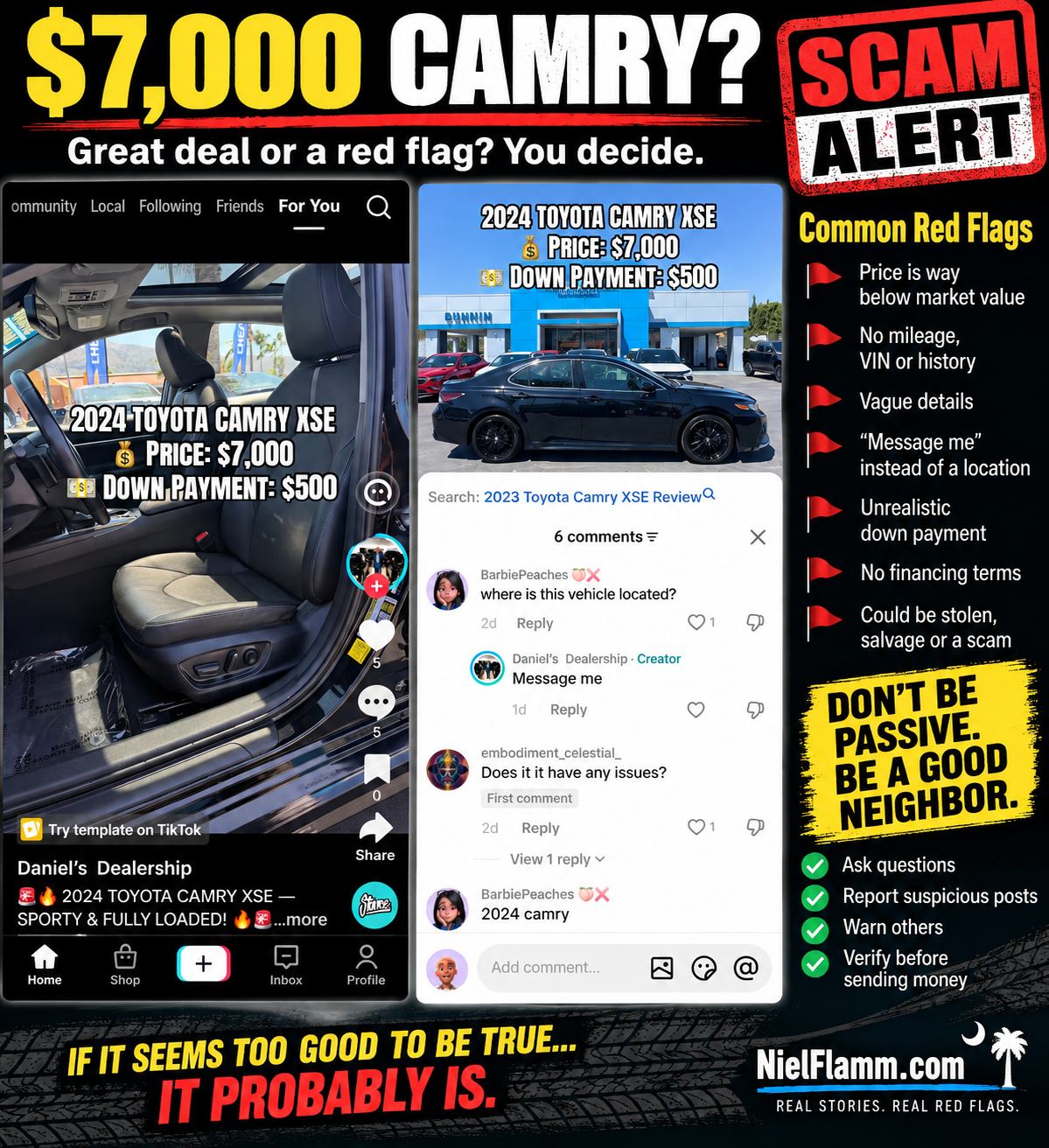
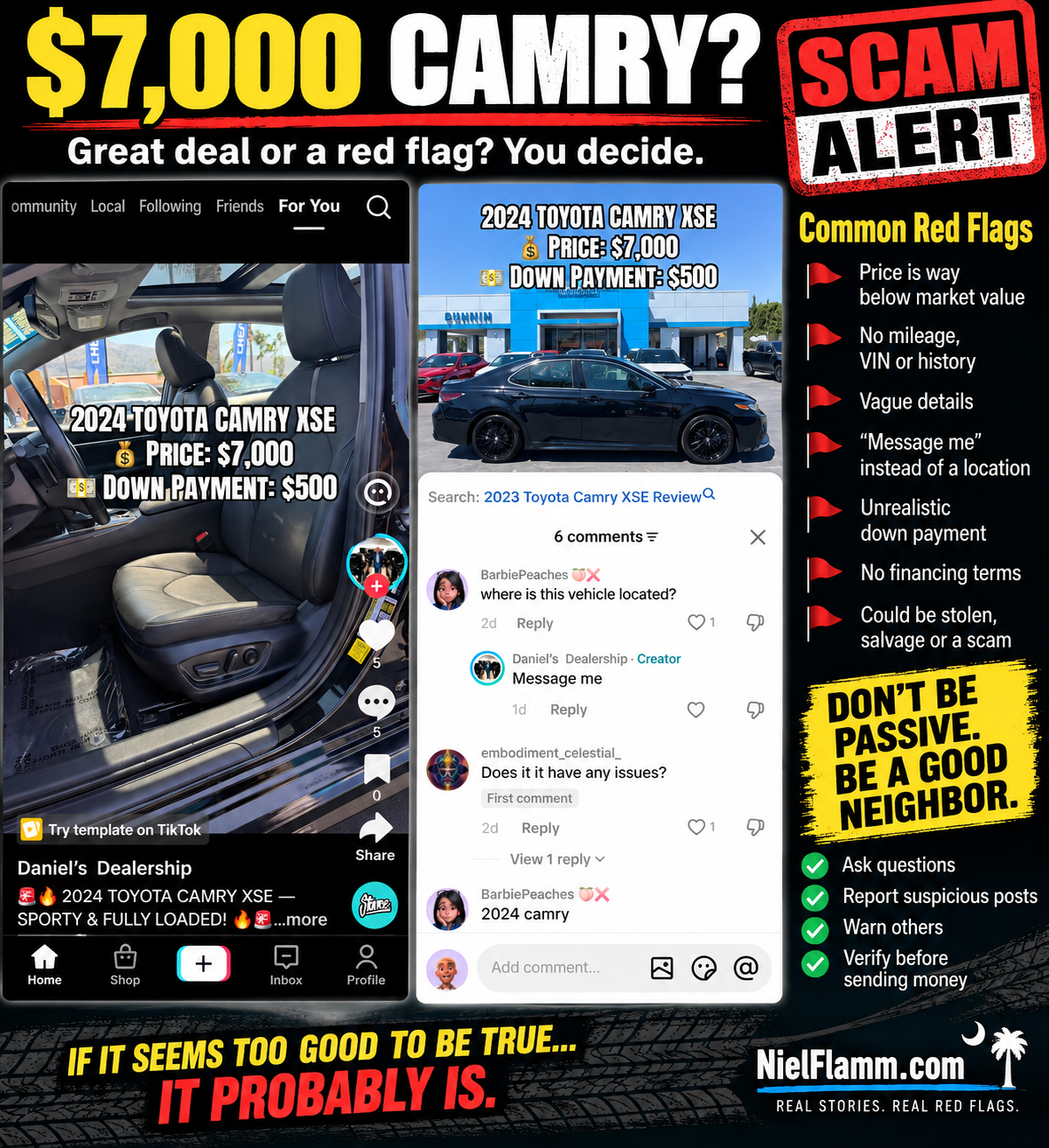
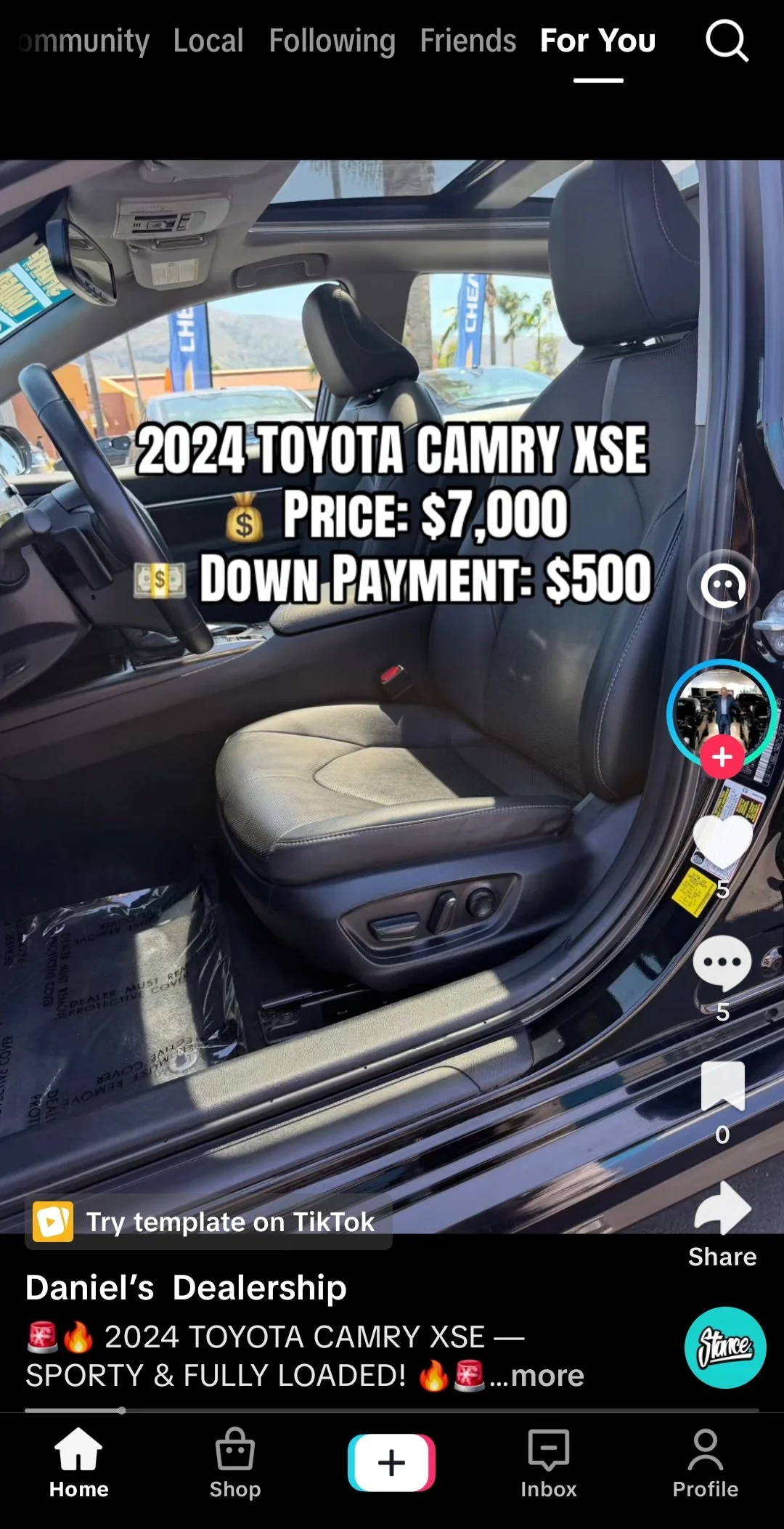
According to a TikTok posted under the name “Daniel’s Dealership,” this is a:
2024 Toyota Camry XSE
Price: $7,000
Down payment: $500
And the caption adds:
“SPORTY & FULLY LOADED!”
Well, fantastic.
Where do I send my $500?
Actually, don't answer that.
🚩 Let's Start With What This Car Is Actually Worth
The advertised price immediately caught my attention, so I checked current values.
Kelley Blue Book currently puts the Fair Purchase Price of a used 2024 Toyota Camry XSE at about $28,000 nationally. Depending on condition, KBB estimates trade-in value around $21,620–$24,920 and private-party value around $23,590–$27,190. Kelley Blue Book
So let's compare:
TikTok: $7,000
KBB Fair Purchase Price: approximately $28,000
That's not a small discount.
That's about 75% below KBB's current Fair Purchase Price.
Even more interesting: Toyota's original base MSRP for a 2024 Camry XSE was $31,720. The XSE AWD started at $33,120 and the XSE V6 at $36,845. Toyota
In other words, we're being presented with a relatively recent Toyota—one of the more desirable Camry trim levels—for less than many dealerships would expect to receive simply by trading one in.
Could a $7,000 Camry exist?
Of course.
Maybe it's wrecked.
Maybe it has a salvage title.
Maybe it has extraordinarily high mileage.
Maybe it has mechanical problems.
Maybe there's some other legitimate explanation.
But those details would be pretty important, wouldn't they?
The TikTok doesn't tell us.
🚩 “Fully Loaded!” Okay. How Many Miles?
This is where these advertisements continue to fascinate me.
We get:
SPORTY!
FULLY LOADED!
🔥🔥🔥
What don't we get?
Mileage.
VIN.
Vehicle history.
Title status.
Accident history.
Financing terms.
APR.
Loan length.
Dealer address.
Those boring little details that might explain why a car worth around $20,000 is supposedly being offered for $7,000.
Maybe there's a perfectly reasonable explanation.
I'd love to hear it.
Preferably publicly.
🚩 And There’s That $500 Again
This is becoming my favorite recurring character.
THE $500 DOWN PAYMENT.
I've now encountered multiple suspiciously cheap vehicle advertisements using essentially the same formula:
Unusually inexpensive vehicle.
Tiny down payment.
Very little financing information.
Then get the interested person into a private conversation.
For this Camry:
$7,000 price.
$500 down.
But what happens to the remaining $6,500?
What's the monthly payment?
How many months?
What's the APR?
Who's financing it?
What credit qualifications apply?
None of that appears in the screenshot.
But don't worry.
We do learn how to get more information.
🚩 “Where Is This Vehicle Located?”
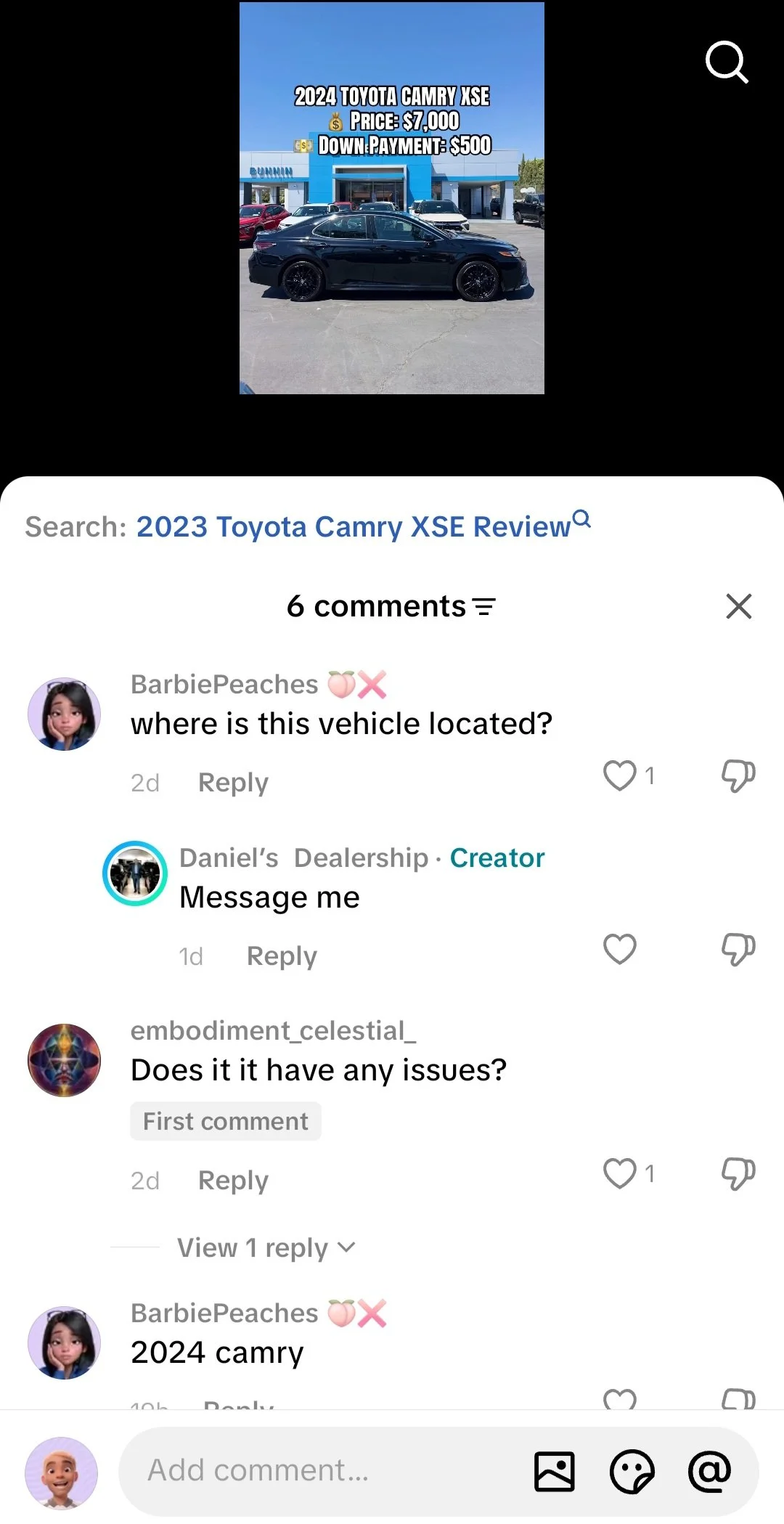
Someone in the comments asks possibly the easiest dealership question imaginable:
“where is this vehicle located?”
That's a fantastic question.
It should also have an extraordinarily simple answer.
Charleston.
Charlotte.
Atlanta.
Chicago.
123 Main Street.
Whatever.
Instead, the account responds:
“Message me”
There it is again.
Why does the location of the vehicle need to be a secret?
If you're a dealership advertising a vehicle for sale, wouldn't you generally want customers to know where the dealership is?
Another commenter asks:
“Does it it have any issues?”
Also a very reasonable question considering the price.
That question is even more important when KBB indicates a typical 2024 XSE is worth several times the advertised $7,000 price. Kelley Blue Book
🚩 The DM Pattern Keeps Appearing
This is now one of the biggest recurring themes I've noticed in these social-media vehicle offers.
The advertisement gets your attention publicly.
The incredibly low price creates interest.
The small down payment makes the vehicle seem obtainable.
Then, when someone asks for basic information:
DM me.
Message us.
Message me.
I have not messaged this account, so I cannot tell you what happens after someone enters the private conversation.
Maybe they provide legitimate dealership information.
Maybe they provide the VIN.
Maybe they explain why the car is $7,000.
I don't know.
And that's an important distinction.
But if that private conversation eventually turns into:
“Send the $500 so we can hold the vehicle,”
I'd stop.
Especially if they ask for payment through a peer-to-peer payment service or another method that makes recovering the money difficult.
Before sending anything, independently verify the dealership, physical location, VIN, title, vehicle history, and that the person you're communicating with actually has authority to sell that vehicle.
🚩 There's Something Else Interesting in the Picture
Look closely at the exterior photo.
A dealership building sits behind the Camry.
There's signage.
There are other vehicles.
It certainly looks like a dealership photograph.
But a picture taken at a legitimate dealership doesn't automatically prove that the social-media account posting it represents that dealership.
That's an important distinction with online vehicle shopping.
Photos can be copied.
Listings can be copied.
Dealer inventory photographs can be copied.
Even entire descriptions can be copied.
So I'd want to identify the dealership visible in the photograph and independently contact that business—not using information supplied by the social-media account—to ask:
“Do you have this 2024 Camry XSE, and are you selling it for $7,000?”
That one phone call could answer quite a few questions.
Let's Do the Reality Check
The TikTok advertisement:
2024 Toyota Camry XSE — $7,000
Kelley Blue Book:
Approximately $28,000 Fair Purchase Price. Kelley Blue Book
Toyota's original XSE base MSRP:
$31,720. Toyota
TikTok down payment:
$500
Someone asks where the vehicle is located.
Response:
“Message me.”
Someone asks whether the vehicle has issues.
And here I am asking:
Why does a car potentially worth four times the advertised price cost only $7,000?
That's the question I'd want answered before worrying about the $500 down payment.
🏡 Don't Just Scroll Past It—Be a Good Neighbor
Another reason I keep writing about these posts is this:
Someone commented asking where the car is located.
Someone else asked whether it has problems.
Those aren't abstract numbers on a screen.
Those are people who may genuinely need transportation.
A $28,000 Camry may be completely outside someone's budget.
A $7,000 Camry with only $500 down may suddenly feel possible.
That's precisely why an extraordinary offer deserves extraordinary scrutiny.
And if you recognize the warning signs, don't be passive.
Say something.
Report suspicious listings.
Tell a friend.
Warn someone in the comments without harassing anyone.
Help somebody independently verify the seller before they send money.
Being a good neighbor online isn't much different from being one offline.
Sometimes it means seeing someone about to make a $500 mistake and saying:
“Before you send that money, let's make sure this car—and this seller—are real.”
Because the best scam prevention tool isn't always sophisticated technology.
Sometimes it's simply another person paying attention.
More scam emails, suspicious recruiters, questionable vehicle deals, and whatever else the internet sends my way at:
NielFlamm.com/blog
The Hinge Experiment: Behold, My Magnificent Collection of Absolutely Nothing
Ladies and gentlemen, I present to you the current state of The Hinge Experiment™.
Please try to contain your excitement.
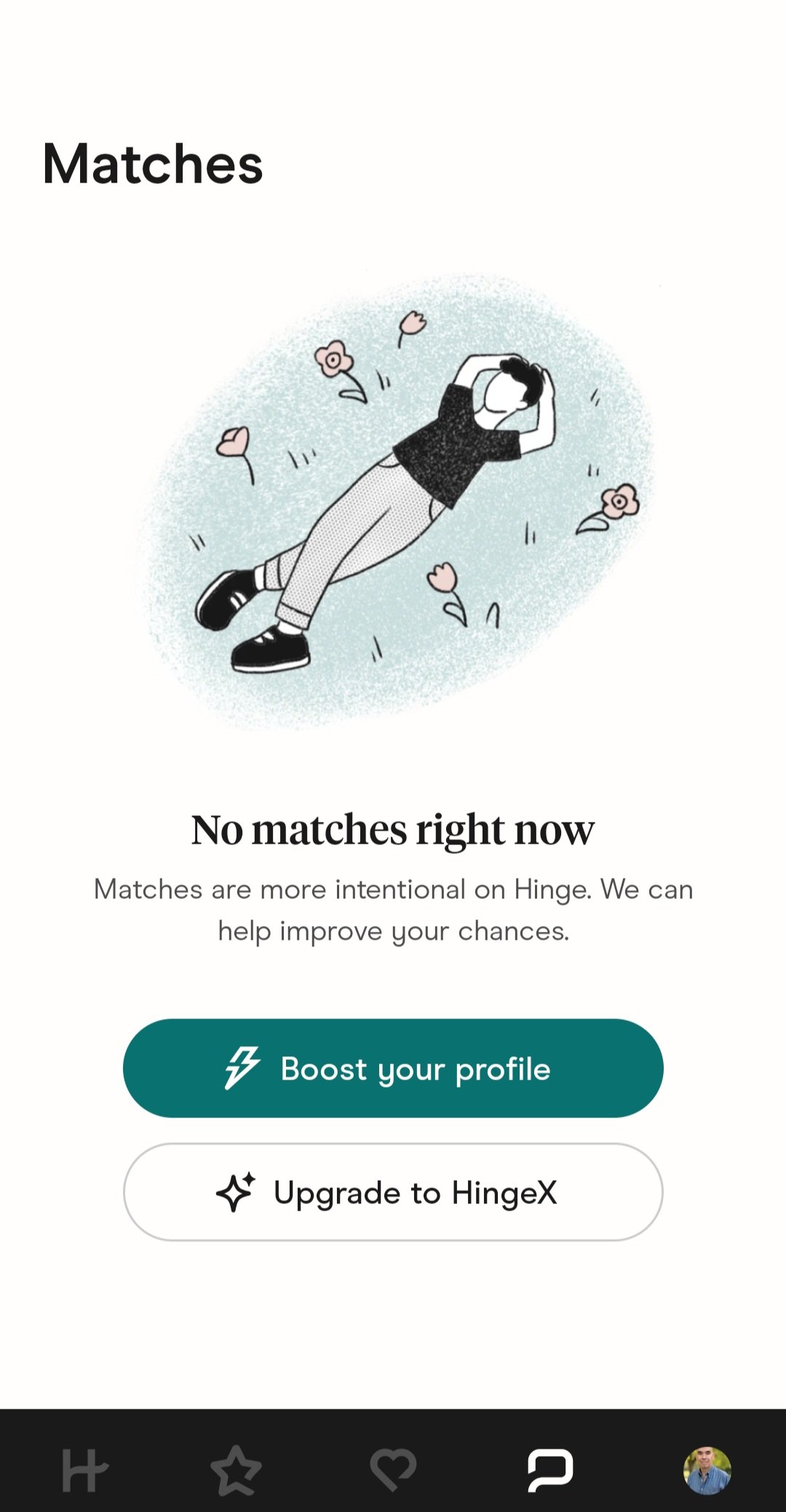
As of this post, this is what my Hinge match queue looks like:
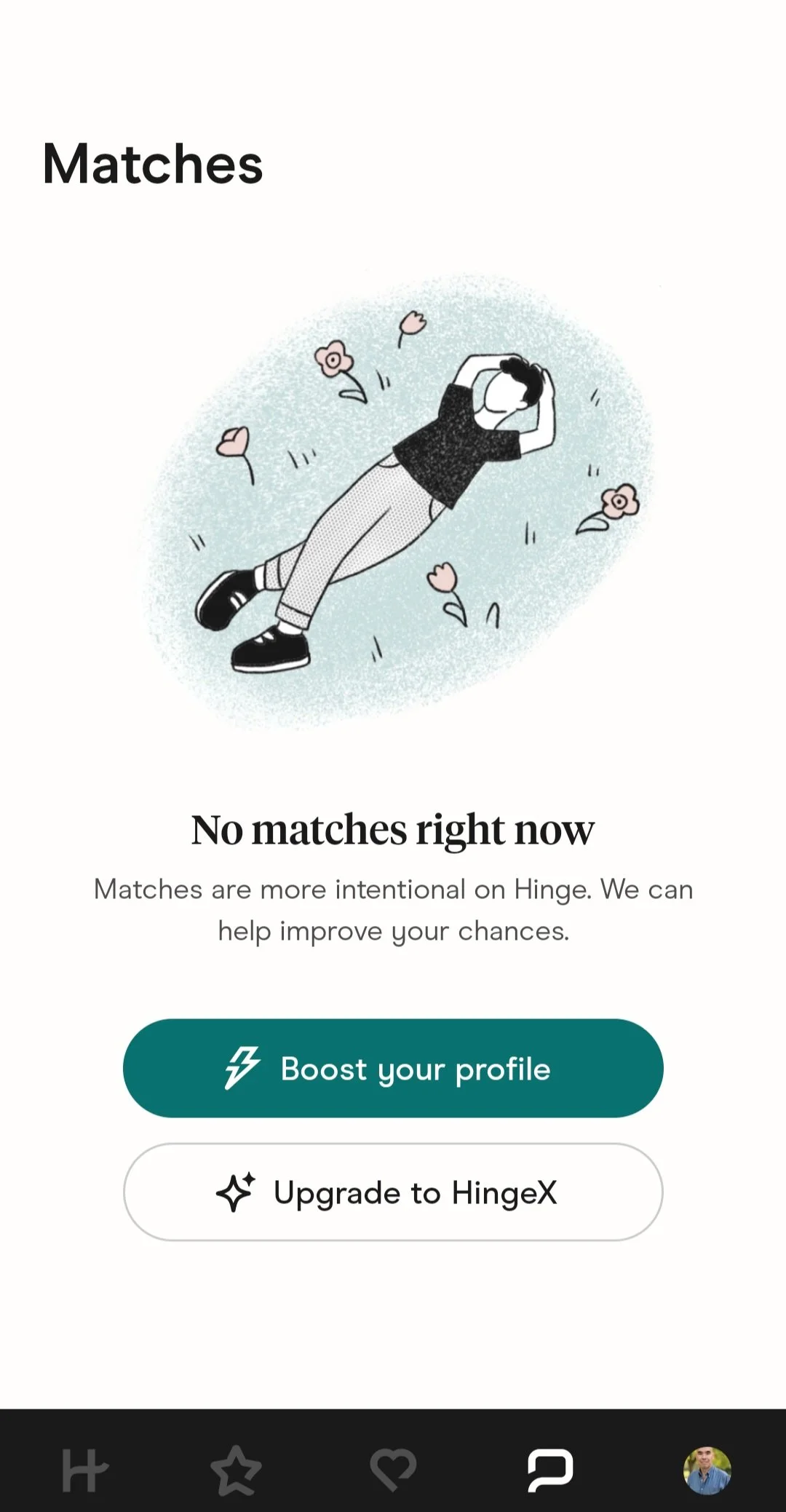
“No matches right now.”
That's it.
That's the update.
Thank you for coming.
Look at All That Room!
I mean, seriously.
Look at this magnificent screen.
Clean.
Uncluttered.
Organized.
Not a single pesky match taking up valuable digital real estate.
Marie Kondo would be proud.
After unmatching Kelli, Missing Me, and most recently Gina, I have achieved something few people have the courage to accomplish on a dating app:
Inbox Zero.
Except it's not email.
It's women.
Okay, that sounded significantly worse than I intended.
Moving on.
Hinge Has Some Suggestions
What I particularly enjoy is that Hinge doesn't simply tell me:
“No matches right now.”
It immediately follows that with what feels suspiciously like:
“Would you like to give us some money for that?”
There's a giant:
BOOST YOUR PROFILE
button.
And underneath that:
UPGRADE TO HINGEX
Ohhhhh.
I see how this works.
Hinge is basically standing next to my completely empty dating queue whispering:
"That's a shame. You know... perhaps your credit card could help."
Nice self-esteem you have there.
Be a shame if something happened to it.
But I'm Not Panicking
Here's the thing.
I'm actually okay with this.
Would I like to have a match?
Sure.
Would I like to be talking with someone?
Absolutely.
Would I like to meet someone, go out, laugh, have dinner, see a movie, take a drive somewhere, and eventually have someone special in my life?
Yes.
But as I wrote recently:
I'm not desperate.
There's a difference between wanting companionship and needing to manufacture it.
I'm not keeping conversations open simply so I can look at my Hinge account and say:
“See! Three women!”
If nobody is communicating, what's the point?
Kelli had her opportunity.
Missing Me almost became Meeting Me.
Gina had her opportunity.
Those conversations went nowhere.
So I cleaned house.
And now...
BEHOLD THE HOUSE.
It's extremely clean.
Possibly condemned.
But definitely clean.
“Matches Are More Intentional on Hinge”
The screen also informs me:
“Matches are more intentional on Hinge.”
Well, they are certainly being VERY intentional about not matching with me.
I respect the commitment.
There's no ambiguity here.
No mixed signals.
No “Good morning” followed by 72 hours of silence.
Just a giant empty screen saying:
NOPE.
In a strange way, it's refreshing.
So What Happens Now?
Nothing changes.
I'm still on Hinge.
I'll continue looking.
I'll continue sending likes when someone seems interesting.
Maybe tomorrow I'll get a match.
Maybe next week.
Maybe someone will eventually appear who actually wants to have a conversation.
And maybe—this is where we're getting wildly optimistic—we'll use this dating app to arrange an actual date.
Imagine the possibilities.
Until then, I'm not paying someone to pretend the empty queue isn't empty.
I'm certainly not going to become discouraged because an algorithm hasn't delivered my forever-after on schedule.
I've got plenty of other things happening in my life.
Dating would be an addition.
Not the definition of it.
Current Official Hinge Standings
Kelli: Unmatched.
Missing Me: Unmatched.
Gina: Unmatched.
Current conversations: 0.
Current matches: 0.
Upcoming dates: 0.
Hinge suggesting I spend money: Naturally.
Steve the Iguana's confidence level: Becoming absolutely unbearable. 🦎
I'm starting to picture him sitting next to me, looking at this screen with that smug reptile face.
"Told you, dude. Get me a leash and let's hit the beach."
Not yet, Steve.
Not yet.
The Hinge Experiment continues.
And for anyone interested in joining the cast...
Apparently, there are openings.
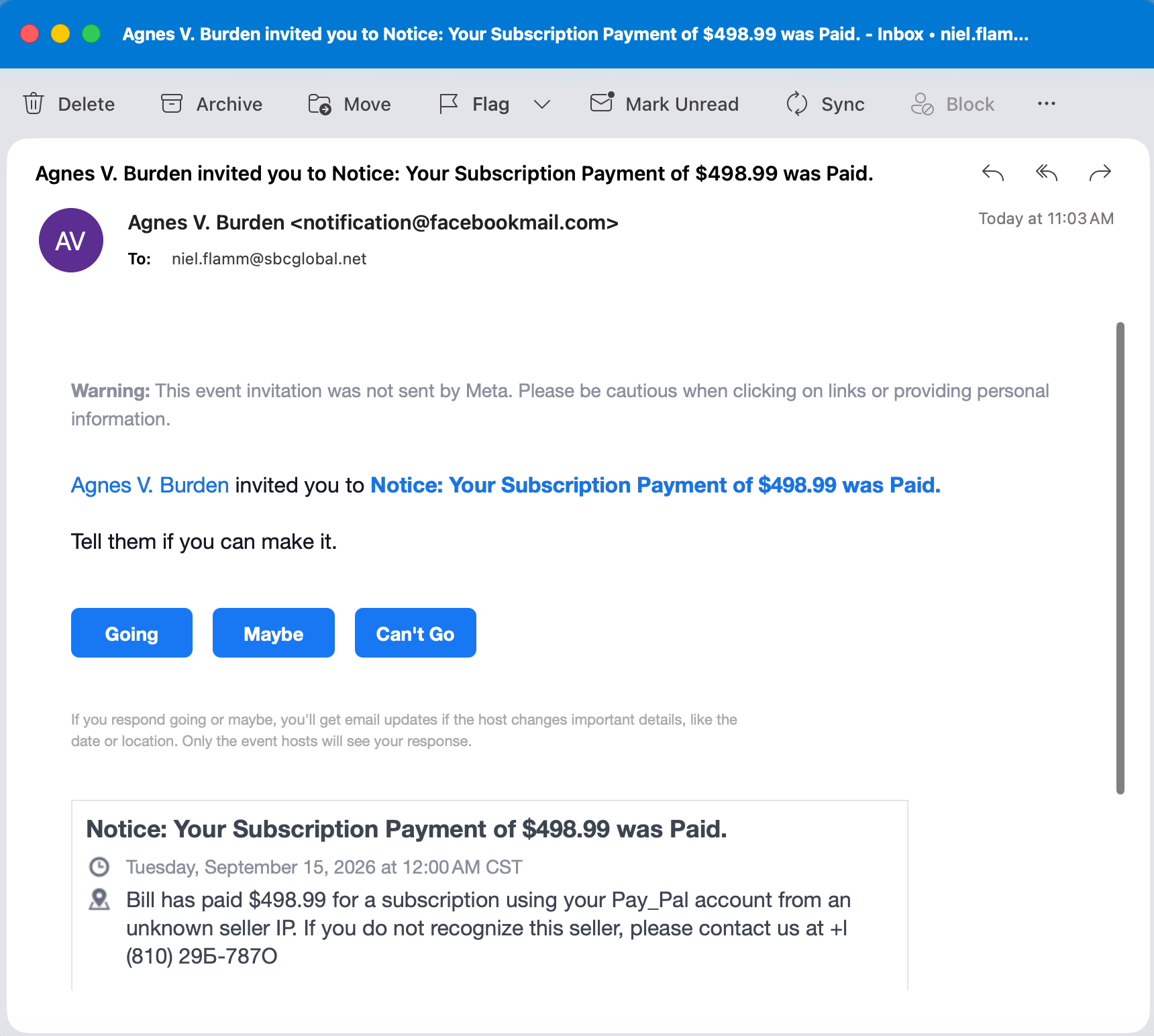
Apparently My $498.99 PayPal Subscription Is Now a Facebook Event
The scammers are getting creative.
Today I received an email with this wonderfully alarming subject line:
“Agnes V. Burden invited you to Notice: Your Subscription Payment of $498.99 was Paid.”
Wait.
I bought a subscription?
For $498.99?
And Agnes is throwing an event to tell me about it?
I appreciate the invitation, Agnes, but I think I'm busy that day.
🚩 The First Red Flag Is Actually a Giant Warning
This one gets interesting because the email appears to be generated through Facebook's event system rather than simply pretending to be a normal PayPal notification.
And Facebook practically puts a warning label on it for us:
“This event invitation was not sent by Meta. Please be cautious when clicking on links or providing personal information.”
That's not exactly subtle.
The apparent sender address is notification@facebookmail.com, which could make someone think, Well, it came through Facebook, so it must be legitimate.
But that's the trick.
The screenshot indicates that Agnes V. Burden created the event. The event itself appears to carry the scam message.
That's an important distinction: a legitimate platform can be used to deliver content created by someone else.
🎉 You're Invited! Your Money Is Gone!
The event title reads:
“Notice: Your Subscription Payment of $498.99 was Paid.”
Then we get the usual Facebook invitation:
Going | Maybe | Can't Go
I'm struggling to choose the right RSVP.
Going: Yes, I definitely want to attend the disappearance of $498.99.
Maybe: Depends. Will there be food?
Can't Go: Sorry, I have another fraudulent transaction at 1:00.
But then we get to the actual event description:
“Bill has paid $498.99 for a subscription using your Pay_Pal account from an unknown seller IP.”
There are so many questions.
Who is Bill?
Why is Bill spending my money?
Why is PayPal suddenly “Pay_Pal”?
And what exactly is an “unknown seller IP” supposed to mean?
But don't worry.
They've conveniently provided a phone number.
🚩 And THAT Is the Point
The message says that if I don't recognize the seller, I should call the number shown in the invitation.
There's the hook.
The $498.99 isn't necessarily the objective.
The objective may be to make me panic about the $498.99 and call the number.
The FTC specifically warns about this type of subscription-renewal scam. Victims receive notices claiming they've been charged hundreds of dollars for a subscription and are instructed to call a number to dispute it. Once they call, scammers may try to get financial information, persuade the victim to grant remote computer access, or create a fake “refund” problem that ultimately leads the victim to send money. Consumer Advice
In other words:
The fake charge creates the panic.
The phone number gives the scammer a path in.
🚩 This Facebook-Event Version Isn't Unique
Here's what really caught my attention.
I found a strikingly similar report in the Better Business Bureau's Scam Tracker from July 2026.
That report described a Facebook/Meta event invitation claiming a $749.49 MetaPay payment, complete with the same warning that the event invitation wasn't sent by Meta. The event then instructed the recipient to call a phone number if the payment was unauthorized. BBB categorized that report as phishing. Better Business Bureau
Different amount.
Different supposed transaction.
Different phone number.
Very similar playbook.
That's a useful reminder that scammers don't always need to spoof an entire company's email system. Sometimes they can abuse legitimate features—event invitations, calendar invites, shared documents, comments or other notifications—to get their message delivered.
💰 So What Should I Do About My $498.99?
First, I'm not calling the number in the invitation.
I'm also not clicking anything in the event to “resolve” the supposed charge.
If I were genuinely concerned that $498.99 had been charged through PayPal, I'd independently open the real PayPal app or website and inspect my transactions.
I'd also check the bank or credit-card account connected to it.
The FTC recommends that same approach for suspicious subscription notices: check your actual financial accounts, and if you need to contact the company, use contact information you know is legitimate—not the phone number supplied in the suspicious message. Consumer Advice
If the $498.99 transaction isn't there?
Then there's nothing to refund.
And there's certainly no reason to call Agnes.
🧠 The Psychology Is Better Than the Grammar
What makes this scam potentially effective isn't perfect spelling or a sophisticated story.
It's the number:
$498.99
That's large enough to make someone panic.
You don't stop to analyze “Pay_Pal.”
You don't wonder why a financial transaction has become a Facebook event.
You don't ask who Bill is.
You see:
YOU JUST LOST $498.99.
Then:
CALL THIS NUMBER.
That's social engineering.
The scammer doesn't need you to believe the entire story.
They just need you to become concerned enough to take the next action.
🏡 Be a Good Neighbor
I've said this before, and I'll keep saying it.
If you see something like this, don't be passive.
Tell your parents.
Tell your grandparents.
Tell your friends.
Tell the neighbor who isn't particularly comfortable with technology.
Share screenshots.
Report suspicious messages.
The FTC even recommends talking to someone you trust—a friend, family member, or neighbor—when you're unsure whether something is a scam. That second set of eyes can interrupt the panic that these schemes depend upon. Consumer Advice
You might recognize it as suspicious right away.
Someone else may see $498.99 and think their money is disappearing.
Sometimes being a good neighbor is simply saying:
“Don't call that number. Let's check your actual account first.”
Agnes, I'm Going to Have to Decline
So, Agnes V. Burden, thank you for inviting me to the celebration of my imaginary $498.99 subscription.
Unfortunately:
Going? No.
Maybe? No.
Can't Go? Absolutely.
And I'm definitely not calling your phone number.
Follow along at NielFlamm.com/blog for more scam emails, questionable TikTok car deals, suspicious recruiters, and whatever creative nonsense lands in my inbox next.