
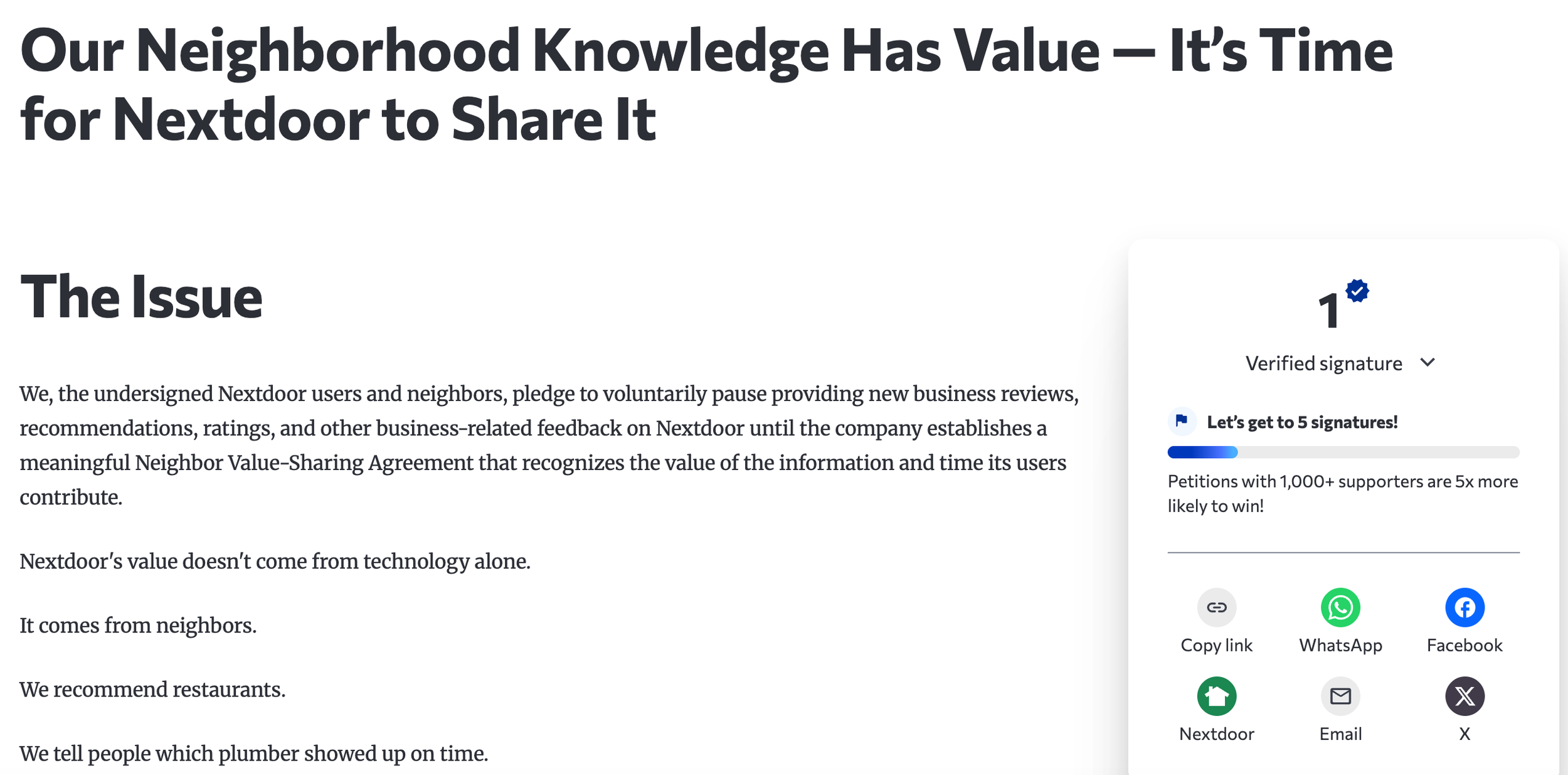
The Petition Is Live: Our Information Has Value
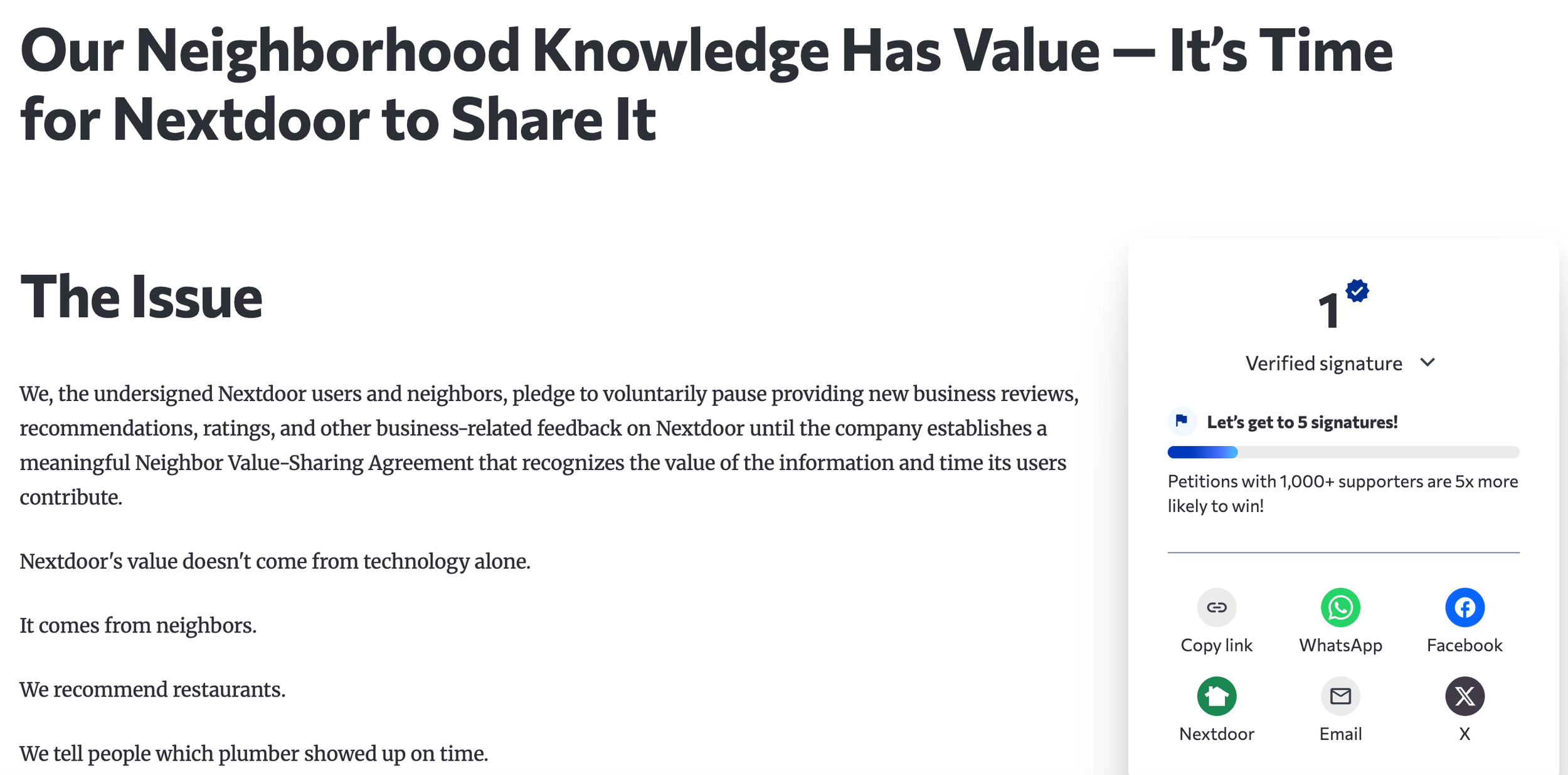
I have a radical idea—and now there's a petition behind it.
For years, Nextdoor neighbors have voluntarily created reviews, recommendations, answers, and other hyperlocal information that helps make the platform useful.
As that accumulated knowledge becomes potentially even more valuable through AI and other commercial products, I think it's time to ask:
If neighbors help create the value, should neighbors share in that value?
I've created a petition asking Nextdoor to establish a Neighbor Value-Sharing Agreement recognizing the time, knowledge, and information neighbors contribute.
Until that happens, the petition asks signers to pledge to pause providing new routine business reviews, recommendations, ratings, and other business-related feedback on Nextdoor.
This isn't about hurting local businesses or withholding emergency or safety information.
It's about recognizing something simple:
Our information has value.
Our recommendations have value.
Our time has value.
Please Sign—and Share It
If you agree, add your name:
Sign the Nextdoor Neighbor Value-Sharing petition
Then please share it with other Nextdoor users, neighbors, small-business owners, and anyone interested in how platforms use and monetize user-generated information.
One signature starts a conversation.
Enough signatures might make that conversation difficult to ignore.
I Have a Radical Idea: If Our Information Has Value, Maybe We Should Get Paid for It
Hear me out.
While doing my usual posting reach this morning, I came across a LinkedIn clip featuring Nextdoor CEO Nirav Tolia.outine
Apparently, Nirav is back on the podcast prowl.
Maybe it's because NXDR has been having a better stretch lately. Maybe not. I can't know the reason, so I'll leave that one alone.
But something Nirav said caught my attention.
He talked about Nextdoor having 16 years of local knowledge and using AI to package that information into something resembling a neighborhood version of ChatGPT. He emphasized that the information comes from real, verified neighbors and said:
“We have the distribution, we have the unique content.” LinkedIn
That's when a radical idea popped into my head.
What if the neighbors started thinking of that “unique content” as ours?
Who Created Those 16 Years of Local Knowledge?
Nextdoor built the platform.
I'll give them that.
They built the technology. They maintain the infrastructure. They developed the distribution. They attracted advertisers. They employ people. They have shareholders—including me—who expect the company to create value eventually
.
But who created those 16 years of neighborhood knowledge Nirav is talking about?
Neighbors did.
We wrote the restaurant recommendations.
We answered:
“Does anybody know a good plumber?”
We explained which mechanic we trusted.
We posted about missing dogs.
We recommended roofers.
We warned people about road closures.
We answered questions about neighborhoods.
We reviewed local businesses.
We told everyone where to find the best pizza.
We debated whether that sound was fireworks, gunshots, or somebody dropping a refrigerator.
And, of course, we conducted thousands upon thousands of neighborhood investigations into the most important issue facing America:
Whose dog left that poop?
😂
Individually, those posts may seem insignificant.
Collectively?
Apparently they're 16 years of unique local knowledge valuable enough to become part of Nextdoor's AI strategy.
Nextdoor itself describes its newer Ask experience as providing summarized recommendations from neighbors. Nextdoor
That changes the way I think about what neighbors are contributing.
Maybe We Should Take Our Information Back
I'm not suggesting people literally own every fact, recommendation, or conversation once it's posted online; the legal rights around platform content are governed by the service's terms and applicable law.
I'm talking about something different:
Recognizing the economic value of our participation.
If my recommendation helps create a dataset that makes Nextdoor more valuable, my recommendation has value.
If I spend five minutes answering another neighbor's question, my time has value.
If thousands—or millions—of neighbors do that repeatedly for years, the resulting body of information has enormous potential value.
That's essentially what makes a network like Nextdoor useful.
Without neighbors contributing information, what's left?
A very sophisticated map with advertisements.
Think About Market Research
Companies routinely pay people to participate in research.
Focus groups.
Consumer panels.
Product testing.
Surveys.
Interviews.
Why?
Because people's experiences, preferences, and opinions have value.
Someone asks:
“Which home insurance company do you use?”
That's data.
“Would you consider switching?”
Data.
“Who's the best plumber around here?”
Data.
“Which restaurant has the best burger?”
Data.
“Which contractor would you never hire again?”
Data.
When I participate in a formal market-research study, somebody may compensate me because my time and opinion are part of the product being created.
But when neighbors collectively produce years of incredibly specific hyperlocal information?
We call that engagement.
Interesting distinction.
Maybe There Should Be a Neighbor Dividend
Now we're getting radical.
What if platforms found ways to share some of the economic value created from user contributions?
It doesn't necessarily have to mean Nextdoor sends me $1.37 every time I recommend a Chinese restaurant.
Although I'm listening, Nirav.
😂
Imagine contribution credits.
Premium-feature credits.
Advertising credits for neighbors who own businesses.
Revenue-sharing pools for certain commercial uses of community-generated insights.
Opt-in research panels where neighbors are compensated when their responses are packaged into commercial research.
Or even a clearly defined rewards program recognizing people whose contributions consistently create useful information.are worth exploring.
Plenty of models
The principle is more interesting than any specific mechanism:
If community-generated knowledge becomes a commercial asset, should the community participate in the value it creates?
That's a conversation I'd love to have.
Because Nextdoor Is Monetizing the Network
There's nothing inherently wrong with that.
Nextdoor is a business.
I'm a shareholder. I want Nextdoor to make money.
Nextdoor sells advertising products to businesses and has expanded its commercial offerings over the years. Its newest small-business initiatives include free Business Pages and forthcoming feed participation, while Opportunity Alerts is explicitly a paid product that routes requests from verified neighbors to local service providers. Nextdoor
That's a business model.
But look at what's happening economically.
A neighbor asks:
“Does anybody know a good landscaper?”
The neighbor created the demand signal.
Other neighbors may create recommendations.
Nextdoor owns the platform where the interaction occurs.
And now a local service provider can pay Nextdoor for an opportunity to respond quickly to that demand. Nextdoor
Again, that's not inherently improper.
But it's certainly worth examining.
Because the small business is potentially paying.
The advertiser is paying.
Nextdoor is monetizing.
And the neighbors generating the underlying conversation?
They're providing the raw material.
So Who Is Squeezing Whom?
I've already provided plenty of feedback about what I see as Nextdoor increasingly squeezing small businesses for revenue.
To be fair, Nextdoor also provides free business tools, and the company says businesses can claim a Business Page at no cost. Nextdoor
But the company is simultaneously building more ways to monetize access to neighborhood demand.
Now Nirav is talking publicly about another incredibly valuable asset:
16 years of local knowledge.
Our knowledge.
Our conversations.
Our recommendations.
Our questions.
Our experiences.
Our time.
If Nextdoor's future AI products become more valuable because they can package years of neighbor-generated knowledge, I think neighbors have every right to ask:
What's our part of the value equation?
“We Have the Unique Content”
I keep coming back to that phrase.
“We have the unique content.” LinkedIn
From a corporate perspective, I understand exactly what Nirav means.
Nextdoor has accumulated something competitors can't easily recreate: years of geographically specific conversations from people connected to actual neighborhoods.
That's potentially a formidable competitive advantage.
But from the neighbor's side, I hear something else:
We created the unique content.
Nextdoor collected it.
Organized it.
Distributed it.
Stored it.
And now AI may make it dramatically easier to extract value from it.
That's why I think the conversation needs to evolve beyond:
“Isn't this a cool AI feature?”
It should also include:
Who created the knowledge?
How is it being used?
How transparent is that use?
Who benefits financially?
Should contributors share in any of that benefit?
Those are much more interesting questions.
Maybe Our Posts Aren’t Free Raw Material
For years, social media trained us to think the transaction was simple:
We get a free platform.
The platform gets our attention.
Advertisers pay for access to that attention.
Fair enough.
AI complicates that bargain.
Our contributions aren't merely something displayed between advertisements anymore.
Years of human conversations can become a knowledge base from which new products are created.
That's different.
And if platforms increasingly treat human-generated information as an asset that can power AI products, perhaps users should increasingly treat their contributions as assets too.
My time isn't worthless because I typed it into an app.
Neither is yours.
Here's My Radical Idea
Nextdoor wants authentic human knowledge.
Neighbors have it.
Nextdoor wants unique local content.
Neighbors create it.
Nextdoor wants businesses to pay to reach neighborhood demand.
Neighbors generate much of that demand.
Nextdoor wants AI to package years of community knowledge into something increasingly useful.
Neighbors spent 16 years building that knowledge base.
So perhaps the next evolution of the neighborhood network shouldn't simply be:
How can Nextdoor monetize neighbors more effectively?
Maybe it should also be:
How can neighbors participate in the value they're helping create?
Pay us for opt-in research.
Reward valuable contributions.
Create meaningful incentives.
Give people greater visibility and control over how their contributions feed commercial products.
Experiment with revenue sharing.
Treat neighbors not merely as users, but as participants in the economic ecosystem.
Because there's an uncomfortable irony in squeezing small businesses for more revenue while simultaneously discovering new ways to extract value from the knowledge neighbors contribute.
The AI Revolution Might Change More Than Search
Nirav may be right that Nextdoor possesses something enormously valuable in an AI world.
AI can summarize the internet.
But Nextdoor potentially has something different:
Hyperlocal human experience.
That's valuable.
Very valuable.
Which is exactly why neighbors should start thinking differently about it.
The next time an app asks:
“Can anyone recommend a good roofer?”
Maybe don't just think:
"I'll help my neighbor."
Think about this too:
I'm contributing another piece to a commercial knowledge network.
Helping your neighbor and understanding the economic value of your contribution aren't mutually exclusive.
Our information has value.
Our experiences have value.
Our recommendations have value.
And our time has value.
If Nextdoor's future is built on 16 years of knowledge from real neighbors, maybe the neighbors who created that knowledge deserve a seat at the table when its value is realized.
Now that would be a radical neighborhood conversation.
Read the continuing Nextdoor case study at NielFlamm.com/blog.
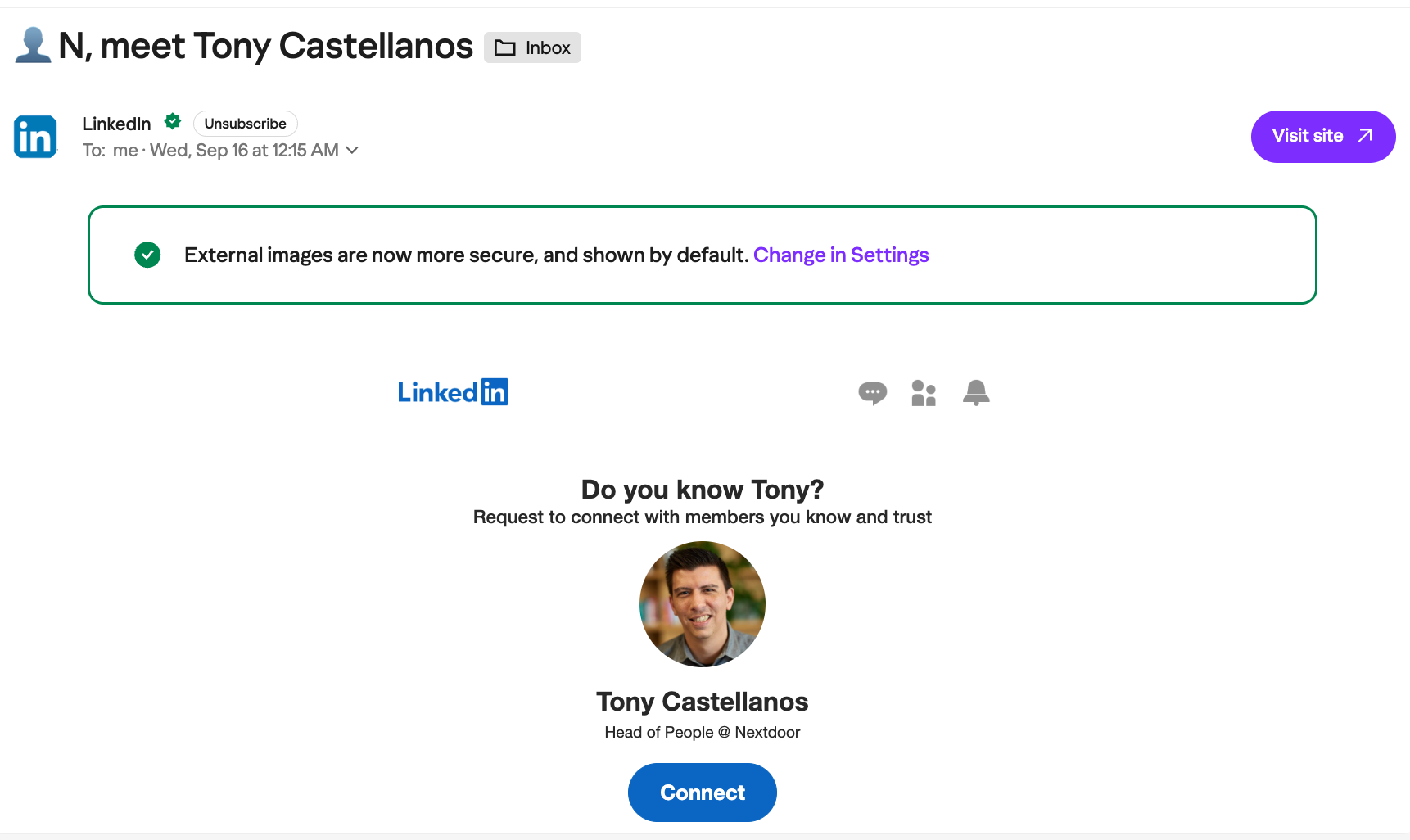
Day 94: LinkedIn Thinks I Should Meet Nextdoor’s Head of People. I Agree.
Sometimes an algorithm has impeccable timing.
At 12:15 this morning, I received an email from LinkedIn with the subject line:
“N, meet Tony Castellanos.”
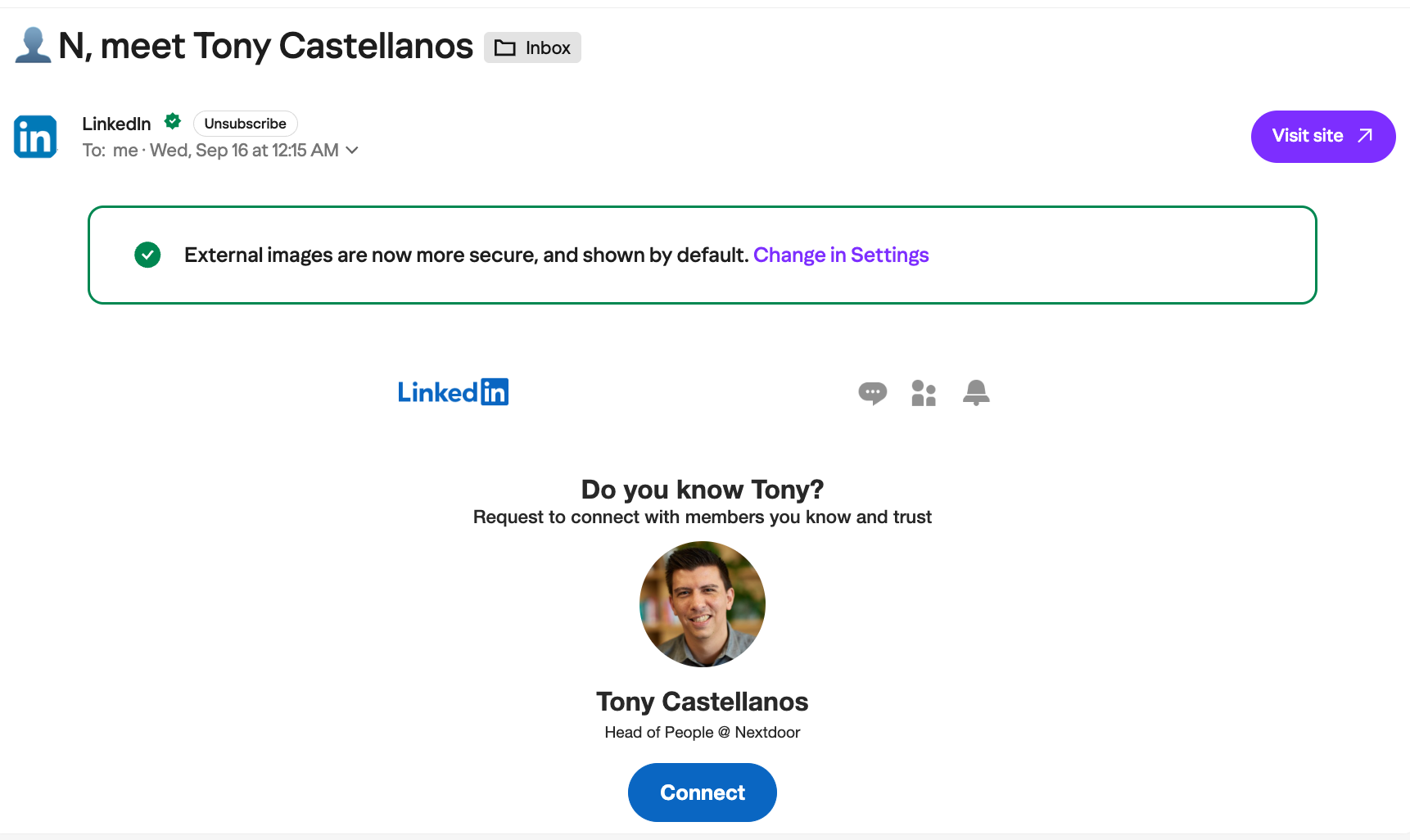
LinkedIn asked:
“Do you know Tony?”
Well, LinkedIn, not exactly.
But after 94 days, I would absolutely love to get to know him.

Tony Castellanos is Nextdoor’s Executive Vice President, People. Nextdoor promoted him to that position in March, giving him responsibility for its People organization, including talent acquisition, compensation, HR business partnering, and benefits. Nextdoor also describes the People function under his leadership as a strategic advisory organization that partners with senior leaders on important talent and organizational decisions. Nextdoor
So LinkedIn, your recommendation got me thinking.
Tony, Want to Have a Virtual Coffee?
I've tagged Tony a few times during this ongoing Nextdoor case study.
I may have even included him on an email or two. After 94 days, the distribution list has gotten a little crowded.
But this isn't about blaming Tony for my unanswered request.
He's not running Nextdoor Insights.
He didn't publish the Home Insurance research.
He's not responsible for sending me the data.
And I wouldn't expect the Head of People to suddenly open a spreadsheet and say:
“Niel, good news. I found your missing insurance study!”
That's not his job.
But the email made me think about something bigger.
What Does the Head of People Think?
My original request remains remarkably simple.
Nextdoor published an Insights article telling readers that they could reach out for detailed data, additional audience segments, and strategic recommendations.
I reached out.
And today is Day 94.
So I'd genuinely be interested in Tony's perspective—not necessarily on where the spreadsheet is, but on what happens organizationally when something like this continues for more than three months.
What does Nextdoor's Head of People think when a shareholder responds to a publicly advertised invitation for information and, 94 days later, still hasn't received the requested material or a definitive explanation that it isn't available?
Does he see a communication problem?
A process problem?
An ownership problem?
An escalation problem?
A training problem?
Or does he look at the situation and think Nextdoor has handled it appropriately?
I'd actually like to know.
And Then There’s Risk
This is where the People perspective becomes especially interesting.
I'm not suggesting that Tony is Nextdoor's chief risk officer, general counsel, or head of investor relations. He's not.
But senior People leaders often have a broad view of organizational behavior, leadership practices, and how internal decisions can affect employees and the business.
Nextdoor itself says Tony's People organization is designed to operate as a strategic advisor to the business. Nextdoor
So from that perspective, I'd be curious about his thoughts on organizational risk.
Not because I am declaring that Nextdoor has created some specific legal liability. That's a different question for lawyers.
I'm talking about something much more basic.
What happens when a small problem is allowed to become a 94-day problem?
The original request could have been resolved with a few sentences:
Yes, here's the data.
No, we can't provide it.
It's restricted, and here are the requirements.
That language in the article was incorrect.
Someone else handles these requests.
Any one of those would have provided closure.
Instead, we're on Day 94.
This Is Becoming a Case Study in Organizational Behavior
That's one of the reasons I've remained fascinated by this.
The longer it goes, the less interesting the actual research data becomes.
The organizational response becomes the story.
Who owns the question?
Who notices when something falls through the cracks?
Who has the authority to resolve it?
When does somebody say, “Why are we still dealing with this?”
How does feedback move through the organization?
Does escalation produce resolution—or another layer of silence?
Those are People questions.
They're also leadership questions.
And they're exactly the kinds of questions that fascinate me after more than two decades working in Learning & Development.
Sometimes what looks like a knowledge problem is really a performance problem.
Sometimes what looks like a communication problem is really an ownership problem.
And sometimes an issue survives for 94 days because nobody has decided it's their job to end it.
Tony Has Talked About Human Judgment
There's another reason LinkedIn's recommendation made me smile.
Nextdoor has recently highlighted Tony's work bringing AI into its People organization. The company says the goal is to use technology for transactional work while letting people spend more time on work that requires human judgment. Nextdoor
I actually like that philosophy.
And this seems like a pretty good opportunity for some human judgment.
Forget AI.
Forget another automated workflow.
Forget another corporate process.
A human being could probably resolve this.
Maybe over coffee.
So Yes, LinkedIn. I’d Like to Meet Tony.
LinkedIn apparently thinks Tony Castellanos and I should know each other.
I'm willing.
Tony, if you happen to see this, the invitation is sincere.
Phone.
Video.
Virtual coffee.
I'll even buy my own coffee.
I don't expect you to personally produce the Insights data. I'd simply be fascinated to hear how someone responsible for Nextdoor's People organization views what has now become a 94-day customer/shareholder communication journey.
What worked?
What didn't?
Where should ownership have existed?
What organizational risks can emerge when relatively simple questions remain unresolved?
And perhaps most importantly:
How would you prevent Day 94 from becoming Day 100?
Because tomorrow, unless something changes, there will be a Day 95.
Thanks for the introduction, LinkedIn.
Tony, the coffee invitation is open.
Follow the continuing case study at NielFlamm.com/blog.

I Can't Wait to See This... Which Is Exactly What Worries Me

Okay...
I REALLY want to see this.
The trailer absolutely did its job. I'm interested, I'm intrigued, and I'm already wondering when I can watch the whole thing.
But I have two concerns.
First:
Did I miss any of the good parts?
We've all watched fantastic trailers, only to discover later that someone basically took the best four minutes of the movie, chopped them into a two-minute trailer, and saved us the trouble of watching the rest.
I'm hoping that's NOT what happened here.
My second concern?
Please don't go the Backrooms route.
Some of the producers involved here are also connected with Backrooms, so I'm hoping this one gives me a very different experience.
For now, though, the trailer has me.
I'm absolutely planning to watch this one.
Hopefully, when it's over, I'll be saying:
“That trailer didn't even show us the best parts.”
And not:
“Well... I guess I already saw the movie.”
🎬 Watch the trailer:
https://www.youtube.com/watch?v=-mnTITqqiT0
I'll definitely have more to say after I see it.
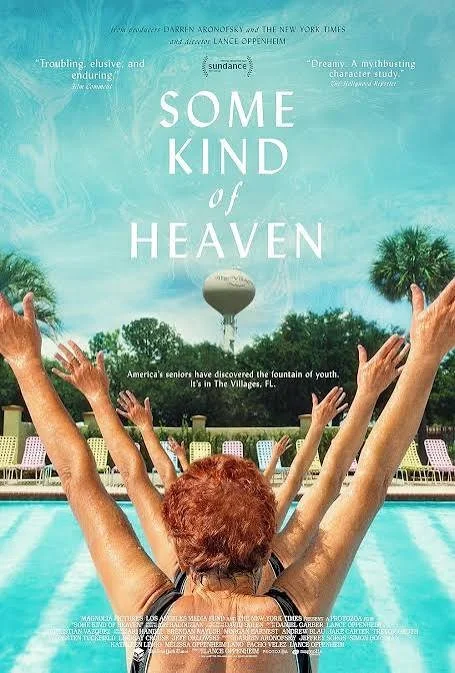
Some Kind of Heaven: I Came for The Villages, I Got The Real World
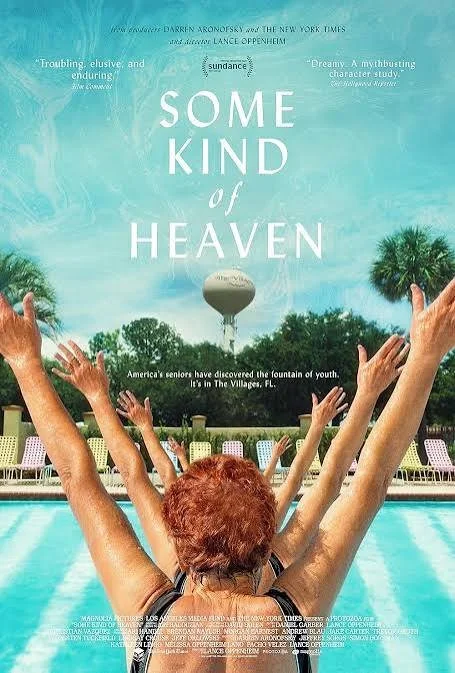
The Villages comes up surprisingly often during our twice-weekly fraternity Zooms.
Golf carts. Senior spring break. The gates. Fictional local history. And, of course...
THE LOOFAHS.
So when the algorithm suggested the 2020 documentary Some Heaven, I figured I'd finally learn what the hell is actually going on inside this massive Florida retirement community.
I didn't.
Instead, I basically got MTV's The Real World with golf carts.
The documentary follows several people dealing with relationships, loneliness, addiction, money, loss, and finding meaning later in life. The Villages is there, but it's more of a backdrop than the main character.
That's not necessarily bad—it just wasn't the documentary I expected.
So, is Some Kind of Heaven worth 81 minutes of your time?
And more importantly...
WHAT ABOUT THE LOOFAHS?
🎬 Watch my full review at NielFlamm.com/videos/moviereviews