
Today started a little later than usual. It was after noon before I got moving. My body told me it needed the rest, and since I didn't have anywhere I needed to be right away, I listened. Sometimes that's the smartest thing you can do.
I finally got cleaned up (I haven't shaved in three days), hopped in the car, washed it, and headed to Costco to pick up one quick item. I was also thinking about grabbing an inexpensive lunch, but the line at the food counter was longer than I wanted to deal with.
Next stop: the skilled nursing facility to visit Mom.
When I arrived, a couple of CNAs or techs were taking her vitals. Everything seemed routine enough. Then the conversation started.
"The people here are mistreating me."
I've heard this song before. I entertained it for a moment, but it didn't take long for the conversation to go in several different directions. And that's when I decided we needed to have a difficult conversation.
So, buckle in. Here we go.
The conversation nobody wants to have
I told Mom that her current situation didn't happen overnight, and it didn't happen because someone randomly decided to put her in a skilled nursing facility.
For at least five years, she hadn't been seeing a doctor or taking medication. I asked her repeatedly:
"Did you see a doctor or take medication during those five years?"
The answer kept changing directions. First, it was about my father. Then it was about the facility. Then something else.
I brought it back to the question.
Eventually, I got the answer: "No."
My next question was simple:
"What did you expect to happen?"
Her answer? "Not this."
Well, I don't think anyone expects to have two strokes, potentially some smaller ones, and end up needing skilled nursing care. But medical consequences don't always arrive with a convenient warning label.
I also reminded her that the peaceful, comfortable ending we see portrayed in movies isn't necessarily how life works. Sometimes things get complicated. Sometimes the consequences are difficult, and sometimes they change just about everything.

The loss of autonomy
Mom told me she "just wants to be comfortable."
I understand that. Who doesn't?
But I also tried to explain something she doesn't seem to want to accept: she's lost a significant amount of independence and autonomy.
I compared the experience to being in a medical jail or prison. Not literally, of course, but in terms of how much control she has over her daily schedule.
In a skilled nursing facility, routines run the show. Meals happen at certain times. Showers, medications, therapy, activities, and even opportunities to go outside are often scheduled around staffing and the needs of the entire facility.
It's not like being home, where you can decide to make a sandwich at 10 p.m., take a shower whenever you feel like it, or change your plans because you don't feel like doing something.
Mom responded that she didn't know because she'd "never been to jail."
Fair enough. That statement would become interesting a little later.
My point was that she needs to recognize how she got here. I told her that she has to stop fighting the reality of her situation and blaming everyone else for it.
Acceptance: Something I learned in recovery
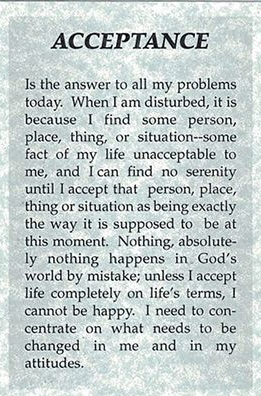
A concept in the recovery literature has stuck with me. It's on page 417, and it's about acceptance.
The idea is that acceptance can change the way we experience life. It doesn't mean we like everything that happens. It doesn't mean we approve of it. It means we stop fighting reality and start working with what is actually in front of us.
I explained to Mom that I could spend my days blaming other people for my above-the-knee amputation and my end-stage renal disease.
I could point fingers. I could complain about everything that happened. I could spend my time wishing my life were different.
But where would that get me?
My own decisions, and things I didn't do, contributed to where I am today. Once I began accepting my circumstances, life became easier to navigate. I found more peace and serenity.
I don't have to like dialysis. I don't have to like being an amputee. I don't have to enjoy the limitations that come with my medical situation.
But I can accept that this is my life today.
Not the life I had before. Not the life I wish I had—the life I have today.
And that distinction makes a difference.
I want Mom to understand that acceptance doesn't mean giving up. It means acknowledging where you are so you can figure out what to do next.
The jail conversation takes an interesting turn.
Mom then mentioned that she had thrown up and that nobody did anything about it.
I asked her, "Did you ask for a doctor?"
She said it would take two days.
"How do you know? Did you ask for one?"
Then came the response:
"They come faster in jail."
Wait a minute.
A few minutes earlier, she told me she didn't know anything about jail because she'd never been there. Now she's apparently familiar with the response times for medical care in correctional facilities?
This is where I brought up something I've discussed with her before: she tends to tell stories and embellish things. Sometimes the details change depending on where the conversation goes.
She says she doesn't make things up. I disagree.
I'm not going to pretend I know exactly why she does it. Still, when the stories keep changing, it becomes difficult to have a productive conversation about what is actually happening.
And that's frustrating, especially when we're trying to make decisions about her care.
Of course, if she's feeling sick or has thrown up, that deserves attention. I don't want legitimate medical concerns dismissed because of disagreements about the facility. Those things need to be reported to the nursing staff and addressed.
But we also need to separate an actual concern from a story that changes every time we discuss it.
The search for a place where everything is perfect
We eventually circled back to Mom saying that all she wants is to be happy.
I've told her before, and I'll say it again: she is never going to be 100% happy wherever she goes.
No facility will be exactly what she wants. The food won't always be perfect. The temperature might be too warm or too cold. The staff won't always arrive the second she presses the call button. There will be noise, lighting issues, schedules, and activities she doesn't like.
She tells me she's "not picky."
Folks, she is.
She complains about the food, the staff, the temperature, the lighting, the noise, the gym, and just about anything else that comes up. At some point, we have to acknowledge that the problem might not be entirely about the building or the people working there.
I keep coming back to the same word: acceptance.
I asked her where she wanted to go. Instead of answering, she went off on another tangent about my father.
And that's when I explained something else.
I've spent time researching and visiting assisted living facilities. I've put effort into figuring out what might work. I've been trying to find a place where she can have more independence and receive the support she needs.
But I cannot guarantee that she'll be happy there.
I can't promise that the food will be perfect, the staff will be perfect, the temperature will be perfect, or that every day will meet her expectations.
I can help find a place. I cannot manufacture happiness.

The decision is now hers.
I have an appointment with my father this Thursday to work on establishing a trust so that funds can be used to pay for Mom's assisted living care.
This is a step toward making a transition possible. It's not about me getting money. It's about making sure the money is available for Mom's housing, care, and related expenses.
But I also told Mom that she needs to decide what she actually wants.
If she doesn't want to move to assisted living, she needs to tell me.
If she doesn't want any of this, then she can come home. From a practical standpoint, that would actually be easier for me. I wouldn't have to keep driving around, touring facilities, researching options, and coordinating another move.
I don't mind visiting her. I don't mind helping her. But I do need her to participate in the process.
I cannot spend all this time trying to arrange a better living situation if she's not willing to consider it or make a decision.
I told her she has until Tuesday, when I don't have dialysis, to decide.
That's the deadline I've given her.
Acceptance applies to me, too.
Here's the part I have to remind myself about.
Acceptance isn't just something I'm asking Mom to practice. It applies to me, too.
I have to accept that I cannot control what she says, what she thinks, what she complains about, or whether she decides to move.
I can provide information. I can research facilities. I can help arrange the finances. I can visit. I can listen.
But I cannot make her accept her circumstances.
I also have to accept that my life has limitations. Between dialysis, my own medical needs, and everything else happening, I have to be mindful of how much I take on.
I want to help Mom. I want her to have a comfortable place to live and the best quality of life possible under the circumstances.
But I also need to maintain some peace in my own life.
And sometimes that means having a difficult conversation, setting a deadline, and letting someone else decide what happens next.
So, Mom has until Tuesday.
Thursday, Dad and I have the appointment about the trust.
What happens next? Well, that's still to be determined.
Stay tuned. This story isn't over.
