
From Carrying Groceries Home to Fighting for Independence: Watching Mom Change
I'm at the skilled nursing facility, spending a bit of time with Mom. We're outside right now, enjoying some fresh air and talking.
This morning reinforced a decision I made a long time ago: I was right not to pursue a career in healthcare. I don't think I have the personality for it.
And that's not a criticism of people who work in healthcare. Quite the opposite. Watching what the CNAs, nurses, and physical therapists do has given me a greater appreciation for the patience required to do their jobs.
Because it’s an easy patient.
She's difficult. She's demanding. And when she wants something, she makes sure everyone knows it.
I'm pretty much the opposite.
"I Want"
While talking with Mom, I noticed how often she uses those two words: "I want."
She wants to get out of the day room. She doesn't want to spend her time sitting there. She wants to go to the physical therapy gym.
I understand it.
The day room sounds like a prison to her. She's in a facility where other people have schedules, where she depends on staff to help her move around, and where she can't simply get up and do whatever she wants whenever she wants.
And when you think about it, that's a significant loss of independence.
I want things, too. We all do. The difference is that I'm generally more inclined to work around circumstances rather than keep pushing until I get what I want.
Mom has a different approach.
Sometimes I get frustrated with her demands. Then I have to remind myself that she's the one living there. She has to spend her days in that environment. What feels like another complaint to me might represent something much bigger to her.
That doesn't mean we can meet every demand immediately. The staff has other patients to care for, and practical limitations limit what can happen.
But I can understand why Mom wants more control over her day.
The Woman I Remember
What's particularly difficult is remembering the woman Mom used to be.
I remember seeing her carry groceries from Post Avenue in Westbury, New York, to our house. It was only three or four blocks, but she made that trip with the groceries she had purchased for our family.
That was the Mom I knew.
She went out, did what needed to be done, and brought the groceries home.
Today, she's in a skilled nursing facility. Her mobility is limited; she needs help, and she wants to get to the physical therapy gym to get stronger.
It's sad to see that change.
I'm not suggesting that the woman I remember has disappeared. She's still Mom. She still has opinions, preferences, and a very clear idea of what she wants.
But the circumstances of her life have changed dramatically.
The woman who once carried groceries home now has to depend on other people to help her get where she wants to go.
And I imagine that's frustrating for her in ways I can't fully appreciate.

A New Appreciation for Healthcare Workers
This is also why I know I made the right decision not to pursue a healthcare career.
I can help Mom. I can visit, advocate for her, ask questions, and try to help her figure out the next chapter of her life.
But can I handle the demands of patient care all day, every day? That's a different story.
Healthcare workers have to balance compassion with practical realities. They need patience, resilience, and the ability to deal with people who may be frightened, frustrated, demanding, or simply unhappy with their circumstances.
I don't think I could do that job well enough to make it my career.
I have limits, and recognizing them matters.
It also makes me appreciate the people who show up and do this work every day.
What Comes Next?
Mom wants to leave the skilled nursing facility and move into assisted living. I'm continuing to explore options and figure out what might work for her.
But beneath all the complaints about the day room, the food, and getting to physical therapy, I want to see past something.
Mom wants to’.
Mom wants to have some control over her life again.
I want things, too. I want her to be safe. I want her to have the opportunity to regain as much independence as possible. And I want to help her find a living situation where she can have a better quality of life.
Those goals don't always align with what she wants in the moment, and there will undoubtedly be harder conversations.
For now, we're outside together.
I'm listening, thinking, and writing.
And I'm remembering those trips from the grocery store on Post Avenue to our house in Westbury.
Life can change in ways none of us anticipate. Sometimes the hardest part isn't figuring out what to do next. It's accepting how much has changed while still trying to help someone move forward.
That's where I am today: sitting outside with Mom, remembering who she was, seeing who she is now, and hoping for what's possible next.
What I Can See, What I Can’t Control
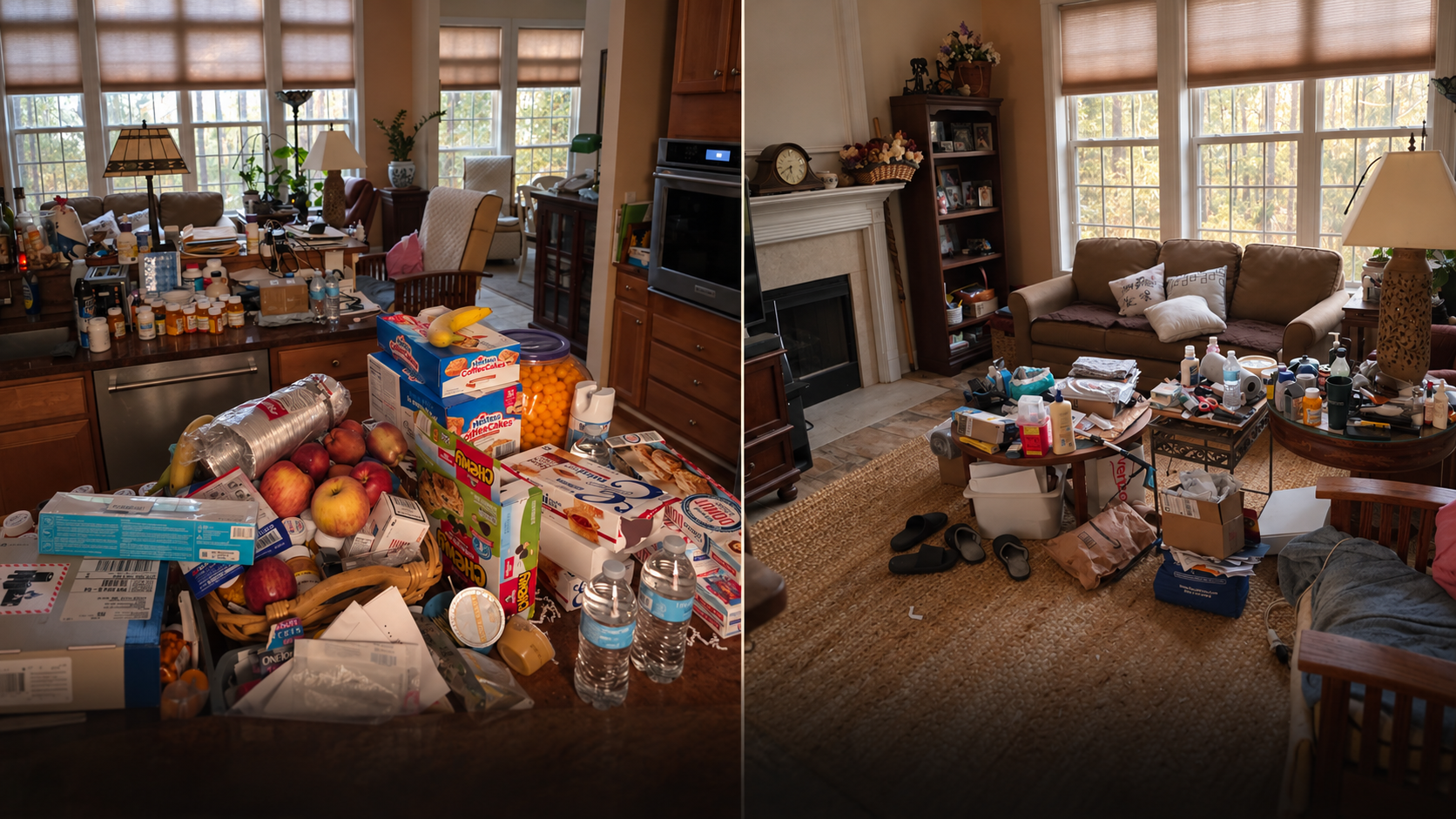
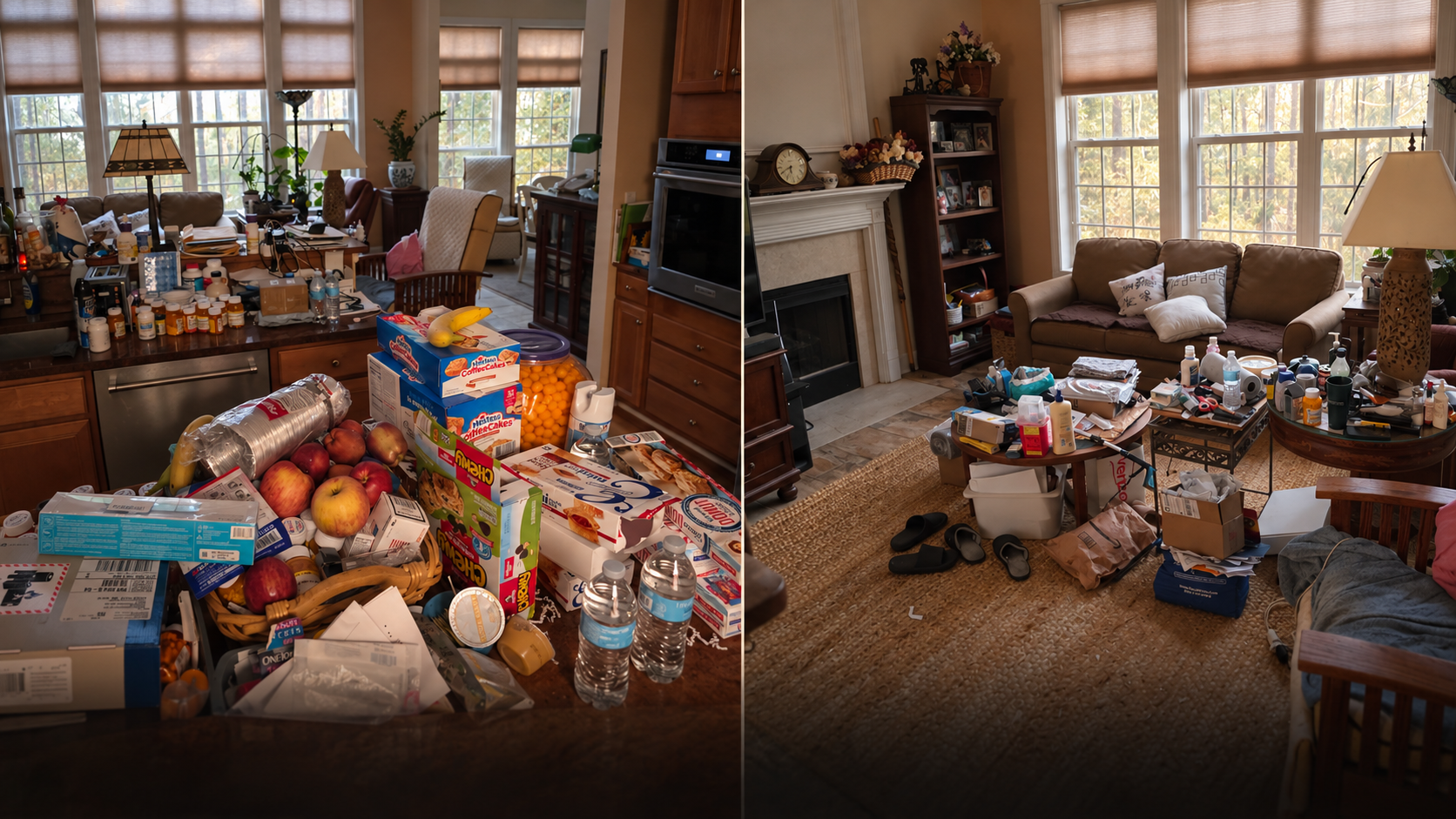
I’ve written before about the struggle with my mother and her second stroke, about setting boundaries with my father, and most recently about the way his home is becoming more cluttered. I want to share what I’ve been noticing—and what I’m learning to do with it.
I’m an alcoholic in recovery. I’ve been sober for 17 years. I believe I’ve always had an addictive mind. Alcohol was my main way of dealing with life—or avoiding it—but food, television, and other things could take hold, too. At one point, I weighed at least 350 pounds. I say “at least” because that’s where the scale stopped.
I understand that alcoholism is a disease, and that genetics can play a part. We inherit genes from both parents. But recovery has also taught me not to point fingers or label someone else. Only a person can identify their own addiction. I can speak about my experience and notice similarities, but I can’t diagnose my father.
For a long time, I’ve noticed that he holds on to things “just in case.” There are expired medications, papers stacked near his computer that never seem to get looked at, and old mail. Lately, I’ve also noticed more processed food coming into the house through Amazon.
When my mother was living at home, she wouldn’t have bought this much junk food. Without her there, my father’s choices seem to be changing. I’m not going to police what he buys or try to manage his home.
This morning, I took a picture of the first floor—the kitchen and the TV area. It was never a Better Homes & Gardens photo, but it used to be tidier and stocked with healthier options. Seeing the difference was hard.
Still, noticing something doesn’t mean I can control it. I’ve set my boundary. My father’s choices are his to make, and my recovery and well-being are mine to protect.
It is what it is. I can care, be honest about what I see, and let go of what isn’t mine to manage.
A Leg Amputee Magnet
Somehow, I’ve become a magnet for leg amputees.
After my pain appointment, I visited a sister-assisted living facility in North Charleston, and as I made my way to the entrance, a resident caught up to me from behind. I don’t remember what he said first, but he noticed my prosthetic and mentioned he had one too. I was wearing shorts; he had on long pants. We chatted briefly, then he went on his way.
After touring the facility, I waited in the lobby for lunches I’d requested from the places I visited. Then another man rolled up. He also had an above-the-knee amputation. He mumbled something, showed me his residual limb, and rolled away.
Later, I delivered the lunches to Mom and waited in a main hallway. A resident who had approached me before asked how I drive. I shared my experience and offered a few suggestions.
Three encounters in one day, each with its own quick connection. I guess my prosthetic has become an unexpected conversation starter—and a way to meet people who understand a part of my life without needing much explanation.
Mom Is Making Progress—and Apparently I’m Her Husband Now
This morning after dialysis, I went to visit Mom at the skilled nursing facility.
When I got to her room, she wasn't there.
That's actually a good thing.
She was doing rehab.
I was told that Mom is making progress, which was great to hear. She still needs someone blocking her left leg because it continues to buckle, but progress is progress.
After everything that's happened, I'll take it.
Eventually, Mom made her way back to the room.
And that's when today's visit took a turn I wasn't prepared for.
There's a New Roommate
Mom got a new roommate on Saturday.
Her previous roommate, Jenny, left last Monday. I don't know the name of the new roommate yet, but I do know that she broke her hip, had surgery, and is now there recovering.
The new roommate came into the room while I was there.
There was some banter.
I'm not particularly good at banter, but I participated.
She mentioned that she's also hard of hearing, so apparently Mom and her new roommate already have something in common.
Everything was going fine.
Normal conversation.
Normal skilled nursing facility visit.
And then she looked at us and asked a question:
“Is that your husband?”
Excuse me?
I'm sorry.
What?
GROSS!!!!
I believe there are moments in life when the human brain protects itself by temporarily refusing to process information.
This was one of those moments.
Of all the possible relationships she could have guessed...
Son?
Nephew?
Relative?
Friend?
Random bald guy who wandered into the wrong room after dialysis?
Nope.
Husband.

I guess...Good for Mom?
Once I recovered from the initial trauma, I had another thought.
I guess that's a compliment to Mom?
Maybe?
Apparently, she looks young enough to be my husband.
Good for her.
Unfortunately, that means the other half of the equation is that I apparently look old enough to be married to my mother.
Not good for me.
I'm choosing to focus on Mom's rehab progress instead.
She's working.
She's improving.
Her left leg still needs support, but she's moving in the right direction.
She has a new roommate.
And apparently, sometime between dialysis and walking into the skilled nursing facility, I aged several decades.
Anyway, I'll be back.
I need a few minutes to clean the vomit out of my mouth.
Then maybe I'll introduce myself properly to the new roommate.
“Hi. I'm Niel. Her SON.”
Let's make sure we've got that established early.

Godspeed, Brooke Eby: A Spirit ALS Couldn’t Take
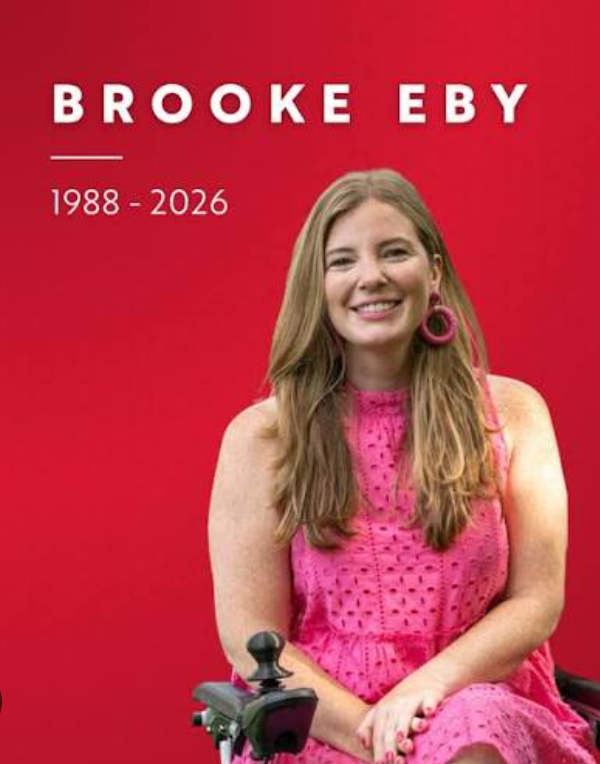
Today I learned that Brooke Eby died after her long journey with ALS, amyotrophic lateral sclerosis, commonly known as Lou Gehrig’s disease. She was only 37 years old. Brooke was diagnosed in 2022 after experiencing symptoms for years, and she eventually became an extraordinary advocate for people living with ALS. People.com
I didn't know Brooke personally.
But I felt like I knew a small piece of her because she was willing to let people like me into her life.
I came across Brooke through her social media posts under the name @LimpBroozkit. By the time I started following her, she was already using a wheelchair. I started watching her short videos, then went back, catching up on the journey that brought her there.
And I kept watching.
What ALS Takes Away
ALS is a progressive neurodegenerative disease that attacks the motor neurons in the brain and spinal cord—the nerve cells that control voluntary muscles.
As those motor neurons deteriorate and die, the brain gradually loses its ability to communicate with the muscles.
The muscles weaken. They atrophy. Movement becomes increasingly difficult.
Over time, ALS can take away a person's ability to walk, use their arms and hands, speak, swallow, eat, and eventually breathe independently. There is currently no cure that stops its progression. ALS Association
One of the things that makes ALS particularly cruel is that the beginning may not look like what most of us imagine a devastating neurological disease would look like. Early symptoms can include tripping, difficulty walking, dropping things, muscle cramps or twitching, weakness in an arm or leg, or changes in speech. ALS Association
Brooke's story made that real to me.
She talked openly about the symptoms that eventually led to her diagnosis—things that, had they happened to me, I don't know that I would immediately have connected with something as serious as ALS.
Then I watched what happened afterward.
The Wedding Story I Never Forgot
One of Brooke's stories especially resonated with me.
She talked about going to a wedding while struggling with everything that was happening to her body. She had to wear sneakers. She felt self-conscious. She wanted to leave the reception early.
A friend followed her.
Instead of letting Brooke disappear from the celebration, her friend encouraged her to stay.
Eventually, Brooke's walker became part of the party. People incorporated it into a makeshift limbo line.
Something that could have represented everything she was losing became, at least for that moment, part of the fun.
I understood that story in a way I wish I didn't.
After my amputation, I became incredibly self-conscious. There was depression. There was grief. There was sadness. I realized the body I had lived in for decades had permanently changed.
And I had to figure out how I was going to live in that changed body.
That's one reason Brooke's approach stayed with me.
She wasn't pretending ALS wasn't horrible.
She wasn't pretending she wasn't losing things.
She found a way to talk about those losses with humor, vulnerability, and transparency.
Then I Watched ALS Take More
During the last month or so, I noticed the changes becoming much more apparent.
Brooke needed a lift to transfer in and out of her wheelchair.
She was beginning to set up an eye-gaze communication system.
When she told stories, the animated movements of her arms and hands that had once accompanied her words were no longer there.
ALS kept taking.
Mobility.
Independence.
Movement.
Eventually, even speaking and swallowing became increasingly difficult. TMZ
But there was something ALS never seemed able to take.
Brooke.
Her personality was still there.
Her humor was still there.
Her willingness to tell the truth was still there.
Her desire to educate people was still there.
She didn't allow ALS to define her spirit.
A Quarter as Hard
I live with my own health challenges.
They aren't ALS, and I won't pretend they're comparable.
But watching Brooke changed how I think about living inside a body that doesn't always cooperate with the plans I have for it.
I've written openly about dialysis, kidney disease, losing my leg, prosthetics, surgeries, recovery, and all the strange little indignities that come along for the ride.
Sometimes I make jokes about them.
Sometimes I'm angry.
Sometimes I'm scared.
Sometimes I'm simply tired of dealing with it all.
And that's why Brooke's example meant something to me.
She showed that humor doesn't mean something isn't serious.
Being vulnerable doesn't mean being weak.
And acknowledging what a disease has taken doesn't require surrendering everything it hasn't.
I hope that whatever comes next in my own journey, I continue to fight even a quarter as hard to keep my spirit up as Brooke did throughout hers.
She deserved more time.
She deserved a different ending.
But in the time she had, Brooke made people laugh. She educated hundreds of thousands of people about a disease many of us knew little about. She created a community for people living with ALS and helped others feel less alone. The MoCo Show
And she made people like me stop scrolling long enough to think differently about our own lives.
I never met Brooke Eby.
I'm grateful she chose to share herself with the rest of us.
Godspeed, Brooke.
ALS took your body piece by piece. It never took your spirit.