
Acceptance Is a Tough Pill to Swallow: Mom, Assisted Living, and a Difficult Conversation
Today started a little later than usual. It was after noon before I got moving. My body told me it needed the rest, and since I didn't have anywhere I needed to be right away, I listened. Sometimes that's the smartest thing you can do.
I finally got cleaned up (I haven't shaved in three days), hopped in the car, washed it, and headed to Costco to pick up one quick item. I was also thinking about grabbing an inexpensive lunch, but the line at the food counter was longer than I wanted to deal with.
Next stop: the skilled nursing facility to visit Mom.
When I arrived, a couple of CNAs or techs were taking her vitals. Everything seemed routine enough. Then the conversation started.
"The people here are mistreating me."
I've heard this song before. I entertained it for a moment, but it didn't take long for the conversation to go in several different directions. And that's when I decided we needed to have a difficult conversation.
So, buckle in. Here we go.
The conversation nobody wants to have
I told Mom that her current situation didn't happen overnight, and it didn't happen because someone randomly decided to put her in a skilled nursing facility.
For at least five years, she hadn't been seeing a doctor or taking medication. I asked her repeatedly:
"Did you see a doctor or take medication during those five years?"
The answer kept changing directions. First, it was about my father. Then it was about the facility. Then something else.
I brought it back to the question.
Eventually, I got the answer: "No."
My next question was simple:
"What did you expect to happen?"
Her answer? "Not this."
Well, I don't think anyone expects to have two strokes, potentially some smaller ones, and end up needing skilled nursing care. But medical consequences don't always arrive with a convenient warning label.
I also reminded her that the peaceful, comfortable ending we see portrayed in movies isn't necessarily how life works. Sometimes things get complicated. Sometimes the consequences are difficult, and sometimes they change just about everything.

The loss of autonomy
Mom told me she "just wants to be comfortable."
I understand that. Who doesn't?
But I also tried to explain something she doesn't seem to want to accept: she's lost a significant amount of independence and autonomy.
I compared the experience to being in a medical jail or prison. Not literally, of course, but in terms of how much control she has over her daily schedule.
In a skilled nursing facility, routines run the show. Meals happen at certain times. Showers, medications, therapy, activities, and even opportunities to go outside are often scheduled around staffing and the needs of the entire facility.
It's not like being home, where you can decide to make a sandwich at 10 p.m., take a shower whenever you feel like it, or change your plans because you don't feel like doing something.
Mom responded that she didn't know because she'd "never been to jail."
Fair enough. That statement would become interesting a little later.
My point was that she needs to recognize how she got here. I told her that she has to stop fighting the reality of her situation and blaming everyone else for it.
Acceptance: Something I learned in recovery
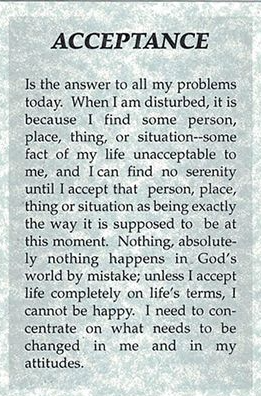
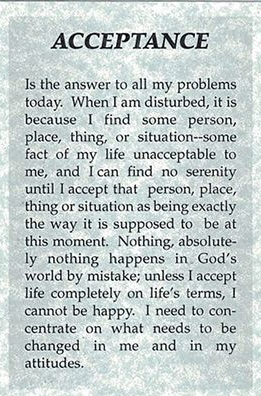
A concept in the recovery literature has stuck with me. It's on page 417, and it's about acceptance.
The idea is that acceptance can change the way we experience life. It doesn't mean we like everything that happens. It doesn't mean we approve of it. It means we stop fighting reality and start working with what is actually in front of us.
I explained to Mom that I could spend my days blaming other people for my above-the-knee amputation and my end-stage renal disease.
I could point fingers. I could complain about everything that happened. I could spend my time wishing my life were different.
But where would that get me?
My own decisions, and things I didn't do, contributed to where I am today. Once I began accepting my circumstances, life became easier to navigate. I found more peace and serenity.
I don't have to like dialysis. I don't have to like being an amputee. I don't have to enjoy the limitations that come with my medical situation.
But I can accept that this is my life today.
Not the life I had before. Not the life I wish I had—the life I have today.
And that distinction makes a difference.
I want Mom to understand that acceptance doesn't mean giving up. It means acknowledging where you are so you can figure out what to do next.
The jail conversation takes an interesting turn.
Mom then mentioned that she had thrown up and that nobody did anything about it.
I asked her, "Did you ask for a doctor?"
She said it would take two days.
"How do you know? Did you ask for one?"
Then came the response:
"They come faster in jail."
Wait a minute.
A few minutes earlier, she told me she didn't know anything about jail because she'd never been there. Now she's apparently familiar with the response times for medical care in correctional facilities?
This is where I brought up something I've discussed with her before: she tends to tell stories and embellish things. Sometimes the details change depending on where the conversation goes.
She says she doesn't make things up. I disagree.
I'm not going to pretend I know exactly why she does it. Still, when the stories keep changing, it becomes difficult to have a productive conversation about what is actually happening.
And that's frustrating, especially when we're trying to make decisions about her care.
Of course, if she's feeling sick or has thrown up, that deserves attention. I don't want legitimate medical concerns dismissed because of disagreements about the facility. Those things need to be reported to the nursing staff and addressed.
But we also need to separate an actual concern from a story that changes every time we discuss it.
The search for a place where everything is perfect
We eventually circled back to Mom saying that all she wants is to be happy.
I've told her before, and I'll say it again: she is never going to be 100% happy wherever she goes.
No facility will be exactly what she wants. The food won't always be perfect. The temperature might be too warm or too cold. The staff won't always arrive the second she presses the call button. There will be noise, lighting issues, schedules, and activities she doesn't like.
She tells me she's "not picky."
Folks, she is.
She complains about the food, the staff, the temperature, the lighting, the noise, the gym, and just about anything else that comes up. At some point, we have to acknowledge that the problem might not be entirely about the building or the people working there.
I keep coming back to the same word: acceptance.
I asked her where she wanted to go. Instead of answering, she went off on another tangent about my father.
And that's when I explained something else.
I've spent time researching and visiting assisted living facilities. I've put effort into figuring out what might work. I've been trying to find a place where she can have more independence and receive the support she needs.
But I cannot guarantee that she'll be happy there.
I can't promise that the food will be perfect, the staff will be perfect, the temperature will be perfect, or that every day will meet her expectations.
I can help find a place. I cannot manufacture happiness.

The decision is now hers.
I have an appointment with my father this Thursday to work on establishing a trust so that funds can be used to pay for Mom's assisted living care.
This is a step toward making a transition possible. It's not about me getting money. It's about making sure the money is available for Mom's housing, care, and related expenses.
But I also told Mom that she needs to decide what she actually wants.
If she doesn't want to move to assisted living, she needs to tell me.
If she doesn't want any of this, then she can come home. From a practical standpoint, that would actually be easier for me. I wouldn't have to keep driving around, touring facilities, researching options, and coordinating another move.
I don't mind visiting her. I don't mind helping her. But I do need her to participate in the process.
I cannot spend all this time trying to arrange a better living situation if she's not willing to consider it or make a decision.
I told her she has until Tuesday, when I don't have dialysis, to decide.
That's the deadline I've given her.
Acceptance applies to me, too.
Here's the part I have to remind myself about.
Acceptance isn't just something I'm asking Mom to practice. It applies to me, too.
I have to accept that I cannot control what she says, what she thinks, what she complains about, or whether she decides to move.
I can provide information. I can research facilities. I can help arrange the finances. I can visit. I can listen.
But I cannot make her accept her circumstances.
I also have to accept that my life has limitations. Between dialysis, my own medical needs, and everything else happening, I have to be mindful of how much I take on.
I want to help Mom. I want her to have a comfortable place to live and the best quality of life possible under the circumstances.
But I also need to maintain some peace in my own life.
And sometimes that means having a difficult conversation, setting a deadline, and letting someone else decide what happens next.
So, Mom has until Tuesday.
Thursday, Dad and I have the appointment about the trust.
What happens next? Well, that's still to be determined.
Stay tuned. This story isn't over.
Mom, Roommate Rumors, and the Art of Separating Fact from Fiction
So here I am again, sitting with Mom at the skilled nursing facility, having another conversation.
You never quite know where these conversations will go. Sometimes they're about her recovery, sometimes about what she wants to eat, and sometimes they take a few unexpected turns.
Today was no exception.
Wait, I Was There on Tuesday!
In a previous post, I mentioned that Mom told me I hadn't visited her in a week.
I reminded her that I had actually been there on Tuesday.
Then I remembered something else.
On that Tuesday visit, I handed her nurse, Coco, and her CNA, Heather, bottles of tequila I had picked up at the grocery store in Cozumel, Mexico, while on my cruise.
So, apparently, I wasn't just there. I was making deliveries!
I guess the tequila should have been a pretty memorable clue.
It's interesting how visit details can get lost or mixed up. I know institutional life can make the days blend together, but sometimes I wonder what Mom actually remembers.
The Story About Dotty
Then our conversation moved to her roommate, Dotty.
Mom started telling me that Dotty was dying.
Naturally, I asked how she knew.
Her explanation?
"Dotty isn't moving."
Well, that's quite a diagnosis.
Mom continued, explaining that Dotty would be at the skilled nursing facility forever. She also had plenty to say about Dotty's family, including that they didn't care about her.
There were other details and observations, too.
I listened, but I wasn't sure how much of what I was hearing was factual and how much was Mom's interpretation or imagination.
I told her something pretty straightforward:
I can't control what Dotty's family does.
I don't know their circumstances, their relationship with Dotty, or what's happening outside the facility. And neither does Mom necessarily.
There may be perfectly reasonable explanations for things she sees or doesn't see.
I don't want to turn every conversation into an investigation, but I also don't want to accept every story as fact.
Why Does Mom Make Things Up?
Here's where the conversation became a little more personal.
My mother tends to make things up.
Actually, calling it a tendency probably understates it. From my experience, it's something she does habitually.
I've noticed it over the years, and it can make conversations challenging because I sometimes find myself trying to figure out what's real, what's exaggerated, and what's been added along the way.
Today, I decided to ask her about it.
I tried to get to the root of why she does it.
First, I asked her whether she was trying to make me feel guilty.
After all, she had just reminded me that I supposedly hadn't visited in a week, even though I had been there Tuesday.
I wanted to know if there was some underlying reason for these stories or comments.
Her answer was no.
I explained that I don't feel guilty. I'm doing everything I can for her. In fact, I'm doing more than my best.
I'm visiting, advocating, researching assisted living facilities, dealing with financial arrangements, managing my own health, and trying to keep everything moving forward.
I can't manufacture more hours in the day.
I can't be in two places at once.
And I can't control everything that happens inside or outside the facility.
Then I asked another question.
Did she learn this behavior from her parents?
Again, she said no.
So much for my amateur attempt at family psychology!
I Hope I Don't Pick Up This Trait
The conversation left me thinking.
Why do people embellish stories? Why do they create narratives about other people? Is it attention? Is it a way of expressing frustration? Is it an attempt to make sense of circumstances they don't fully understand?
I don't have the answers.
And I certainly don't want to diagnose Mom based on conversations like these.
There could be several explanations, including changes in memory, perception, or cognition. Given everything she's been through medically, I think it's worth keeping an open mind rather than assuming every inaccurate statement is intentional.
Still, it can be frustrating.
Especially when I'm trying to have a straightforward conversation and suddenly find myself sorting through a collection of claims that may or may not be accurate.
And here's my biggest takeaway:
I hope I don't pick up this trait.
I already have enough going on without developing a habit of creating my own versions of events!
Another Day, Another Conversation
That's the thing about visiting Mom.
There are good moments, frustrating moments, funny moments, and conversations that leave me scratching my head.
I want her to recover as much as possible. I want her to have a good quality of life. I want to help her find the right living arrangement and make sure she has the resources she needs.
But I also have to recognize that I can't control everything she says, thinks, remembers, or believes.
I can listen.
I can ask questions.
I can clarify what I know.
And sometimes, I can simply change the subject.
And perhaps next time, I'll bring another bottle of tequila for Coco and Heather.
At least I know that part of Tuesday actually happened!
One thing is certain: life with Mom still provides plenty of material for the blog.
Breaking Out, Losing Track of Days, and the Importance of Showing Up: Another Visit with Mom
This morning was already shaping up to be busy.
I got the car washed, ran an errand, and was preparing to head to Bluffton, South Carolina, to pick up a nephew so we could see the new Godzilla movie.
But before all of that, I had one more stop to make.
Mom.
Was Mom Trying to Escape?
As I walked into the skilled nursing facility, I spotted Mom rolling toward the entrance/exit.
My first thought?
Was she trying to escape?
I couldn't really blame her.
When I was in a skilled nursing facility back in June 2023, I wanted out as quickly as possible. I couldn't leave fast enough. There's something about being in an institutional environment, having other people control your schedule, and depending on someone else for things you once did independently that can make you want to head for the nearest exit.
So perhaps Mom and I have something in common.
When I got to her, she mentioned that I hadn't been there for a week.
Well, that's interesting!
I had actually seen her on Tuesday after dialysis.
Apparently, the days are starting to run together for her.
And I can understand how that happens.
A Few Supplies for Mom
I didn't arrive empty-handed.
I brought her a few things to keep her occupied and comfortable:
Some magazines to read.
Three tubes of Pringles.
Bars of Ivory soap.
Yes, Ivory soap again!
Apparently, that's an important item on Mom's shopping list. When Mom requests something specific, I try to deliver.
After we talked for a bit, I took her outside so we could enjoy some fresh air.
We got her situated, and about five minutes later, a physical therapist appeared.
It was time for her physical therapy session.
The Hardest Working Woman Here
The physical therapist said something that caught my attention.
He described Mom as:
"The hardest working woman here."
He was excited to work with her.
That's encouraging to hear.
After everything she's been through, it's important to see her keep putting effort into rehabilitation.
Her recovery hasn't been easy, and there are still challenges with her mobility. But having someone on the rehabilitation team recognize her effort is encouraging.
It also brought back some memories of my own rehabilitation.
When I Didn't Want to Do the Work
I remember being in a skilled nursing facility myself.
Some days, I didn't particularly want to work toward a goal. In fact, I remember one day when I outright refused to participate in physical therapy.
Why?
I had developed a resentment toward the facility.
I wasn't happy with the circumstances, and that frustration carried over into my willingness to participate.
Looking back, that didn't do me any good.
The facility might not have been where I wanted to be, but refusing to work toward my recovery only hurt me.
Eventually, I had to recognize that the work I was doing wasn't for the facility, the therapists, or anyone else.
It was for me.
That's something I can relate to when I watch Mom working through her own rehabilitation.
She may not want to be there. She may want to roll toward the exit. She may have complaints about the food, the schedule, or just about everything else.
But the physical therapy is an investment in herself.
And hearing that she's working hard makes me happy.
I'll Be Back Tomorrow
Before leaving, I told Mom I'd be back tomorrow, Sunday.
It's easy to lose track of days in a place like this.
The routine becomes repetitive. Meals, medication, therapy, visitors, and waiting for the next activity. Before you know it, Tuesday feels like yesterday, and Sunday feels like another Tuesday.
I can imagine how difficult that must be.
That's one reason I try to keep visiting and letting her know when I'll be back.
Sometimes it's not about bringing something, fixing something, or having a major conversation.
Sometimes it's simply showing up.
Today, I brought magazines, Pringles, and Ivory soap. We got outside for a little while. She had physical therapy, and I heard she's working hard.
Then I headed off to Bluffton for my next adventure: a nephew, a movie, and Godzilla.
Life continues outside those facility walls.
And tomorrow, I'll be back.
Keep working, Mom. That physical therapist is excited to work with you, and I'm cheering you on, too.
After Dialysis, Assisted Living Tours and Complaints: I Need the Ocean and Bacon
Today was one of those days when my internal battery was already flashing red before I walked through the door.
After dialysis, I toured The Palms, an assisted living facility I'm considering for Mom.
Today's dialysis was a little more difficult than Monday's. By the time everything was finished, I didn't even make it to my recovery meeting.
Instead, I had another mission:
Deliver Mom's dinner.
Ham, grits, and peas.
Gross.
I'm sure someone loves that combination. That someone is not me.
So, after dialysis and touring The Palms, I headed over to the skilled nursing facility with Mom's meal.
And then the complaining began.
Apparently, Everything Is Terrible
It was nonstop.
The food.
Physical therapy.
Nursing.
This.
That.
Something else.
At times, Mom was saying things that, from my perspective, didn't line up with what had actually happened. I've experienced that before with both of my parents, and today I didn't have much energy left to sort through what was accurate, what was frustration, and what might have been something else entirely.
I could feel myself reaching my limit.
That's when H.A.L.T. popped into my head.
Hungry.
Angry.
Lonely.
Tired.
I was feeling three out of the four.
I'll let everyone guess which three.
Actually, don't think about it too hard.
The important part was recognizing what was happening before I allowed myself to get dragged into an argument that wasn't going to accomplish anything.
See You Tomorrow
I finally told Mom I was going to leave and that I'd see her tomorrow.
Tomorrow, I'm touring another assisted living facility.
Her response?
“Don't come.”
My response?
“See you tomorrow.”
At this point, it felt less like a discussion and more like defiance.
Ugh.
Yesterday, I wrote about needing to establish boundaries. Today was another opportunity, actually, to practice one.
I didn't argue.
I didn't address every complaint.
I didn't stay there until I was completely exhausted and angry.
I left.
Sometimes that's the healthiest option available.
I'm Still Doing the Work
The frustrating part is that behind all these conversations, I'm still trying to do what Mom has said she wants.
She wants assisted living.
So I'm touring assisted living facilities.
I'm looking at rooms.
I'm learning about services.
I'm figuring out costs.
I'm asking questions.
I'm trying to imagine what her life might look like in each place.
Then I walk into the skilled nursing facility and hear complaint after complaint about the place she's currently living.
I understand that she's frustrated. She's been through a lot.
But I've been through a few things myself.
Today alone started with dialysis, moved into an assisted living tour, and ended with me delivering ham, grits, and peas while listening to a review of practically every department in the building.
Eventually, the tank is empty.
Mine was empty.
So I went home.
Tomorrow, I'll get up and do it again.
Another facility.
Another tour.
Another visit with Mom, regardless of today's “don't come.”
And hopefully another reminder to myself that I don't have to solve everything in one day.
I Need the Ocean and Bacon
Fortunately, I have something waiting for me at the end of October.
I'm going on a cruise.
And after the last few weeks, I think I've identified exactly what I need:
The ocean and bacon.
Lots of ocean.
An unreasonable amount of bacon.
Maybe I'll sit somewhere, looking out over the water, holding a plate stacked with bacon and doing absolutely nothing for anyone.
No assisted living tours.
No skilled nursing complaints.
No ham, grits, and peas.
No problem-solving.
Just me, the ocean, and enough breakfast meat to concern a cardiologist.
But first, tomorrow.
Another assisted living facility.
Another visit with Mom.
Because even when she says, “Don't come,” sometimes I know what she really needs is for me to keep showing up.
So...
See you tomorrow, Mom.

Touring The Palms: Nice Grounds, Friendly People, and Unfortunately, Peas

After dialysis today, I toured The Palms as I continue looking at assisted living options for Mom.
Dialysis followed by a facility tour makes for a full day, but I’m learning something useful at each stop. Seeing these places in person gives me a better sense of what daily life might look like for her—and what the differences are beyond the monthly price.
The Palms is in a building that’s about 50 years old and is being renovated. I learned the HVAC system was recently updated and needed adjustments to work properly.
I appreciate hearing about those details. Renovations are part of the picture, and I want to understand both what’s already been done and what’s still being worked on.
Compared with Somerby, The Palms didn’t feel as open and airy to me. It has a different atmosphere, and I noticed that as I walked through the common areas and rooms.
But I also noticed friendly staff and people who seemed happy.
That was only my impression during one visit, but it matters to me. I’m trying to imagine Mom living somewhere, spending time with people, asking for help, and finding a routine. A place's feel includes the people in it.
The grounds were another positive. There were trees, shaded paths, and places to sit outside. After recently spending time outdoors with Mom at the skilled nursing facility, I could appreciate having pleasant outdoor space available.
Then came the food.
You knew I was getting there.
In my opinion, the meal wasn’t as good as what I brought back from Somerby. And there were peas mixed with the corn and carrots.
Peas.
The corn and carrots had been doing perfectly well without that kind of interference.
I understand some people enjoy peas. I respect their right to be wrong at lunch.
My personal vegetable grievances aside, food is still an important part of this search. Mom has made her opinions about facility meals very clear, and I want to pay attention to what she might actually enjoy eating.
One meal gives me a sample, and this sample didn’t impress me as much as Somerby’s did.

The Palms does have another meaningful difference: it costs less per month.
That deserves consideration. These are substantial ongoing expenses, and I’m trying to weigh the cost alongside the setting, the people, the food, and how well a place could meet Mom’s needs.
So my impression today was mixed, with some real positives. The building is older and undergoing updates. The interior felt less open than Somerby. I preferred Somerby’s food. But the staff was friendly, the people I saw seemed happy, the grounds were nice, and the monthly cost was lower.
I’m glad I went.
I’ve also been sharing my thoughts with my brothers and their wives, and posting pictures in a shared Google Drive so everyone can see what I’m seeing. I want them included as we think through the options for Mom. The photos give us something concrete to discuss, and their perspectives help me consider things I might have missed. My opinion of peas, however, is already firmly established.
Each tour is helping me figure out which questions to ask and which details I want to bring back to Mom. I want her involved in thinking about where she could feel comfortable and what matters most to her.
Tomorrow, I tour another place.
I’ll keep asking questions, looking around, and tasting the food.
And quietly hoping the vegetables have made better decisions.