

Nextdoor’s Good Neighbor Awards Get the Spirit Right. I Still Have Questions About the Selection Process.

Nextdoor is highlighting the honorees from its 2026 Good Neighbor Day program, and I want to start somewhere that may surprise people who have followed my ongoing Nextdoor posts:
Bravo. Seriously.
Nextdoor says it received more than 1,300 nominations and ultimately selected five honorees from different regions of the country. The stories are exactly the kinds of things I think deserve recognition: cooking meals for neighbors, helping someone recover after hospitalization, maintaining a neighbor's property during a difficult time, and years of service to a community. Nextdoor Blog
I love this stuff.
Being of Service Matters to Me
Being of service is an important part of my own recovery program.
Help somebody.
Extend my hand.
Be available when somebody needs me.
Do something for another person without constantly calculating what I'll get in return.
That's why I genuinely enjoy reading about these neighbors.
And I'll give Nextdoor additional credit for something else: the stories largely allow the neighbors' actions to stand on their own.
They're not simply commercials screaming, LOOK WHAT NEXTDOOR DID!
The people did these things.
The people deserve the recognition.
That's how it should be.
But Here Comes Niel With Another Question
I know. Shocking. 😂
Nextdoor has provided more information about the process than it did when I first started asking about the program.
The original nomination announcement said a committee of Nextdoor employees would select winners, with one winner per region. It said a panel would review the strongest nominations and score them based on how specific, sustained, and impactful the stories were. Nextdoor Blog
The final announcement provides a little more detail. Nextdoor says it scored nominations using a consistent rubric and reviewed them with Nextdoor employees. They selected the five honorees based on how specific and lasting the acts were and the difference they made. Nextdoor Blog
That's useful information.
But I still have questions.
Who was on the committee?
What roles did they hold at Nextdoor?
How were committee members selected?
What qualifications or experience did they bring to evaluating the nominations?
What did the scoring rubric actually look like?
Were nominations scored independently by multiple people?
Were scores averaged?
Did committee members discuss finalists and reach consensus?
Could someone recuse themselves if they knew a nominee?
Were there conflict-of-interest rules?
How did Nextdoor get from 1,300+ nominations to five people?
Those aren't accusations.
They're questions about process.
Even Reality Television Shows Us the Judges
Think about it.
American Idol doesn't tell viewers, “A committee listened to everybody. Trust us.”
We know who the judges are.
Dancing With the Stars doesn't hide the judging panel behind the ballroom curtain.
We see the judges. We see scores. We understand that there is a process.
Even competition programs built primarily for entertainment recognize that when people are being evaluated, the credibility of the process matters alongside the outcome.
I'm not suggesting Nextdoor needs Ryan Seacrest standing next to a giant scoreboard while an employee holds up a 9.5 for snow shoveling.
Although I'd probably watch that. 😂
I'm saying transparency makes recognition more credible.
Who Judges the Judges?
Here's the uncomfortable hypothetical.
Suppose someone selecting recipients of a community-service award had previously been convicted of embezzling money from a charity or employer.
Would that automatically mean that person couldn't recognize a good deed?
No.
But wouldn't people reasonably want to know who was making the decision?
I'd certainly want to know.
That's why an awards committee's identities, relevant qualifications, and conflict-of-interest standards can matter.
I'm not suggesting anyone on Nextdoor's committee has that kind of history. I don't know who the committee members were—that's precisely the point.
If Nextdoor wants people to trust a selection process, giving people enough information to understand that process would strengthen it.
Nextdoor Is Actually Close Here
This may be one of the stranger conclusions in my continuing Nextdoor case study:
I think Nextdoor got a lot right.
More than 1,300 neighbors apparently took the time to recognize someone else. Nextdoor Blog
Nextdoor established criteria.
It divided recognition geographically.
It published descriptions of how the honorees helped others.
It disclosed that employees participated in the selection.
And, most importantly to me, it largely kept the spotlight on the people actually doing the work.
That's good.
My issue is that Nextdoor stops just short of the transparency I'd like to see.
It tells us there was a committee.
Great. Who was on it?
It tells us there was a rubric.
Great. Show us the rubric.
It tells us nominations were scored.
Great. Explain how.
It tells us five people emerged from more than 1,300 nominations.
Great. Show us how the process got from Point A to Point B.
This Is Becoming a Familiar Theme
That question fits rather neatly into what I've been writing about Nextdoor under CEO Nirav Tolia for months.
Research methodology.
Detailed Insights data.
Communication.
Moderation.
Metrics.
Awards.
Again and again, I find myself arriving at essentially the same place:
Show us the process.
That's where I think Nextdoor's leadership continues to leave an opportunity on the table.
Transparency doesn't diminish these awards.
It could make them stronger.
Publish the committee.
Publish the rubric.
Explain the scoring and consensus process.
Explain conflict-of-interest safeguards.
Then get out of the way and let these neighbors enjoy the recognition they've earned.
Because on the most important part of this story, I have no complaints at all.
People helping other people deserve a spotlight.
As someone whose own recovery reminds me of the importance of extending a hand and serving others, I celebrate every one of them.
Bravo to the neighbors.
Now, Nextdoor, show us how you chose them.
👉 Read my continuing Nextdoor case study at NielFlamm.com/blog

Day 102: Transparency Shouldn’t Be This Difficult

Day 102.
Earlier today, I posted something on NielFlamm.com/blog that I think connects directly to this entire Nextdoor journey:
My own numbers.
Not just the flattering ones.
My latest 30-day website metrics show approximately 2,500 visits, 2,500 unique visitors, and 2,700 pageviews. Visits are up 537% month over month, unique visitors are up 554%, and pageviews are up 320%.
Sounds fantastic.
Then there's the 97.31% bounce rate.
Not exactly something I'm putting on a trophy. 😂
And I'm showing that number too.
China? Apparently, I’m Huge in China.
The geography surprised me even more.
Of the traffic shown in my analytics:
China: 2,025 visits — 80.1%
United States: 312 — 12.3%
Brazil: 27 — 1.07%
Vietnam: 21 — 0.83%
India: 12 — 0.47%
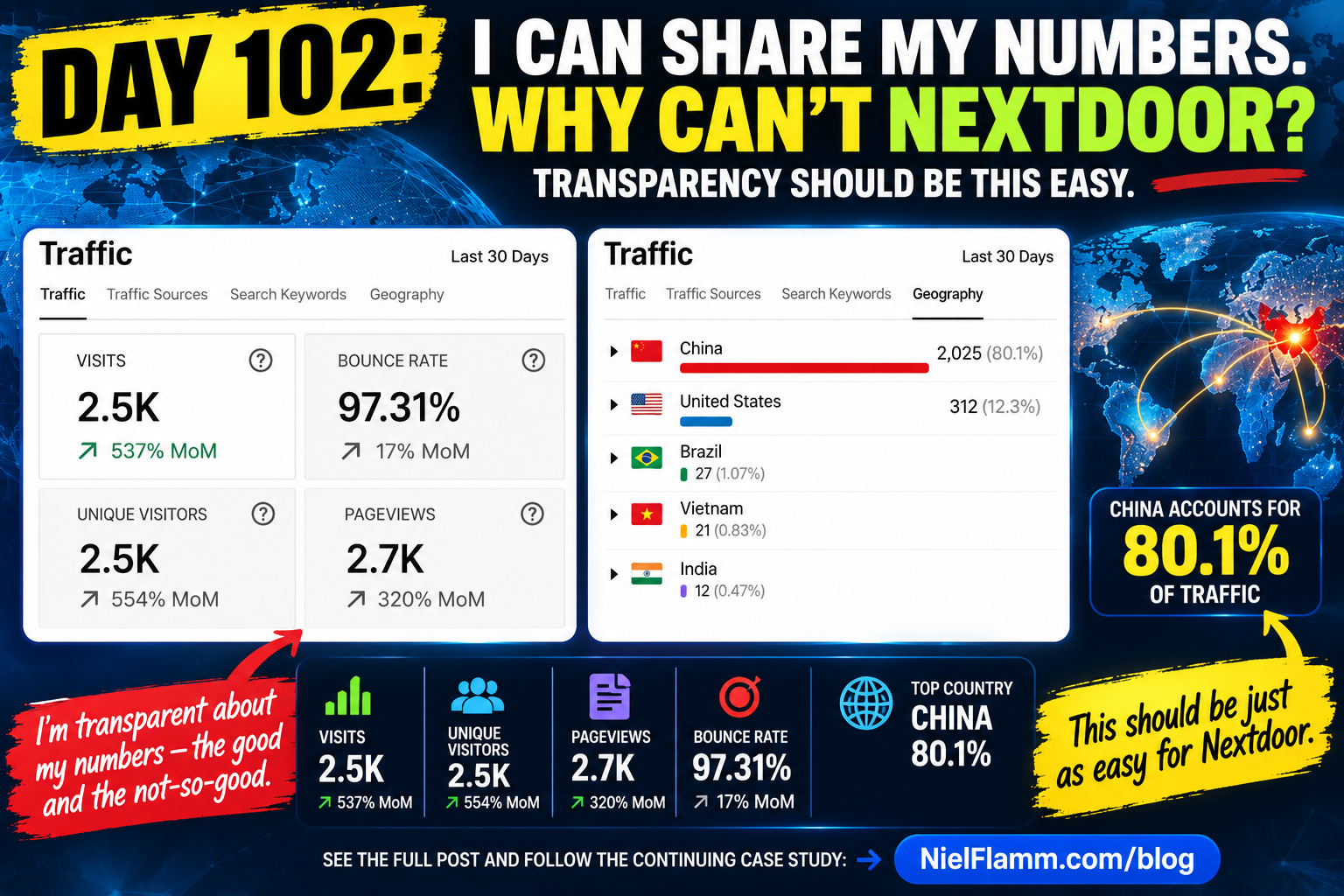
Do I completely understand why China represents 80% of the traffic?
Nope.
Could some traffic be automated, routed strangely, or otherwise not represent 2,025 people sitting in China eagerly awaiting my next blog post?
Absolutely.
That's the point.
I don't know everything happening behind the numbers.
So I'm showing them, asking questions and asking readers for feedback.
,
Why Is That So Difficult?
This brings me back to Nextdoor.
I've asked about WAU—Weekly Active Users.
I've asked for the detailed Insights reports that Nextdoor itself told readers were available upon request.
I've asked questions about methodology, engagement, communication, and other metrics.
And after 102 days, what have I received?
Links to information that was already publicly available and responses that, from my perspective, haven't answered the underlying questions.
That's not the transparency I'm talking about.
Transparency isn't:
“Here's the number we want you to see.”
It's also:
“Here's the number. Here's what we know about it. Here's what we don't know. Here's how we calculated it. Ask us questions.”
I Don't Know Everything
That's an easy sentence for me to write.
I don't know why my traffic suddenly jumped.
I don't know exactly why China dominates it.
I don't know how many visitors read every word versus those who accidentally land on the site and disappear.
And I certainly don't know what's going on inside the minds of my readers and viewers.
So I ask.
What are you reading?
What isn't working?
Why did you leave?
What should I change?
What would make you come back?
That's useful feedback.
And if a guy running NielFlamm.com can publish both the pretty numbers and the ugly ones, ask questions about them and admit what he doesn't know, I don't think it's unreasonable to expect a publicly traded neighborhood platform to engage seriously when a shareholder asks questions about its metrics and research.
I'm not asking Nextdoor to know everything.
I'm asking it to explain what it does know.
Day 102.
👉 See the metrics and follow the continuing case study:
NielFlamm.com/blog