
Day 141: Nextdoor's Winter Travel Study — Where Are the Methodology and the Advertising Results?
Another day, another Nextdoor LinkedIn post promoting research, insights, and the platform’s value. This time, the subject is winter travel, household planning, and how businesses can use Nextdoor to advertise more effectively.
I read the article several times. I came away with more questions than answers.
The article is titled When Do People Plan Winter Travel? What Nextdoor Research Says About the Household Planner.
There's nothing wrong with conducting research or sharing findings. In fact, I encourage it. But when a company promotes research as evidence of consumer behavior and uses it to support its advertising platform, I want to understand what's behind the numbers.
And that's where the questions begin.
Where is the research methodology?
The article discusses findings about winter travel planning, but where is the supporting methodology?
Some basic questions deserve answers:
How many people participated in the survey?
Who was surveyed?
How were participants selected?
When was the research conducted?
What questions were asked?
What was the margin of error, if applicable?
Were the results representative of Nextdoor users or a broader population?
These aren't unreasonable requests. They're the basic details that help readers understand what research actually tells us.
I previously contacted Jacob Chavis about Nextdoor Insights research after public references suggested I could get additional information by reaching out to him. I'm still interested in reviewing the underlying research and methodology.
If the full study is available, why not make it easier to access? If it isn't available, say so.
AI and travel planning: What's really new?
The article also discusses how people use AI and software to plan travel.
Technology-assisted travel planning isn't exactly new.
I remember using MapQuest when it was software installed on a computer. Before that, people used paper maps, guidebooks, travel agents, and all sorts of tools to organize trips.
MapQuest wasn't generative AI, and I'm not suggesting it was. It's simply an example of how people have been using technology to make travel planning easier for decades.
The technology has evolved. The tools are more sophisticated, and generative AI adds new capabilities. But the underlying desire to plan a trip, compare options, and make decisions with technology’s help is hardly revolutionary.

What makes Nextdoor advertising effective?
Here's where I really want to understand the message.
I also saw a Nextdoor post on X discussing the research in the context of effective advertising.
I went back and read the article several times. I couldn't find a clear explanation of what makes advertising effective, how Nextdoor measures that effectiveness, or what specific guidance a small business receives.
Are we talking about impressions? Click-through rates? Engagement? Leads? Store visits? Actual purchases?
Those are very different measurements.
And if a small business is spending money on Nextdoor advertising, shouldn't it clearly understand what it is trying to accomplish and how it will measure success?
My customer experience perspective
I've spent more than 20 years working in learning and development, customer experience, and contact center operations. Measurement has always been part of the work.
I've worked with metrics such as:
Average Handle Time (AHT)
Average Wait Time
First Call Resolution (FCR)
Customer Satisfaction (CSAT)
Calls per hour
Abandoned calls
Quality Assurance (QA) scores
Voice of the Customer (VoC) feedback
And those measurements aren't limited to day-to-day operations. They're used throughout the employee and customer lifecycle.
When you introduce a new hire class, change a procedure, roll out software, or implement a process improvement, you establish a baseline. You identify the business objectives and determine what should change.
Then comes the implementation.
You plan the rollout, prepare employees, provide training, conduct a soft launch when appropriate, move into full implementation, and measure the results.
You monitor the numbers, gather feedback from employees and customers, and determine whether the change actually accomplished what it was supposed to accomplish.
You don't simply announce that a new system will make everything better and walk away.
You measure it.
And you combine quantitative results with qualitative feedback. Surveys, focus groups, employee input, customer comments, and even word of mouth can help explain what the numbers are telling you.
A suggestion for Nextdoor: Hire Karen Romero
Here's a suggestion for Nextdoor: You really need to hire my former colleague and friend, Karen Romero.
She has the kind of QA experience and analytical perspective that could help Nextdoor evaluate whether its advertising campaigns are actually effective.
Think about it. Advertising effectiveness shouldn't be determined solely by how many people saw an advertisement or clicked on it. A proper QA analysis could examine the campaign's objectives, messaging, audience experience, customer interactions, and results to help determine what worked, what didn't, and what needs improvement.
Karen could help craft a meaningful approach to evaluating those campaigns, using QA analysis to go beyond surface-level numbers and identify opportunities to improve the customer and advertiser experience.
She's on LinkedIn, and Nextdoor can reach out to her there.
I'm making this recommendation because I know the value of having the right people involved in measuring performance and improving processes. Sometimes the answer isn't another marketing slogan or another research announcement. It's bringing in people who know how to evaluate the work and turn findings into actionable improvements.
Karen, consider this a public endorsement!

What happens after a small business buys an advertisement?
This is the part I think deserves more attention.
Does Nextdoor give a small business survey percentages and advertising tools, then leave it to figure out the marketing strategy?
Or does Nextdoor offer consultation to help that business determine:
Which audience it should target?
What type of advertising message is most appropriate?
How should the campaign be structured?
What does success look like?
Which metrics should be monitored?
How should the business interpret the results?
What adjustments should be made along the way?
If these services are available, Nextdoor could communicate that value much better.
Small businesses don't necessarily have dedicated marketing departments, analytics teams, or advertising specialists. They may be spending money they can't afford to waste.
An advertising platform should explain not only how to place an ad, but also how it helps businesses understand and evaluate the results.
And no, I'm not suggesting that Nextdoor can guarantee increased revenue. No advertising platform can reasonably promise that every campaign will produce a particular financial result.
But it should explain what it measures, what support it provides, and how businesses can evaluate whether their advertising investment is working.
The bigger picture: Research, transparency, and trust
This is becoming a recurring theme in my Nextdoor case study.
Nextdoor promotes research, insights, advertising opportunities, partnerships, and the value of its platform. Yet I continue to have questions about the details behind those claims.
Research should be supported by accessible methodology. Advertising effectiveness should be measured and explained. Small businesses should understand what they're buying and what resources are available to help them evaluate their investment.
These aren't complicated concepts. They're fundamentals of customer experience and business accountability.
And when a publicly traded company promotes its ability to help businesses grow, investors and customers alike should understand how it delivers that value.
Nirav, add this to the list of questions about why NXDR is struggling to build investor confidence. I wouldn't be surprised if some of these same concerns show up in a Google AI discussion about Nextdoor a year from now.
Day 141. The questions continue. The door is still open.

Day 126: Another Email to Nextdoor. The Request Hasn't Changed.

📧 Day 126. Another email sent. Another opportunity for Nextdoor to close the loop.
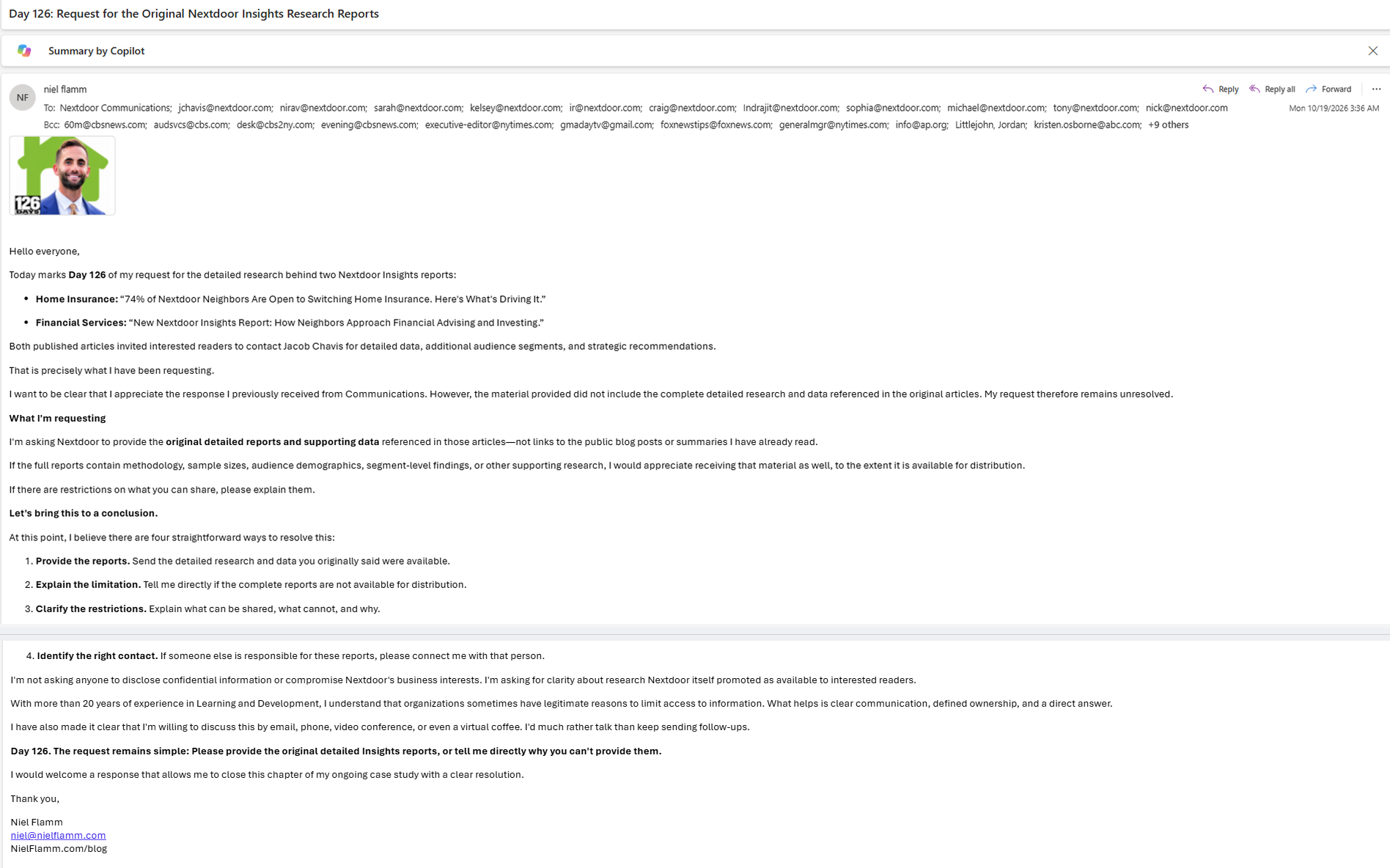
Today, I sent another email to the usual group of Nextdoor contacts, including Communications, Jacob Chavis, CEO Nirav Tolia, and members of the leadership team.
The subject line was straightforward:
Day 126: Request for the Original Nextdoor Insights Research Reports
No new accusations. No complicated demands. Just a request that has sat unresolved for 126 days.
What Am I Asking For?
Let's go back to the beginning.
Nextdoor published two Insights articles that invited interested readers to contact Jacob Chavis for detailed data, additional audience segments, and strategic recommendations.
The two reports were:
🏠 Home Insurance: “74% of Nextdoor Neighbors Are Open to Switching Home Insurance. Here's What's Driving It.”
💰 Financial Services: “New Nextdoor Insights Report: How Neighbors Approach Financial Advising and Investing.”
I didn't ask Nextdoor to create a new study for me. I didn't ask it to build a custom research project. I asked for the detailed research that the original articles said was available.
That distinction matters.
Communications Responded. But the Request Remains Unresolved.
I want to acknowledge that Nextdoor Communications previously responded. I'm not claiming the company has never communicated with me.
However, the material I received did not include the complete detailed reports and supporting data I originally requested.
Being sent links to public blog posts isn't the same as receiving the detailed research those posts reference.
I'm not asking for the same summary again. I'm asking for the underlying reports.
If those reports aren't available for distribution, please tell me. If there are restrictions, explain them. If someone else handles the request, connect me with that person.
Any of those responses would be more useful than leaving the central question unresolved.
Four Ways to Close This Case
In today's email, I laid out four straightforward options:
Provide the reports. Send the detailed research and data you originally said were available.
Explain the limitation. Please tell me directly if you can't distribute the complete reports.
Clarify the restrictions. Explain what can be shared, what cannot, and why.
Identify the right contact. Connect me with the person responsible for these reports.
That's it.
I'm not asking Nextdoor to disclose confidential information or compromise its business interests. I'm asking for clarity about research the company itself promoted as available to interested readers.
If some portions contain confidential information, perhaps you can share a version that excludes those portions. If that isn't possible, I'd like to understand why.
A Learning and Development Perspective
I've spent more than 20 years working in Learning and Development, including instructional design, facilitation, management, and organizational processes.
One lesson from that experience is that when a task gets stuck, it helps to identify the owner, define the expected outcome, and clarify what needs to happen next.
A request shouldn't require an endless chain of follow-ups simply because nobody has clearly communicated the answer or the next step.
Sometimes the answer is yes. Sometimes it's no. Sometimes there are conditions.
But clear communication and defined ownership help people move forward.
That's the perspective I'm bringing to this situation. I'm not claiming to know what's happening inside Nextdoor or why this request hasn't been resolved. I can only describe what I've requested, what I've received, and what remains outstanding.
I'd Rather Talk Than Keep Typing
I've made it clear that I'm willing to discuss this by email, phone, video conference, or even a virtual coffee.
I'd much rather talk than keep writing follow-up emails and documenting another day in this case study.
I don't expect a CEO to respond to every shareholder question personally. But I do believe someone within an organization should be able to take ownership of a straightforward request and provide a clear answer.
And if the reports cannot be shared, I can accept a direct explanation of that decision—even if it's not the answer I hoped to receive.
Day 126: The Clock Keeps Ticking
I'm still interested in understanding Nextdoor's research, its methodology, and how the company develops insights from its neighborhood community.
I also want Nextdoor to succeed. I've said that repeatedly, and I mean it.
But wanting a company to succeed doesn't mean ignoring every unanswered question. Asking questions and providing feedback help businesses identify gaps and improve their processes.
So, here's where things stand.
Day 126. The request remains simple: Please provide the original detailed Insights reports, or tell me directly why you can’t.
I would love for the next update in this case study to be about a resolution rather than another follow-up.
Nextdoor, the ball is in your court.
👉 Follow the continuing case study at NielFlamm.com/blog

Nextdoor Published a Study About Trust. This Is More Like It.
I have spent a lot of time providing feedback about Nextdoor's Insights reports, so when the company does something substantially better, I think it's important to say so.
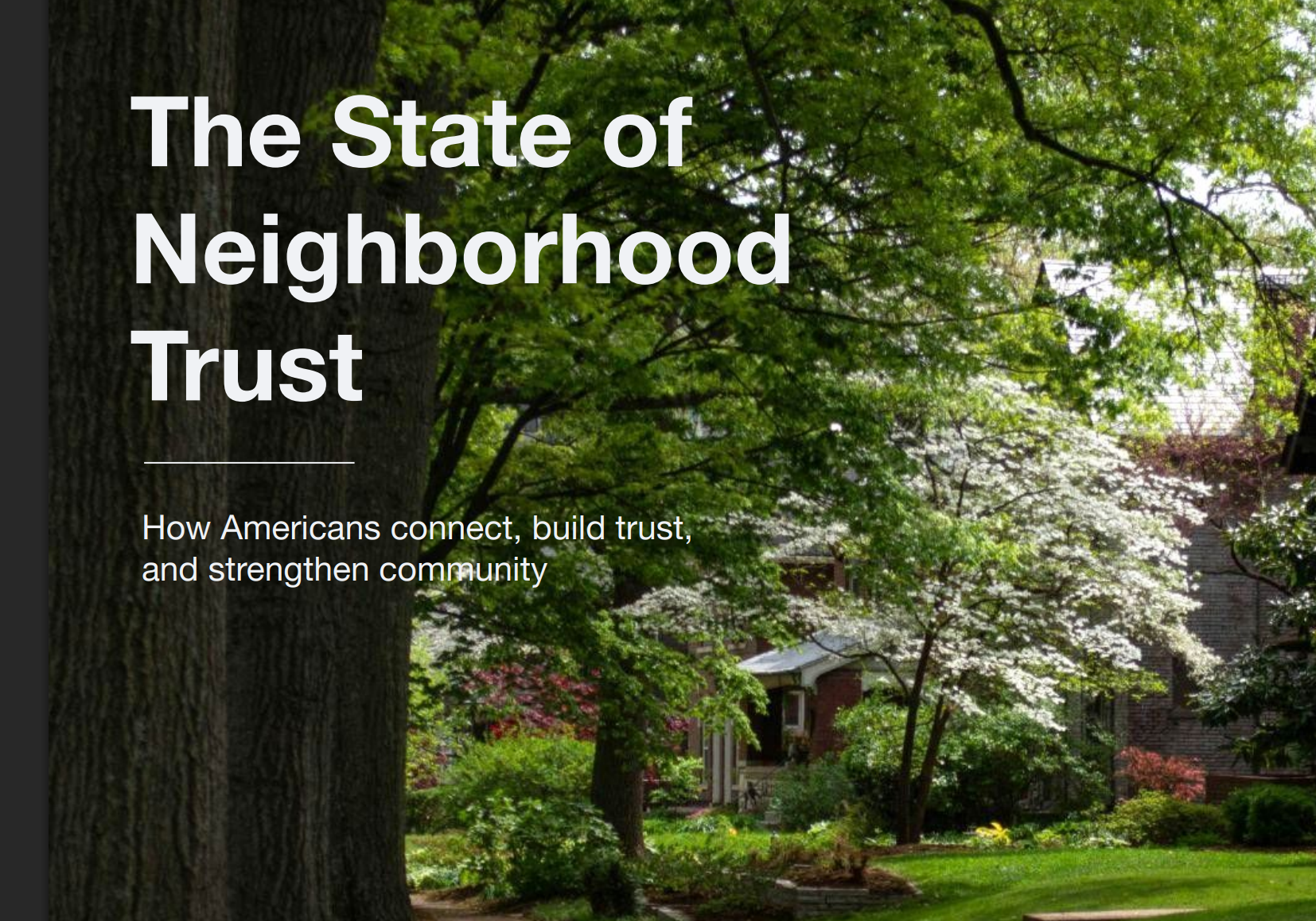
Nextdoor's new “The State of Neighborhood Trust” report, produced with The Harris Poll, is much closer to what I've been asking to see.
This looks and reads like an actual research report.
Not simply a blog post with percentages and a statement that more information exists somewhere else.
The report is 24 pages long. It identifies the research partner, describes the sample, discusses methodology, presents findings in context, includes statistical analysis, identifies outside sources, and provides a research contact. Nextdoor Blog
Read Nextdoor and The Harris Poll's full Neighborhood Trust study
Bravo, Nextdoor.
Yes, I actually said that.
Screenshot it before somebody blocks me. 😂
This Is What I've Been Asking For
Nextdoor commissioned the research, and The Harris Poll fielded it in April 2026 among about 1,000 U.S. adults age 18 and older. Respondents came through The Harris Poll's online panel and were weighted to reflect the U.S. adult population. Nextdoor says it then analyzed the findings and conducted statistical modeling examining factors associated with trust and outcomes including safety, belonging, civic participation and reliance on neighbor recommendations. Nextdoor Blog

The accompanying Nextdoor article provides even more methodological detail: the survey was conducted April 16–20 among 1,003 adults, weighting included age within gender, region, race/ethnicity, marital status, household size, income, education and political affiliation where necessary, and the reported Bayesian credible interval is ±3.8 percentage points at a 95% confidence level. Nextdoor also acknowledges other potential sources of survey error. Nextdoor Blog
That's transparency.
Could there be more?
Sure.
I'd love to see an appendix containing the questionnaire, complete crosstabs and additional demographic breakouts. Since The Harris Poll fielded the survey, it would also be useful to provide a Harris Poll contact or link explaining whether additional demographic information, questionnaires or crosstabs can be obtained.
But that's me asking for the cherry on top rather than wondering where the sundae went.
This report gives readers enough information to begin understanding where the numbers came from and how the research was conducted.
And the Subject Is…Trust
This is where things become particularly interesting given my recent experience with Nextdoor.
The entire report revolves around trust.
One finding says 66% identify friendly day-to-day interactions as something that builds neighborhood trust. Meanwhile, the leading factor respondents identified as weakening neighborhood trust was lack of communication, at 46%. Nextdoor Blog
Read that again.
Lack of communication: 46%.
I've been writing about communication for more than 100 days.
You couldn't script this better.
The study says trust grows through regular opportunities to communicate, interact, and rely on one another. It also says the strongest predictors include how easy people feel reaching their neighbors and how often they actually interact. Nextdoor Blog
That's not my interpretation of what Nextdoor should believe.
That's in Nextdoor's own report.
Then Nirav Tolia Says This
The report includes a statement from CEO Nirav Tolia:
“The difference between a neighborhood and a community is trust.”
That's a powerful statement. Nextdoor Blog
And that's precisely why I can't ignore the contrast with my experience.
Yesterday I discovered that Nirav had blocked me on X.
Again.
For the second time in roughly six months.
I don't know why Nirav blocked me. Only he knows his reason, and I'm not going to pretend otherwise.
He also doesn't have an obligation to personally engage with every person who comments on his social media account.
But I'm allowed to ask what message the action sends to me.
Because I'm not some anonymous account that appeared yesterday screaming at the CEO.
I'm a shareholder.
I've spent months publicly documenting questions about Nextdoor.
I've repeatedly offered to have an actual conversation.
I've said I'd rather talk than type.
And for more than 100 days I've been pursuing detailed research that Nextdoor itself told readers was available by contacting its Insights representative.
Now I'm reading a Nextdoor report telling me:
Trust depends on communication.
You can't make this stuff up.

Trust Has to Work in Both Directions
Another line in the report fascinates me.
Nextdoor writes that trust is built through repeated interactions, communication, and confidence that others will respond when it matters. Nextdoor Blog
Exactly.
That shouldn't only apply neighbor to neighbor.
I think it's a valuable principle for company-to-customer, leadership-to-shareholder, platform-to-user, and executive-to-stakeholder relationships too.
Trust isn't created by saying the word trust repeatedly.
It isn't created by putting trust in the title of a 24-page PDF.
And it isn't automatically created because a company commissions a reputable polling organization.
Trust grows when words and experiences begin matching.
That's what makes this new report simultaneously encouraging and fascinating to me.
The Research Is Actually Helping Build Trust
Here's where I give Nextdoor genuine credit.
This report increases my confidence in these findings because Nextdoor told me how the research was conducted.
That's exactly how transparency builds trust.
Compare:
“67% of Americans say, X.”
Okay. Where did that number come from?
Versus:
Here's who conducted the survey. Here's when it was conducted. Here's the population. Here's the sample. Here's how respondents were recruited. Here's how weighting worked. Here's the statistical approach. Here are limitations. Here are outside sources. Here's a research contact.
Now we're talking.
Interestingly, the PDF once again lists Jacob Chavis, Senior Manager, Customer Insights, along with his Nextdoor email address as the research contact. Nextdoor Blog
Jacob and I already have some history.
😂
Maybe This Is Progress
I've said throughout this case study that if Nextdoor does something I think is good, I'll say it's good.
This report is progress.
I don't know whether my months of posts had anything whatsoever to do with the format. I have no evidence that they did, so I'm not taking credit.
Maybe Nextdoor was already moving toward more comprehensive research reports.
Maybe working with The Harris Poll resulted in a more rigorous presentation.
Maybe somebody inside Nextdoor independently said, We should probably show people how we got these numbers.
Whatever the reason:
Keep doing this.
And take it one step further.
Provide a Harris Poll link or research contact.
Make additional demographic tables available.
Publish questionnaires where appropriate.
Provide downloadable crosstabs.
Let researchers, journalists, advertisers, shareholders, and curious bald bloggers dig deeper.
That's how confidence in research grows.
Now Apply the Research to Leadership
That's my bigger challenge to Nextdoor.
The report says communication matters.
It says repeated interaction matters.
It says accessibility matters.
It says trust helps communities function.
And its CEO says the difference between a neighborhood and a community is trust. Nextdoor Blog
Great.
Apply those principles internally and externally.
When somebody asks a difficult question, communicate.
When somebody provides feedback, listen.
When somebody requests information that you've advertised as available, answer.
When a shareholder repeatedly offers to have a conversation, perhaps conversation is more consistent with the company's message than another block button.
Nirav doesn't have to agree with me.
Nextdoor doesn't have to agree with me.
Jacob doesn't have to agree with me.
Nobody has to like my posts.
But if we're going to talk about rebuilding trust through communication and interaction, then I think it's fair to ask Nextdoor's leadership to demonstrate the same behavior it celebrates in its research.
Trust is a great research topic.
It's an even better leadership practice.
And this time, Nextdoor, on the research itself:
Bravo. Keep going.
👉 Read my continuing Nextdoor case study at NielFlamm.com/blog

13 Days. No Study. No Response. No Accountability.
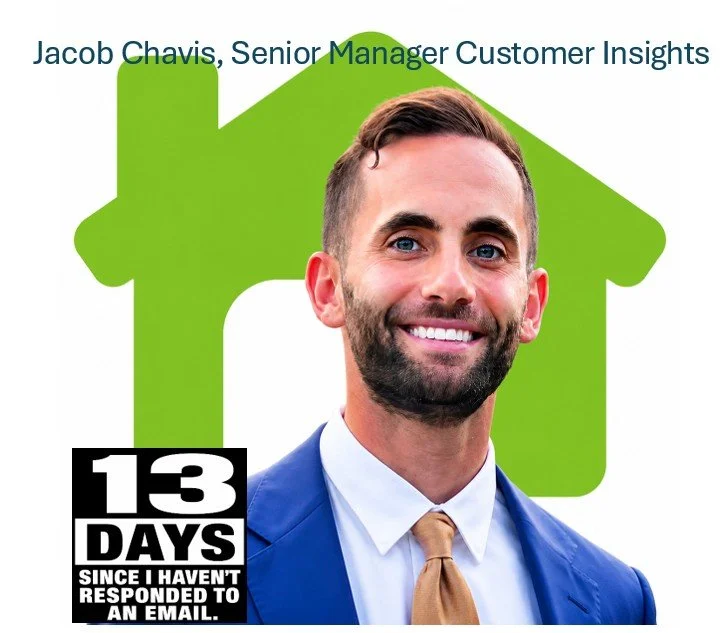
It's been 13 days since I requested the study referenced by Jacob Chavis, Senior Manager of Customer Insights at Nextdoor — and the silence is deafening.
To be clear, #NiravTolia and the C-Suite are aware of this request. They are aware of my pursuit of transparency. And they've made a choice — to say nothing.
Which raises a legitimate question: Does this study actually exist? Or was AI used to generate a news piece with a conveniently buried line inviting requests — banking on no one actually asking?
Here's what I know:
Jacob has blocked me on LinkedIn. His profile returns "doesn't exist" when I search for it. This mirrors Nirav Tolia's behavior exactly. The apple doesn't fall far from the tree.
From internet research outside of LinkedIn: Jacob is based in New York, attended the University of South Carolina and Columbia University, and began his career as an intern at the Public Defender Service for the District of Columbia—a meaningful start — one that implies a commitment to accountability and transparency.
Jacob, is Nextdoor the last company you plan to work for? Because factual, documented experiences posted publicly tend to follow professionals to their next landing spot.
To Nextdoor: you don't operate in a vacuum. I tag you across multiple platforms. And the pattern of blocking, ignoring, and hoping critics go away isn't a strategy — it's a liability.
Jacob, is this the hill you want to die on?
🔗 Full commentary and to join the discussion, go to NielFlamm.com/blog