

Day 114: Nextdoor Finally Found a Way to Sell What It Knows

Nextdoor just launched Neighborhood Intelligence, and I think it could be one of the most important developments I've seen in this 114-day case study.
The basic idea is pretty simple: Nextdoor has spent 15 years building a massive collection of neighborhood-level information. Now it's turning that information into an advertiser product.
Nextdoor says its Neighborhood Intelligence platform maps roughly 350,000 neighborhoods and analyzes signals including neighbor activity, household information, and neighborhood-level activity. It gives advertisers a much more granular view than traditional ZIP-code targeting. Nextdoor Business
That's potentially valuable.
And it brings me back to something I've been saying for a while:
The Data Has Value
For years, neighbors have supplied the conversations, recommendations, reviews, opinions, and local knowledge that make Nextdoor useful.
Now Nextdoor is packaging neighborhood intelligence into something advertisers can use.
That's business.
But here's my question:
Why did it take 15 years?
Nextdoor has been around since 2011. It went public in 2021. Yet it has never achieved GAAP profitability. Even after the recent improvement, Q2 2026 produced a $2 million net loss, although revenue reached a record $75 million and adjusted EBITDA was $10 million. Securities and Exchange Commission
That's a long time to possess a potentially unique asset without figuring out how to turn it into sustainable profits.
Don't Blame Just the Current CEO
It's tempting to point the finger at Nirav Tolia.
He returned as CEO in 2024 and has been tasked with turning the company around.
But that's too easy.
Nirav founded Nextdoor and ran it for years before leaving the CEO role. He then returned.
So this isn't simply:
“The new CEO hasn't figured it out.”
The company has had 15 years to find its niche, monetize its advantages and create sustainable shareholder value.
Now, perhaps, we're seeing a clearer path.
The Neighborhood May Be the Niche
That's what interests me about Neighborhood Intelligence.
Nextdoor doesn't have to beat Google at everything.
It doesn't have to beat Meta at everything.
It doesn't have to become another generic social-media platform.
Maybe the opportunity is much narrower:
Own neighborhood-level intelligence.
Nextdoor says its neighborhood graph provides roughly 12 times the geographic granularity of ZIP-code targeting in covered areas, and its pilot campaigns showed lifts in brand awareness, ad recall and favorability compared with ZIP-code targeting. Investing.com
If advertisers will pay for that advantage, now we're talking.
That's the kind of niche I want Nextdoor to own.
And Then There's the Dividend
I'm not saying Nextdoor should pay a dividend tomorrow.
The company needs to continue investing, improve profitability, and determine the best use of its capital.
But eventually, that's the shareholder question:
Can this company consistently generate enough cash to reward the people who invested in it?
A $100 million share-repurchase authorization already shows that returning capital to shareholders is part of the conversation. Simply Wall St
I'd like to see the next step be sustainable profitability.
Then, someday, perhaps a dividend.
Because revenue isn't the finish line.
Profitability is.

Day 114
Here's the irony.
I've spent 114 days asking Nextdoor for detailed information about its Insights research.
Now Nextdoor is announcing a product that essentially says:
Our neighborhood data is valuable.
I agree.
I've been saying that.
The difference is that Nextdoor is now trying to prove it in the marketplace.
Good.
Now show me that this isn't just another interesting product.
Show me that Nextdoor can turn 15 years of neighborhood intelligence into a sustainable, profitable business.
Because that's what shareholders ultimately need.
Not just data.
Results.
And maybe—finally—Nextdoor has found the niche.
👉 NielFlamm.com/blog

Day 102: Transparency Shouldn’t Be This Difficult

Day 102.
Earlier today, I posted something on NielFlamm.com/blog that I think connects directly to this entire Nextdoor journey:
My own numbers.
Not just the flattering ones.
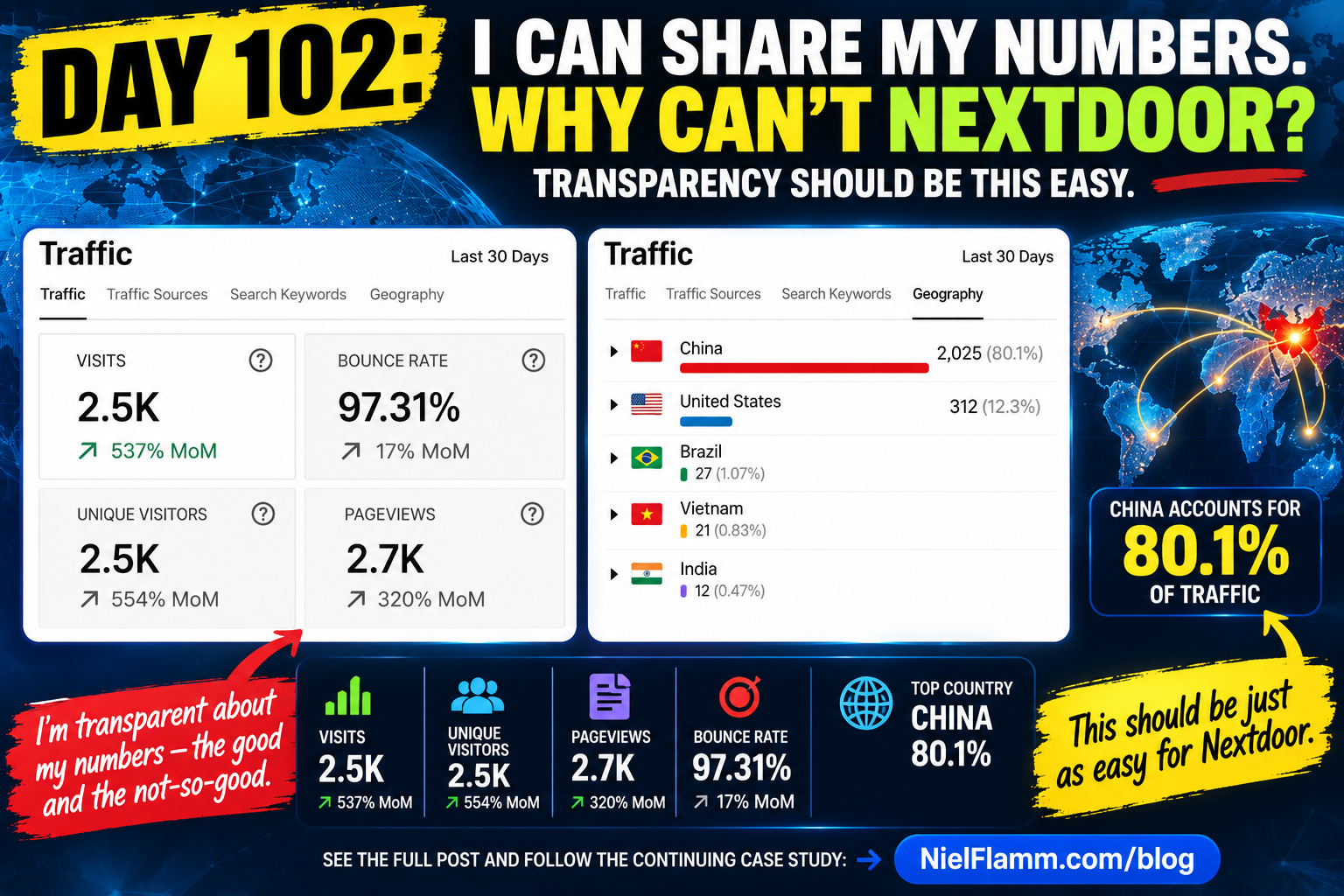
My latest 30-day website metrics show approximately 2,500 visits, 2,500 unique visitors, and 2,700 pageviews. Visits are up 537% month over month, unique visitors are up 554%, and pageviews are up 320%.
Sounds fantastic.
Then there's the 97.31% bounce rate.
Not exactly something I'm putting on a trophy. 😂
And I'm showing that number too.
China? Apparently, I’m Huge in China.
The geography surprised me even more.
Of the traffic shown in my analytics:
China: 2,025 visits — 80.1%
United States: 312 — 12.3%
Brazil: 27 — 1.07%
Vietnam: 21 — 0.83%
India: 12 — 0.47%
Do I completely understand why China represents 80% of the traffic?
Nope.
Could some traffic be automated, routed strangely, or otherwise not represent 2,025 people sitting in China eagerly awaiting my next blog post?
Absolutely.
That's the point.
I don't know everything happening behind the numbers.
So I'm showing them, asking questions and asking readers for feedback.
,
Why Is That So Difficult?
This brings me back to Nextdoor.
I've asked about WAU—Weekly Active Users.
I've asked for the detailed Insights reports that Nextdoor itself told readers were available upon request.
I've asked questions about methodology, engagement, communication, and other metrics.
And after 102 days, what have I received?
Links to information that was already publicly available and responses that, from my perspective, haven't answered the underlying questions.
That's not the transparency I'm talking about.
Transparency isn't:
“Here's the number we want you to see.”
It's also:
“Here's the number. Here's what we know about it. Here's what we don't know. Here's how we calculated it. Ask us questions.”
I Don't Know Everything
That's an easy sentence for me to write.
I don't know why my traffic suddenly jumped.
I don't know exactly why China dominates it.
I don't know how many visitors read every word versus those who accidentally land on the site and disappear.
And I certainly don't know what's going on inside the minds of my readers and viewers.
So I ask.
What are you reading?
What isn't working?
Why did you leave?
What should I change?
What would make you come back?
That's useful feedback.
And if a guy running NielFlamm.com can publish both the pretty numbers and the ugly ones, ask questions about them and admit what he doesn't know, I don't think it's unreasonable to expect a publicly traded neighborhood platform to engage seriously when a shareholder asks questions about its metrics and research.
I'm not asking Nextdoor to know everything.
I'm asking it to explain what it does know.
Day 102.
👉 See the metrics and follow the continuing case study:
NielFlamm.com/blog

Day 101: Our Data Is a Commodity. Why Are We Giving It Away?

Day 101.
Today I want to strip this Nextdoor discussion down to basic economics.
If I have something of value, another party uses it, and that use generates revenue, why shouldn't I share in the value created?
In this case, the commodity is information.
Reviews are information.
Recommendations are information.
Posts, comments, neighborhood observations, business experiences, and local knowledge are information.
Collectively, that's user-generated content.
And when a platform can aggregate, organize, analyze, and monetize that information, those individual contributions can become economically valuable.
We Call It “Content.” But It's Also an Economic Input.
Suppose I recommend a plumber on Nextdoor.
I supplied the experience. I paid to hire the plumber. I evaluated the work. I spent my time writing the recommendation.
Another neighbor reads it.
The plumber potentially gets business.
Nextdoor gets engagement and another piece of local knowledge stored within its platform.
Now multiply that by millions of neighbors and years of participation.
Suddenly, what looks like individual posts becomes something much more interesting:
An asset.
And with AI making it increasingly possible to organize, summarize, and extract useful information from enormous collections of human-created knowledge, that accumulated information may become even more useful.
I'm Not Saying Nextdoor Shouldn't Profit
Quite the opposite.
I'm a shareholder. I want Nextdoor to make money.
Nextdoor built the technology. It operates the platform. It employs people, develops products, sells advertising, and assumes the financial risk of running the business.
Nextdoor should benefit from the value it creates.
My question is:
Why does that automatically mean the neighbor gets zero?
If my contribution becomes part of something commercially valuable, why couldn't there be a model where:
Nextdoor wins.
Shareholders win.
Businesses win.
And the neighbors supplying the information win too.
I'm not suggesting every post deserves a royalty check.
But reviews, recommendations, local knowledge, research participation, and other user-generated information that contributes to commercial value?
Let's have that conversation.
Until Then, Maybe We Stop Supplying the Commodity
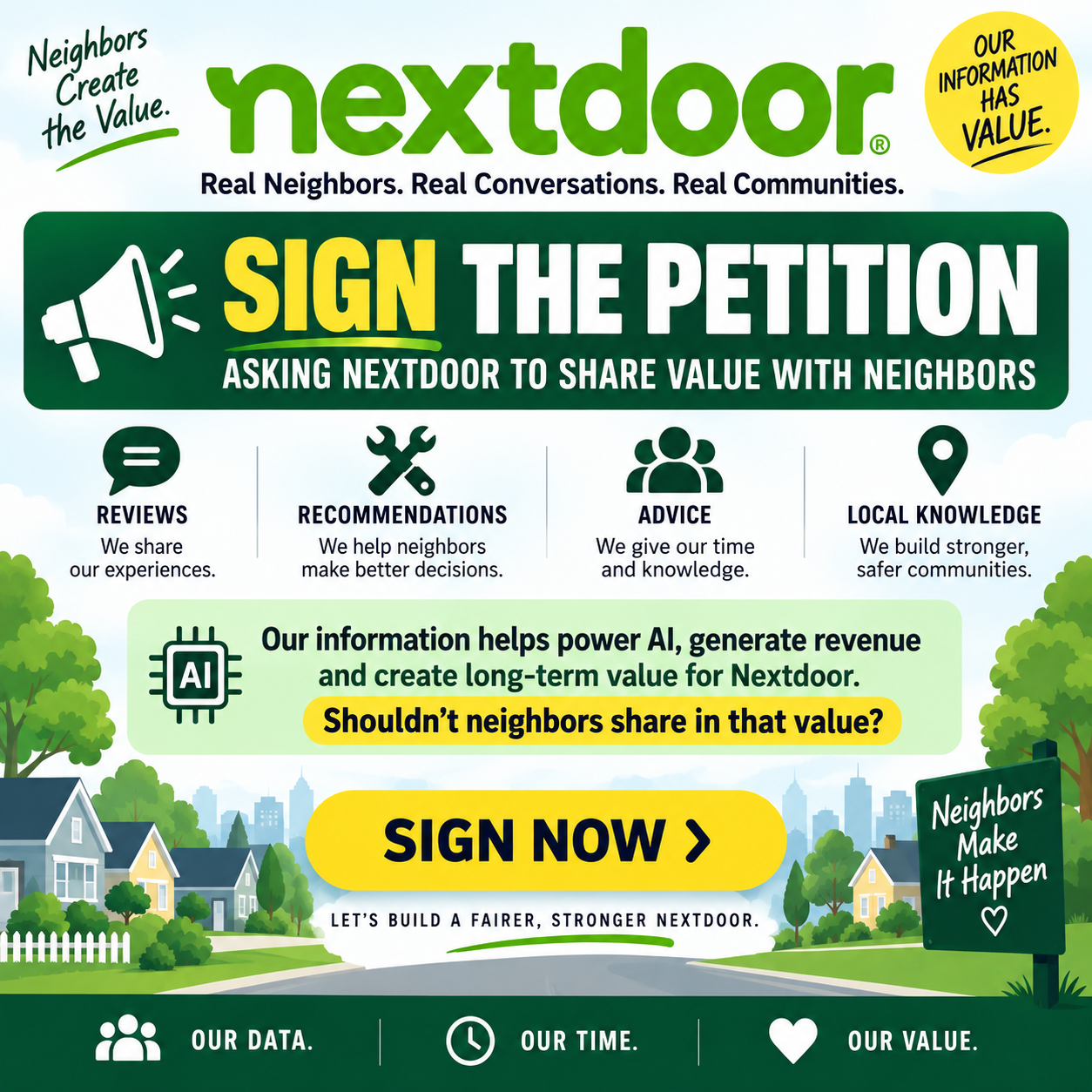
That's the idea behind my Neighbor Value-Sharing Petition.
The petition asks Nextdoor users to voluntarily stop providing new routine data, business reviews, recommendations, and other commercial user-generated content until Nextdoor develops a meaningful way for neighbors to participate in the revenue and value their contributions help generate.
It's not about withholding emergency information, safety alerts, missing-person information or other important community communication.
It's about the commodity.
If our information has value, perhaps we should stop giving that value away for free until there's a conversation about sharing it.
Read and sign the petition:
Then share it with another Nextdoor user.
Nextdoor Built the Container. Neighbors Keep Filling It.
A platform without people is software.
A review platform without reviews is an empty database.
A neighborhood network without neighbors sharing neighborhood knowledge isn't much of a neighborhood network.
Nextdoor built the container.
Neighbors keep filling it.
If what's inside that container can be monetized, I think it's reasonable for the people supplying it to ask:
Where's our share?
Until Nextdoor is willing to have that conversation, I'm asking neighbors to consider something incredibly simple:
Don't provide the commodity.
No new routine reviews.
No new business recommendations.
No additional commercial data.
Then let's see how valuable the commodity becomes when the people producing it decide they want to share in its value.
Our data. Our knowledge. Our time. Our value.
👉 Sign the petition:
https://c.org/GkNWmffgg9
👉 More of my continuing Nextdoor case study:
NielFlamm.com/blog
My Nextdoor Petition Has One Signature. Mine. So…What Am I Missing?
Time for a little open-book transparency.
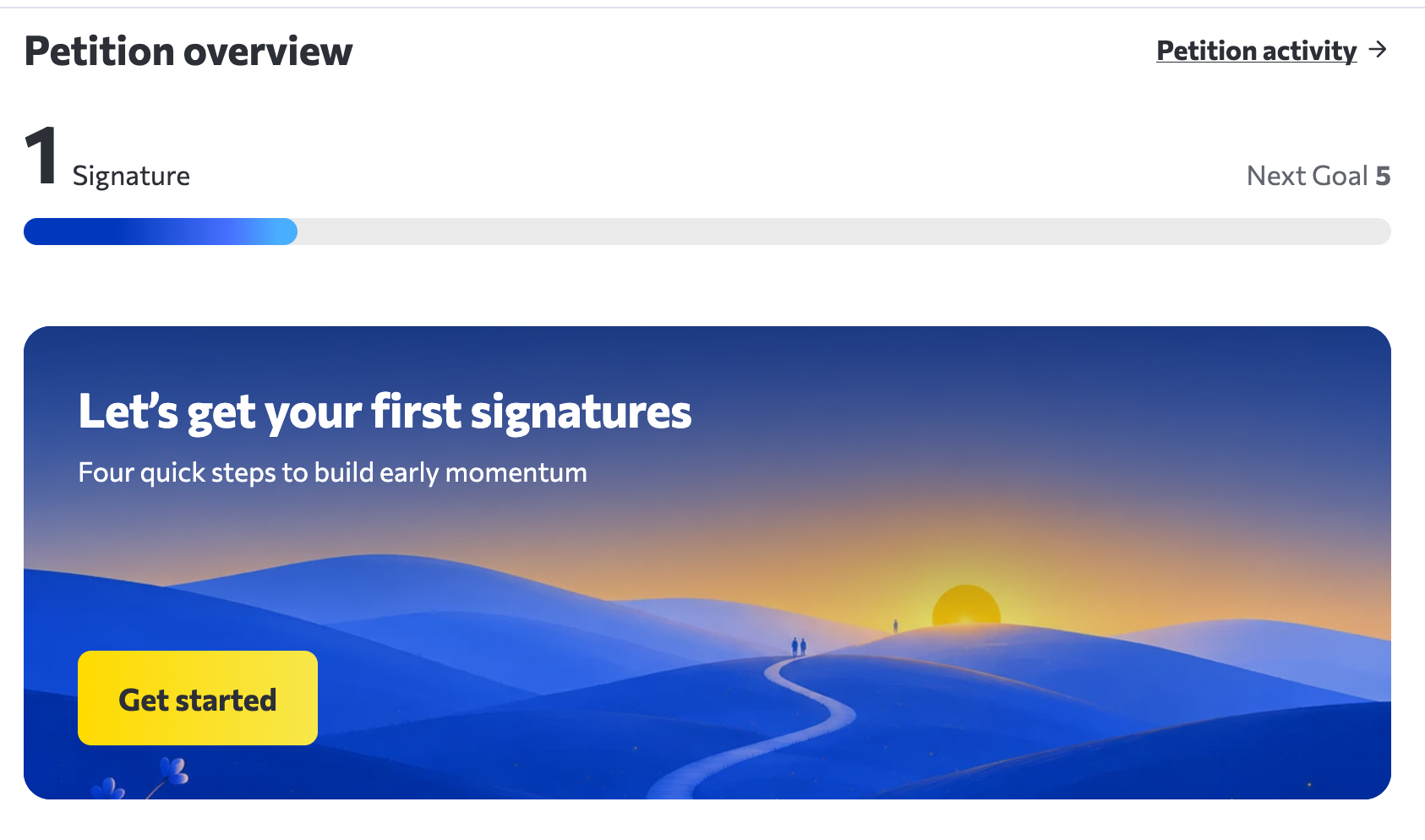
I launched my petition asking Nextdoor to create a meaningful value-sharing model for the neighbors whose reviews, recommendations, advice and local knowledge help make the platform valuable.
How's it going?
One signature.
Mine. 😂
So clearly, I'm not exactly storming the gates with an angry mob.
But instead of pretending it's gaining traction when it isn't, I'd rather ask why.
Maybe I Got the Petition Wrong
The basic idea still makes sense to me.
Nextdoor provides the platform. Neighbors provide enormous amounts of information and local knowledge. If that information can ultimately be organized, analyzed, used by AI, and turned into commercial value, why shouldn't the people helping create that value participate in some of the upside?
I mean some form of profit or value sharing tied to what users contribute and what the platform ultimately earns from it.
Nextdoor should make money.
I'm a shareholder. I want Nextdoor to make money.
But why does it have to be either platform profits or users’ benefit?
Why not both?
Now I Need Your Feedback
Maybe the petition is too complicated.
Maybe the ask isn't clear enough.
Maybe people like the concept but don't want to sign a petition.
Maybe asking users to pause business reviews and recommendations is the wrong approach.
Or maybe people simply disagree with me.
Tell me.
I spend plenty of time asking Nextdoor to listen to feedback, so I'd better be willing to do the same.
Read the petition and tell me what you'd change. What would make you sign it? What part doesn't work? Is there a better model for sharing the value neighbors create?
And if you do agree with the idea, I need two things:
First, sign it. Then share it.
Right now, the petition has exactly one supporter—and I already know what that guy thinks. 😂
Read and sign the Nextdoor Neighbor Value-Sharing Petition
Our information. Our time. Our value. Why not share?

Day 98: Maybe the Silence Is the Most Interesting Data of All

Day 98.
We're now two days away from triple digits, and I’m still waiting for the detailed Nextdoor Insights studies I originally requested.
But today, I’m looking at this saga differently.
What If the Experiment Wasn't the Study?
For 98 days, I've been asking Nextdoor for research data.
In the process, I've accidentally collected some data of my own.
How does an organization respond when one person simply refuses to let a reasonable question disappear?
Not with threats. Not with harassment. Not by screaming louder.
Just by continuing to ask.
At some point, the absence of an answer becomes information itself—not proof of anyone's motive, but a case study in how an organization handles persistence, ownership, and closure.
That's something you won't find in a spreadsheet.
Meanwhile, the Petition Is Live
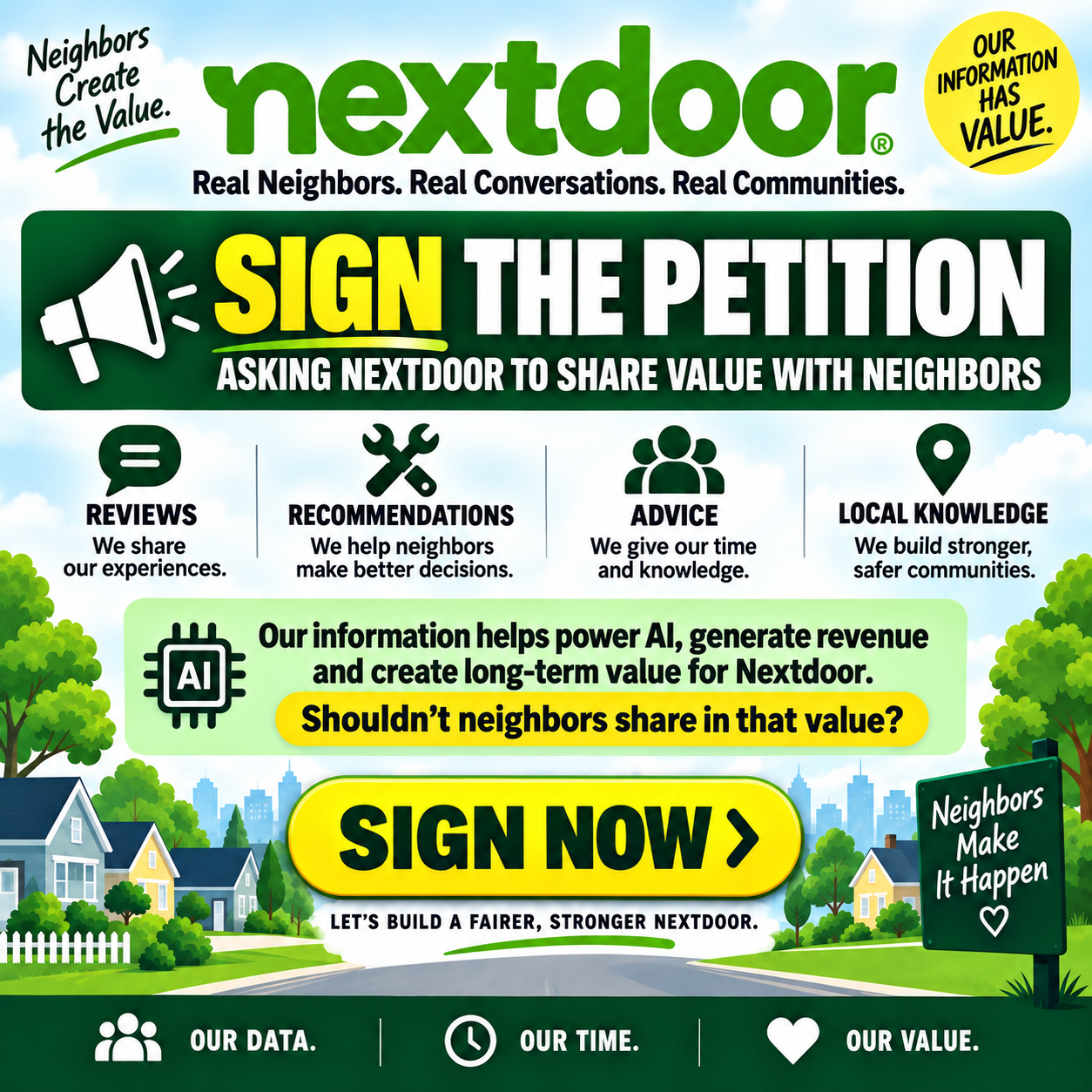
There's now another question on the table:
If neighbor reviews, recommendations, and local knowledge become increasingly valuable to Nextdoor—especially in the age of AI—should the neighbors creating that value participate in it?
I've launched the Neighbor Value-Sharing Petition to start that conversation.
If you agree, please sign it and share it.
Tomorrow: Day 99.
Then comes 100.
The funny thing is, I started this journey looking for Nextdoor's data.
I didn't expect Nextdoor's response to become data of its own.
👉 Follow the saga at NielFlamm.com/blog