
Whistleblowers Welcome: Help Shine a Light on Leadership and Workplace Culture
Every organization has room to improve. Some embrace feedback. Others silence it.
If you are a current or former employee who is concerned about workplace culture, leadership, management practices, accountability, or organizational performance, I’d like to hear your perspective.
If you choose to reach out, I will take reasonable steps to redact identifying information before discussing your experience publicly. Please do not send confidential, proprietary, or legally protected information. I’m interested in your experiences, observations, and opinions—not trade secrets.
Poor performance should not be rewarded.
Ineffective leadership should be examined, not ignored.
A toxic culture rarely appears overnight. It often starts at the top and spreads throughout an organization until someone has the courage to confront it.
One of my favorite leadership principles is simple:
You tolerate what you allow.
If leaders allow dysfunction, it becomes the culture.
If employees remain silent out of fear, meaningful change becomes even more difficult.
Constructive transparency and accountability make organizations stronger—not weaker.
If there are stories that deserve to be heard, let’s have that conversation.
I Asked AI for a Gap Analysis of Nextdoor. The Results Were Interesting.
Over the past several months, I've asked ChatGPT to help me write dozens of posts about Nextdoor, CEO Nirav Tolia, moderation, shareholder value, AI, surveys, advertisers, community building, and leadership.
So I asked a simple question:
Based on everything I've asked you to write, publicly available information, Nextdoor's financial results, and the stock price, what would you do differently if you were CEO?
The answer wasn't "fire everyone."
It wasn't "replace the board."
It wasn't even "launch more AI."
The biggest gap identified was this:
Nextdoor talks about human connection more than it measures human connection.
The company has made progress with revenue growth, weekly active users, near breakeven adjusted EBITDA, and a substantial cash position.
Yet AI suggested five priorities:
1. Fix trust first.
Create transparent moderator quality assurance, appeals, accountability, and enforcement metrics.
2. Turn AI into a product feature, not a podcast talking point.
Use AI for conflict de-escalation, scam detection, neighbor matching, and improving conversations.
3. Run real behavioral studies.
Pilot mediation labs, MBTI and DISC communication workshops, community service challenges, and neighborhood engagement programs using control groups and measurable outcomes.
4. Treat local advertisers like customers.
Provide responsive support, clear ROI reporting, and escalation paths when issues arise.
5. Create and communicate shareholder value.
Clearly explain how capital is being deployed and how management decisions are expected to improve long-term returns.
What fascinated me was that AI didn't conclude Nextdoor's biggest challenge is technology.
It concluded the challenge is execution.
One thing people often forget is that AI is excellent at analyzing more than numbers. It analyzes patterns, trends, sentiment, behaviors, interactions, and outcomes. That's exactly why it can be useful in understanding how neighbors communicate, where conflict emerges, and what interventions might actually improve trust and engagement.
Imagine if Nextdoor applied the same rigor as an epidemiology study.
Create pilot neighborhoods. Establish control groups. Measure sentiment, retention, advertiser engagement, conflict reduction, and community participation. Publish the methodology, demographics, limitations, and findings.
That's data.
That's science.
That's accountability.
Instead of another survey headline, we'd learn what actually helps neighbors connect.
The most surprising conclusion?
AI suggested the gap between the message and the experience may be larger than the gap between the technology and the opportunity.
That's a leadership challenge.
And leadership is ultimately measured by results.
Loyalty, Accountability, and the Difference Between the Two
On June 22, 2026, Nirav Tolia posted about his longtime professional relationship with Sarah Leary, noting that they’ve worked together for 27 years and that she’s someone he trusts completely. The comments were pulled from his appearance on Ollie Forsyth’s New Economies podcast.
Let me be clear:
I have nothing against Sarah Leary.
I don’t have anything personal against Nirav Tolia, either.
What I am doing is holding a public company CEO accountable for decisions that impact employees, users, advertisers, and shareholders.
There’s a difference.
While podcasts focus on connection, trust, and vision, investors have to evaluate outcomes.
Some questions I continue to ask:
Why should shareholders be excited about a stock trading around $2.16 per share, down on the day?
When will investors see meaningful value creation?
Why spend capital on a Dallas office when much of the work could be performed remotely, potentially reducing costs?
Why promote neighborhood connection while many users continue to report division, moderation concerns, and inconsistent experiences?
Why reference surveys publicly while requests for supporting studies go unanswered?
Speaking of unanswered questions, I’m still waiting for a response regarding a survey request sent to Jacob Chavis.
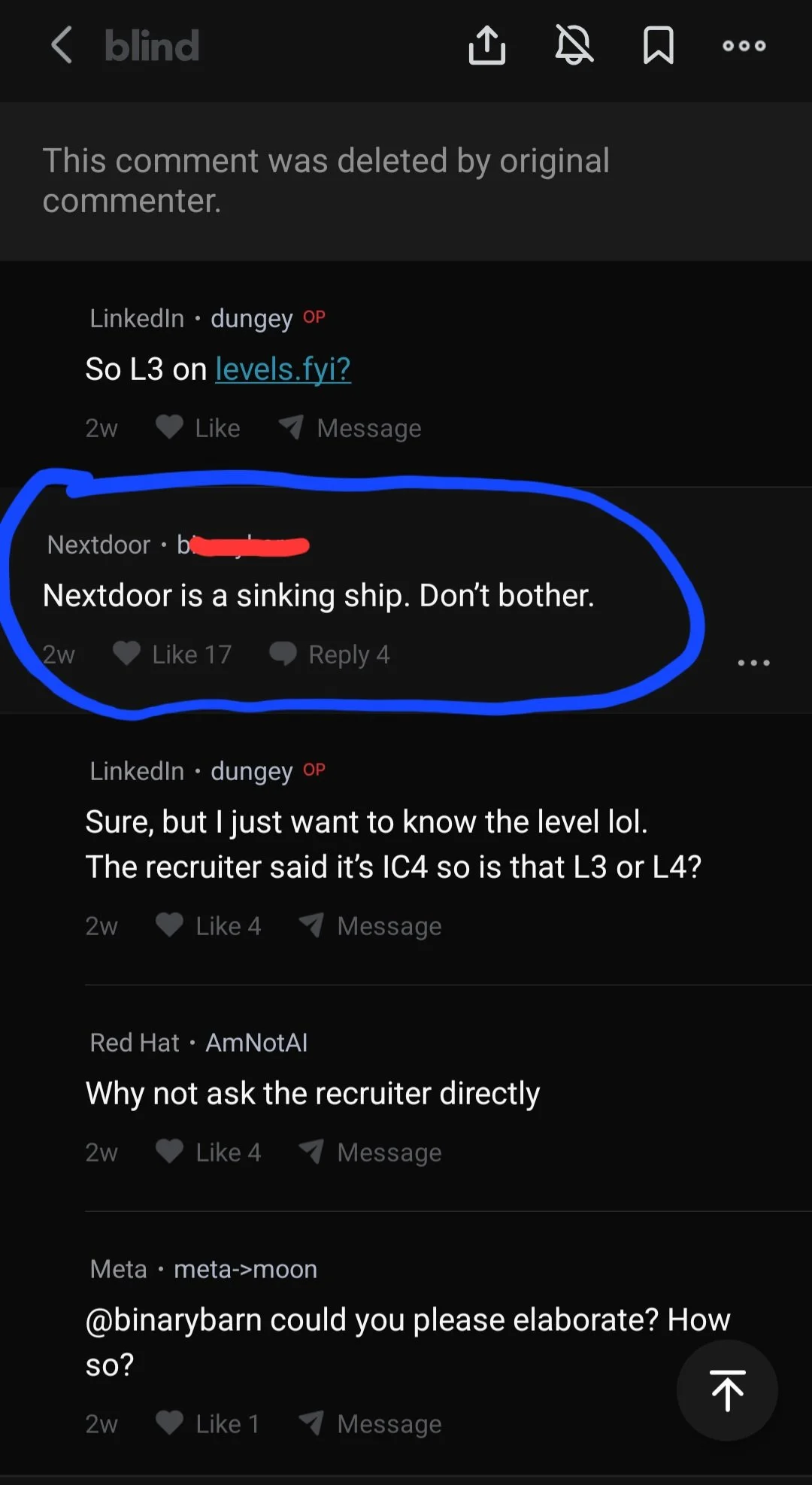
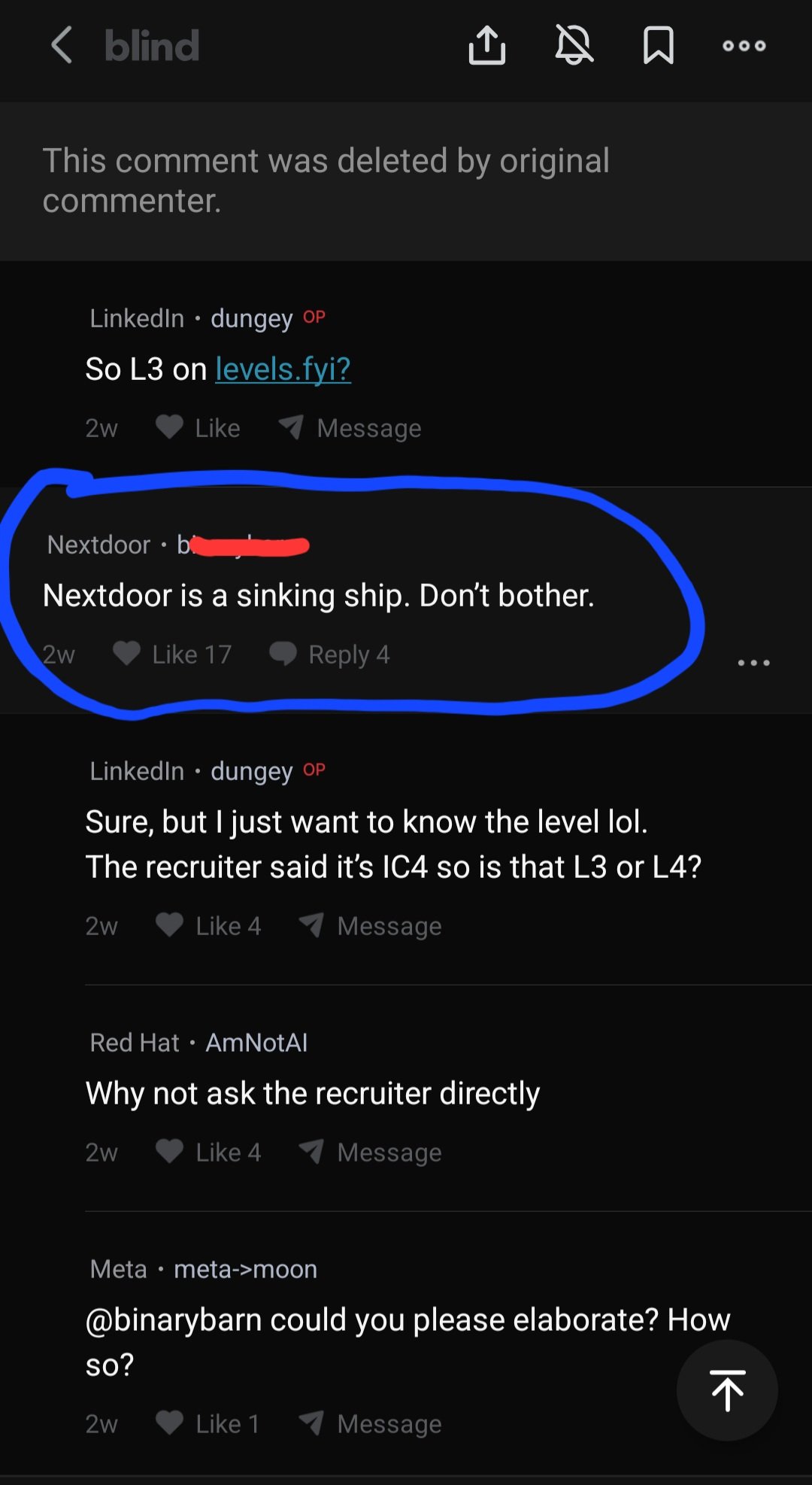
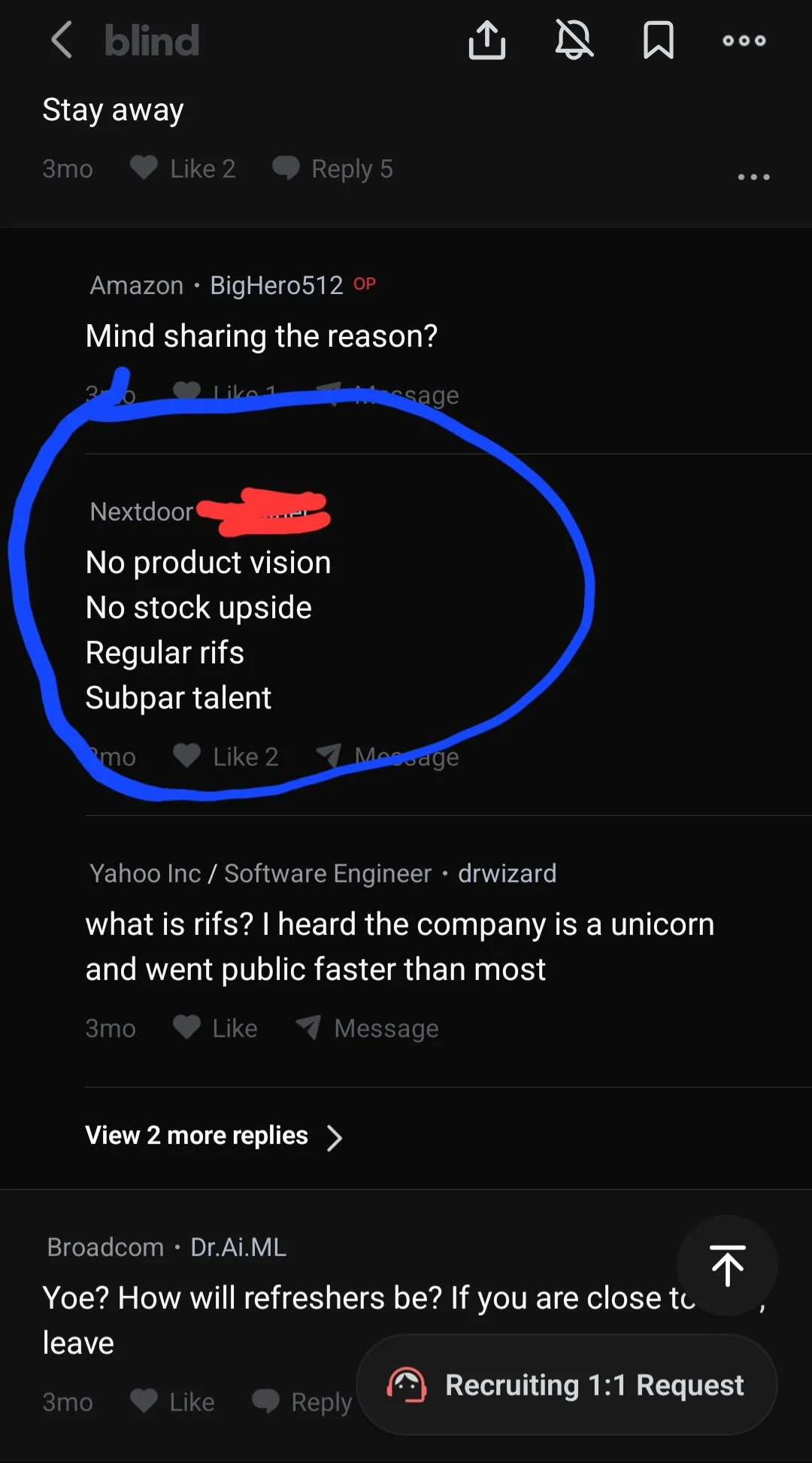
That experience made me think about Blind, the anonymous workplace app where employees discuss company culture, leadership, compensation, and strategy without attaching their real names. Like any anonymous platform, comments should be evaluated carefully, but it often provides insight that differs from the polished narratives presented in earnings calls, podcasts, and press releases.
What interests me is the gap between internal sentiment and external messaging.
Sometimes Nextdoor reminds me of The Stepford Wives—a place where conformity appears more valued than disagreement. If you fit the narrative, everything is fine. If you challenge it, you may find yourself ignored, blocked, or dismissed.
That’s why feedback matters.
Strong companies don’t improve because everyone agrees.
They improve because leaders are willing to hear perspectives they may not like.
Loyalty is important.
Accountability is more important.
Leadership Isn’t About the Camera—It’s About Building Human Connection
I’ve spent a lot of time thinking about leadership, organizational culture, and why some companies unite people while others seem to profit from keeping them divided.
That led me to think about Nirav Tolia’s educational background in English.
An English degree can produce exceptional communicators and storytellers. By all appearances, Nirav has excelled at being in front of a camera, speaking with the media, appearing on podcasts, and presenting a compelling vision.
My concern isn’t the degree.
It’s whether the product consistently delivers on that vision.
I’ve heard many times throughout my career that success is a combination of hard work, who you know, and a lot of luck.
Looking at Nirav’s career, it’s difficult to argue those elements haven’t played a role. Joining Yahoo during the infancy of the web. Founding ePinions during the dot-com era and seeing it acquired. Launching Nextdoor when social media and local communities were colliding online.
Those opportunities required work and execution.
But they also required timing.
As I learned while living in Las Vegas, luck eventually runs out and markers eventually come due.
The challenge for every founder is proving that success wasn’t just the product of timing.
If AI and human connection are truly the future of Nextdoor, why not invest in initiatives grounded in behavioral psychology instead of simply driving engagement?
For less than the cost of many marketing campaigns, Nextdoor could sponsor five pilot neighborhoods at $50,000 each and scientifically measure outcomes.
Consider initiatives such as:
Neighborhood Mediation Labs: Professionally facilitated sessions where neighbors resolve recurring disputes over parking, pets, noise, fireworks, and HOA issues while AI identifies common themes and recommends solutions.
Community Service Challenges: Competing neighborhoods earn recognition by volunteering at food banks, cleaning parks, assisting seniors, or supporting veterans’ organizations, rewarding cooperation instead of conflict.
MBTI and DISC Community Workshops: MBTI (Myers-Briggs Type Indicator) and DISC are personality frameworks used worldwide to help people understand communication styles, motivations, and conflict behaviors. Imagine neighbors learning that the person they disagree with isn’t necessarily unreasonable—they simply process information differently. Understanding differences often reduces conflict and increases empathy.
Behavioral AI Nudges: Before posting an inflammatory comment, AI could ask, “Would you say this face-to-face to your neighbor?” while suggesting language that promotes constructive dialogue instead of escalation.
Track neighborhood sentiment. Track retention. Track advertiser engagement. Track participation.
If the pilots work, expand them nationwide.
That’s what investing in human connection looks like.
Instead, too often the platform appears optimized for complaints, arguments, outrage, missing packages, barking dogs, fireworks disputes, and HOA drama because conflict generates engagement.
The best leaders don’t simply talk about bringing people together.
They build systems that make it happen.
Because eventually every founder faces the same test:
Was it skill?
Was it timing?
Or was it luck?
And as every gambler eventually learns, even a broken clock is right twice a day.
I came across a Facebook video today that immediately reminded me why Nextdoor's unpaid moderator model doesn't work.
Watch it here:
https://www.facebook.com/share/v/1LCFC3TzYb/
The video shows what can happen when someone believes they have authority beyond what was intended. The result is an environment where people stop engaging because they don't feel heard or treated fairly.
That's exactly the risk of relying on unpaid neighborhood moderators with inconsistent oversight and accountability.
The frustrating part is that this is fixable.
I've repeatedly suggested that Nextdoor implement a Quality Assurance scoring program similar to those used in customer service organizations, where moderator decisions are routinely reviewed for consistency, policy adherence, professionalism, and bias. I even suggested that Karen Romero lead such an initiative through coaching, calibration sessions, and measurable quality metrics.
I've also raised another question that I believe deserves an answer.
What vetting and ongoing safeguards exist to protect users if an unpaid moderator becomes unhinged and decides to retaliate against a local neighbor?
Moderators operate within communities tied to real identities and local information. If someone abuses that position, what oversight exists? What audit trail is reviewed? What protections are in place for the people they moderate?
I've asked these questions repeatedly at multiple levels within Nextdoor.
So far, the response has been silence.
I'm not simply saying the model is broken and walking away. I'm proposing practical improvements and asking reasonable governance questions.
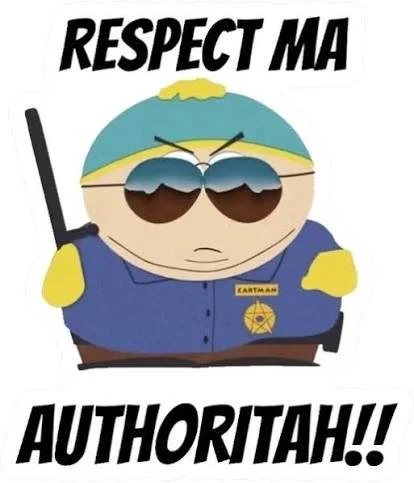
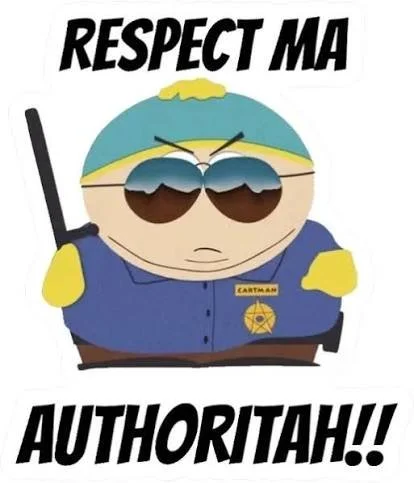
For a little humor, I added a picture of Eric Cartman and his famous catchphrase, "Respect my authoritah!" While it's meant to be comedic, it's often the image that comes to mind when I think about unpaid moderators sitting behind a monitor, wearing an imaginary badge and sunglasses, convinced they've been granted far more authority than they actually have.
Leadership doesn't have to agree with every suggestion, but acknowledging thoughtful feedback and explaining existing safeguards would go a long way toward building trust with users and shareholders alike.
The issue isn't the volunteers themselves.
The issue is a moderation model that lacks the transparency, oversight, and quality controls necessary to inspire confidence.
Communities deserve consistency. Volunteers deserve coaching. Users deserve answers.
And great leaders don't ignore difficult questions.