
We Expect What We Inspect
A few weeks ago, I wrote about my experience at a local Starbucks where the music being played didn't exactly sound like it came from the corporate-approved playlist. Think death metal, explicit rap, and enough profanity to make me wonder if someone had hijacked the speakers.
I submitted feedback through the Starbucks website chat because I thought someone should know. My goal wasn't to get anyone in trouble. It was simply to share a customer experience that didn't match what I've come to expect from Starbucks.
Fast forward to today.
As I write this blog post, I'm sitting in that same Starbucks.
Something feels different.
I believe the store manager is here. I could be wrong, but here's why I think so:
The music isn't death metal, trap music, or The Best of "Weird Al" Yankovic. It's what I'd expect to hear in a Starbucks.
She's spent a significant amount of time working on an iPad, which looked like inventory or operational work.
She's now working tableside on a laptop.
I overheard what sounded like a discussion about scheduling with one of the baristas.
None of those things stood out to me the last Sunday I visited.
There's an old saying I've used throughout my career:
We expect what we inspect.
Whether you're leading a coffee shop, a Fortune 500 company, or a small business, it's difficult to know what's really happening if leaders never spend time where the work is being done.
Now, am I the reason she's here today?
Probably not.
Did my feedback play some small role?
Maybe.
I have no way of knowing, and I'm not going to pretend otherwise.
What I do know is this: today's customer experience feels noticeably different from the one I wrote about a few weeks ago. The atmosphere is calmer, the music fits the environment, and it feels more like the Starbucks experience I expected in the first place.
Sometimes customers don't expect perfection.
They simply want to know someone is paying attention.
What do you think? Have you ever noticed a business improve after you provided respectful, constructive feedback? I'd love to hear your experience.
Join the discussion on NielFlamm.com.
Whistleblowers Welcome: Help Shine a Light on Leadership and Workplace Culture
Every organization has room to improve. Some embrace feedback. Others silence it.
If you are a current or former employee who is concerned about workplace culture, leadership, management practices, accountability, or organizational performance, I’d like to hear your perspective.
If you choose to reach out, I will take reasonable steps to redact identifying information before discussing your experience publicly. Please do not send confidential, proprietary, or legally protected information. I’m interested in your experiences, observations, and opinions—not trade secrets.
Poor performance should not be rewarded.
Ineffective leadership should be examined, not ignored.
A toxic culture rarely appears overnight. It often starts at the top and spreads throughout an organization until someone has the courage to confront it.
One of my favorite leadership principles is simple:
You tolerate what you allow.
If leaders allow dysfunction, it becomes the culture.
If employees remain silent out of fear, meaningful change becomes even more difficult.
Constructive transparency and accountability make organizations stronger—not weaker.
If there are stories that deserve to be heard, let’s have that conversation.
“Meet the new boss, same as the old boss.”
Those lyrics from The Who kept running through my head this morning.
With my family still going through a difficult time, I’ve been spending a lot of hours in a hospital room with my mom. That has given me time to read, research, and think.
One topic I revisited was Nextdoor’s decision to establish a new engineering hub in Dallas, Texas, while continuing to lease office space at The Stack in Deep Ellum.
That led me to ask: Where is the executive leadership team generally based?
Based on publicly available information, I found:
- Nirav Tolia, CEO – Dallas, Texas
- Sarah Leary, Head of Marketing, Community & Business Operations – Boston, Massachusetts
- Craig Lisowski, President of Product – San Francisco, California
- Indrajit Ponnambalam, Chief Financial Officer – Dallas, Texas
- Sophia Contreras Schwartz, Chief Legal Officer – San Francisco, California
- Michael Kiernan, Chief Revenue Officer – Brooklyn, New York
- Tony Castellanos, EVP, People – San Francisco, California
- Kelsey Grady, EVP, Communications – San Francisco, California
- Nick Lisher, EVP, Product – Tunbridge Wells, England
- Anita Patwardhan, EVP, Product Design – San Francisco, California
These are general locations based on public information, not personal addresses.
If the objective is to hire the best executive talent, the search went as far as England.
So if Nextdoor can recruit globally for its C-Suite, why require engineering talent to be concentrated in one office?
If the goal is to attract top engineers with competitive pay, benefits, bonuses, and equity, why require Dallas when many executives they collaborate with are in San Francisco, Boston, New York, or England?
And it’s 2026.
Cloud infrastructure is managed through providers like Amazon Web Services (AWS) and Microsoft Azure DevOps. Hardware monitoring and data center operations are largely handled by specialists and cloud providers, not executives walking the halls.
Is physical proximity improving collaboration, or just creating another layer of management?
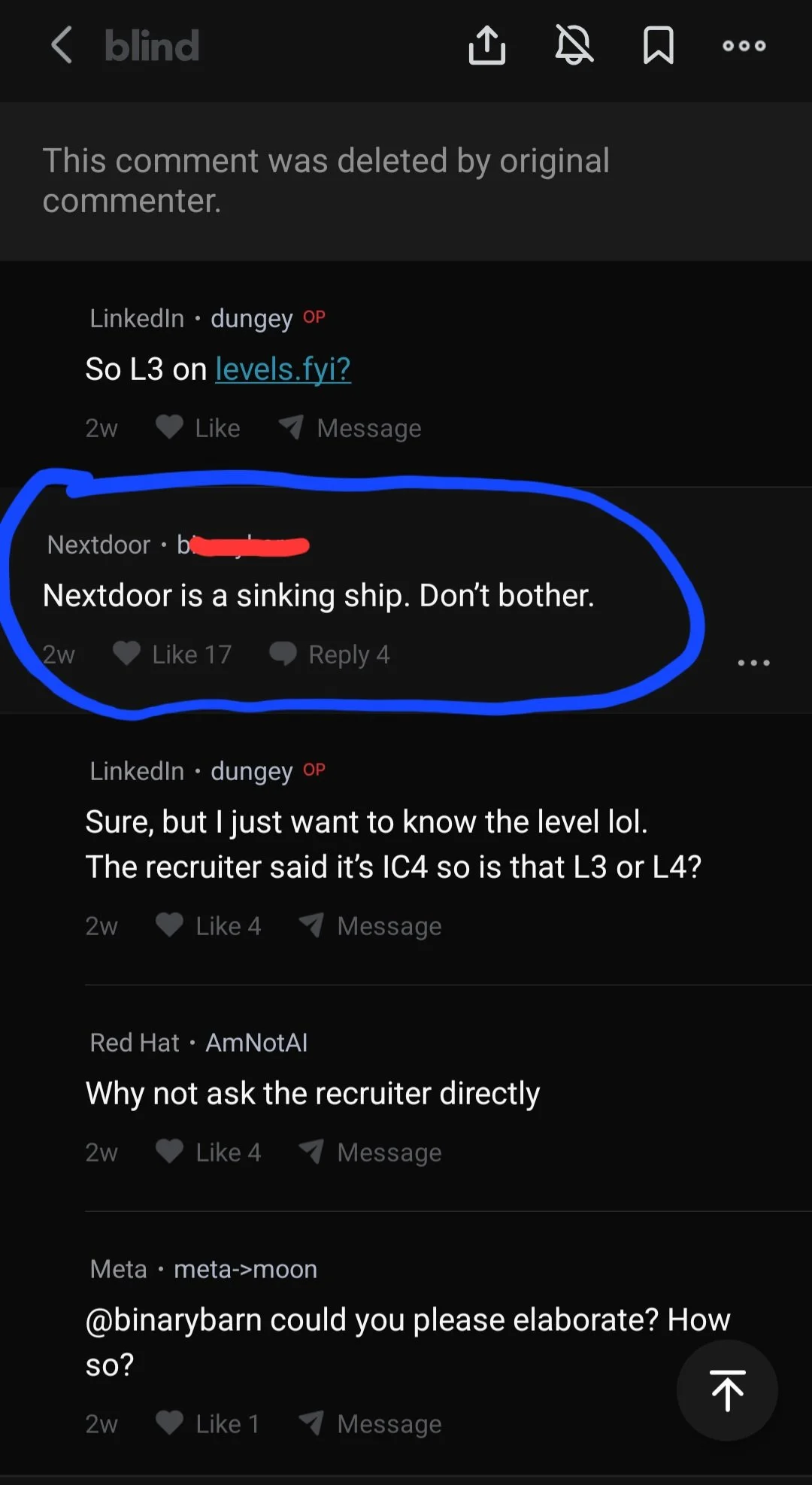
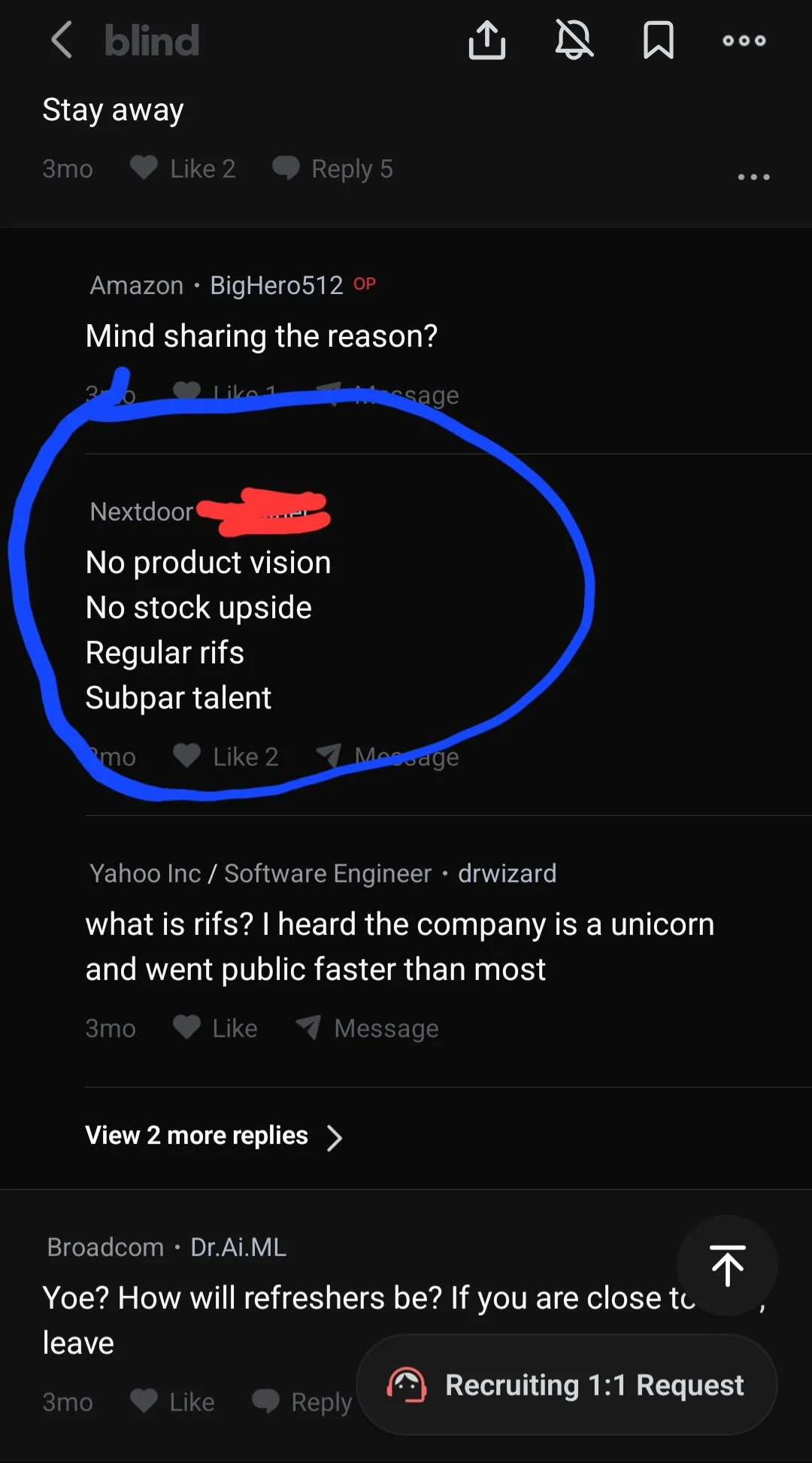
Anonymous Blind discussions mention micromanagement, toxic culture, and even cult-like comparisons. Those are anonymous opinions, not verified facts, but they raise questions worth asking.
Throughout my career, I’ve learned that strong leaders hire talented people, coach them consistently, provide candid feedback, and trust them to do the job.
When performance falls short, you coach, mentor, and partner with HR when needed.
Micromanagement is alive and well in 2026.
Trust still scales better.
Join the discussion on NielFlamm.com/blog.
Loyalty, Accountability, and the Difference Between the Two
On June 22, 2026, Nirav Tolia posted about his longtime professional relationship with Sarah Leary, noting that they’ve worked together for 27 years and that she’s someone he trusts completely. The comments were pulled from his appearance on Ollie Forsyth’s New Economies podcast.
Let me be clear:
I have nothing against Sarah Leary.
I don’t have anything personal against Nirav Tolia, either.
What I am doing is holding a public company CEO accountable for decisions that impact employees, users, advertisers, and shareholders.
There’s a difference.
While podcasts focus on connection, trust, and vision, investors have to evaluate outcomes.
Some questions I continue to ask:
Why should shareholders be excited about a stock trading around $2.16 per share, down on the day?
When will investors see meaningful value creation?
Why spend capital on a Dallas office when much of the work could be performed remotely, potentially reducing costs?
Why promote neighborhood connection while many users continue to report division, moderation concerns, and inconsistent experiences?
Why reference surveys publicly while requests for supporting studies go unanswered?
Speaking of unanswered questions, I’m still waiting for a response regarding a survey request sent to Jacob Chavis.
That experience made me think about Blind, the anonymous workplace app where employees discuss company culture, leadership, compensation, and strategy without attaching their real names. Like any anonymous platform, comments should be evaluated carefully, but it often provides insight that differs from the polished narratives presented in earnings calls, podcasts, and press releases.
What interests me is the gap between internal sentiment and external messaging.
Sometimes Nextdoor reminds me of The Stepford Wives—a place where conformity appears more valued than disagreement. If you fit the narrative, everything is fine. If you challenge it, you may find yourself ignored, blocked, or dismissed.
That’s why feedback matters.
Strong companies don’t improve because everyone agrees.
They improve because leaders are willing to hear perspectives they may not like.
Loyalty is important.
Accountability is more important.
Leadership Starts with How I Treat the "Little Person"
Today, while making my usual social media rounds, I shared my dissatisfaction with Nextdoor, its culture, and CEO Nirav Tolia.
I started thinking about where I learned one of the most valuable lessons of my life.
It wasn't in a boardroom or a Stanford classroom.
It came from working everyday jobs—sweeping floors in a deli, delivering newspapers, cleaning gum off a movie theater carpet, and doing the kinds of jobs that keep society moving.
Those experiences taught me a simple creed:
Treat everyone as if they were the CEO.
The person making the sandwich at Jersey Mike's. The attendant pumping gas in Oregon. The landscaping crew cleaning up the neighborhood. The janitor, the cashier, the receptionist, the call center agent.
Everyone deserves to be acknowledged. Everyone deserves to be heard.
That's where I believe the culture problem at Nextdoor begins.
I'm not a billionaire investor. I'm not a celebrity entrepreneur. I don't have a television show or a Founding Shark title. And I don't automatically agree with every mention of AI as the solution to everything.
Does that mean my feedback should be ignored? My questions silenced? My LinkedIn account blocked for expressing shareholder concerns?
Leadership isn't measured by how you treat influential people. It's measured by how you treat the person with no power at all.
I'd rather treat the building environmental services engineer like they're the CEO than imitate a CEO who dismisses the little person.
Because one approach builds loyalty and trust.
The other builds resentment.