
After Dialysis, Assisted Living Tours and Complaints: I Need the Ocean and Bacon
Today was one of those days when my internal battery was already flashing red before I walked through the door.
After dialysis, I toured The Palms, an assisted living facility I'm considering for Mom.
Today's dialysis was a little more difficult than Monday's. By the time everything was finished, I didn't even make it to my recovery meeting.
Instead, I had another mission:
Deliver Mom's dinner.
Ham, grits, and peas.
Gross.
I'm sure someone loves that combination. That someone is not me.
So, after dialysis and touring The Palms, I headed over to the skilled nursing facility with Mom's meal.
And then the complaining began.
Apparently, Everything Is Terrible
It was nonstop.
The food.
Physical therapy.
Nursing.
This.
That.
Something else.
At times, Mom was saying things that, from my perspective, didn't line up with what had actually happened. I've experienced that before with both of my parents, and today I didn't have much energy left to sort through what was accurate, what was frustration, and what might have been something else entirely.
I could feel myself reaching my limit.
That's when H.A.L.T. popped into my head.
Hungry.
Angry.
Lonely.
Tired.
I was feeling three out of the four.
I'll let everyone guess which three.
Actually, don't think about it too hard.
The important part was recognizing what was happening before I allowed myself to get dragged into an argument that wasn't going to accomplish anything.
See You Tomorrow
I finally told Mom I was going to leave and that I'd see her tomorrow.
Tomorrow, I'm touring another assisted living facility.
Her response?
“Don't come.”
My response?
“See you tomorrow.”
At this point, it felt less like a discussion and more like defiance.
Ugh.
Yesterday, I wrote about needing to establish boundaries. Today was another opportunity, actually, to practice one.
I didn't argue.
I didn't address every complaint.
I didn't stay there until I was completely exhausted and angry.
I left.
Sometimes that's the healthiest option available.
I'm Still Doing the Work
The frustrating part is that behind all these conversations, I'm still trying to do what Mom has said she wants.
She wants assisted living.
So I'm touring assisted living facilities.
I'm looking at rooms.
I'm learning about services.
I'm figuring out costs.
I'm asking questions.
I'm trying to imagine what her life might look like in each place.
Then I walk into the skilled nursing facility and hear complaint after complaint about the place she's currently living.
I understand that she's frustrated. She's been through a lot.
But I've been through a few things myself.
Today alone started with dialysis, moved into an assisted living tour, and ended with me delivering ham, grits, and peas while listening to a review of practically every department in the building.
Eventually, the tank is empty.
Mine was empty.
So I went home.
Tomorrow, I'll get up and do it again.
Another facility.
Another tour.
Another visit with Mom, regardless of today's “don't come.”
And hopefully another reminder to myself that I don't have to solve everything in one day.
I Need the Ocean and Bacon
Fortunately, I have something waiting for me at the end of October.
I'm going on a cruise.
And after the last few weeks, I think I've identified exactly what I need:
The ocean and bacon.
Lots of ocean.
An unreasonable amount of bacon.
Maybe I'll sit somewhere, looking out over the water, holding a plate stacked with bacon and doing absolutely nothing for anyone.
No assisted living tours.
No skilled nursing complaints.
No ham, grits, and peas.
No problem-solving.
Just me, the ocean, and enough breakfast meat to concern a cardiologist.
But first, tomorrow.
Another assisted living facility.
Another visit with Mom.
Because even when she says, “Don't come,” sometimes I know what she really needs is for me to keep showing up.
So...
See you tomorrow, Mom.

My First Assisted Living Tour—and a Mom-Approved Dinner
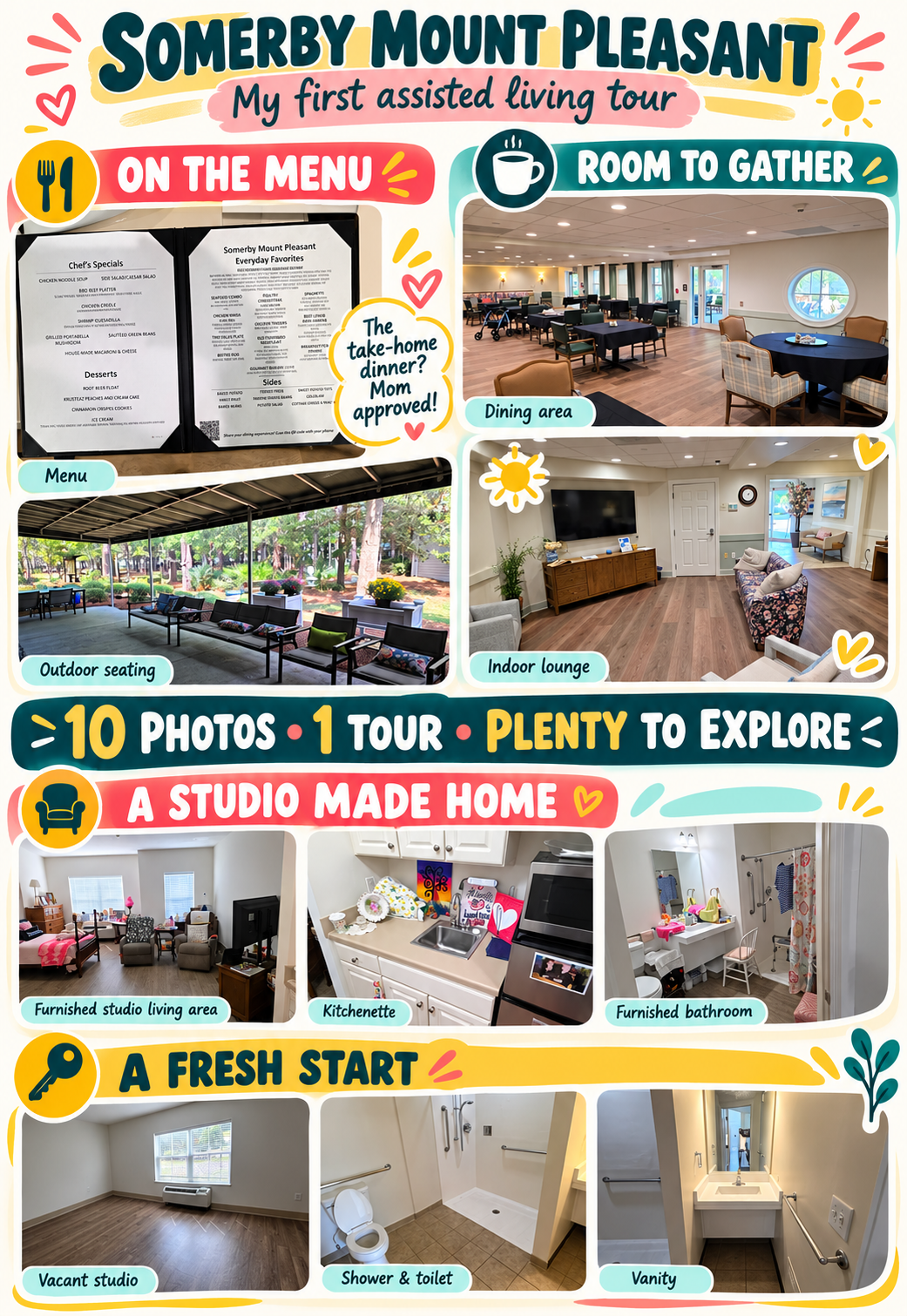
Today was a full day.
I started with a 10:15 a.m. cardiology appointment and left with some action items of my own. Taking care of Mom doesn’t take my health off the calendar.
Then I went to an afternoon recovery meeting before heading to Somerby in Mount Pleasant for my first assisted living tour.
I’ve been scheduling these visits, thinking through questions, and trying to understand what the next step could look like for Mom. Today, I got to walk through a place and start putting that information into context.
There was a lot to take in.
We discussed what Mom would need to qualify for assisted living, what’s included in the residence, activities, security, and more. I’m learning how much there is to understand beyond whether a room looks nice.
I want to know how the place would work for her day-to-day. What would she have access to? What could she participate in? Would it feel like somewhere she could settle in and enjoy herself?
I saw lounges, dining and activity spaces, coffee areas, and outdoor spaces. Walking through helped me picture where Mom might spend time beyond her own room.
I also asked whether I could take pictures and made a point of saying I wouldn’t include residents. This is their home. I wanted to document the spaces while respecting the privacy of the people living there.
Then came the part of the tour I had been particularly interested in.
The food.
If you’ve been following along, you know I’ve been requesting tastings. Choosing somewhere Mom might eat every day deserves a little investigation. A brochure can describe dinner beautifully, but Mom has never eaten a brochure.
I left with two to-go boxes.
One had a fish combination with shrimp and flounder, a baked potato, and sautéed green beans. The other had a shrimp quesadilla. There were also two green salads, tartar sauce, fruit salad, and two peach cake desserts.
I had arrived for information and left carrying dinner. This is a meeting format I can support.
Of course, my opinion was only part of the process. The food needed to make it to Mom.
And it was Mom-approved.
If you're following her recent reviews of hospital and facility meals, you know this is meaningful news. We have encountered wraps that did not survive the review process.
This meal got her approval. I was glad to bring her something she enjoyed—and to have her take part in this step toward a possible next home.
One tour and one meal are a beginning. I still have information to work through and more to learn about what will fit her needs.
But I left this first visit with a clearer understanding of assisted living, a lot to think about, and something concrete to share with Mom.
After a day of my own medical responsibilities, recovery, and planning for her care, it felt good to have a simple, positive moment.
Mom liked dinner.
I’ll take that win—with a side of peach cake.
When Helping Mom Means Setting a Boundary
This afternoon, I got frustrated with Mom.
Really frustrated.
It was lunchtime at the skilled nursing facility, which meant it was also time for one of Mom's favorite activities whenever she's in an institutional setting:
Complaining about the food.
Her favorite word seems to be “terrible.”
She uses it a lot.
More than a lot.
Today, though, the frustration wasn't just about whether lunch deserved another terrible review.
While Mom ate, I stood in the hallway when one of the CNAs approached me. She brought up several concerns.
Mom isn't eating enough. She wants to go to sleep immediately after eating, even though she's been told she needs to remain upright for at least 30 minutes. Her stomach hasn't really settled since her second stroke. She's also frustrated because she says it sometimes takes too long for someone to respond after she pushes the call button.
There may have been a few other things mentioned that I'm forgetting.
I understand the complaints individually.
Put them all together, though, and I started getting frustrated.
What Does Mom Actually Want?
We've talked about this before.
Mom doesn't want to go home. She wants to leave skilled nursing and eventually move into an assisted living facility.
I'm touring two assisted living facilities this week to help make that happen.
But I explained something to her again today: moving to another facility won’t necessarily solve everything she doesn't like about this one.
There will still be other residents.
Staff will still care for multiple people.
There will still be menus she doesn't control.
There will still be times when she pushes a call button, and someone doesn't magically materialize next to her bed.
That's part of the compromise that comes with choosing a facility over living at home.
At home, she could have significantly more control over what she eats, when she eats, when she goes to bed, and many of the other things she's frustrated about now.
She doesn't want that option.
I respect that.
But choosing another option means accepting compromises.
And that's where we weren't getting anywhere today.
I'm Not Going to Chase the Impossible
I finally told Mom something that may have sounded harsh.
I'm not going to put in all the work required to find another facility, arrange everything, deal with the finances, move her, and get her settled somewhere else if we're going to repeat the same cycle.
New building.
New room.
New staff.
New food.
Same word:
“Terrible.”
I'm willing to help her find a place where she's safe, comfortable, and treated well.
I'm willing to tour facilities.
I'm willing to ask questions.
I'm willing to work through the financial issues.
I'm willing to help her get where she says she wants to go.
I can’t guarantee she’ll like everything.
No facility can do that.
I Had to Remove Myself
Eventually, I realized the conversation wasn't accomplishing anything.
I was frustrated.
She wasn't changing her position.
I wasn't changing mine.
Continuing the conversation would only make both of us more upset.
So I told her that I needed to remove myself from the situation.
That's a boundary I need right now.
There is a difference between helping someone and taking responsibility for making them happy.
I can help Mom.
I can't manufacture happiness for her.
And I can't keep running from facility to facility looking for a place where absolutely everything will be exactly the way she wants it.
Then There's the Money
There's another practical reality.
Assisted living costs money.
Potentially a lot of money.
If Mom is going to be unhappy regardless of where she lives, I have to ask a difficult question:
Why spend a significant amount of her money changing locations if the result will be the same dissatisfaction?
That's where my mind went today.
If she's going to be unhappy in assisted living and unhappy at home, then financially, being unhappy at home is considerably less expensive.
That doesn't mean I've decided she needs to go home.
It doesn't mean I'm abandoning the search.
I'm still touring the facilities this week.
But I am starting to recognize that finding Mom a new place to live and finding Mom a place where she'll never complain are two completely different assignments.
I can work on the first one.
The second one isn't mine.
Today, I needed to remind myself of that—and walk away before frustration took over the conversation.
Tomorrow is another day.
And apparently, somewhere out there, I still need to find a facility whose food doesn't earn the word “terrible.”
Wish me luck.
Some Days Moving Forward Means Staying Still
In a previous post, I wrote about visiting my mother in the skilled nursing facility—spending time with her, seeing what her days are like there, and trying to navigate everything that comes with figuring out what happens next.
Today, I was supposed to visit again.
My body had other plans.
Today my body said, “I'm not getting out of bed.”
And I listened.
I didn't finally get out of bed until about 5:30 p.m. Eastern Time.
I was awake earlier in the day, and once I realized I wasn't going to make it, I messaged the family group text. I let everyone know I wouldn't be there and asked if the brother who was in the area could let Mom know.
They were there hanging out with her, so she wasn't alone.
Still, I felt like I was missing something.
I didn't get to hear from Donna Woods today—or try to keep up with Donna Woods. That's become part of these visits, too. There are the people I originally go there to see, and then there are the people I meet along the way who somehow become part of the story.
And that little community around Mom may be changing this week.
Her current roommate, Jenny, might be leaving tomorrow. If she does, Mom may be getting a new roommate.
Donna Woods may be leaving on Tuesday.
It's strange how quickly these temporary communities form. People enter a skilled nursing facility because something happened in their lives. They become roommates. They sit in the same hallways. They eat meals together. Families begin recognizing one another. Personalities emerge. Stories get shared.
Then someone gets better.
Someone moves.
Someone goes home.
Someone new arrives.
And the little world rearranges itself again.
Maybe that's part of what I've been watching while visiting Mom: life continuing to move even when, from the outside, it can look like everyone is standing still.
Today, I was the one standing still.
I always feel some guilt when I don't make it to see Mom. I want to show up. I want to be involved. I want to keep things moving forward.
But sometimes my body gets a vote, too.
Today it apparently had veto power.
So I stayed in bed.
Tomorrow begins another week, and it's time to push ahead again.
On Tuesday, I'm touring an assisted living facility as we continue exploring what the next chapter might look like for Mom.
The timing feels especially interesting now.
Jenny may be leaving.
Donna Woods may be leaving.
Mom may have a new roommate.
And I'm going to walk through a completely different place and try to imagine whether it could eventually become Mom's next home.
I’m not sure this facility is the right one. I don't know what Tuesday will bring. There are still questions to ask, things to see, decisions to make, and probably a few surprises nobody has thought about yet.
But that's where things are today.
Yesterday's plans change.
Roommates come and go.
People recover and move on.
Some days I visit Mom.
Some days my body tells me I'm staying in bed until 5:30 p.m.
And then another week begins.
So I get up, push ahead, and take the next step.
Caring for My Mother Without Running the Show
Yesterday, during meditation, I felt a conscious contact with a Power Greater than myself. I felt grounded and right-sized.
Then, before a conversation with another alcoholic, a few questions came up.
Are my motives pure when it comes to my mother? Am I doing God’s will?
Without a doubt, I want my mother to have the best experiences she can with whatever time she has here on Earth before moving on to the next dimension. I want her to have care, comfort, choices, and things to look forward to.
That part is clear to me.
But another question followed: Am I trying to exert my own will? Am I taking control? Is my ego involved?
Apparently, my ego also attended the meditation and hoped nobody would take attendance.
After prayer and discussion, I could acknowledge it: I am trying to run the show.
That is uncomfortable to admit, especially after writing so openly about my frustrations with my father. But if I’m willing to share my anger, I need to be willing to share my self-reflection, too.
I can deeply love my mother and still get caught up in wanting everything done my way. I can have good intentions and become attached to being the person who makes the decisions.
My concern for her is real. So is my responsibility to examine how I act on that concern.
I’ve written about money and control, and how I’ve experienced my father’s responses. Now I need to look at my own desire for control.
Whether my father is trying to run the show, appease his ego, or act from some other motive is not mine to judge. I don’t know everything going on inside him.
I am responsible for my actions.
That gives me plenty to work on without taking on a second job managing his spiritual condition.
For the moment, I’m going to relent. I’m going to loosen my grip on how this has to happen.
My mother has expressed that she wants assisted living. After that, the plan is Thailand with me for the 6+6. As long as her care and those plans are being funded, who manages the finances or makes the payments does not need to be the thing I fight over.
The resources need to be there. The bills need to be paid. My mother’s wishes need to remain part of the decisions about her life.
I can do my part: show up, listen, help with arrangements, ask questions, and follow through on my responsibilities.
Then I need to let God control the result.
I would love to report that I have mastered this and will never mentally grab the steering wheel again. Unfortunately, I know the driver.
This will take practice. More prayer. More honest conversations. More willingness to pause when I start confusing helping with directing every detail.
My boundaries with my father remain.
I have identified what I will accept in that relationship and what I won’t tolerate. Letting go of an outcome doesn’t erase those boundaries. I am still responsible for how I participate, what I agree to, and when I need to step back.
I won’t let fear of people or economic insecurity make those decisions for me. When fear shows up, I can bring it into prayer and talk about it honestly instead of giving it control over my behavior.
Today, I feel clearer about where my work is.
I love my mother. I want to help her have a life she enjoys. I can act with care and hold my boundaries while leaving room for things to happen without my direction.
I’ll do my part—and keep practicing the part where I let go.