

Day 80: Nextdoor Wants to Talk About Reputation? Seriously?

Today is Day 80.
And Nextdoor managed to stop me in my tracks with the very first sentence of a LinkedIn post:
“A reputation you earn is worth more than one you can buy.”
They have to be kidding.
Of all the subjects Nextdoor could lecture businesses about, they chose:
Reputation.
This accompanies a new announcement distributed through Business Wire:
Nextdoor Deepens Its Commitment to Local Business Discovery and Recommendations
The release describes Nextdoor as “the essential neighborhood network” and announces changes intended to make the platform a destination for trusted local-business recommendations. It says nearly 30% of Nextdoor content already involves local business recommendations and reports nearly 75 million Faves across almost 6.6 million businesses. Business Wire
Those are impressive talking points.
But let's talk about reputation versus reality.
“The Essential Neighborhood Network”?
Nextdoor can call itself that.
But reputations aren't created by press releases.
And Nextdoor has spent years dealing with a very different nickname:
The “Karen” of social media.
That reputation didn't appear out of nowhere. Nextdoor's so-called “Karen problem” has been publicly discussed for years, including criticism involving neighbors policing one another and reporting behavior they don't like. Wikipedia
Spend enough time on the platform, and the irony becomes hard to miss.
Neighbors arguing about noise.
Lawns.
Politics.
Parking.
Dogs.
e-Bikes.
Someone's trash cans.
Someone else's kids.
Someone looked suspicious.
Someone's music is too loud.
Someone's grass is apparently threatening civilization.
Welcome to the essential neighborhood network.
Nextdoor says a reputation should be earned.
Okay.
Then Nextdoor's reputation has to be judged by what its platform actually produces—not merely by what Communications writes about it.
Then There Are the Businesses
Here's where today's announcement gets particularly interesting.
The release celebrates businesses earning recommendations organically and says Nextdoor is helping businesses build reputations that “can't be bought.”
Then, just a few paragraphs later, we get:
Opportunity Alerts.
That's a paid product that routes requests from verified neighbors directly to local service providers. The release also says a forthcoming business feed will allow businesses to comment and engage with neighbors. Business Wire
Wait.
We're celebrating reputations that can't be bought...
while introducing paid access to opportunities?
I'm not saying businesses shouldn't pay for advertising or leads. Nextdoor needs revenue. I'm a shareholder—I want it to make money.
But let's not pretend there isn't a tension worth discussing.
If a neighbor says:
“Can anyone recommend a plumber?”
and as businesses are increasingly encouraged to pursue paid products to reach those opportunities, where does authentic neighborhood conversation end and lead generation begin?
That's the conversation I'd like Nextdoor to have.
Users. Businesses. Investors.
That's what I find so fascinating about the current Nextdoor strategy.
I see friction across all three groups.
Users can end up fighting with other users over everything from lawns to e-Bikes.
Businesses are being introduced to new monetized tools for reaching neighbors actively seeking services.
And then there are investors like me.
Nextdoor has been around for roughly 15 years, and shareholders are still waiting for the enormous upside we've been promised.
Meanwhile, Q2 2026 still produced a $2 million GAAP net loss, although that's substantially better than the $15 million loss a year earlier, and adjusted EBITDA was positive $10 million. Business Wire
I've already made my position clear:
I have lost confidence in Nirav Tolia's leadership and believe Nextdoor needs a change at the top.
The Press Release Has a Messaging Problem
Read the announcement carefully.
It says:
Real people, not algorithms, decide who's trustworthy.
Then the very same announcement touts AI-powered Search and machine-learning ranking systems that improve what neighbors see. Business Wire
It says reputations can't be bought.
Then promotes a paid product for routing neighbor requests to service providers.
It emphasizes organic word of mouth.
Then discusses tools businesses can use to manage campaigns.
None of those products is inherently bad.
The problem is the gap between the beautifully crafted language and the much messier reality of operating and monetizing the platform.
And after 80 days of examining Nextdoor, that's becoming a recurring theme.
About That Reputation...
Nextdoor's own CEO, Nirav Tolia, says in the release:
“Local businesses have always grown through word of mouth.” Business Wire
I agree.
And word of mouth works for public companies too.
Customers talk.
Businesses talk.
Employees talk.
Investors talk.
Reputation isn't what a company calls itself in a Business Wire headline.
It's what people say about the company when the Communications department isn't writing the sentence.
So when Nextdoor tells businesses:
“A reputation you earn is worth more than one you can buy.”
I actually agree completely.
Which leads to my Day 80 question:
Nextdoor, what reputation have you earned?
Because that's a much more interesting question than the one the press release answers.
Day 80.
Still waiting for the two detailed Insights reports.
Still documenting the contradictions.
Still a shareholder.
And still wondering whether Nextdoor reads its own messaging before telling everyone else about reputation.
Read the full continuing Nextdoor case study at NielFlamm.com/blog and subscribe at NielFlamm.com to follow what happens next.
Day 79: Wait...Did Nextdoor Just Change Its Insights Playbook?
While looking through Nextdoor's latest blog posts, something caught my attention.
On August 31, Nextdoor published a new Insights article:
New Nextdoor Research: Movers Stay in Purchase Mode for Months. Here's How They Decide What to Buy.
It's based on Nextdoor's 2026 Moving Insights Report, and the post contains plenty of numbers: 66% of neighbors update their Nextdoor address within a month of moving, 46% wished they could ask people already living in a neighborhood questions before moving, 54% bought new home décor, and 80% expect to hire professionals for renovations or repairs. Nextdoor Blog
But those numbers aren't what immediately caught my attention.
It was what was missing at the bottom.
Where Did “Contact Jacob” Go?
Historically, I've seen Nextdoor Insights posts direct readers who want the complete findings or detailed data to Jacob Chavis and the Insights team.
That's how this entire months-long adventure started.
I followed those instructions.
I requested the detailed data.
Again.
And again.
And again.
Instead, look at how this newest report ends.
There's now a section called:
“Turning this into a campaign.”
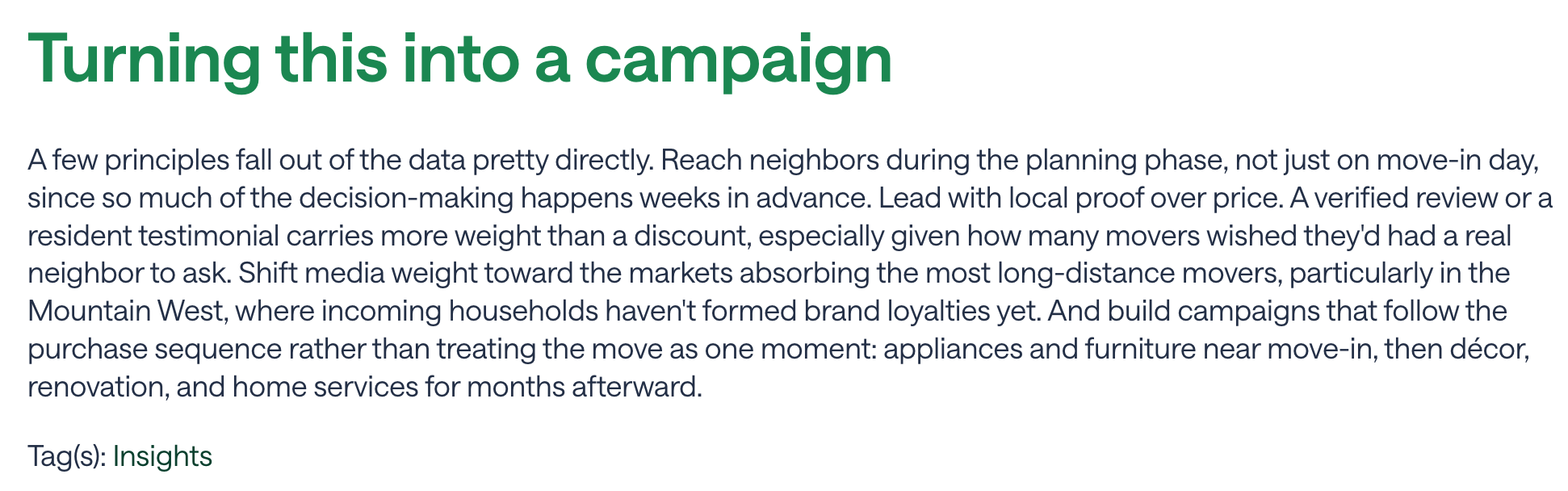
Nextdoor takes the reported findings and turns them directly into recommendations for advertisers: reach neighbors during the planning phase, emphasize local proof, focus advertising on markets receiving long-distance movers, and build campaigns around the purchasing sequence. Nextdoor Blog
Then the article ends.
No invitation to contact Jacob for the complete findings.
No “reach out for detailed data.”
Interesting.
So first:
You're Welcome, Jacob.
You're welcome, Insights Team.
You're welcome, Communications.
😂
Have my 79 days of persistence actually produced a change?
I obviously can't prove that.
Maybe Nextdoor independently decided to change the format.
Maybe this report was always going to be published this way.
But after spending months asking for the “detailed data” Nextdoor publicly invited readers to request, I find the change pretty damn interesting.
Accountability sometimes produces change—even if nobody sends a thank-you note.
But Now I Have Another Question
Nextdoor makes numerous specific statistical claims in this article.
I'm not saying they're wrong.
I'm asking how an external reader would independently evaluate them.
Because putting a percentage in a blog post doesn't magically transform it into unquestionable fact.
For example:
44% of dog walkers prefer non-biodegradable plastic bags over environmentally friendly alternatives.
There.
I just conducted the 2026 Niel Flamm Dog Poop Insights Report.
🐕💩📊
Except I didn't.
I made the number up.
See how easy that was?
Maybe somebody challenges me.
Maybe nobody does.
That's why methodology matters.
Who was surveyed?
How many people participated?
How were respondents selected?
When was the research conducted?
What questions were asked?
What was the margin of error?
What population does the sample represent?
Those details help readers distinguish research from marketing copy.
To Nextdoor's credit, this new article cites independent research from United Van Lines and Harvard's Joint Center for Housing Studies for some of its broader context on moving and home improvement. Nextdoor Blog
But I'm still interested in seeing the methodology behind Nextdoor's own percentages.
And That Brings Me Back to Two Other Reports
Because while Nextdoor may have changed how this newest Insights article ends, there's still some unfinished business.
What about the two previous studies I've requested?
Those posts explicitly told readers that more information was available.
I followed the instructions.
I asked for it.
The wording on a new blog post doesn't erase those previous requests.
So maybe Nextdoor learned something from this experience.
Great.
I'll even take partial credit. 😂
But accountability isn't only about changing what happens next.
It's also about finishing what came before.
Jacob, Insights Team, Communications:
I noticed the change.
Now...
How about those other two studies?
The complete continuing Nextdoor case study is at NielFlamm.com/blog.

Day 78: Blocked Again — While the Stock Does the Slide

Today is Day 78 of my continuing Nextdoor case study.
And apparently we're doing two kinds of sliding:
The NXDR stock price is sliding.
And I've apparently slid right back onto Nirav Tolia's LinkedIn blocked list.
Well, that didn't take long.
On August 29, I was once again able to comment on Nirav's LinkedIn posts.
So I did.
I surfaced the same questions I've been raising publicly about how Nextdoor is being run: leadership decisions, communication, accountability, transparency, customer experience, and what I believe are some very questionable strategic choices.
And now?
I'm blocked again.
I have to admit, this one really gets me.
I'm one guy.
I'm not running a public company.
I'm not a Silicon Valley CEO.
I'm not appearing on podcasts discussing leadership, entrepreneurship, community, and human connection.
I've never sat in one of those big chairs on Shark Tank deciding whether somebody else's company deserves an investment.
I'm just a small shareholder with a website, a LinkedIn account, questions—and apparently a remarkable ability to locate Nirav Tolia's block button.
Meanwhile, Let's Talk About the Stock
NXDR has been doing a little slide of its own.
The stock closed at $2.68 on August 10.
By August 28, it closed at $2.27.
Stocks go up. Stocks go down. Eighteen days certainly don't determine the future of a company.
But shareholders are allowed to ask questions when the direction isn't the one we'd like to see.
And Nextdoor's latest quarterly results still included a net loss of $2 million.
Yes, that's a significant improvement from the $15 million loss during the same quarter a year earlier. Nextdoor also reported positive adjusted EBITDA.
I acknowledge progress when it's there.
But a loss is still a loss.
And here's what gets me:
The CEO of a public company can receive compensation worth millions while shareholders watch the stock struggle and the company continues reporting a GAAP net loss—and somehow my LinkedIn comments are enough to get me blocked again?
That's fascinating to me.
I'm not the person running the company.
I'm one of the people invested in it.
Imagine This on Shark Tank
An entrepreneur walks into the Tank.
The Shark starts asking uncomfortable questions:
Why are you losing money?
Why is the stock struggling?
Why isn't the strategy producing better results?
What are customers saying?
Why should investors believe in the turnaround?
The entrepreneur doesn't like the questions.
So instead of answering...
they block the Shark.
🦈 “And for that reason, you're blocked.”
I'd watch that episode.
Leadership Isn't Tested by Compliments
It's easy to talk about transparency when everyone agrees.
It's easy to talk about community when everyone is applauding.
It's easy to talk about listening when the message is flattering.
Leadership gets more interesting when someone says:
I don't think you're doing this well. Explain why I'm wrong.
Maybe I am wrong.
Show me.
Challenge my argument.
Explain the strategy.
Tell me why the decisions I'm criticizing make sense.
I'd welcome that conversation.
Blocking is easier.
And apparently we've chosen easier again.
Day 78 — And the Questions Haven't Been Blocked
I'm still waiting for the detailed Insights data that started this entire counter.
I'm still documenting what happens.
And I'm still a shareholder who wants Nextdoor to succeed.
That's precisely why I'm asking questions.
Nirav can block my LinkedIn account.
He can prevent my comments from appearing underneath his posts.
But here's the problem:
Blocking the shareholder doesn't block the questions.
It doesn't change the earnings report.
It doesn't move the stock price.
It doesn't improve communication.
And it doesn't end this case study.
So here we are.
Day 78.
The stock has been sliding.
I'm blocked again.
The detailed data still hasn't arrived.
And somehow, one guy with a blog keeps being worth blocking.
That's becoming a story all by itself.
Read the complete continuing Nextdoor case study at NielFlamm.com/blog and subscribe at NielFlamm.com to see what happens on Day 79.

Day 75: What Could Nextdoor Have Accomplished in 75 Days?

Today is Day 75.
Instead of writing another post about unanswered emails, detailed data, panels, communication strategies, or who did—or didn't—respond, I started wondering:
What can actually happen in 75 days?
Quite a lot.
A company can launch a product.
A marketing team can build and execute a campaign.
A business can hire and onboard employees.
A research team can conduct a study, analyze the results, write a report, and publish the findings.
A CEO can appear on multiple podcasts.
Nextdoor can publish new Insights reports, announce initiatives, change how small businesses interact with the platform, promote advertisers, celebrate emergency managers, and launch a Good Neighbor recognition program.
While one simple request remains unresolved.
Let's Measure This Differently
Forget days for a moment.
75 days = 1,800 hours.
That's approximately 108,000 minutes.
My original request probably requires one of three responses:
1. Here's the detailed data.
2. The detailed data isn't available to you.
3. Here's who you need to contact to obtain it.
That's it.
At this point, I'm almost impressed.
We've taken something that potentially required a two-minute email and turned it into a 75-day communications case study.
As someone with more than 20 years in Learning & Development, I've taught and designed training around efficiency, customer experience, communication, process improvement, and identifying performance gaps.
If this were presented as a training scenario, I'd probably ask learners:
“What could the organization have done differently?”
I have a feeling that discussion would be lively.
The Opportunity Cost Is More Interesting
Here's the part organizations sometimes miss.
Every unnecessary customer interaction has a cost.
Someone reads the email.
Someone forwards it.
Someone discusses it.
Someone decides whether to respond.
Communications becomes involved.
Leadership gets copied.
More emails arrive.
More public posts appear.
And suddenly the cost of not resolving something becomes greater than the cost of resolving it.
That's the fascinating part of Day 75.
Nextdoor didn't just spend 75 days not providing the detailed data.
It turned a two-minute question into a 75-day story.
And I'm still writing it.
So Let's Try Something New
I'm giving Nextdoor a hypothetical challenge:
You have two minutes.
No committee.
No communications strategy meeting.
No executive approval process.
No corporate language.
Just answer:
Is the “detailed data” referenced in your blog available to me?
Yes?
Send it.
No?
Tell me.
Restricted to advertisers?
Tell me.
That's communication.
And then we can finally retire the counter.
Because I'd much rather write:
Day 75: NEXTDOOR SENT THE DATA
That's a post I'd genuinely enjoy publishing.
Until then...
1,800 hours and counting.
This is the condensed version. My complete thoughts and continuing Nextdoor study are at NielFlamm.com/blog.
And subscribe at NielFlamm.com because apparently we're finding out together how high this counter can go.

Day 74: I’m Trying to Make the Questions Impossible to Misunderstand

It's Day 74 of waiting for the detailed Nextdoor Insights data I've been requesting.
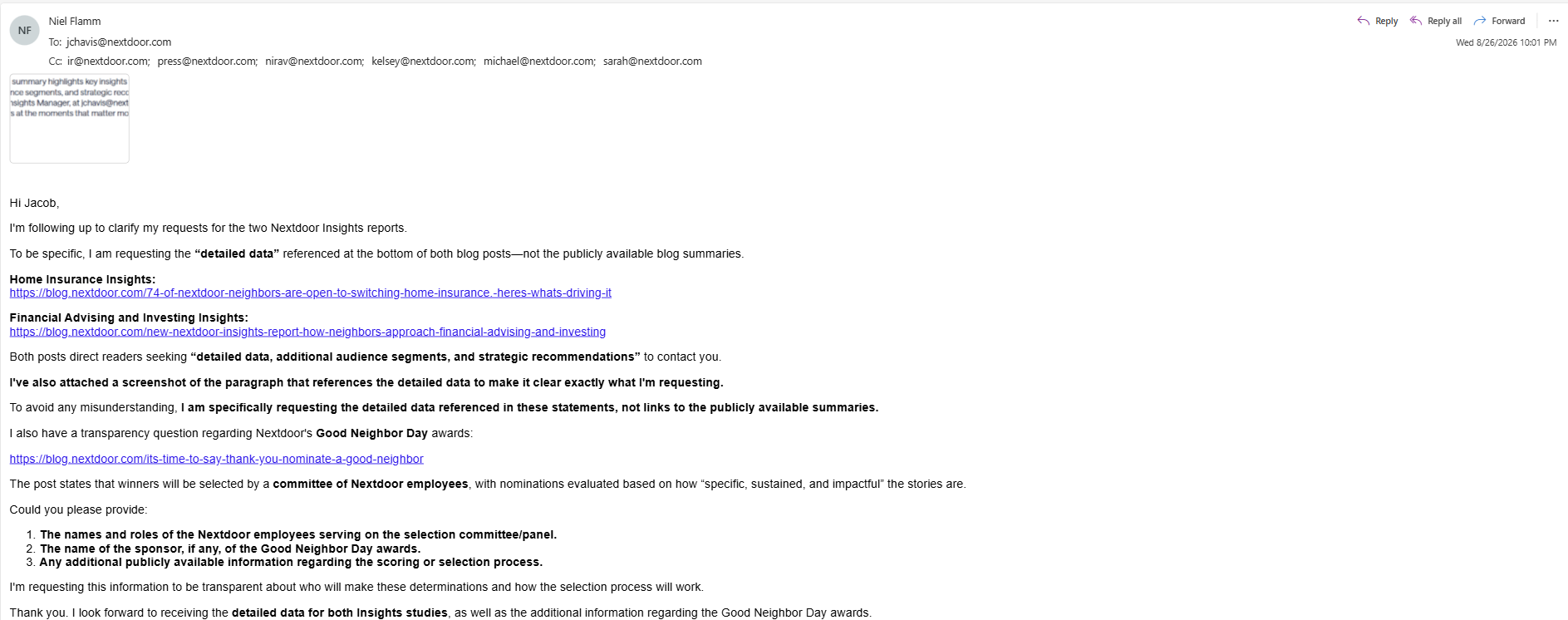
Last night, I sent another email to Jacob Chavis, copying Investor Relations, Press, Nirav Tolia, Kelsey Grady, Michael Kiernan, and Sarah Leary.
This time, I tried to remove any possible ambiguity.
I am not asking for links to the publicly available blog summaries.
I am specifically requesting the “detailed data” that Nextdoor itself says is available at the bottom of its Insights posts.
Both posts tell readers seeking:
“detailed data, additional audience segments, and strategic recommendations”
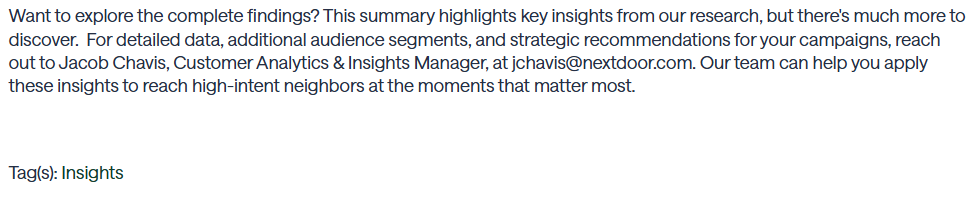
to contact Jacob.
That's what I'm doing.
Again.
I even attached a screenshot of the paragraph so there's no confusion about which information I'm requesting.
And I Added Three New Questions
My email also asks about Nextdoor's new Good Neighbor Day awards.
Nextdoor says a committee of Nextdoor employees will evaluate nominations based on how “specific, sustained, and impactful” the stories are.
So I asked:
Who are the employees serving on the committee/panel?
Who is sponsoring the awards, if anyone?
What additional information is publicly available about the scoring and selection process?
These aren't complicated questions.
They're transparency questions.
Yesterday I wrote about my concern with an unnamed panel deciding which neighbors deserve recognition.
Today I'm doing something about it:
I'm asking Nextdoor directly.
Hearing vs. Listening—Again
After 20+ years in Learning & Development, I've spent plenty of time discussing the difference between hearing and listening.
Nextdoor knows I'm asking.
Communications has responded before.
Multiple executives and departments have received my emails.
At Day 74, the issue isn’t whether the message has been heard.
The question is whether anyone will listen and answer the actual question.
No interpretation necessary.
No guessing.
No need to send the blog summaries again, please.
The request is in writing.
The screenshot is attached.
The questions are numbered.
Day 74.
Now we wait.
Again.
My LinkedIn posts are the condensed version. The complete continuing study, timeline, and my full thoughts are at NielFlamm.com/blog.
And subscribe at NielFlamm.com so you don't miss Day 75—although I'd be perfectly happy if there didn't need to be one.