

Day 103: I Expanded the Email List. The Board Emails Didn’t Cooperate.

Day 103.
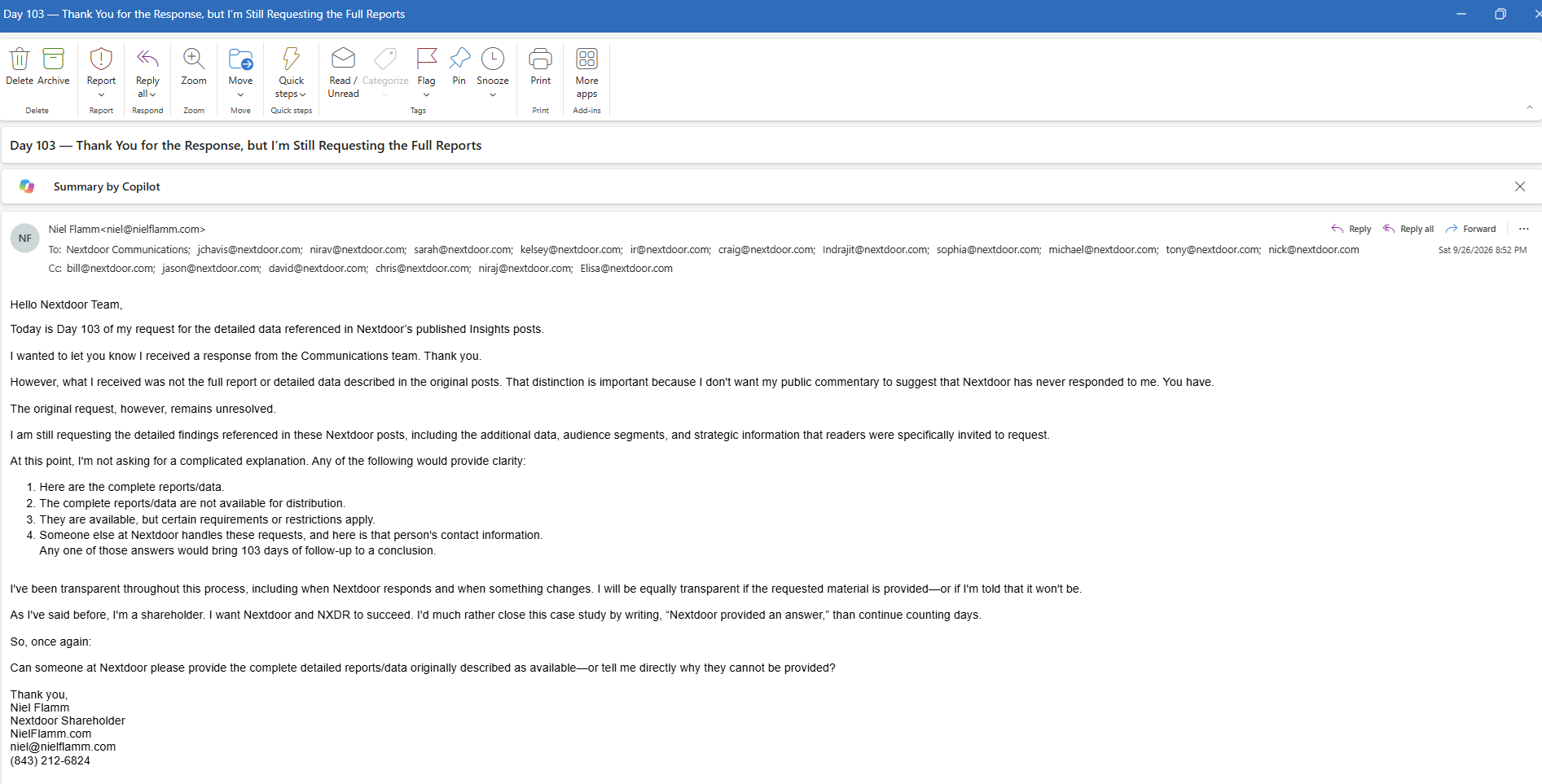
Today, I sent another email to Nextdoor.
After 103 days, I decided to expand the audience.
I put the Nextdoor Executive Team in the “To” field, along with the people who have already been part of this conversation.
I also attempted to include members of the Nextdoor Board of Directors in the CC field.
There was just one problem.
Apparently, my attempt at figuring out the board members' Nextdoor email addresses wasn't particularly successful. 😂
The Board Emails Bounced
I tried the fairly obvious formula: first name@nextdoor.com.
No such luck.
I received failed-delivery notices for the addresses I attempted for:
Michael Kiernan, Jason Pressman, Tony Castellanos, Niraj Shah, Chris Varelas, Elisa Steele, David Sze, and Bill Gurley.
I don’t have confirmation that the board members received today's email.
They apparently didn't.
I’ll research whether there are publicly available professional contact addresses through the companies or organizations they represent.
Interestingly, I haven't received bounce-back notices for the Executive Team addresses included in the “To” field so far. That doesn't prove anyone personally read the email, but at least I haven't received a delivery-failure notification.
What Did I Ask This Time?
The email itself is published in full on this blog, but the short version is remarkably simple.
I acknowledged that Nextdoor Communications did respond to me. I want to be fair and accurate.
The problem is that what I received wasn't the complete report or detailed data described in the original Nextdoor Insights posts.
So I asked again.
Send the complete reports.
Please let me know if they aren't available for distribution.
Tell me what restrictions or requirements apply.
Could you tell me who at Nextdoor is responsible for providing them?
Any of those answers creates closure.
That's really it.
This Shouldn't Require 103 Days
That's what continues to fascinate me about this entire experience.
The request hasn't become more complicated.
The distribution list has.
This started as a request for research referenced as available and has now moved through Communications, members of the Executive Team, and—once I have the working contact information—potentially the Board.
I'm not trying to make it look like people received something when they didn't.
That's why I'm publishing the bounce-backs too.
Transparency works both ways.
If Nextdoor responds, I'll say it responded.
If the response doesn't contain what I requested, I'll say that too.
If my emails to the Board don't work, I'll tell you that.
And if tomorrow Nextdoor sends me the complete reports—or says, “Niel, we're not giving them to you”—I'll publish that, too.
At least we'd finally have an answer.
For now:
Day 103.
The Executive Team email appears to have gone through.
My first attempt at reaching the Board?
Not so much. 😂
The full email I sent is included below,
👉 NielFlamm.com/blog

Day 102: Transparency Shouldn’t Be This Difficult

Day 102.
Earlier today, I posted something on NielFlamm.com/blog that I think connects directly to this entire Nextdoor journey:
My own numbers.
Not just the flattering ones.
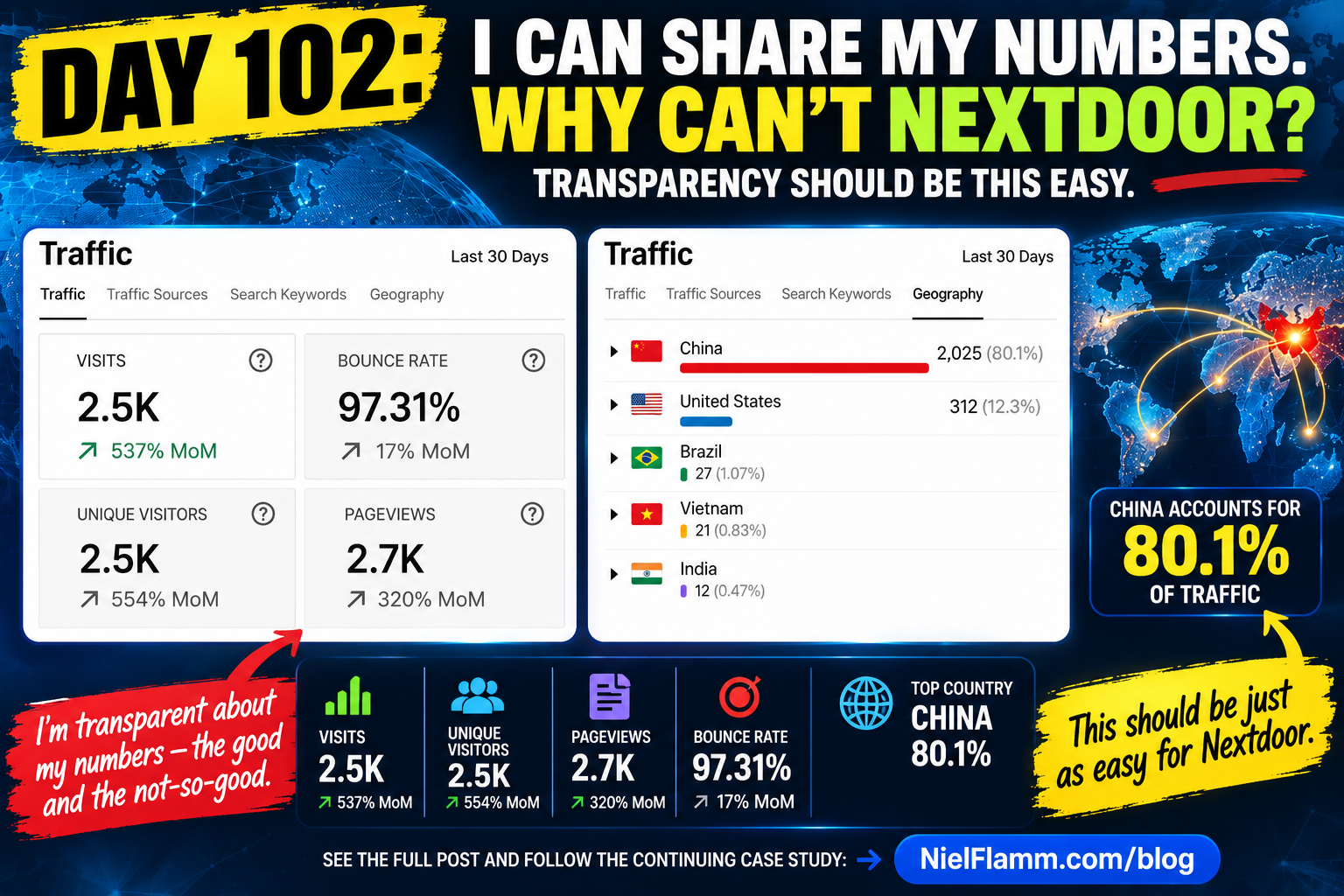
My latest 30-day website metrics show approximately 2,500 visits, 2,500 unique visitors, and 2,700 pageviews. Visits are up 537% month over month, unique visitors are up 554%, and pageviews are up 320%.
Sounds fantastic.
Then there's the 97.31% bounce rate.
Not exactly something I'm putting on a trophy. 😂
And I'm showing that number too.
China? Apparently, I’m Huge in China.
The geography surprised me even more.
Of the traffic shown in my analytics:
China: 2,025 visits — 80.1%
United States: 312 — 12.3%
Brazil: 27 — 1.07%
Vietnam: 21 — 0.83%
India: 12 — 0.47%
Do I completely understand why China represents 80% of the traffic?
Nope.
Could some traffic be automated, routed strangely, or otherwise not represent 2,025 people sitting in China eagerly awaiting my next blog post?
Absolutely.
That's the point.
I don't know everything happening behind the numbers.
So I'm showing them, asking questions and asking readers for feedback.
,
Why Is That So Difficult?
This brings me back to Nextdoor.
I've asked about WAU—Weekly Active Users.
I've asked for the detailed Insights reports that Nextdoor itself told readers were available upon request.
I've asked questions about methodology, engagement, communication, and other metrics.
And after 102 days, what have I received?
Links to information that was already publicly available and responses that, from my perspective, haven't answered the underlying questions.
That's not the transparency I'm talking about.
Transparency isn't:
“Here's the number we want you to see.”
It's also:
“Here's the number. Here's what we know about it. Here's what we don't know. Here's how we calculated it. Ask us questions.”
I Don't Know Everything
That's an easy sentence for me to write.
I don't know why my traffic suddenly jumped.
I don't know exactly why China dominates it.
I don't know how many visitors read every word versus those who accidentally land on the site and disappear.
And I certainly don't know what's going on inside the minds of my readers and viewers.
So I ask.
What are you reading?
What isn't working?
Why did you leave?
What should I change?
What would make you come back?
That's useful feedback.
And if a guy running NielFlamm.com can publish both the pretty numbers and the ugly ones, ask questions about them and admit what he doesn't know, I don't think it's unreasonable to expect a publicly traded neighborhood platform to engage seriously when a shareholder asks questions about its metrics and research.
I'm not asking Nextdoor to know everything.
I'm asking it to explain what it does know.
Day 102.
👉 See the metrics and follow the continuing case study:
NielFlamm.com/blog

Day 101: Our Data Is a Commodity. Why Are We Giving It Away?

Day 101.
Today I want to strip this Nextdoor discussion down to basic economics.
If I have something of value, another party uses it, and that use generates revenue, why shouldn't I share in the value created?
In this case, the commodity is information.
Reviews are information.
Recommendations are information.
Posts, comments, neighborhood observations, business experiences, and local knowledge are information.
Collectively, that's user-generated content.
And when a platform can aggregate, organize, analyze, and monetize that information, those individual contributions can become economically valuable.
We Call It “Content.” But It's Also an Economic Input.
Suppose I recommend a plumber on Nextdoor.
I supplied the experience. I paid to hire the plumber. I evaluated the work. I spent my time writing the recommendation.
Another neighbor reads it.
The plumber potentially gets business.
Nextdoor gets engagement and another piece of local knowledge stored within its platform.
Now multiply that by millions of neighbors and years of participation.
Suddenly, what looks like individual posts becomes something much more interesting:
An asset.
And with AI making it increasingly possible to organize, summarize, and extract useful information from enormous collections of human-created knowledge, that accumulated information may become even more useful.
I'm Not Saying Nextdoor Shouldn't Profit
Quite the opposite.
I'm a shareholder. I want Nextdoor to make money.
Nextdoor built the technology. It operates the platform. It employs people, develops products, sells advertising, and assumes the financial risk of running the business.
Nextdoor should benefit from the value it creates.
My question is:
Why does that automatically mean the neighbor gets zero?
If my contribution becomes part of something commercially valuable, why couldn't there be a model where:
Nextdoor wins.
Shareholders win.
Businesses win.
And the neighbors supplying the information win too.
I'm not suggesting every post deserves a royalty check.
But reviews, recommendations, local knowledge, research participation, and other user-generated information that contributes to commercial value?
Let's have that conversation.
Until Then, Maybe We Stop Supplying the Commodity
That's the idea behind my Neighbor Value-Sharing Petition.
The petition asks Nextdoor users to voluntarily stop providing new routine data, business reviews, recommendations, and other commercial user-generated content until Nextdoor develops a meaningful way for neighbors to participate in the revenue and value their contributions help generate.
It's not about withholding emergency information, safety alerts, missing-person information or other important community communication.
It's about the commodity.
If our information has value, perhaps we should stop giving that value away for free until there's a conversation about sharing it.
Read and sign the petition:
Then share it with another Nextdoor user.
Nextdoor Built the Container. Neighbors Keep Filling It.
A platform without people is software.
A review platform without reviews is an empty database.
A neighborhood network without neighbors sharing neighborhood knowledge isn't much of a neighborhood network.
Nextdoor built the container.
Neighbors keep filling it.
If what's inside that container can be monetized, I think it's reasonable for the people supplying it to ask:
Where's our share?
Until Nextdoor is willing to have that conversation, I'm asking neighbors to consider something incredibly simple:
Don't provide the commodity.
No new routine reviews.
No new business recommendations.
No additional commercial data.
Then let's see how valuable the commodity becomes when the people producing it decide they want to share in its value.
Our data. Our knowledge. Our time. Our value.
👉 Sign the petition:
https://c.org/GkNWmffgg9
👉 More of my continuing Nextdoor case study:
NielFlamm.com/blog

Day 101: Nextdoor Said It. The Person Behind the Post Is Doing the Work.

I missed yesterday on LinkedIn, although I posted almost everywhere else.
So, welcome to Day 101.
NXDR closed today at $2.38, down 4.8%.
But something Nextdoor posted on LinkedIn caught my attention even more.
Read Nextdoor's LinkedIn post.
It highlights Jessica Spann, a Charlotte educator whose work supporting students ultimately caught the attention of The Drew Barrymore Show.
Then I got to Nextdoor's final sentence:
“Local posts have a way of traveling when the person behind them is doing the work.”
ABSOLUTELY!
That's my point.
Jessica did the work.
Jessica made the impact.
Jessica created something worth talking about.
Nextdoor provided the platform that helped amplify it.
That's valuable too.
But if Nextdoor recognizes that the person behind the post is doing the work, why shouldn't we also talk about that person participating in the value their contributions help create?
Think of Nextdoor as the funnel.
The funnel helps direct the gasoline.
But the gasoline makes the engine run.
Neighbors provide the stories, reviews, recommendations, conversations, and local knowledge that keep the platform interesting.
That's why I started the Neighbor Value-Sharing Petition.
And, for transparency, I remain its sole signer. 😂
I need signature No. 2.
If you believe neighbors should participate in the value their contributions help create, sign it. Then share it.
Sign the Neighbor Value-Sharing Petition
Nextdoor said it, not me: the person behind the post is doing the work.
Now let's talk about sharing the value created by that work.
👉 Full Day 101 post: NielFlamm.com/blog
My Nextdoor Petition Has One Signature. Mine. So…What Am I Missing?
Time for a little open-book transparency.
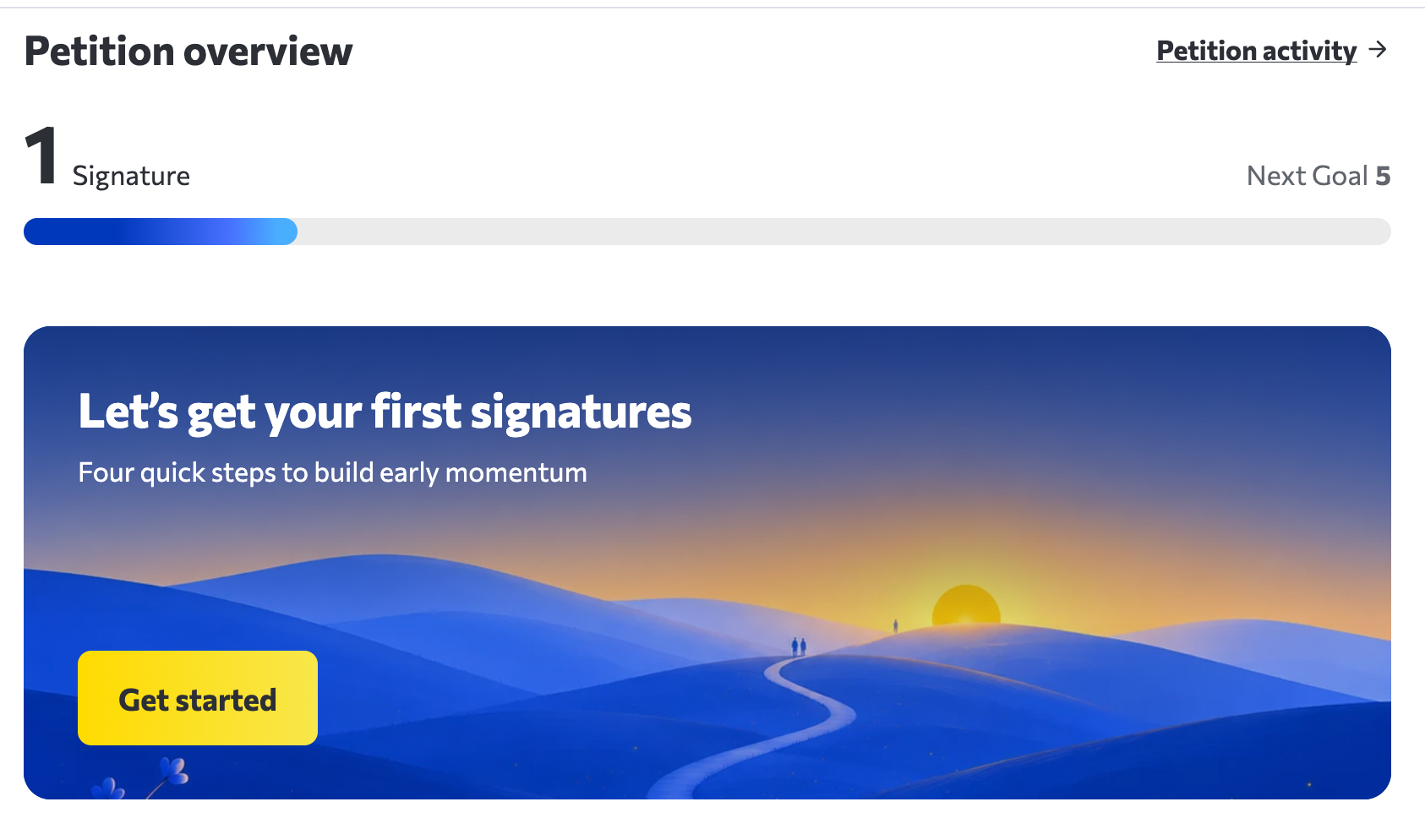
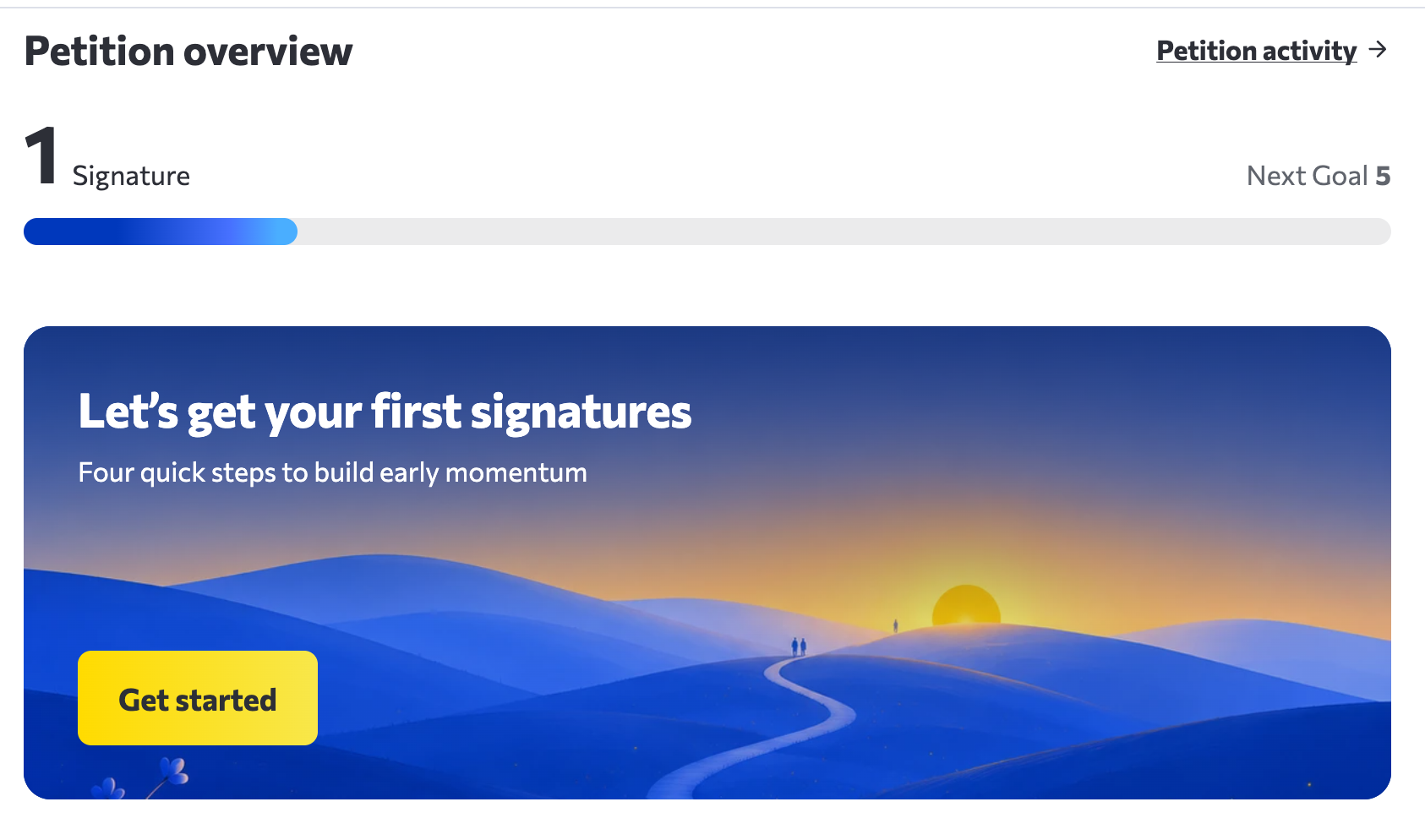
I launched my petition asking Nextdoor to create a meaningful value-sharing model for the neighbors whose reviews, recommendations, advice and local knowledge help make the platform valuable.
How's it going?
One signature.
Mine. 😂
So clearly, I'm not exactly storming the gates with an angry mob.
But instead of pretending it's gaining traction when it isn't, I'd rather ask why.
Maybe I Got the Petition Wrong
The basic idea still makes sense to me.
Nextdoor provides the platform. Neighbors provide enormous amounts of information and local knowledge. If that information can ultimately be organized, analyzed, used by AI, and turned into commercial value, why shouldn't the people helping create that value participate in some of the upside?
I mean some form of profit or value sharing tied to what users contribute and what the platform ultimately earns from it.
Nextdoor should make money.
I'm a shareholder. I want Nextdoor to make money.
But why does it have to be either platform profits or users’ benefit?
Why not both?
Now I Need Your Feedback
Maybe the petition is too complicated.
Maybe the ask isn't clear enough.
Maybe people like the concept but don't want to sign a petition.
Maybe asking users to pause business reviews and recommendations is the wrong approach.
Or maybe people simply disagree with me.
Tell me.
I spend plenty of time asking Nextdoor to listen to feedback, so I'd better be willing to do the same.
Read the petition and tell me what you'd change. What would make you sign it? What part doesn't work? Is there a better model for sharing the value neighbors create?
And if you do agree with the idea, I need two things:
First, sign it. Then share it.
Right now, the petition has exactly one supporter—and I already know what that guy thinks. 😂
Read and sign the Nextdoor Neighbor Value-Sharing Petition
Our information. Our time. Our value. Why not share?