
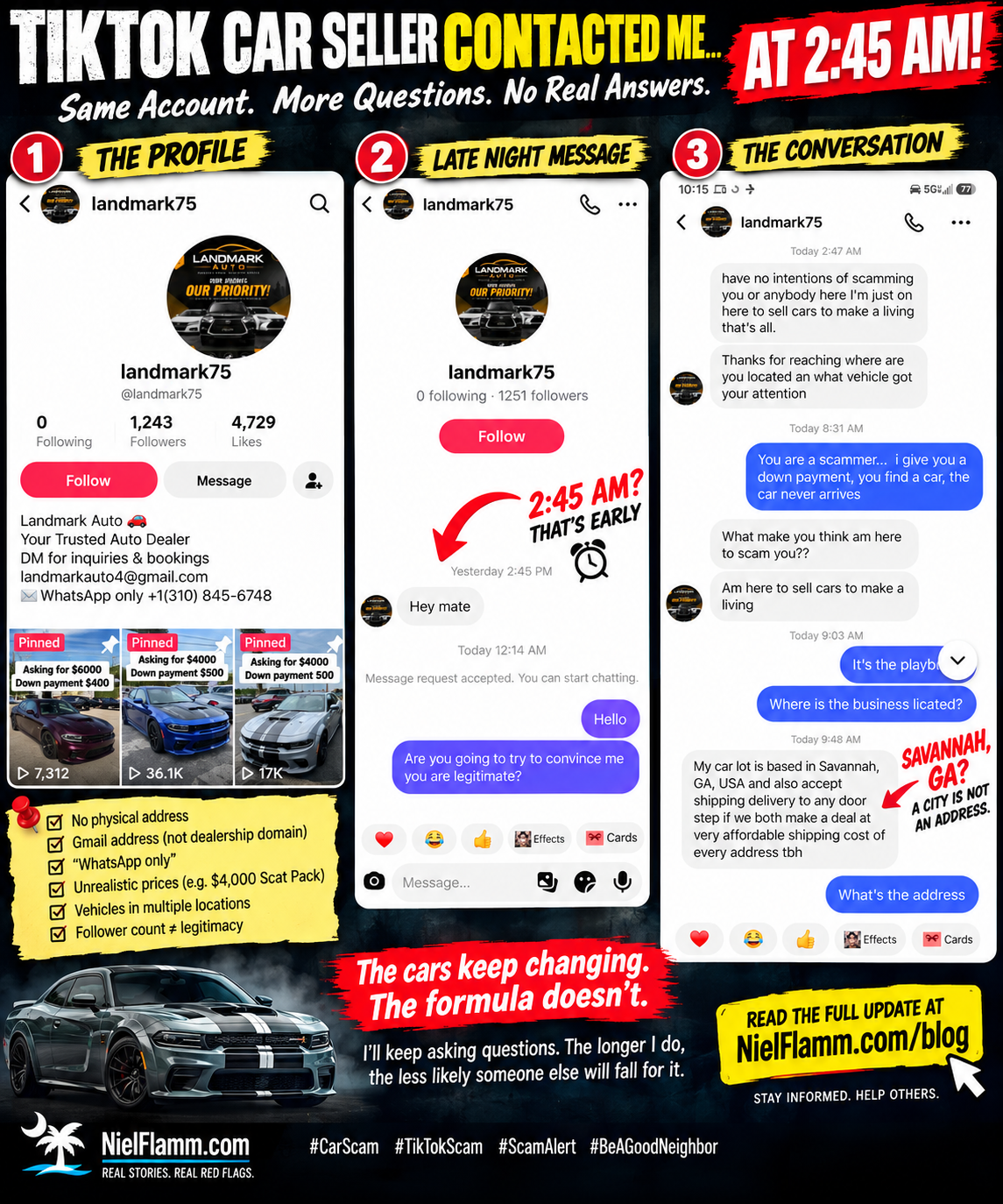
Update: The $4,000 Scat Pack Seller Messaged Me—At 2:45 in the Morning
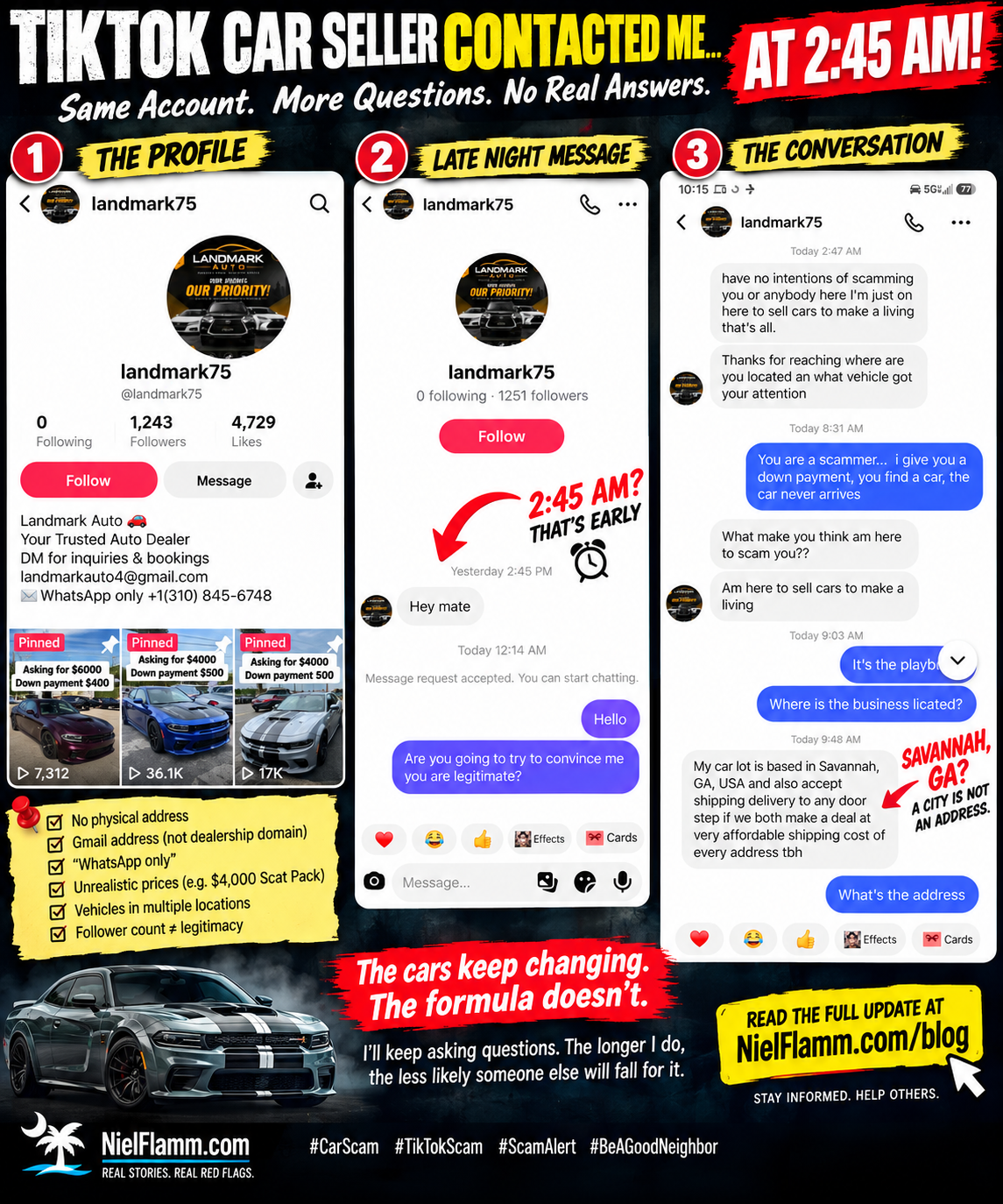
Well, this story just became interactive.
In my last post, I looked at the TikTok account landmark75, which describes itself as “Landmark Auto” and advertises vehicles at prices and down payments that immediately raised questions—including a purported 2021 Dodge Scat Pack with 45,000 miles for $4,000 and $500 down.
Now the account has contacted me directly.
And apparently, dealership hours start at 2:45 AM.
🌙 “Hey mate”
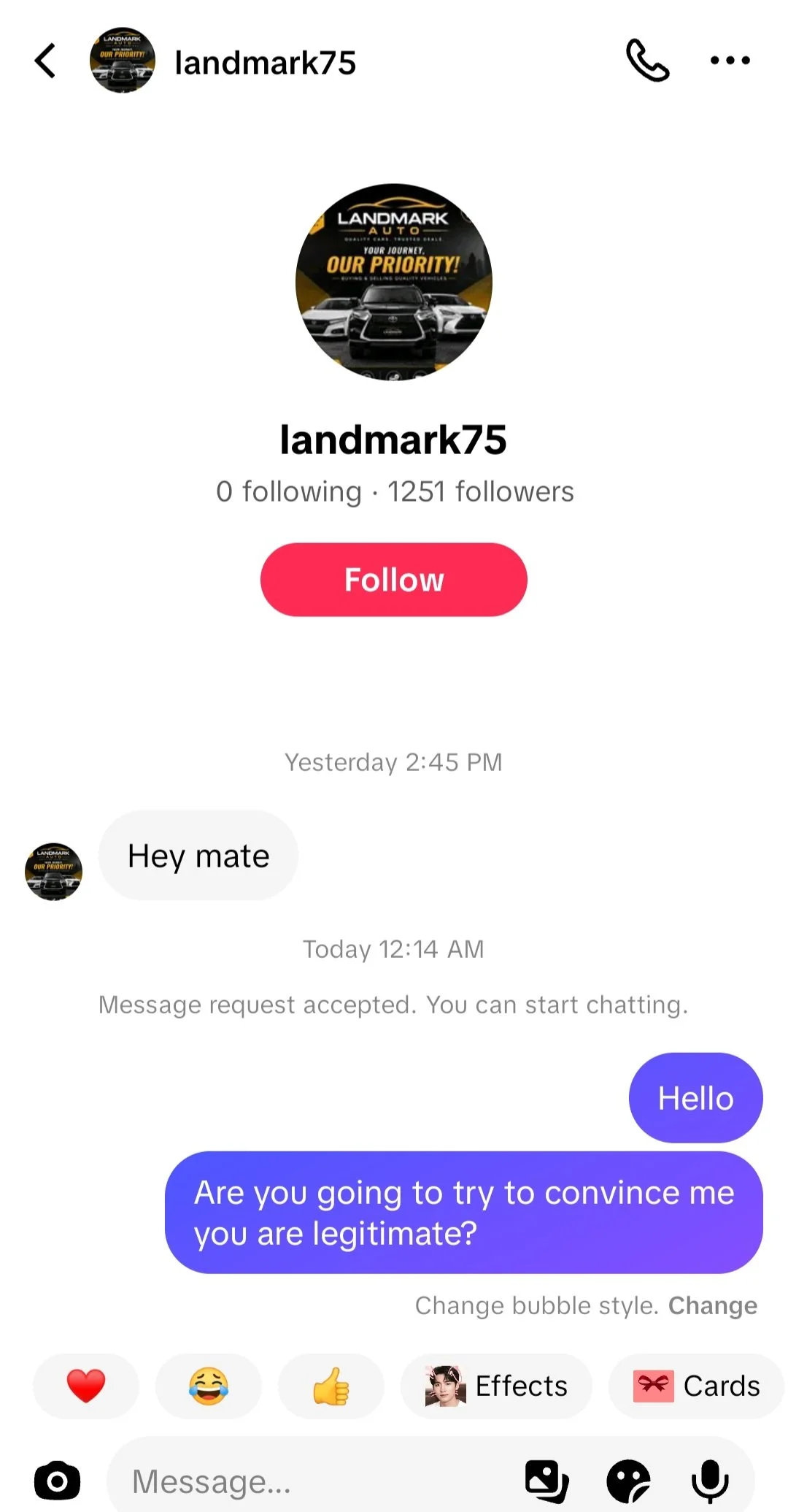
The first message arrived at 2:45 AM:
“Hey mate”
I eventually accepted the message request and didn't exactly hide my skepticism.
I asked:
“Are you going to try to convince me you are legitimate?”
The response came at 2:47 AM:
“have no intentions of scamming you or anybody here I'm just on here to sell cars to make a living that's all.”
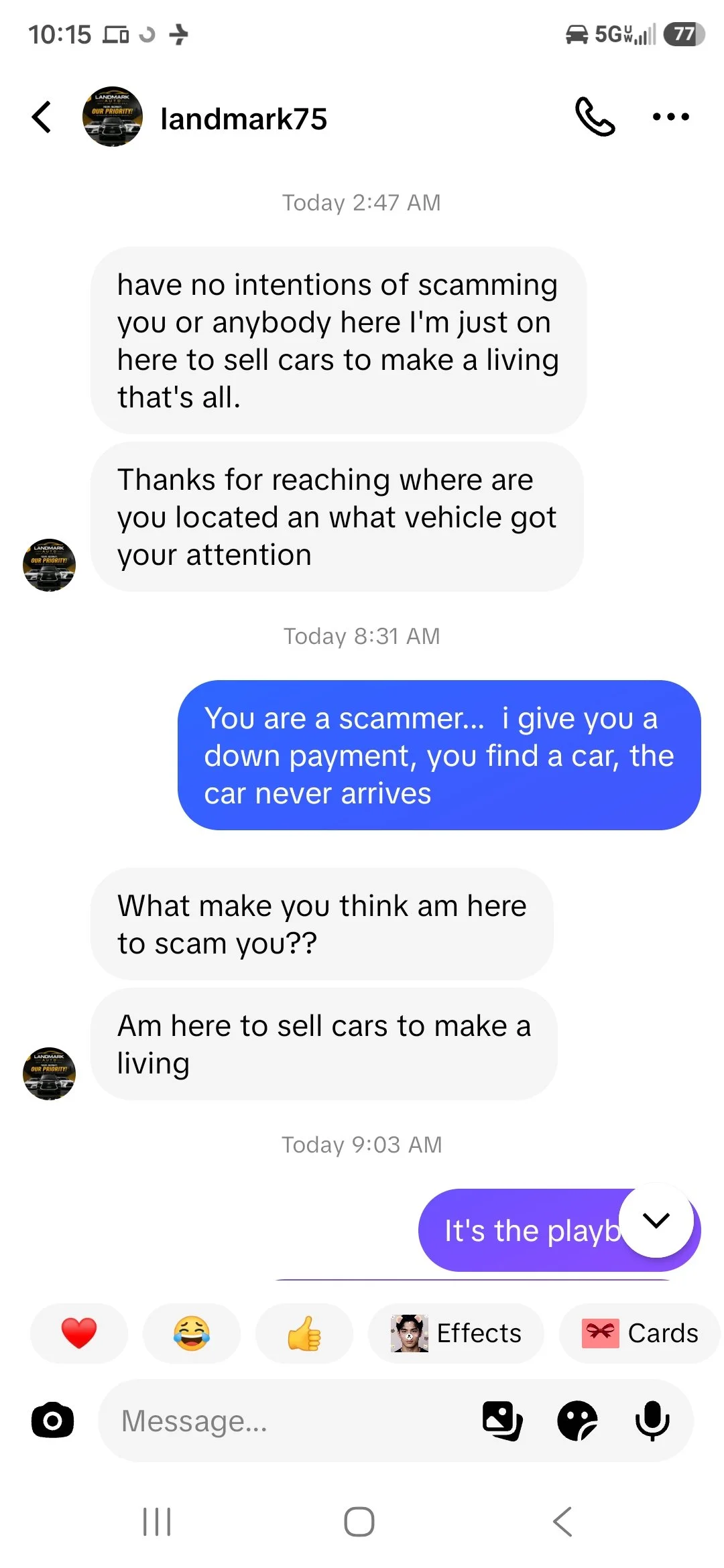
They then asked where I was located and which vehicle caught my attention.
Fair enough.
Except I wasn't shopping.
I was investigating.
🚩 I Asked Direct Questions. I Wanted Direct Answers.
I told the account why I was skeptical.
Their response was essentially: What makes you think I'm here to scam you? I'm here to sell cars and make a living.
But that's not really the question I need answered.
I don't need someone to tell me they're legitimate.
I need information that allows me to independently verify they're legitimate.
There's a big difference.
So I asked one of the simplest questions imaginable:
Where is the business located?
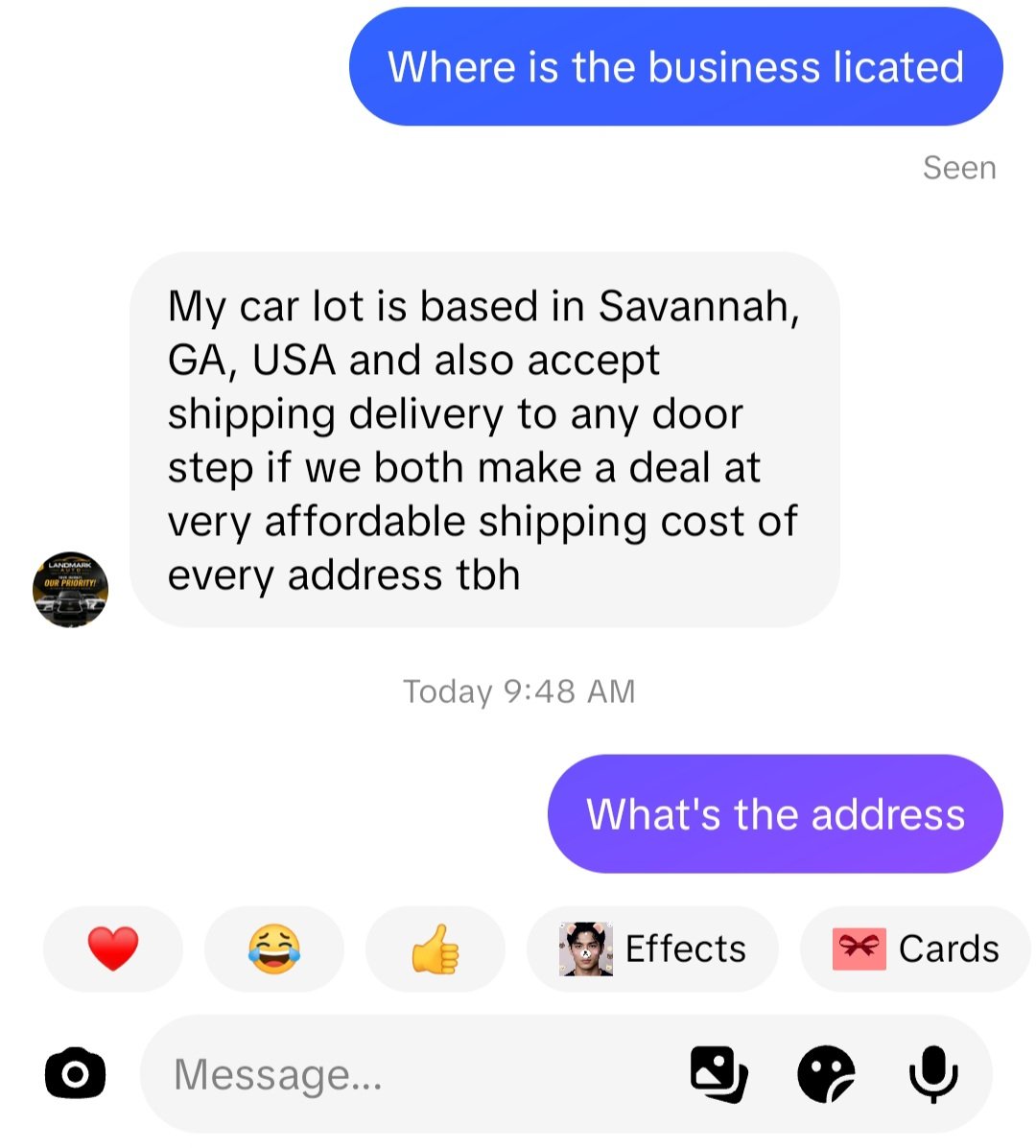
The answer:
“My car lot is based in Savannah, GA, USA and also accept shipping delivery to any door step if we both make a deal at very affordable shipping cost…”
Okay.
Savannah, Georgia.
That's a city.
It's not an address.
So I followed up with an even simpler question:
“What's the address?”
That's where the screenshots currently end.
🔎 I Tried Independently Verifying It
I also searched publicly available sources for the business information displayed on the TikTok profile.
The profile previously showed a Gmail address and a 310-area-code WhatsApp number, while the person messaging me now says the car lot is based in Savannah, Georgia.
My searches did turn up several legitimate businesses around the country using variations of the name “Landmark Auto,” but I did not find a Savannah used-car dealership in the local-business results that clearly matched this TikTok account, its displayed contact information, and the Savannah claim. Instead, search results surfaced unrelated Landmark businesses and other established Savannah used-car dealers with publicly listed street addresses. Landmark Auto Sales
That doesn't by itself prove the TikTok account is fraudulent.
But it certainly doesn't answer my question either.
One public phone-directory result also associates the 310-845 number block containing the number displayed on the TikTok profile with Culver City, California—not Savannah. Phone numbers can be retained, ported, and used remotely, so that isn't proof of anything by itself. It's simply another detail I'd want explained before sending money. Stan at Work
🚩 This Is Why “What's the Address?” Matters
If you're operating a physical car lot, an exact street address shouldn't be hard to provide.
In fact, a legitimate dealership normally wants customers to know where it is.
I should be able to independently look up that address and determine:
Does the dealership exist?
Is the business registered there?
Is it licensed to sell vehicles?
Does the business name match?
Does the phone number match?
Do the vehicles shown online actually belong to that dealership?
Can I physically inspect the car?
Can I call a publicly listed number instead of communicating only through TikTok or WhatsApp?
Those are ordinary due-diligence questions.
I'm not asking for the Coca-Cola recipe.
I'm asking where the car lot is.
🚩 The Conversation Is More Interesting Than the Sales Pitch
Something else stands out.
The account initiated this conversation with me.
They've continued responding even after I openly told them I believe the operation follows a familiar scam playbook.
That's useful.
Because every additional answer gives me something else I can potentially check independently.
If I get an address, I'll check it.
If I get a dealership name, I'll check it.
If I get a dealer-license number, I'll check it.
If I get a VIN for that $4,000 Scat Pack, I'll check it.
And if I get asked to send a deposit before I'm allowed to independently verify those things?
Well...
That'll be interesting too.
🧠 “Trust Me” Isn't Verification
This is one of the bigger lessons from this entire series.
Someone saying:
“I have no intention of scamming you.”
doesn't establish legitimacy.
Neither does:
“I'm just here to sell cars to make a living.”
Those statements might be completely sincere.
But legitimate businesses don't need customers to rely exclusively on sincerity.
They can provide independently verifiable information.
Business name.
Street address.
Dealer license.
VIN.
Title information.
Written purchase agreement.
Financing disclosures.
Independently verifiable telephone number.
That's evidence.
⏰ I'll Keep the Conversation Going
I'll keep engaging with this account as long as the conversation remains useful and safe.
Not because I plan to buy a car.
And definitely not because I'm sending a down payment.
I'm interested in seeing where the conversation goes and documenting the process.
There's another reason.
Time spent answering my questions is time not spent moving someone else quickly toward a deposit.
I can't know whether my conversation actually prevents someone else from being targeted, so I won't pretend it does.
But if keeping the conversation going gives me more information to verify—and gives readers a better look at how these interactions develop—I'm willing to keep asking questions.
And my next one is already sitting there:
What's the address?
A city isn't an address.
Let's see what comes next.
Follow the continuing story at NielFlamm.com/blog.
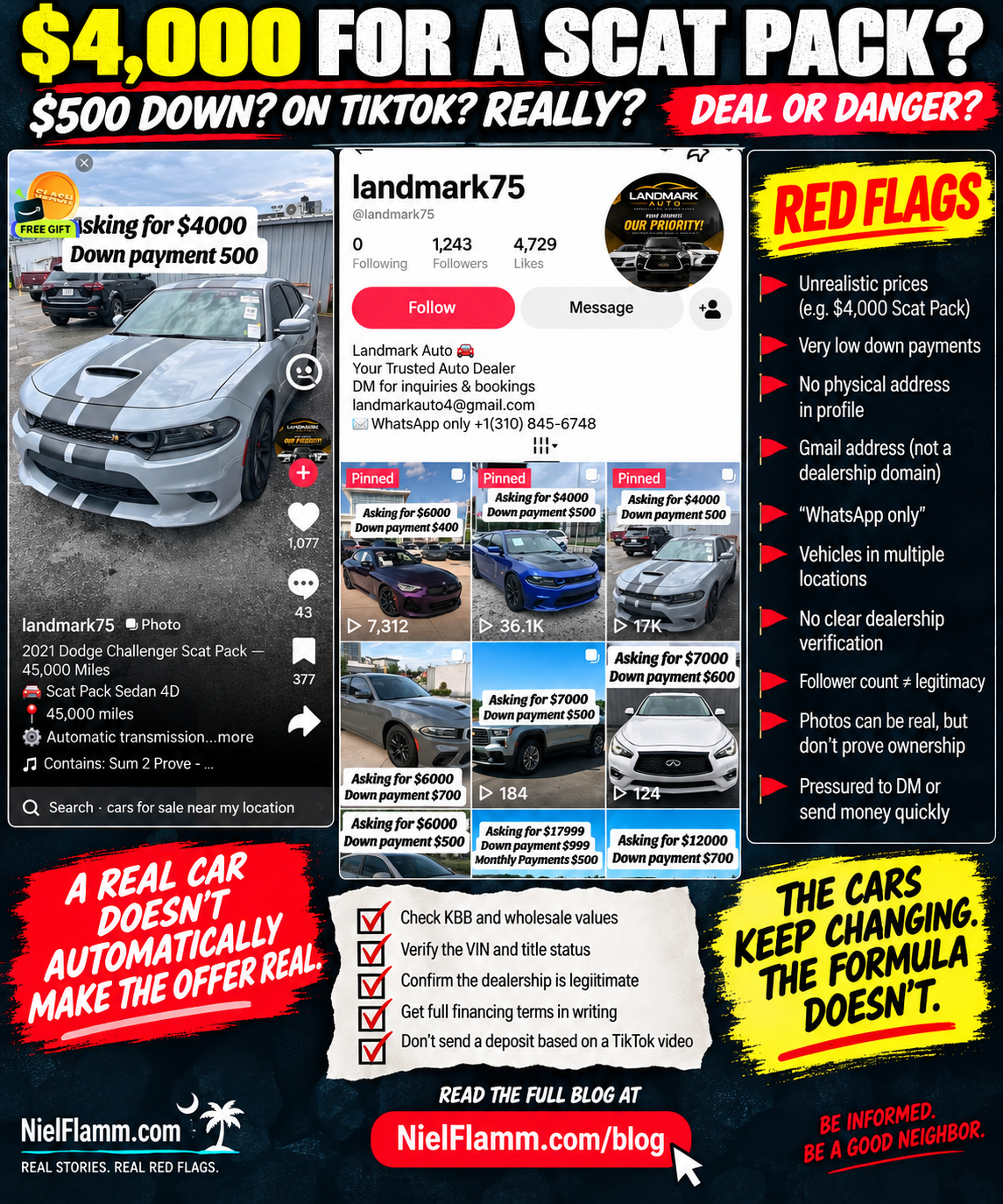
Another TikTok Car Deal: A $4,000 Scat Pack With $500 Down? Here We Go Again
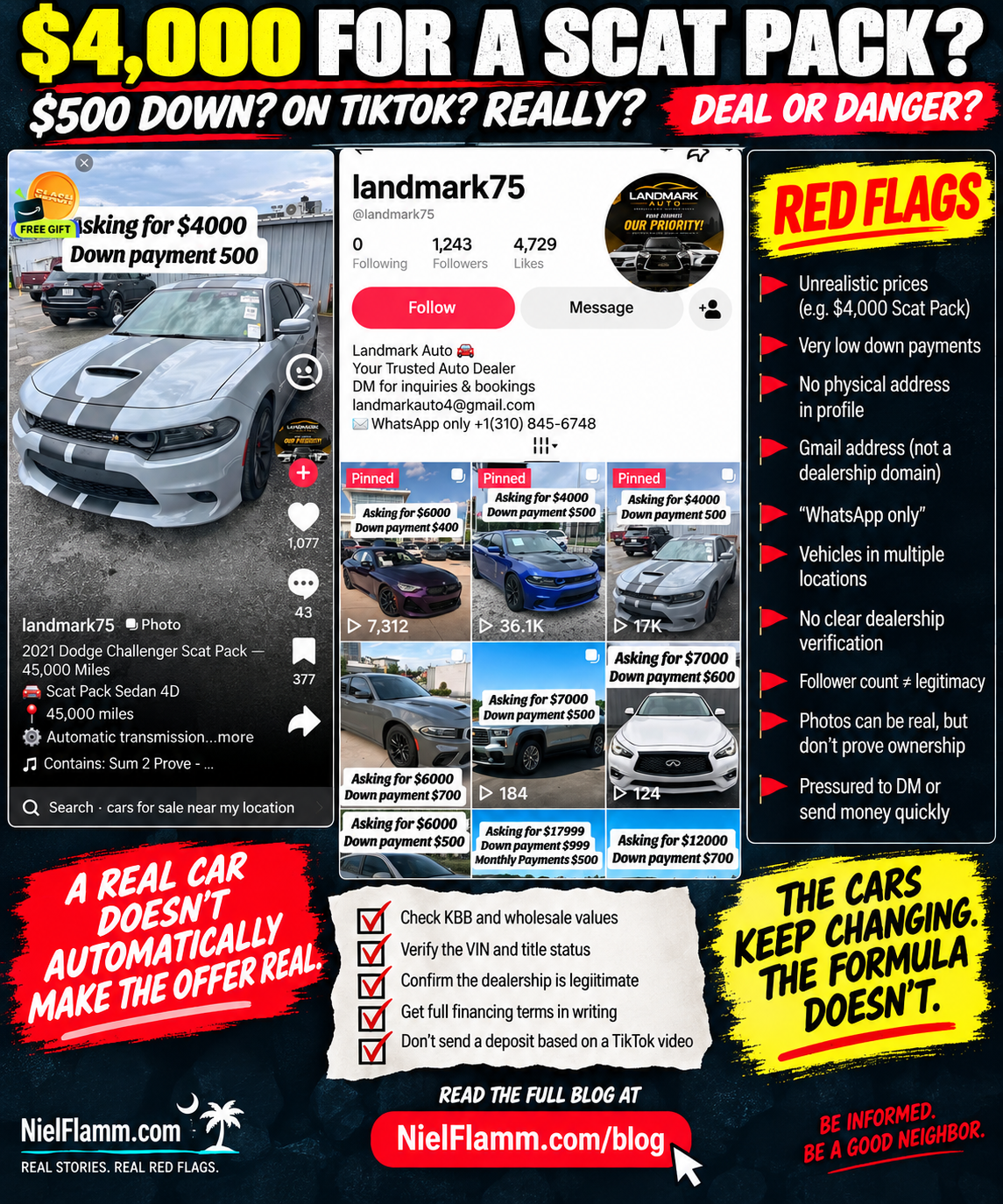
Apparently TikTok has decided that one questionable car account wasn't enough for me.
After looking at an account advertising everything from inexpensive transportation to Porsches with tiny down payments, another account appeared in my feed.
This one calls itself “landmark75.”
At the time of my screenshot, the profile showed more than 1,200 followers and 4,700 likes and described itself as:
“Landmark Auto 🚗
Your Trusted Auto Dealer
DM for inquiries & bookings”
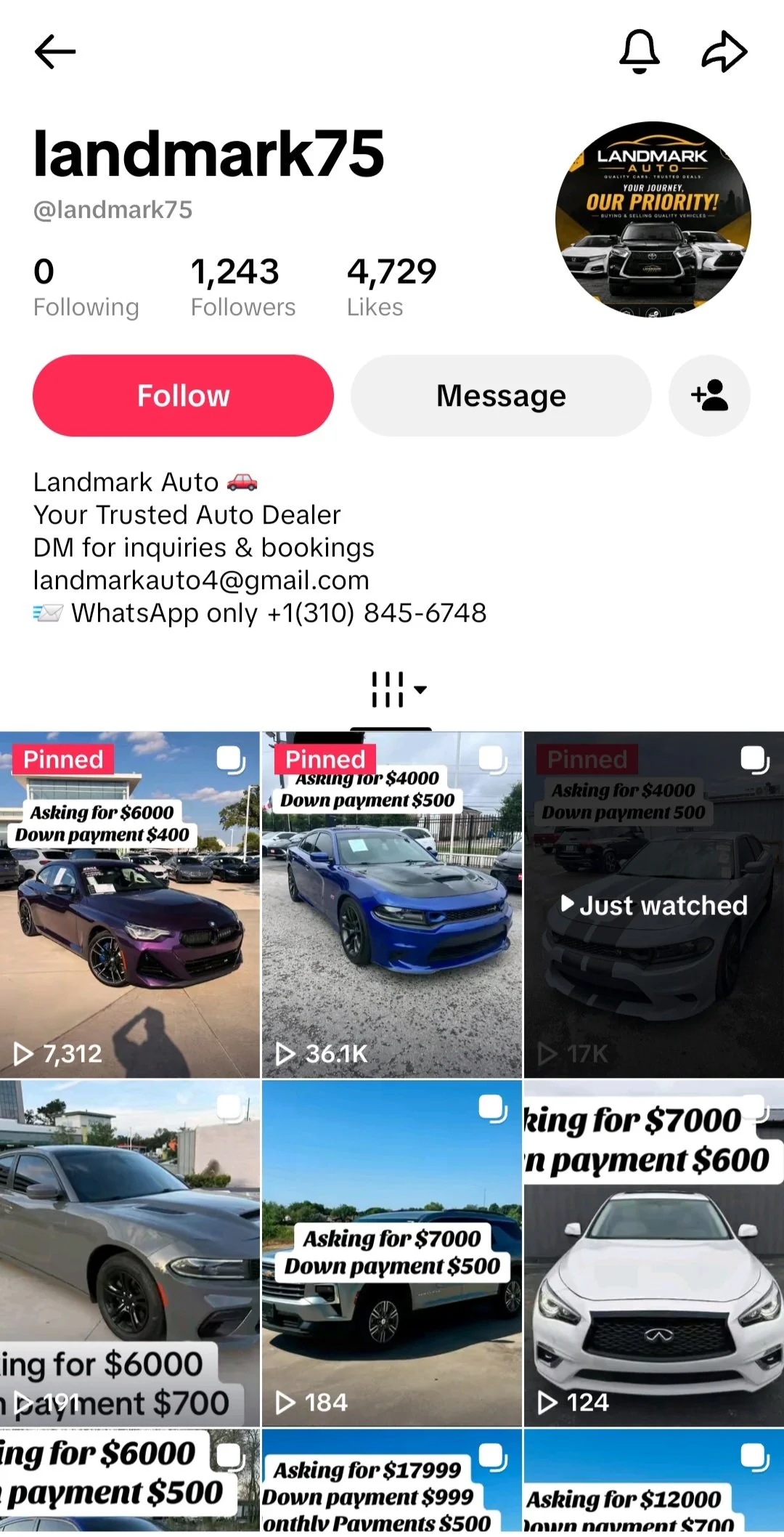
Then things get interesting.
The profile lists a Gmail address and says
“WhatsApp only”
The profile doesn't show a physical dealership address.
And the inventory?
Once again, apparently we're living in the magical land of extremely inexpensive automobiles.
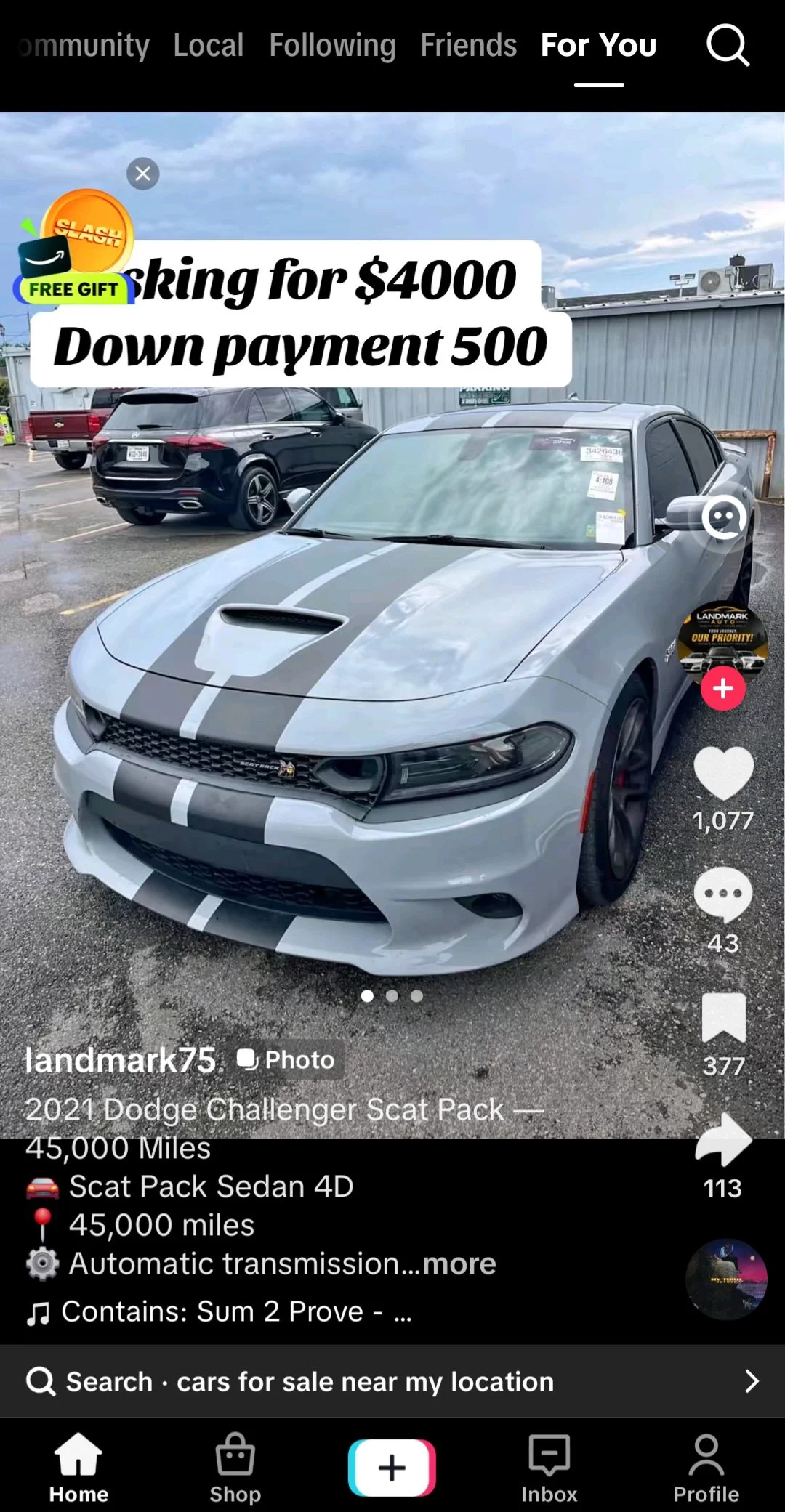
🚗 Today's Special: A 2021 Dodge Charger Scat Pack for $4,000
One post advertises what it describes as a:
2021 Dodge Charger Scat Pack
45,000 miles
And across the top of the photograph:
“Asking for $4000
Down payment 500”
Wait.
$4,000?
For a 2021 Charger Scat Pack with 45,000 miles?
I thought the $500 down payment was supposed to be the unbelievable part.
This time it's the alleged asking price.
And this wasn't some obscure post nobody had seen. My screenshot showed more than 1,000 likes, along with dozens of comments and hundreds of saves.
💰 Let's Check Reality
A 2021 Dodge Charger Scat Pack wasn't inexpensive when new, and clean used examples haven't suddenly become $4,000 cars.
Current Kelley Blue Book values vary considerably by mileage, equipment, condition, and location, but a 2021 Charger Scat Pack remains worth many times the $4,000 advertised here.
Even before knowing the VIN, vehicle history, or exact condition, that's enough of a pricing discrepancy to make me stop.
Could a $4,000 Charger exist?
Sure.
Maybe it's wrecked.
Maybe it has a branded or salvage title.
Maybe it has catastrophic mechanical problems.
Maybe it's missing an engine.
Maybe there's some other legitimate explanation.
But none of those explanations appear in the TikTok post.
Instead, I'm seeing a shiny Scat Pack photographed on what appears to be a dealer or auction lot and an advertised price of:
$4,000
That's when I want documentation, not emojis.
🚩 And It's Not Just the Scat Pack
Then I looked at the rest of the profile.
One pinned post appears to advertise a BMW for:
Asking: $6,000
Down payment: $400
Another Charger:
Asking: $4,000
Down payment: $500
Another vehicle:
Asking: $6,000
Down payment: $700
Another:
Asking: $7,000
Down payment: $500
An Infiniti appears with:
Asking: $7,000
Down payment: $600
Farther down, there's another vehicle advertised at $17,999 with $999 down and $500 monthly payments.
It's the same pattern I've been seeing repeatedly.
Attractive vehicles.
Extremely attractive prices.
Tiny down payments.
And social media as the storefront.
🚩 But Look at the Charger Photo More Closely
Here's something else that caught my attention.
The Charger has multiple stickers on the windshield.
That makes the vehicle look more credible because we're clearly looking at an actual car.
But that's something I've been stressing throughout this series:
A real car doesn't automatically make the offer real.
A vehicle can exist without the person posting its photograph owning it.
A vehicle can sit on an auction lot without a TikTok account having authority to sell it.
A photograph can come from another dealership, auction, listing or social-media account.
I'm not saying that's necessarily what happened here.
I'm saying a photograph isn't proof of ownership.
Before I send someone $500, I'd want the VIN and I'd want to independently establish exactly who owns the vehicle and where it's physically located.
📱 “WhatsApp Only”
Then we get to one of the biggest things that would make me cautious.
The profile doesn't direct potential buyers to a recognizable dealership website or give a street address.
Instead:
DM for inquiries & bookings
and
WhatsApp only
WhatsApp itself isn't suspicious. Millions of legitimate businesses use it.
But if I'm supposedly purchasing a vehicle from an auto dealer, I want more than a social-media profile and messaging account.
I want:
The legal business name.
Physical dealership address.
Dealer license information.
VIN.
Title status.
Vehicle history.
Actual cash selling price.
Financing terms.
APR.
Length of loan.
Total of payments.
And I want to verify those things independently, not solely through information sent to me by the person asking for my money.
💵 $500 Down Doesn't Tell Me What the Car Costs
This is another distinction consumers need to understand.
A legitimate dealer absolutely can sell a $30,000 vehicle with only $500 down.
That doesn't mean the vehicle costs $500.
The remaining balance gets financed.
That's why a post screaming “ONLY $500 DOWN!” tells me very little without the rest of the transaction.
But this Charger post goes further.
It appears to say the asking price itself is $4,000.
If that's genuinely the total purchase price for a running, roadworthy 2021 Charger Scat Pack with 45,000 miles and a transferable title, I would want to understand exactly why it is being offered so dramatically below normal market value.
🚩 Followers Still Aren't Verified
We've seen this before.
This account has more than a thousand followers.
One of its videos has tens of thousands of views.
That creates social proof.
People think:
“Other people are following them.”
“The video has 36,000 views.”
“There are hundreds of likes.”
“The cars are real.”
Therefore:
“The seller must be legitimate.”
Those aren't the same thing.
A follower isn't a dealer license.
A like isn't a title.
A view isn't a VIN.
And 36,000 views don't turn a $4,000 Scat Pack into a normal market transaction.
🧮 The Numbers Have to Make Sense
This is where I keep returning to KBB and wholesale-market values.
A legitimate business generally needs to acquire inventory for less than it sells that inventory for.
That's the business model.
If the normal wholesale value of a vehicle is dramatically higher than the advertised retail price, I want to know how that transaction works economically.
Maybe there's a legitimate explanation.
Great.
Show me.
That's what due diligence is for.
I don't have the VIN or enough vehicle-specific information from this TikTok post to produce an exact Manheim Market Report value, and I'm not going to invent one.
MMR depends on factors including mileage, condition, trim, region and recent auction transactions.
But that's actually part of the problem.
The information necessary to properly evaluate these deals isn't prominently provided.
The extraordinary price is.
🏡 Don't Be Passive. Be a Good Neighbor.
Here's why I continue writing about these.
Imagine someone who needs a car desperately.
Their credit is damaged.
Their current car just died.
They have to get to work.
Traditional financing hasn't gone well.
Then TikTok serves them:
2021 CHARGER SCAT PACK
$4,000
$500 DOWN
That doesn't just look like a deal.
It can look like a solution to a serious problem.
Before someone you know sends $500 through an app because they're afraid another buyer will grab the car first, help them investigate.
Ask for the VIN.
Verify the VIN independently.
Find the physical dealership.
Verify its dealer license.
Call the dealership using a phone number you find independently.
Check the title.
Compare KBB retail value.
Compare wholesale value.
Ask for complete financing terms in writing.
And if somebody says you need to send money right now before you can do those things?
That answer tells you something too.
The Cars Keep Changing. The Formula Doesn't.
Over the past several posts, I've seen Toyotas, Hondas, BMWs, Audis, Camaros, Porsches and now Dodge Scat Packs advertised on social media with extraordinarily low prices or down payments.
Different accounts.
Different cars.
Different backgrounds.
But some remarkably familiar marketing:
Low price.
Tiny down payment.
DM me.
Quick approval.
Shipping available.
Send money.
I'm not sending $500 to find out what happens next.
I'll keep doing the free part:
Asking questions.
Because whether this particular offer has some explanation I can't see from the TikTok post or not, $4,000 for a 2021 Charger Scat Pack with 45,000 miles deserves a lot more than a swipe and a DM.
Follow along at NielFlamm.com/blog as I continue looking at questionable vehicle offers, suspicious emails, recruiting scams, and whatever the algorithm decides to throw at me next.
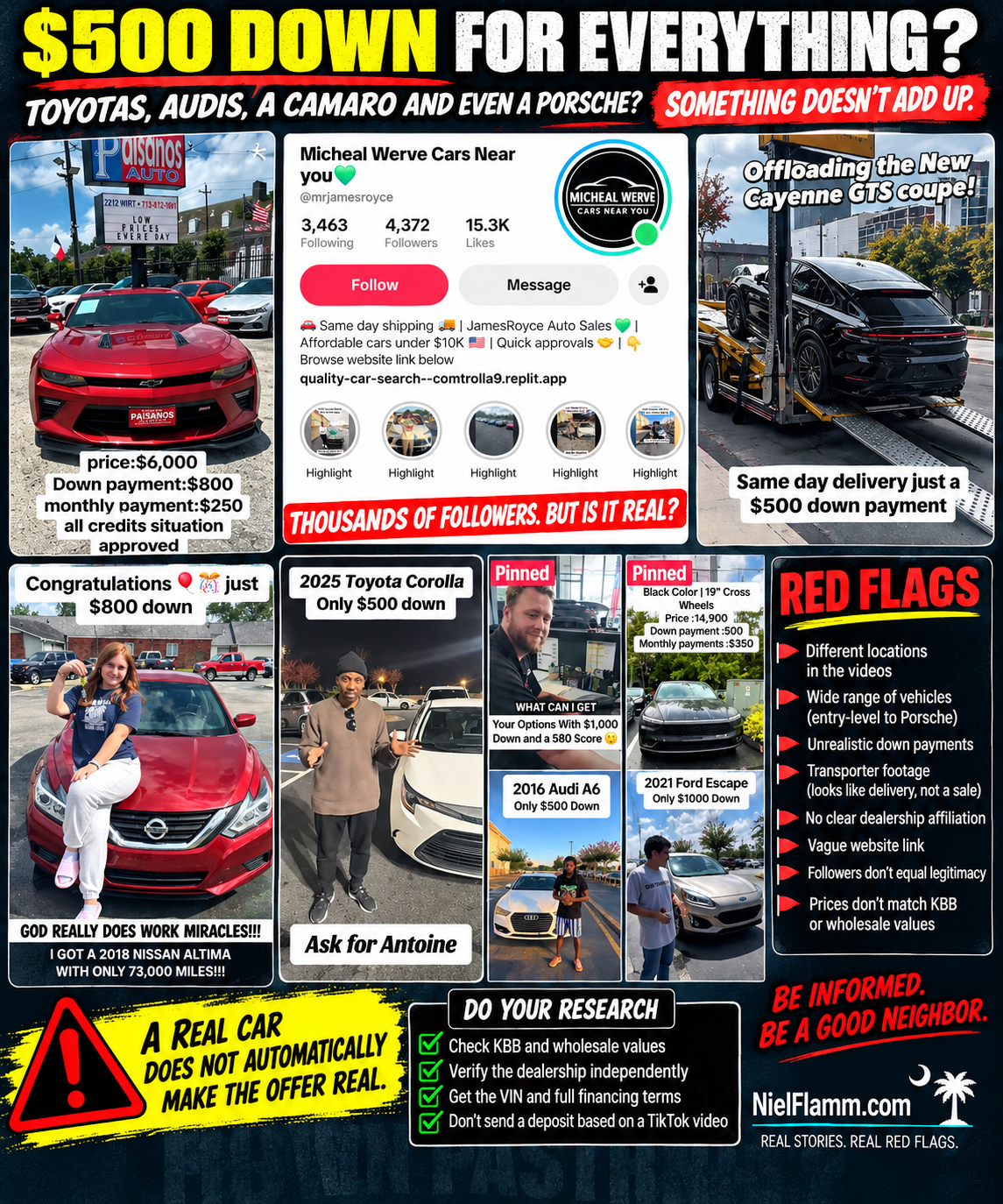
$500 Down for Everything? This TikTok Car Account Raised More Questions the Longer I Watched
Apparently, TikTok still thinks I need a car.
At this point, I'm starting to think the algorithm wants me to open a dealership.
This time I came across an account calling itself “Michael Werve Cars Near You” with more than 4,300 followers and 15,000 likes shown on the profile when I took the screenshot.
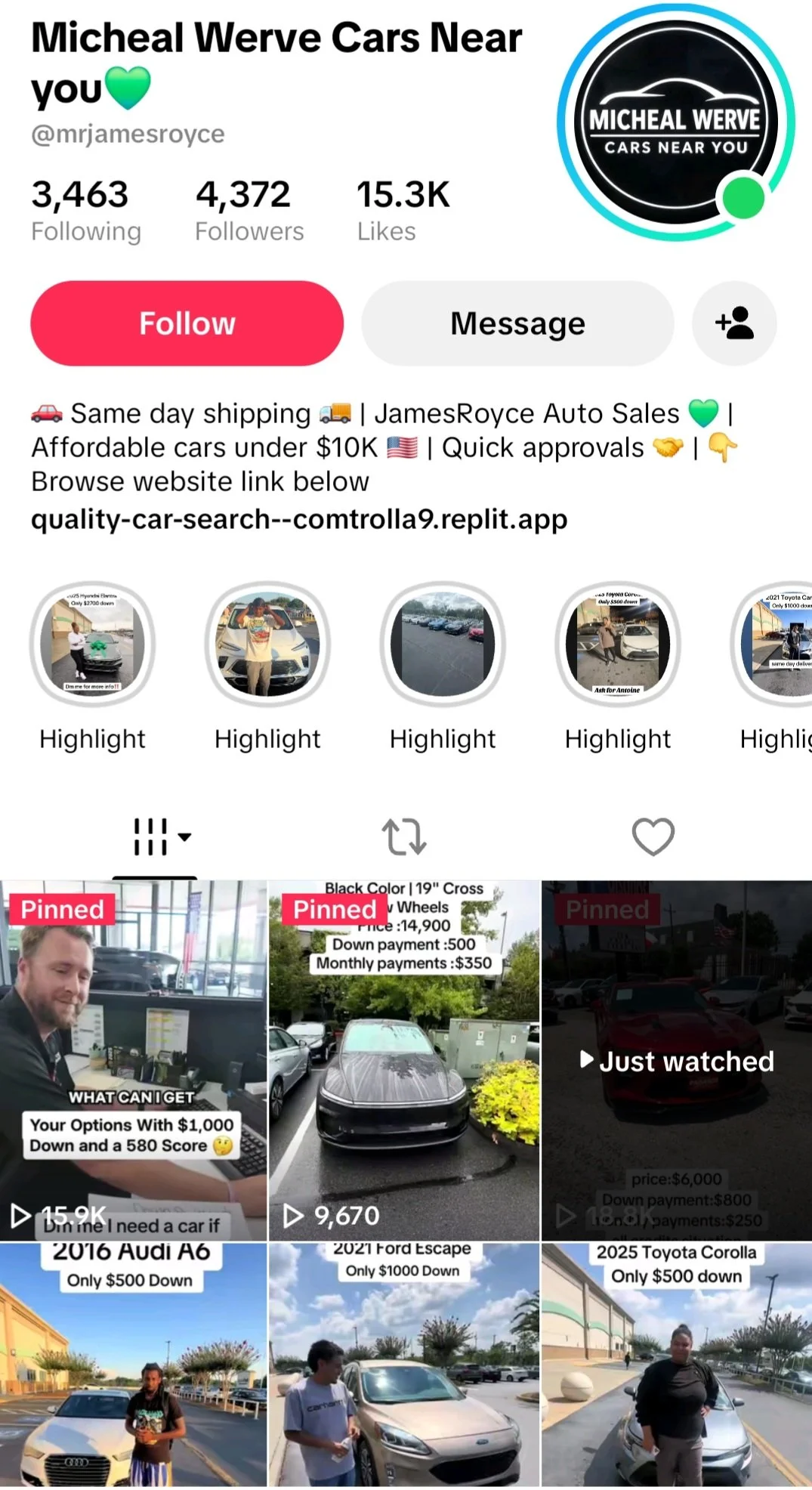
The bio promises:
“Same day shipping”
“Affordable cars under $10K”
“Quick approvals”
And, of course, the magic number that keeps appearing in these TikTok vehicle posts:
$500 DOWN
But the more videos I watched, the more questions I had.
🚩 This Isn't Just a Few Cheap Used Cars
The account shows a surprisingly broad assortment of vehicles.
There's a 2016 Audi A6 advertised with only $500 down.
There's a 2021 Ford Escape with $1,000 down.
There's a 2025 Toyota Corolla with only $500 down.
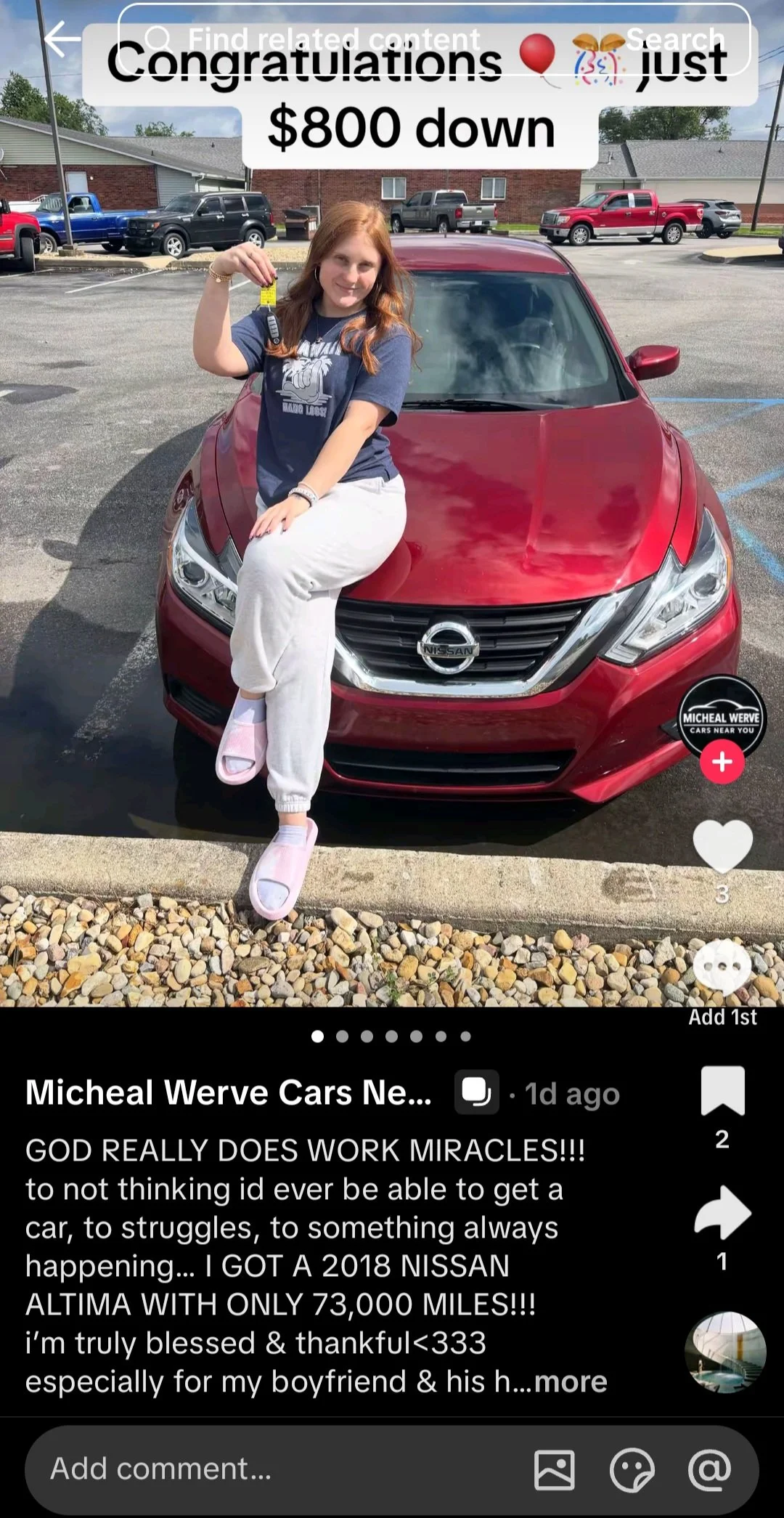
There's a woman pictured with a 2018 Nissan Altima with 73,000 miles, accompanied by text saying:
“Congratulations 🎈🎊 just $800 down.”
Then we jump to something much more interesting:
“Offloading the New Cayenne GTS coupe!”
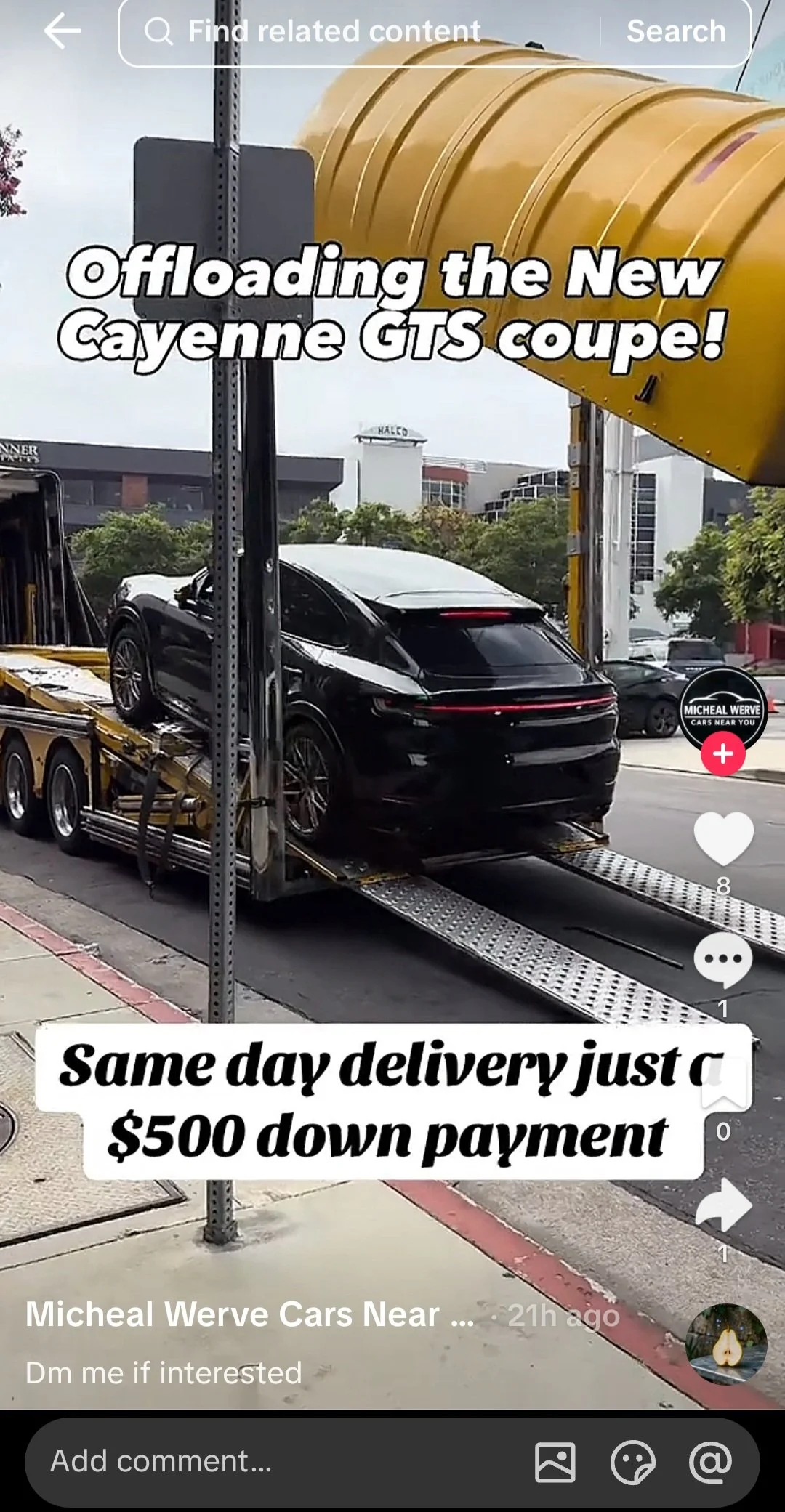
The video shows a Porsche being unloaded from a vehicle transporter and says:
“Same-day delivery with just a $500 down payment.”
That's quite a range of inventory.
Entry-level cars.
Used luxury cars.
SUVs.
Nearly new Toyotas.
And a Porsche Cayenne GTS Coupe.
All apparently tied together by remarkably small down payments.
🚩 Then There's the Camaro
One video caught my attention because the vehicle is sitting directly in front of a dealership.
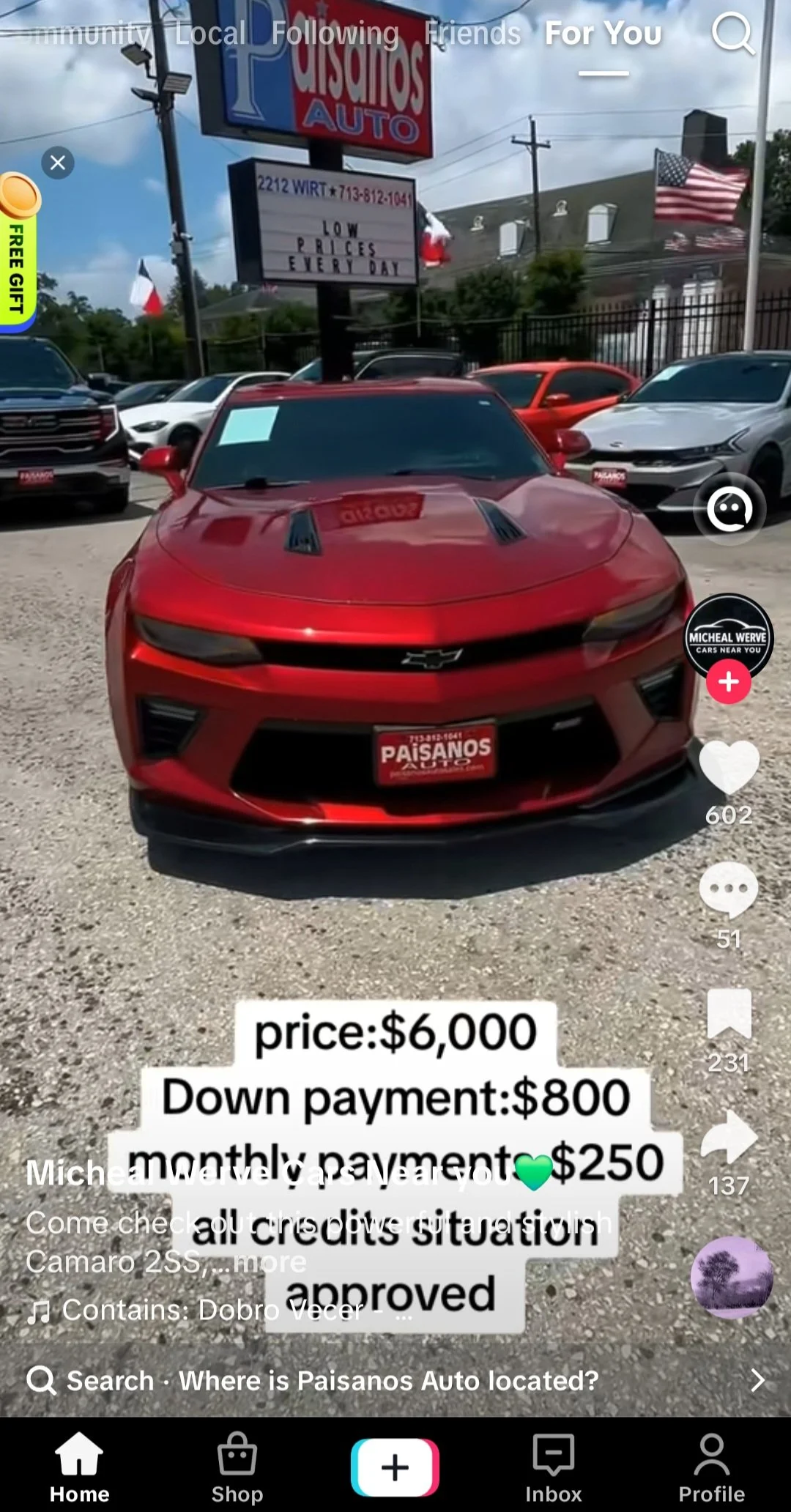
The TikTok overlay says:
Price: $6,000
Down payment: $800
Monthly payment: $250
All credit situations approved
But look behind the Camaro.
The dealership sign says Paisanos Auto.
That gave me something I could actually verify.
Paisanos Auto is a real used-car dealership at 2212 Wirt Road in Houston, Texas. Its own website confirms that address and says it has operated for more than 20 years. Paisano's Auto Sales
Here's where it gets much more interesting.
I found actual listings associated with Paisanos for Camaro 2SS models. One listing for a 2020 Camaro 2SS didn't advertise a $3,500 purchase price—it advertised $3,500 DOWN. Another 2023 Camaro listing similarly advertised $3,000 DOWN. OfferUp
Paisanos' own website makes the distinction even clearer. Its disclaimer says that prices advertised on Facebook Marketplace may represent the down payment, while the actual cash price and financing terms are separate. Paisano's Auto Sales
So a photograph or video of a real vehicle at a real dealership does not establish that the TikTok account showing it is authorized to sell that vehicle for the price it puts on the screen.
That's a very important distinction.
🚩 Then I Started Paying Attention to the Locations
This was another thing that bothered me.
I watched several of the account's shorts.
The scenery changes.
Dramatically.
One vehicle is clearly sitting at Paisanos Auto in Houston.
Another shows what looks like a transporter unloading a Porsche on a city street.
Another vehicle is photographed in a parking lot surrounded by brick, residential-looking buildings.
Another Corolla appears in a completely different retail parking lot at night.
Different backgrounds by themselves don't prove anything. A legitimate broker, multi-location dealership or delivery operation could certainly photograph vehicles in different places.
But when an account presents a stream of vehicles as available for extraordinarily small down payments, those changing locations become another reason I'd want to know:
Where is the actual dealership?
Who owns these vehicles?
Where can I physically inspect them?
What dealer license is the seller operating under?
What's the VIN?
And why do these videos appear to come from so many different places?
🚩 The Porsche Video Looks Like Transportation—not a Sale
The Cayenne video particularly caught my attention.
The text says:
“Offloading the New Cayenne GTS coupe!”
And:
“Same day delivery just a $500 down payment.”
But what I'm looking at is a Porsche coming off what appears to be a commercial vehicle transporter.
That establishes that somebody was transporting a Porsche.
It does not establish that the TikTok account owns that Porsche, sold that Porsche or can deliver that Porsche to me for $500 down.
That's the recurring problem with social-media vehicle content:
A real car doesn't automatically mean a real offer.
A real transporter doesn't prove a sale.
A real dealership in the background doesn't prove affiliation.
A real customer photograph doesn't independently establish the terms of a transaction.
Pictures prove what's visible in the pictures.
Not necessarily the story wrapped around them.
💰 Let's Talk About the Actual Values
This is where the economics become difficult to ignore.
Take the 2025 Toyota Corolla shown with “Only $500 down.”
Kelley Blue Book currently puts the Fair Purchase Price of a 2025 Corolla at roughly $21,400 to $26,600, depending on trim, with original MSRP ranging from $23,460 to $29,175. Kbb.com
Then there's the 2021 Ford Escape.
KBB currently shows Fair Purchase Prices ranging from about $13,900 to $18,050, depending on configuration. Even KBB trade-in estimates run roughly $7,550 to $12,200. Kbb.com
The 2016 Audi A6?
KBB's current Fair Purchase Price ranges from approximately $11,350 to $14,600, depending on trim. Kbb.com
And the 2018 Nissan Altima supposedly purchased with $800 down?
KBB currently puts dealer Fair Purchase Prices around $10,200 to $11,750, depending on trim, before adjusting for the specific 73,000-mile vehicle shown in the post. Kbb.com
None of this means a legitimate dealer can't finance a vehicle with a small down payment.
They absolutely can.
But a down payment isn't a purchase price.
That's precisely why the rest of the financing information matters.
📊 What About MMR Wholesale?
I also wanted to compare these offers with MMR—Manheim Market Report- because retail KBB values only tell part of the story.
MMR is a wholesale benchmark based on actual Manheim auction transactions. Manheim says its database draws from millions of auction transactions across the United States and Canada. Manheim
Here's the problem with giving one blanket “MMR price”: MMR is vehicle-specific. Mileage, trim, condition, region and the date of the transaction matter. Without the VINs and exact specifications of these TikTok vehicles—and direct MMR access—I don't want to manufacture wholesale numbers and pretend they're precise.
But we can find real-world examples.
A 2018 Nissan Altima 2.5 S with about 150,000 miles recently showed an MMR median of $4,275, with a range of roughly $3,225–$5,350. AUTOMAX
For 2021 Ford Escape examples, recent Manheim-linked data varies dramatically with mileage and condition. One high-mileage SE showed an MMR median of $3,425, while another better-condition example showed $8,225. A recent SEL example showed $6,000. AUTOMAX
That's exactly why VIN, mileage and condition matter.
And it's also why a vague “$500 down” tells a consumer almost nothing about what they're actually agreeing to pay.
🚩 The Math Is What Matters
Let's say somebody genuinely finances a $20,000 vehicle with $500 down.
They haven't bought a $500 car.
They've put $500 toward a transaction that could ultimately cost tens of thousands of dollars after the remaining principal, interest, taxes, registration, documentation fees, and other charges.
That's why I want to know:
What's the actual selling price?
What's the APR?
What's the loan term?
What's the monthly payment?
What's the total of payments?
Who's the lender?
Are there additional dealer fees?
What credit qualifications apply?
Is the $500 refundable?
And—before we get to any of that—
Does this account actually own or represent the vehicle?
Those aren't annoying questions.
Those are $20,000 questions.
🚩 Followers Don't Equal Verification
The account had thousands of followers when I looked at it.
That can create credibility.
“Four thousand people follow this person. It must be legitimate.”
No.
Follower counts aren't dealer licenses.
Likes aren't vehicle titles.
Views aren't VINs.
A polished TikTok profile isn't proof that the person behind it owns the vehicles appearing in the videos.
And a link in a bio doesn't become trustworthy simply because thousands of people follow the account.
🏡 Don't Be Passive—Be a Good Neighbor
This is the part I keep coming back to.
Someone desperately needs transportation.
They've been rejected for financing.
Their credit isn't great.
They need to get to work Monday.
Then TikTok serves them:
2025 COROLLA — $500 DOWN
or:
SAME DAY DELIVERY — $500 DOWN
Suddenly, something that seemed financially impossible looks possible.
That's exactly when another person asking questions can make a difference.
If you see a friend or family member getting excited about an offer like this, don't mock them.
Help them verify it.
Ask for the VIN.
Look up the dealership independently.
Call the dealership using the phone number on its official website, not a number supplied in a TikTok DM.
Check the vehicle's value.
Get the complete financing terms.
And don't send somebody a deposit simply because they say they can deliver the vehicle today.
The real Paisanos Auto, for example, has an independently verifiable Houston address, website, and phone number. Paisano's Auto Sales. That's the kind of information I'd use to verify whether someone posting a vehicle photographed on its property actually represents the dealership.
Because there is one sentence I keep repeating throughout this experiment:
A real car does not automatically make the offer real.
And neither do 4,000 followers.
Before sending $500, $800—or one dollar—verify who's actually on the other side of the screen.
Follow along at NielFlamm.com/blog for more questionable vehicle offers, suspicious emails, recruiting scams and whatever TikTok decides I need to investigate next.
Thank You for Your Order! What Did I Buy? Apparently, I Have to Open the Mystery Attachment
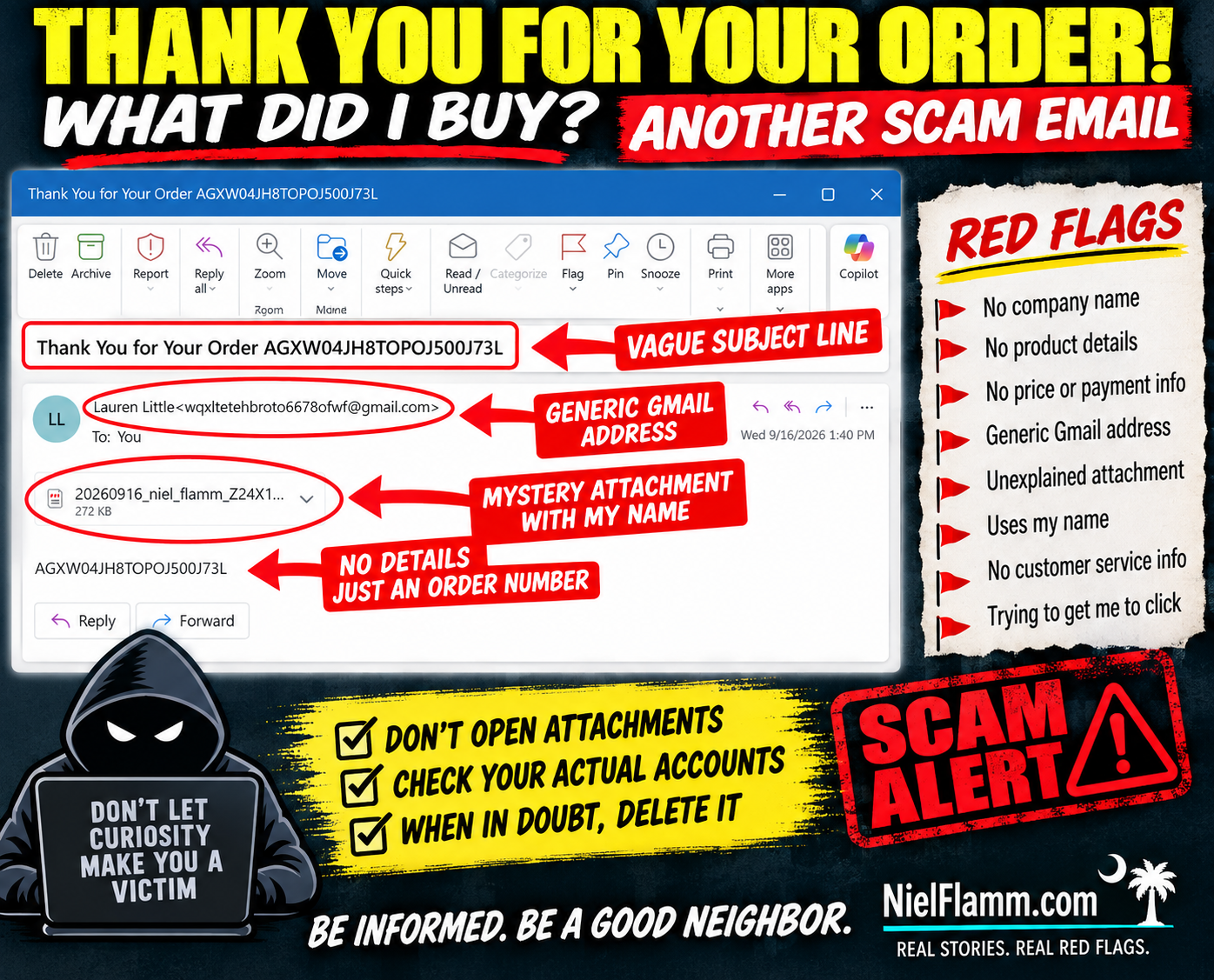
Oh, this one barely even tries. 😂
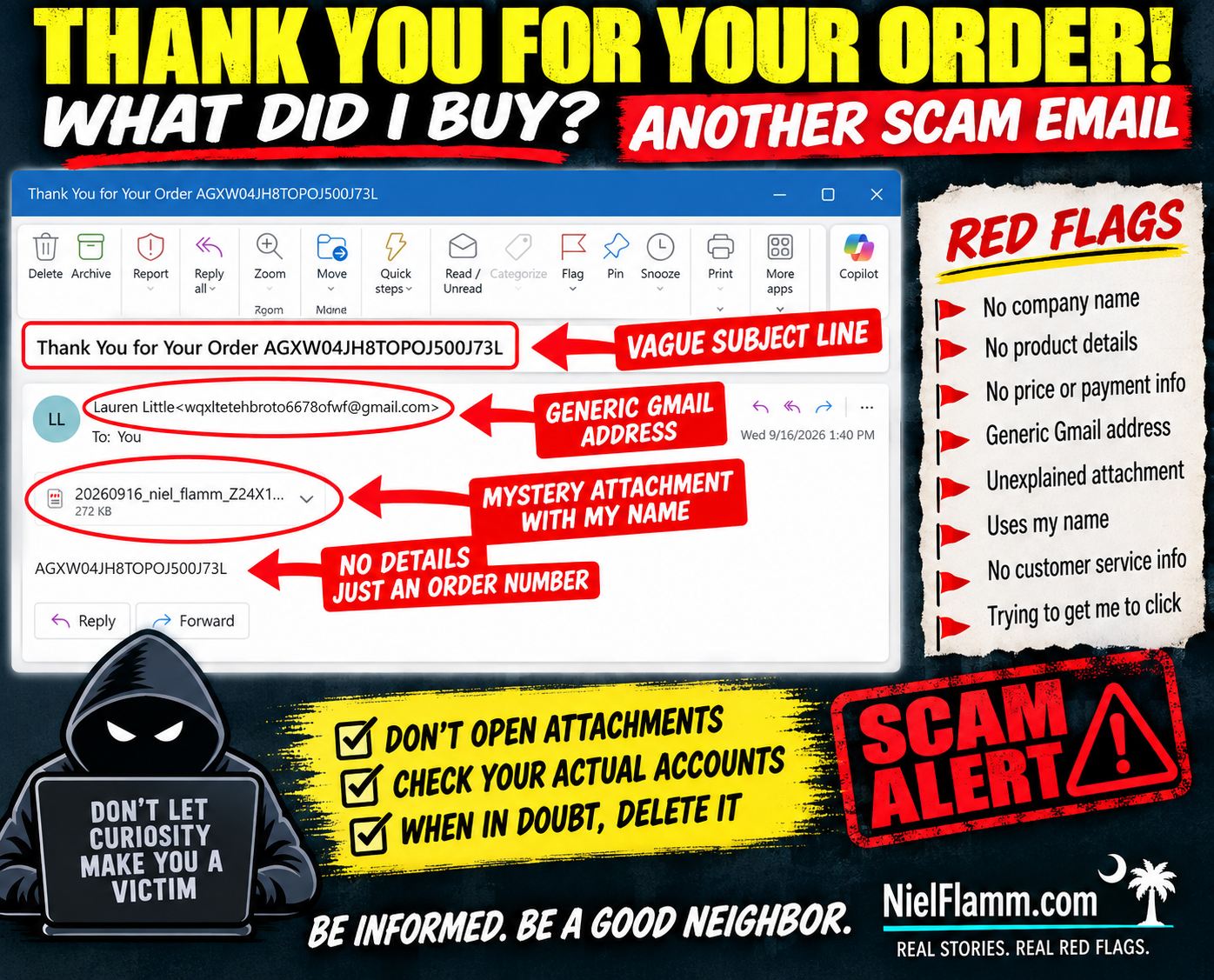
Another suspicious email landed in my inbox with the subject:
“Thank You for Your Order AGXW04JH8TOPOJ500J73L”
Well, thank you!
There's just one small problem.
WHAT DID I ORDER?
The email doesn't tell me.
No company name.
No product.
No price.
No payment method.
No shipping information.
No customer-service information.
Nothing.
The sender is Lauren Little, using a Gmail address that doesn't identify any recognizable merchant.
But don't worry—they did give me an order number.
And, more importantly, a 272 KB mystery attachment.
How thoughtful.
🚩 The Attachment IS the Email
The actual body contains essentially nothing except the same mysterious order number.
So if I want to know what I supposedly purchased, there's an obvious temptation:
Open the attachment.
And that's exactly what I'm not going to do.
I don't know what's inside that file, because I didn't open it. I'm not going to claim it's malware, a malicious document or anything else I haven't verified.
I also don't need to find out.
An unexpected email from an unknown sender telling me about an unidentified purchase and giving me an unexplained attachment has already failed my trust test.
🚩 Apparently Scammers Have Discovered Personalization
Here's another nice touch.
The attachment's filename includes:
“niel_flamm”
Ahhh.
They know my name!
That changes everything.
Actually, no.
Putting my name in the attachment doesn't make me more likely to open it. It makes me more likely to delete it.
Personalization isn't proof of legitimacy.
Names, email addresses, and other basic information can come from countless places online.
🧠 Curiosity Is the Hook
That's what makes these minimalist emails interesting.
They don't need an elaborate story.
They want me to create the story:
Did I accidentally buy something?
Did someone use my credit card?
How much did they charge me?
What company is this?
What's in that attachment?
And there's the trap.
Instead of giving me information, the email creates an information gap and gives me a file that supposedly fills it.
No thanks.
If I'm concerned about an unauthorized purchase, I'll check my bank and credit-card accounts myself.
I don't need to open a mystery attachment to discover whether I've spent money.
🏡 Don't Be Passive. Be a Good Neighbor.
If you receive something like this and recognize the warning signs, share them.
Someone else may see “Thank You for Your Order” and immediately panic.
Before they open the attachment, tell them:
Check your actual financial accounts first.
Sometimes being a good neighbor means preventing someone from making that one curious click.
Because sometimes the safest attachment is the one you never open.
Follow along at NielFlamm.com/blog for more suspicious emails, questionable vehicle offers, recruiting scams and whatever strange thing lands in my inbox next.
Another $399.99 Subscription? Apparently Geek Squad Is Throwing a Facebook Event
I have another expensive subscription I didn’t know about.
And once again, the scammers were thoughtful enough to invite me to a Facebook event to celebrate it.
This email arrived with the subject:
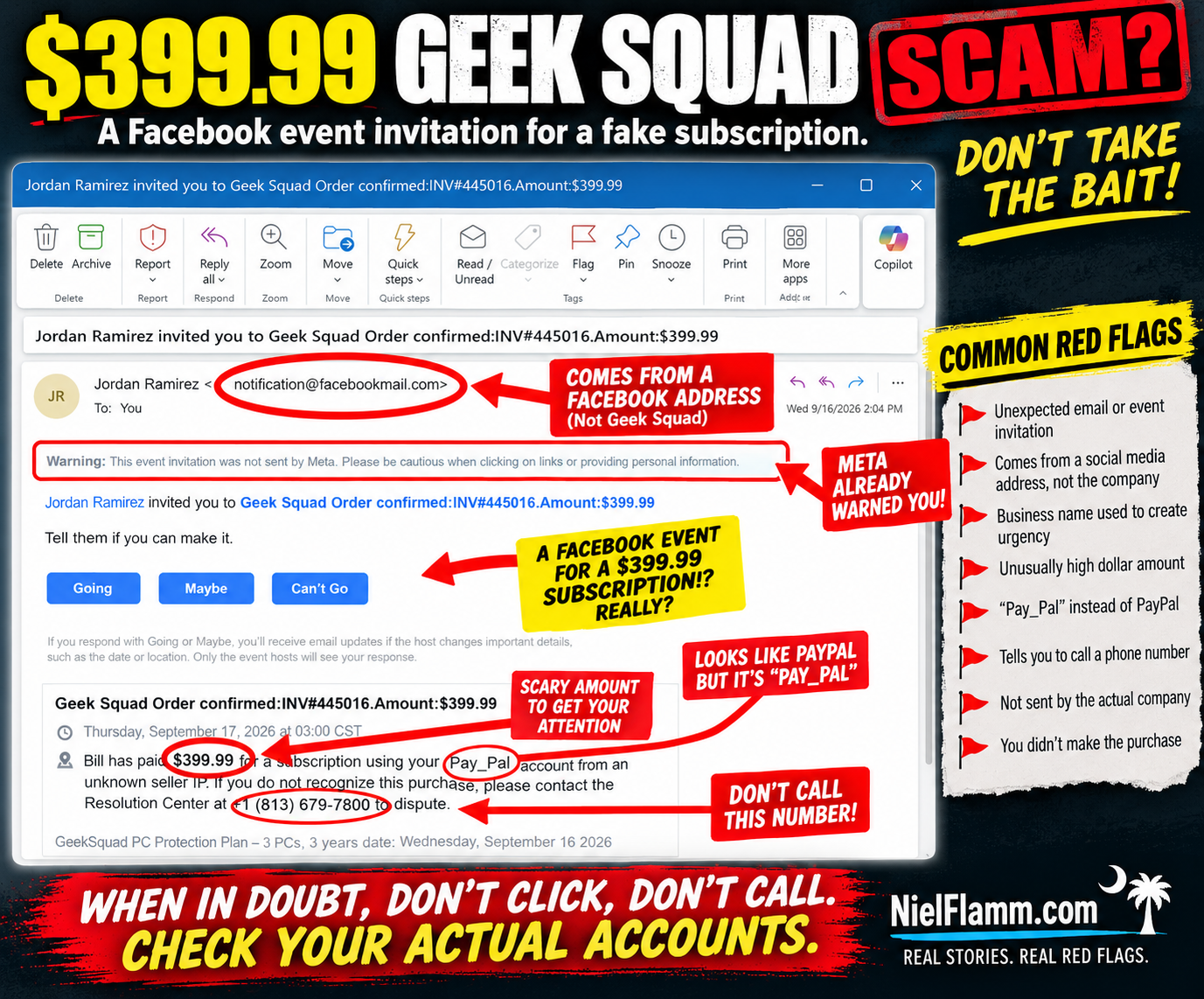
“Jordan Ramirez invited you to Geek Squad Order confirmed: INV#445016.Amount:$399.99”
According to the invitation, I supposedly paid $399.99 for a Geek Squad PC Protection Plan.
There's just one minor problem.
I didn't.
And if this looks familiar, it should.
🚩 Haven't We Seen This Movie Before?
Just recently, I received another Facebook event invitation claiming that $498.99 had been paid for a subscription through my PayPal account.
That one came from “Agnes V. Burden.”
This time we have Jordan Ramirez, Geek Squad, and $399.99.
Different person.
Different company.
Different dollar amount.
But remarkably similar script.
The invitation claims:
“Bill has paid $399.99 for a subscription using your PayPal account from an unknown seller IP.”
Wait.
Bill is back?!
Apparently Bill has access to my imaginary PayPal account and is having quite a shopping spree.
It would be helpful to sit Bill down and discuss boundaries.
🚩 Facebook Is Literally Warning Me
One of my favorite parts is that the warning is sitting right there at the top of the message:
“Meta did not send this event invitation. Please be cautious when clicking on links or providing personal information.”
Thank you, Meta.
Message received.
That's an important distinction because the sender shown in the email is:
Jordan Ramirez <notification@facebookmail.com>
Someone might see the Facebook-related email address and assume the underlying message must be trustworthy.
But the screenshot itself explains what's happening.
Jordan Ramirez invited me to an event.
The suspicious content is contained inside that event invitation.
A legitimate platform delivering a notification doesn't automatically make the content created by another user legitimate.
🎉 What Time Does My Geek Squad Party Start?
The invitation gives me the traditional Facebook choices:
Going
Maybe
Can't Go
Let's see.
Am I going to my imaginary $399.99 Geek Squad subscription celebration?
I'm leaning toward:
Can't Go.
I have plans that evening.
Specifically, not calling the phone number in this message.
🚩 And There It Is: The Phone Number
The message says that if I don't recognize the purchase, I should contact a:
“Resolution Center”
and conveniently provides a phone number.
That's the part that deserves attention.
The scary $399.99 charge gets your attention.
Geek Squad provides a recognizable brand.
PayPal adds a financial component.
And the phone number provides an immediate way to “fix” the problem.
That's exactly when I'd stop.
If I genuinely thought Geek Squad charged me $399.99, I wouldn't call the number supplied in a suspicious Facebook event.
I'd check my PayPal, credit card, and bank accounts independently.
Then, if necessary, I'd independently find the legitimate contact information for Geek Squad or the financial institution involved.
The suspicious message doesn't provide both the problem and the solution.
🚩 “Pay_Pal” Makes Another Appearance
This is another detail I noticed in both messages.
Not PayPal.
Pay_Pal.
The previous $498.99 subscription invitation used essentially the same wording.
Now this one does too.
So let's compare.
Previous message:
$498.99 subscription.
Facebook event invitation.
Claim involving “Pay_Pal.”
Unknown seller IP.
Phone number to call.
Current message:
$399.99 Geek Squad subscription.
Facebook event invitation.
Claim involving “PayPal.”
Unknown seller IP.
Phone number to call.
That's quite a coincidence.
Or perhaps we're looking at variations of the same social-engineering template.
🧠 The Scam Isn't Really About Geek Squad
That's an important point.
The recognizable company name makes the story believable.
Today it's Geek Squad.
Another day it could be PayPal, Norton, McAfee, Amazon, Microsoft, or another familiar brand.
The psychology is what matters.
You see:
$399.99
Your immediate reaction might be:
WHAT DID I BUY?!
Then you see:
“If you do not recognize this purchase, please contact...”
Perfect!
There's a phone number!
And before you've checked whether the transaction actually exists, you're talking to whoever is on the other end.
That's why urgency is so effective.
The message doesn't necessarily need to survive careful analysis.
It just needs to get you to act before you do careful analysis.
🚩 Don't Call the Number to Find Out Whether the Number Is Legitimate
This seems obvious when you say it out loud, but it's worth repeating.
If a suspicious message tells you that something terrible happened and then provides a phone number to fix it:
Don't use the suspicious message to verify the suspicious message.
Go around it.
Open your actual PayPal app.
Check your bank.
Check your credit card.
Go independently to the company's official website.
If there's no $399.99 transaction anywhere, that's important information.
And if there is an unauthorized transaction, contact the financial institution using independently verified information—not the number supplied in the questionable message.
🏡 Don't Be Passive. Be a Good Neighbor.
This is why I keep sharing these.
I recognize the pattern because I've been documenting them.
Someone else might not.
Someone might see Geek Squad, recognize the name, and panic.
Someone might think their spouse or child bought something.
Someone might worry that their PayPal account has been hacked.
And someone might immediately call.
If you see one of these, don't just delete it and move on.
Warn somebody.
Show your parents.
Show your neighbors.
Show the person who always calls you when something weird appears on their computer.
Report suspicious content through the appropriate platform.
Sometimes being a good neighbor is simply saying:
“Don't call that number. Let's check your actual account first.”
Jordan, I'm Going to Have to Decline
So thank you, Jordan Ramirez, for inviting me to the celebration of my imaginary $399.99 Geek Squad subscription.
Unfortunately:
Going? Nope.
Maybe? Still nope.
Can't Go? That's the one.
And apparently I need to have a serious conversation with Bill, because he keeps buying subscriptions with my imaginary PayPal account.
Follow along at NielFlamm.com/blog for more scam emails, suspicious recruiters, questionable vehicle offers, and whatever strange invitation lands in my inbox next.