
Another $399.99 Subscription? Apparently Geek Squad Is Throwing a Facebook Event
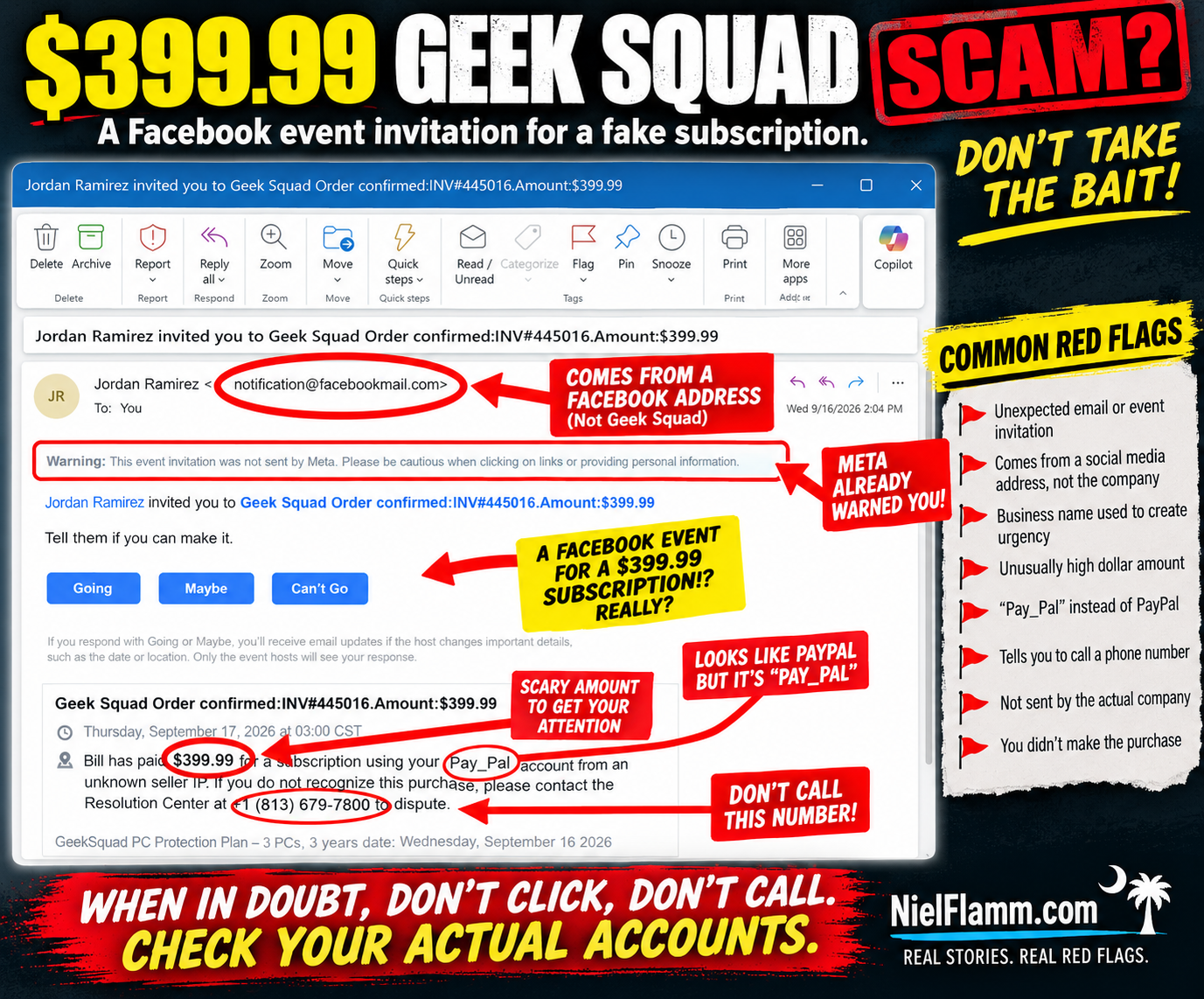
I have another expensive subscription I didn’t know about.
And once again, the scammers were thoughtful enough to invite me to a Facebook event to celebrate it.
This email arrived with the subject:
“Jordan Ramirez invited you to Geek Squad Order confirmed: INV#445016.Amount:$399.99”
According to the invitation, I supposedly paid $399.99 for a Geek Squad PC Protection Plan.
There's just one minor problem.
I didn't.
And if this looks familiar, it should.
🚩 Haven't We Seen This Movie Before?
Just recently, I received another Facebook event invitation claiming that $498.99 had been paid for a subscription through my PayPal account.
That one came from “Agnes V. Burden.”
This time we have Jordan Ramirez, Geek Squad, and $399.99.
Different person.
Different company.
Different dollar amount.
But remarkably similar script.
The invitation claims:
“Bill has paid $399.99 for a subscription using your PayPal account from an unknown seller IP.”
Wait.
Bill is back?!
Apparently Bill has access to my imaginary PayPal account and is having quite a shopping spree.
It would be helpful to sit Bill down and discuss boundaries.
🚩 Facebook Is Literally Warning Me
One of my favorite parts is that the warning is sitting right there at the top of the message:
“Meta did not send this event invitation. Please be cautious when clicking on links or providing personal information.”
Thank you, Meta.
Message received.
That's an important distinction because the sender shown in the email is:
Jordan Ramirez <notification@facebookmail.com>
Someone might see the Facebook-related email address and assume the underlying message must be trustworthy.
But the screenshot itself explains what's happening.
Jordan Ramirez invited me to an event.
The suspicious content is contained inside that event invitation.
A legitimate platform delivering a notification doesn't automatically make the content created by another user legitimate.
🎉 What Time Does My Geek Squad Party Start?
The invitation gives me the traditional Facebook choices:
Going
Maybe
Can't Go
Let's see.
Am I going to my imaginary $399.99 Geek Squad subscription celebration?
I'm leaning toward:
Can't Go.
I have plans that evening.
Specifically, not calling the phone number in this message.
🚩 And There It Is: The Phone Number
The message says that if I don't recognize the purchase, I should contact a:
“Resolution Center”
and conveniently provides a phone number.
That's the part that deserves attention.
The scary $399.99 charge gets your attention.
Geek Squad provides a recognizable brand.
PayPal adds a financial component.
And the phone number provides an immediate way to “fix” the problem.
That's exactly when I'd stop.
If I genuinely thought Geek Squad charged me $399.99, I wouldn't call the number supplied in a suspicious Facebook event.
I'd check my PayPal, credit card, and bank accounts independently.
Then, if necessary, I'd independently find the legitimate contact information for Geek Squad or the financial institution involved.
The suspicious message doesn't provide both the problem and the solution.
🚩 “Pay_Pal” Makes Another Appearance
This is another detail I noticed in both messages.
Not PayPal.
Pay_Pal.
The previous $498.99 subscription invitation used essentially the same wording.
Now this one does too.
So let's compare.
Previous message:
$498.99 subscription.
Facebook event invitation.
Claim involving “Pay_Pal.”
Unknown seller IP.
Phone number to call.
Current message:
$399.99 Geek Squad subscription.
Facebook event invitation.
Claim involving “PayPal.”
Unknown seller IP.
Phone number to call.
That's quite a coincidence.
Or perhaps we're looking at variations of the same social-engineering template.
🧠 The Scam Isn't Really About Geek Squad
That's an important point.
The recognizable company name makes the story believable.
Today it's Geek Squad.
Another day it could be PayPal, Norton, McAfee, Amazon, Microsoft, or another familiar brand.
The psychology is what matters.
You see:
$399.99
Your immediate reaction might be:
WHAT DID I BUY?!
Then you see:
“If you do not recognize this purchase, please contact...”
Perfect!
There's a phone number!
And before you've checked whether the transaction actually exists, you're talking to whoever is on the other end.
That's why urgency is so effective.
The message doesn't necessarily need to survive careful analysis.
It just needs to get you to act before you do careful analysis.
🚩 Don't Call the Number to Find Out Whether the Number Is Legitimate
This seems obvious when you say it out loud, but it's worth repeating.
If a suspicious message tells you that something terrible happened and then provides a phone number to fix it:
Don't use the suspicious message to verify the suspicious message.
Go around it.
Open your actual PayPal app.
Check your bank.
Check your credit card.
Go independently to the company's official website.
If there's no $399.99 transaction anywhere, that's important information.
And if there is an unauthorized transaction, contact the financial institution using independently verified information—not the number supplied in the questionable message.
🏡 Don't Be Passive. Be a Good Neighbor.
This is why I keep sharing these.
I recognize the pattern because I've been documenting them.
Someone else might not.
Someone might see Geek Squad, recognize the name, and panic.
Someone might think their spouse or child bought something.
Someone might worry that their PayPal account has been hacked.
And someone might immediately call.
If you see one of these, don't just delete it and move on.
Warn somebody.
Show your parents.
Show your neighbors.
Show the person who always calls you when something weird appears on their computer.
Report suspicious content through the appropriate platform.
Sometimes being a good neighbor is simply saying:
“Don't call that number. Let's check your actual account first.”
Jordan, I'm Going to Have to Decline
So thank you, Jordan Ramirez, for inviting me to the celebration of my imaginary $399.99 Geek Squad subscription.
Unfortunately:
Going? Nope.
Maybe? Still nope.
Can't Go? That's the one.
And apparently I need to have a serious conversation with Bill, because he keeps buying subscriptions with my imaginary PayPal account.
Follow along at NielFlamm.com/blog for more scam emails, suspicious recruiters, questionable vehicle offers, and whatever strange invitation lands in my inbox next.
