
Cortisol, Spirituality, Stress & Healing | Down A Hole Podcast – Season 1 Episode 7
How much of our daily stress is affecting our bodies, our thinking, and even our ability to connect with other people?
In Season 1, Episode 7 of Down A Hole, Fish and I dive into a conversation about cortisol, stress, spirituality, emotional regulation, meditation, mindfulness, and the challenges of navigating an increasingly stressful world.
From the science behind stress hormones to practical discussions about breathing, awareness, recovery, and personal growth, this episode explores how our minds and bodies respond to pressure—and what we can do about it.
🎙️ Watch or listen to the full episode at:
Interested in being a guest on the podcast?
📅 Use the Calendly link on the podcast page and schedule a conversation. We're always looking for interesting people, unique perspectives, and great stories.
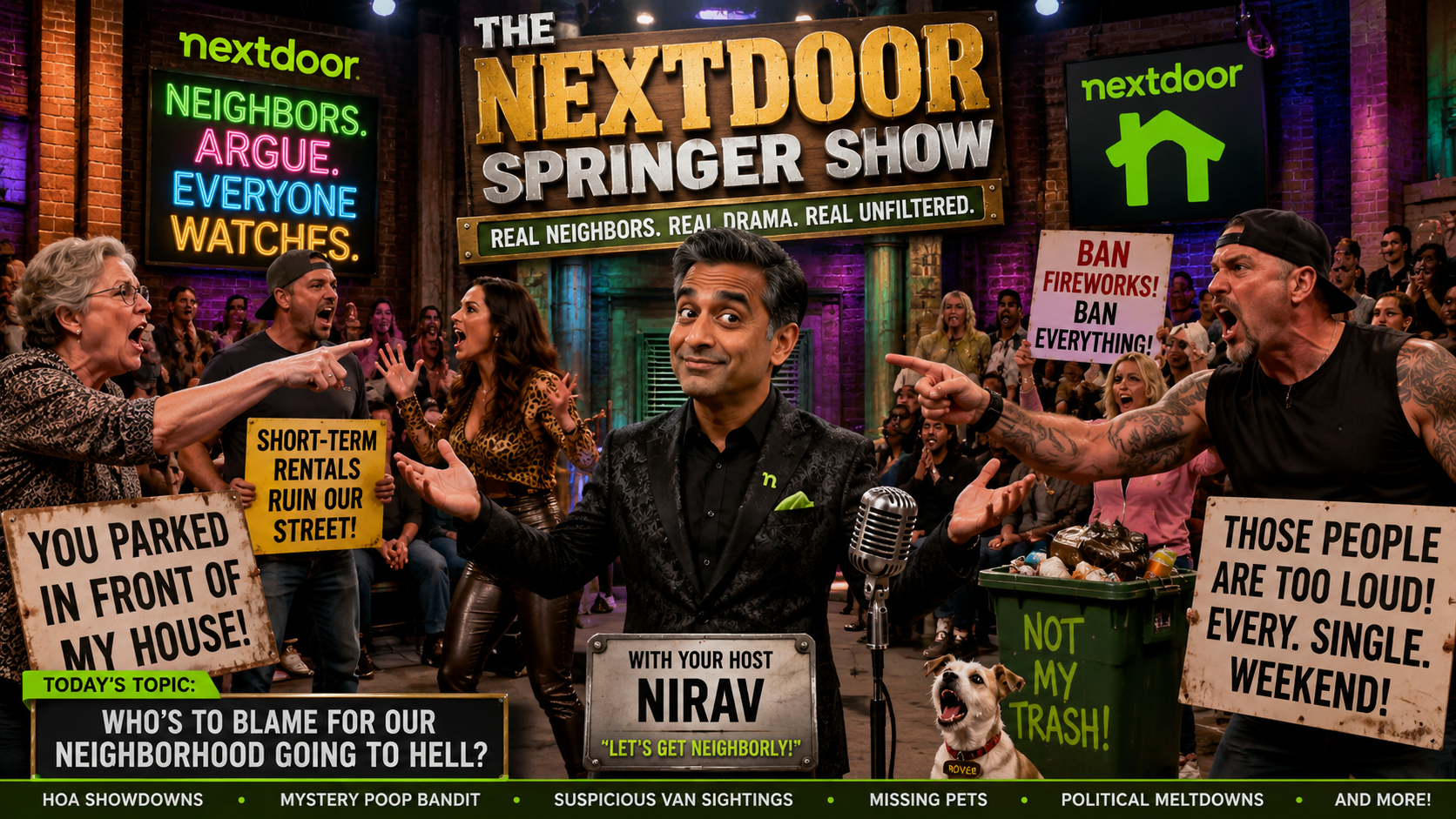
𝗜𝘁 𝗙𝗶𝗻𝗮𝗹𝗹𝘆 𝗗𝗮𝘄𝗻𝗲𝗱 𝗢𝗻 𝗠𝗲 𝗪𝗵𝗮𝘁 𝗜’𝗺 𝗗𝗼𝗶𝗻𝗴 𝘄𝗶𝘁𝗵 𝗡𝗲𝘅𝘁𝗱𝗼𝗼𝗿
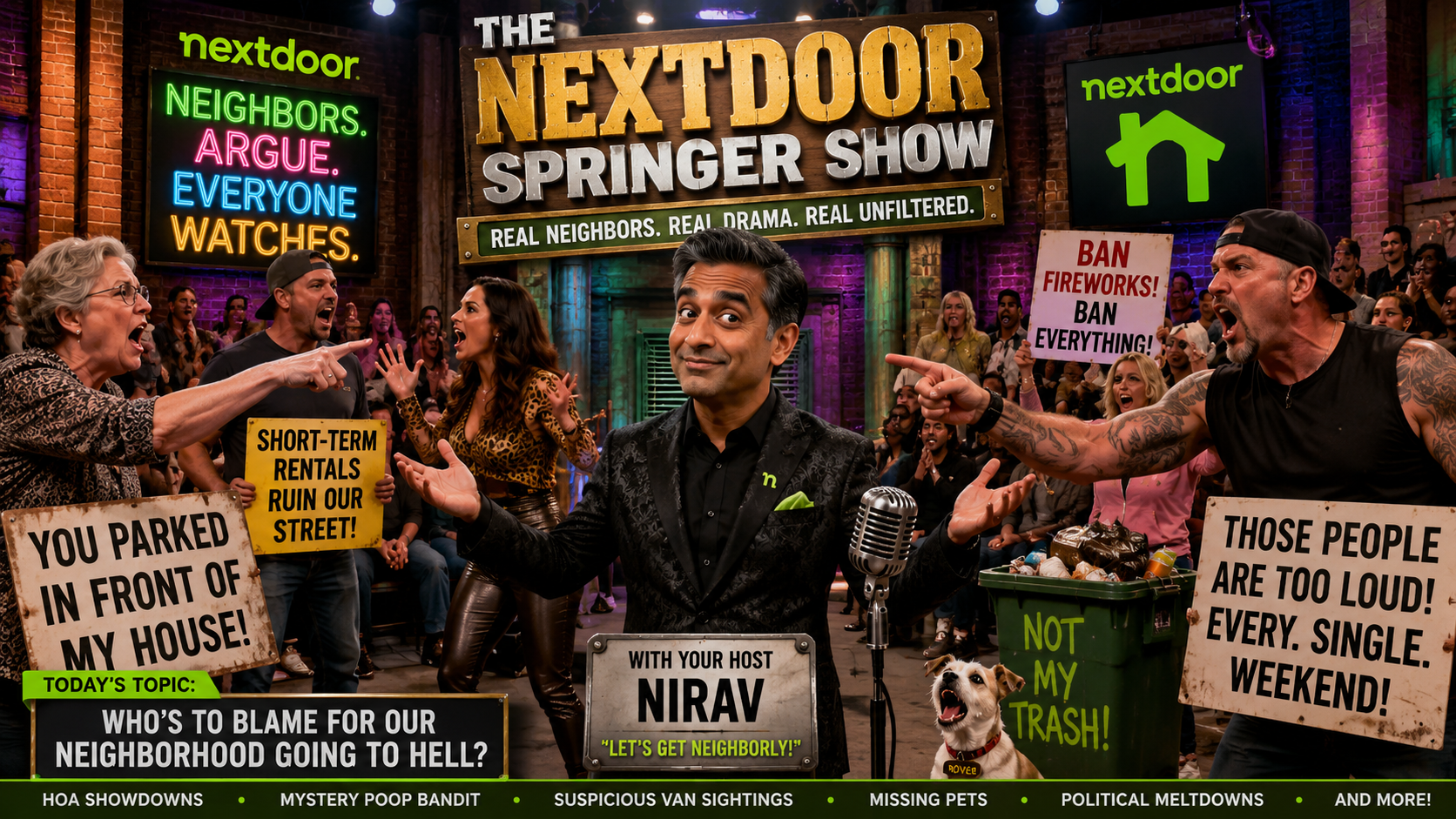
I think I finally figured it out.
By publicly criticizing, analyzing, parodying, and discussing Nextdoor so often… I’m helping drive attention directly to the platform.
Because Nextdoor doesn’t always feel like a calm digital neighborhood square.
Sometimes it feels like daytime chaos television.
A little The Jerry Springer Show, mixed with The Steve Wilkos Show security energy, and a dash of Maury “the DNA results determined…” drama — except instead of paternity tests, it’s HOA complaints, parking wars, surveillance screenshots, suspicious vans, missing pets, fireworks at midnight, and neighbors arguing over garbage cans.
And historically, chaotic talk shows worked for one reason:
People watched.
People shared.
People talked about the chaos afterward.
That attention became the product.
The irony is hard to ignore:
The more people debate moderation, censorship, neighborhood drama, and strange platform behavior… the more engagement the platform receives.
Even investors may be noticing.
The stock has shown signs of life recently, and whether people love the platform, hate it, mock it, or criticize it — attention still fuels visibility.
That doesn’t erase legitimate concerns surrounding moderation transparency, unpaid moderators, vague rule enforcement, or appeals systems.
But it does reveal something uncomfortable about modern social media:
Outrage has economic value.
Drama has engagement value.
And maybe Nextdoor accidentally became less of a neighborhood app and more of a reality show with property lines.
Which means… I may have joined the marketing department by mistake.
You’re welcome Nirav Tolia.
World Cup 2026 Will Expose What Nextdoor Really Is
FIFA World Cup 2026 is coming to North America.
Millions of visitors. Dozens of host cities. Neighborhoods transformed overnight into unofficial fan zones.
And somewhere in the middle of all of it — Nextdoor's unpaid volunteer moderators trying to hold together a platform that was never really about unity in the first place.
Because Nextdoor markets itself as the app that connects neighbors.
But spend five minutes on it, and you'll find something closer to the opposite — a platform that monetizes suspicion, amplifies grievance, and turns the people living closest to you into the people you trust least.
And World Cup 2026 is about to pour gasoline on it.
When millions of visitors flood into host city neighborhoods, watch how fast "community" curdles into:
"Suspicious vehicle" reports filed against fans who don't look like they belong
Racial profiling dressed up as safety concerns — reported, ignored, or quietly deleted
"Out-of-towners are ruining our neighborhood" posts racking up hundreds of upvotes
Flag displays triggering nationality-based arguments that moderators don't know how to touch
Short-term rental rage that splits neighbors into economic factions
Noise complaints weaponized against certain households but not others
Local businesses accused of price gouging — with no context, no fairness, no appeal
The moderation will be inconsistent. The rule enforcement will be opaque. Some posts will disappear. Others — somehow — won't.
That's not a bug. That's the pattern.
Nextdoor has spent years positioning itself as the trusted hub for hyper-local connection. But what it's actually built is a digital space where fear travels faster than goodwill, where anonymity emboldens bad-faith reporting, and where the loudest, most territorial voices set the tone for everyone else.
World Cup 2026 won't just stress-test Nextdoor's moderation infrastructure.
It will expose what the platform has always been — not a town square, but a complaint box. Not a community builder, but a division engine with a neighborhood aesthetic.
The world is coming to North America to celebrate together.
Nextdoor will find a way to make it a neighborhood dispute.
Is Nextdoor a connector or a divider? Have you seen it bring people together — or push them apart?
𝗝𝗼𝘂𝗿𝗻𝗮𝗹𝗶𝘀𝘁𝘀 𝗦𝗵𝗼𝘂𝗹𝗱 𝗣𝗮𝘂𝘀𝗲 𝗕𝗲𝗳𝗼𝗿𝗲 𝗣𝗮𝗿𝘁𝗻𝗲𝗿𝗶𝗻𝗴 𝗪𝗶𝘁𝗵 Nextdoor
On #NationalLocalNewsDay (April 9th), Nextdoor announced early access for "Local Journalist Accounts" — a pilot already tested with 75+ reporters from outlets like The Dallas Morning News, Fort Worth Star-Telegram, and Hearst Newspapers.
The pitch: verified presence, DMA-wide reach from day one, and real-time search to monitor neighborhood conversations before a story goes to print.
On paper, it sounds like a lifeline for a struggling industry.
But journalists should read the fine print before signing on.
Here's the tension nobody in the press release is naming:
Journalism has historically stood against censorship, opaque moderation, and systems where speech is controlled without transparency or accountability.
Yet longtime Nextdoor users consistently describe exactly those problems:
- Unpaid volunteer moderators with significant enforcement power
- Little visibility into why posts are removed
- Vague Guidelines, inconsistently applied, and hard to appeal
- Public criticism quietly moderated away — while the company markets itself around "authentic community conversation."
That's not a minor footnote. That's a structural contradiction.
And for journalists, the stakes are higher.
Nextdoor offers immediate reach with no audience-building required — genuinely attractive when local newsrooms are hemorrhaging resources.
But reach comes with dependency.
Once journalists build sources and story pipelines inside a platform ecosystem, they become subject to that platform's rules, algorithms, and enforcement priorities — controlled by a private company with its own business interests.
If those systems lack transparency for ordinary neighbors today, what does that mean for editorial independence tomorrow?
A verified badge is not editorial freedom.
Reach is not the same as transparency.
And a company that moderates criticism while marketing "community conversation" deserves scrutiny — not just participation.
The right response isn't reflexive rejection.
Local journalism is in crisis. Nextdoor claims it reaches 1 in 3 U.S. households. The overlap is real.
But the right entry point is as a journalist, not a brand partner — asking publicly: What speech protections exist for journalist accounts? Who reviews moderation decisions affecting reporters? What recourse exists when content is removed?
Local journalism matters too much to trade those questions for a verified checkmark and a shortcut to distribution.
Subscribe to NielFlamm.com.
Nextdoor says it connects neighbors. This comedian just exposed why that's complicated.
John Crist's bit on neighborhood apps is genuinely funny.
It's also a little too accurate.
He describes maintaining two Nextdoor accounts — one progressive, one conservative — and arguing with himself as he watches strangers pile on. He backs out and lets the chaos run.
The crowd laughs. But sit with it for a second.
Nextdoor's founder, Nirav Tolia, has pointed to TransUnion’s address verification as the platform's backbone of trust. Real neighbors. Real accountability.
And yet — a comedian openly jokes about running burner accounts to manufacture conflict on the platform. Not as a hypothetical. As a bit rooted in something he actually does.
That raises real questions:
How robust is the verification in actually keeping bad actors out?
If one person can run two accounts and stoke division for sport, what does that do to Weekly Active User numbers the platform reports to investors?
And if the algorithm rewards conflict — which it clearly does — are we measuring engagement, or just outrage?
Comedy works because it tells the truth sideways.
John Crist didn't set out to write a platform audit. But he did.
If you work in community building, social platforms, or neighborhood tech, this 60-second clip is worth your attention.
🎭 Watch the short: https://www.youtube.com/shorts/9Kx4QSkbqX0
What's your experience with Nextdoor? Does it bring your neighborhood together — or surface the fault lines?
Subscribe to NielFlamm.com