
Taking My Concerns to Nextdoor’s Largest Shareholders
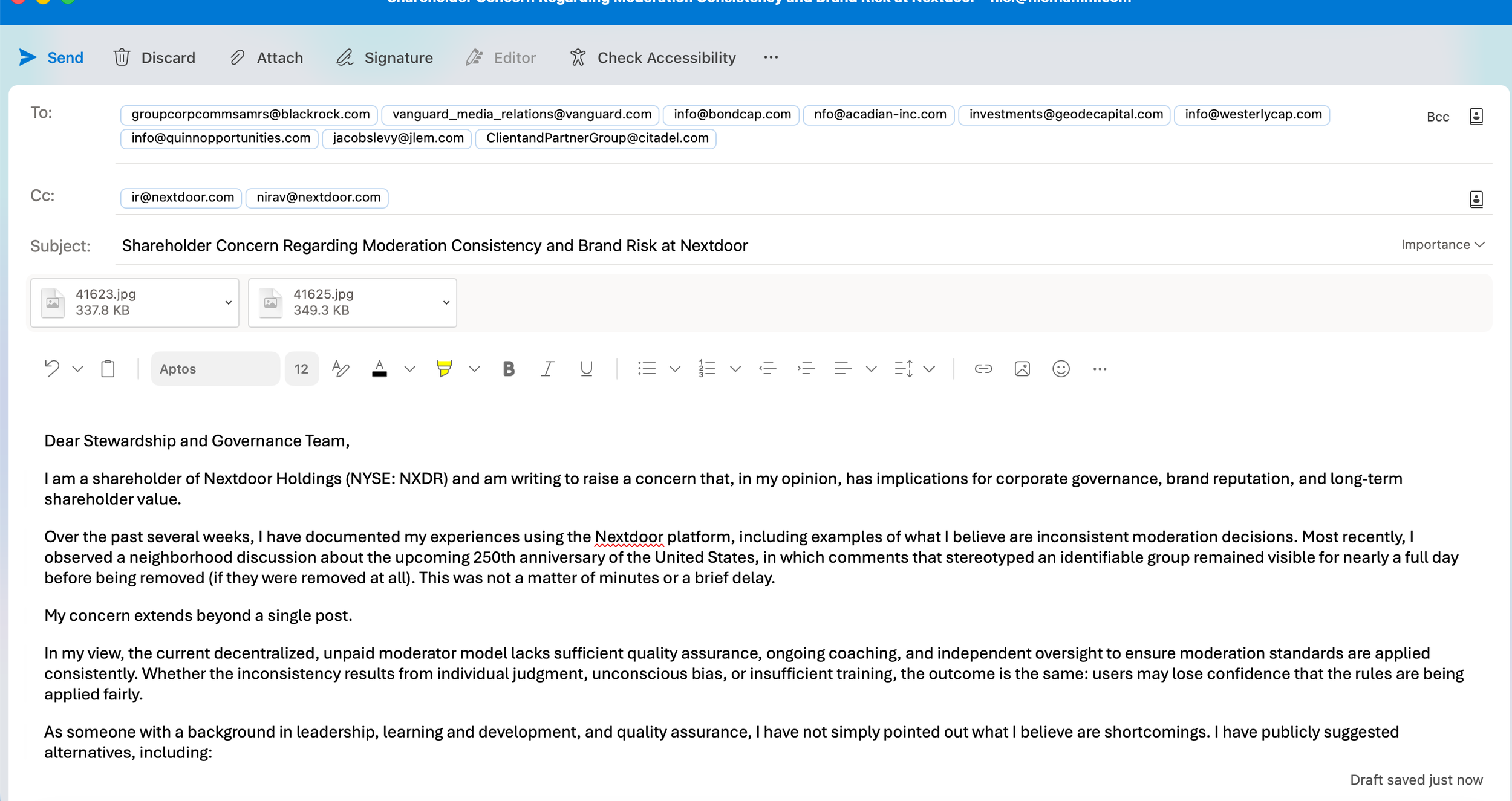
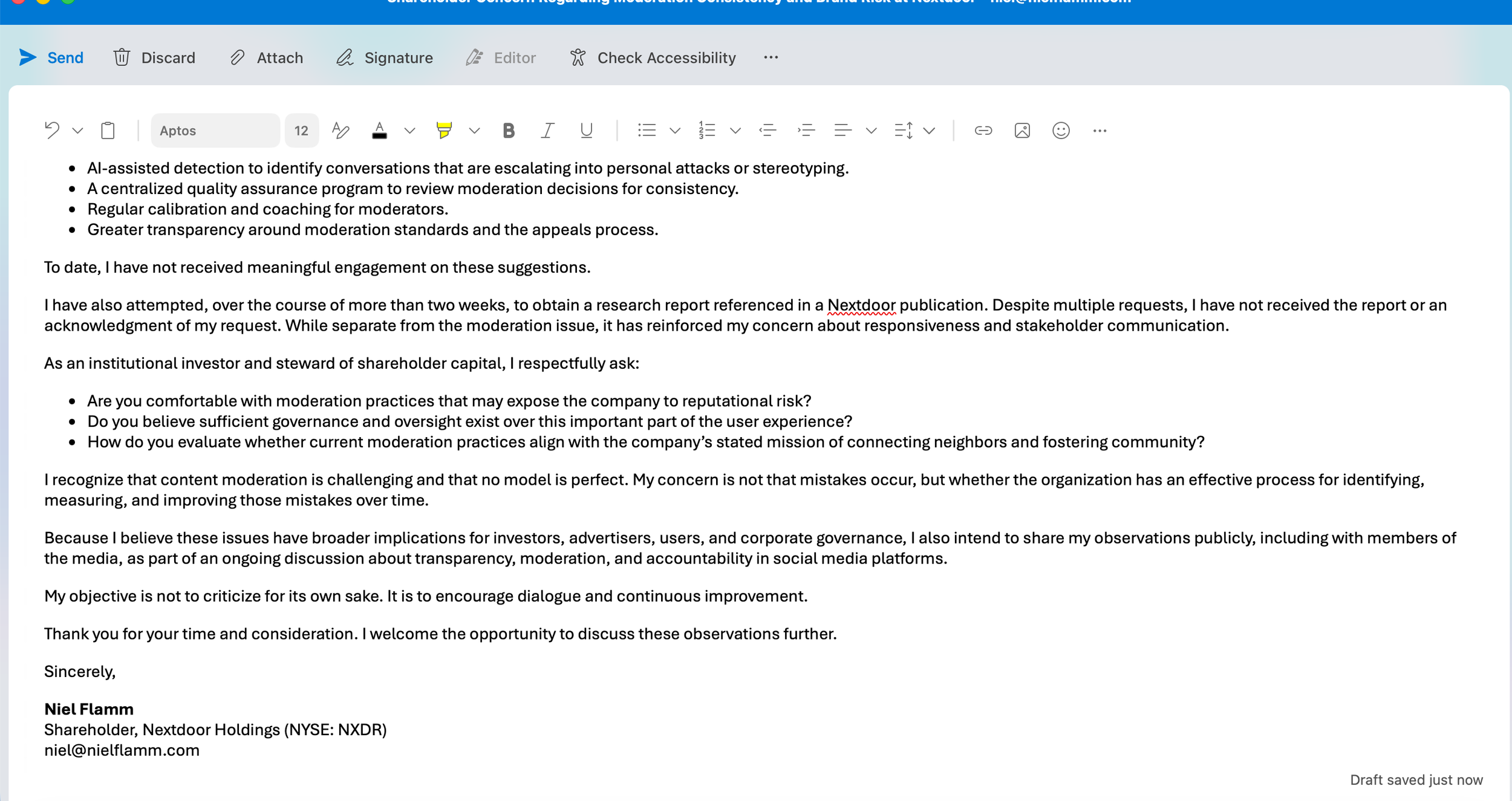
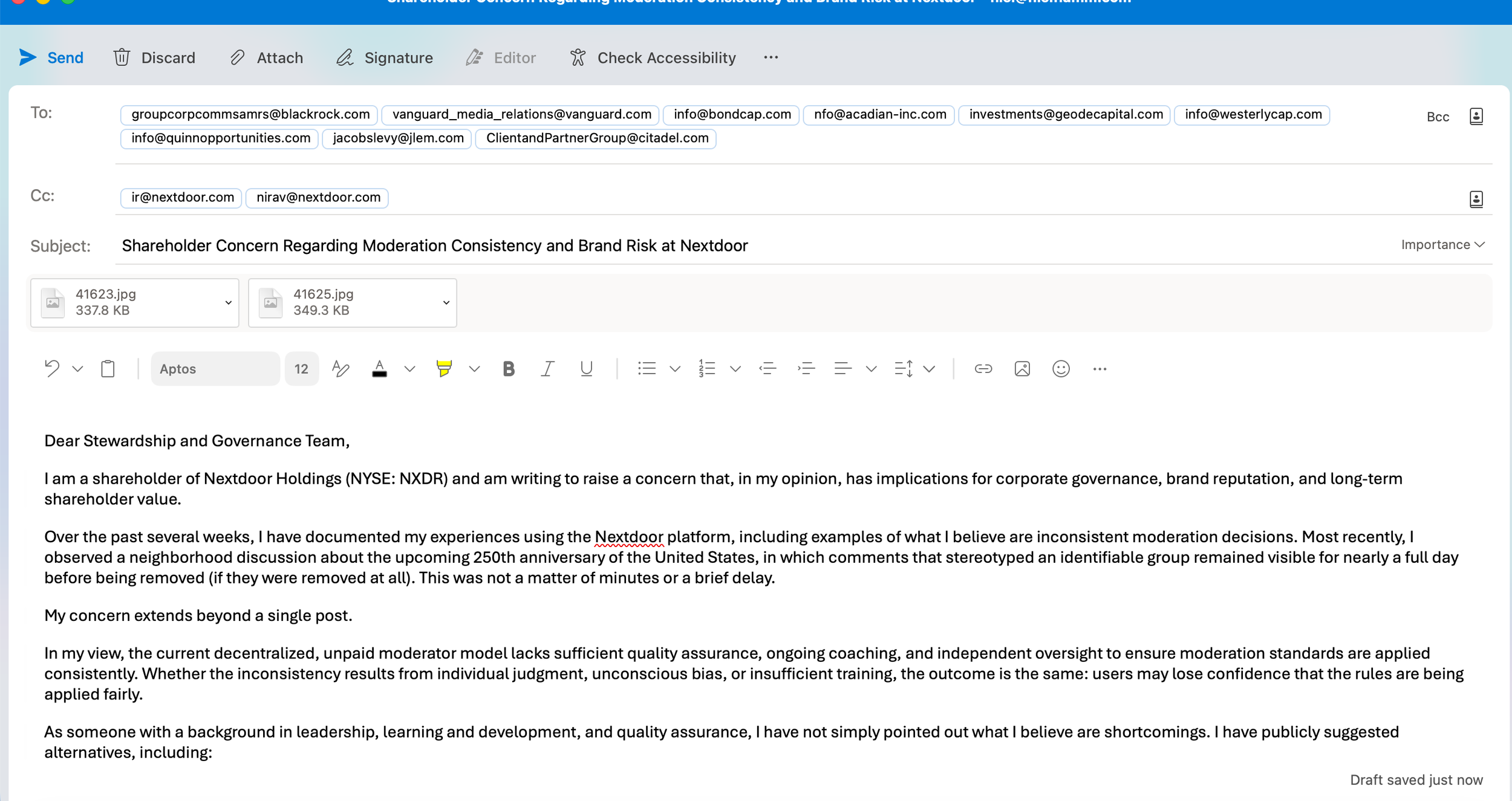
For the past several weeks, I’ve documented my observations and experiences with Nextdoor as both a shareholder and user. My goal has been straightforward: ask questions, offer recommendations, and encourage continuous improvement.
Today, I’m taking the next step.
I have sent the attached letter to several of Nextdoor’s major institutional investors, including BlackRock, Vanguard, State Street, Geode Capital Management, Acadian Asset Management, and Bond Capital.
My request is simple.
I am asking these investors to review the concerns I’ve raised and consider whether Nextdoor’s moderation practices, governance, and customer experience align with the long-term interests of shareholders.
In particular, I’m asking them to seek an explanation from Nextdoor’s leadership regarding how the moderation example I’ve documented was allowed to remain on the platform for an extended period and what oversight exists to promote consistent moderation decisions.
Content moderation is complex, and reasonable people may disagree about individual decisions. My concern is whether the company has effective quality assurance, accountability, and transparency around the process.
Whether you agree with my conclusions or not, I believe these are fair questions for shareholders to ask of company leadership.
I welcome respectful discussion and differing viewpoints. Continuous improvement begins with asking questions.
My Nextdoor Experiment: When Moderation Leaves Questions Unanswered
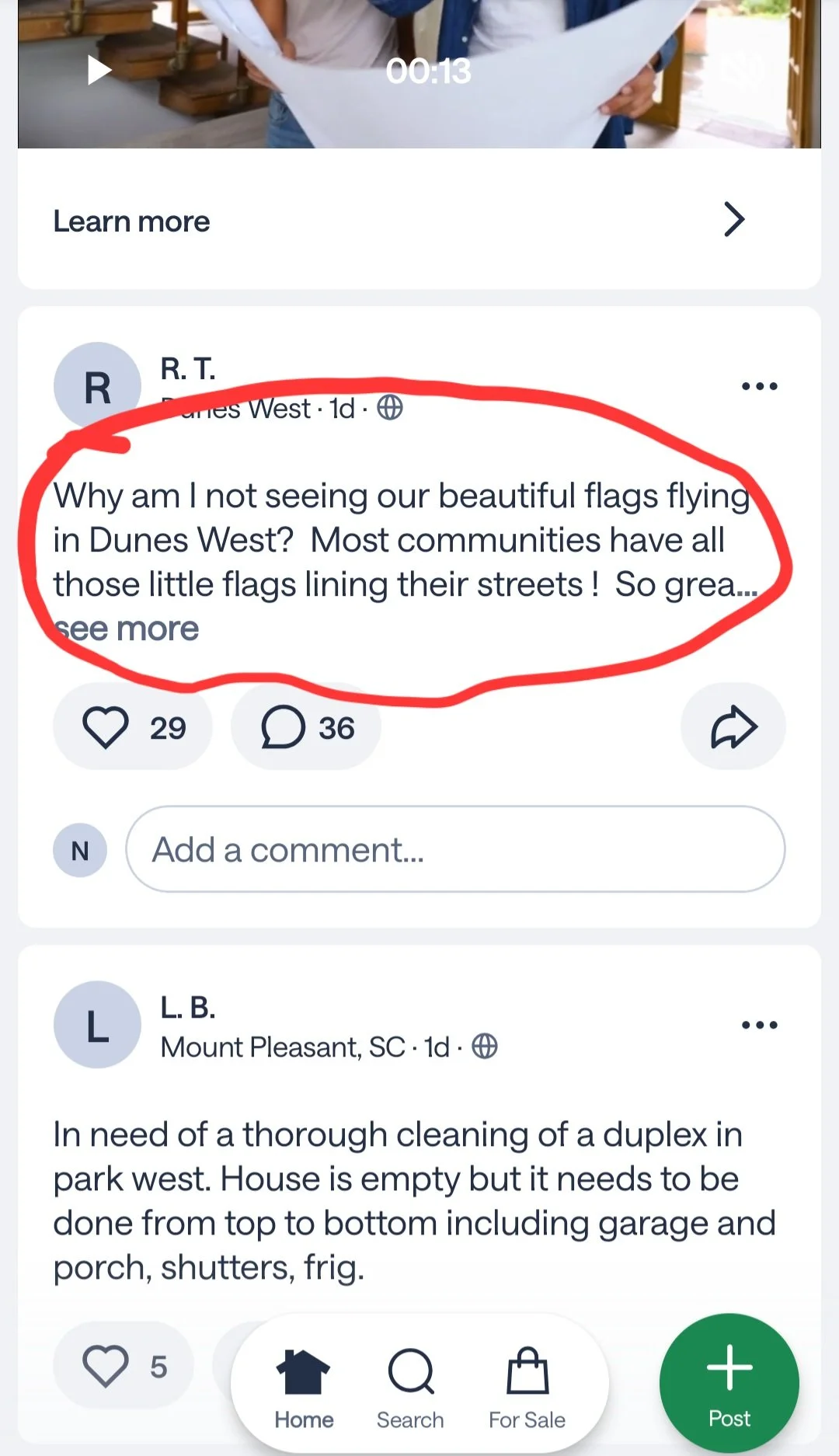
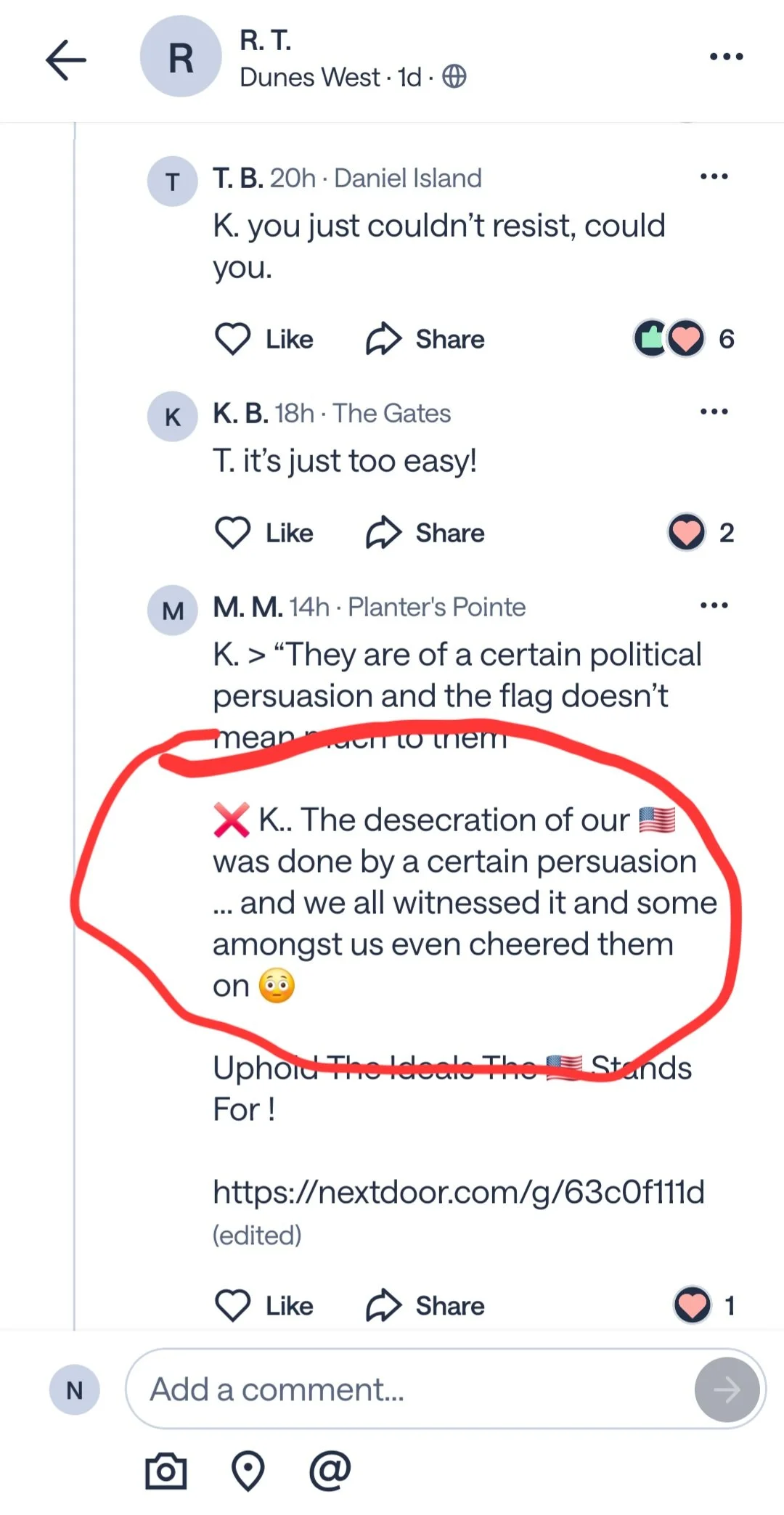
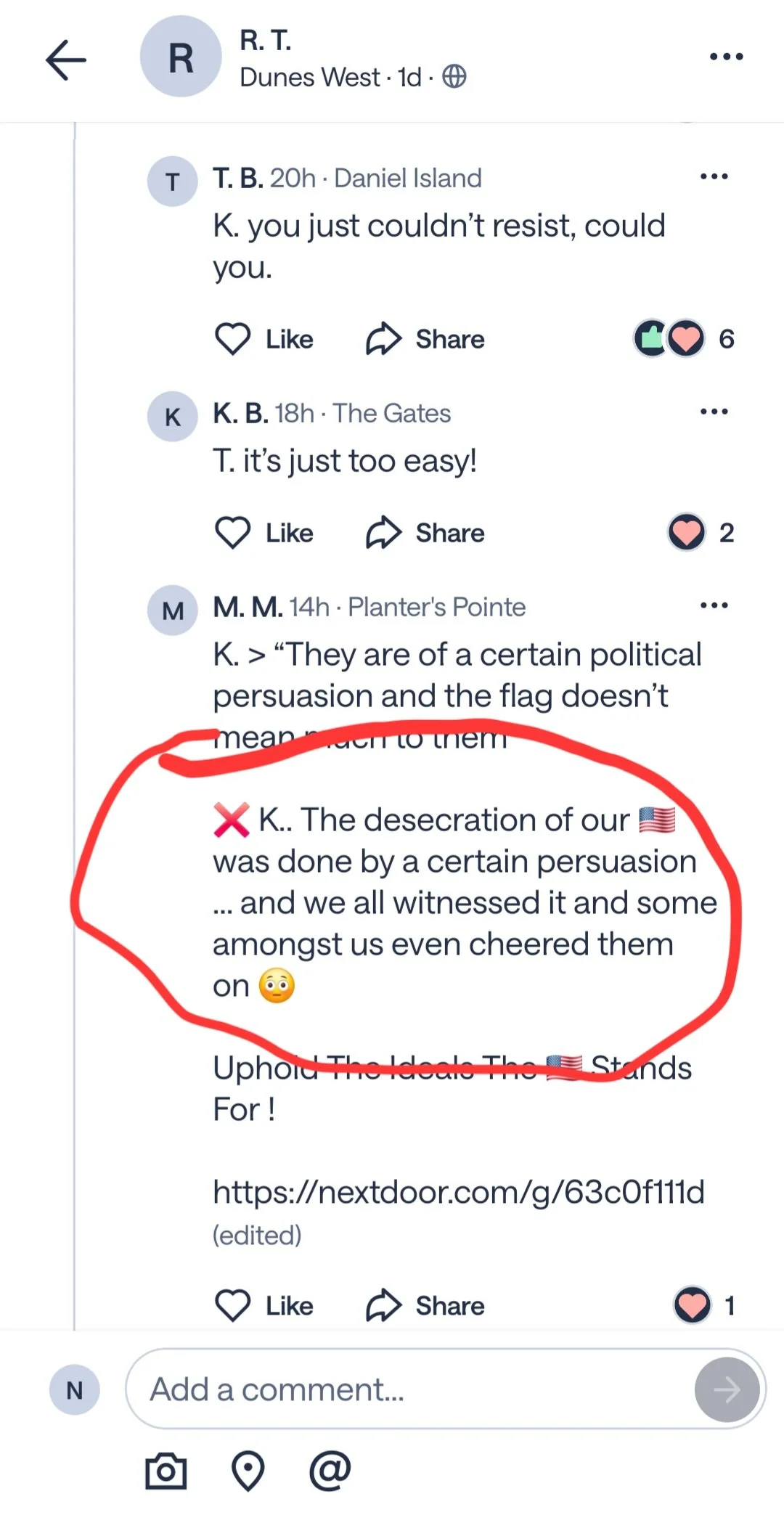
As part of my ongoing Nextdoor experiment, I continue to observe discussions in my local community. Some of what I see is thoughtful. Some of it is disappointing.
With the 250th anniversary of the founding of the United States approaching, it’s encouraging to see neighbors celebrating a milestone in our country’s history. I’m grateful to have been born in the United States and appreciate the opportunities this country has provided.
What concerns me is when conversations move beyond the topic itself and begin singling out groups of people with broad stereotypes or negative generalizations.
Whether the target is based on race, ethnicity, religion, political affiliation, or another characteristic, allowing comments that stereotype an entire group can undermine the sense of community a platform aims to foster.
I included a screenshot of the discussion in this post so readers can judge the context for themselves.
That brings me back to a question I’ve asked repeatedly:
How are moderation decisions being made, and are they being applied consistently?
When users see some comments removed while others containing personal attacks or broad stereotypes remain, it’s natural to ask whether the moderation process is consistent.
I’ve suggested before that Nextdoor could strengthen its moderation model by combining AI-assisted detection with centralized quality assurance and regular moderator coaching. Regardless of the approach, consistency and transparency are important if users are expected to trust the process.
I’d like to see moderation that encourages constructive conversations while reducing comments that target or stereotype groups of people.
You can see the screenshots, read my full analysis, and join the discussion on NielFlamm.com/blog.
What has your experience been with online community moderation?
Day 16: Consistency Shouldn’t Depend on Who You Know
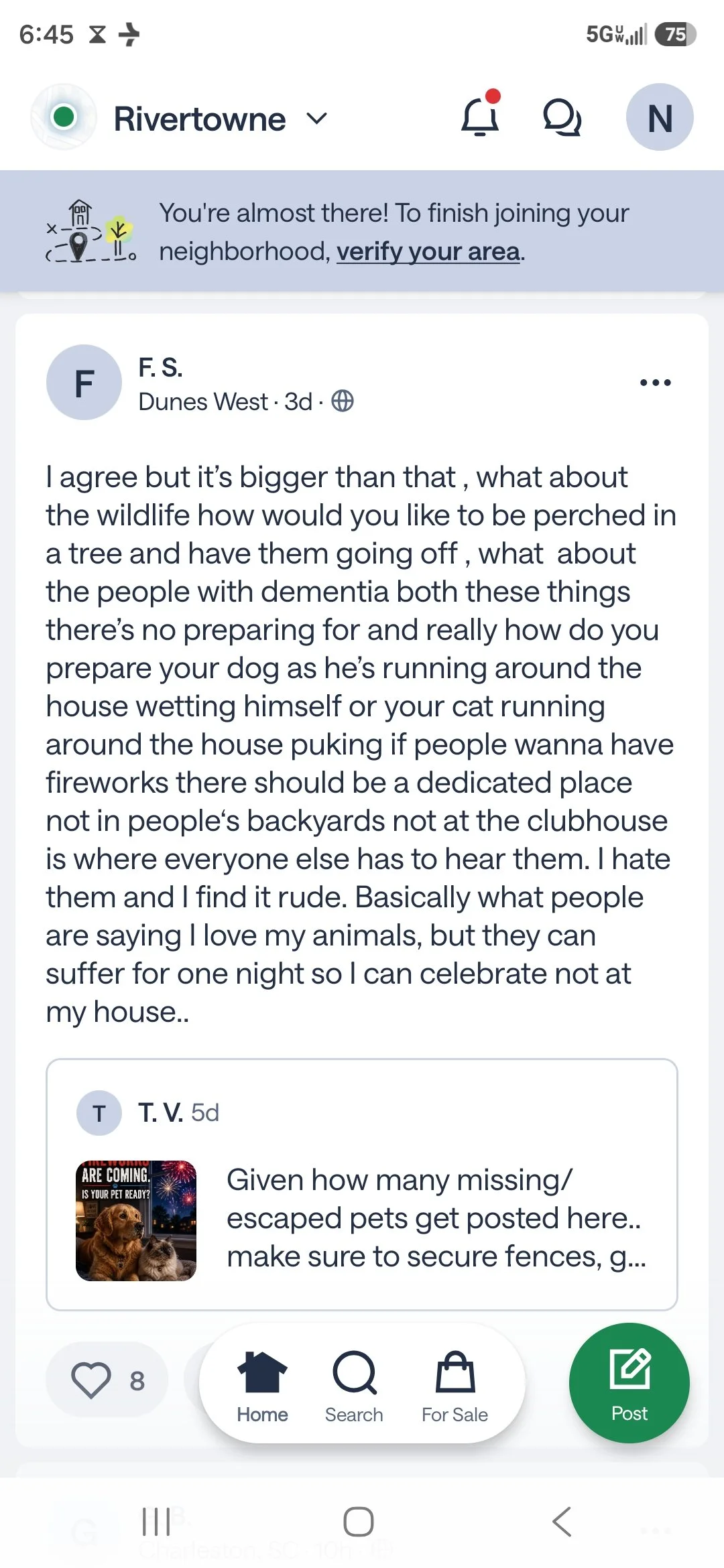
Every year around Independence Day, neighborhoods light up with discussions about fireworks and pets.
I understand why. It’s a topic that generates strong opinions.
What caught my attention wasn’t the topic itself—it was the comments that followed.
One commenter referred to another neighbor as “Karen.” By the way, I know an awesome Karen, Karen Romero and would recommend her for a leadership QA role in a heartbeat.
Another made a reference to Charles Darwin, implying that a species disappears because of poor choices—a comment clearly aimed at another person.
Yet those comments remained visible.
That leaves me asking the same question I’ve been asking throughout my Nextdoor experiment:
How are comments like these allowed to remain while other posts or comments are moderated or removed?
From my perspective, consistency is the issue.
Whether the inconsistency stems from differences in judgment, neighborhood dynamics, or something else, the result is the same: users may wonder whether the standards are being applied evenly.
My suggestion hasn’t changed.
Combine AI with centralized quality assurance and independent oversight. Let AI identify conversations that are becoming personal, and have trained reviewers apply the same standards across every neighborhood.
That seems like a better investment than expanding office space if the goal is to improve the user experience.
Meanwhile, today is Day 16 since I requested the Home Insurance Insights study referenced in a Nextdoor article.
I’ve now emailed Nirav Tolia, Jacob Chavis, and another member of the Customer Insights team.
Was it awkward?
A little.
But it also raises a broader question.
If this is the experience of someone making a straightforward request for information referenced in a public article, what should advertisers or users expect when they need help with a billing issue, campaign, or account problem?
Customer experience is built one interaction at a time.
I’d love to hear your thoughts.
Join the discussion on NielFlamm.com.
Stay Cool: A Summer Tip Every Amputee Should Know
Sometimes the smallest tips can make the biggest difference.
If you're an amputee and summer heat leaves you battling sweat, socket fit, and comfort issues, I have one simple change that made a noticeable difference for me. It's not what I expected, but it's worked surprisingly well.
Curious what it is?
Head over to https://NielFlamm.com/videos to watch this video, along with my movie reviews, leadership commentary, technology observations, and plenty of other Junk Cast internet garbage designed to help fuel your doom scrolling.
See you over there!
When You Can't Go Up the Chain, You Go Down It
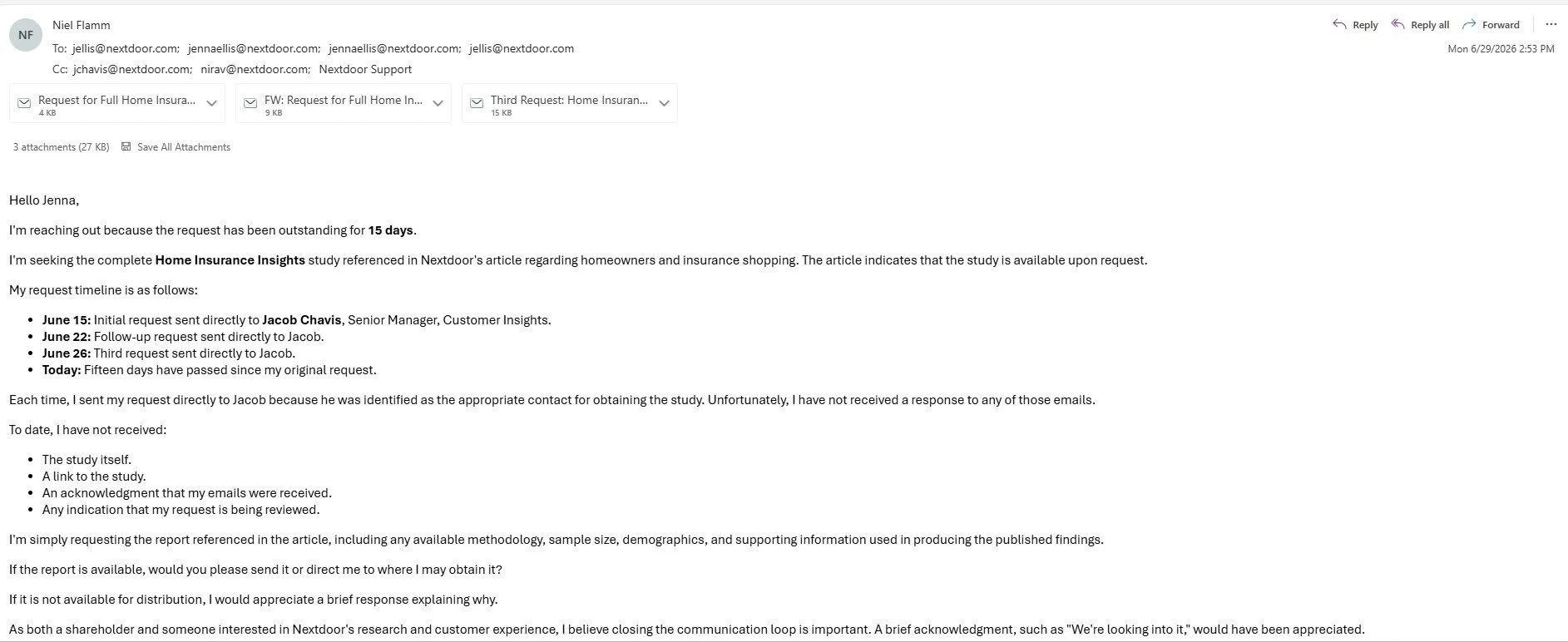
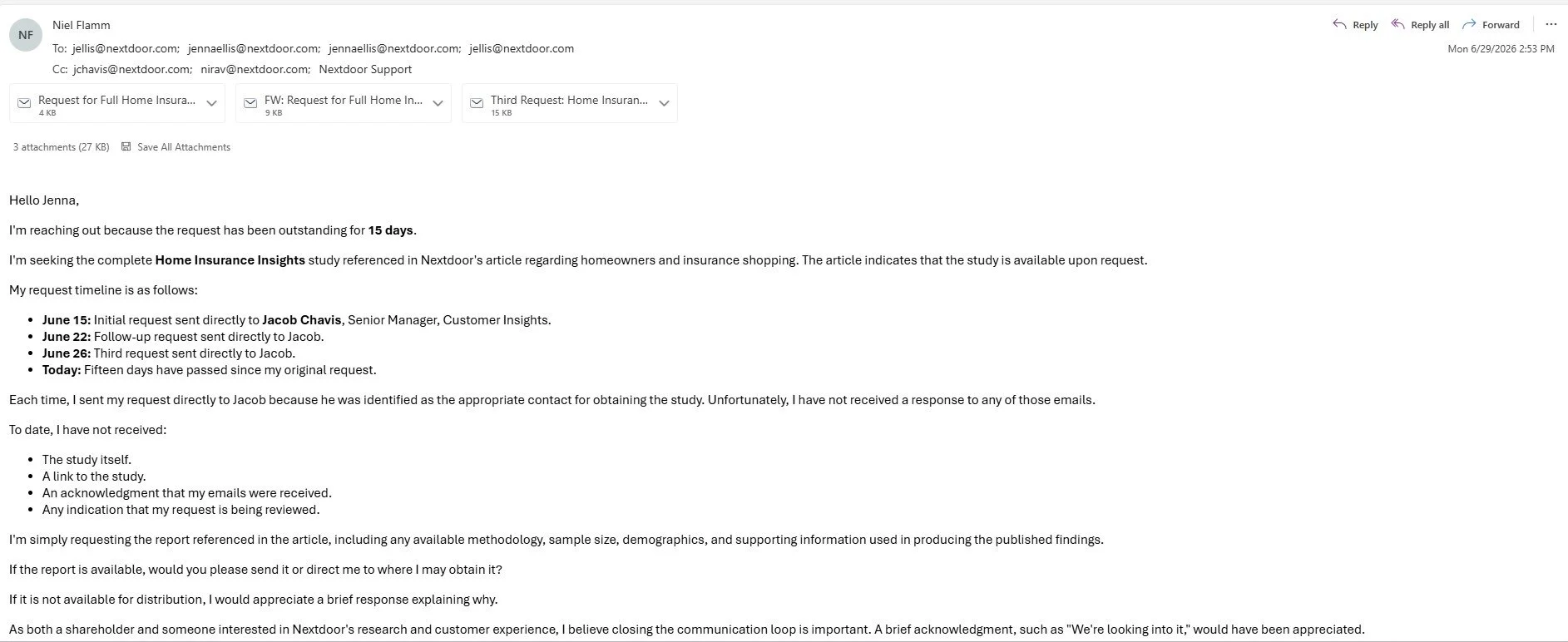
It's now been more than two weeks since I first requested the Home Insurance Insights study referenced in a Nextdoor article.
After several requests to Jacob Chavis went unacknowledged, I decided to try a different approach.
Instead of continuing up the chain, I went the opposite direction.
I identified Jenna Ellis, Customer Insights & Analytics Manager, and attempted to reach her. I couldn't find a published email address, so I tried several common corporate email formats to reach her inbox. I also copied Jacob, Nirav Tolia, and Nextdoor's support email.
At this point, I'm not looking for anything extraordinary.
I'm requesting the study that Nextdoor publicly stated was available upon request.
This whole experience reminded me of a question I've asked during performance reviews throughout my career:
How do you evaluate an employee's performance when the person responsible for reviewing that performance isn't meeting expectations themselves?
Leadership isn't just about assigning accountability.
It's also about demonstrating it.
I'd love to hear your thoughts.
Join the discussion at NielFlamm.com.