

Day 23: The Report Is No Longer the Story — The Silence Is

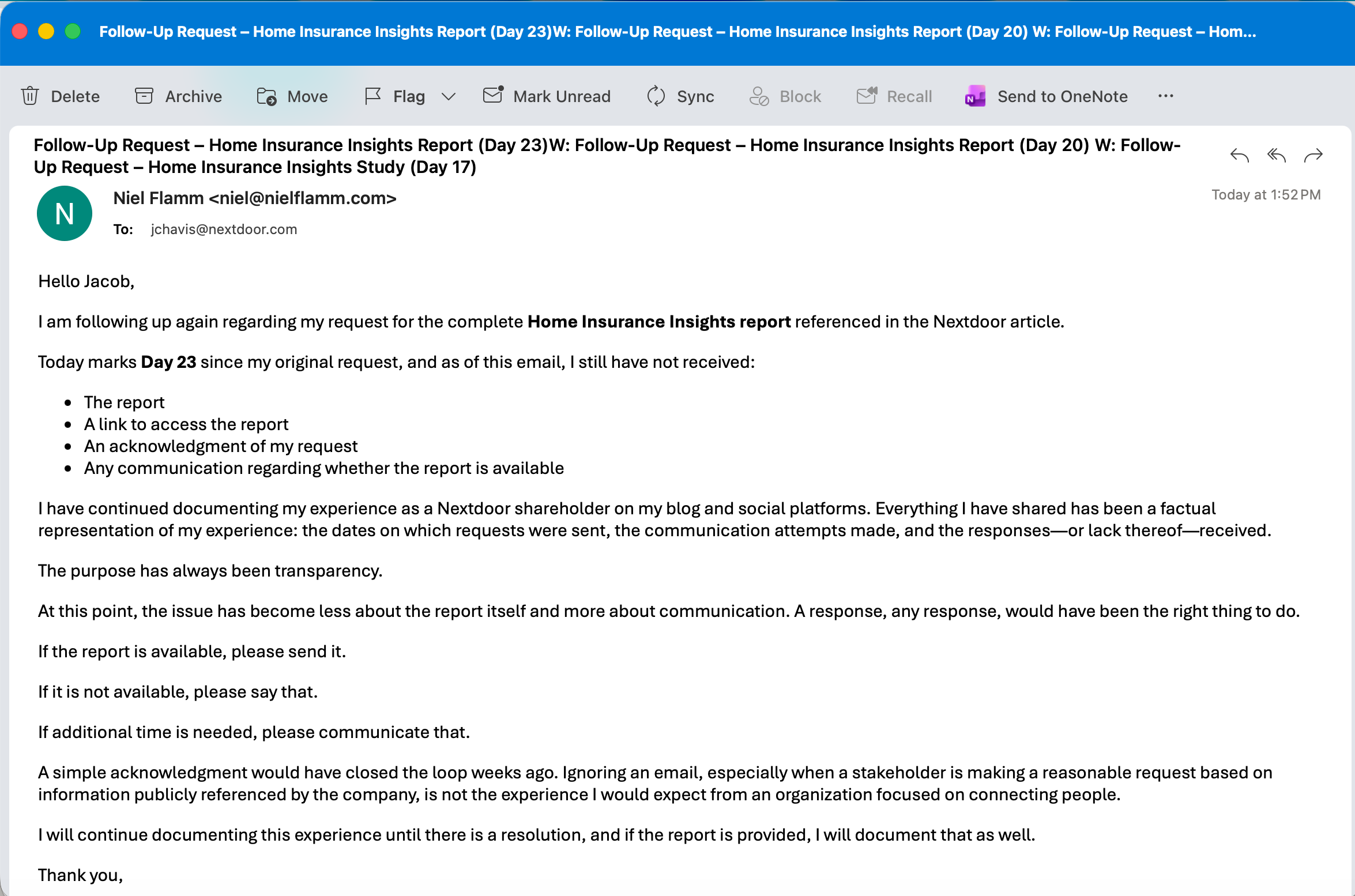
Today marks 23 days since I first requested the Home Insurance Insights report referenced in a Nextdoor article.
I sent another follow-up email today.
At this point, I still have not received:
The report
A link to the report
An acknowledgment of my request
Any communication regarding its availability
What started as a simple request for information has evolved into a larger conversation about communication, transparency, and stakeholder experience.
Throughout this process, I have documented my journey on my blog and social platforms. What I have shared is a factual timeline of my shareholder experience:
When emails were sent.
Who they were sent to.
What responses were received?
Or in this case, what responses were not received.
A response—any response—is the right thing to do.
“We’re looking into it.”
Any of those would have closed the loop.
Ignoring communication isn’t a customer experience strategy, and it raises a larger question:
If this is the experience of a shareholder asking for a report referenced publicly, what experience should users, advertisers, or partners expect when they need assistance?
Communication builds trust.
Silence creates questions.
Join the discussion on NielFlamm.com.

Nextdoor’s Identity Question: Community Platform or Data & Advertising Company?

I continue to look more deeply into Nextdoor, not only as a shareholder but also as someone trying to understand its long-term vision, strategy, and execution.
Nextdoor recently released its 2026 Back-to-School Research, which discusses today’s parents, the importance of neighborhoods, local recommendations, and how communities support each other.
On the surface, this aligns with the message CEO Nirav Tolia often shares — building connection, strengthening communities, using AI to improve the neighbor experience, and bringing people together.
I support that mission.
The challenge is that the messaging starts to feel contradictory when compared to other leadership conversations.
In a recent interview, Chief Revenue Officer Michael Kiernan discussed Nextdoor’s future revenue strategy, AI transformation, and new monetization opportunities.
He discussed how Nextdoor has over 110 million people on the platform, and how the company understands neighbors — where they live, their interests, their communities, and how they engage. He also discussed how the “neighborhood graph” could become a monetization asset.
From a business perspective, I understand this.
Nextdoor is a publicly traded company. It has shareholders. It has expenses. It needs sustainable revenue.
Advertising, partnerships, AI efficiency, and new revenue streams are expected parts of running a technology company.
But here is where I continue to ask questions:
Where does the neighbor fit into the equation?
If surveys and neighbor insights are valuable enough to promote to advertisers, partners, and the public, shouldn’t the full research methodology be transparent?
How many people participated?
How were participants selected?
What were the demographics?
What questions were asked?
What was the complete data set?
Today marks Day 22 since I requested the full research information from Jacob Chavis regarding previous Nextdoor studies.
No full study.
No methodology.
No response.
That is where trust becomes difficult.
A company cannot talk about transparency, trust, and an authentic community while also controlling which information neighbors and investors are allowed to see.
The bigger question:
Is Nextdoor a neighborhood platform that creates revenue opportunities by connecting people?
Or is Nextdoor becoming a data and advertising company powered by neighbor activity?
Those are two very different stories.
Maybe the answer is somewhere in the middle — but that requires transparency.
Neighbors deserve clarity.
Advertisers deserve clarity.
Shareholders deserve clarity.
Trust is not created through messaging.
Trust is created through actions.
Join the discussion on NielFlamm.com.
I don't like saunas
This early in the morning with 91% humidity and a 79 degree dew point.
Welcome to the Low Country.

🎬 The Devil Wears Prada 2 Review Is Up — Fashion, Drama & More Internet Garbage

The fashion world is back, and so am I with another completely necessary contribution to the endless world of internet scrolling.
I watched The Devil Wears Prada 2 and shared my thoughts on where the story goes, the characters returning after all these years, and whether stepping back into the world of Runway was worth it.
Was it fabulous? Was it a fashion disaster? Or somewhere in between?
You’ll have to watch and find out.
Head over to https://NielFlamm.com/videos to watch the full review, along with other movie reviews and random internet garbage.
Join the discussion — agree, disagree, or tell me what I should watch next.
If the Ads Are There, Where Are the Profits?
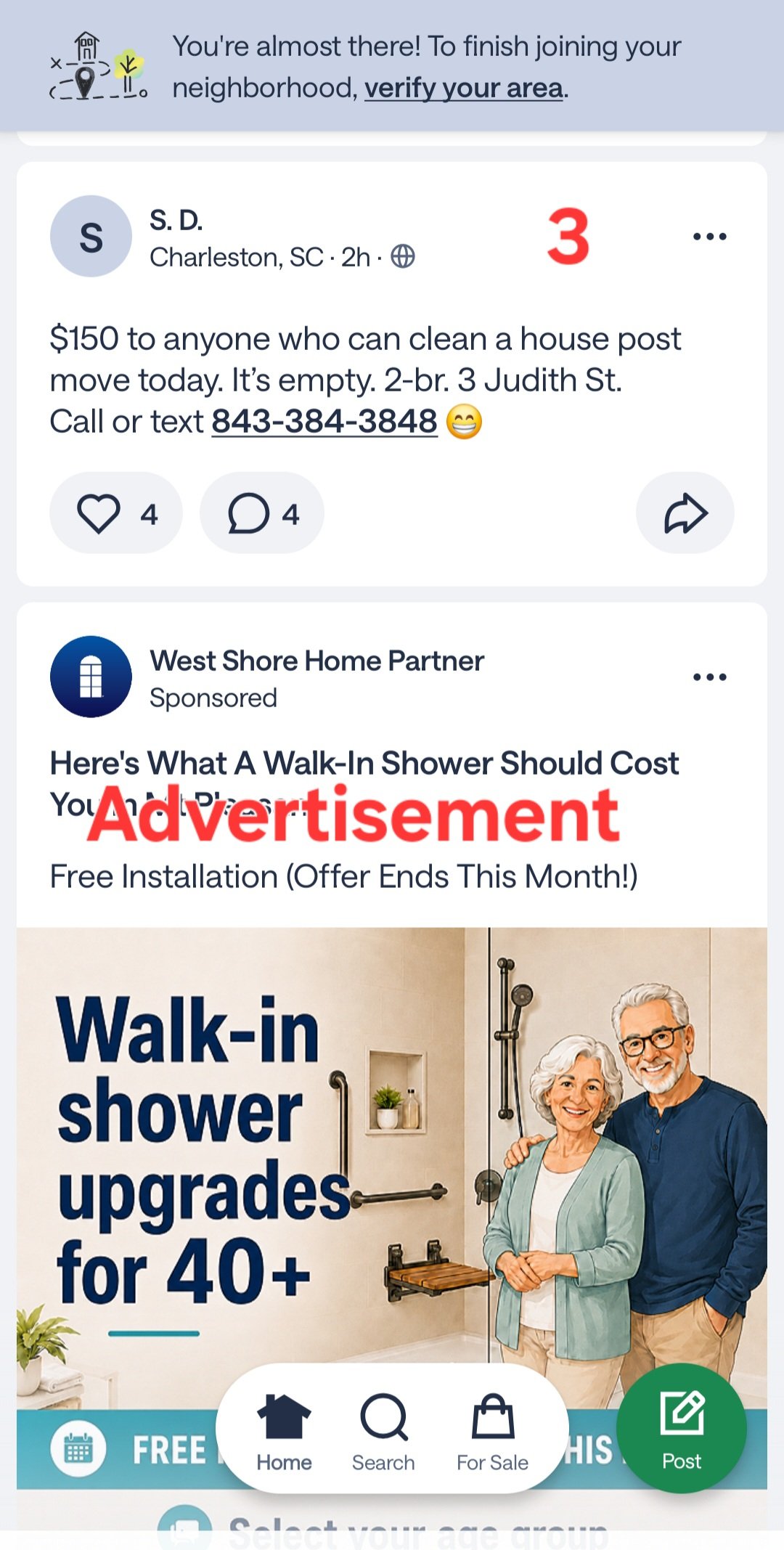
My Nextdoor experiment continues.
This time I wanted to look at something simple:
How quickly does a user see a paid advertisement?
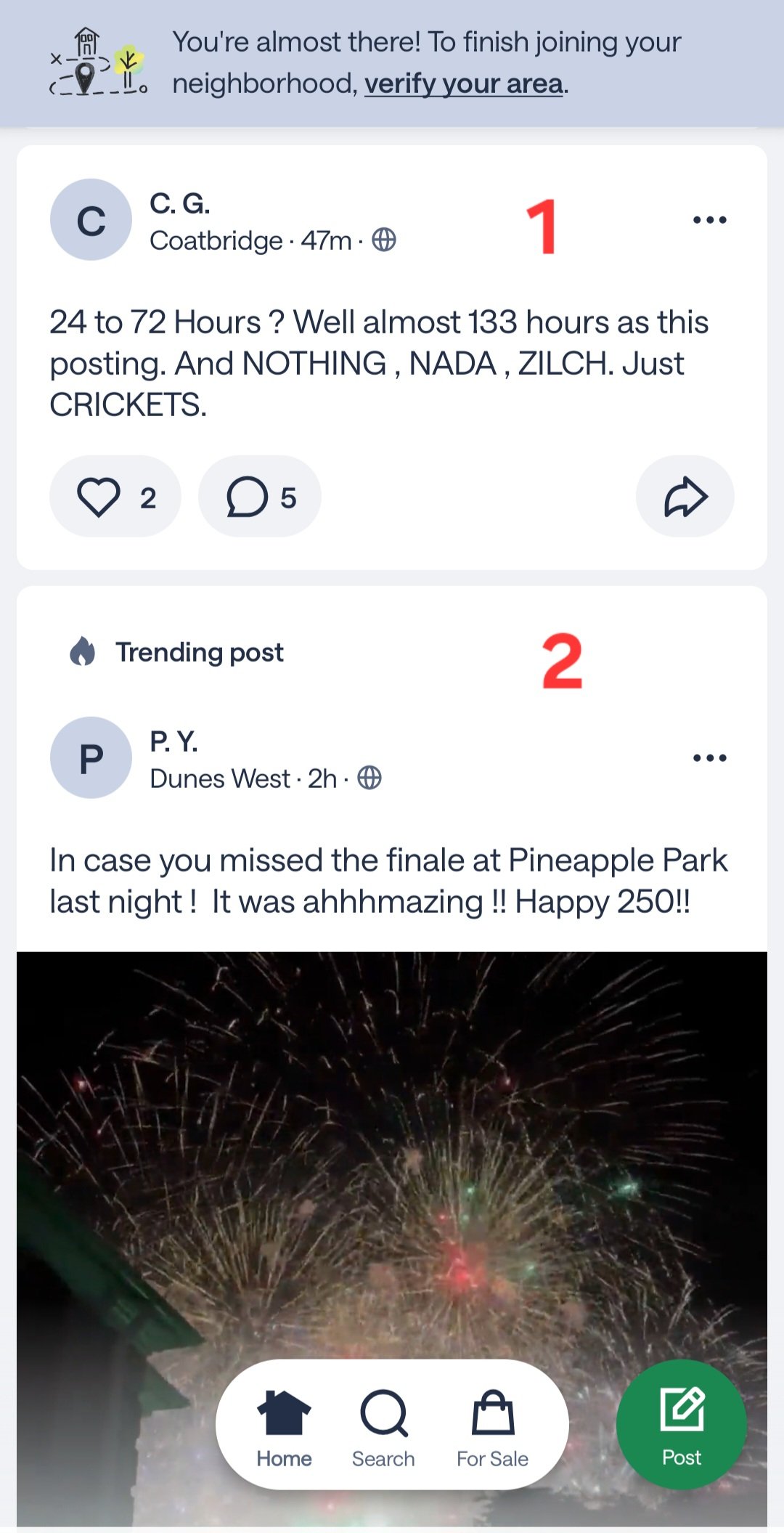
While scrolling through the app, I counted.
That’s it.
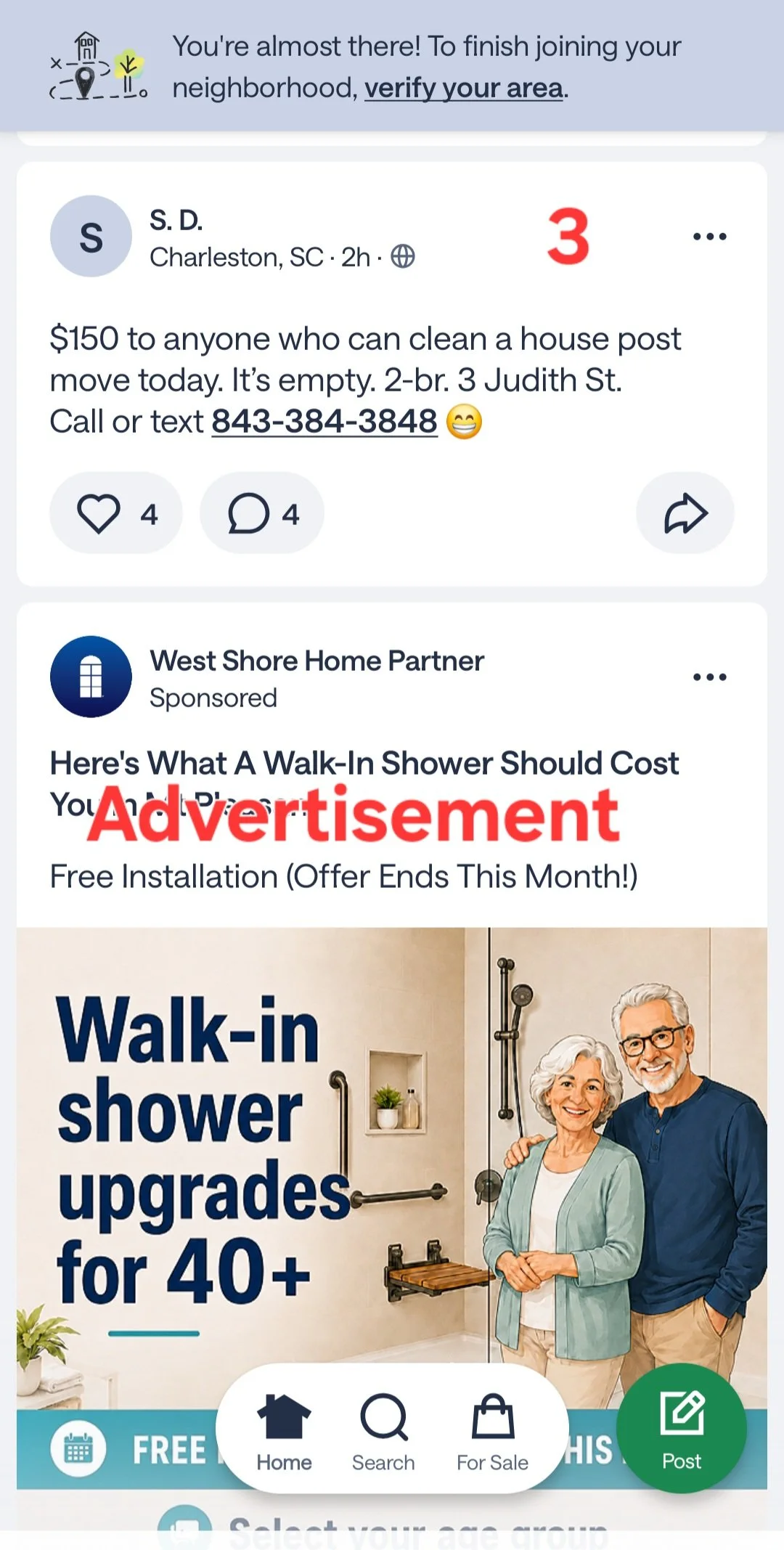
After only three neighbor posts, I was served a nationally sponsored advertisement. Not a local small business promoting a neighborhood service—a national advertiser.
So I kept testing.
More scrolling.
Same result.
Approximately three posts, then another sponsored placement.
That got me thinking about the bigger business question.
Nextdoor highlights statistics such as over 100 million neighbors, tens of millions of active users, and significant household reach.
With that kind of audience, and advertisements appearing that frequently in the user experience, I keep coming back to the same question as a shareholder:
How is Nextdoor still struggling to reach sustained profitability?
Where is the revenue going?
A social platform can always increase ad load—but is moving toward more ads really the answer for users?
A 1:1 ratio of posts to advertisements?
Fantastic user experience.
(Yes, that’s sarcasm.)
The challenge, in my opinion, isn’t simply adding more advertisements.
It’s leadership, execution, capital allocation, and turning engagement into a sustainable business model.
At the end of the day, the CEO is responsible for results.
Nirav Tolia owns the strategy, and shareholders should evaluate the outcome.
The question isn’t whether Nextdoor has an audience.
The question is whether the current leadership approach is converting that audience into long-term value.
Join the discussion at NielFlamm.com.