
The Hinge Experiment: Gina Has Been Unmatched, and I’m Perfectly Fine With That
Another one bites the dust.
It's time for another update from The Hinge Experiment™, and today's roster move is official:
I unmatched Gina.
No dramatic confrontation.
No angry final message.
No lengthy explanation.
No sad music playing while I stared thoughtfully out a rain-covered window.
I hit Unmatch.
Because at some point, you have to ask yourself:
Why am I keeping this chat open?
There Was Nowhere Left to Go
Gina and I matched before “Missing Me,” so she'd actually been hanging around The Hinge Experiment for a while.
There were messages.
There were pauses.
There were more messages.
There were significantly more pauses.
I tried asking questions.
I asked about her day.
I asked about her meeting.
I asked whether she was available.
Finally, I went with the incredibly complicated, deeply philosophical question:
“What's your number?”
And...
Nothing.
Could she still have responded eventually?
Sure.
Tomorrow?
Maybe.
Next week?
Possibly.
November?
Who knows?
Perhaps in 2032 I'll receive a carrier pigeon carrying her phone number.
But I'm not waiting.
An Open Chat Isn't a Relationship
This is something I'm starting to realize during this whole experiment.
There's no prize for accumulating matches.
I'm not collecting Pokémon.
A match sitting in my inbox isn't evidence that my dating life is thriving.
If we're not talking, we're not getting to know each other.
If we're not getting to know each other, we probably won’t meet.
And if we're never going to meet, what's the point of leaving the conversation sitting there?
Unmatch.
Next.
Not out of anger.
Not because I think she owes me anything.
She doesn't.
It's simply recognizing when something isn't going anywhere.
Here's the Bigger Thing: I'm Not Desperate
I think this distinction matters.
I'm not desperate to find someone.
Would I like to find someone?
Absolutely.
It would be nice.
I want someone to go to dinner with.
Someone to see a movie with.
Someone to take a completely unnecessary road trip with.
Someone to laugh with.
Someone who can carry half a conversation without me feeling like I'm conducting a deposition.
Someone who occasionally asks me a question.
Crazy standards, apparently.
But there's a big difference between:
“I'd like someone in my life.”
and
“I need someone in my life.”
I don't need to force something simply because I don't want to be alone.
I don't need to keep dead conversations alive just because they're technically matches.
And I certainly don't need to convince someone to be interested in me.
If someone wants to talk to me?
Great.
If someone wants to meet me?
Even better.
If someone isn't interested?
That's okay too.
I'm Looking for Mutual Effort
Maybe that's what The Hinge Experiment has actually taught me so far.
I'm not looking for perfection.
I'm not looking for someone who immediately reorganizes her entire life because we matched Tuesday afternoon.
I'm looking for reciprocity.
I'll ask questions.
Ask me some.
I'll make an effort.
Make one too.
I'll suggest meeting.
If you're interested, help me make that happen.
Scheduling coffee shouldn't require a project manager, three status meetings, and a Gantt chart.
And if I'm doing all the work to keep a basic conversation alive?
That's probably not the conversation I'm looking for.
The Hinge Roster Is Getting Awfully Small
Let's check the historical standings.
Kelli: Unmatched.
Missing Me: Unmatched.
Gina: Unmatched.
New matches: Well...
About that.
The Hinge offices aren't exactly overwhelmed processing my incoming requests.
But that's okay.
I'd rather have zero matches than stare at three conversations that aren't going anywhere and pretend something is happening.
I'm still on Hinge.
I'm still open to meeting someone.
I'm still hopeful that eventually I'll match with someone where the conversation doesn't feel like I'm trying to start a lawn mower that's been sitting in a garage since 1987.
Pull.
Nothing.
Pull again.
Nothing.
Prime it.
Pull.
GOOD MORNING!
And then silence.
Would It Be Nice?
Yes.
That's really where I am.
Would it be nice to find someone?
Absolutely.
Someone funny.
Someone smart.
Someone interesting.
Someone who wants companionship but already has a life of her own.
Someone who actually wants to meet instead of becoming my longtime digital pen pal.
But I'm not racing against a clock.
I'm not trying to fill a vacancy.
I'm not going to turn every match into something it isn't because I desperately need The Hinge Experiment to have a happy ending.
If it happens, it happens.
Until then, I have a life to live.
And apparently...
an increasingly unemployed imaginary iguana named Steve. 🦎
Although given the current match statistics, Steve probably shouldn't make any long-term plans.
The Hinge Experiment continues.
The roster is currently accepting applications.

The Last House: Now I Understand Why It’s on Netflix
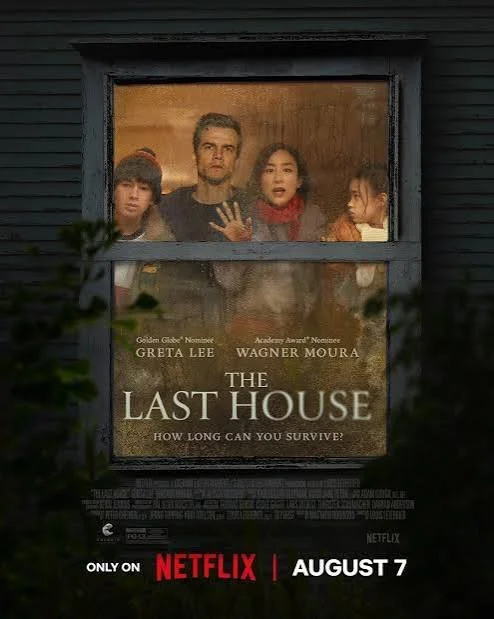
I was so tired Wednesday night that I couldn't sleep.
Apparently, the solution was The Last House.
A family near Seattle gets trapped inside during a storm because the rain contains some mysterious goo. At first, I was hooked. Rain, thunderstorms, and sci-fi weirdness—I actually thought it was a shame this wasn't playing on a giant theater screen with booming sound.
Then I reached the halfway point.
Oh. Now I understand why it's on Netflix.
Imagine The Martian, Waterworld, Pirates of the Caribbean, MacGyver, and Predator getting thrown into a blender. Once the movie starts explaining what's happening, things get... complicated.
Is The Last House worth streaming?
Maybe if it's raining and you're trapped inside too.
🎬 Watch my full movie review at NielFlamm.com/videos/moviereviews

Three Months, One Leadership Role, and No Update: What Does Hiring Silence Say?
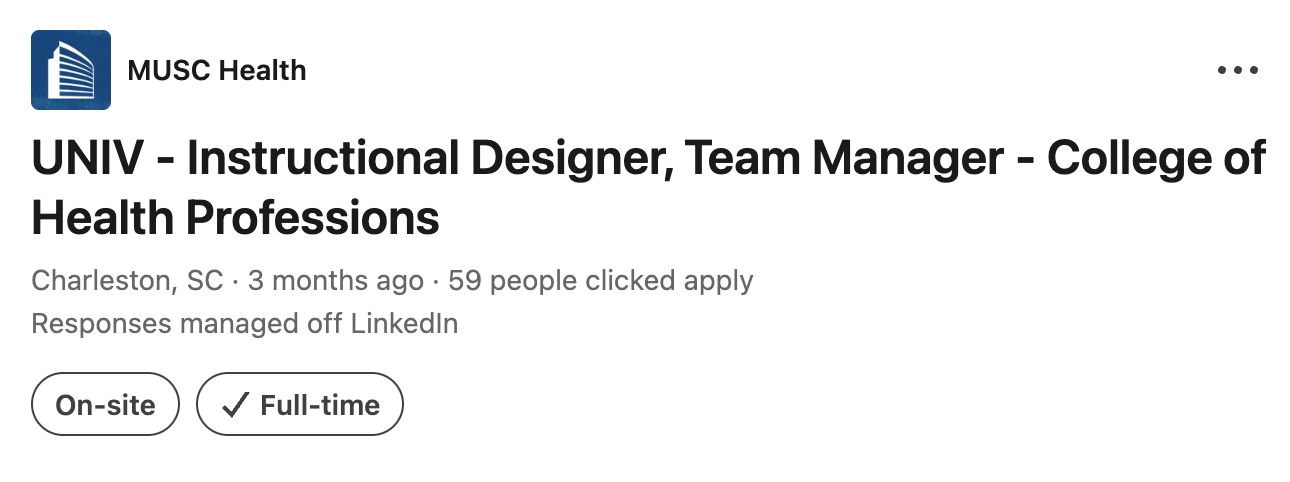
Three months after a leadership position is posted, what should applicants—and the team waiting for that leader—expect? I applied for MUSC Health’s Instructional Designer, Team Manager position in the College of Health Professions and have not received an update, a rejection letter, or any indication of where my application stands. T
he attached listing shows that the position was posted three months ago. That does not establish whether the search remains active, an offer is pending, or the posting simply has not been updated. Still, the absence of communication leaves me wondering: Has this role been filled, and if not, what is delaying the decision?
If the position remains unfilled, has no candidate met the requirements in three months? Are the expectations aligned with the compensation, on-site requirements, and available talent? Could budget approval be delaying a hire while the posting remains visible? Perhaps the responsibilities are being revised, a search committee is navigating competing priorities, or a finalist declined an offer. An internal candidate could be under consideration, or an organizational change could have paused the process.
These are hypothetical explanations, not claims about MUSC Health. Without an update, applicants cannot know whether a search is progressing, paused, or already complete.
The team’s experience also matters. If this leadership seat has been vacant for three months, how is the team being supported? An interim leader may be providing excellent coverage, but is that person carrying another full-time workload? Who is setting priorities, supporting professional development, resolving competing requests, and making decisions about instructional quality?
A vacant position does not necessarily mean an absence of leadership, but prolonged coverage arrangements raise reasonable questions about workload, continuity, and whether employees have the support they need.
I recognize that hiring takes time, particularly in complex institutions, and submitting an application does not guarantee an interview or an offer. Still, timely communication is a reasonable professional expectation. A brief update that a search is ongoing, delayed, closed, or being reconsidered would demonstrate respect for candidates’ time. How can organizations make their hiring communication reflect the professionalism they expect from applicants?
I welcome perspectives from candidates, hiring managers, and teams navigating extended searches. For more of my thoughts on leadership, hiring, and the workplace, follow along at https://NielFlamm.com/blog.

Recovery Update: The Scabs Are Leaving, the Scar Is Staying
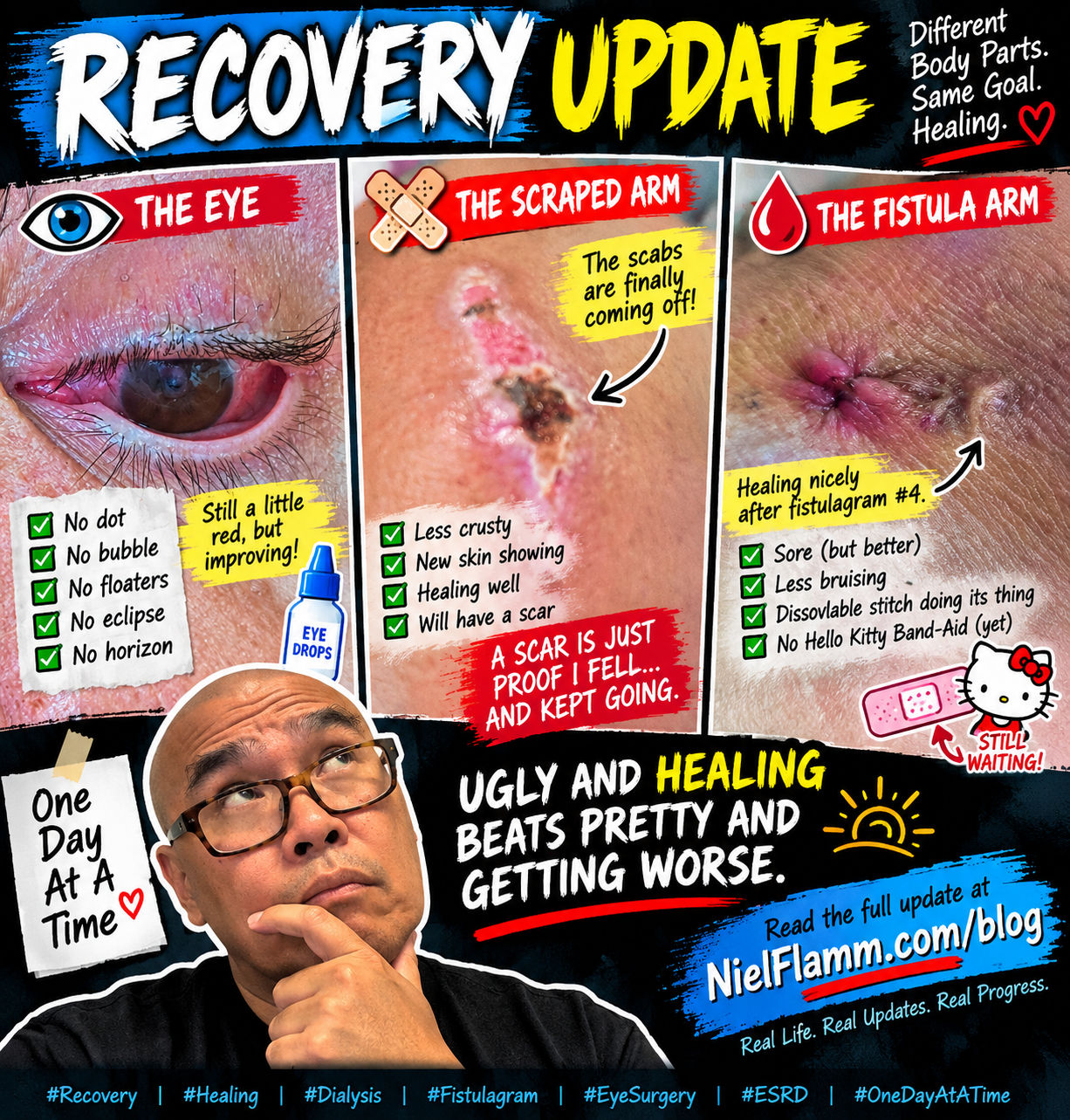
Healing apparently has stages.
First, everything looks terrible.
Then it somehow looks even worse.
Then one day I look at it and realize, “Wait… that actually looks a lot better.”
That’s where I seem to be today.
👁️ The Eye: Boring Is Still Beautiful
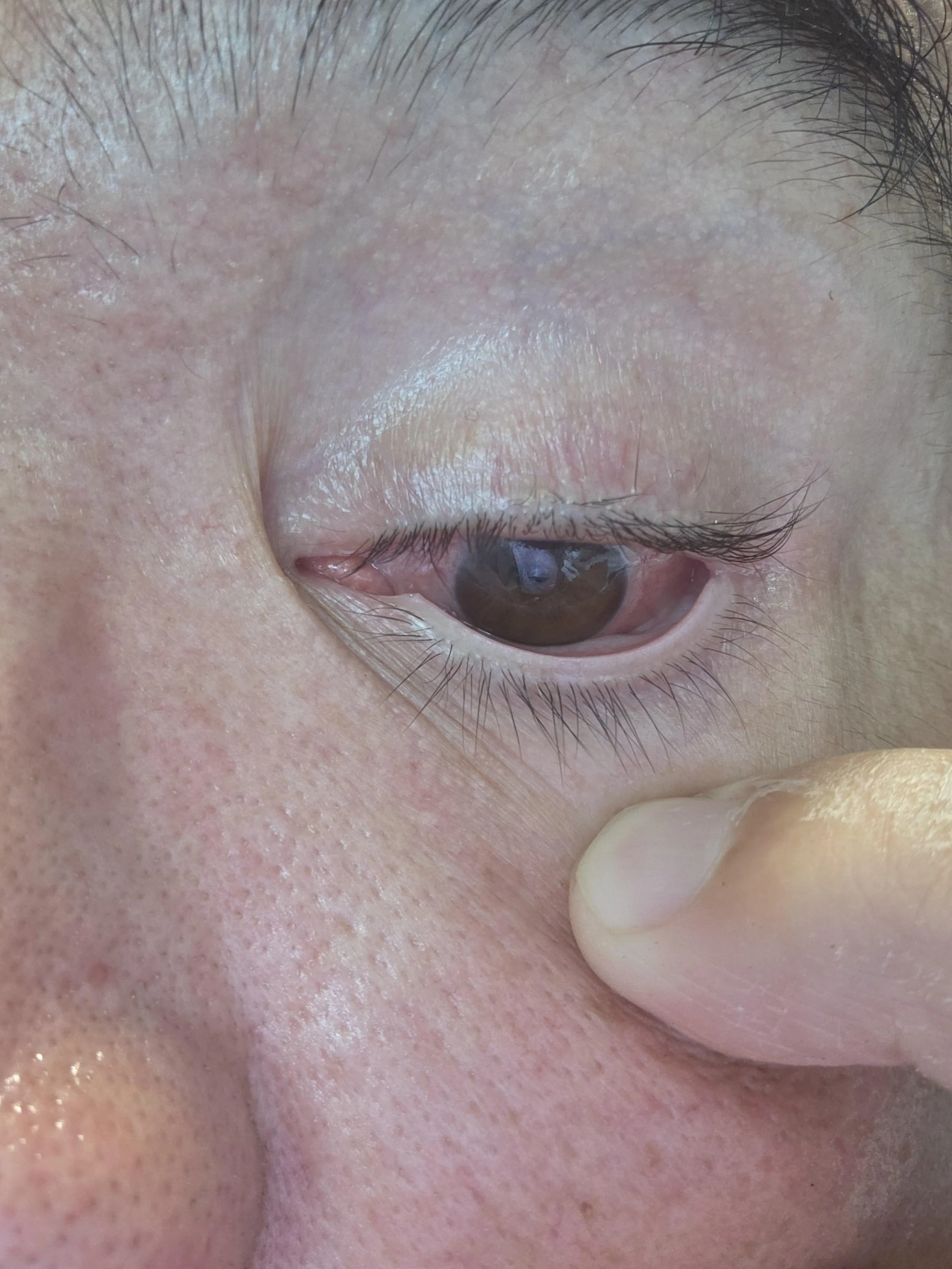
My eye continues to look better. There’s still some redness, but compared with where this adventure started after the silicone oil removal, I'll take it.
More importantly, the visual effects are still gone.
No dot. No bubble. No floaters. No horizon. No eclipse.
I never thought I’d be this excited about seeing absolutely nothing unusual.
I'm continuing the drops and watching the eye, but boredom remains my favorite development.
💪 The Scraped Arm: Crust City Is Being Demolished
Now for the arm.
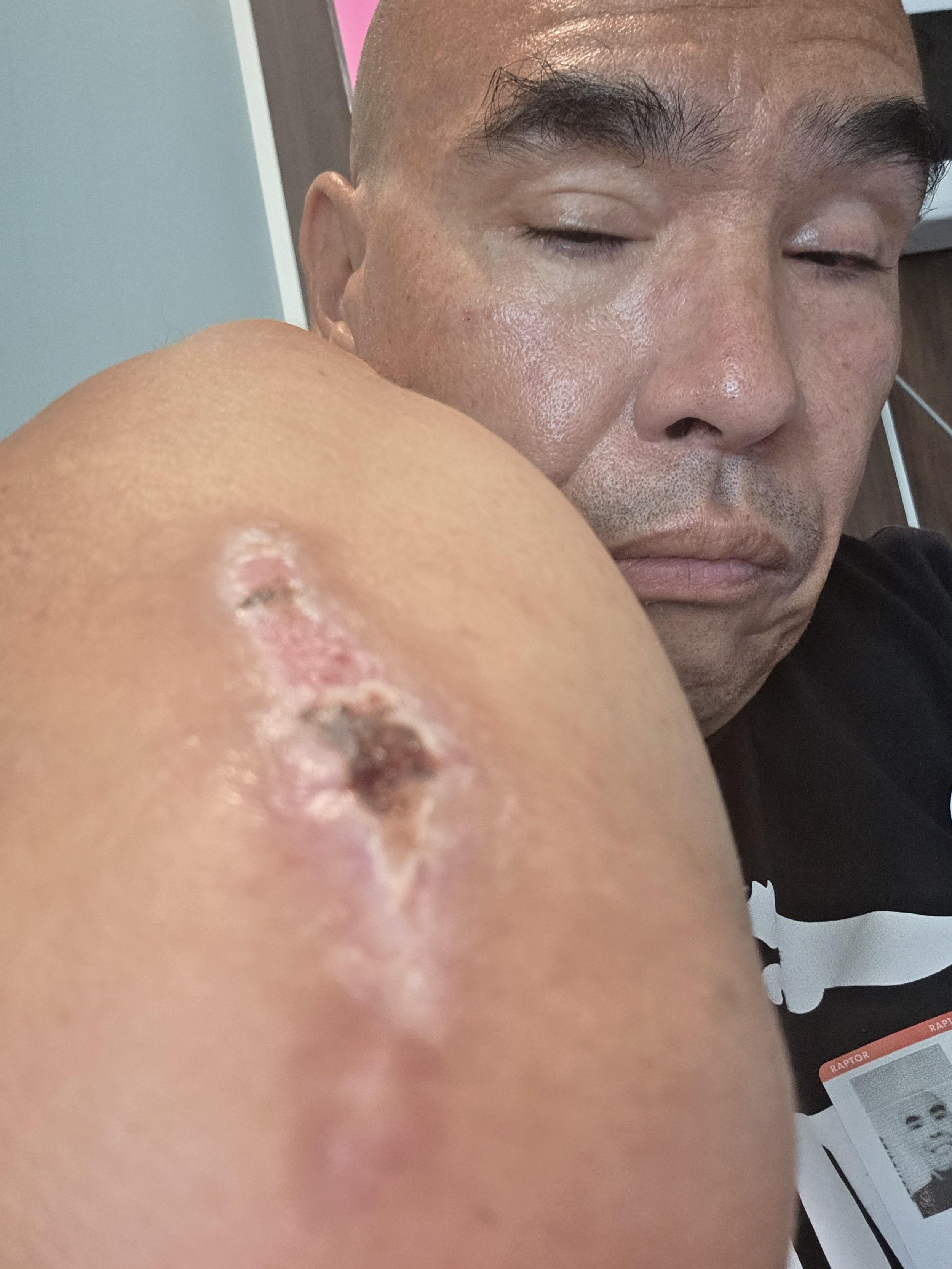
Look at the difference.
Most of that giant, nasty scab that has been starring in these updates is finally gone. What’s underneath is pink, fresh-looking skin with one stubborn darker area hanging around.
And I think we can officially call this one:
I'm going to have a scar.
Considering what this thing looked like immediately after the fall—and then during its glorious Crust City phase—a scar seems like a pretty reasonable souvenir.
I suppose I could make up an impressive story about how I got it.
Shark attack?
Bar fight in Singapore?
Saving a family from a burning building?
Nope.
I fell.
Sometimes reality just doesn't cooperate with the legend.
🩸 The Fistula Arm: Where Did the Stitch Go?
Meanwhile, the fistulagram site keeps healing, too.
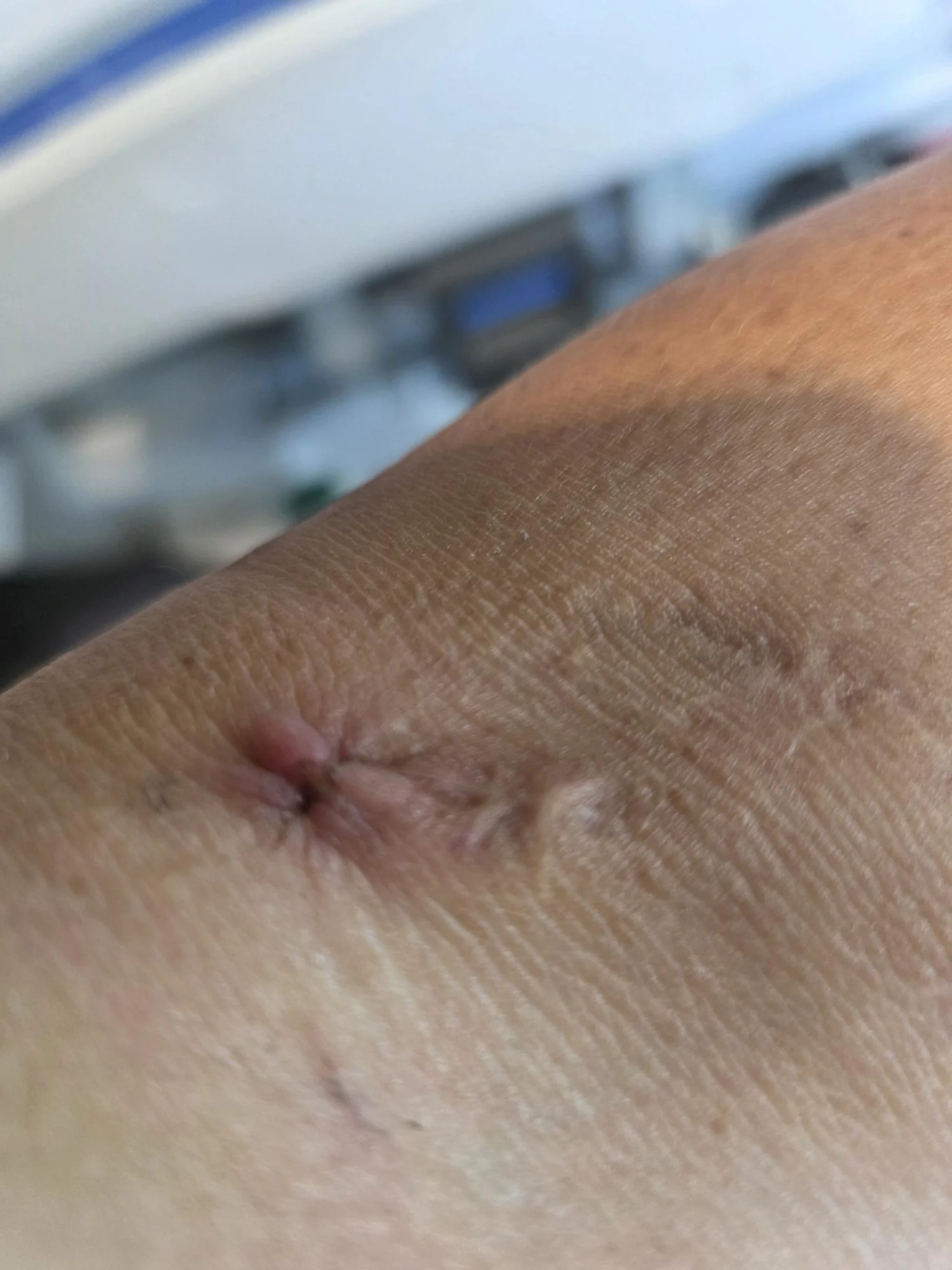
The dissolvable stitch appears to be doing exactly what the name advertised. The area is still visible and there’s some discoloration, but it looks considerably less dramatic.
Still waiting on that Hello Kitty Band-Aid upgrade. 🎀
I haven't forgotten.
Three Different Parts. Same Direction.
So today's recovery report is considerably less disgusting than some of the previous editions:
Eye: less red, no dots or floaters.
Scraped arm: most of the scab is gone, new skin is showing—and yes, there will be a scar.
Fistula arm: healing nicely after fistulagram #4.
The scar on my arm will probably stick around long after I've stopped writing these daily updates.
That's okay.
Scars are just receipts proving my body paid the bill and kept going.
And this particular receipt comes with a very simple description:
Fell down. Got back up.

Apparently, the Scammers Have Stopped Writing Emails
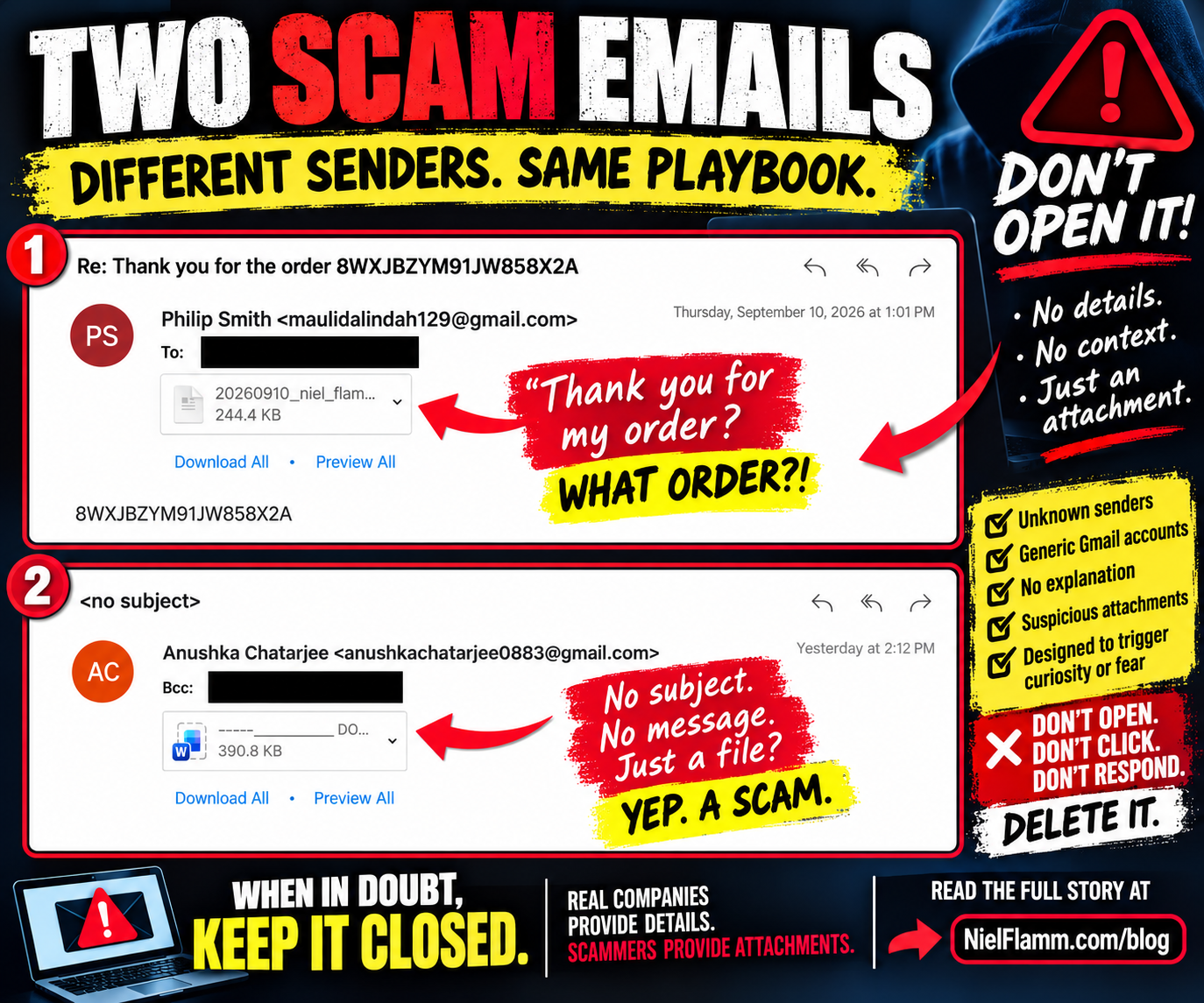
I've written quite a bit lately about scam emails, suspicious recruiters, mystery attachments, and people desperately trying to convince me to click something.
Apparently, we've now reached the minimalist phase of scamming.
Why bother writing an elaborate fake invoice when you can simply send me an attachment and hope I do the rest?
Over the past few days, I received two more emails that follow essentially the same strategy: almost no information, a mystery attachment, and curiosity as the bait.
🚩 Scam Email #1: Thank You for the Order!
The first one came from someone identifying himself as Philip Smith, using a Gmail address.
The subject:
“Re: Thank you for the order 8WXJBZYM91JW858X2A”
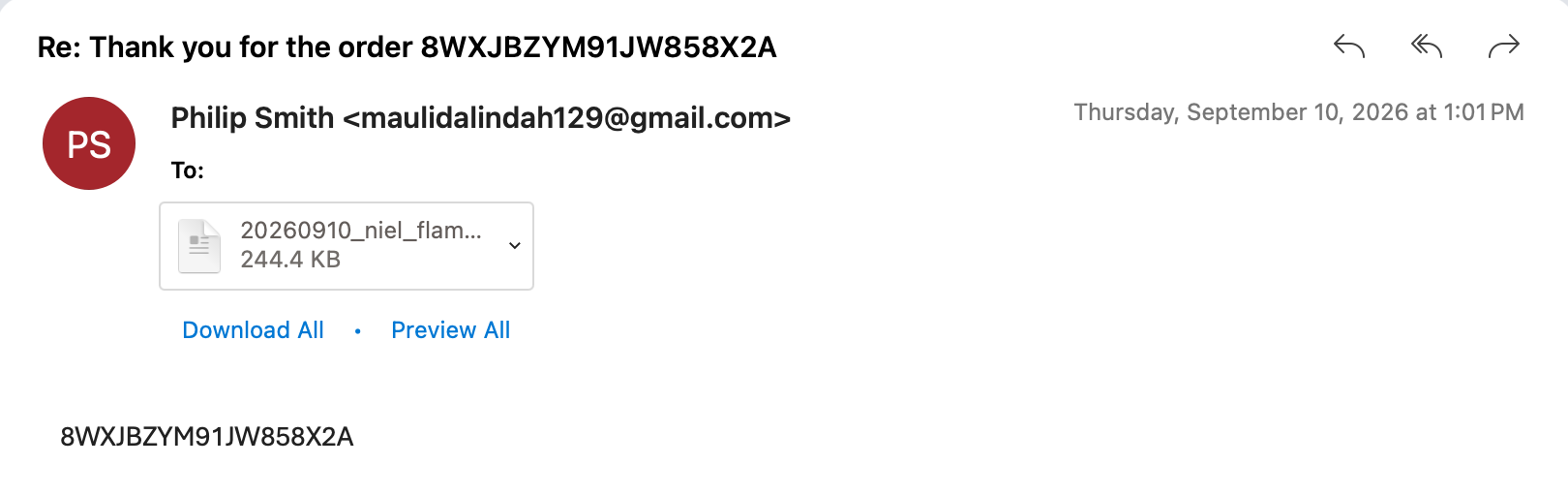
Oh!
Thank you for my order!
There's just one tiny problem.
What order?
There's no company name.
No product.
No price.
No shipping information.
No recognizable merchant.
The body of the email contains essentially nothing except the same mysterious string:
8WXJBZYM91JW858X2A
And then there's an attachment.
A 244.4 KB file with a filename beginning with a date and my name.
That's a nice touch.
Putting someone's name in a filename can make the attachment feel personalized and legitimate.
But I'm supposed to believe I placed an order somewhere, received no explanation of what I purchased, and now need to open an unexplained attachment to discover what happened?
No thanks.
🚩 Scam Email #2: They Didn't Even Bother With a Subject
Then another masterpiece arrived.
Sender:
Anushka Chatarjee
Another Gmail account.
Subject:
<no subject>
The message was sent using BCC, suggesting I may simply be one of multiple recipients who received the same message.
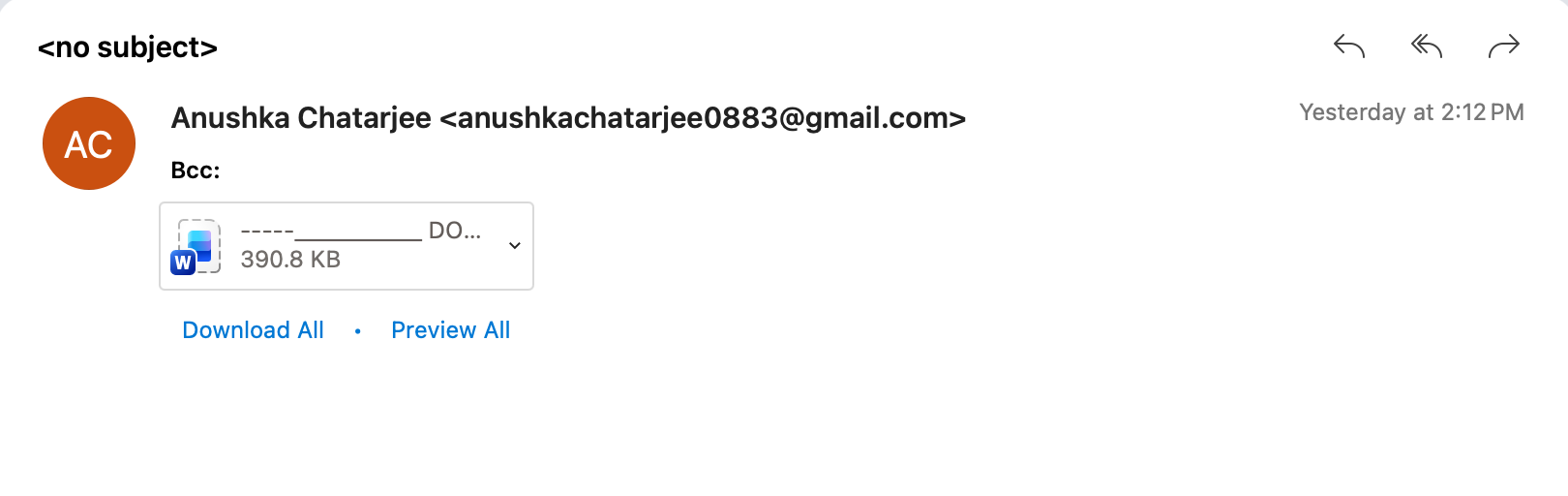
And what's in the email?
Nothing useful.
But, naturally, there's a 390.8 KB Microsoft Word attachment.
So now the pitch has been reduced to:
Hi.
Actually, they didn't even say hi.
It's basically:
Here's a Word document. Open it.
That's the entire sales presentation.
The Attachment IS the Email
This is what people need to understand about messages like these.
The lack of information isn't necessarily a failure.
Curiosity can be the social-engineering technique.
The first email wants me wondering:
Did I accidentally order something?
Was my credit card compromised?
How much did they charge me?
What did I supposedly buy?
And where should I look for the answer?
Inside the attachment.
The second email is even more direct.
There's no story at all. Just a mysterious Word document.
The scammer doesn't necessarily need me to believe anything yet.
They just need me to open the file.
Why I Don't Open Them
I don't know what's inside either attachment because I didn't open them.
That's important.
I'm not going to claim these particular files contain malware, malicious links or credential-stealing software when I haven't analyzed them.
I also don't need to.
An unexpected attachment from an unknown Gmail account with no legitimate explanation for why I'm receiving it has already failed my trust test.
The safest question isn't:
“I wonder what's inside?”
It's:
“Why would I open this?”
And in both cases, I can't come up with a good answer.
The Fake Order Trick Is Particularly Clever
The fake-order approach adds another psychological ingredient:
Fear.
Imagine someone receives the first email and thinks:
I didn't order anything!
That's exactly when rational thinking can get replaced by urgency.
They want to find out whether someone used their credit card.
They want to know how much money was charged.
They want to cancel the transaction.
So they open the attachment.
That's why, if you receive a suspicious purchase confirmation, don't use the mystery attachment to investigate it.
Check your credit card or bank account independently.
Log into Amazon, Walmart, PayPal or whatever company supposedly processed the purchase by going directly to the service yourself—not through links or attachments supplied in the suspicious message.
If there's no transaction, there's nothing to cancel.
From “Pharmacy Office” to This
Just days ago, I received another email with the subject “Pharmacy Office.”
That one also contained mystery attachments with practically no explanation.
Now I've received a mysterious order confirmation and a completely blank email carrying a Word document.
There seems to be a theme developing:
The scammers want me to supply the curiosity.
Sorry.
I'm fresh out.
My New Attachment Policy Is Pretty Simple
Unknown sender?
Unexpected attachment?
No explanation?
Generic Gmail account?
Fake urgency?
Mystery purchase?
I'm not opening it.
If someone legitimately needs me to review a document, they can identify themselves, explain what they're sending, and give me a reason to expect it.
Until then, your mysterious 390.8 KB Word document can remain a mystery forever.
Sometimes the safest click is the one you never make.
Follow along at NielFlamm.com/blog for more scams, suspicious emails, questionable recruiters and the increasingly creative ways strangers on the internet try to get me to click things.