

Apparently My $498.99 PayPal Subscription Is Now a Facebook Event
The scammers are getting creative.
Today I received an email with this wonderfully alarming subject line:
“Agnes V. Burden invited you to Notice: Your Subscription Payment of $498.99 was Paid.”
Wait.
I bought a subscription?
For $498.99?
And Agnes is throwing an event to tell me about it?
I appreciate the invitation, Agnes, but I think I'm busy that day.
🚩 The First Red Flag Is Actually a Giant Warning
This one gets interesting because the email appears to be generated through Facebook's event system rather than simply pretending to be a normal PayPal notification.
And Facebook practically puts a warning label on it for us:
“This event invitation was not sent by Meta. Please be cautious when clicking on links or providing personal information.”
That's not exactly subtle.
The apparent sender address is notification@facebookmail.com, which could make someone think, Well, it came through Facebook, so it must be legitimate.
But that's the trick.
The screenshot indicates that Agnes V. Burden created the event. The event itself appears to carry the scam message.
That's an important distinction: a legitimate platform can be used to deliver content created by someone else.
🎉 You're Invited! Your Money Is Gone!
The event title reads:
“Notice: Your Subscription Payment of $498.99 was Paid.”
Then we get the usual Facebook invitation:
Going | Maybe | Can't Go
I'm struggling to choose the right RSVP.
Going: Yes, I definitely want to attend the disappearance of $498.99.
Maybe: Depends. Will there be food?
Can't Go: Sorry, I have another fraudulent transaction at 1:00.
But then we get to the actual event description:
“Bill has paid $498.99 for a subscription using your Pay_Pal account from an unknown seller IP.”
There are so many questions.
Who is Bill?
Why is Bill spending my money?
Why is PayPal suddenly “Pay_Pal”?
And what exactly is an “unknown seller IP” supposed to mean?
But don't worry.
They've conveniently provided a phone number.
🚩 And THAT Is the Point
The message says that if I don't recognize the seller, I should call the number shown in the invitation.
There's the hook.
The $498.99 isn't necessarily the objective.
The objective may be to make me panic about the $498.99 and call the number.
The FTC specifically warns about this type of subscription-renewal scam. Victims receive notices claiming they've been charged hundreds of dollars for a subscription and are instructed to call a number to dispute it. Once they call, scammers may try to get financial information, persuade the victim to grant remote computer access, or create a fake “refund” problem that ultimately leads the victim to send money. Consumer Advice
In other words:
The fake charge creates the panic.
The phone number gives the scammer a path in.
🚩 This Facebook-Event Version Isn't Unique
Here's what really caught my attention.
I found a strikingly similar report in the Better Business Bureau's Scam Tracker from July 2026.
That report described a Facebook/Meta event invitation claiming a $749.49 MetaPay payment, complete with the same warning that the event invitation wasn't sent by Meta. The event then instructed the recipient to call a phone number if the payment was unauthorized. BBB categorized that report as phishing. Better Business Bureau
Different amount.
Different supposed transaction.
Different phone number.
Very similar playbook.
That's a useful reminder that scammers don't always need to spoof an entire company's email system. Sometimes they can abuse legitimate features—event invitations, calendar invites, shared documents, comments or other notifications—to get their message delivered.
💰 So What Should I Do About My $498.99?
First, I'm not calling the number in the invitation.
I'm also not clicking anything in the event to “resolve” the supposed charge.
If I were genuinely concerned that $498.99 had been charged through PayPal, I'd independently open the real PayPal app or website and inspect my transactions.
I'd also check the bank or credit-card account connected to it.
The FTC recommends that same approach for suspicious subscription notices: check your actual financial accounts, and if you need to contact the company, use contact information you know is legitimate—not the phone number supplied in the suspicious message. Consumer Advice
If the $498.99 transaction isn't there?
Then there's nothing to refund.
And there's certainly no reason to call Agnes.
🧠 The Psychology Is Better Than the Grammar
What makes this scam potentially effective isn't perfect spelling or a sophisticated story.
It's the number:
$498.99
That's large enough to make someone panic.
You don't stop to analyze “Pay_Pal.”
You don't wonder why a financial transaction has become a Facebook event.
You don't ask who Bill is.
You see:
YOU JUST LOST $498.99.
Then:
CALL THIS NUMBER.
That's social engineering.
The scammer doesn't need you to believe the entire story.
They just need you to become concerned enough to take the next action.
🏡 Be a Good Neighbor
I've said this before, and I'll keep saying it.
If you see something like this, don't be passive.
Tell your parents.
Tell your grandparents.
Tell your friends.
Tell the neighbor who isn't particularly comfortable with technology.
Share screenshots.
Report suspicious messages.
The FTC even recommends talking to someone you trust—a friend, family member, or neighbor—when you're unsure whether something is a scam. That second set of eyes can interrupt the panic that these schemes depend upon. Consumer Advice
You might recognize it as suspicious right away.
Someone else may see $498.99 and think their money is disappearing.
Sometimes being a good neighbor is simply saying:
“Don't call that number. Let's check your actual account first.”
Agnes, I'm Going to Have to Decline
So, Agnes V. Burden, thank you for inviting me to the celebration of my imaginary $498.99 subscription.
Unfortunately:
Going? No.
Maybe? No.
Can't Go? Absolutely.
And I'm definitely not calling your phone number.
Follow along at NielFlamm.com/blog for more scam emails, questionable TikTok car deals, suspicious recruiters, and whatever creative nonsense lands in my inbox next.

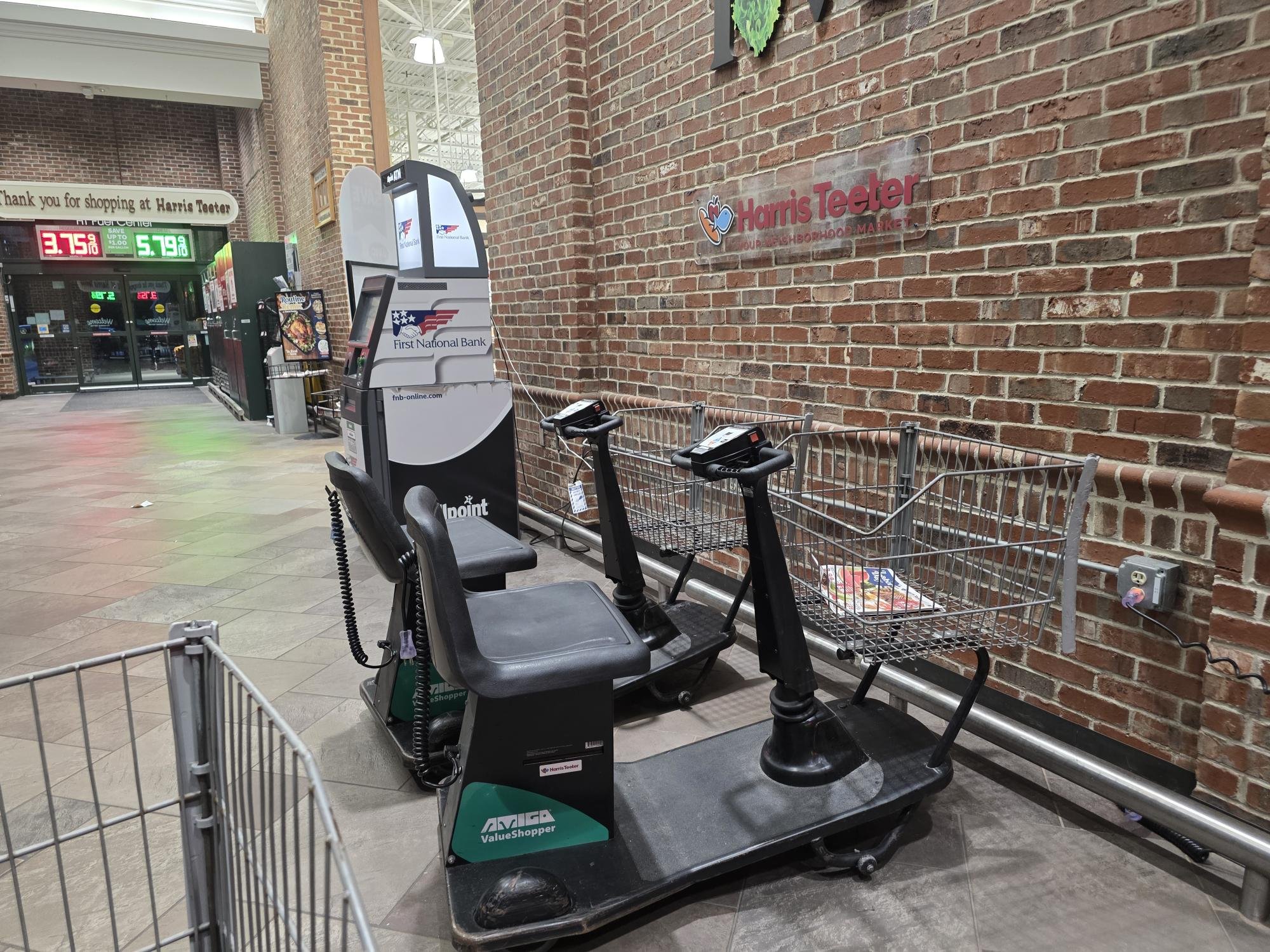
What is wrong with this picture?
Accessibility Should Start in the Parking Lot
I was at the Harris Teeter in the Rivertowne area on Thursday and saw these electric shopping scooters parked inside. Most of you might not notice anything wrong. In my opinion, though, this picture shows a gap in how we think about accessibility.
First, let me say thank you to Harris Teeter for providing this equipment for customers with mobility issues, including me. These scooters make grocery shopping easier and less stressful. I appreciate having them available.
Here is where my opinion may be controversial—or perhaps seem petty to someone who has never struggled to walk across a parking lot.
The scooters are inside.
Someone who needs one must first get from their vehicle to the store and through the entrance before reaching the equipment that helps them get around. For some customers, that journey is already difficult.
The help is there. But you have to reach it first.
I do not know whether stores are required under the Americans with Disabilities Act to provide these scooters. My concern is about the everyday experience of using them. From my perspective, providing mobility assistance only after someone gets inside feels like a half-measure.
I have suggested keeping scooters in a designated, sheltered area near the accessible parking spaces during store hours, with the spaces and access aisles kept clear. Employees who collect shopping carts could check that area and bring the scooters inside when the store closes.
I understand these machines are expensive. Weather, charging, security, and upkeep all need to be considered. That is why I am suggesting a managed arrangement during business hours. If outdoor storage isn't practical, an easy way to request a scooter from the parking lot could help close that gap.
The people who need these devices should have a say in where and how they are made available.
I have written reviews of hotels where, from my experience as a guest with mobility issues, the approach to accessibility felt like doing the minimum—especially in bathrooms. A feature can be present and still be awkward or difficult to use. The details matter when you are the person depending on them.
I would love to see a company take the lead by asking customers, “What would make your visit easier from the moment you arrive?”
I believe that kind of care could bring a meaningful return through loyalty, repeat visits, and recommendations. When a business makes an everyday task easier, people remember.
So, thank you, Harris Teeter, for providing these scooters. They make a difference to customers like me.
Please consider taking that care a few steps farther—out to the parking lot, where we may need it first.

Nextdoor Changed Course—and I’m Going to Applaud Them for It
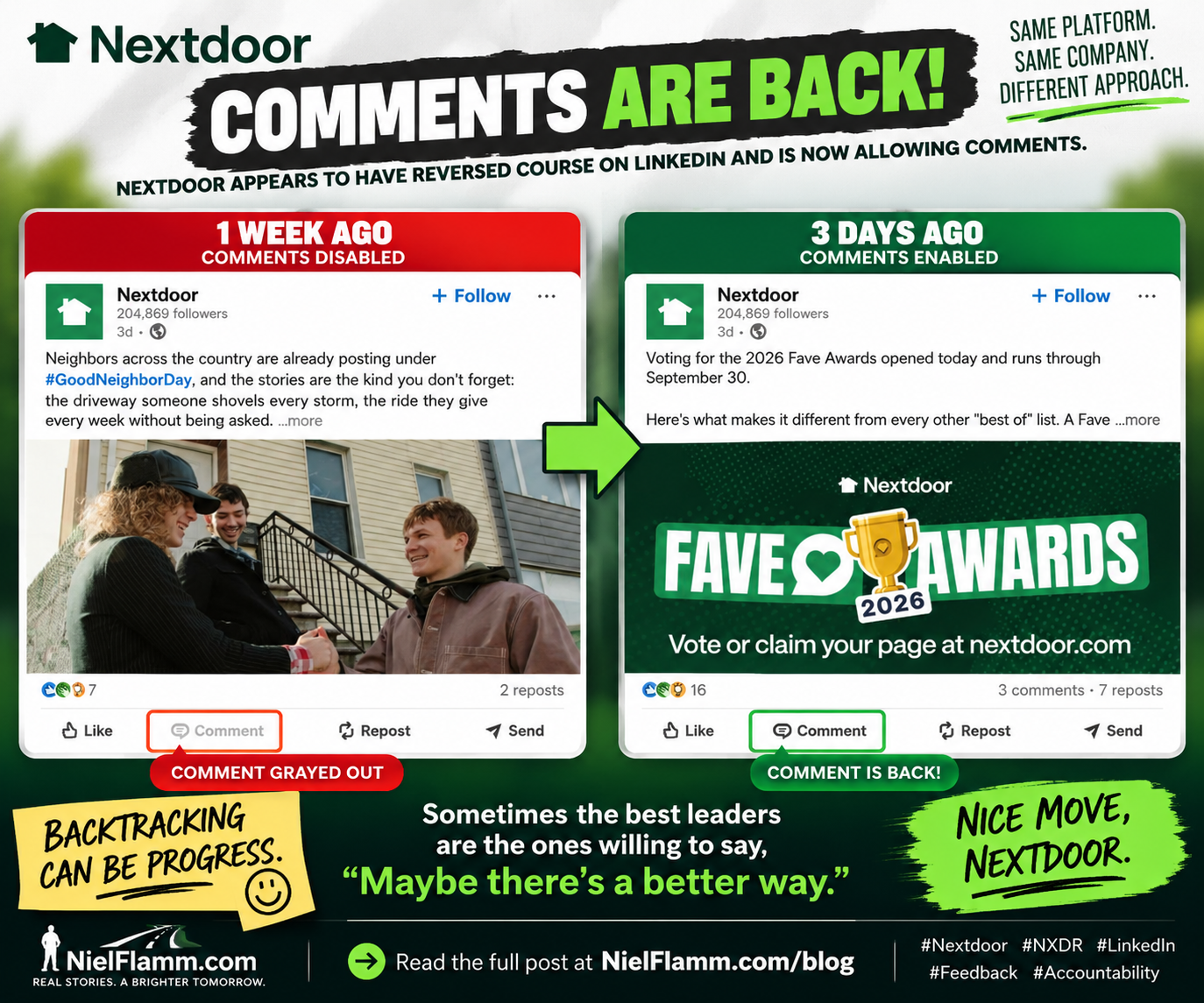
If I'm going to spend time providing feedback to Nextdoor, I should also acknowledge when I see the company do something positive.
And today, I noticed something:
Nextdoor appears to have turned LinkedIn comments back on.
Yes, I'm complimenting Nextdoor.
A Week Ago: No Comments
A Nextdoor LinkedIn post from about a week ago promoting #GoodNeighborDay had commenting disabled. Like, Repost, and Send were available, but Comment was grayed out.
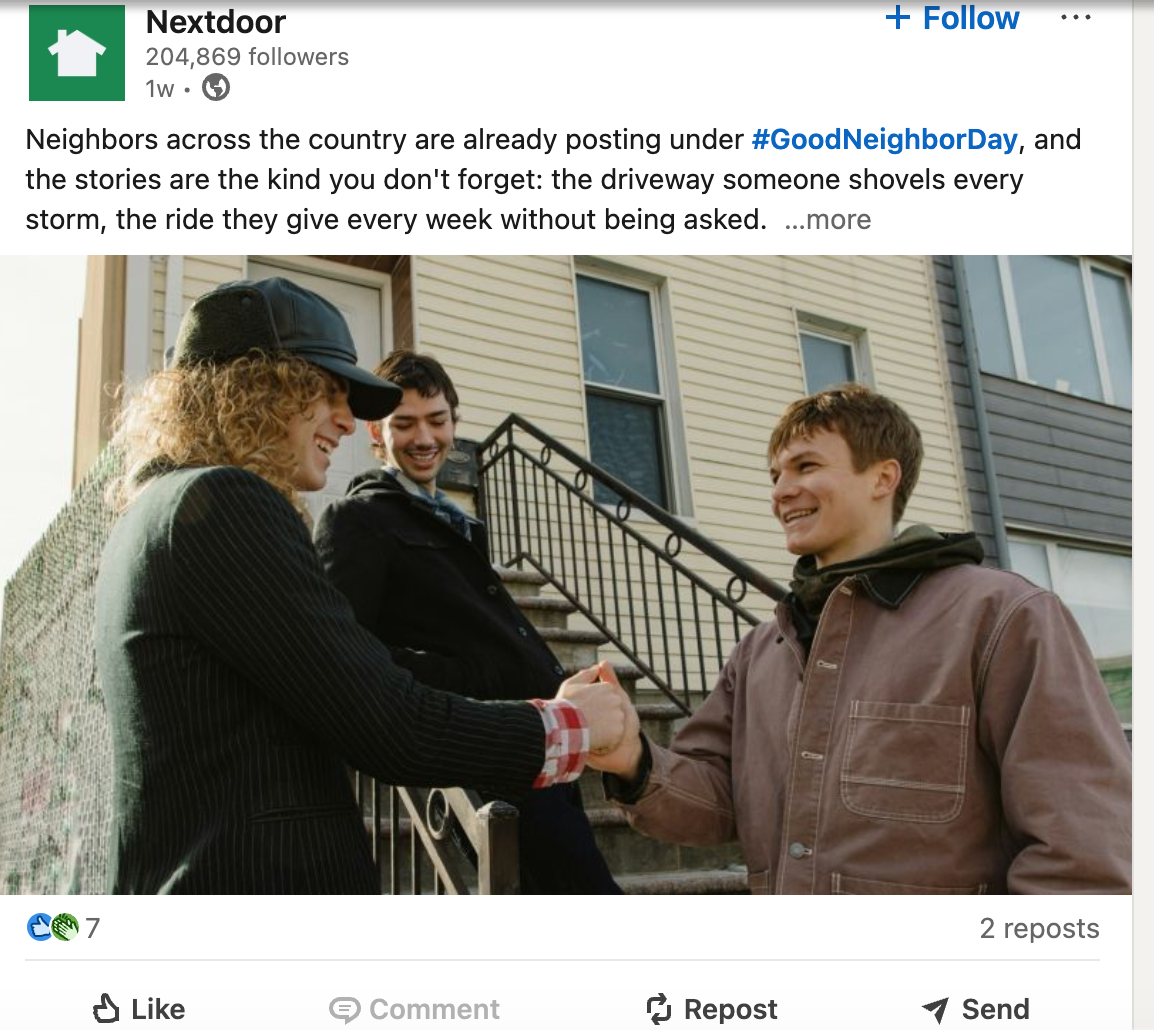
I previously provided feedback about this. For a company built around neighborhood conversations, limiting conversation on its own corporate social media seemed like an odd choice.
But something changed.
Comments Are Back
A more recent post promoting the 2026 Fave Awards allows comments.
There's also another Nextdoor post between these two where commenting is available.
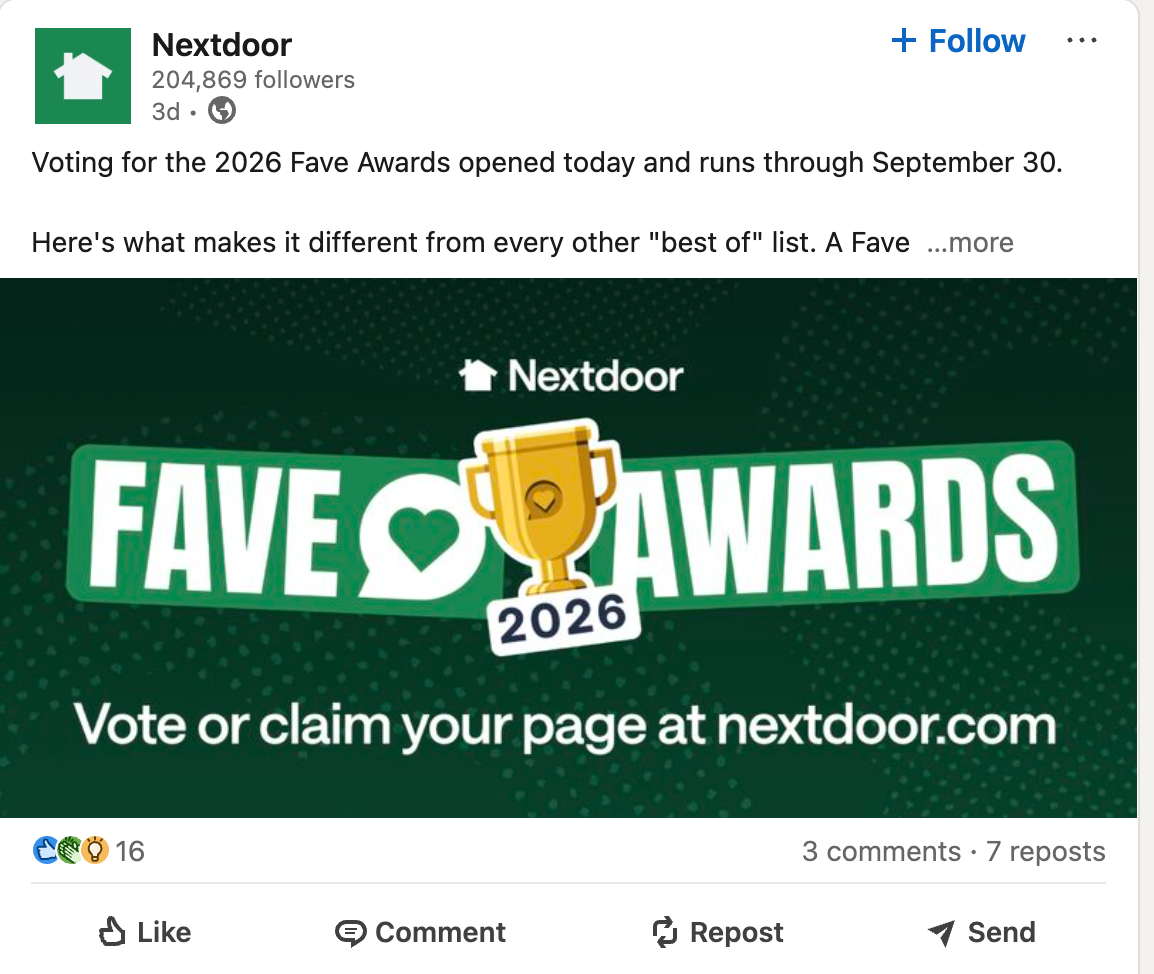
So, whatever the reason, comments appear to be back.
And you know what?
Good. I applaud the decision.
I don't know who made the change or why. I don't know whether Communications reconsidered the approach, whether this is temporary, or whether there's another explanation.
And I'm certainly not claiming my feedback had anything to do with it.
I can only document what I see:
Comments were disabled. Now multiple newer posts allow them.
That's movement in the right direction.
Backtracking Can Be Progress
Companies shouldn't be afraid to reconsider a decision.
If I’m driving somewhere and realize I've made a wrong turn, I don't continue another 40 miles just to prove I was committed to the route.
I turn around.
Changing course isn't necessarily weakness.
Sometimes it's good leadership.
A Social Network Should Be Social
Nextdoor is built around people communicating.
That doesn't mean its LinkedIn page should tolerate spam, abuse, or inappropriate behavior. Moderation has a purpose.
But there's an important difference between:
Moderating the conversation
and
preventing the conversation.
If Nextdoor has decided to allow that conversation again, I think that's a good move.
Credit Where Credit Is Due
I've provided plenty of feedback about Nextdoor's communication, leadership, research transparency, moderation, monetization and shareholder value.
And yes, I'm still waiting for the detailed Insights data I've requested.
But accountability works both ways.
If I'm willing to publicly point out where I think Nextdoor can improve, I should publicly acknowledge when I think Nextdoor gets something right.
This case study isn't about finding something wrong every day.
It's about observing, asking questions, providing feedback, and documenting what happens.
So today:
Nice move, Nextdoor. Keep going.
Now, about that Insights data...
Follow my continuing Nextdoor case study at NielFlamm.com/blog.

Day 91: Another Email Sent. The Question Hasn’t Changed.

Day 91.
I've officially sent another email to the Nextdoor team.
And after 91 days, I have managed to make the request even shorter.
Not because the issue has become less important.
Because I'm running out of ways to make the question clearer.
The Request Is Still Incredibly Simple
Nextdoor published an Insights report about home insurance that told readers they could reach out for “detailed data, additional audience segments, and strategic recommendations.”
Another Nextdoor Insights report about financial advising and investing made a similar offer.
So I did something apparently radical.
I asked for the detailed data.
Not the blog posts.
Not links to the summaries I've already read.
Not an explanation of where the information appears on Nextdoor's website.
The detailed data referenced in the posts.
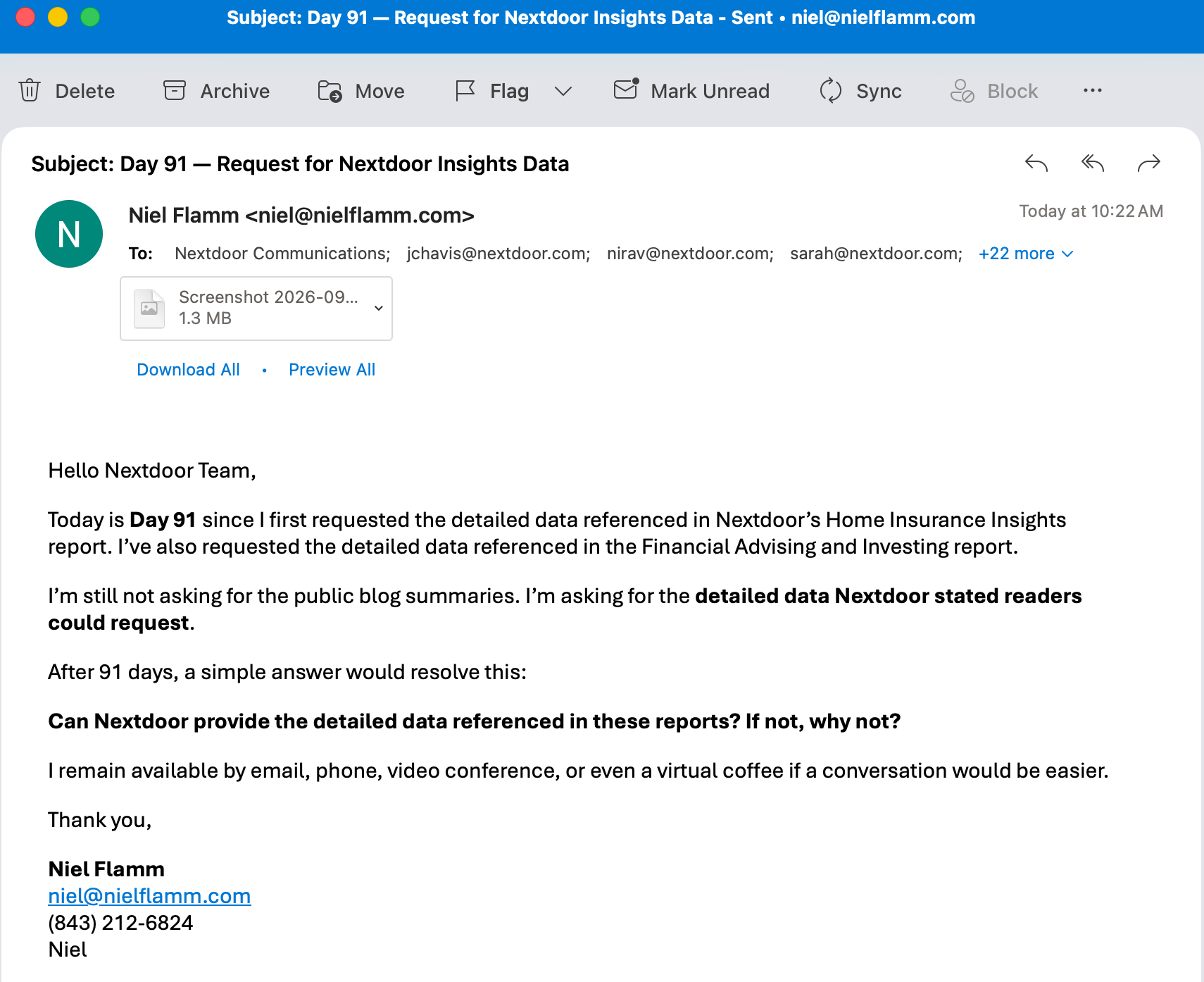
And today, on Day 91, I sent another email.
This Time, I Made the Choices Pretty Easy
My email essentially asks one question:
Can Nextdoor provide the detailed data referenced in these reports? If not, why not?
That's it.
At this point, I'm not even asking for a yes.
A no is an answer.
“The data isn't available” is an answer.
“The data is restricted to advertisers” is an answer.
“You need to meet certain requirements” is an answer.
“Someone else handles these requests” is an answer.
Silence isn't much of an answer.
91 Days Is a Long Time to Ask One Question
What started as a research request has gradually become something much more interesting to me.
It's become a case study in corporate communication.
If your company publicly tells people to contact someone for more information, what happens when somebody actually does?
Apparently, in my case, you get enough material for 91 days of writing.
I don't think that was the intended content-marketing strategy.
But here we are.
I'm Still Offering an Easier Option
I've repeatedly said that I'm willing to talk.
Email me.
Call me.
Video conference.
Virtual coffee.
I'm not interested in turning this into some endless game of corporate email Ping-Pong.
I'd rather talk than type.
And I'm certainly not hiding.
I included the same contact information I provided before.
Day 91: Another Email Is in the Inbox
Maybe today is the day.
Maybe someone at Nextdoor reads the email and says:
“Wait...has nobody answered this yet?”
Maybe the detailed data arrives.
Maybe somebody explains why it can't be provided.
Either one moves the story forward.
Until then, Day 91 gets added to the case study.
Another email sent.
Same question.
Still waiting for the answer.
Follow the continuing Nextdoor case study at NielFlamm.com/blog.

$8,500 for a BRAND-NEW 2026 Toyota RAV4 Plug-In XSE? TikTok Has Outdone Itself
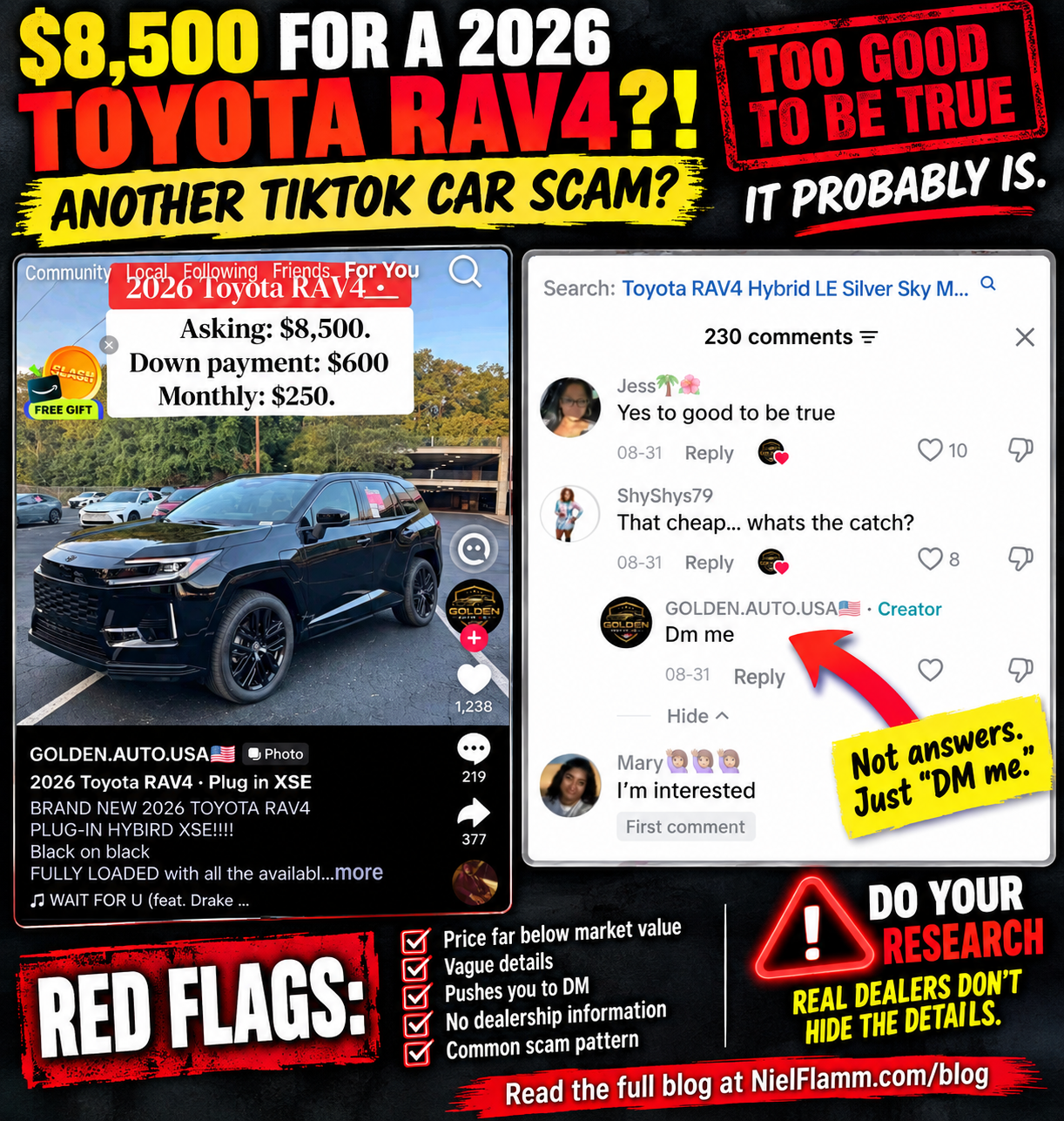
I thought the $6,800 Toyota Camry was impressive.
Then TikTok showed me a $5,000 Honda Accord Sport.
Apparently, the algorithm took that as a challenge.
Because now we've reached:
2026 Toyota RAV4 Plug-In Hybrid XSE
Asking: $8,500
Down payment: $600
Monthly payment: $250
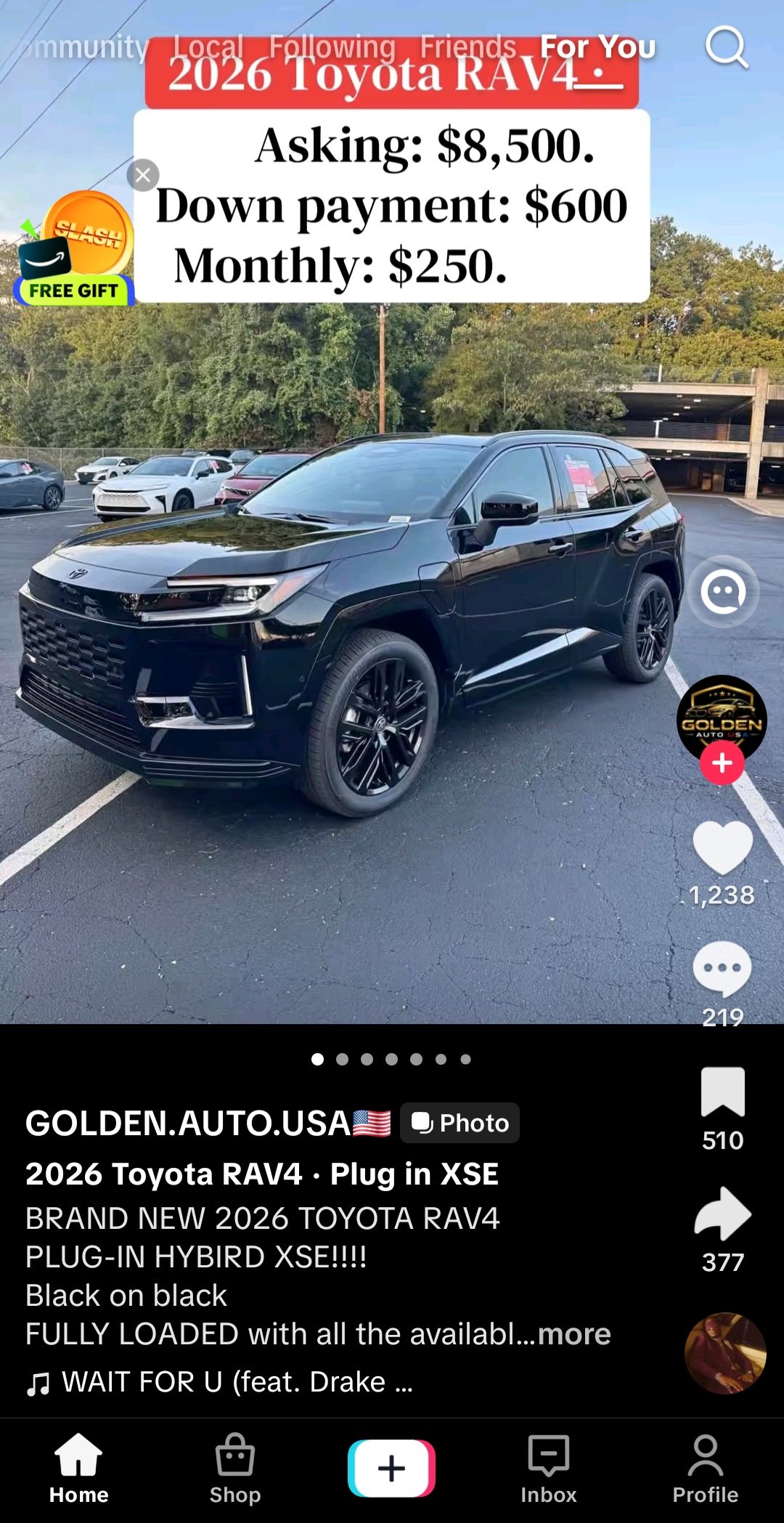
And according to the TikTok description, this isn't some damaged, high-mileage auction vehicle.
It's supposedly:
“BRAND NEW.”
And:
“FULLY LOADED.”
Okay.
This may be my favorite one yet.
🚩 Let's Start With the Actual Price
The easiest way to test this offer is to forget about complicated used-car valuations.
It's a brand-new 2026 model.
Toyota itself tells us what it costs.
Toyota lists the 2026 RAV4 Plug-In Hybrid XSE at a starting MSRP of $47,200. Toyota's consumer site currently shows the overall plug-in lineup starting at $41,500. Toyota Pressroom
Kelley Blue Book puts the XSE's MSRP at $48,650. Kelley Blue Book
And TikTok?
$8,500.
We're not talking about saving $2,000.
Or $5,000.
Or even $10,000.
The advertised price is roughly $38,700 below Toyota's $47,200 starting MSRP.
That's about an 82% discount.
Apparently Toyota has invented a revolutionary new sales strategy:
Build a nearly $50,000 plug-in hybrid SUV and immediately sell it for less than the price of many ten-year-old used cars.
Sounds perfectly reasonable.
🚩 Even a Dealer Couldn't Make This Math Work
This is where I always ask the same question:
Why me?
Why would anyone sell this vehicle to a random person scrolling TikTok for $8,500?
If this is genuinely a brand-new, fully loaded 2026 RAV4 Plug-In Hybrid XSE, a legitimate dealer doesn't need to discount it by almost $40,000 to make it disappear.
They could presumably sell it to another dealer for dramatically more.
They could take it to auction.
They could put it on any major automotive marketplace.
They could park it on the lot with a giant inflatable gorilla dancing beside it.
Almost anything makes more financial sense than:
“TikTok special! $8,500!”
That's why comparing these offers with wholesale or auction values matters. If a supposedly clean vehicle is advertised for dramatically less than what the seller could reasonably obtain through normal wholesale channels, you have to ask why.
With a brand-new 2026 model, the claim becomes even harder to explain away.
🚩 Then Comes My Favorite Part: $600 Down
The previous two suspicious vehicle advertisements I found used a remarkably similar formula.
Cheap vehicle.
Small down payment.
Low monthly payment.
Move the interested buyer into private messages.
This time:
$600 down.
That's slightly different from the $500 figure in the other ads.
Apparently inflation has reached the scam economy too.
But here's what I want to know.
$250 a month for HOW LONG?
The advertisement doesn't say.
Let's perform some kindergarten-level financing.
$8,500 minus the $600 down payment leaves:
$7,900.
At $250 per month, ignoring interest, taxes, and fees completely, that would take about:
31.6 months.
So apparently I'm financing a brand-new $47,000+ RAV4 XSE for less than three years at $250 a month?
Toyota currently has a real financing offer on the 2026 RAV4 Plug-In Hybrid: 4.99% APR for 48 months, for qualified customers. Toyota states that this works out to $23.02 per month for every $1,000 financed. Toyota
Finance $47,200 using that calculation, and you're looking at roughly $1,087 per month before accounting for things like taxes, registration, dealer-installed equipment, or a down payment.
TikTok:
$250.
That's quite a financing department.
🚩 Where Are the Financing Disclosures?
Once again, the advertisement gives us the magic number:
Monthly: $250
But where's the APR?
Where's the term?
How many payments?
Who's the lender?
What credit score is required?
What's the total amount financed?
Are there taxes and fees?
Nothing.
We're simply supposed to see $250/month and become excited.
And then comes the next part.
🚩 Somebody Actually Asked the Right Question
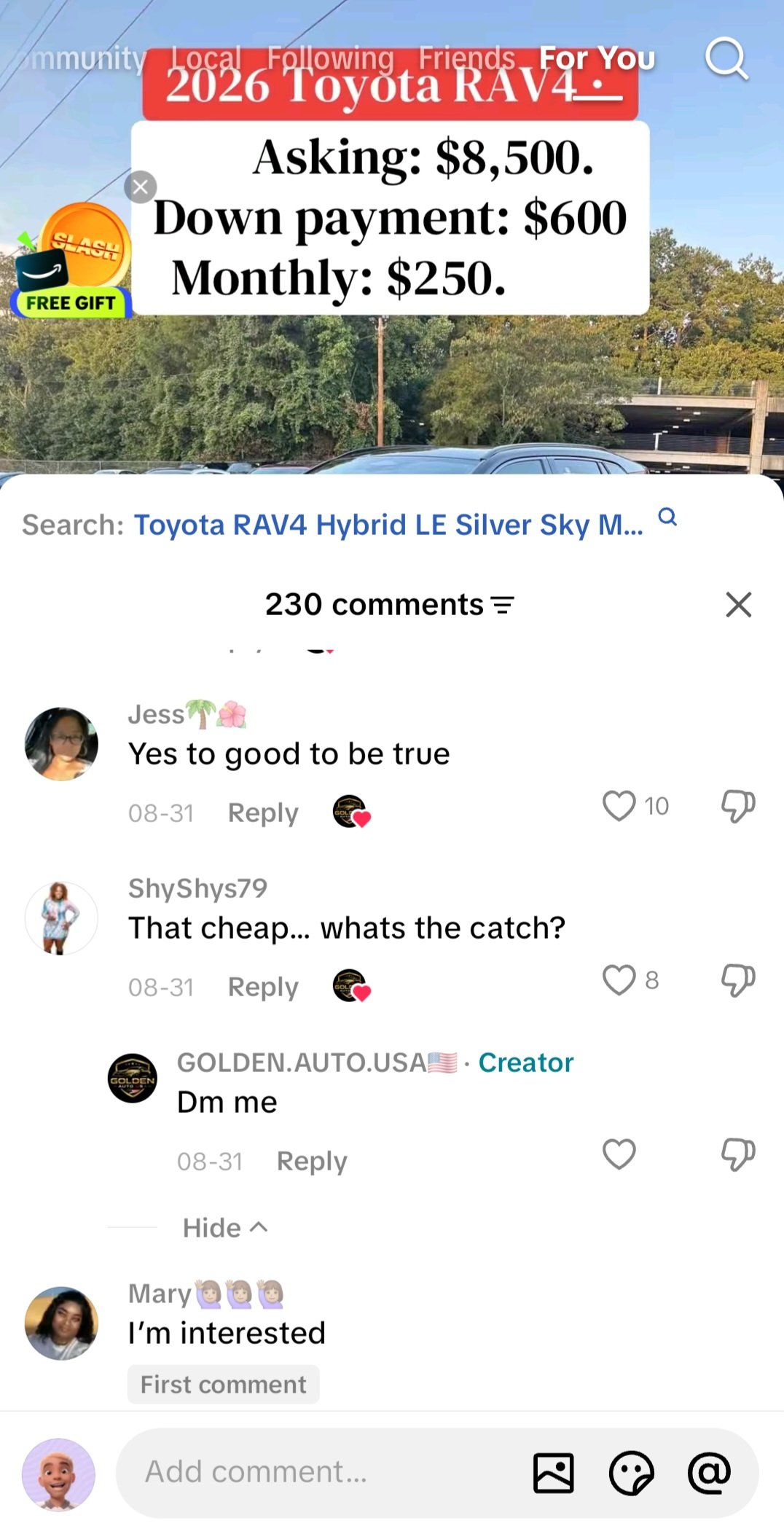
I opened the comments.
One person wrote:
“Yes to good to be true”
I'm assuming they meant too good to be true.
Correct.
Another asked exactly what everyone should be asking:
“That cheap... whats the catch?”
Excellent question.
And the account's public response?
“Dm me”
There it is again!
Not:
Here's our dealership address.
Not:
Here's the VIN.
Not:
Here's the complete financing disclosure.
Not:
Here's the listing on our dealership website.
Not even:
Here's why a nearly $50,000 SUV costs $8,500.
Just:
DM me.
Meanwhile, another commenter writes:
“I'm interested.”
That's precisely what worries me about these posts.
🚩 The Public Ad Creates the Dream. The DM May Close the Deal.
I have not privately messaged this account, so I don't know what happens after someone enters the DMs.
And I'm not going to claim that I do.
But after looking at several of these TikTok vehicle advertisements, I'm seeing a pattern worth recognizing.
The public post advertises an extraordinary deal.
It sets a small down payment.
Interested people comment publicly.
Then they invite them into private messages.
That's where I'd want to know whether the conversation eventually becomes:
We have several interested buyers.
You need to reserve the vehicle.
Send the $600 deposit.
We'll hold it for you.
And perhaps the payment needs to go through Cash App, Zelle, PayPal, crypto, or some other method.
Again, I haven't seen that happen with this account.
But if someone claiming to sell this vehicle asks you to send that $600 before you've independently verified the business, VIN, title, physical vehicle, and seller, I would stop immediately.
🚩 “Golden Auto USA”
The TikTok account identifies itself as GOLDEN.AUTO.USA.
A professional-looking name or logo doesn't prove who operates an account.
Before sending a penny, I'd want to independently establish that the seller is a real licensed dealer, find its physical address through independent sources, call a publicly listed number, verify the TikTok account actually belongs to that business and confirm that this exact vehicle exists.
And I'd want the VIN.
If the answer to:
“What's the VIN?”
is:
“DM me.”
We're not making much progress.
Let's Put This One Into Perspective
Toyota:
2026 RAV4 Plug-In Hybrid XSE — starting MSRP $47,200. Toyota
Kelley Blue Book:
MSRP $48,650. Kelley Blue Book
TikTok:
$8,500.
Down payment:
$600.
Monthly payment:
$250.
Question from a potential customer:
“What's the catch?”
Seller:
“Dm me.”
Ladies and gentlemen, I think we've assembled enough red flags to open our own flag store.
And This Is Why These Posts Matter
It would be easy to laugh at something this ridiculous.
But look at the engagement in the screenshot:
1,238 likes.
219 comments.
510 saves.
377 shares.
People are seeing it.
Somebody is interested.
And somebody looking for reliable transportation who doesn't know what a RAV4 Plug-In Hybrid XSE actually costs might see:
$600 DOWN!
and think they've finally found something they can afford.
That's why I keep writing about these.
Scams don't have to fool everyone.
They only need to reach the right person at the wrong moment.
Before sending money for a vehicle advertised on social media, independently verify the seller, the vehicle, the VIN, and the price.
And if someone offers you a brand-new, nearly $50,000 Toyota for $8,500?
You probably shouldn't start by asking:
“Where do I send the $600?”
Start with:
“Why would you possibly sell it to me for that?”
Follow along at NielFlamm.com/blog for more questionable TikTok vehicle deals, scam emails, suspicious recruiters, and whatever the algorithm decides to throw at me next.