

Day 96: The Stock Is Flat. The Communications Team Is Quiet. The Petition Isn’t.

Welcome to Day 96.
As I write this, Nextdoor Holdings (NXDR) is sitting at $2.48—no gain, no loss. Recent market data confirms the shares at roughly that level after a nice run from $2.15 on September 9. Yahoo!ファイナンス
So, today the stock is doing something Nextdoor Communications seems pretty good at lately:
Sitting quietly.
One Post. About Someone Else’s Award.
Nextdoor's LinkedIn communications have been unusually quiet this week. The notable post on Monday highlighted Publix, which ranked No. 4 on PEOPLE's 100 Companies That Care list. Nextdoor itself wasn't among the companies being recognized; the connection was that a Publix employee used Nextdoor while helping neighbors ahead of Hurricane Milton. LinkedIn
As I wrote earlier: congratulations to Publix and, especially, the employee who actually helped those neighbors.
But we're now at Day 96, and the detailed Insights data I've been requesting remains unresolved.
Meanwhile, something new is moving.
The Petition Is Live
I've launched a petition asking Nextdoor to consider a Neighbor Value-Sharing Agreement.
The idea is simple: if years of reviews, recommendations, advice, and local knowledge contributed by neighbors become increasingly valuable—particularly in an AI-driven world—shouldn't the people creating that value participate in it?
If you agree, take a moment to sign it.
Then do something even more important:
Share it.
Send it to another Nextdoor user. A small-business owner. A neighbor. Someone interested in AI, user-generated content, or how platforms monetize the communities that make them useful.
Day 96.
The stock is flat.
Communications is quiet.
The conversation doesn't have to be.
👉 Follow the continuing case study at NielFlamm.com/blog
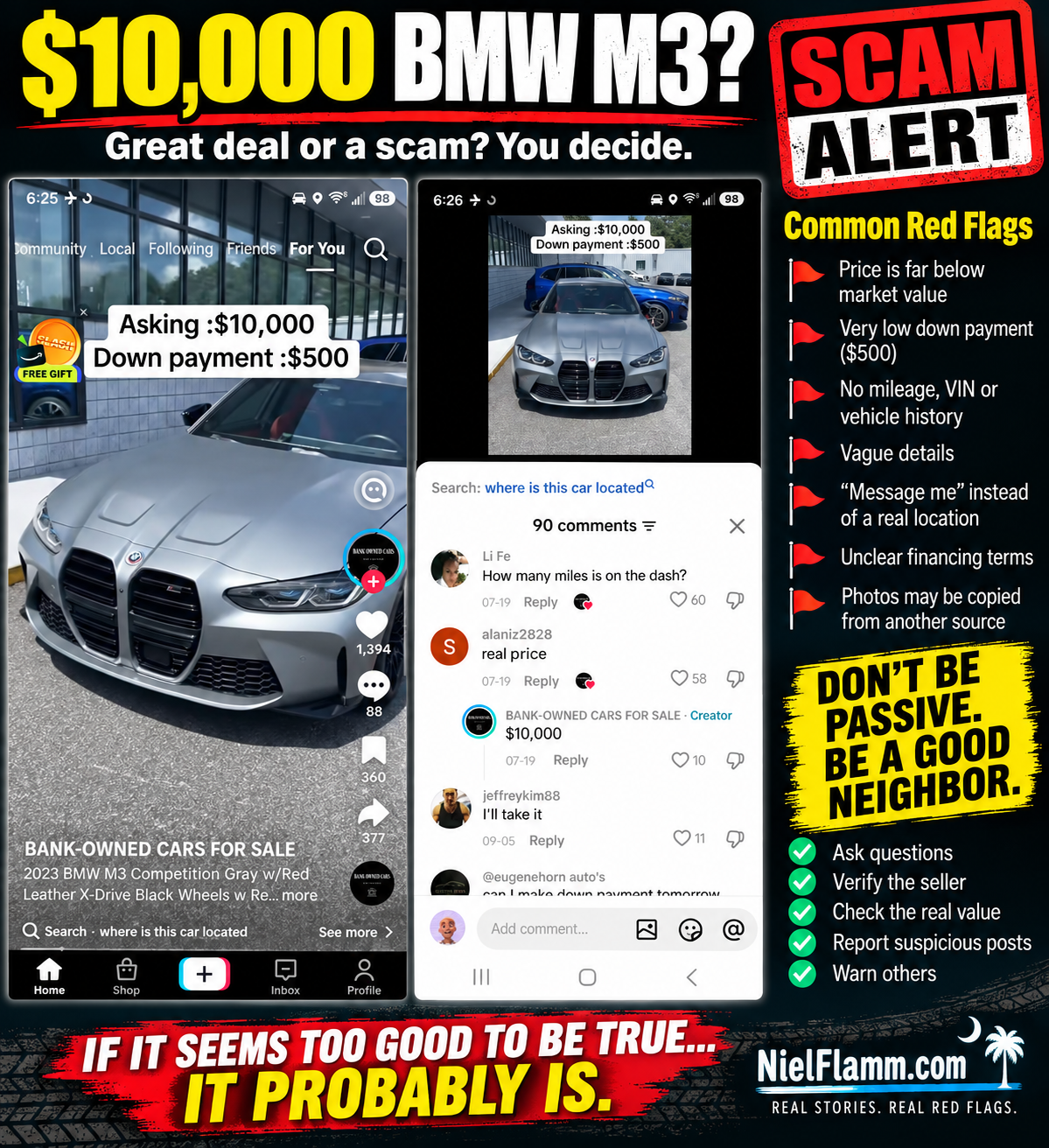
A $10,000 2023 BMW M3 Competition? TikTok Has Apparently Entered the Luxury-Car Business
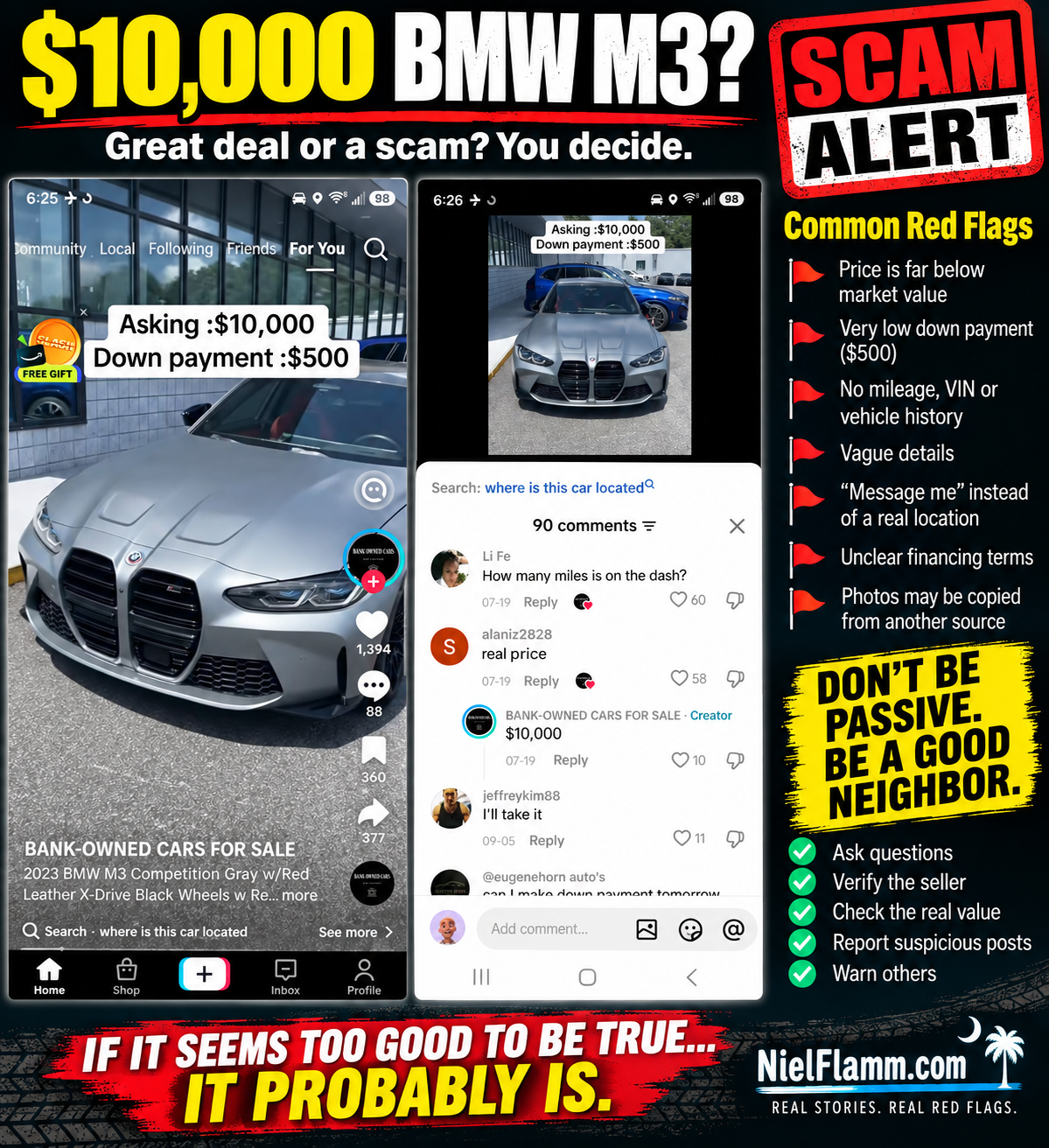
TikTok must really want me to buy a car.
After showing me suspiciously cheap Toyotas and Hondas, the algorithm has apparently decided I deserve an upgrade.
This time, the account is called “BANK-OWNED CARS FOR SALE,” and the vehicle in the video is described as a:
2023 BMW M3 Competition
Asking price: $10,000
Down payment: $500
Yes.
A 2023 BMW M3 Competition for ten grand.
At least we're moving up in the world.
🚩 Let's Check What a 2023 BMW M3 Competition Is Actually Worth
This is where the offer becomes interesting.
Kelley Blue Book currently puts a typical 2023 BMW M3 Competition at roughly $74,000–$75,000 as a Fair Purchase Price. KBB lists private-party value around $69,000 and trade-in value around $65,000, though actual values vary substantially with mileage, condition, and location. Kbb.com
And if the car pictured is the Competition xDrive version, KBB puts the Fair Purchase Price even higher—roughly $77,000. Kbb.com
TikTok?
$10,000.
That's not a good deal.
That price demands an explanation.
If the typical Competition is worth around $74,000, the TikTok price is roughly 86% lower.
Maybe the vehicle has substantial damage.
Maybe there's a title issue.
Maybe it has astronomical mileage.
Maybe there's some other legitimate explanation.
But that's precisely the information a buyer needs before getting excited about a $500 down payment.
🚩 Wait... How Many Miles Does It Have?
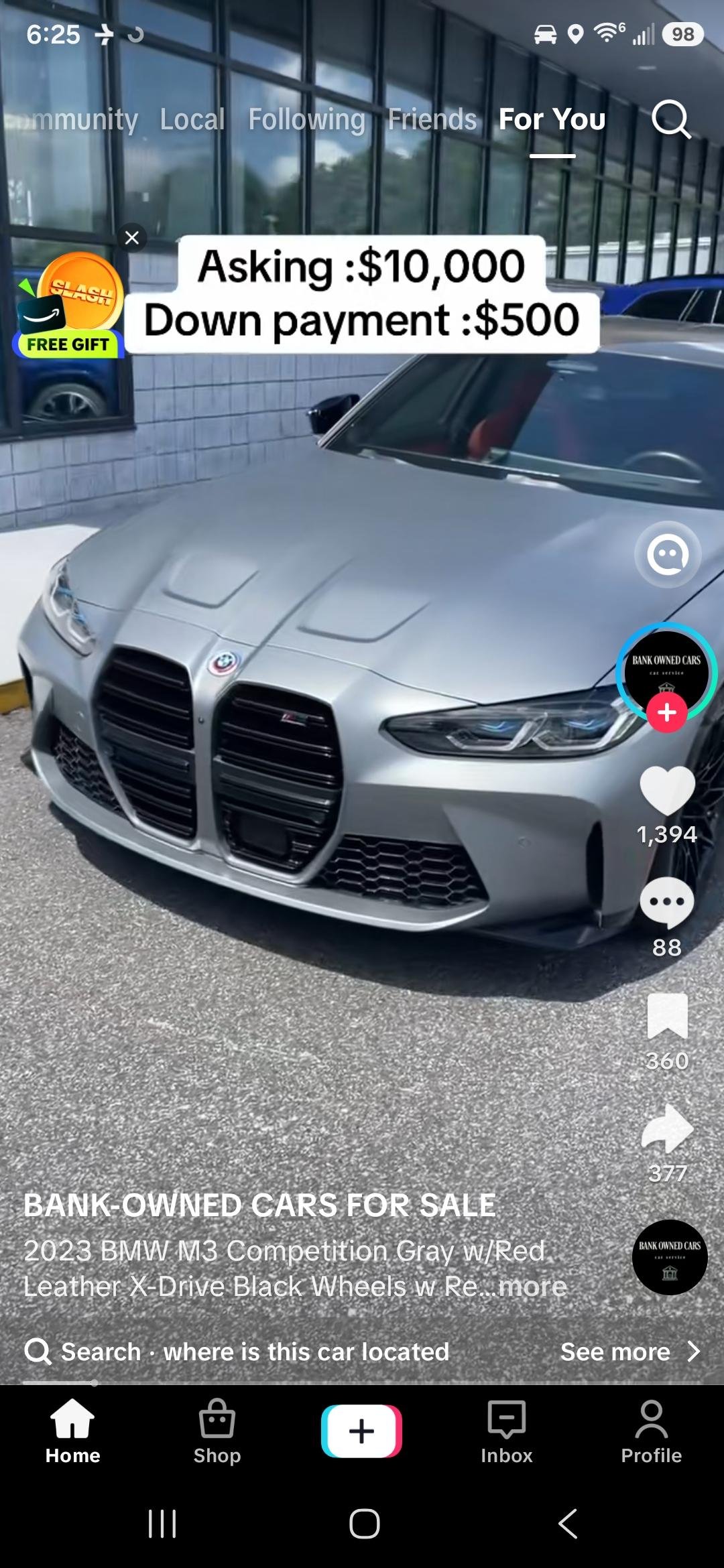
Someone in the comments asked:
“How many miles are on the dash?”
Excellent question.
The screenshot doesn't tell us.
Mileage matters when we're discussing why a late-model performance BMW is supposedly selling for a fraction of its normal value.
Another commenter simply writes:
“real price”
The account responds:
“$10,000”
Okay.
That answers the question without actually answering the much bigger question:
WHY is it $10,000?
🚩 But It's “Bank-Owned!”
This version adds a new ingredient to the recipe.
The account calls itself:
BANK-OWNED CARS FOR SALE
That sounds official, doesn't it?
Maybe people imagine a bank repossessed the BMW and just wants to recover whatever money it can.
But think about the economics.
If a bank legitimately repossessed an asset potentially worth tens of thousands of dollars, why would it voluntarily sell it for $10,000 if substantially more could potentially be recovered through established wholesale or auction channels?
“Bank-owned” doesn't magically make market value disappear.
If anything, that description makes me want more documentation, not less.
Which bank owns it?
Where is the vehicle?
What's the VIN?
What's the mileage?
What's the title status?
Where can I inspect it?
Who is legally authorized to sell it?
Those are boring questions.
Boring questions are extremely useful when somebody wants your money.
🚩 And My Old Friend Is Back: $500 Down
There it is again.
$500 DOWN.
This number has become a recurring character in the questionable vehicle ads showing up in my TikTok feed.
The vehicles change.
The prices change.
The accounts change.
But somehow that small, psychologically appealing down payment keeps appearing.
This time we're supposed to believe that $500 gets the process started on a late-model BMW M3 Competition.
What happens to the remaining $9,500?
What's the APR?
What's the loan term?
What's the monthly payment?
Who's financing it?
What are the credit requirements?
The screenshots don't tell us.
That's a lot of missing information for an advertisement prominently featuring a down payment.
🚩 Look at the Engagement
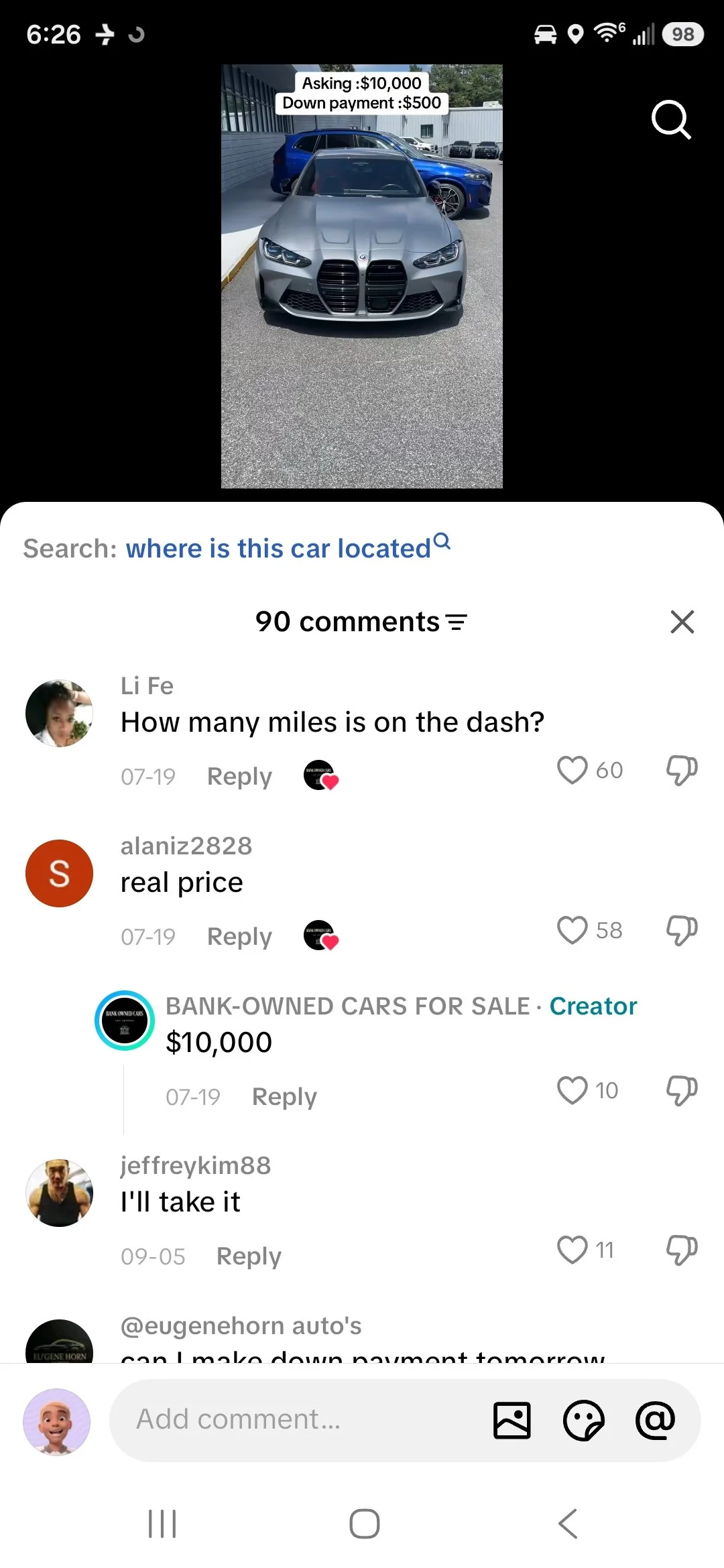
This is why I don't simply laugh and scroll away.
The video shows:
1,394 likes.
88 comments.
360 saves.
377 shares.
And in the comments, someone says:
“I'll take it”
That's the part that matters.
Because a person who knows what an M3 Competition normally costs may immediately recognize how extraordinary this offer is.
Someone else might not.
They may simply see:
BMW M3
$10,000
$500 DOWN
And think they just stumbled across the opportunity of a lifetime.
🚩 “Where Is This Car Located?”
There's another interesting detail right on the TikTok screenshot.
The suggested search says:
“where is this car located”
That's exactly what I'd want to know.
If I were seriously considering this vehicle, I wouldn't begin with:
“How do I send the $500?”
I'd begin with:
Where is it?
Then:
What's the VIN?
Then:
Who owns it?
Then:
Can I see the title?
Then:
Can I have an independent mechanic inspect it?
Then:
Can I see the car in person before paying you anything?
A legitimate transaction should survive those questions.
🚩 The Pictures Don't Prove Who Owns the BMW
The screenshots show what appears to be a real BMW M3 sitting outside an automotive business.
That's useful for showing us that a BMW existed somewhere when the images were taken.
It does not, by itself, establish that the TikTok account owns the vehicle or is authorized to sell it.
That's one of the most important lessons with social-media vehicle listings.
A photograph of a real car doesn't automatically make the offer real.
Dealer photographs can be copied.
Auction photographs can be copied.
Videos can be reposted.
Descriptions can be copied.
A scammer doesn't necessarily need to invent a car.
They may only need pictures of someone else's car.
I'm not saying that's what happened here; I haven't independently established who owns the BMW in these screenshots. But that's exactly why verification matters.
🧮 Let's Put the Numbers Side by Side
According to KBB, a typical 2023 M3 Competition currently has a Fair Purchase Price around $74,000, while the xDrive version is around $77,000. Kbb.com
The TikTok advertisement:
$10,000
Down payment:
$500
Mileage shown:
Not in these screenshots
VIN shown:
Not in these screenshots
Bank identified:
Not in these screenshots
Financing terms:
Not in these screenshots
Someone ready to buy:
“I'll take it.”
That's exactly why these posts deserve attention.
🏡 Don't Be Passive. Be a Good Neighbor.
I've been saying this more frequently because I think it's important.
When you see something online that looks suspicious, don't automatically assume everyone else sees what you see.
Someone may desperately need transportation.
Someone may not know what an M3 normally costs.
Someone may believe that “bank-owned” explains the enormous discount.
Someone may be one private message away from being told:
“Send $500, and we'll reserve it.”
I have not messaged this account, so I don't know what happens next, and I'm not claiming that's what this seller does.
But if you see someone preparing to send money on an extraordinary social-media offer, say something.
Ask questions.
Report suspicious posts.
Help them verify the seller.
Look up the vehicle's real value.
Ask for the VIN.
Independently identify the dealership or bank supposedly selling it.
And most importantly:
Don't send a deposit merely because someone on social media says the deal won't last.
Being a good neighbor doesn't stop when you go online.
Sometimes it simply means telling somebody:
“Before you send that $500, let's figure out why a $74,000 BMW supposedly costs $10,000.”
Because if there's a legitimate explanation, the seller should be able to provide it.
And if there isn't?
You may have just helped somebody keep their $500.
Follow along at NielFlamm.com/blog for more questionable vehicle offers, suspicious emails, recruiting scams and whatever the algorithm sends me next.
Mom, the Call Button, and My Own Bad Example
I’ve been hanging out with Mom at the skilled nursing facility for about four hours. Since I’m on disability due to my awesome health—please read that with the intended sarcasm—I have some time.
While I’ve been here, she has used the call button at least four times. Eventually, I had a conversation with her about it.
My first reaction came from how I behaved when I was in the hospital. I hardly ever used the call button. I thought that if I kept calling, people might respond more slowly.
That was my assumption. No one ever told me that would happen.
In fact, I’ve been told that my reluctance to call can create its own problems because I sometimes wait too long. And I have a pretty good example of that.
During a hospital stay here in Mount Pleasant, I felt my blood sugar dropping. I thought maybe it would bounce back on its own.
So I waited.
And waited.
Eventually, I realized I was in trouble. I pressed the call button and could barely get out the words that my blood sugar was low.
A nurse arrived with a glucose monitor and checked it with a finger stick. If I remember correctly, the reading was somewhere in the high 40s.
Then came the orange juice, graham crackers, peanut butter, cheese—the nurse brought what felt like every available food item.
When I called, the nurses’ desk understood that I needed help urgently. At the time, I took that as evidence that they rarely called unless I was serious.
Looking back, I can’t say that my previous silence had anything to do with their response. What I do know is that I waited until I could barely explain what was happening.
That is not exactly a success story about being a low-maintenance patient.
So, while I may have opinions about Mom pressing her call button, I also need to remember that my approach wasn’t necessarily better. Four calls in four hours doesn’t tell the whole story. What she needed matters more than the number.
There is room to be considerate of busy staff and, when practical, ask for several things at once. There also has to be room to ask for help without feeling like a nuisance.
After writing about advocating for Mom, I suppose I need to apply that same thinking when she advocates for herself.
Apparently, I’m not just spending time with her. I’m getting a refresher course in my own contradictions.
Mom Needed a Bathroom. We Needed a Solution.
My mother is now in a skilled nursing facility. She had a stroke at the end of June 2026 and a second one about three weeks ago. This is her fourth hospital or medical facility in the last three months.
That is a lot of moving, adjusting, and starting over. I get it. I’ve been there.
Part of the longer-term plan involves her wish not to return home once she gets back to where she was before the second stroke. That is a story for another time.
Today’s story is about something much more immediate: Mom needed to use the bathroom.
She arrived at the facility this afternoon, and her evaluations weren’t complete yet. Because physical therapy hadn’t evaluated her, there was uncertainty about how she could safely get to the bathroom—or whether she could get there at all.
I understood the concern. Nobody wanted her to fall or get hurt.
But her need to go wouldn’t wait for an evaluation.
I heard the explanation from three different people, delivered almost the same way each time. What I didn’t hear was a solution.
Mom and I asked for a bedpan.
We were told the facility doesn’t use bedpans.
Okay. So what do we do now?
This was also the point when I started feeling increasingly confident about my decision not to pursue a career in healthcare. As I wrote recently, patience is not one of my strengths. Hearing the same explanation repeatedly while my mother still needed help was putting that to the test.
I asked again: We need to find a solution. She can’t simply not go.
Eventually, someone made the executive decision to find a bedpan. I assume someone dug it out of the nonexistent basement.
Crisis averted.
I appreciate the need for evaluations and safe procedures. I also appreciate the person who finally found a way to help. But there needs to be an answer for what happens while a new resident is waiting for those evaluations.
From our side of the conversation, we had a basic, immediate need and several explanations of why it was complicated.
What would have helped was hearing: “We haven’t assessed her mobility yet. Here is how we can help her safely in the meantime.”
That would have given Mom some reassurance and both of us a plan.
Today, we eventually got there. It just took three explanations and a supposedly unavailable bedpan.
Nirav Tolia’s Son Got to Pitch Mr. Wonderful. What About the Kid Nextdoor?
I came across a post from Erica Wenger of Park Rangers Capital highlighting a story from her Trailblazers interview with Nextdoor CEO Nirav Tolia.
In the clip, Nirav talks about his friendship with Shark Tank’s Kevin O’Leary—Mr. Wonderful—and an experience his 14-year-old son, Deven, had with him.
You can watch the clip here:
Watch Nirav Tolia tell the story on LinkedIn
Apparently, Nirav’s son found himself riding in a car with Mr. Wonderful himself.
And he did exactly what an aspiring young entrepreneur should do.
He pitched him.
Kevin listened, answered his questions, and encouraged him. According to Nirav, his son was thrilled afterward.
That’s awesome.
Seriously.
If I were 14 years old and had a business idea, I’d probably be pretty excited to get one-on-one advice from a Shark too.
But something about this story also struck me as remarkably tone deaf when viewed through the lens of Nextdoor’s stated purpose.
Not Every 14-Year-Old Gets Chicken Nuggets With Mr. Wonderful
Let’s acknowledge something obvious.
Nirav’s son didn’t do anything wrong.
He should take advantage of every opportunity his parents can provide him. That’s what parents do.
But his position in the world gives him access that millions of other kids could never imagine.
Most 14-year-olds aren’t riding around with Kevin O’Leary.
They aren’t having dinner with famous investors.
They don’t have a CEO father who can say, “I’ve become friends with Mr. Wonderful.”
Some kid somewhere has an incredible idea right now and absolutely no idea how to get anyone to listen.
That’s the story I wish Nextdoor would create.
Imagine If Nextdoor Actually Did This
Nextdoor talks constantly about neighbors.
Community.
Connection.
Local knowledge.
Helping people connect with the resources around them.
So here’s an idea that seems almost ridiculously aligned with that mission:
Find the kid who doesn’t have access.
Use the Nextdoor network to find young entrepreneurs in underserved communities with great ideas but no Silicon Valley Rolodex.
Ask neighbors to nominate them.
Maybe it’s a teenager in Chicago designing something in a bedroom.
Maybe it’s a 15-year-old in Detroit working on a business idea after school.
Maybe it’s a kid in Charleston selling something out of a parent’s garage.
Maybe it’s somebody nobody has heard of yet.
Then give that kid 30 minutes with Kevin O’Leary.
Or Mark Cuban.
Or another successful entrepreneur.
Not because of who their parents know.
Because their neighbors discovered them.
That would be interesting.
That would be different.
And that would feel incredibly neighborly.
Nextdoor Has Something Most Venture Capital Firms Don’t
Nextdoor doesn’t need to become a venture-capital firm.
It already possesses something potentially more interesting: a network built around geographic communities.
That creates an opportunity to discover talent from places traditional entrepreneurial networks may overlook.
Think about it:
Nextdoor Young Entrepreneurs.
Neighbors nominate teenagers with business ideas.
Local business owners mentor them.
Nextdoor employees volunteer.
Entrepreneurs evaluate pitches.
Finalists receive mentorship, introductions, or perhaps small grants.
And once a year?
Put one of those kids in a car with Mr. Wonderful.
Chicken nuggets optional.
This Is Where I Think the Story Becomes Tone Deaf
Again, the problem isn’t that Nirav gave his son an extraordinary opportunity.
I’d probably do exactly the same thing.
The disconnect, in my view, is celebrating extraordinary access as an inspirational entrepreneurship story while leading a company whose identity is supposedly built around neighbors helping neighbors.
Listen to Nirav tell the story yourself:
Nirav Tolia discussing his son and Kevin O’Leary
Then imagine if the story ended differently.
Imagine Nirav saying:
“That experience made me realize how many brilliant kids will never have this opportunity. Nextdoor is going to help find them.”
Now you’ve got my attention.
Don’t Just Talk About Opportunity. Create It.
I’ve spent months giving feedback on Nextdoor because I believe the platform has enormous unrealized potential.
This is another example.
Nextdoor keeps talking about the value of its neighborhood network.
Okay.
Use it.
Find talent traditional networks miss.
Find the teenager whose parents don’t know venture capitalists.
Find the kid whose family isn’t hosting Kevin O’Leary for dinner.
Find someone who doesn’t know a Shark.
Then introduce them to one.
Because maybe the next great entrepreneur isn’t sitting in the backseat with Mr. Wonderful.
Maybe they’re sitting three blocks away wondering whether anybody will ever take their idea seriously.
Nextdoor could help find them.
Nirav’s son got an incredible opportunity because of the world he was born into. Imagine using Nextdoor to give an incredible opportunity to a kid who wasn’t.
Now that would be a story worth putting on a podcast.
And I promise I won’t complain if Kevin buys the chicken nuggets.
👉 More of my ongoing Nextdoor commentary at NielFlamm.com/blog